Type of Object
Material
Type of Object
Material
Many of the things in this book were present when their owners died, but this is the only one that was responsible for its owner’s death. On 4 June 1737, François Lemoyne committed suicide by stabbing himself nine times with his own sword. Professionally, at this moment, Lemoyne appeared to be at an all-time career high, having just been appointed premier peintre du roi (first painter to the king) after completing his enormous ceiling painting at Versailles of the Apotheosis of Hercules (1731–36, Château de Versailles). But at the same time, personally, he was experiencing his deepest low. After losing his wife a few years earlier, Lemoyne had plunged himself into excessive work and then gradually descended into a relentless psychological state of anxiety and paranoia, convinced that his colleagues at the Académie were plotting to bring him down.1 It was in this state that, at 11 o’clock on a Saturday morning, following an ordinary session in the studio with his students, and just before a meeting with a patron about a commissioned painting, Lemoyne locked himself in his bedroom, took up his sword, and ended his life with that painful and violent act.
Lemoyne’s sword no longer survives, but because of the task the painter gave it in those final minutes of his life, the object left an archival trace in a series of police reports.2 It makes its most detailed appearance in the police commissaire’s account of the crime scene (suicide still being a crime in eighteenth-century France), where his methodical description of the sword in situ gives a vivid sense of the last act it performed for its owner. Upon entering Lemoyne’s bedroom, the commissaire described encountering the painter’s blood-soaked body lying in the doorway, and then, casting his eye around the room, he noted first “the brown of the deceased” flung on the floor near a , under which he then observed “the deceased’s sword,” where it had fallen after the deadly ordeal was over. Along with suggesting its recent actions, the report also indicated some of the sword’s physical characteristics, distinguishing it as “an olinde with guard and grip of gilt steel,” which, the commissaire noted with grisly accuracy, was at that point “almost entirely covered in blood, as was its naked blade.”3

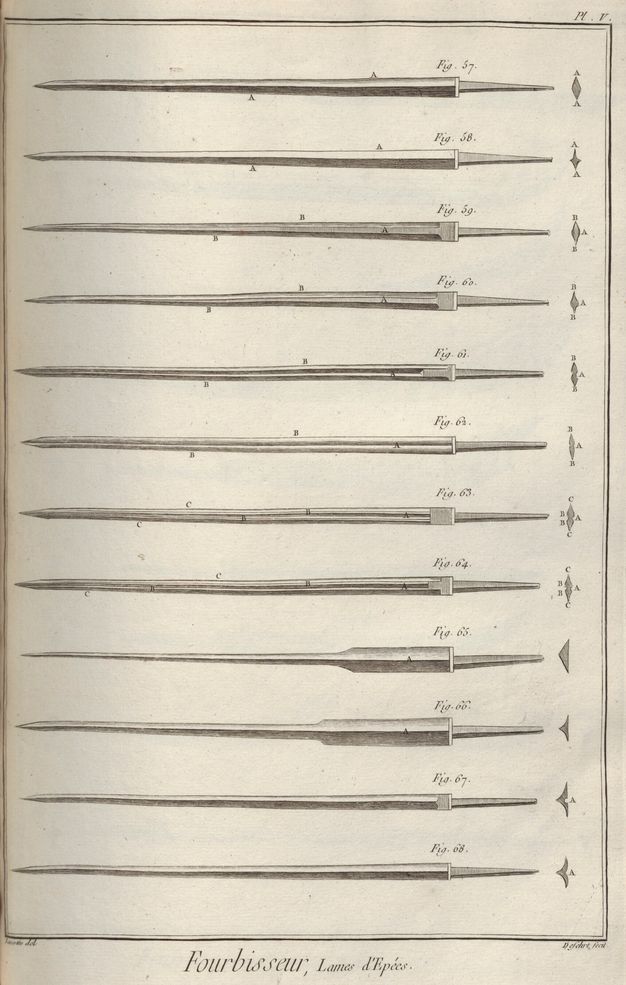
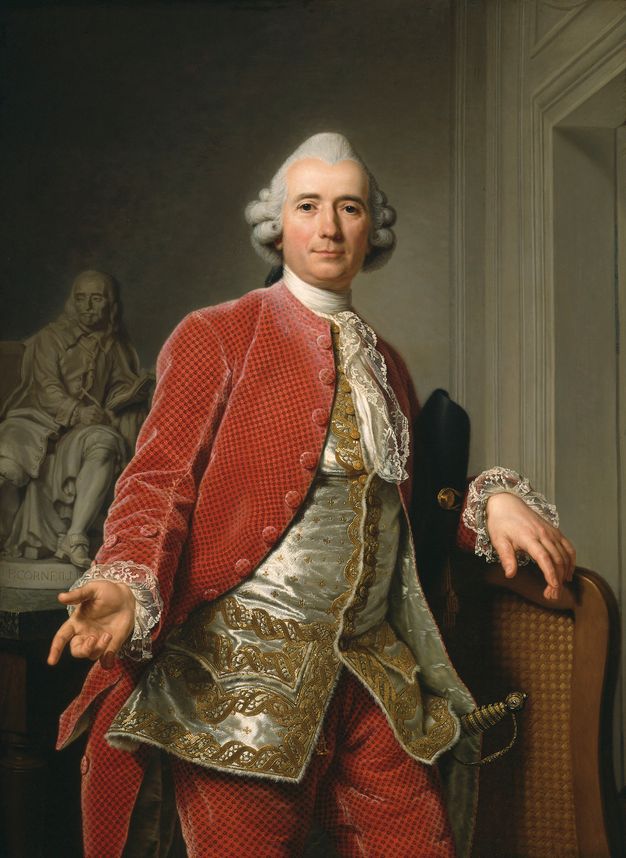
From the few lines describing Lemoyne’s sword in the police reports it is possible to extract a substantial amount of information. First, not surprisingly, we discover that Lemoyne’s sword was an épée or smallsword (similar to that in fig. 160), a light sword designed for dueling and thrusting and that was the most prevalent bladed weapon in eighteenth-century France. Next, more specifically, the commissaire provides some details about the sword’s two main parts: the hilt and the blade. The hilt of an épée was composed of several elements (guard, grip, and pommel) and was conventionally the most decorated area of the sword. Worn prominently at the front of the body (as modeled by Jean-Jacques Caffieri in his portrait; see fig. 175), the hilt could be an eminently fashionable commodity, made from precious metals by an orfèvre (goldsmith) and signifying wealth and status like other accessories (jewelry, shoe buckles, , etc.). Lemoyne’s hilt, however, made from gilt steel rather than gold, was not such a high-end item and had likely been made by and acquired from a fourbisseur (swordsmith). The blade, meanwhile, was top of the line. The commissaire describes it as an “olinde,” a francophone corruption of the German town of Solingen (Solingue in French), which had a reputation for producing the finest-quality blades in Europe. (The sword in fig. 160 is also a Solingen blade mounted on a French hilt). The blade of Lemoyne’s sword features again in the autopsy report, written by the police surgeon, who observed that the cadaver’s wounds appeared to have been inflicted by a “trois carré” blade.4 This triangular-shaped blade—flat on one side and with two faces on the other, like those at the bottom of a plate from the Encyplopédie (fig. 161)—was the lightest and swiftest of the regular blade types. Thus, on the scale from lethal weapon to luxurious accessory, Lemoyne’s sword—with its top-quality blade on a mid-range hilt—certainly came closer to the weapon side. While it is extremely unlikely that Lemoyne purchased his épée with any real intent to kill (himself or anyone else), the sword was, nevertheless, ideally suited to the deadly task it was given.
Yet as lethal as Lemoyne’s sword was as a weapon, it was not an efficient tool for suicide. An épée was, after all, designed for dueling. Optimized to keep an opponent at a distance, the smallsword’s blade was intentionally longer than a human arm, making it a difficult instrument with which to self-inflict a stab wound. As a method of suicide, the sword therefore resulted in a death that was both extremely violent and logistically onerous, as Lemoyne repeatedly engineered the blade to pierce his body nine times—three times into his throat, then six times into his chest around and through his heart (five with enough vigor to drive right through his torso).5 While Lemoyne’s actions were, by this point, far from rational, the painful and protracted manner of his death calls into question the significance of the sword as the object chosen for the task. What did Lemoyne’s sword mean to its owner in life that he would select it as the instrument of his death?
In ancien régime France, a sword was the mark of a gentleman. As a signifier of nobility, it was far less specific than regalia identifying ranks or roles (like Joseph-Marie Vien’s as a chevalier of the Order of Saint-Michel), but its elite connotations stemmed from sixteenth-century sumptuary laws restricting the right to carry a sword to those of noble status.6 By the eighteenth century, however, the regulations were not as strictly enforced. While some artists (like Vien) were ennobled and legitimately entitled to wear a sword, the sartorial practice was much more widespread. Indeed, it became customary for academicians (ennobled or not) to wear an épée as an indication of the gentlemanly status they held as members of a royal institution. For academicians, this commonly owned item also became a problematic one, not least because swords were dangerous objects to accommodate in a professional space. In a gesture toward control, the Académie banned the wearing of swords on the premises, but it was a rule that required regular reinforcement due to its consistent flouting, especially by the students.7 In fact, during his own student days Lemoyne’s artistic career had nearly been even more prematurely derailed by his sword, though in a very different way. In 1708 he was temporarily expelled, along with the painter Nicolas Lancret and the engraver Joseph-Charles Roettiers, for wearing his sword in the Académie and using it in a fight with another student.8
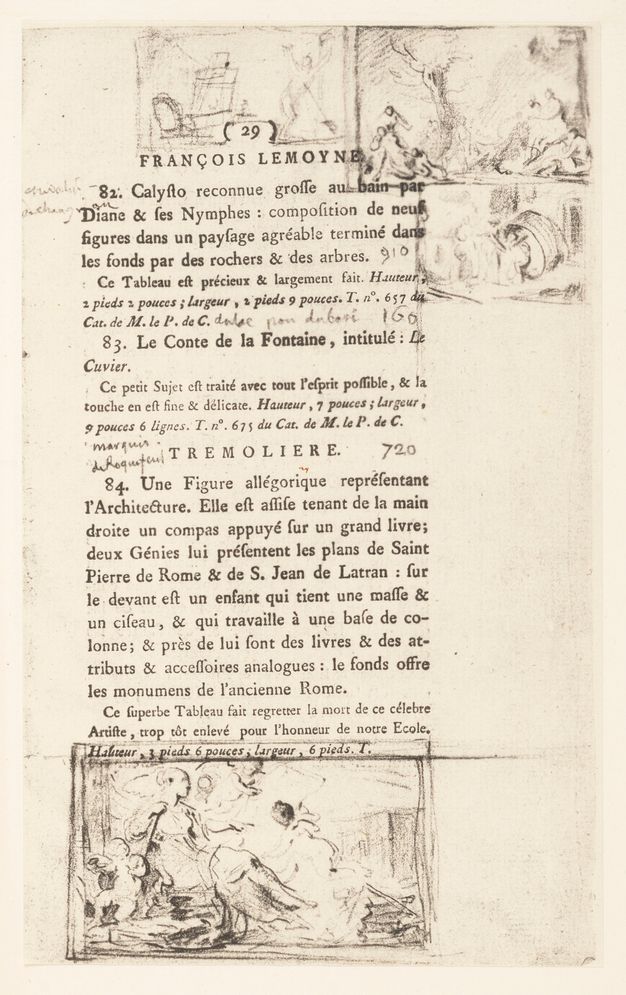
Dying by the sword was, like wearing it, evocative of noble ideals. The classical connotations of valor and heroism associated with suicide by sword—whether historical (like Cato the Younger) or fictional (like Sophocles’s Ajax)—would eventually provide Lemoyne’s colleagues and contemporaries with a means of mythologizing his violent death. In his Life of Lemoyne, Antoine-Joseph Dézallier d’Argenville claimed that, in the weeks before his death, Lemoyne had found solace in having friends read aloud to him from the histories and “whenever some Roman killed himself with great honor, Lemoyne had them re-read the passage, exclaiming now there is a beautiful death!”9 The relative horror of Lemoyne’s own far-from-beautiful death was glossed over at the time in most official death announcements, from which the sword (and the suicide) were generally absented.10 But over time, Lemoyne’s tragic end became the stuff of art-world legend, and the sword returned to center stage. This was certainly how Gabriel de Saint-Aubin recalled it, though he was barely a teenager at the time of Lemoyne’s death. Forty years later, however, while attending a sale at which some of Lemoyne’s paintings were being sold, the suicide came to mind. Ever the annotator of , Saint-Aubin sketched some of the works in the margins, among them Lemoyne’s Diana and Callisto (1725–28, Los Angeles County Museum of Art). But in a separate vignette around Lemoyne’s printed name, he imagined a sensationalized scene of the painter’s death (fig. 162). Rushing from the easel with arms dramatically outstretched, Lemoyne throws himself upon a sword rising up to meet him in the corner of the studio. In this romanticized vision, Lemoyne becomes a tortured genius, driven from his canvas, and his sword becomes the instrument that enabled his honorable death. Over the intervening years, Lemoyne’s painful, desperate, and violent suicide had been reinvented to almost mythic proportions, a tale like any other represented on that page. ‡
For a full investigation of Lemoyne’s death and the circumstances around it, see Hannah Williams, “The Mysterious Suicide of François Lemoyne,” Oxford Art Journal 38, no. 2 (2015): 225–45. Parts of this entry have been drawn from that article. ↩︎
Suicide was still a crime in eighteenth-century France, so Lemoyne’s death was treated as a criminal investigation. On suicide in this period, see Jeffrey Merrick, “Death and Life in the Archives: Patterns and Attitudes to Suicide in Eighteenth-Century Paris,” in Histories of Suicide: International Perspectives on Self-Destruction in the Modern World, ed. John Weaver and David Wright (Toronto: University of Toronto Press, 2009), 73–90; and Dominique Godineau, S’abréger les jours: Le suicide en France au XVIIIe^ siècle (Paris: Armand Colin, 2012). ↩︎
“Procès-verbal d’apposition de scellés après le décès de François Lemoyne, premier peintre du roi,” in Jules Guiffrey, Scellés et inventaires d’artistes français du XVIIe et XVIIIe siècle (Paris: Charavay, 1884), 1:341–42. ↩︎
“Rapport du chirurgien du Châtelet sur l’état du cadaver du sieur Lemoyne,” NAAF, 1877, 196–97. ↩︎
“Rapport du chirurgien,” 196–97. ↩︎
Ellery Schalk, From Valor to Pedigree: Ideas of Nobility in the Sixteenth and Seventeenth Centuries (Princeton: Princeton University Press, 1986), 148–49. ↩︎
See, for instance, Charles-Nicolas Cochin’s letter to the marquis de Marigny, 5 September 1768, in Marc Furcy-Raynaud, Correspondance de M. de Marigny, NAAF, 1904, 155–56. ↩︎
PV, 4:69–70, 76. ↩︎
Antoine-Joseph Dézallier d’Argenville, Abrégé de la vie des plus fameux peintres (Paris: 1762), 425. ↩︎
The Académie’s minutes recorded only “the death” of the history painter (28 June 1737, PV, 5:207), while his obituary in the Mercure noted simply that “he died” (Mercure de France, June 1737, 1410), with no further details in either case. ↩︎
| words