Type of Object
Theme
Type of Object
Theme
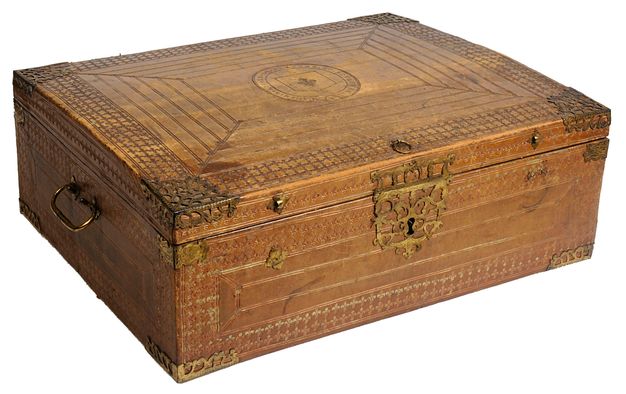
Still residing today in the archives of the Académie at the École Nationale Supérieure des Beaux-Arts, there is a leather chest that witnessed a century and a half of institutional life (fig. 39). Like the other things in this book that once occupied the Académie’s rooms—the concierge’s or Jean-Antoine Houdon’s —the secrétaire’s document box is one of those rare traces that restores a sense of materiality to an institution that is often largely dematerialized in the narratives of art history, abstracted into ideas of cultural ideology, art theory, and pedagogy. By contrast, the long life of this well-used object reveals aspects of the lived experience of its members, from administrative practicalities and habitual customs to singular dramatic events and divisive community conflicts.
As an item of property, the document box has a complex status that draws attention to the personal in the professional in this art-world space. Legally it belonged to the Académie, serving as the vessel for the very documents that constituted that institution as an entity in ancien régime law. In practice, however, it was possessed by a succession of individuals, in the form of the Académie’s secretaries, each of whom became the box’s temporary custodian during his long term in office, usually held from nomination until death. Thus, while the box belonged in some sense to every member of the Académie—and thus to nearly every artist in this book—it had a much closer connection to the tenures of the six artists who served as secrétaire and keeper of the box’s : Henri Testelin (1650–81), Nicolas Guérin (1681–1714), François Tavernier (1714–25), Bernard Lépicié (1737–55), Charles-Nicolas II Cochin (1755–90), and Antoine Renou (1790–93).1 While most of these artists would have known only the secretary who came before or after, the box created a material link between them all. Passing from hand to hand—kept but never owned—it was not only a container for legal documents but a repository of shared institutional heritage, recalled in the thing itself and in the ritualized practices that its keepers performed.
Those ritualized practices developed over the box’s long and fairly mundane professional career as an item of administrative equipment. Along with its sedentary daily charge of preserving the Académie’s official papers, the box performed a more active annual rite. Every January, at the first meeting of the year, the secrétaire carried the box into the assembly room, opened it, took out the Statuts, and read aloud the articles that the assembled members had all sworn to uphold.2 This little annual ceremony was never written down as an official regulatory practice, but the company’s minutes reveal that it began somewhat organically at the end of the 1670s and continued right through the eighteenth century, with every secrétaire—from Testelin to Renou—participating in this habitual rite to mark the start of the year and reiterate the collective aims and ideals of this community.
The box’s working life thus unfolded quietly and rhythmically, but it started very differently. Indeed, the origins of those ritualized practices actually took shape two decades earlier, during its incredibly dramatic entry into the world as the ceremonial focus of a pivotal event. The box’s beginnings are inextricably linked with a founding legend of the Académie as it was recorded by Testelin and retold in the eighteenth century in the official Mémoires pour servir à l’histoire de l’Académie.3 At its formation in 1648, the Académie had notoriously set itself in direct opposition to the Guild of Painters and Sculptors. But in 1651 the rival institutions attempted a reconciling jonction (union) to serve their mutual ends: the guild masters looking to profit from the Académie’s privileges; and the academicians seeking to secure the lettres patentes (letters patent) that the guild had hitherto been opposing.4 Not surprisingly, the jonction was a disaster. Remaining loyal to the supremacy of the guild, the masters persistently threatened the Académie’s stability with their large numbers, disrupting meetings and inciting discord.5 By 1654, the academicians were fed up and started planning an elaborate coup to oust the obstreperous masters once and for all.6 Led by Charles Le Brun and with the patronage of Antoine de Ratabon, they began meeting in secret to arrange three crucial documents: a new set of Statuts; a brevet from the king ensuring royal support; and the long-awaited lettres patentes that would grant legal legitimacy. When all three had been passed by the Paris Parlement in June 1655, the academicians set about preparing for a ceremonial showdown, in which the document box would make its début performance.7
Calling a general assembly, the plotting academicians set the stage the night before, secretly decorating the meeting room. Its walls were hung with rich tapestries and, at the far end, a table was installed along with three , all covered in sumptuous red velvet and gold trim.8 When the masters arrived the next morning, they realized something was up, but before they could react, three coaches drew up outside, and the senior academicians descended, with Testelin, as secrétaire, carrying the new ceremonial box acquired for this moment. Processing the full length of the room, Testelin placed the box upon the table. Ratabon, as directeur, took his place on one of the armchairs, leaving the others symbolically empty for the absent protecteur and vice-protecteur, positions recently accepted by two of the most powerful men in France, Cardinal Mazarin and Chancellor Séguier. With the power and patronage of the court established, Ratabon declared that he spoke at the command of the king to bring the Académie new graces and privileges from its bountiful monarch. At this point, he turned to the secrétaire and ordered the opening of the chest.
Testelin rose and took from the box the three precious documents for which it had been made, and which would in turn “make” the Académie. Unfurling them over the table, he began to read aloud. First, the brevet du roi, granting the Académie privileges including an annual income and new lodgings in a royal building. Next, the lettres patentes, legally ratifying these privileges and granting others, in particular that the Académie had the sole right to conduct life drawing classes. Finally, the new Statuts, whose twenty-one articles Testelin turned to last. When he reached Article IX—decreeing that only elected officers would now hold voting rights—the impact of the coup started to resonate; an indignant rumble emanated from the masters as they realized their majority numbers were now worthless.9 As Testelin concluded his reading, the masters rose, remonstrating passionately and, in a dramatic flurry, gathered their retinue and exited the meeting, never again to return to the Académie.10 That was the end of the jonction. But that moment reinforced a bitter institutional rivalry that would continue for over a century, until the guild was eventually disbanded in the 1770s.
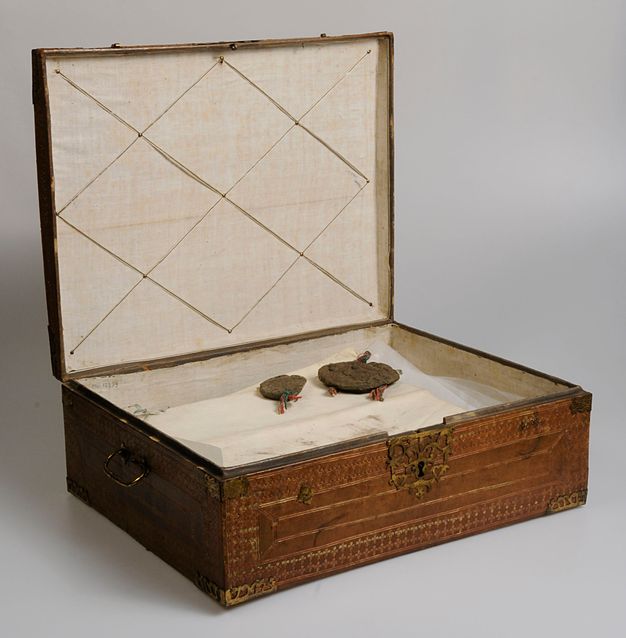
Although its leather has discolored from blue to brown and much of its gilding has worn away, the box is still recognizable from its description in the Mémoires as the ritual object borne by Testelin: “a small chest of blue leather covered with gold fleur-de-lis, decorated with gilt silver . . . and adorned on top with the arms of the Académie.”11 The box’s materiality reveals the functionality—both practical and symbolic—for which it was always intended. This “small chest” is actually a fairly large box (around 20 by 54 by 43 centimeters—the size of a small suitcase): sizeable enough to accommodate the grand format of the legal parchments (when folded) (fig. 40), but still comfortably carried by a single person, grasping the handles at each short end. Decorative gilt-metal mounts on every corner provide reinforcement where contact and pressure were most likely for an object designed to be moved around, while the hinges and rings permit ease of opening for contents that needed to be accessed. The lock fitted for security suggests the considerable value ascribed to the contents, but with its single closure mechanism (the simplest kind of chest lock available), it seems no imminent threat of theft was anticipated.12 The box’s design also addressed its symbolic functions. Ownership was inscribed directly in the words on the lid, ACADEMIE ROYALE DE PEMTVRE ET SCVLPTVRE, while the arms—a fleur-de-lis in a shield—made clear the extent of the institution’s elite and powerful patronage. A symbol of the French crown, the fleur-de-lis is actually repeated all over, as the shape of the tooled pattern bordering each face of the chest, thus ensuring that the Académie’s royal connections were established from every angle. In short, the institution’s document box was entirely fit for purpose: a bespoke, transportable, lockable, and ideologically decorated container, with administrative functionality and ceremonial gravitas.
Despite the contrast between the box’s dramatic beginnings and its quieter subsequent career, as an object, its function changed very little. From start to finish, it served as the receptacle for the Académie’s official documents and as a vehicle for institutional rituals. What did change, however, after that inaugural entry, was its mode of being, as it transitioned from theatrical prop to everyday equipment. In the academicians’ coup, the document box was an indispensable part of a staged performance, captivating attention and orchestrating the climax. The documents could have been carried on their own, but inside the box they were kept intriguingly hidden until the crucial moment of their reveal. At the same time, the box elevated the status of those pieces of parchment, conveying that their symbolic value far exceeded their material worth. But, for the box, this was a one-time performance. While there were always echoes of its past in those later ritualized annual practices, the box would never again perform its task in the guise of a prop, in such a ceremonial manner, on such a theatrical stage, or with such a riveted audience.
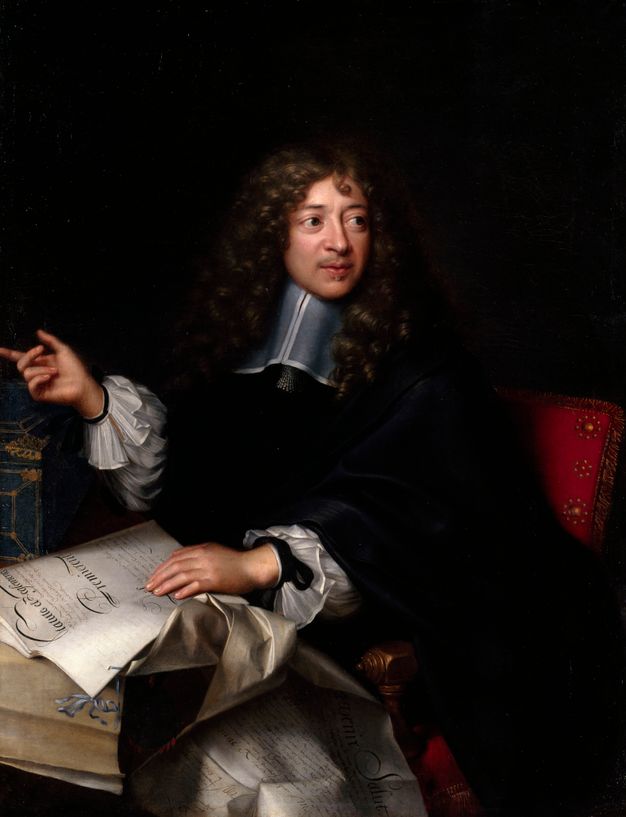
Whatever the relationship between the box and its eighteenth-century keepers—Guérin, Tavernier, Lépicié, Cochin, and Renou—theirs was a slightly different lived experience from that of Testelin, its original guardian, with whom it had that additional poignant history. It is perhaps no coincidence then that only Testelin ever had himself painted with the box (fig. 41). Recognizable from its original description and from its current state, the blue leather box with gilt metal mounts sits quietly under the elegant gesture of Testelin’s pointing hand in his official Académie portrait, thus serving as his defining professional attribute. His other hand rests on the box’s precious contents, pressing down the central fold of the Statuts as though he were about to launch into the annual recital of the institution’s rules and regulations. Hanging in the Académie, this portrait immortalized not only its sitter but also the box and its ritualized customs, giving them an iconic status in the institution’s past, even as the material thing itself continued to exist and operate in the present. Indeed, for the secrétaires that followed, this painted representation of the box may have proved a self-reflexive presence in their own working lives. Installed in the Académie’s Salle des Portraits, the portrait was not only next door to the company’s meeting room but hung such that Testelin was perpetually pointing to its door.13 Thus, every January, as the current secrétaire brought the box for the customary reading of the statutes, it would be carried past its official portrait, in a passage that instilled that annual rite with the symbolic echoes of its original foundational act. ‡
The role was also held by Louis-François Dubois de Saint-Gelais (1725–37), an amateur but not an artist. On the Académie’s secrétaires, see Hannah Williams, Académie Royale: A History in Portraits (New York: Routledge, 2015), 46, 57–61. ↩︎
The first new-year reading of the Statuts took place on 7 January 1679. PV, 2:142. On that occasion, it was noted that the practice would be repeated on the last Saturday of every quarter, so it is possible that the box served in more regular rituals than the annual reading. ↩︎
Mémoires pour servir à l’histoire de l’Académie royale de peinture et de sculpture, ed. Anatole de Montaiglon, 2 vols. (Paris: P. Jannet, 1853). This text was described in a meeting on 1 February 1772 as “Mémoires de M. Testelin, rédigés par feu M. Hulst, Honoraire Amateur.” PV, 8:94. ↩︎
Mémoires pour servir, 1:95–96. ↩︎
Mémoires pour servir, 1:111–31. On the history of the Académie and the period known as the jonction, see Christian Michel, The Académie Royale de Peinture et de Sculpture: The Birth of the French School, 1648–1793, trans. Chris Miller (Los Angeles: Getty Publications, 2018), 18–20. ↩︎
Mémoires pour servir, 1:162–64. ↩︎
Mémoires pour servir, 1:173, 179–80. ↩︎
Mémoires pour servir, 1:181. ↩︎
“Articles que le roi veut être augmentés et ajoutés aux premiers statuts et règlements de l’Académie Royale de Peinture et de Sculpture.” 24 December 1654, ratified by Parlement on 23 June 1655. Léon Aucoc, Loi, statuts et règlements concernant les anciennes Académies et l’Institut de 1635 à 1889 (Paris: Imprimerie Nationale, 1889), cxiii–cxviii. ↩︎
Mémoires pour servir, 1:183–87. Proceedings were recorded much more prosaically in the official minutes of the meeting on 3 July 1655. PV, 1:101. ↩︎
Mémoires pour servir, 1:182. ↩︎
On lock types, see plate XXVII, “Serrurier” in Encyclopédie, http://encyclopedie.uchicago.edu/, 26:4:1. ↩︎
In 1781 the portrait was described as hanging “above the door to the Gallery of Apollo,” in Antoine-Nicolas Dézallier d’Argenville, Description sommaire des ouvrages de peinture, sculpture et gravure exposé dans les salles de l’Académie royale (Paris: De Bure, 1781), 46. On the Académie’s Salle des Portraits, see Williams, Académie Royale, 144–51. ↩︎
| words