Contemporary painters often choose commercially primed canvases as their painting support; however, manufacturers provide little technical information about the materials used in their production. The authors were prompted to learn more about these materials’ manufacture after observing unexpected responses to established conservation treatments. Canvas fiber, priming binder, pigments, and fillers used in fifty-three commercially primed canvases purchased from Australian and Singaporean suppliers were analyzed. The materials detected show variations in canvas types and priming formulations that suggest reasons for unusual conservation treatment characteristics.
62. Investigating Commercially Primed Contemporary Artist Canvases
- Anne Carter, Paintings Conservator, Queensland Art Gallery | Gallery of Modern Art, Brisbane, Australia
- Lynn Chua, Conservation Scientist, Heritage Conservation Centre, National Heritage Board, Singapore
- Filzah Mohd Amir, Assistant Conservator, Heritage Conservation Centre, National Heritage Board, Singapore
- Ruby Awburn, Independent Conservator, Australia
- Gillian Osmond, Paintings Conservator, Queensland Art Gallery | Gallery of Modern Art, Brisbane, Australia
- Joey Ng, Lab Assistant, National University of Singapore
Introduction
Commercially primed artists canvases are common supports for contemporary painters. Such canvases are convenient and often affordable; however, the product information available for both artists and conservators to inform purchase choice or likely aging characteristics is limited. This paper reports on the material analysis of fifty-three commercially primed artists canvases purchased from Australian and Singaporean suppliers in 2018–19.
Research was prompted by observations that some contemporary paintings exhibit unusual responses to conservation treatment that are potentially attributable to their commercially primed canvas support. Observations include stretchiness, the priming’s ability to tolerate heat above 45°C (sometimes as high as 80°C), unpredictable response to humidification, priming discoloration, and delamination of subsequently applied oil paint. Commercially primed canvases from seventeen applicable collection paintings dating from 1990 to 2018 were also analyzed; however, those results are presented here only where they help to inform the discussion.
Background
Historical studies of commercially primed canvases document the frequent use of lead white, chalk, protein, and oil in single or double priming layers on cotton or linen canvas supports (Ravaud, E., M. Eveno, T. Calligaro, V. Gonzalez, G. Wallez, W. Nowik, and J. Aufort. 2014. “Study of a Pre-primed Canvas Bundle from the Binant Color Merchant.” In ICOM-CC: 17th Triennial Conference, 15–19 September 2014, Melbourne, Australia: Preprints, edited by Janet Bridgland. Paris: ICOM.; Hackney, Stephen. 2020. On Canvas: Preserving the Structure of Paintings. Los Angeles: Getty Publications.; Townsend, J., T. Doherty, G. Heydenreich, and J. Ridge, eds. 2008. Preparation for Painting: The Artist’s Choice and Its Consequences. London: Archetype.). Today, these priming layers are commonly substituted with synthetic alternatives, with acrylics being the most commonly encountered. For example, Ormsby et al. studied priming layers of fifty-two paintings from the Tate collection dated 1963–2008 and identified 60% of priming layers as acrylic emulsion, 27% as oil based, and 10% as alkyd, with 3% “other” (Ormsby, B., E. Hagan, P. Smithen, and T. Learner. 2008. “Comparing Contemporary Titanium White-Based Acrylic Emulsion Grounds and Paints: Characterisation, Properties and Conservation.” In Preparation for Painting: The Artists’ Choice and Its Consequences, edited by Joyce Townsend, 163–71. London: Archetype.). The prevalence of synthetic fiber use in contemporary canvas supports is also a question to be investigated.
To inform canvas sample selection for this current study, thirty-seven Australian and Singaporean painters were surveyed about their canvas choices, revealing that most painters routinely purchased commercially primed canvases—selecting their canvas by trial and error, availability, working qualities, and price point (Osmond, G., L. Chua, A. Carter, R. Awburn, and F. Mohd Amir. 2018. “An FTIR Survey of Contemporary Pre-primed Artist Canvases.” Poster presented at Infrared & Raman Users Group (IRUG) 13th Biennial Conference, Sydney. https://www.roots.gov.sg/resources-landing/publications/Heritage-Conservation-Centre/An-FTIR-survey-of-contemporary-pre-primed-artist-canvases.). Commercially primed canvases are usually produced as type U: universal (synthetic emulsion), suitable for both water- and oil-based paint; or type O: suitable for oil paint. However, many artists were unaware of the priming type and did not vary their canvas selection according to paint medium.
Methodology and Results
Fifty-three commercially primed artists canvases were collected from art stores in Australia and Singapore, representing nineteen brands manufactured in Europe, China, Australia, the United States, India, and Mexico: Artfix, Claessens, Belle Arti, Fredrix, Winsor and Newton, Caravaggio, Sydney Canvas Company, Art Spectrum, Clairefontaine, Mont Marte, National Art Materials, Jasart, Overjoyed, Pebeo, Semco, Francheville, Phoenix, Talens, and Colorpro. Samples cover various price points, and forty-nine samples were identified as having synthetic polymer priming and oil-based priming.
Canvas fiber, priming binder, and pigments/fillers were primarily analyzed using optical microscopy, attenuated total reflectance–Fourier transform infrared spectroscopy (ATR-FTIR), pyrolysis–gas chromatography–mass spectrometry (Py-GCMS), and X-ray fluorescence spectroscopy (XRF); some were analyzed with Raman spectroscopy and scanning electron microscopy–energy dispersive X-ray spectroscopy (SEM-EDS). In addition, uniaxial tensile strength testing and heat testing were undertaken.
A summary of results is presented below. More detailed analysis for each sample is found as supplementary data (Carter, A., L. Chua, F. Mohd Amir, R. Awburn, and G. Osmond. 2020. “Investigating Commercially-Primed Contemporary Artist Canvases: Supplementary Data.” https://www.qagoma.qld.gov.au/__data/assets/pdf_file/0004/596821/Investigating-commercially-primed-contemporary-artist-canvases-supplementary-data.pdf).
Priming Stratigraphy
Cross sections were prepared, and four priming layer stratigraphies were identified in visible light. Thirty-two percent of samples contained single priming layers, often with irregular thickness. Others appeared as double layers in three stratigraphies: equal layer thickness, with the bottom layer sometimes irregular in thickness and usually opaque (30%); thin layer over thick, with the bottom layer often irregular in thickness (19%); thick layer over thin, with the bottom layer sometimes transparent or opaque and continuous or noncontinuous (19%). The multiple priming layers specified by suppliers were not always discernible.
BINDER
The top surface of priming layers was characterized using ATR-FTIR (table 62.1, fig. 62.1) (Osmond, G., L. Chua, A. Carter, R. Awburn, and F. Mohd Amir. 2018. “An FTIR Survey of Contemporary Pre-primed Artist Canvases.” Poster presented at Infrared & Raman Users Group (IRUG) 13th Biennial Conference, Sydney. https://www.roots.gov.sg/resources-landing/publications/Heritage-Conservation-Centre/An-FTIR-survey-of-contemporary-pre-primed-artist-canvases.). At this surface layer, forty-nine of the fifty-three canvas samples contained synthetic polymer binders and four samples contained oil priming. Styrenated-acrylic predominated as a binder, followed by acrylic and acrylic–polyvinyl acetate (PVAc) binders. No alkyd binders were found.
| Binder | % | Pigments and fillers | % | Fiber type | % | Weave | % |
|---|---|---|---|---|---|---|---|
| Acrylic-styrene | 41.4 | Chalk, titanium dioxide (TiO2) | 43.7 | Cotton | 58.5 | Plain (1 × 1) |
58.2 |
| Acrylic | 20.9 | Chalk, TiO2, talc | 20 | Linen | 32 | Half basket (1 × 2) |
36.4 |
| Acrylic-PVAc | 11.3 | Chalk | 9.6 | PET | 5.7 | Full basket (2 × 2) |
5.4 |
| Acrylic-PVAc-styrene | 9.4 | Chalk, TiO2, barium sulfate (BaSO4) | 3.6 | PET-cotton | 3.8 | ||
| PVAc | 7.5 | Gypsum | 3.6 | ||||
| Oil | 7.5 | TiO2, kaolinite | 3.6 | ||||
| PVAc-styrene | 2.0 | Other | 15.9 |
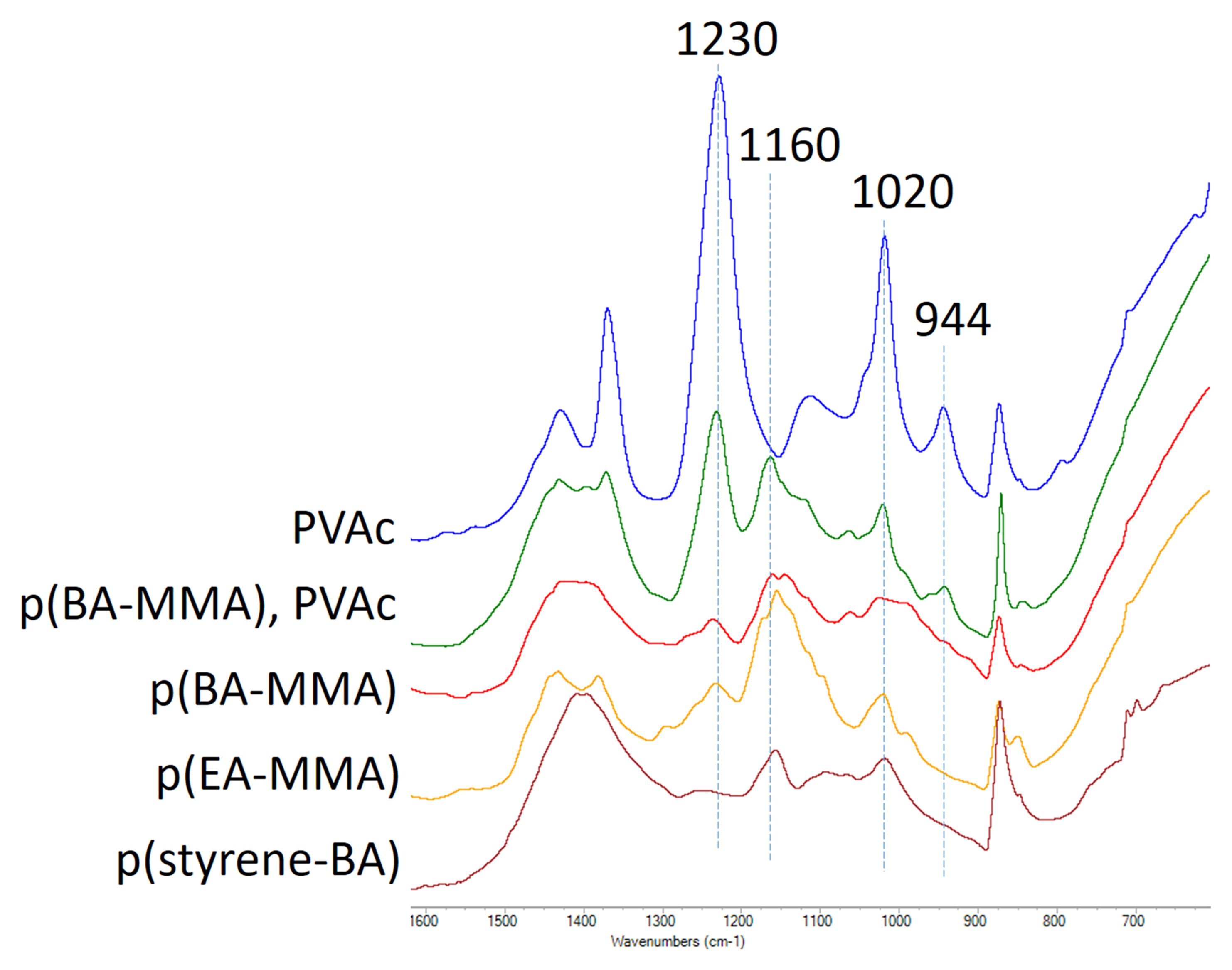
Py-GCMS provided further details of synthetic polymer binder constituents, including verification of the use of seven different acrylic monomers. Within the group of styrenated-acrylics, styrene n-butyl acrylate (BA) predominated (37%), and within the group of “pure” acrylics, only ethyl acrylate–methyl methacrylate (EA-MMA) and BA-MMA were found, with a slightly higher occurrence of EA-MMA. One EA-MMA priming showed significant amounts of diethylene glycol dibenzoate plasticizer. Within the group of PVAc-acrylic binders, some were copolymerized with vinyl versatate (VeoVa). Surfactants such as polyethylene oxide (PEO) (Scalarone, D., and O. Chiantore. 2004. “FTIR Monitoring of Surfactant Phase Separation and Stability in Waterborne Organic Coatings and Artists’ Acrylic Paints.” In Proceedings of the Sixth Infrared and Raman Users Group Conference (IRUG 6): Florence, Italy, March 29th–April 1st, 2004, edited by Marcello Picollo. Padua: Il Prato.) were not observed with ATR-FTIR.
Priming layer combinations varied (fig. 62.2). Double priming layers included acrylic over styrenated acrylic (see fig. 62.2b), acrylic over acrylic-PVAc (see fig. 62.2c), and oil over styrenated acrylic (fig. 62.2d).
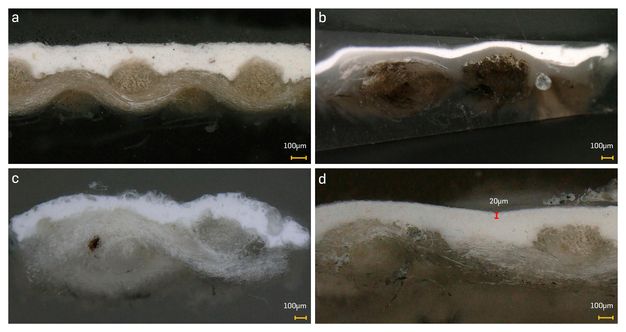
Variations were observed between ATR-FTIR and Py-GCMS data, including a significantly higher incidence of PVAc detected with Py-GCMS. This was found to correlate with the presence of PVAc in lower priming layers not captured by the surface-only ATR-FTIR. Thin surface layers were sometimes difficult to separate from other, similarly colored layers for Py-GCMS analysis (fig. 62.2d) (Osmond, G., L. Chua, A. Carter, R. Awburn, and F. Mohd Amir. 2018. “An FTIR Survey of Contemporary Pre-primed Artist Canvases.” Poster presented at Infrared & Raman Users Group (IRUG) 13th Biennial Conference, Sydney. https://www.roots.gov.sg/resources-landing/publications/Heritage-Conservation-Centre/An-FTIR-survey-of-contemporary-pre-primed-artist-canvases.).
In total, thirty-four different copolymer binder combinations in the upper layer were found in the surface layer of the forty-nine synthetic-primed samples—indicating a wide variety of formulations and subsequent properties. The history of synthetic emulsion binders and copolymer properties is well documented, including in conservation literature (Scalarone, D., and O. Chiantore. 2004. “FTIR Monitoring of Surfactant Phase Separation and Stability in Waterborne Organic Coatings and Artists’ Acrylic Paints.” In Proceedings of the Sixth Infrared and Raman Users Group Conference (IRUG 6): Florence, Italy, March 29th–April 1st, 2004, edited by Marcello Picollo. Padua: Il Prato.; Learner, Thomas J. S. 2004. The Analysis of Modern Paints. Los Angeles: Getty Conservation Institute.; Croll, S. 2007. “Overview of Developments in the Paint Industry since 1930.” In Modern Paints Uncovered, edited by Thomas J. S. Learner, Patricia Smithen, Jay W. Krueger, and Michael R. Schilling, 17–29. Los Angeles: Getty Conservation Institute.; Standeven, H. 2011. House Paints, 1900–1960: History and Use. Los Angeles: Getty Conservation Institute.), which describes how copolymers are formulated to provide optimal coating properties. For example, adding monomers that have a higher glass transition temperature (Tg), such as styrene (or MMA), to a “soft” acrylic monomer such as n-butyl acrylate results in a stiffer and possibly more heat-tolerant priming, depending on the monomer ratio (table 62.2).
| “Soft” monomers | Tg (°C) | “Hard” monomers | Tg (°C) | Copolymers | Tg (°C) |
|---|---|---|---|---|---|
| n-Butyl acrylate (BA) | −43 | Styrene (sty) | 107 |
p(BA-sty) (20:80) (40:60) (60:40) (80:20) |
74 41 13 −16 |
| Ethyl acrylate (EA) | −8 | Methyl methacrylate (MMA) | 105 |
p(EA-MMA) (20:80) (40:60) (60:40) (80:20) |
81 50 24 5 |
Source: Penzel, Rieger, and Schneider 1997
Pigments and Fillers
Fourteen different pigment and filler combinations were identified. The most frequent combinations are detailed in table 62.1. Two-thirds of synthetic primings were composed of titanium dioxide and chalk; some also contained talc. Nine percent of samples contained chalk only. Pigmentation of layers also varied within samples; for example, titanium white was sometimes found only in the top of double-layered priming (see fig. 62.2b).
Oil Priming and Zinc Soaps
The four oil-primed samples were double primed. Three were oil over acrylic or acrylic-PVAc, and one contained two oil layers. Barium sulfate, titanium white, and calcium carbonate were found in oil primings. Additionally, zinc was detected in three of the oil-primed samples, and zinc soaps (amorphous and/or crystalline) were detected at the surface of these samples.
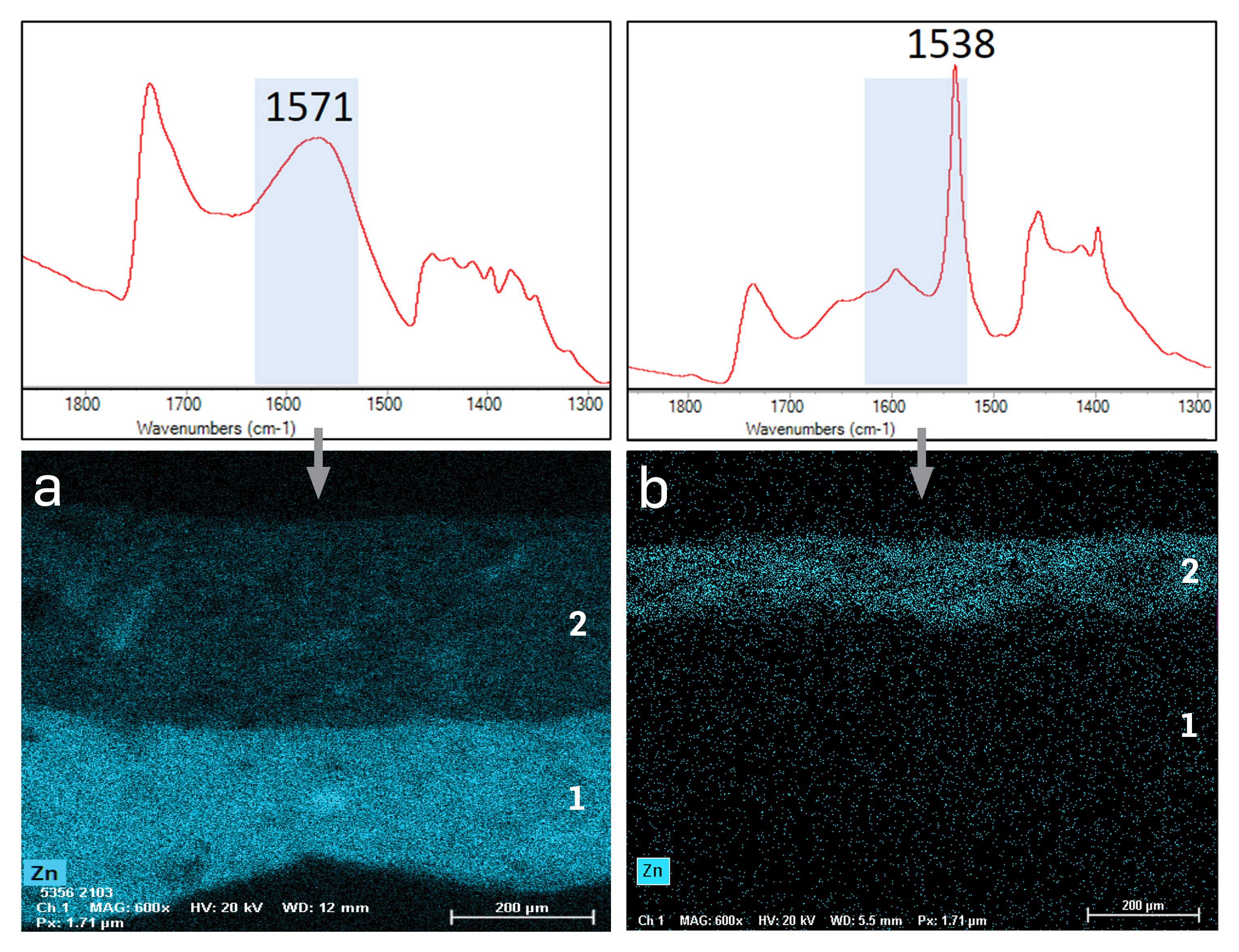
Amorphous zinc carboxylates (broad band centered 1571 cm−1) were found at the top surface of the double oil priming where zinc oxide was present only in the underlayer. This suggests in situ formation of zinc soaps and migration from the lower layer to the surface (fig. 62.3a).
Crystalline zinc soaps (1538 cm−1) were detected at the surface of two oil-primed canvases with acrylic-PVAc underlayers. The oil priming contained no zinc oxide, and thus zinc stearate was likely a constituent in the priming formulation (see fig. 62.3b). These results are important, as zinc soaps at the surface of oil-primed canvases may pose a risk to subsequent oil-paint adhesion (Osmond, G. 2019. “Zinc Soaps: An Overview of Zinc Oxide Reactivity and Consequences of Soap Formation in Oil-Based Paintings.” In Metal Soaps in Art: Conservation and Research, edited by Francesca Casadio, Katrien Keune, Petria Noble, Annelies Van Loon, Ella Hendriks, Silvia A. Centeno, and Gillian Osmond, 25–46. Cham: Springer.).
Canvas
Fiber analysis showed good correlation with the information provided by manufacturers. Cotton was the most prevalent fiber, followed by linen. Polyethylene terephthalate (PET) and PET-cotton blends were less common (see table 62.1).
Three weave patterns were identified: plain weave (1 × 1), half basket (2 × 1), and full basket (2 × 2) (see table 62.1). Cotton was typically found as half basket, while linen, PET, and PET-cotton blends were mostly plain weave. Twenty-five percent of cotton samples had a thread count of 10 × 30 threads/cm2; otherwise, thread counts varied.
Uniaxial tensile strength testing of canvas samples indicated that the type or number of priming layers did not significantly affect tensile strength. The force at maximum for cotton and PET-cotton (56–258 N) was generally lower than for linen and PET (191–514 N) regardless of priming layers. The modulus of elasticity of the samples varied, generally showing a lower modulus of elasticity in the warp direction than the weft, aligning with research by others (Young, Christina, and Suzanne Jardine. 2012. “Fabrics for the Twenty-First Century: As Artist Canvas and for the Structural Reinforcement of Easel Paintings on Canvas.” Studies in Conservation 57, no. 4: 237–53.).
Heat tests
Response of the priming layer to heat was tested. Most samples were visually affected after holding a spatula heated to 80°C against the surface for one minute; however, there was no obvious visual effect in 19% of samples—that is, no flattening, burnishing, softening, or tackiness. No obvious correlation was found between heat response and binder or pigmentation type to inform conservation practice.
Conclusions
The synthetic emulsion primings found in this study reflect commercial development over the past seventy years. However, where industry has broadly transitioned from PVAc and PVAc-acrylic copolymers to acrylics and styrenated acrylics (Schwartz, M., and H. Kossmann. 1998. “Acrylic and Acrylic/Styrene Copolymer Dispersions.” European Coatings Journal 3: 134–40.), PVAc remains a common constituent in commercially primed artist canvases.
Styrene was found in 64% of priming surface layers—most frequently with acrylic but also combined with PVAc. Styrenated acrylics were also found as underlayers for both oil and acrylic layers. The prevalence of styrenated acrylics indicates a trend of increased use since 2008 (Ormsby, B., E. Hagan, P. Smithen, and T. Learner. 2008. “Comparing Contemporary Titanium White-Based Acrylic Emulsion Grounds and Paints: Characterisation, Properties and Conservation.” In Preparation for Painting: The Artists’ Choice and Its Consequences, edited by Joyce Townsend, 163–71. London: Archetype.).
Styrenated acrylic emulsions are generally used in more economical paints, as styrene monomers are cheaper than acrylics. However, styrenated acrylics can also produce high-end paints, depending on the performance required.1 Importantly, styrene is not stable when exposed to UV radiation (Standeven, H. 2011. House Paints, 1900–1960: History and Use. Los Angeles: Getty Conservation Institute.). It can become yellow and may “chalk” and crack if sufficient UV exposure occurs. When covered with another paint layer, styrenated acrylic is considered stable.2 Thus, a general recommendation from this research is for artists to avoid leaving commercial priming layers (which may contain styrene) exposed to possible UV degradation.
In regard to oil-primed canvases, surface zinc carboxylates were identified. They present the risk of delamination of subsequently applied oil paint.
Of the fifty-three commercially primed canvases, none showed identical formulations of binder and pigment/filler except for some of the same brand. This finding implies that there is no standard formulation for commercially primed canvases, nor necessarily consistency within brands—the same product from different suppliers was not always identical, suggesting inconsistent production. Thus, priming-layer properties are difficult to identify from supplier information.
Cotton canvas predominated, primarily in half-basket weave. Synthetic canvases were not common; however, they showed the greatest tensile strength. Correlations between observations from artwork treatments and those works’ commercially primed canvas type were unclear. However, within the small number of paintings analyzed (seventeen), artworks on half-basket weave cotton canvas with chalk-dominated priming were the main contenders for unusual treatment observations.
Acknowledgments
The project was carried out as part of the memorandum of understanding between Queensland Art Gallery | Gallery of Modern Art (QAGOMA), Australia, and the Heritage Conservation Centre (National Heritage Board), Singapore. This research is supported by the QAGOMA Foundation and the QAGOMA Centre for Contemporary Art Conservation.
Experimental Equipment and Conditions
ATR-FTIR: Thermo Scientific Nicolet iN10 microscope with DTGS room-temperature detector coupled to an iZ10 diamond ATR bench accessory; 16 scans over 4000–400 cm−1 range, 4 cm−1 resolution.
Py-GCMS: Shimadzu GCMS QP2020 combined with a Frontier PY3030D pyrolizer unit with autosampler AOC-20i. Pyrolysis conditions: 600°C for 0.2 minutes. Gas chromatography conditions: 40°C for 5 minutes, ramped to 300°C at 10°C/min., hold 5 minutes. Oil-containing samples were derivatized with 3 µl of 25% tetramethylammonium hydroxide (TMAH) in methanol. Mass spectrometry conditions: Electronic index (EI) mode (70 eV), scan range: 50–600 m/z.
Uniaxial testing: 500N Zwick/Roell with 10 mm sample width and gauge length, and speed of 100 mm/min. at 55 ±5% RH and 22 ±3°C. Samples were tested in warp and weft with a tensile load of 500 N, measuring [Fmax/N] and t [Emod/GPa].
XRF: Bruker T 5i with Rh excitation anode, silicon drift PIN diode detector, no vacuum, Geo-Exploration mode calibration, spot size 8 mm.
Raman spectroscopy: Renishaw Raman spectroscopy instrument coupled to a confocal microscope. Laser of excitation: 785 nm.
SEM-EDX: Hitachi SU5000 scanning electron microscope coupled to a Bruker EDX system in partial pressure of 50 Pa. Voltage of 20 kV was applied, and EDS mapping of cross sections was collected over 5 minutes.