In 2016, after the flooding of the temporary storage area of the Musée Girodet of Montargis, sixty-nine paintings were brought to the Centre de Recherche et de Restauration des Musées de France for restoration. The works showed various structural and aesthetic alterations due to their prolonged immersion. The aims of the interventions were to reestablish the cohesion of the multilayer system to ensure its conservation over time and to improve the presentation of the paintings. The restoration campaign of this corpus allowed the authors to study the behavior of works according to their age, including old alterations and earlier restorations, and notably the presence of old backing supports. Different types of structural restoration treatment (modern or traditional practices) were then chosen depending on the sensitivity and state of conservation of each painting. The methodological approach of the interventions is discussed through a case study of a work presenting a particular restoration problem, The Sacrifice of Abraham, by a follower of Maertens De Vos.
35. The Impact of a Major Flood on Relined and Transferred Paintings from the Musée Girodet in Montargis, France, and the Conservation That Followed
- Dominique Martos-Levif, Scientist and Painting Conservator, in charge of the restoration paintings studios, Centre de Recherche et de Restauration des Musées de France, Paris, France
- Ludovic Roudet, Private Conservator, Paris, France
- Matthieu Gilles, Head of Painting Section, Centre de Recherche et de Restauration des Musées de France, Paris, France
Introduction
On May 31, 2016, the failure of a dam on the Loing canal, a tributary of the river Seine, completely flooded the temporary storage area of the Musée Girodet in Montargis, France.1 As a result, 182 paintings, 450 sculptures, and 1,230 drawings were immersed in water for three days. After emergency conservation measures on-site, fifty-one paintings on canvas of importance or presenting complex conservation problems (or both) were brought to the Centre de Recherche et de Restauration des Musées de France (C2RMF) for conservation.2 Among the fifty-one paintings, all painted oils (except one painted with gouache), four dated from the sixteenth century, eighteen from the seventeenth century, eight from the eighteenth century, and twenty-one from the nineteenth century.
Numerous alterations due to prolonged water immersion could be seen on the canvas supports and on the paint layers. The aim of the conservation interventions was to stop the degradation process of these paintings, to ensure their conservation over time, and to improve their visual presentation. Various structural operations were carried out, in particular relining with traditional, synthetic, or mixed techniques, while taking care to adapt the treatments to the specific problems of each artwork. Several teams of private conservators were selected by the collection managers of the Musée Girodet to work in the C2RMF workshops for two years. They were thus able to benefit from studio space, specific equipment, logistical means, and the assistance of the center’s professionals, both curators and scientists.
This paper first presents a synthesis of the multidisciplinary study carried out on this corpus of immersed works based on archival study of the material history of the artworks, detailed condition reports, scientific imaging, and analysis. We will then review the different types of structural treatments carried out by conservators during this campaign, in particular relining with different adhesives and techniques. Finally, we will present one case study, the conservation of The Sacrifice of Abraham by a follower of Maertens De Vos.
Behavior of a Corpus of Artworks Immersed for Seventy-Two Hours
The behavior of paintings during and after immersion is linked to the physical and chemical properties of their constitutive materials and the painting technique, as well as the past intervention history of the artworks and their prior state of conservation. A canvas naturally oxidizes and becomes brittle over time, and storage conditions also affect aging, especially when artworks are stored under poor conditions. Examination of the fifty-one paintings showed that forty had already undergone conservation treatments prior to the flood, including major structural intervention on thirty-one of them, sometimes at the C2RMF. Two had been transferred; twenty-five had been lined with glue paste, one with wax resin, and two with synthetic adhesives; and one had been mounted on cardboard. In addition, many of the paintings that had not been entirely relined had reinforcing patches added to their back, and one of them had been strip-lined. Most of the paintings from the sixteenth and seventeenth centuries had been either transferred or lined using the traditional method with glue paste, while some from the eighteenth century had been lined with polyvinyl acetate (PVA) materials. Artworks from the nineteenth century had undergone fewer structural conservation interventions but were more often treated with a large number of patches on the back of the paintings. Table 35.1 summarizes the past structural interventions of the paintings.
| 16th century | 17th century | 18th century | 19th century | Total | |
|---|---|---|---|---|---|
| Transfer | 1 | 1 | 2 | ||
| Lining, glue paste | 3 | 14 | 4 | 4 | 25 |
| Lining, wax resin | 1 | 1 | |||
| Lining, synthetic adhesive | 1 | 1 | 2 | ||
| Marouflage on cardboard | 1 | 1 | |||
| Strip-lining | 1 | 1 | |||
| Reinforcing patch | 1a | 2 | 6a | 7 | |
| Total structural interventions | 4 | 16 | 8 | 11 | 39 |
| Total paintings | 4 | 18 | 8 | 21 | 51 |
a. One 17th-century and one 19th-century painting had both lining and reinforcing patches.
Table: Dominique Martos-Levif
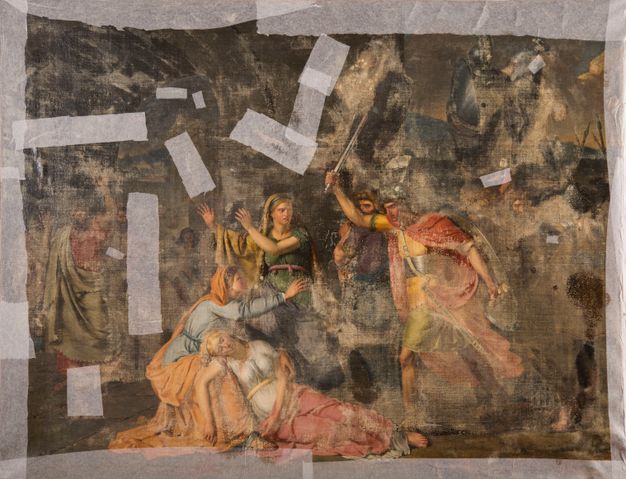
Canvas is a hygroscopic material that swells in the presence of water and shrinks upon drying if it is not properly stretched on a frame (Roche, A. 2003. Comportement mécanique des peintures sur toile. Dégradation et prevention. Paris: CNRS Editions.). Consequently, paintings that had too weak a frame or were not sufficiently stretched suffered particularly during the flood. In addition, twenty-eight out of thirty-one past linings peeled off partially or completely; only three linings of small-format paintings retained their mechanical properties. To limit the shrinkage of the canvases at the time of the rescue, conservators removed eighteen paintings from their stretchers and placed them on wooden boards. They also stapled a certain number of canvases to their stretchers. Nevertheless, many canvases were distorted during drying and some shrank at their edges or at tears. Indeed, tears were observed on thirty-five of the fifty-one paintings. Twenty paintings had old tears that had been treated in the past, and fifteen had new, more complex tears corresponding to traumas suffered during the flooding (fig. 35.1).
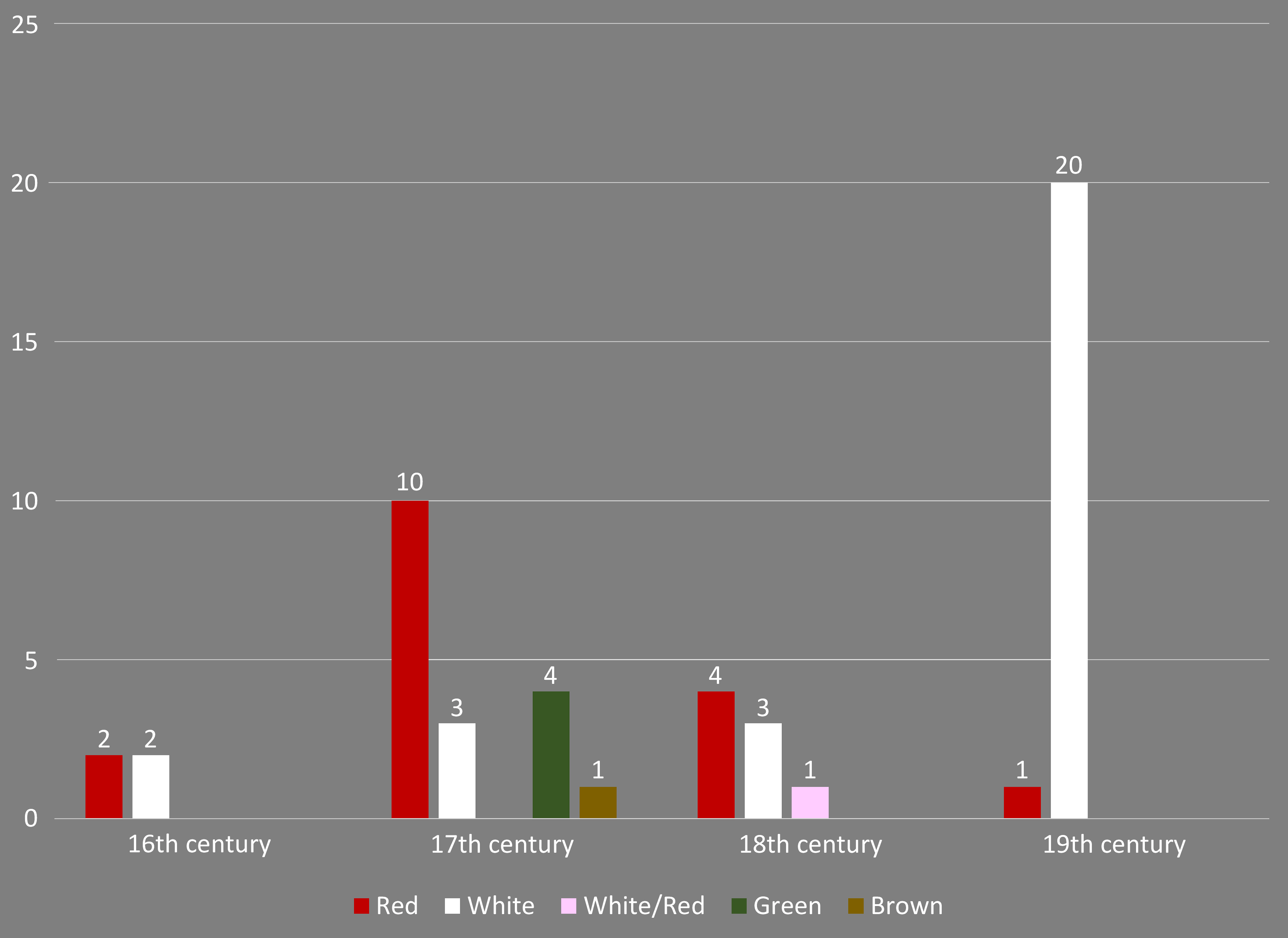
The swelling and subsequent shrinking of the canvas during first immersion and then drying caused not only deformations to the canvas itself but also loss of adhesion, and sometimes powdering, of the preparation layer. The canvas and the paint layers form a heterogeneous multilayer system. When the canvas swells, the paint layers separate from the support because their elasticity is limited. In addition, the physicochemical properties of some preparation layers can exacerbate the split between the support and the paint layers. Clay preparation layers may contain swelling clays and are often more sensitive to water than preparation layers made of calcium carbonate. Furthermore, lean preparation layers made with animal glue are more reactive than oil preparation layers. Most of the sixteenth- to eighteenth-century artworks’ preparation layers contain clay (generally red, brown, or green in color; fig. 35.2). According to records, at least thirty-four out of the fifty-one paintings have shown adhesion problems between the paint layers and the support in the past, and thirty-one of these had already been reaffixed. On the paintings that had a clay ground layer, numerous consolidations were made during lining interventions, whereas the reaffixing was more localized on paints with calcium carbonate preparations (white in color in fig. 35.2).3
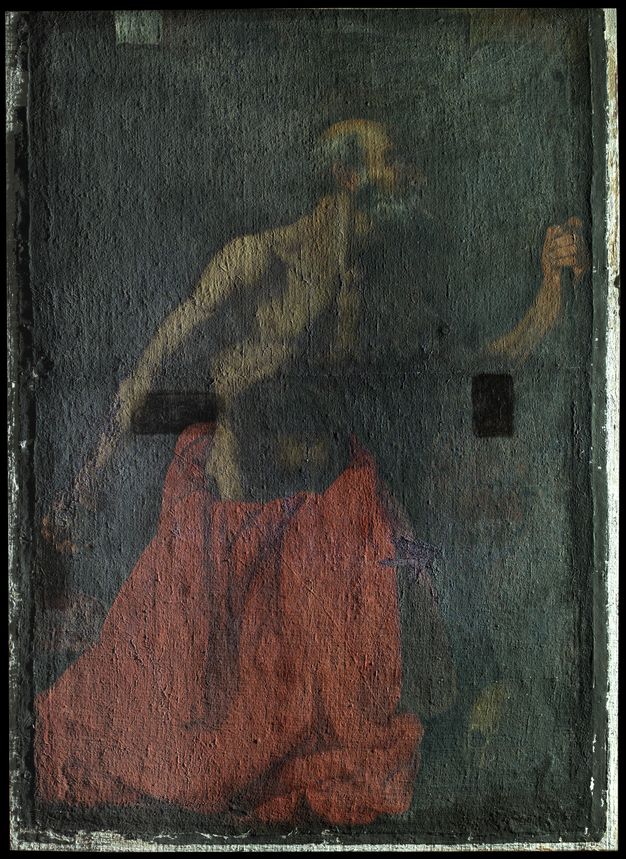
During drying, the shrinking of the canvas led to the failure of adhesion between paint layers and canvas and caused tenting: roof-shape lifting and loss of the paint layer. During the rescue, temporary protection papers (facing) were adhered to the paint layer of thirty-one paintings to limit the loss of paint. As an example, Francisco de Zurbarán’s painting Saint Jerome in the Desert (fig. 35.3) suffered greatly during the flood.4 This artwork, painted on a dark clay preparation, was lined at the end of the nineteenth century or at the beginning of the twentieth. In 1981, the paint layer was reaffixed. During its immersion in water, the materials used for reaffixing and for the lining lost their mechanical properties, and the canvas lining spontaneously peeled off. In this case, the clay nature of the ground layer did affect the level of degradation caused by immersion in water, especially loss of cohesion of the paint layer.
Structural Interventions
According to Cesare Brandi, matter is structure and aspect, and the aim of conservation is to stop the process of degradation of the artwork and to restore its structural unity to improve the perception of image and color (Brandi, Cesare. 2001. Théorie de la restauration. Translated by Colette Déroche. Paris: Centre des Monuments Nationaux, Editions du patrimoine.). Additionally, conservation treatments and products must be compatible with the original materials, stable, and as reversible as possible.
In 1974, the Greenwich Conference on Comparative Lining Techniques highlighted the risks incurred by paint layers when moisture, pressure, and heat are applied, particularly with regard to traditional glue-paste and wax-resin techniques (Roche, A. 2003. Comportement mécanique des peintures sur toile. Dégradation et prevention. Paris: CNRS Editions.). Indeed, these treatments can crush the paint layers, especially the impasto, and can also induce blanching. More recently, new methods of lining with synthetic adhesives have been developed, while traditional methods have evolved to improve the control of the different parameters of the procedure.
The goal of the 2016–2017 interventions was to correct the deformations of the canvas, to reduce the lifting of paint layers, and to restore the cohesion of the multilayer system. Conservation protocols for all the paintings were established by taking into consideration the characteristics of each painting: the physicochemical properties of the original materials, the nature of the alterations, and past conservation treatments. Due to the fragility of the paintings, the conservators intervened very gradually. They alternated operations from the front, such as cleaning, and from the back of the artwork: reduction of deformations, consolidation, and relining, taking care to protect the paint layer with facings when it was necessary.
For all the paintings, the first intervention essentially consisted of locally consolidating the paint layer with sturgeon glue before removing the facings with Bollore paper and hide glue applied during the rescue. Securing the paint layer with new facings made it possible to remove the mud residue, the adhesive, the patches, and the deficient old linings. After the long work of reducing the fabric canvas deformations with controlled humidity and pressure, and stretching the paintings on temporary metallic stretchers or with paper strips on panel as necessary, the localized moisture input and the application of weights made it possible to relax the canvas and bring the edges of the tears closer together before consolidating them by linking them thread to thread.
Moisture was also essential to relax the canvas and to allow the paint layer to regain its place in the areas of roof-shape lifting. The conservators then applied facings, often in several layers, to restore the flatness of the paint layer. The supply of moisture and the level of pressure was controlled by using a variety of papers or gauzes with different properties of stretching upon wetting and of tension and shrinkage upon drying, as well as synthetic or natural adhesives at different concentrations (Delsaut, J., and R. Durand. 1989. “Mesure de la force de rétraction des papiers.” Conservation Restauration des Biens Culturels 1: 64–66.). Facings adhered to the paint layer with glue paste along with moderate heat and moisture were the most successful in flattening the roof-shape lifting back to the surface plane. However, this treatment was not systematic. Throughout the interventions, conservators also used a low-pressure vacuum table, in particular to restore the flatness of the paint layer and to simultaneously consolidate it.
Another type of intervention was carried out to restore the cohesion of the different layers and the adhesion between the paint layers and the support. Most of the paintings were impregnated from the reverse of the canvas with different adhesives: Aquazol, hide glue, sturgeon glue, and acrylic resins: Beva 371, Plexisol P550, and Paraloid B72. A total of forty-one paintings were thus consolidated (table 35.2). Most of the paintings with a red clay–based preparation layer were consolidated with protein adhesives (animal glues) used in colloidal solutions. Because the clay-based preparations have a significant absorption capacity, this consolidation restores the cohesion within the preparation layer and the adhesion between the different layers. In contrast, white preparations form a more cohesive and rigid layer, so the addition of an aqueous adhesive is likely to accentuate the stresses between the preparation layer and the canvas—which, on more recent paintings, is often more reactive to water. For that reason, synthetic adhesives were used on most artworks with a white preparation layer.
| Preparation layer | Adhesive | ||||
|---|---|---|---|---|---|
| Hide glue | Sturgeon glue | Aquazol | Plexisol P550 | Paraloid B72 | |
| Red, brown, green | 10 | 4 | 1 | 4 | |
| White, white-red | 5 | 3 | 1 | 10 | 3 |
| Total paintings | 15 | 7 | 2 | 14 | 3 |
To increase the mechanical properties of the original fabric and to stabilize it, thirty-six of the fifty-one paintings were relined. Of the thirty-one paintings that had been lined in the past, all but three had to be relined following the disaster. As mentioned, those paintings whose lining was kept are small format. One was previously lined with glue paste and the other two with vinyl glue, according to previous treatment documentation.
When the paint layers showed significant roof-shaped lifting, the traditional relining allowed restoration of the cohesion and the stability of the multilayer system due to the controlled provision of humidity and heat. The operation starts first with the protection of the paint surface with one or more layers of paper adhered with glue paste; then a gauze and a new transfer canvas are applied to the back of the original canvas with glue paste. After drying, the paint layer is returned to the surface plane using controlled ironing (heat and pressure).
Mixed treatments consist of applying a gauze with glue paste to the back of the original canvas, sometimes followed by other interlayers such as nonwoven polyester. The canvas is then lined with a synthetic adhesive: Beva 371 or Plextol B500. These treatments make it possible to obtain a good flattening of the paint layer while minimizing the quantity of moisture added during the relining. (The case study presented below explains in detail this new mixed treatment, which interweaves tradition and modernity.) Finally, moisture-sensitive paints and less-damaged nineteenth-century paintings were relined only with synthetic adhesives.
While in the past the majority of paintings were lined with glue paste (twenty-five out of thirty-one), the relining methods were diversified in the 2016–17 restorations. Out of thirty-six relined paintings, only sixteen were treated with traditional lining adhesives (glue paste), six with mixed adhesives, and fourteen with synthetic adhesives. Table 35.3 summarizes the types of structural interventions carried out in 2016–17 and compares them to past interventions.
| 16th century | 17th century | 18th century | 19th century | Total | |||||||
|---|---|---|---|---|---|---|---|---|---|---|---|
| Number of interventions and when | |||||||||||
| Past | 2016–17 | Past | 2016–17 | Past | 2016–17 | Past | 2016–17 | Past | 2016–17 | ||
| Major structural intervention: transfer and lining | |||||||||||
| Transfer | 1 | 1 | 2 | ||||||||
| Lining, glue paste | 3 | 14 | 10 | 4 | 5 | 4 | 1 | 25 | 16 | ||
| Lining, wax resin | 1 | 1 | |||||||||
| Lining, mixed | 5 | 1 | 6 | ||||||||
| Lining, synthetic adhesive | 4 | 2 | 1 | 1 | 1 | 7 | 2 | 14 | |||
| Marouflage on cardboard | 1 | 1 | |||||||||
| Total major structural interventions | 4 | 4 | 15 | 17 | 6 | 6 | 6 | 9 | 31 | 36 | |
| Minor or no structural interventiona | |||||||||||
| Strip-lining | 1 | 1b | 1b | 8b | 1 | 10b | |||||
| Reinforcing patches | 1c | 1b | 2 | 1b | 6c | 5b | 7 | 7 b | |||
| Double canvas loose-lining | 1 b | 1 b | |||||||||
| Past lining kept | 1d | 2d | 3 d | ||||||||
| No structural interventiona | 2 | 1 | 10 | 4 | 12 | 5 | |||||
| Total minor or no structural interventions | 3 | 1 | 2 | 2 | 15 | 12 | 20 | 15 | |||
| Total paintings | 4 | 18 | 8 | 21 | 51 | ||||||
a. For the purpose of this table, paintings consolidated from the back only are included in the “No structural intervention” category.
b. Some paintings simultaneously had strip-lining, reinforcing patches, and double canvas applied.
c. One 17th-century and one 19th-century painting had both lining and patches. These paintings are not included in the totals for “Minor or no structural intervention.”
d. Paintings whose past lining were kept during the 2016–17 campaign and had no new structural intervention are included in the “No structural intervention” category in 2016–17.
Table: Dominique Martos-Levif
Case Study: The Sacrifice of Abraham
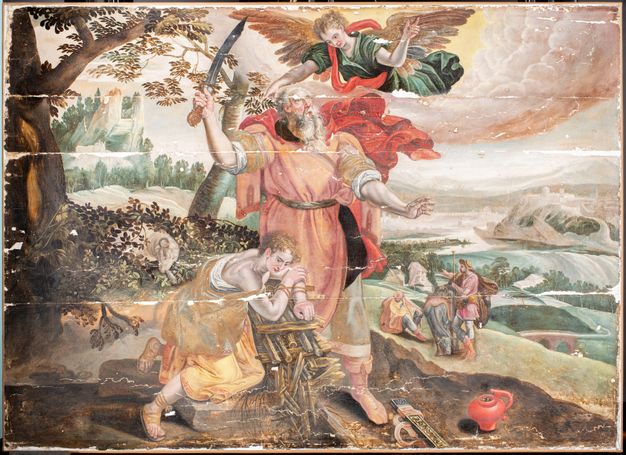
The Sacrifice of Abraham, attributed to a follower of Maertens de Vos (sixteenth century), was originally an oil painting on panel; it entered the collections of the Musée Girodet between 1853 and 1857. The museum’s archives indicate that, due to extensive flaking, it was transferred from panel onto canvas in 1960.
As a reminder, a transfer is the replacement of the original support of a painting by a new support. Transfer is no longer practiced today; our view on the artworks has changed, and we have set ourselves certain limits for ethical and philosophical reasons. But in the eighteenth century and for some time after, transfer was thought to “bring back life” to paintings in poor condition, “saving” them from the ravages of time by giving them “eternal life” (Lépicié, B.-F. 1752. Catalogue raisonné des tableaux du Roy, vol. 1: Ecole florentine, Paris: Imprimerie Nationale. Quoted in G. Emile-Mâle, “Survol sur l’histoire de la restauration des peintures du Louvre,” in Histoire de la restauration en Europe [Postprints of the 1989 International Congress Held by the Swiss Association for Conservation and Restoration in Interlaken], vol. 1. Worms: Wernersche Verlagsgesellschaft, 1991–93.). Indeed, some restorers would be awarded the task of transferring the king’s royal paintings to other supports (Emile-Mâle, G. 1982. “La première transposition au Louvre en 1750: La Charité d’Andrea del Sarto.” Revue du Louvre 32, no. 3: 223–30.). There is a whole corpus of paintings previously transferred, on a part of which it may be necessary to intervene.
In May 2016, The Sacrifice of Abraham remained submerged for seventy-two hours, due to the disaster that occurred in the Musée Girodet storerooms after the flooding of the Loing river in the city of Montargis. The deep immersion of the painting caused a significant alteration of the support of the artwork: very pronounced roof-shape lifting of the paint layer (fig. 35.4), separation of the canvas, and—as we discovered later—powdering of the ground layer. The transfer as a whole was weakened, and thus a complete dismounting was necessary.
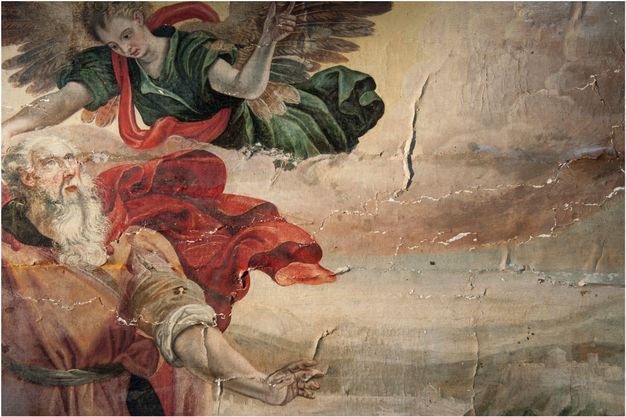
What was visually disturbing was that the painting appeared to still be on the wooden panel: the cracks, mainly horizontal, followed the grain of the former support and the joints between the former boards were visible, so that anyone facing the painting would have thought that it was still on a wooden panel.
The first step was some local consolidations with sturgeon glue, using the temporary protection papers glued during the emergency operations carried out in 2016 at the museum. These papers were delicately removed, as well as the crushed flakes that had been spread upside down all over the painting and which could not be put back in place.
A first layer of fine paper was applied to the paint layer with glue paste; after drying, this facing allowed the stretcher to be removed without risk. Then we used glue paste to add several other protective layers of facing paper and a cotton gauze onto the painting. As a reminder, glue paste is basically a baked glue made of wheat flour and rabbit-skin glue. This strong, reliable protection perfectly matched the damaged surface condition of the paint layer: dismounting a transfer is always a very delicate operation—one that requires a perfect facing, because once the transfer support is removed, the facing is the only way to secure the painting.
The painting was stretched on a working stretcher, and the transfer canvas was gradually dismounted by peeling, using controlled moisture, to loosen all stresses. The removal of the transfer canvas revealed two layers of cotton gauze. As we had suspected, it was indeed a transfer using the traditional “French-style” technique with glue paste.
The only difference from the traditional technique was that the cotton gauze directly in contact with the original ground was glued with PVA, instead of glue paste. The previous conservator must have thought that this would improve the bonding. The moisture used for the dismounting made the PVA layer swell, and it peeled off without much difficulty (fig. 35.5).
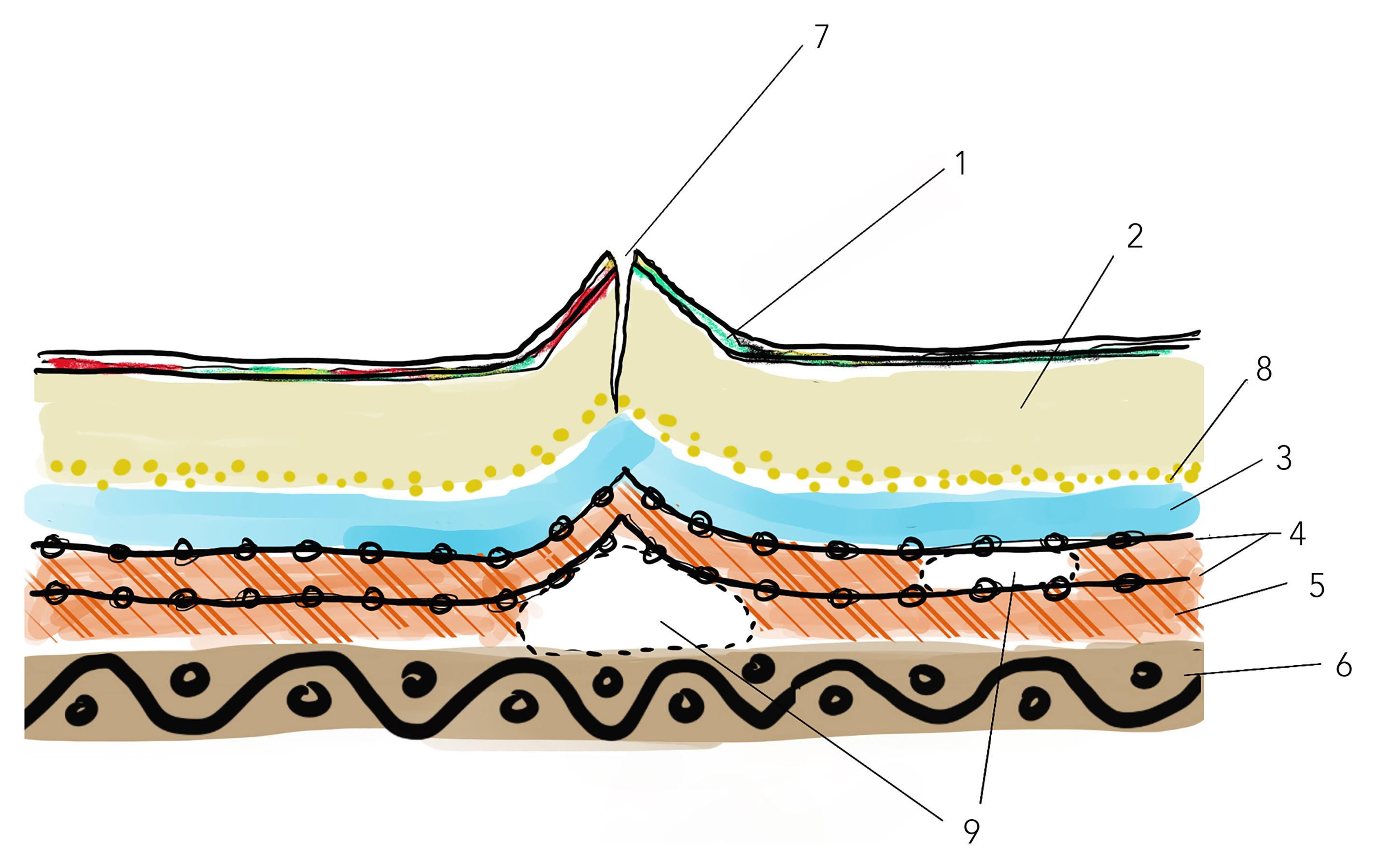
The dismounting revealed the thick, original chalk ground, which still showed signs of the veins of its former wooden support. The original ground layer was almost wholly preserved, a rare occurrence in the case of a transferred painting. However, its surface was very powdery: the slightest contact with the surface left a white residue on the fingers. If this powdering had obviously facilitated dismounting, as it stood, no further treatment was possible without consolidation of the ground layer—a difficult decision to make, since it would slightly change the nature of the original ground.
After a long discussion, we collectively chose to impregnate it with Plexisol P550 to enable the intervention to continue. We used the Plexisol at low concentration (5%), with volatile solvents, in order not to cause too much penetration of the consolidant into the ground, which would have been likely to optically modify the painting.
A thin cotton gauze was then glued with glue paste to the reverse side of the painting. It perfectly matched its imperfections. This new temporary support made it possible to replace the actual facing—which had been used to dismount the transfer—with a new one that was more flexible, made of two layers of paper. By releasing the painting from some of these constraints, we were able to start flattening the distortions. The deformations were reduced by using the intrinsic properties of the paper and the tensile strength of the glue paste, with the help of a low-pressure table. Gradually, through controlled moistening and drying, most of the deformations were reduced.
The facing was removed next to allow us to examine the condition of the surface of the painting. There were still some small roof-shape liftings, which were now noticeable due to the removal of the larger ones. These were reduced using local moistening and careful massage to transform small, narrow deformations into larger, more flexible ones. Then these larger deformations were flattened using a mini low-pressure table, as well as through the local use of paper and glue paste.
Once this surface condition was satisfactory, a new facing was applied with glue paste to the painting, in preparation for the adhesion to a new support. The gauze on the reverse was removed because the operations carried out so far on the deformations could have weakened its adhesion. It was replaced by two new thin cotton gauzes, adhered with glue paste.
There remained the issue of bonding the new transfer canvas itself. In the traditional French technique, the painting is adhered with glue paste to its new canvas, then ironed through the facing; this technique provides very good improvement of the surface condition and good flattening of the lifting paint. Nevertheless, it is a delicate procedure, one that requires a high degree of mastery. As the surface condition was now satisfactory, we considered that such an operation was not necessary.
From that point, we shifted to a synthetic type of bonding. We glued a nonwoven polyester fabric layer onto the cotton gauzes with diluted Plextol B500; this thin, fast-drying layer is meant to isolate the reverse from the greater amount of moisture used during the lining.
On another working strainer, we stretched a linen-polyester lining canvas, which combines the strength and tension of linen with inertia and the relative stability of polyester to moisture variations. It was adhered to the reverse of the painting using a mixture of equal parts Plextol B500 and Tylose MH-300 (methyl cellulose) at 6% (see fig. 35.6). After the lining, the protective facing layers were removed, and the painting was stretched on a new stretcher.
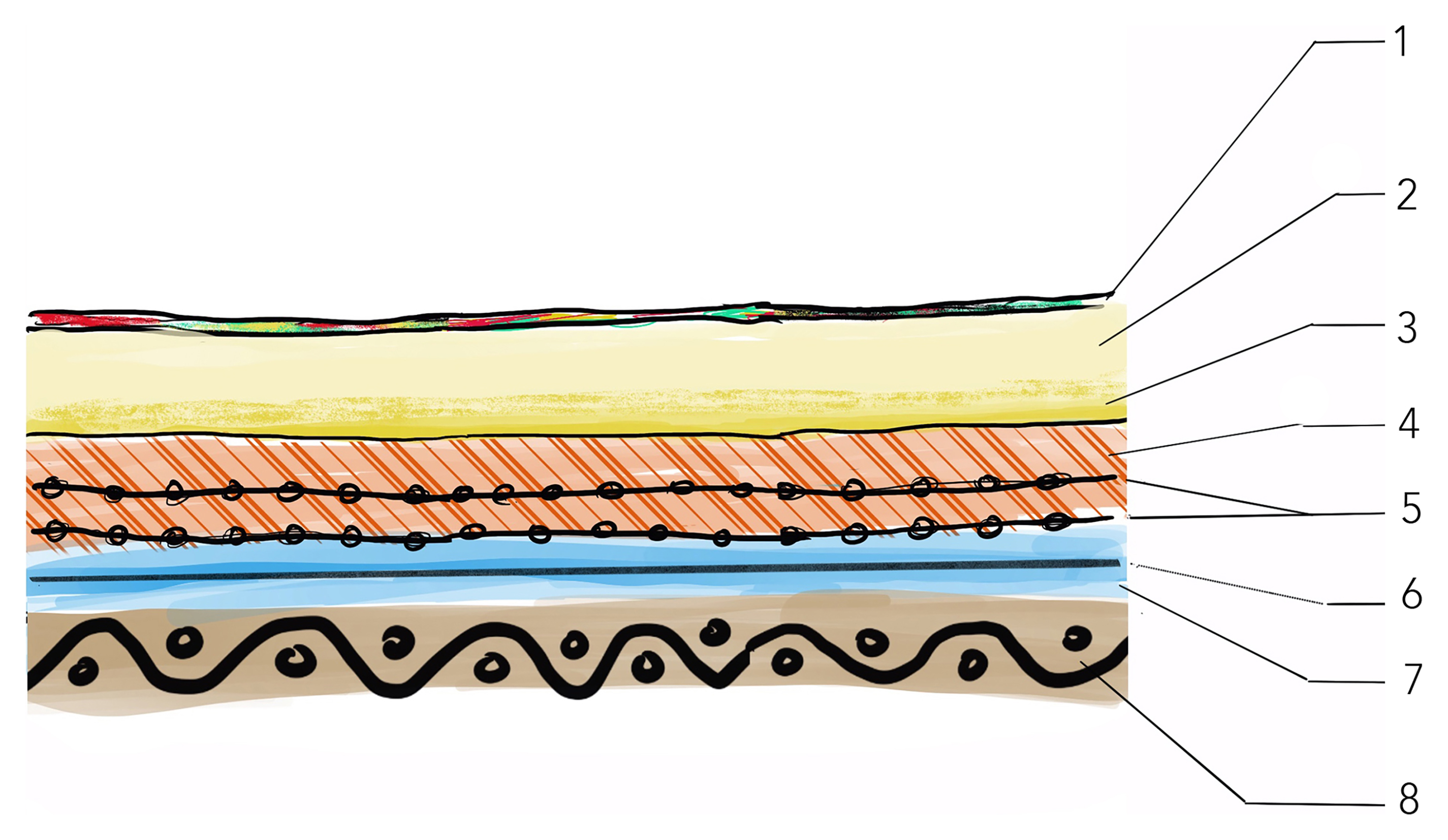
This restoration proved to be complex. We constantly had to balance the advantages and disadvantages of the several techniques available to us, and there was never a straightforward answer. The traditional French technique, using glue paste, did not ensure the consolidation of the ground layer nor a long-lasting bond, due to the ground’s powdery surface. The traditional lining process would have involved sustained moistening of the stratigraphy, and this would have inevitably led to a reappearance of deformations, which ironing could not have effectively reduced, as the chalk priming reacts primarily to humidity and not to heat. The traditional technique would therefore have been a risk with no apparent benefit.
On the other hand, while synthetic materials offered the benefit of good consolidation and adhesion, they did not have the rigidity of glue paste, and they did not intrinsically contribute to the surface flattening. Moreover, they would have provided elasticity to a painting that did not have any elasticity and caused the appearance of new cracking on this painting, which is stiff by nature.
The painting is now consolidated and lined; the deformations and roof-shape lifting have been reduced and no longer impede its legibility. The structure keeps a certain stiffness, which respects the thick chalk ground layer (fig. 35.7). Moreover, the synthetic materials on the outer part of the painting somehow form a moisture barrier. It is therefore the deliberate combination of traditional and synthetic methods that made this balanced result possible.
Conclusion
For almost three years, the collection managers of the Musée Girodet in Montargis and the painting department of the C2RMF monitored the conservation work carried out on the paintings damaged by the 2016 flood. The treatment choices were made collectively by the museum collection managers, the C2RMF staff, and the conservators during weekly visits organized in the studios, taking into consideration technical, scientific, and aesthetic issues.
The work carried out by the six teams of conservators enabled the fifty-one paintings hosted at the C2RMF to regain their physical integrity and their visual appearance so that they may be returned to the exhibition galleries of the Musée Girodet. The paintings conservators specializing in the canvas support worked in collaboration with the paintings conservators specializing in the paint layers, who were responsible for carrying out all cleaning and reintegration operations of the paint layers. It was important to work with several teams of conservators, each of which had distinct skills and practices. They were able to assess different and complex problems together.
During this campaign, knowledge of the painting techniques, material history, behavior and treatment of the immersed works has greatly improved. Out of a corpus of fifty-one paintings submerged for seventy-two hours, thirty-one of which had already undergone major structural interventions in the past, thirty-six were relined using traditional, synthetic, or mixed methods. The interventions carried out show that traditional and modern methods of relining are not opposed but complement each other.
It is also crucial that the knowledge of both traditional and modern methods be passed on so that the full range of treatments remain available to conservators in the future. The guiding principle was to find the best treatment for each painting in this very particular context, while considering the number of paintings that needed to treated at the same time.
Notes
-
The town of Montargis is 100 kilometers south of Paris. In France, Montargis is known as the birthplace of the painter Anne-Louis Girodet-Trioson (1767–1824). ↩︎
-
C2RMF is a French public institution whose mission is to implement, in conjunction with the curators in charge of collections, the policies of the Ministry of Culture in the areas of research, preventive conservation, and conservation of artworks from public French museums. ↩︎
-
Statistics from artwork files compiled by S. Lemeux-Fraitot from conservation reports in the C2RMF and Musée Girodet archives. ↩︎
-
This painting was conserved by L. Roudet and E. Joyerot for the structural interventions, and S. Deyrolle, B. Bedel de Buzareingues, and D. Dollé for the paint layers. ↩︎