Chicago
Orata, Luigi. “47. A System to Keep Paintings on Canvas at a
Constant Tension during Conservation Treatment.” In
Conserving Canvas, by
Cynthia Schwarz, Ian McClure, and Jim Coddington. Los Angeles:
Getty Conservation Institute, 2023.
https://www.getty.edu/publications/conserving-canvas/viii-posters/47/.
MLA
Orata, Luigi. “47. A System to Keep Paintings on Canvas at a
Constant Tension during Conservation Treatment.”
Conserving Canvas, by
Cynthia Schwarz et al., Getty Conservation Institute, 2023,
https://www.getty.edu/publications/conserving-canvas/viii-posters/47/.
Accessed DD Mon. YYYY.
47.
A System to Keep Paintings on Canvas at a Constant Tension
during Conservation Treatment
47. A System to Keep Paintings at Constant Tension
Luigi Orata,
Painting Restorer, private practice, Florence, and
Professor of Structural Conservation Treatment,
Academies of Fine Arts, Bologna; Brera, Milan; and
Naples
This paper focuses on the issue of tension variation on
canvas paintings during conservation treatment. The solution
proposed has been developed through the observation of
several cases encountered during many years of professional
activity. It aims at keeping the painting in a constant
tension during structural conservation phases, thus
minimizing potential damage to the canvas.
When a painting on canvas is removed from its stretcher, it
usually undergoes a tension variation. In most cases, it will
be restretched, using added tacking edges, on a temporary
stretcher for structural treatment (e.g., consolidation of the
paint and ground layers or for lining). During this operation,
the painting is put under tension and stretched. When the work
is finished, the canvas is detached again (another
contraction) to be definitively stretched on the final
stretcher (another stretching). These repeated movements cause
mechanical stresses in the painting that affect its different
layers, that is, the canvas as well as ground and paint
layers, and these can result in real structural microtraumas.
The problem has previously been highlighted, for instance, by
V. R. Mehra and Sergio Taiti.1
Both restorers, despite coming from different restoration
traditions and schools of thought, dedicated particular
attention to the study of a method for maintaining constant
tension during the treatment of a painting, specifically so as
to avoid problems created by relaxation and contraction of the
canvas. Mehra set up a well-known system with three stretchers
in which, after the painting is removed from its stretcher, it
is immediately tensioned on an interim stretcher by means of a
nonwoven fabric. After the consolidation phase (or after
lining, in the final phase), the system obtained is dismantled
and the painting is remounted on the definitive stretcher. A
possible solution, shared during his lessons, consisted of
remounting the painting from the interim stretcher to a
larger, definitive stretcher. The latter is positioned on the
back, and the canvas is secured directly from the front, along
the original edges, with metal staples. Naturally, Mehra was
aware that this practice was not always feasible, especially
in the presence of an original stretcher or dimensional
restrictions (e.g., due to a frame or reinstallation in an
architectural niche).
In parallel, Taiti, well aware of the stresses and movements
occurring in a painting undergoing consolidation with animal
glue in an aqueous solution (following the traditional
techniques of Florentine glue-paste lining), figured out how
to mount the painting on a larger interim stretcher. He
employed strips of kraft paper, later replaced by polyester
canvas as the use of different materials evolved, and thus
maintained tension until the eventual lining. He was also
developing ideas on the final step, although, unfortunately,
these were never brought to fruition due to his premature
death.
The sensitivity of approach demonstrated by these two
important figures for numerous aspects of restoration was
greatly influential as it spurred the desire to continue
delving into what is a delicate and often undervalued subject.
A Versatile System
My experience in the field of structural conservation of
canvas paintings has allowed me to test and use a system2
to mitigate the problem of variation in tension of canvases
undergoing restoration, with significant results. This
innovation aims to maintain the painting under a constant
tension during all of the phases of treatment and to transfer
the degree of tension that is initially established for the
temporary stretcher to the definitive one, thereby avoiding
the potentially damaging “accordion” effect.
The system is extremely versatile in that it is applicable to
paintings undergoing either only consolidation or a full
lining, and hinges on the use of specially designed perimeter
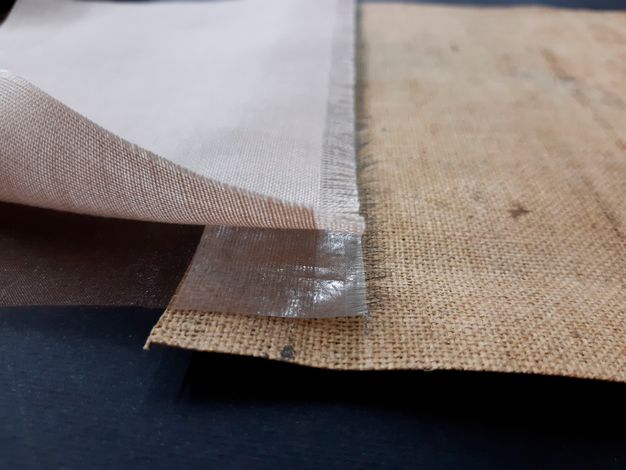
strips. Each strip is composed of two polyester canvas layers:
the first, a lightweight polyester that comes in contact with
the original painting (Origam 254, 18 g/m2), and
the second, a heavier polyester (Trevira C.S. Ispra, 130
g/m2). Each is frayed3
for about 10 mm along the longer edge. The individual strips,
thus prepared, are then paired in a staggered manner,
longitudinally, with Beva 371 film between them. They are then
inserted in a vacuum envelope, and the adhesive is reactivated
by heating it to 80°C, a measure aimed at ensuring a
particularly solid bond4
(fig. 47.1).
ExpandFigure 47.1Detail of the double-strip lining used in the tension
variation system for canvas paintings. From the bottom:
original canvas, frayed Origam, Beva 371 film, and frayed
Trevira, positioned in a staggered manner.Image: Luigi Orata
Once the painting is detached from the original stretcher, and
after the back has been cleaned, it is possible to apply these
double strips to the back of the original canvas (inside the
fold-over marks from the original stretcher at a distance
suited to the specific painting) with pressure (best if
generated with vacuum suction for a better and more even bond)
and heat, but only up to the minimal temperature for Beva
reactivation (65°C), to provide for better reversibility. This
means the double strip adheres to the original canvas less
aggressively, while the bond between the two strips is
stronger.
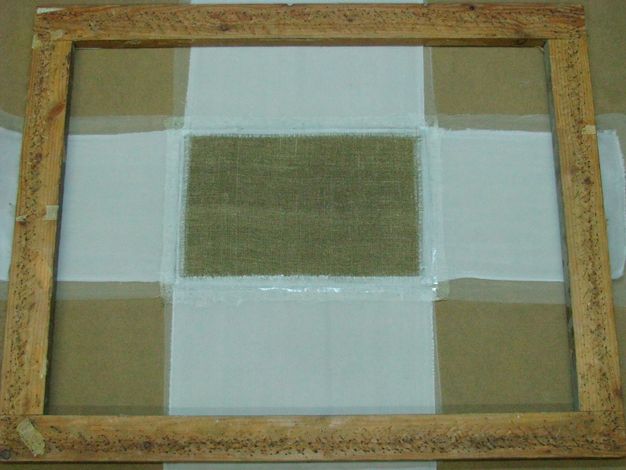
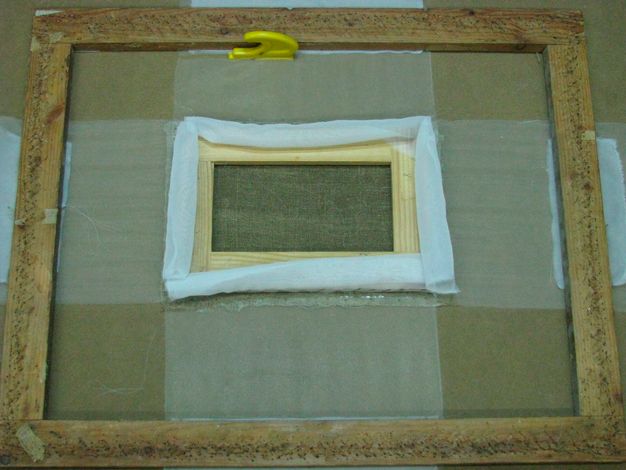
Afterward, the original canvas is stretched on the temporary
stretcher using the plane of the table to provide support for
the canvas as the double-layer perimeter strips are secured to
the temporary stretcher (fig. 47.2).
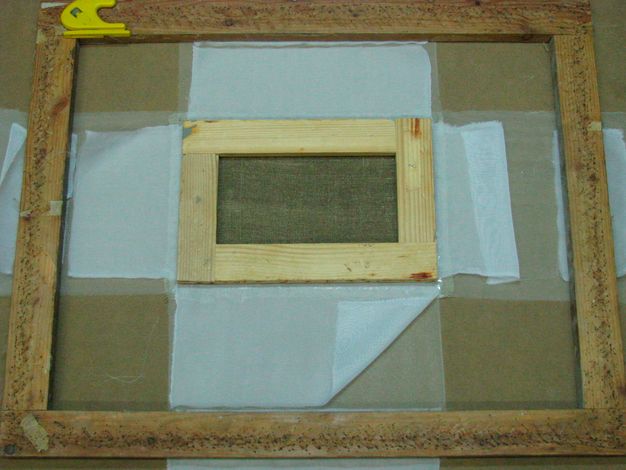
Following structural conservation treatment, the temporary
stretcher and canvas are again laid facedown on a flat
surface. The definitive stretcher is then positioned on the
back, within the width of the temporary stretcher, aligned
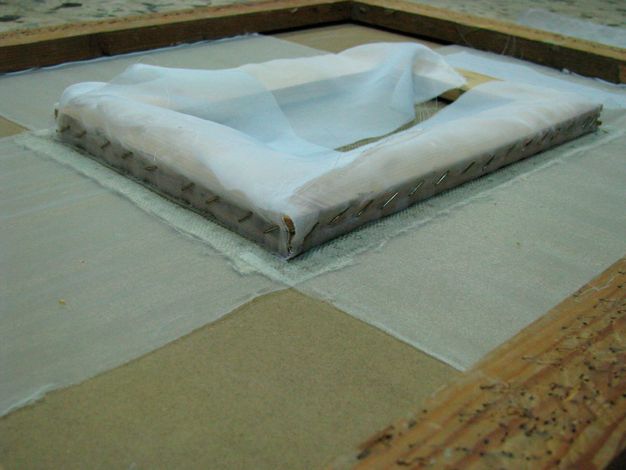
with the fold-over marks on the original canvas. The first of
the two layers of the added tacking margin (the heavier,
outside one) is cut free from the temporary stretcher and
fixed to the definitive one with steel staples, thus
preventing the canvas from contracting (figs. 47.3, 47.4). Only after having secured
the entire perimeter is the second layer of the strip cut free
from the working stretcher and fixed to the definitive one (fig. 47.5).
ExpandFigure 47.2The double-strip lining is stretched and secured on the
temporary stretcher.Image: Luigi OrataExpandFigure 47.3After structural conservation, the definitive stretcher
is placed down. The first layer of the double-strip lining
is cut free from the temporary lining and secured to the
definitive stretcher while the second layer is still under
tension.Image: Luigi OrataExpandFigure 47.4Detail showing attachment of the first layer to the
definitive stretcher.Image: Luigi OrataExpandFigure 47.5When the first layer of the double-strip lining is
completely secured, the second layer is cut free and
attached to the definitive stretcher.Image: Luigi Orata
This sequence avoids variations in tension as, during the
shift to the final stretcher, a bond is always maintained with
the temporary stretcher. The initial tension is constant and
can be transferred to the definitive stretcher.
For further study, the system could be tested on different
models while carrying out measurements in order to give some
scientific weight to the method described. This would provide
numerical values and objective data to support the use of this
simple technical innovation.
Notes
Sergio Taiti was head restorer of the structural
conservation of canvas paintings at the Opificio delle
Pietre Dure (OPD) from the 1940s to 1987, the year of
his death.
↩︎
The first use of this system was in 2002 on the painting
that was the subject of my diploma thesis: Bartolomeo
Bimbi, Le zucche dei monaci di Monteoliveto,
1714, oil on canvas, 202 × 144 cm.
↩︎
The aim of the fraying is to lessen the abruptness of
the differential created by the thermal-hygrometric
exchange between the front and back of the original
canvas.
↩︎
Alternatively, different adhesives, canvases, or
adhesion methods can be used, taking into consideration
the adhesive strength that is optimal with respect to
the characteristics of the painting.
↩︎
Figure 47.1Detail of the double-strip lining used in the tension
variation system for canvas paintings. From the bottom:
original canvas, frayed Origam, Beva 371 film, and frayed
Trevira, positioned in a staggered manner. Image: Luigi
Orata
Figure 47.2The double-strip lining is stretched and secured on the
temporary stretcher. Image: Luigi Orata
Figure 47.3After structural conservation, the definitive stretcher is
placed down. The first layer of the double-strip lining is cut
free from the temporary lining and secured to the definitive
stretcher while the second layer is still under tension.
Image: Luigi Orata
Figure 47.4Detail showing attachment of the first layer to the
definitive stretcher. Image: Luigi Orata
Figure 47.5When the first layer of the double-strip lining is completely
secured, the second layer is cut free and attached to the
definitive stretcher. Image: Luigi Orata