This paper discusses the ways that different fabrics, weaving, and structures of a canvas influence its mechanical and hydromechanical behavior. It goes on to consider how this already complex composite is further modified by subsequent layers, whether in a new or degraded state. In particular, it highlights the conditions in which the weave structure—and behavior related to that structure—still influences the overall response of a painting on canvas. The paper also reviews research relevant to conserving canvas in the fields of polymer mechanics, fiber-reinforced composites, and smart materials, looking at research related to both the modeling of canvas and composite properties and at experimental studies. Often, there appears to be a big gap between research carried out in science, engineering, and conservation science and the research that conservators feel will help them solve practical problems and devise effective treatments. This paper suggests directions for future research—pure and applied—that may aid in the structural conservation of paintings on canvas.
15. Canvas Complexity: The Life of a Complex Composite
- Christina Young, Professor, Glasgow University, Kelvin Centre for Conservation and Cultural Heritage Research
Introduction
The woven structure of canvas, although modified by the subsequent layers of the painting, still influences the mechanical and hydromechanical behavior of this complex composite. To highlight the issues of complexity, this paper brings together and reevaluates collaborative research conducted over twenty-five years that addresses these issues in the context of the structural conservation of canvas paintings. It discusses the methodologies of research related to experimental work, practical conservation implementation, and the modeling of canvas and its composite properties. The key findings, with examples, and the methods used to obtain useful data and practical insights are given, along with the references for the experimental details and results.1
Recent research in the fields of polymer mechanics, fiber-reinforced composites, and smart materials that are relevant to conserving canvases of the past (and future) is highlighted, as are directions for future research—pure and applied—that will aid in the structural conservation of paintings on canvas.
Physical Structure
Types of Canvas
In the context of artists canvas and lining fabric, most fabrics are made from natural materials. For painted cloth, silk, calico, cotton, and linen have been the most common fabrics both geographically and historically. However, other natural materials—for instance, bark cloth (Lennard, Frances, Misa Tamura, and Mark Nesbitt. 2017. “Re-evaluating Student Treatments of Barkcloth Artefacts from the Economic Botany Collection, Royal Botanic Gardens, Kew.” In ICOM Committee for Conservation 18th Triennial Meeting, Copenhagen, Denmark, 4–8 September 2017, edited by Janet Bridgland. Paris: ICOM. http://eprints.gla.ac.uk/140888/.)—are part of rich traditions of painting, and we are only beginning to understand their behavior as painting supports (Smith, Margaret J., A. Sheila Holmes-Smith, and Frances Lennard. 2019. “Development of Non-destructive Methodology Using ATR-FTIR with PCA to Differentiate between Historical Pacific Barkcloth.” Journal of Cultural Heritage 39: 32–41. http://eprints.gla.ac.uk/182259/.).
The choice of canvas by artists is often made for pragmatic reasons, including local production, availability, expense, and size. Important features of these natural materials are their flexibility, texture, and absorbency (see “Moisture Response” below), which make them suitable for the application of paint. For fabric supports, some of these features are a product of the preparation, but most originate from the fiber type, yarn structure, and weave structure (flexibility and texture). It is reasonable to suggest that in all but the most prestigious commissions the artist had little control, or even interest, in these factors, but instead innately, or through treatises and word of mouth, thought of a canvas as either suitable or not suitable for the execution of a particular painting.
The discussion below focuses on cotton and linen but acknowledges the use of silk, both in traditional non-Western and Western art and in contemporary contexts. In a few cases, it has been possible to trace the evidence of artists choice through letters, colormen archives, and anecdotes (Johnson, D., E. Hendriks, M. Geldof, and C. R. Johnson Jr. 2010. “Do Weave Matches Imply Canvas Roll Matches?” In Conservation Continuum—Examining the Past, Envisioning the Future: American Institute for Conservation of Historic and Artistic Works, 38th Annual Meeting, May 11–14, 2010, Milwaukee, WI. Washington, DC: AIC.), but rarely has the production of the canvas been under their control. Historically, cloth was a commodity for household furnishings, military and naval outfitting, and ecclesiastic and court events. It is with the advent of industrial weaving that different weights of cloth became more accessible through artists suppliers, and the small-batch production of artists canvas started to occur. However, there is mounting evidence through technical examination and conservation records that, prior to industrialization, artists had access to different types and weaves, and in some cases clearly chose some over others (Heydenreich, Gunnar, David Carson, Cecily Grzywacz, Herant Khanjian, Joy Mazure, and Michael Schilling. 2008. “Painting on White Canvas: Sixteenth Century Bleaching Practices and Analysis of Morphological and Chemical Changes in Flax Fibres.” In ICOM-CC 15th Triennial Conference, New Delhi, 22–26 September 2008: Preprints, 609–18. New Delhi: Allied Publishers.; Seccaroni, C. 2012. “A New Survey of Caravaggio’s Canvases and Preparatory Layers: Materials and Aesthetic Effects.” In Caravaggio’s Painting Technique: Proceedings of the Charisma Workshop, edited by Marco Ciatti and Brunetto Giovanni Brunetti, 56–67. Florence: Nardini Editore.). Sources, including the National Portrait Gallery’s list of British artists suppliers (1650–1950),2 individual websites, and publications that include research into the trade in artists materials (Kirby, J., S. Nash, and J. Cannon, eds. 2010. Trade in Painters’ Materials and Commerce in Europe to 1700. London: Archetype.), provide invaluable information from which to build up a better understanding of the context in which artists choose their materials.
Contemporary artists make both conscious and pragmatic choices to use best-quality artists canvas (usually fine plain-weave linen or cheaper cotton duck, which is also available in wider widths), sacking (jute, usually plain weave), bank money bags (cotton and linen, plain or twill weave), and mattress ticking (an old favorite, usually linen with a herringbone twill weave), as well as older, traditional materials used in a contemporary context, such as bark cloth (Schneider, A., ed. 2021. Michael Armitage, Paradise Edict. Exhibition catalogue, Haus der Kunst. Cologne: Verlag der Buchhandlung Walther und Franz König; Munich: Haus der Kunst.).
Artists use canvas in a variety of ways: unstretched, sewn, pierced, or formed into three dimensions. Canvas is also woven from polyester specifically for art and conservation. This is manufactured/supplied by companies such as Fredrix in the United States, Haywards in the United Kingdom, and Lascaux in Germany.3 In the performing arts, there is more painting on plastic gauzes and projection cloths made from woven and nonwoven synthetics, including polyester, nylon, and Kevlar. The range of fabrics used and available is best appreciated by visiting the website of J. D. McDougall, a company that has supplied fabrics for over a hundred years.4
Types of Weave
A woven fabric made from a single type of fiber (e.g., flax) is a composite influenced by the way it is grown or synthesized and then processed into yarn ready for weaving. The various levels of hierarchy in the structure influence, to differing degrees, the overall fabric behavior. The yarn type, diameter, flatness, and stiffness affect flexibility and moisture response. The density of fiber yarns and type of weave influence yarn mobility, stiffness, drape, fracture toughness, and permeability (Young, Christina, and Suzanne Jardine. 2012. “Fabrics for the Twenty-First Century: As Artist Canvas and for the Structural Reinforcement of Easel Paintings on Canvas.” Studies in Conservation 57, no. 4: 237–53.). The fabric permeability affects moisture response, consolidation, impregnation, and lining treatments (Young, Christina, and Paul Ackroyd. 2001. “The Mechanical Behavior and Environmental Response of Paintings to Three Types of Lining Treatment.” National Gallery Technical Bulletin 22: 85–104.).
Additionally, surface or impregnating coatings (e.g., size, paint, and consolidants) affect tensile, shear, bending properties, yarn mobility, and fracture toughness. For traditional Western paintings, we have a good experimental and empirical understanding of the complex composite of woven fabric and coatings. Research into the behavior of double-sided painted cloth such as trade union banners (fig. 15.1) (Smith, Margaret J., K. Thompson, and E. Hermens. 2016. “Breaking Down Banners: Analytical Approaches to Determining the Materials of Painted Banners.” Heritage Science 4: 23. http://eprints.gla.ac.uk/116762/.; Sanchez, Villavicencio, D., C. Young, and K. Thompson. “How to Paint a Trade Union Banner: The Role of Sources and Reconstructions in the Characterisation of George Kenning’s Banners in Glasgow Museums.” In Eighth Symposium of the ICOM-CC Working Group on Art Technological Source Research, Cologne, Germany, 26–27 September 2019, 115–22. Glasgow: Enlighten Publications.) or the behavior of twill and more complex weaves, however, is in its infancy (see “Reconstructing Weaves” below). Certainly, more research is required to determine the dominant contributing factors in the mechanical and hydromechanical behavior of canvas when new materials and techniques are used in contemporary art or used in mixed media and with new synthetic artists materials such as water-mixable oil paint, inks, or acrylic-primed spun polyester canvas (see “Reconstructions for the Contemporary Use of Canvas” below).
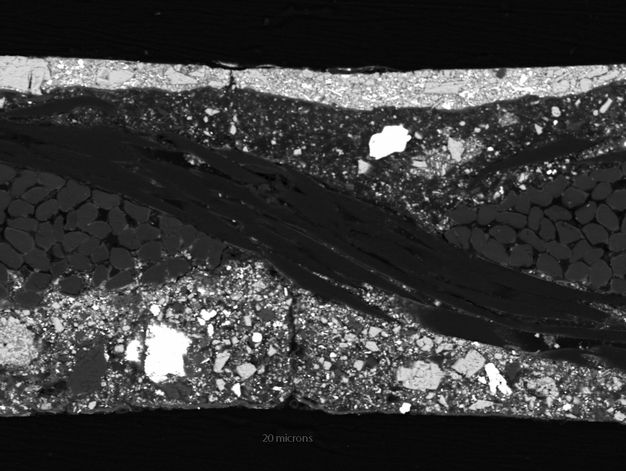
Prediction of painted canvas properties from experimental mechanical and chemical data is the first step. Testing on single-constituent yarns, free films, single layers, and/or simple multilayers provides invaluable information that relates to both the present and past and to changes in properties caused by natural aging and conservation treatments. However, these are relatively simple interactions and therefore only partially representative. Conservation treatments themselves are a valuable source of “live” empirical data of the real complex interactions, but they are not easily reproducible. Nevertheless, many years of experience add up to a powerful knowledge base of possible outcomes.
Analytical or computational studies for fabric/canvas behavior have developed models that can account for one level of hierarchy—fiber level, yarn level, weave pattern level—or with continuous, homogeneous layers with simplified superposition of layers. Ideally, however, to model fabric permeability, for example, it is necessary to consider both microporosity (fiber spacing) and macroporosity (yarn spacing) (Zeng, Xuesen, Louise P. Brown, Andreas Endruweit, Mikhail Matveev, and Andrew C. Long. 2014. “Geometrical Modelling of 3D Woven Reinforcements for Polymer Composites: Prediction of Fabric Permeability and Composite Mechanical Properties.” Composites Part A: Applied Science and Manufacturing 56: 150–60.). Models based on geomechanical structures (soil and rock) have been suggested as a useful approach to studying consolidation (Michalski, Stefan. 2008. “A Physical Model of the Consolidation Process, Particularly of Paintings (with Errata).” In The Care of Painted Surfaces: Materials and Methods for Consolidation, and Scientific Methods to Evaluate Their Effectiveness: Proceedings of the CESMAR7 Conference, Milan, November 10–11, 2006, 23–47. Saonara, Italy: Il Prato.). Certainly, many of the phenomena—such as crack networks, diffusion, and complex interacting layers—are common to both fields. Therefore, applying such models would be beneficial to canvas conservation studies.
Similarly, to predict biaxial behavior of woven fabric, the model of the weave needs to consider friction at the yarn crossover. These more complex multilevel models are yet to be fully developed (Aliabadi, M. H. 2015. Woven Composites. London: Imperial College Press.). Past attempts to model the complex structure of canvas paintings and fabrics have used a finite element analysis (FEA) approach (Guanzhi, L., Z. Qiang, W. Jun, and R. Gong. 2017. “Modelling of Transverse Compression Behaviour of Yarns.” Textile Research Journal: 184–90. https://www.research.manchester.ac.uk/portal/files/47250913/Modeling_of_transverse_compression_behavior.pdf.; Mecklenburg, Marion, Mark McCormick-Goodhart, and Charles S. Tumosa. 1994. “Investigation into the Deterioration of Paintings and Photographs Using Computerized Modeling of Stress Development.” Journal of the American Institute for Conservation 33, no. 2: 153–70.). By using analytical models developed for tensioned fabric structures, the problems normally encountered with accurately modeling complex curved surfaces are mitigated. Bicubic-spline models developed originally for architectural applications (Brew, J. S., and W. J. Lewis. 2007. “Tension Membranes Modelled by Curvi-linear Bicubic Splines.” International Journal for Numerical Methods in Engineering 72, no. 1: 1–21.) are the most representative way to model a woven stretched canvas on a stretcher (Young, Christina. 2013. “The Use of 3D ESPI for the Structural Analysis of Paintings on Canvas.” In LACONA IX: Lasers in the Conservation of Artworks, edited by David Saunders, Matija Strlič, Capucine Korenberg, Naomi Luxford, and Karen Birkhölzer, 108–15. London: Archetype.; see “Strain Distribution” below). However, the interaction of the uppermost layers can be successfully modeled with FEA, taking into account their viscoelastic properties (Tantideeravit, D., M. N. Charalambidesa, D. S. Balinta, and C. R. T. Young. 2013. “Prediction of Delamination in Multilayer Artist Paints under Low Amplitude Fatigue Loading.” Engineering Fracture Mechanics 112–13: 41–57. https://doi.org/10.1016/j.engfracmech.2013.09.011.).
Dealing with Complexity
In what ways is it possible to complement the existing research? One approach is epidemiological studies of collections and promotion of documentation protocols that include canvas weave pattern and count, fiber type, and duty/colorman stamps. This information not only helps in the identification of the date and source of the canvas but also is invaluable for understanding the artist’s intent and the provenance of artists materials (Johnson, D., E. Hendriks, M. Geldof, and C. R. Johnson Jr. 2010. “Do Weave Matches Imply Canvas Roll Matches?” In Conservation Continuum—Examining the Past, Envisioning the Future: American Institute for Conservation of Historic and Artistic Works, 38th Annual Meeting, May 11–14, 2010, Milwaukee, WI. Washington, DC: AIC.; Murillo-Fuentes, J. J., and L. Alba. 2018. “Thread Counting in X-Rays of Plain-Weave Painting Canvas.” In Advanced Characterization Techniques: Diagnostic Tools and Evaluation Methods in Heritage Science, edited by David M. Bastidas and Emilio Cano, chapter 7. Cham, Germany: Springer.). It is also important for conservation, as the weave structure still influences the overall response of a painting, whatever its age. Combined with consistent materials characterization, such information may allow further insights to be gained into the mechanical and hydromechanical behavior of real paintings.
While it is not always possible to be historically accurate at every level of the canvas structure, weave, painting, and lining reconstructions allow for repeatability and for endless combinations to be experimentally tested and trends in behavior to be established (Daly Hartin, Debra, Eric Hagan, Stefan Michalski, and Mylène Choquette. 2011. “CCI Lining Project: Testing of Lined Model Paintings from Fractions of a Second to Decades.” In ICOM-CC Lisbon 2011: Preprints, 16th Triennial Conference, Lisbon, 19–23 September 2011, edited by Janet Bridgland and Catherine Antomarchi, paper 1309, 288–96. Almada, Portugal: Critério Produção Grafica; Paris: ICOM Committee for Conservation.; also see “Moisture Response of Linings” and “Reconstructing Weaves” below). Lined paintings, as well as modern and contemporary use of “canvas”—wherein if a material exists, an artist will use it, and unconventionally—require an understanding of geometry, construction, and potentially the properties of many different materials. Reconstructions play a crucial role in understanding these elements.
Strain Distribution
Several factors make the strain distribution within canvas complex: it is a woven rather than a continuous, homogeneous layer; the strain response of the yarns is usually different in the weft and warp; and factors including friction, density, and weave pattern influence the strain distribution. Additionally, on a strainer or stretcher, the attachments and the stretcher construction (corners) induce uneven loading. While the stress distribution that this loading creates cannot be directly measured, the strain distribution can be measured by techniques including electronic speckle pattern interferometry (ESPI), digital image correlation (DIC), and photogrammetry. ESPI can be used to obtain accurate quantitative measurements of strain distributions of primed canvas on a stretcher that replicate a real painting configuration. Biaxial tensile properties of a painting and its constituents can be obtained by mechanical testing. By combining biaxial tensile testing with two-dimensional strain mapping, however, it is possible to gain an understanding of the composite behavior of a stretched canvas and the forces to which it is subjected.
The biaxial restraint of the canvas alters the strain distribution around the tacks or staples, becoming progressively more complex toward the corners. At the macro level, the strain patterns induced by the attachments are similar, with closer spacing resulting in more even strain distribution. If the attachments pass through preprimed canvas, there is reduced local cusping because of the greater resistance of uncracked primed canvas to distortion in the bias direction of the canvas. The restraint imposed by tight corner folds reduces the high load that would be imposed on the attachments near the corners if a loosely folded corner was keyed out. Nevertheless, shrinkage of the canvas or keying out will lead to significant strain concentrations in these areas. The strain irregularities become significantly less if the canvas is attached on the rear face of the stretcher rather than the side. Staples are effective attachments until the canvas between the legs begins to slip; tears may then occur because the staple leg creates very high strain concentrations. Tacks appear to be as effective in restraining the canvas and less likely to cause tears (Young, Christina R. T., and Roger D. Hibberd. 2000. “The Role of Attachments in the Degradation and Strain Distribution of Canvas Paintings.” In Tradition and Innovation: Advances in Conservation, edited by Ashok Roy and Perry Smith, 212–20. London: International Institute for Conservation of Historic and Artistic Works.).
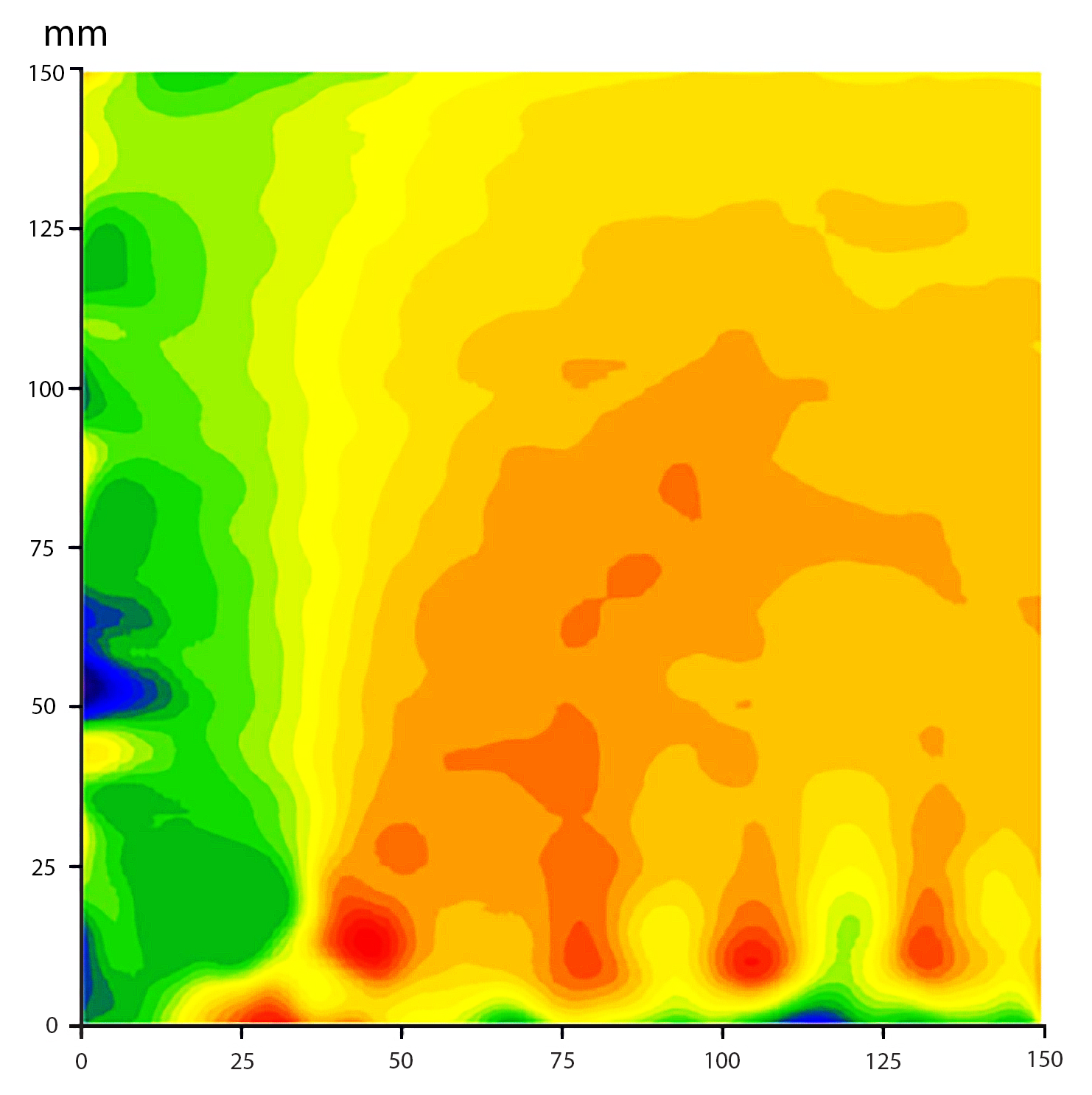
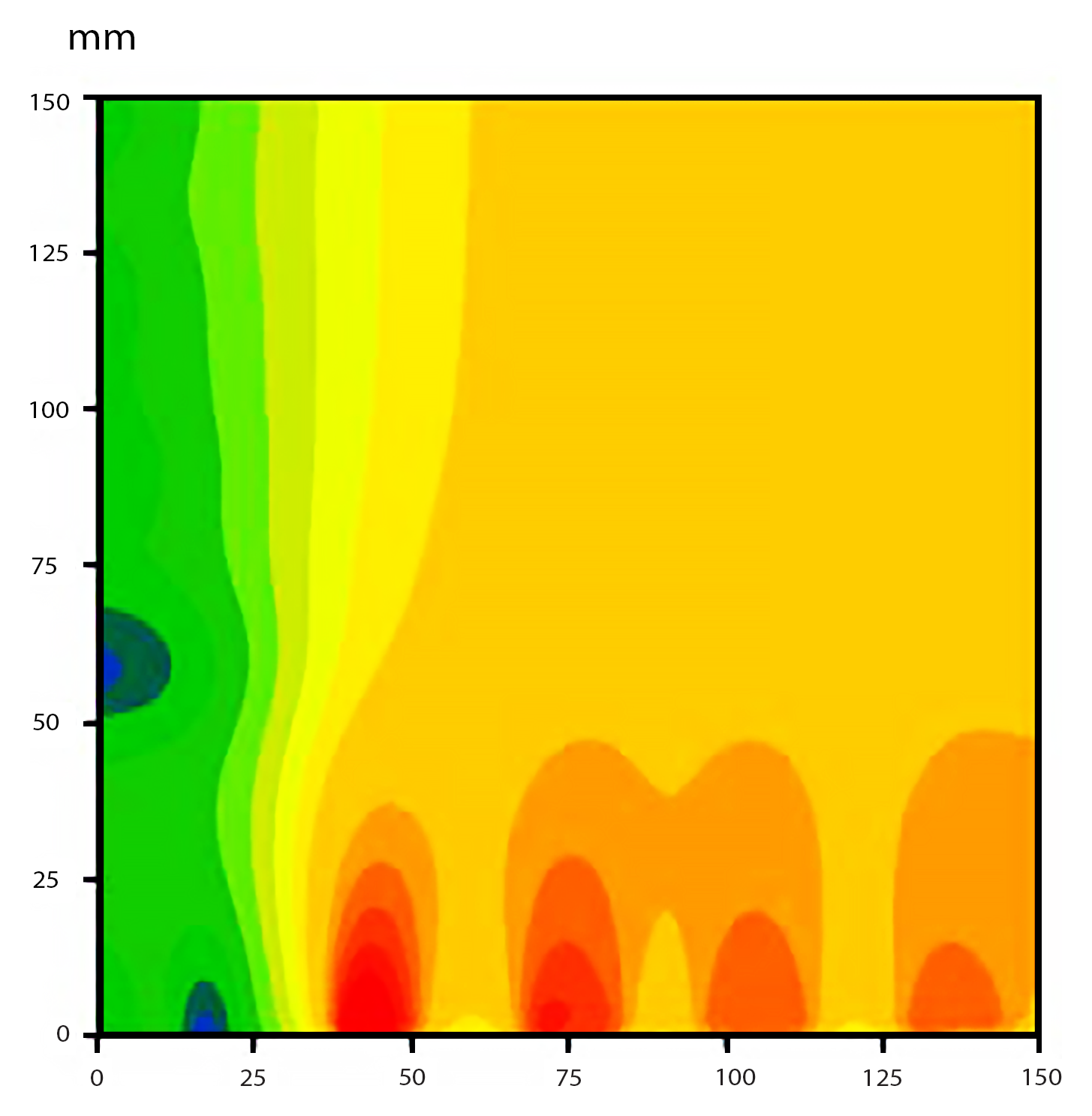
Bicubic-spline modeling (validated by ESPI) was the first computational model of a painting to incorporate the stretcher, staples, corner folds, and frictional forces. The inclusion in the model of the measured coefficient of friction of 0.63 for a pine stretcher bar showed that areas of high strain move outward toward the edges of the stretcher. Figures 15.2 and 15.3 compare the measured strain obtained using ESPI with the modeled strain for the same canvas properties and loading conditions. The close correlation of the two distributions in terms of overall magnitude and specific features is very good. This gives a high level of confidence in using a bicubic-spline model to predict modes of failure and improve upon the present methods of tensioning canvas by simulating the strains induced in canvas under different conditions (Brew, J. S, W. J. Lewis, and C. Young. 2016. “Painting Conservation and Novel Artist Materials.” In Designing for the 21st Century, vol. 2, chap. 20, pt. 2, edited by Tom Inns. New York: Taylor and Francis. E-book.).
ESPI has also been a useful tool for evaluating structural conservation treatments, for instance, tear mending. A painting will have high strains near the tear and strain concentrations at the ends of the tear, which are sites for potential propagation of the tear. If a tear is close to a corner or a tack/staple, this situation will be exacerbated because of the nonuniform loading. Implicit in restoring the mechanical integrity of a painting is the requirement to reestablish a uniform strain field across the painting—or at least one whose average strain is commensurate (Young, Christina. 2003. “The Mechanical Requirements of Tear Mends.” In Alternatives to Lining: Structural Treatment of Paintings on Canvas without Lining: A Conference Held Jointly by the British Association of Paintings Conservator-Restorers and the United Kingdom Institute for Conservation Paintings Section, 19 September 2003: Preprints, edited by Mary Bustin and Tom Caley, 55–58. London: United Kingdom Institute for Conservation of Historic and Artistic Works.). This can be seen for the Heiber (thread-by-thread) tear-mend strain map shown in figure 15.4 for an acrylic-primed canvas under 50 N biaxial tension. Redistribution, reduction, or eradication of strain concentrations (one color in the map) implies a uniform strain field. Both the patch (fig. 15.5) and the Heiber mend demonstrate that this can be achieved to some degree.
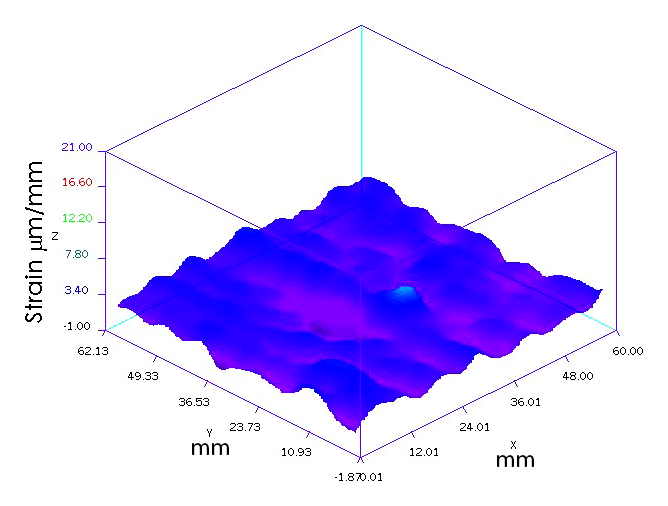
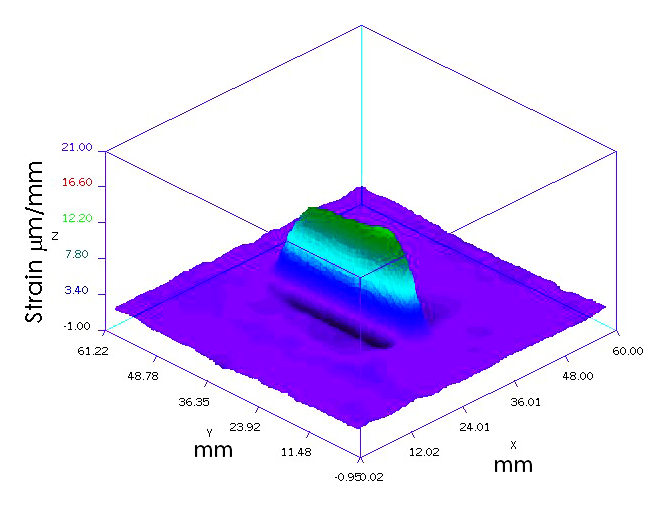
In both cases, residual strain concentrations are present. For the Heiber—or any equivalent tear mend—reducing these concentrations below these levels is very hard to achieve by visual inspection alone. A “perfect” mend would eliminate strain concentrations around the original fracture site, preventing potential propagation of the tear. Similarly, any patch should have high fracture toughness and minimal stiffness. The patch strain map (see fig. 15.5) shows that the level of strain concentrations has been reduced, but small discontinuities in strain occur at the edges of the patch.
Patches, which impart additional flexural stiffness with the aim of keeping the tear flat, are likely to result in an area of lower strain across the patch, but also larger discontinuities. The adhesive and type of adhesive interface will be the major factors in determining whether a tear mend is strong enough to withstand “normal” stress distributions within the canvas. The onset of failure will be evident as an increase in strain concentrations while loading.
Apart from assessing which techniques are mechanically most successful, future research needs to look at how the materials used in the subsequent layers of fill and retouching alter the balance of forces in and around the tear. This includes looking at interfacial tensions built up by the drying of fills and coatings (Daly Hartin, Debra, Eric Hagan, Stefan Michalski, and Mylène Choquette. 2011. “CCI Lining Project: Testing of Lined Model Paintings from Fractions of a Second to Decades.” In ICOM-CC Lisbon 2011: Preprints, 16th Triennial Conference, Lisbon, 19–23 September 2011, edited by Janet Bridgland and Catherine Antomarchi, paper 1309, 288–96. Almada, Portugal: Critério Produção Grafica; Paris: ICOM Committee for Conservation.), as well as the ability of the filled mend to withstand fatigue caused by cycling of temperature and relative humidity (RH) (Young, Christina. 2013. “The Use of 3D ESPI for the Structural Analysis of Paintings on Canvas.” In LACONA IX: Lasers in the Conservation of Artworks, edited by David Saunders, Matija Strlič, Capucine Korenberg, Naomi Luxford, and Karen Birkhölzer, 108–15. London: Archetype.).
Strip-lining is another structural treatment perceived as minimally invasive that aims to reinstate, as far as possible, the structural integrity of the painting. The various configurations and methods to prevent a sharp change in stiffness at the edge of a strip in the picture plane have been evaluated by ESPI. For example, strip-lining with Beva 371 and polyester sailcloth (00169, manufactured solely to order by Richard Hayward & Co., United Kingdom)—with pinked edges to prevent a hard transition—actually results in strain concentrations within the picture plane at the point of the pinked triangle of polyester (Brew, J. S, W. J. Lewis, and C. Young. 2016. “Painting Conservation and Novel Artist Materials.” In Designing for the 21st Century, vol. 2, chap. 20, pt. 2, edited by Tom Inns. New York: Taylor and Francis. E-book.). As expected, under the same loading conditions a feathered edge transition results in lower strain concentrations. However, if too much adhesive is used, the stiffness of the adhesive (even Beva 371) dominates, and a strain concentration along the edge of the feathering occurs.
ESPI is a very sensitive technique and does not always work well for real paintings, especially those with glossy varnishes or that are in situ where exterior vibrations occur. For the application of strip-linings and other structural conservation treatments, DIC with a relatively inexpensive, fast-frame-rate, high-resolution camera can produce good results. Such systems are standard in engineering and offer a complementary technique for nondestructive evaluation of structural conservation treatments.
Moisture Response
The literature on the moisture response of canvas paintings and the key findings are covered in On Canvas (Hackney, Stephen. 2020. On Canvas: Preserving the Structure of Paintings. Los Angeles: Getty Publications.). For emphasis, some specific points from some of the published literature follow.
Moisture Response of Original Supports
Most of the data in the literature on moisture response relate to uniaxial testing. The results, however, can be misleading, as uniaxially the canvas is unconstrained in one direction, and this is not representative of the stresses that build up under biaxial constraint on a stretcher. Nonetheless, careful experimental design and interpretation can mitigate this difference. One of the most valuable resources for measuring moisture response has come from deaccessioned paintings and from nineteenth-century primed loose-linings. Figure 15.6 shows the typical load response in the weft and warp direction for a primed loose-lining produced by Roberson colormen (Carlyle, L., C. Young, and S. Jardine. 2008. “The Mechanical Response of Flour Paste Grounds.” In Preparation for Painting: The Artist’s Choice and Its Consequences, edited by J. H. Townsend, T. Doherty, G. Heydenreich, and J. Ridge, 123–31. London: Archetype.). The tension in the two directions drops until an inversion occurs at 70% RH, where the tension starts to rise as RH increases.
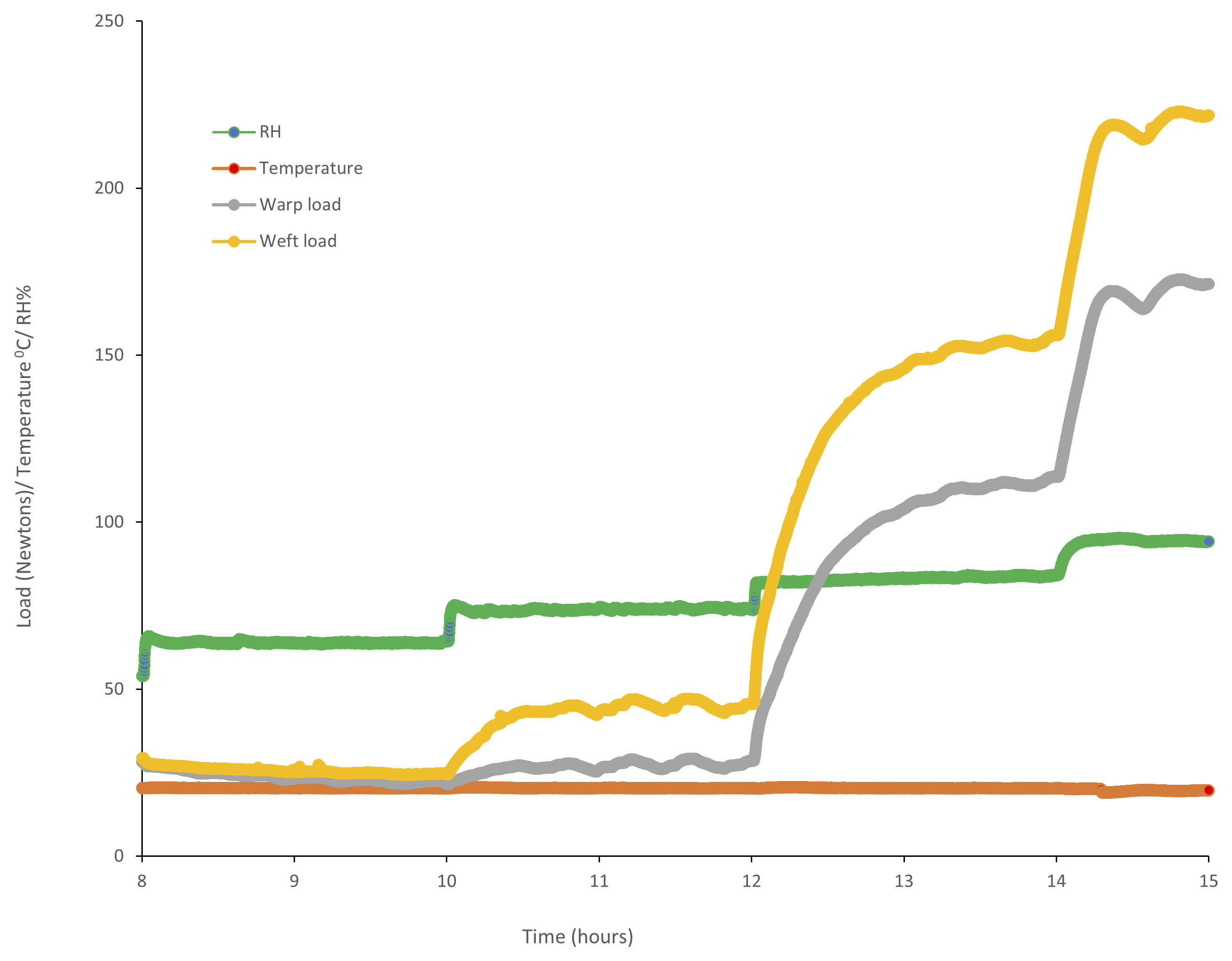
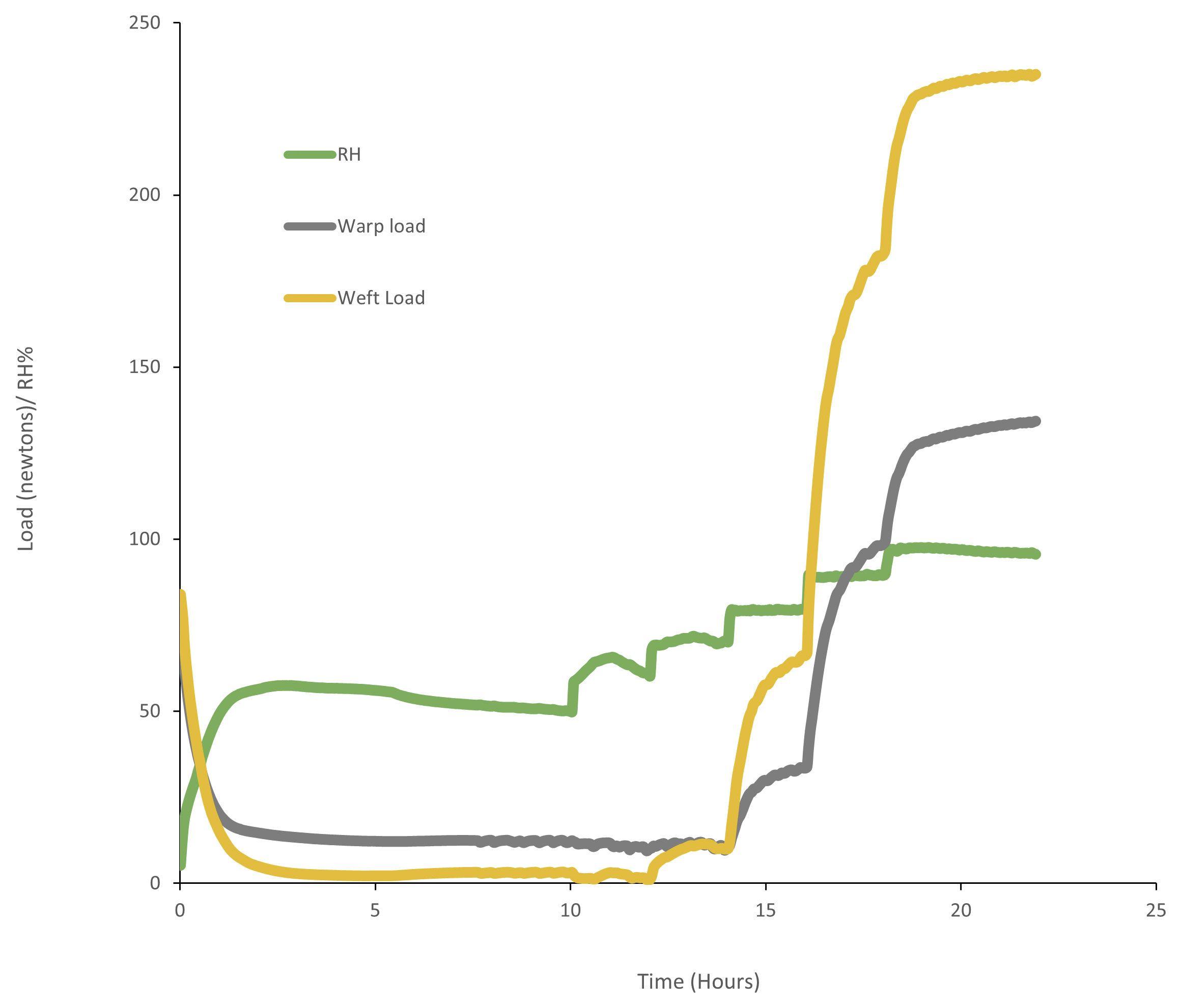
This pattern occurs for many oil-primed canvases (loose-linings), as was demonstrated by Hedley under uniaxial tension (Hedley, Gerry. 1988. “Relative Humidity and the Stress/Strain Response of Canvas Paintings: Uniaxial Measurements of Naturally Aged Samples.” Studies in Conservation 33, no. 3: 133–48. https://doi.org/10.2307/1506206.). The initial drop in tension is attributed to the size layer becoming softer as it absorbs moisture until it reaches a gelatinous state. Simultaneously, the fibers in the canvas are absorbing moisture. At some point, the swollen fibers cause the canvas to contract, and because it is tacked in place the tension rises. Typically, the tension in the weft direction increases significantly more than the warp because it has less crimp. The major influences on where this inversion occurs are weave density and the glue-size application. Inversions have been measured from between 65% and 85% RH for nineteenth-century English commercially glue-sized oil-primed canvases and glue-sized new canvas. Figure 15.7 shows the response of another Roberson primed loose-lining with the inversion at 65% RH (Carlyle, L., C. Young, and S. Jardine. 2008. “The Mechanical Response of Flour Paste Grounds.” In Preparation for Painting: The Artist’s Choice and Its Consequences, edited by J. H. Townsend, T. Doherty, G. Heydenreich, and J. Ridge, 123–31. London: Archetype.; Carr, D. J., C. R. T. Young, A. Phenix, and R. D. Hibberd. 2003. “Development of a Physical Model of a Typical Nineteenth-Century English Canvas Painting.” Studies in Conservation 48, no. 3: 145–54.).
Moisture Response of Linings
A database of moisture response for archival canvas, reconstructions, and new types of canvas is useful in deciding on a moisture treatment (how long and at how much moisture), especially when the complexity of two canvases is involved, as is the case with lined paintings. As a first approximation, one can think of the problem as a superposition of two canvases, and hence two moisture responses that induce expansion and contraction, leading to stresses within the canvases and induced stress distributions in all the layers. This can be modeled with appropriate boundary conditions using FEA and/or analytical models—if the properties of each layer are known. However, there is often added complexity because the lining adhesive (especially traditional glue-paste and wax) has impregnated the original canvas, cracks, and interfaces of the painting. Nevertheless, it is possible to see trends in behavior when there is sufficient archival material to characterize degradation and mechanical properties (Young, Christina, and Paul Ackroyd. 2001. “The Mechanical Behavior and Environmental Response of Paintings to Three Types of Lining Treatment.” National Gallery Technical Bulletin 22: 85–104.).
Moisture Response of Modern Materials
The use of synthetic/modern materials in painted textiles can be traced to the patents for textile coatings of the nineteenth century (Young, Christina. 2012. “History of Fabric Supports.” In Conservation of Easel Paintings, edited by J. H. Stoner and R. A. Rushfield, 116–47. Abingdon-on-Thames, UK: Routledge.). Research into their properties began to have a direct influence of practice with the work of Hedley and Hackney in the 1980s (Hackney, Stephen. 2020. On Canvas: Preserving the Structure of Paintings. Los Angeles: Getty Publications.). Artists’ use of new materials, plus the conservator’s desire to find a suitable lining canvas, means we need to continue to characterize a wide selection of natural and synthetic fabrics. It is insufficient to characterize only the type of canvas (linen or polyester), because even for synthetic fabrics the yarn processing, fabric weave density, and coatings (e.g., fire retardants) influence moisture response (Young, Christina, and Suzanne Jardine. 2012. “Fabrics for the Twenty-First Century: As Artist Canvas and for the Structural Reinforcement of Easel Paintings on Canvas.” Studies in Conservation 57, no. 4: 237–53.). More disconcerting for those choosing materials for treatments is the generic naming of canvases; for example, “12 oz Belgian linen” is a name, not a description; it does not even mean it comes from Belgium. This is confusing and misleading if one assumes certain properties are dependent on the material’s source country. Similarly, cotton duck data produced over twenty years ago (Young, Christina. 1996. “Biaxial Properties of Sized Cotton-Duck.” In ICOM Committee for Conservation 11th Triennial Meeting, Edinburgh, 1–6 September 1996, 322–31. London: James & James. http://eprints.gla.ac.uk/137319/.) will generally be valid today, but changes to the source—and therefore the twist of the yarn, sizing, tension during weaving, and subsequent regulatory coatings and processes—can change the hydromechanical response.
Of course, this has always been the case. For instance, in the eighteenth century, weavers in the east of Scotland branded their linen fabrics “Osnaburg” (or Osnabrigg) an imitation of Osnaburgh (also known as Osnabrück) (Young, Christina. 2012. “History of Fabric Supports.” In Conservation of Easel Paintings, edited by J. H. Stoner and R. A. Rushfield, 116–47. Abingdon-on-Thames, UK: Routledge.). Similarly, Lascaux P360 polyester (a linen look-alike) has changed properties since it was introduced (Young, Christina, and Suzanne Jardine. 2012. “Fabrics for the Twenty-First Century: As Artist Canvas and for the Structural Reinforcement of Easel Paintings on Canvas.” Studies in Conservation 57, no. 4: 237–53.). Ideally, one should characterize (or at least empirically test) each new batch if one cannot guarantee its response.
Reconstructing Weaves
Reconstructions of painted textiles in general—starting at the yarn level and proceeding through weaving, stretching, preparation layers, and subsequent artists materials/techniques relevant to the work—are invaluable for understanding how the manufacturing process, subsequent preparations, and materials influence the aesthetic, kinesthetic, and physiochemical behavior of the painting. Fraught with uncertainty as to how authentic or historically accurate they may be, reconstructions still allow one to explore which properties have the biggest influence on behavior by trying different variations and through repeated testing.
Reconstruction of canvas weaves is a relatively new approach. It has come about in part from a greater awareness of and interest in the weave’s significance in the provenance, interpretation, and conservation of a painting. For example, during the conservation treatment at the Cleveland Museum of Art of The Crucifixion of Saint Andrew (1606–7) by Caravaggio, it was possible to retrieve some information about the original canvas from the X-radiograph, even though it had been lined with a plain-weave canvas.5 This painting may have been cut down, which would mean less cusping would be visible. Inferences drawn from the cusping had been extrapolated from simple plain-weave canvases, rather than the complex weave of Caravaggio’s original canvas.
While the clarity of the original weave was hard to discern, a trained eye (in this case, that of Dr. Dan Coughlan, curator and master weaver at Paisley Museum, Scotland) identified the weave as a huckaback, which is a plain weave with a floating warp. Hence, he was able to set up the weaving pattern for a traditional four-frame hand loom. Linen and jute yarn samples were sourced from Jos Vanneste, a Belgian linen company. The closest match to a yarn fragment from the painting was a linen yarn, which was then woven into a canvas by a local Scottish weaver. Empirical testing found that the canvas was more stable on the bias than an equivalent plain weave without a floating warp, and it developed less cusping when tacked onto a stretcher.
The canvas was also prepared with a traditional double ground layer, and, interestingly, drying cracks within these layers were of a very similar size and pattern (Brunton, J. 2018. “Canvas Weave in Caravaggio’s Crucifixion of Saint Andrew.” Technical art history research diss., Glasgow University.). A more systematic and controlled set of tests is now being performed on these samples using the biaxial tensile tester in the Conservation Research Laboratory at the Kelvin Centre, Glasgow University. Such reconstructions are useful not only for understanding the complexity of canvas but also for possible use as fabrics for structural treatments. Having control over the weaving process allows for a bespoke pattern (see Loermans’s poster in these proceedings) and, combined with testing, the ability to tune its properties.
Reconstructions for the Contemporary Use of Canvas
The value of reconstructions for conservation/preventive issues related to contemporary works as well as older works cannot be underestimated. Either by working directly with the artists, gallery, artists studio, fabricators, or documented interviews, much can be gleaned, if not always volunteered, that enable the use of the same materials and technique in the reconstruction. This approach has been used in cleaning (Barker, Rachel, and Bronwyn Ormsby. 2015. “Conserving Mark Rothko’s Black on Maroon, 1958: The Construction of a ‘Representative Sample’ and the Removal of Graffiti Ink.” Tate Papers no. 23. https://www.tate.org.uk/research/publications/tate-papers/23/conserving-mark-rothkos-black-on-maroon-1958-the-construction-of-a-representative-sample-and-the-removal-of-graffiti-ink.; Krueger, J. 2017. “Color Field Paintings and Sun-Bleaching: An Approach for Removing Stains in Unprimed Canvas.” In Treatment 2017: Innovation in Conservation and Collection Care: 45th Annual Meeting of the American Institute for Conservation of Historic & Artistic Works, May 28–June 2, 2017, Chicago, 47. Washington, DC: AIC.; Diamond, Olympia, Maggie Barkovic, Maureen Cross, and Bronwyn Ormsby. 2019. “The Role of Agar Gel in Treating Water Stains on Acrylic Paintings: Case Study of Composition, 1963, by Justin Knowles.” Journal of the American Institute for Conservation 58, no. 3: 144–57.), very effectively for tear mending (Piotrowska, Kinga, and Sandra Amann. 2009. “Minimal-Adhesive Mend and Cast In-painting: A Treatment of a Tear on an Ed Ruscha Painting.” In AIC Paintings Specialty Group Postprints, vol. 22, edited by Barbara Buckley, Meg Newburger, and American Institute for Conservation of Historic and Artistic Works, AIC Paintings Specialty Group, 48–57. Washington, DC: American Institute for Conservation.), and assessment of structural stability and preventive treatments (Griffin, Amy, Christina Young, and Tom Hale. 2014. “‘History Is My Material.’” In ICOM-CC 17th Triennial Conference Preprints, Melbourne, 15–19 September 2014, edited by Janet Bridgland, art. 1305. Paris: ICOM. http://eprints.gla.ac.uk/135500/.).
One example is a series of acrylic preprimed linen and polyester canvases on which acrylic paint and screen-print ink had been applied either directly or through a screen. These works were unstretched on arrival for a display of the artist’s work at a gallery in London. Several features were considered undesirable: a general buckling of the canvas with sharp cupping in certain areas, cracking in the upper paint layers, and some buckling remaining in the works, once stretched, with an overall lack of tension. By matching the canvases as closely as possible and applying the inks used by the artist, it was possible to conduct a series of tests on the biaxial tensile tester to re-create the phenomenon and to understand its cause.6 This allowed recommendation of an appropriate treatment and possible ways to mitigate the effects in the future. It was found that the liquid phase of inks caused local shrinkage of linen. In the synthetic canvases, the liquid phase interacted with the acrylic priming, softening it, unlocking the woven polyester yarns, and allowing distortions to occur.
Possibly more challenging to conservators of the future is the embedding of materials within canvas (Nahum, Andrew, Justin McGuirk, and Eleanor Watson, eds. 2019. Moving to Mars: Design for the Red Planet. Exhibition catalogue. London: Design Museum.) and haptics (Bianchi, M. 2016. “A Fabric-Based Approach for Wearable Haptics.” Electronics 5: 44.).7 The testing of contemporary materials that an artist might use as a “canvas” or in a sculpture/installation or that might be a suitable alternative to traditional lining materials should be an ongoing, proactive area of research within conservation. While attempts have been made to work with manufacturers to produce materials to our specifications, commercial production of bespoke lining fabric is not viable. A proactive approach is required to understand textiles manufactured for other industries and to specify/design fabrics, as well as an investment in our profession if we are to drive research and production.
Future directions for the conservation of canvas could include:
-
Designing, fabricating, and assessing canvas for artists and conservators
-
Collecting more data on material properties to make available through master classes and online resources, including how to interpret the data
-
Devising better simple, studio-based evaluation tests before and during treatment or when using new materials
Future Options: Complex Canvas Complexity—Good Candidates for Artists Canvas and Lining Fabrics
The largest drivers of the development of new materials come from the aerospace, military, and apparel industries. The fact that woven fabrics are part of contemporary composite engineering materials attests to their success in increasing the fracture toughness of structures. Fracture toughness prevents cracks (tears) from propagating: in degraded canvas, it is the brittleness of the yarns due to chain scission and increased crystallinity of the cellulose (for flax and linen) that substantially reduces the fracture toughness. Cotton duck has a much lower fracture toughness even when new because of its short staple length. Interestingly, natural materials, including linen, are still part of active research into improving the service life of structural composites, as they have properties yet to be fully replicated by other methods (Pandian, A., and S. Jailani. 2019. “Development and Investigation of Jute/Linen Fibre Reinforced Polymer Composite.” No. 2019-28-0171. SAE International. https://saemobilus.sae.org/content/2019-28-017/.).
Nonwoven fabrics have been used by both artists and conservators, typically as part of collage pieces or, in conservation applications, as interleaves in linings. Such fabrics can be made to be homogeneous and heterogeneous, so it would seem their relative lack of use is due to the lack of texture, drape (ability to bend and form shapes, e.g., around a stretcher bar corner), and “responsiveness” when painting. However, the low absorbency of many synthetic materials may be considered a good property for linings.
State-of-the-art fabric structures use surface modifications to give the desired properties, such as hydrophobicity using vapor deposition on fabric (Xu, Liyun, Jiawen Deng, Ying Guo, Wei Wang, Ruiyun Zhang, and Jianyong Yu. 2019. “Fabrication of Super-hydrophobic Cotton Fabric by Low-Pressure Plasma-Enhanced Chemical Vapor Deposition.” Textile Research Journal 89, no. 10: 1853–62.). Filled yarns have been developed to increase stiffness and fracture toughness (Gilchrist, M. D., S. Svensson, and R. Shishoo. 1998. “Fracture and Fatigue Performance of Textile Commingled Yarn Composites.” Journal of Materials Science 33: 4049–58.). Triaxial weaves, which have two sets of warps at 60 degrees to the weft, give increased stability and stiffness on the bias and better fracture toughness (Wang, Zhenzhou, Jiangbo Bai, Adam Sobey, Junjiang Xiong, and Ajit Shenoi. 2018. “Optimal Design of Triaxial Weave Fabric Composites under Tension.” Composite Structures 201: 616–24.).
Embedded sensors in fabrics have been the subject of experimentation for over twenty years and offer the possibility of in situ monitoring of canvas properties: moisture content via electrical resistance and induced strain via fiber optics (Zawadzki, Witold, Marcin Bartosik, Krzysztof Dzierżga, Łukasz Bratasz, Michał Łukomski, and Elizabeth Peacock. 2012. “Application of Fiber Bragg Gratings for Strain Measurement in Historic Textiles and Paintings on Canvas.” Optica Applicata 42: 503–17.). The problem from a conservation/preventive point of view is that embedded optical devices considerably stiffen the fabric. However, with the present development of haptics and wearable sensors in the military, sports, and gaming industries (Muhammad Sayem, Abu S., Siew Hon Teay, Hasan Shahariar, Paula Luise Fink, and Alhussein Albarbar. 2020. “Review on Smart Electro-Clothing Systems (SeCSs).” Sensors 20, no. 3: 587.), it is likely that the technology will evolve to enable development of embedded sensors for structural conservation and the monitoring of canvas complexity. Shape memory sensors may also offer an additional option. For example, self-regulating structures that respond to environmental conditions could be woven into fabric (Ibrahim, N. A., B. M. Eid, M. M. Hashem, R. Refai, and M. El-Hossamy. 2010. “Smart Options for Functional Finishing of Linen-Containing Fabrics.” Journal of Industrial Textiles 39, no. 3: 233–65.)—and at the least they are bound to be part of future artworks.
Driven by the need to reduce our carbon footprint, energy-harvesting fabrics are being developed that convert ambient energy into electrical energy. These include dye-sensitized solar cells fabricated into functionalized yarns and made into films that can be spray-coated onto textiles (Torah, Russel, Jake Lawrie-Ashton, Yi Li, Sasikumar Arumugam, Henry A. Sodano, and Steve Beeby. 2018. “Energy-Harvesting Materials for Smart Fabrics and Textiles.” MRS Bulletin 43, no. 3: 214–19.), as well as screen-printable polymer film and polymer fibers that can harvest mechanical energy from textiles. Maybe the canvas paintings of the future could provide their own “active” microclimate.
Acknowledgments
I would like to thank Tim Green, retired paintings conservator, Tate; Dean Yoder, senior conservator, Cleveland Museum of Art; Dr. Dan Coughlan, curator and master weaver, Paisley Museum; Jean Mabon, for her expertise and for weaving the Cleveland canvas reconstructions; Jennifer Brunton, technical art history student, Glasgow University; Janey Zagreb (London); and my colleagues at the Kelvin Centre, University of Glasgow.
Notes
-
For an up-to-date, comprehensive review of the published research in the conservation field, see Stephen Hackney’s On Canvas: Preserving the Structure of Paintings (Hackney, Stephen. 2020. On Canvas: Preserving the Structure of Paintings. Los Angeles: Getty Publications.). ↩︎
-
See https://www.npg.org.uk/research/programmes/directory-of-suppliers/. ↩︎
-
Fredrix: https://fredrixartistcanvas.com/product-category/canvas-rolls/polyflax-poly-cotton-rolls-acrylic-primed; Haywards (now part of Heathcoat): https://www.heathcoat.co.uk/contact; Lascaux: https://lascaux.ch/fabrics/polyester-fabric-p110. ↩︎
-
McDougall: https://mcdougall.co.uk/fabric/fabrics/. The company’s longevity is described in Ian McDougall’s biographical statement at https://powertotransform.gla.ac.uk/interviewees/. ↩︎
-
Private communication with Dean Yoder, senior conservator, Cleveland Museum of Art, 2018. ↩︎
-
Testing performed in the Conservation and Technology Department at the Courtauld Institute of Art. ↩︎
-
Haptics is any type of technology that provides a tactile response. The technology can be embedded in fabrics or directly fabricated as a woven structure. ↩︎