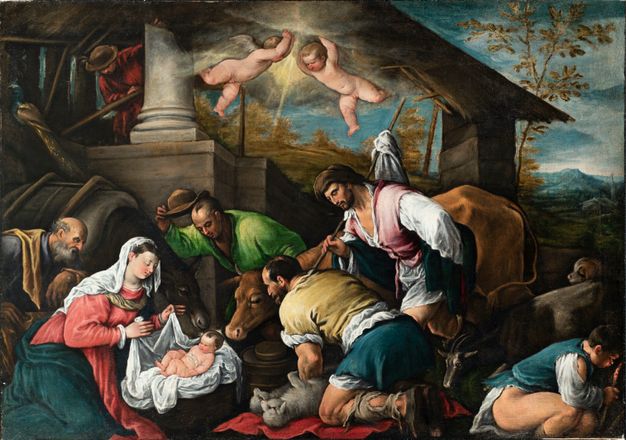
During treatment of Francesco Bassano’s Adoration of the Shepherds (Arkansas Arts Center), the painting was found to have been lined to a very open-weave canvas using glue-paste adhesive. Further research revealed this to be an Italian lining technique, likely applied before the painting’s acquisition by the Kress Foundation in the 1930s. This poster explores the differences between Florentine and Roman lining techniques, proposing that the lining applied to the Bassano is Roman. It also provides an overview of the Roman lining method and ultimately identifies the type of canvas used on the Bassano.
43. A Roman Technique of Open-Weave Canvas Lining
- Emma Kimmel, Graduate Student, Conservation Center of the Institute of Fine Arts, New York University
Introduction
In the fall of 2018, the Arkansas Arts Center’s Adoration of the Shepherds, attributed to Francesco Bassano (fig. 43.1), was brought to New York University’s Conservation Center for treatment. The painting is part of the dispersed Kress Collection and had not been studied since 1932, when it was restored by then-conservator of the Kress Collection, Stephen Pichetto.1 During treatment at the Conservation Center, it was revealed that the painting had been lined with a very open-weave canvas (fig. 43.2). This was an unusual discovery, as canvas paintings treated by the Kress Foundation during this period were often lined after acquisition with tightly woven canvases.2 Additionally, there were no notes in the Kress Foundation Archive that discussed the addition of a lining. So where was it applied?
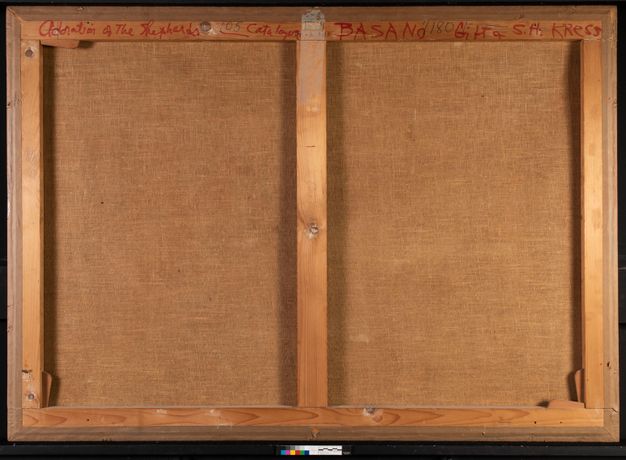
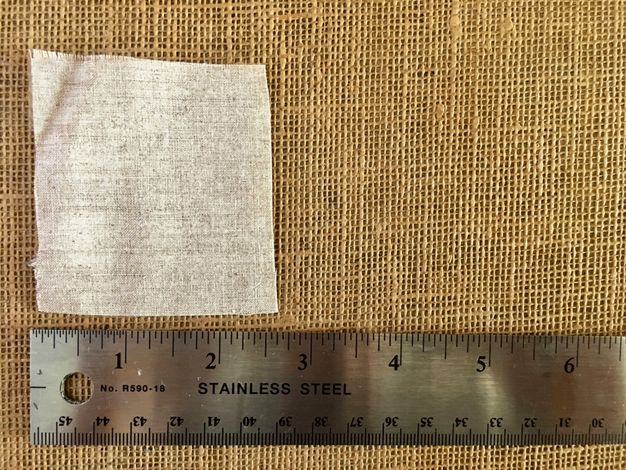
The lining has several characteristics that point to an Italian method of canvas lining. Although the original canvas has a fine weave, approximately 30 × 30 threads per inch, the lining has a very open, plain weave with approximately 16 × 16 threads per inch. The canvas is composed of threads with irregular widths (fig. 43.3), and the lining overall was adhered with a thin layer of glue-paste adhesive. Clues from the painting’s provenance were quite limited, leading back only to the dealer who sold it to the Kress Foundation in 1930; this was Florentine dealer Count Alessandro Contini-Bonacossi, who supplied many paintings to Samuel H. Kress (Shapley, Fern Rusk. 1973. Paintings from the Samuel H. Kress Collection: Italian Paintings XVI–XVIII Century. London: Phaidon.). It is therefore likely the lining was applied in Italy before the painting was sold, though it is unknown where it might have been done, or by whom.
Roman versus Florentine Lining Canvases
In Italy, there are two traditional glue-paste lining methods: Florentine and Roman. This distinction originates from the work of two nineteenth-century Italian restorers, Count Giovanni Secco-Suardo and Ulisse Forni. The glue-paste recipe and lining techniques advocated by Secco-Suardo informed the Florentine technique, whereas Forni’s became the basis for the Roman technique (Forni, Ulisse. 1866. Manuale del pittore restauratore. Florence: Successori le Monnier.; Reifsnyder, Joan Marie. 1995. “The Florentine Paste Technique: What Makes It Different from Other Glue-Paste Linings for Pictures.” In Lining and Backing: The Support of Paintings, Paper, and Textiles: Papers Delivered at the UKIC Conference, 1995, 77–82. London: United Kingdom Institute for Conservation of Historic and Artistic Works.).3 A characteristic difference often cited between these approaches is the glue-paste recipes;4 however, there is also a large variation in the types of lining canvas chosen. While both methods generally employ plain weave hemp and/or flax-based canvases, their weave densities differ greatly.
Typically, the Florentine method uses a tighter weave similar to that of the original canvas, though slightly more robust, to support the painting (Reifsnyder, Joan Marie. 1995. “The Florentine Paste Technique: What Makes It Different from Other Glue-Paste Linings for Pictures.” In Lining and Backing: The Support of Paintings, Paper, and Textiles: Papers Delivered at the UKIC Conference, 1995, 77–82. London: United Kingdom Institute for Conservation of Historic and Artistic Works.).5 This type of canvas is chosen to provide a more rigid support and minimize weave interference (Baldini, Umberto, and Sergio Taiti. 2003. “Italian Lining Techniques: Lining with Pasta Adhesive (and Other Methods) at the Fortezza da Basso, Florence.” In Lining Paintings: Papers from the Greenwich Conference on Comparative Lining Techniques, edited by Caroline Villers, 115–20. London: Archetype.). The Roman technique, in contrast, uses an open weave. There are two main types of this open-weave canvas: the more open tela patta, at 10–15 threads per inch, and the slightly more dense tela pattina, at 20–25 threads per inch. Selection of either the tela patta or tela pattina largely depends on the size of the painting, the structure of the original canvas, and the painting’s condition (Laroche, Jacqueline, and Maria Vittoria Saccarello. 1996. “La foderatura dei dipinti: Due tradizioni a confronto.” Kermes 25: 11–24.). Generally, this type of canvas allows for a lighter, more flexible support after lining; however, the overall flexibility is also highly dependent on the glue-paste recipe (Lavorini, Barbara. 2007. “La foderatura a pasta secondo il metodo fiorentino: Varianti di applicazioni della pasta fiorentina” [Glue-paste lining with the Florentine method: Variants of applications]. In Dipinti su tela: Problemi e prospettive per la conservazione, giornata di studio, Ferrara, 1 aprile 2006, edited by Marco Ciatti and Erminio Signorini, 29–48. Padua: Il Prato.).6
Brief Overview of the Traditional Roman Lining Process
The following outlines the steps of the Roman lining process.
-
The painting is prepared for lining by applying an overall facing, removing it from its support, cleaning the reverse of the canvas, mending tears, and applying any canvas inserts.
-
Diluted colletta (glue) is applied to the back of the original canvas to consolidate preparatory layers before the lining procedure.
-
The colletta is often composed of hide glue, water, white vinegar, molasses, and oxgall, and sometimes a small amount of fungicide.
-
For moisture-sensitive paintings, a synthetic adhesive or mastic resin can be substituted for this step.
-
-
The lining canvas is soaked in water for at least twelve hours and then left to dry before being stretched onto a wood or metal working frame.
-
A thin layer of colla di pasta, or colla pasta (glue paste), is spread onto the back of the painting. The lining canvas is placed on the back of the painting and massaged from the reverse, pushing from the center outward to remove excess glue. This process is sometimes repeated from the front of the painting until only a thin layer of glue remains.
-
The colla pasta is often composed of wheat flour, water, undiluted or dry colletta, and Venice turpentine. A fungicide and/or alum is also sometimes added.
-
Although excess glue is extracted, it is important that the lining canvas be fully impregnated with the glue paste for an adequate bond with the original canvas.
-
-
After drying for several hours in an upright position, the painting is then ironed from the front through waxed paper until the surface is dry to the touch. Normally the iron weighs 3–7 kg and is heated to 45°C–60°C.
-
The painting is left to dry fully for at least a day before removing the facing. After several days, the painting can then be stretched onto its final support.7
The Roman method has several advantages, primarily a lower overall weight after lining, a thin layer of glue, and the flexibility of the open-weave canvases. It does have limitations, however, and would not be suitable for highly damaged or sensitive works. The heat, moisture, and pressure of traditional glue-paste lining processes are also not appropriate for many paintings and require a very skilled practitioner for proper implementation.
Conclusions
After investigation into the various types of traditional Italian lining canvases, it was determined that Adoration of the Shepherds was lined with a Roman tela patta canvas. The exact techniques and recipes used for its application remain unknown, though Italian scholarship provides an overview of the salient differences between the Florentine and Roman methodologies that may have been employed. Traditional glue-paste linings are now considered inappropriate for many works, yet almost ninety years later this Roman lining remains unobtrusive and flexible. During treatment, it was decided to retain the lining due to its excellent state of preservation. There are many favorable aspects of the Roman lining process, and further experimentation using open-weave canvases with alternative adhesives and/or application methods could make this traditional technique less intensive while still providing a light, flexible support.
Acknowledgments
The author would like to thank the following for their guidance and expertise: Dianne Dwyer Modestini, Michele Marincola, Margaret Holben Ellis, Hannelore Roemich, Paolo Roma, Kevin Martin, Shan Kuang, and Kristin Holder. She would also like to thank the Samuel H. Kress Foundation for its continued support throughout her studies, and the Arkansas Arts Center for the study of its wonderful painting.
Notes
-
Art Collection Data Sheet K-105. Samuel H. Kress Foundation Archive, New York, New York. For more information on Stephen Pichetto and the conservation practices of the Kress Collection from this period, see Hoenigswald, Ann. 2006. “Stephen Pichetto, Conservator of the Kress Collection, 1927–1949.” In Studying and Conserving Paintings: Occasional Papers on the Samuel H. Kress Collection, 31–41. London: Archetype.. ↩︎
-
Dianne Dwyer Modestini, in discussion with the author, fall 2018. ↩︎
-
See also Laroche, Jacqueline, and Maria Vittoria Saccarello. 1996. “La foderatura dei dipinti: Due tradizioni a confronto.” Kermes 25: 11–24.. The Florentine technique has been used and taught by Opificio delle Pietre Dure, in Florence; the Roman technique, at the Instituto Centrale di Restauro, in Rome. ↩︎
-
See Laroche, Jacqueline, and Maria Vittoria Saccarello. 1996. “La foderatura dei dipinti: Due tradizioni a confronto.” Kermes 25: 11–24., Lavorini, Barbara. 2007. “La foderatura a pasta secondo il metodo fiorentino: Varianti di applicazioni della pasta fiorentina” [Glue-paste lining with the Florentine method: Variants of applications]. In Dipinti su tela: Problemi e prospettive per la conservazione, giornata di studio, Ferrara, 1 aprile 2006, edited by Marco Ciatti and Erminio Signorini, 29–48. Padua: Il Prato., and Reifsnyder, Joan Marie. 1995. “The Florentine Paste Technique: What Makes It Different from Other Glue-Paste Linings for Pictures.” In Lining and Backing: The Support of Paintings, Paper, and Textiles: Papers Delivered at the UKIC Conference, 1995, 77–82. London: United Kingdom Institute for Conservation of Historic and Artistic Works. for detailed descriptions of various glue-paste recipes. ↩︎
-
This type of canvas can be called olona and is typically closer to 30 threads per inch; see Laroche, Jacqueline, and Maria Vittoria Saccarello. 1996. “La foderatura dei dipinti: Due tradizioni a confronto.” Kermes 25: 11–24.. ↩︎
-
See also Reifsnyder’s comments on the flexibility of the recipes she tested, citing the Roman glue paste as being more rigid after lining (Reifsnyder, Joan Marie. 1995. “The Florentine Paste Technique: What Makes It Different from Other Glue-Paste Linings for Pictures.” In Lining and Backing: The Support of Paintings, Paper, and Textiles: Papers Delivered at the UKIC Conference, 1995, 77–82. London: United Kingdom Institute for Conservation of Historic and Artistic Works.). ↩︎
-
This description reflects the practices of the Instituto Centrale de Restauro, in Rome, from the early 1980s, as described in Laroche, Jacqueline, and Maria Vittoria Saccarello. 1996. “La foderatura dei dipinti: Due tradizioni a confronto.” Kermes 25: 11–24.. See also Forni’s description of nineteenth-century approaches (Forni, Ulisse. 1866. Manuale del pittore restauratore. Florence: Successori le Monnier.). ↩︎