The Sword of Damocles, by French artist Antoine Dubost, is a jewel of the European painting collection of the Chhatrapati Shivaji Maharaj Vastu Sangrahalaya (CSMVS), in Mumbai. Since its acquisition, the painting, which was previously glue-paste lined, gradually deteriorated: the lined support became rigid and inflexible, the paint layer became extremely brittle, and the varnish layer darkened. Furthermore, displayed in the coastal city of Mumbai, the painting has been exposed to high levels of RH and warm temperatures, which often result in recurring incidences of fungal growth. For the restoration, CSMVS collaborated with the Courtauld Institute of Art. Experts from the Courtauld and the National Museum, London, and art historians from the United Kingdom were consulted to develop a best-practice structural conservation plan for this painting that would take into account the environmental conditions prevalent in Mumbai. Conservation treatment was jointly executed by conservators from the Courtauld and CSMVS.
60. Structural Conservation Issues with European Easel Paintings Housed in High-Humidity Regions Such as Mumbai, India
- Omkar Kadu, Assistant Curator of Conservation, Chhatrapati Shivaji Maharaj Vastu Sangrahalaya, Mumbai
Introduction
The European paintings collection of the Chhatrapati Shivaji Maharaj Vastu Sangrahalaya (CSMVS), in Mumbai—one of India’s premier history and art museums—holds nearly 240 European oil paintings. Paintings in the collection date from as early as the sixteenth century and include artworks from British, Italian, French, Dutch, Flemish, and German schools. Sir Ratan Tata and Sir Dorabji Tata, the pioneer industrialists of India, bequeathed these paintings to CSMVS. Most of these works were shifted to CSMVS from the donors’ residences in London and Mumbai in 1922 and 1933.
Mumbai is located on India’s western coast, on the Arabian Sea. The coastal nature of the city results in a moderately warm and fluctuating temperature with high levels of humidity. Due to the coastal location of the museum, the paintings have been exposed to high levels of RH and warm temperatures, which have often resulted in recurring dimensional changes of paintings and incidences of fungal growth. Many galleries located in the museum’s east wing are equipped with high-precision climate control systems. The galleries in the museum’s main building do not yet have such control systems installed, and this includes the European paintings galleries and their associated storage area.
Many paintings had undergone structural conservation treatment prior to their transfer to CSMVS. This paper is an attempt to present comparative case studies of two paintings. These works had undergone structural conservation treatments about a hundred years ago using two different lining adhesives and techniques. The alterations and the changes observed on the paintings over the years with respect to the varying temperature and high humidity climate of Mumbai form the basis of this research.
The Collection and Its Condition
About 30 percent of the museum’s European painting collection has been displayed in two galleries named after the Tata brothers. The majority of the collection is housed in the European painting storage. Many have survived well for the last hundred years in the fluctuating temperature and high-humidity environment of the city. Few works show common signs of structural and visual deterioration, such as bulging, sagging of support, craquelure, and alteration of pigments due to aging; however, some paintings, especially works on panel supports, have been affected by insect attack in the past, while others show signs of paint losses and other physical damages over a period of time. Natural resin varnishes, commonly used in many of the paintings, have darkened over time. It was observed that the paintings were previously lined with either wax-resin or glue-paste adhesive before they were acquired by the museum. In this comparative case study, one painting previously lined with a glue paste and another with wax-resin adhesive are discussed, along with a brief description of their conservation status and challenges faced when re-treating the paintings.
Case Study 1: The Sword of Damocles
Brief History of the Painting
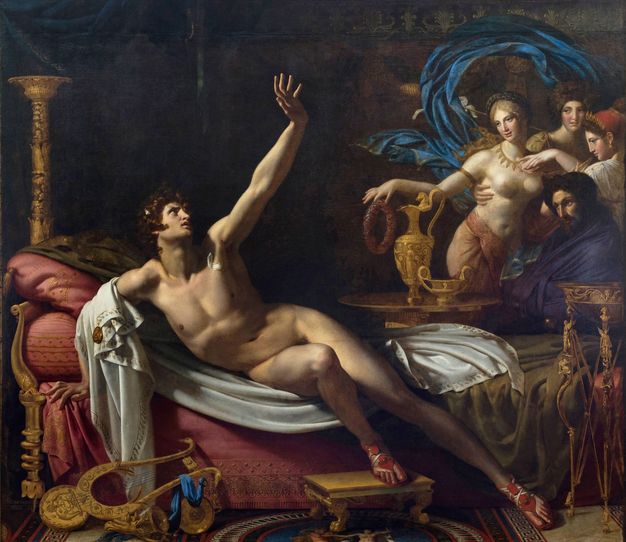
The Sword of Damocles is an early nineteenth-century Neoclassical painting by French artist Antoine Dubost (fig. 60.1). This valuable piece of artwork was bequeathed to the museum by Sir Ratan Tata in 1921. The name of the artist was at that time unknown and remained a mystery for several decades. In 2004, art historian Richard Spear of the University of Maryland came to study the European paintings collection at CSMVS. Based on his expertise on the subject, Spear suspected that the painting was the work of Dubost. This suspicion was reaffirmed two years later, when the artist’s hidden signature was discovered during conservation efforts.
Condition and Conservation Status
The painting previously formed part of the interiors of Sir Ratan Tata’s York House, in Richmond (London). The painting had been lined using a glue-based adhesive before it was bequeathed to the museum. Over the years the painting gradually started showing signs of deterioration. The support had become very rigid, stiff, and inflexible, and the paint layer was extremely brittle. Due to exposure to the high levels of humidity and warm temperatures of Mumbai, there were also recurring incidences of fungal growth. Fungus had not only attacked the back of the painting but also contributed to the separation of the various strata of the canvas and the ground and paint layers. The old varnish layer had darkened with time as well, necessitating its removal and replacement.
Conservation History at CSMVS
In the 1980s, CSMVS staff noticed that the edges of the cracks of the paint layer appeared raised and that paint layers had begun to flake off in a few areas. They decided to consolidate the paint layer using wax. The flaking paint layers were first faced with wax and tissue, then a layer of wax was applied from the back of the painting. Heat was applied from the back, which flattened the raised edges of the craquelure. The facing was then removed, and the painting was put back on display.
In 2004, Dr. Kalpana Desai, then the director of CSMVS, was instrumental in setting up a conservation lab within the museum premises and initiating a conservation project on the Sword of Damocles, supported by the Sir Dorabji Tata Trust. It was under her leadership that a team of conservation experts from New York, Abraham Joel and Barbara Bertieri, was invited to examine the painting and prepare an initial treatment plan. The darkened varnish was removed along with any overpaint. This was a particularly important step, as it revealed the artist’s signature on the footstool in the bottom half of the painting. The flaking paint layer was then consolidated, and antifungal treatment was carried out using absolute alcohol (ethanol) applied to the verso. The painting was then faced with gelatin and Japanese tissue pending the next phase of the project.
Several years later, in 2011, the final treatment plan was developed under the leadership of Director General Sabyasachi Mukherjee; Anupam Sah, head of Art Conservation, Research, and Training; and Dilip Ranade, senior curator of the European Painting Collection. The museum collaborated with the Courtauld Institute of Art and experts Dr. Aviva Burnstock, head of the Department of Conservation and Technology; Paul Ackroyd, senior conservator at the National Gallery, London; and Dr. Satish Padiyar, an art historian specializing in paintings of the Neoclassical period. A conservation team was assembled, led by Harriet Pearson and Mark Coombs, postgraduate students at the Courtauld specializing in conservation of easel paintings, and CSMVS conservator Omkar Kadu. A support team from the museum assisted in executing the treatment plan.
Technical Examination and Documentation
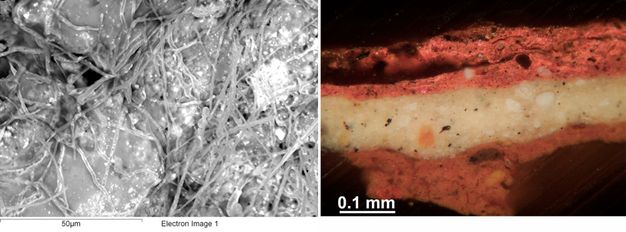
The painting was extensively documented and examined under visible light, UV radiation, and infrared reflectography (IR). The pigments were identified using scanning electron microscopy–energy dispersive X-ray analysis (SEM-EDX), and cross sections of samples taken from the painting were examined under a compound microscope. The examination using IR revealed pentimenti that showed changes to the positions of the hands and the sword itself. This helped in understanding not only the artist’s painting process but also what happened to the painting once it left the artist’s studio (for more on this, see Spear, Richard. 2006. “Antoine Dubost’s ‘Sword of Damocles’ and Thomas Hope: An Anglo-French Skirmish.” Burlington Magazine 148, no. 1241: 520–27.). Examination of the cross section and SEM-EDX of the underside of the ground (fig. 60.2) revealed that the fungus had infested not only the surface but also the lining fabric, glue layer, and original canvas support. It was thus important to remove the old lining and reline the painting.
Conservation Treatment
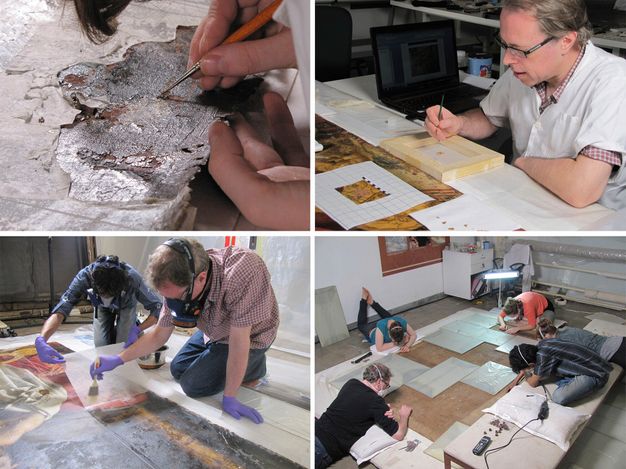
The fragile paint layer was faced using Beva 371 film and tissue to protect it during further conservation treatment; this replaced the temporary gelatin facing, which was removed before the technical study. The painting was then placed facedown and the old lining and glue layer removed mechanically by shaving it off the support. This process was painstakingly difficult due to the strong, rigid glue, which could not be dissolved or softened by any solvent. Tears were then mended and losses in the support filled.
A number of lining techniques were considered, while keeping in mind the local climate and the exhibition conditions under which the painting would be displayed. Glue-paste lining was eliminated due to the responsivity of the material to fluctuating RH and its propensity to fungal growth. Wax-resin lining was rejected because of its penetrative nature and, potentially, the excessive amount of material required to create a bond.
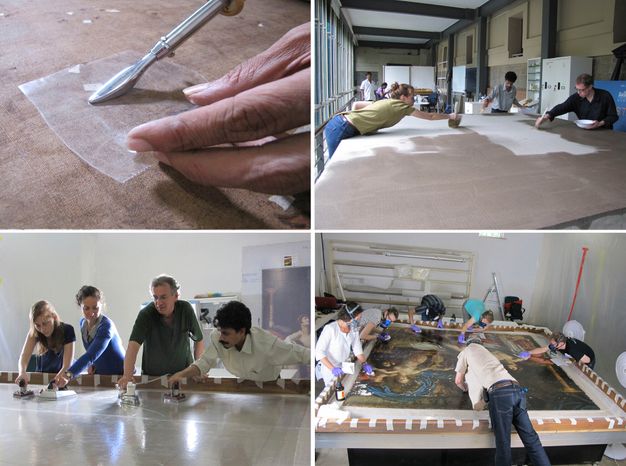
Beva 371 gel was used to reline the painting. The relative ease of application, its reversibility, and its potential to create a barrier against moisture (as suggested by the invited experts) made Beva 371 an apt choice for relining. Trevor Cumine, a specialist in the lining of oil paintings from the U.K., was specially invited to lead the lining process. Beva 371 was applied on the lining cloth and the back of the painting. A vacuum envelope was then created around the painting, and controlled, uniform heat was applied. Once the lining was complete, it was observed that the painting had become more flexible and the paint layer stable. The painting was then stretched and varnished, and paint losses were filled and retouched (figs. 60.3, 60.4). Finally, the painting was reframed, and it is currently on display.
Results
This project successfully conserved the painting and fostered global relationships with experts and institutes who consulted on the project. Some new innovations were formulated by the author to tackle difficult situations. For example, syringes with extended capillary tubes were used to inject consolidants where air pockets had formed between the support, ground, and paint layer. Manually inflated airbags were placed underneath the support. The air pressure introduced in the airbags helped to push the canvas toward the ground and paint layer. This ensured secure adhesion between the three layers of the painting without applying pressure directly on the paint layer from the top. Delaminated flakes were assembled using a net prepared with exceptionally fine monofilament threads.
The skill sets of both Indian and visiting conservators were widened. Both groups learned from their accumulated expertise how to further develop and adapt techniques and methodologies to their needs.
Case Study 2: Portrait of Henry Philip Hope
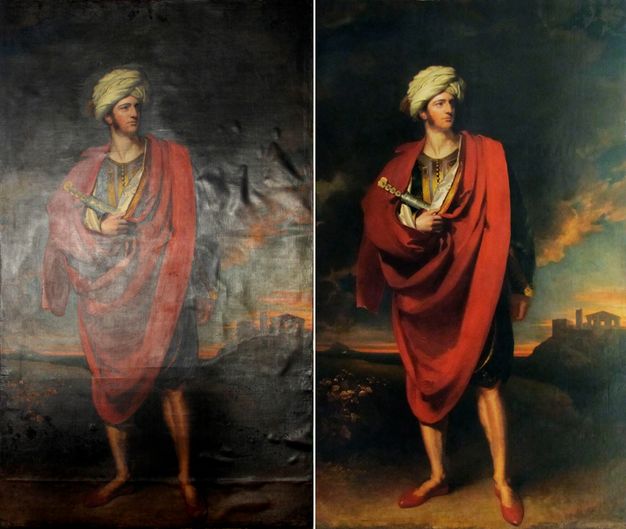
The early nineteenth-century Portrait of Henry Philip Hope, showing the subject in Ottoman costume, was painted by British artist Sir Thomas Lawrence and completed by Martin Archer Shee. This valuable piece of artwork was bequeathed to the museum by Sir Ratan Tata in 1921.
Condition and Conservation Status
At the time of its acquisition, this painting had already been lined with wax resin. The lined support was flexible but had started detaching at various places. Air pockets were observed from the front, and the painting had sagged considerably. Although most of the paint layer was in good condition, active flaking was noticed at the bottom area of the painting, where the sagging was most prominent. The old varnish layer had darkened and was not uniform.
Conservation Treatment
A detailed condition report was produced and a treatment plan devised in 2012. During this time, the painting was extensively documented and examined. The artist’s materials and process, as well as the painting’s current condition, were used to design the treatment plan.
The paint flakes were first consolidated and the darkened varnish removed. The fragile paint surfaces were faced locally using methyl cellulose. The painting was then placed facedown and the old lining and wax-resin layer removed using a combination of mechanical and solvent-based methods. When the old lining was being removed, it was found that the wax application was not uniform. The adhesive was soft and easy to remove. Once previous old patches had been removed, the painting was ready for lining.
Given the positive results of using Beva 371 for the Sword of Damocles, it was decided to follow the same process meticulously. The painting was hand-lined with Beva 371. The painting was then restretched, local facings removed, and paint losses filled, and the painting was varnished, retouched, and framed for display (fig. 60.5).
Conclusion
The experience gained from both these projects was stimulating. The deteriorations resulting from the different lining techniques used in the paintings’ respective pasts were diverse. These experiences encouraged the author to observe and monitor the behavior of other paintings in the collection. Damages were mapped in the collection more closely and with a new perspective. It was observed that paintings lined using glue-paste adhesives undergo regular dimensional changes with changing seasons, whereas others show different problems, and paintings on panel have altogether distinct structural conservation issues. This understanding raises further questions with respect to conservation interventions at CSMVS: Should conservators follow the often recommended policy of wait, watch, and monitor, and treat only those paintings that have begun to show signs of deterioration? Or should paintings be conserved using materials and techniques more suitable to Mumbai weather before any future damage occurs?
Based on our local environment, we should strive for a balance and adapt both new techniques and traditional old methods that have stood the test of time. Through various national and international collaborations, CSMVS has taken the initiative to take experts’ opinions on these issues and draw a conservation plan to safeguard our collection.