The paper outlines the contribution of the Neapolitan tradition to the structural conservation of paintings on canvas. It is possible to trace the existence in the eighteenth century of diversified practices, which included the use of temporary stretchers for lining. It also defines the mesticatori-foderatori (fillers-liners), professionals who specialized in the preparation of new canvases for painting and the lining of old ones. A profound knowledge of the materials of painting during the nineteenth century in the Museo Borbonico advised extreme caution in interventions on glue-tempera paintings by Parmigianino and Bertoja, which were not lined but equipped with additional canvases. The use of transfer has been practiced since the eighteenth century in Naples but has been consciously avoided in the nineteenth century in the museum and only put into practice at the beginning of the twentieth century, with questionable results. In the second half of the twentieth century, an improvement to traditional lining techniques was found by Antonio De Mata, who developed an effective procedure for the preventive consolidation and lining of paintings on canvas that reduced the risks of humidity. With due caution, this method continues to be effective in many cases.
5. The Lining of Paintings on Canvas in Naples
- Angela Cerasuolo, Head of Restoration Department, Museo e Real Bosco di Capodimonte, Naples
Introduction
The intention of this paper is to outline the important contributions made by the Neapolitan tradition of structural conservation of paintings on canvas, the history of which remains little known. Knowledge of this tradition has increased over the past twenty years thanks to studies that have brought to light many documents presented during two conferences held in the Capodimonte Museum in 1999 and 2007 (Catalano, M. I., and G. Prisco, eds. 2003. Storia del restauro dei dipinti a Napoli e nel Regno nel XIX secolo, proceedings of the International Symposium, in Bollettino d’Arte, special issue.; D’Alconzo, P., ed. 2007. Gli uomini e le cose: Figure di restauratori e casi di restauro in Italia tra XVIII e XX secolo. Proceedings of the National Symposium. Naples: Clio Press.. These studies made it possible to compare elements from the examination of the paintings themselves, elucidating the contents of the documents and allowing an understanding of the methods employed.
A number of interesting elements were thus brought to light, such as the distinction—as early as the eighteenth century—between the “artistic” operations of cleaning and retouching and those of lining/consolidation, which were entrusted to the “liner” rather than to the “restorer.” The studies highlighted the existence in the eighteenth century of diverse practices in the museums, often limited to cautious interventions, together with an awareness of the specificity of the materials involved. Traditionally, animal glue and flour paste were almost exclusively the materials employed to consolidate the paint layers and line the canvases throughout the period under consideration.
These studies also identified the presence of certain “professionals” who specialized in the preparation of new canvases for painting and in the lining of old ones. The history of the Chiariello, a family of mesticatori-foderatori (fillers-liners) from the eighteenth to the twentieth century, is of particular interest.
Telaioli and Foderatori: First Evidence of Lining Practices
The history of the profession of foderatore (liner) in Naples sits at the intersection of craft, art, and profession, and it is here where the definition of the discipline of conservation-restoration unfolds.
In 1960, Raffaello Causa, the renowned art historian who in the 1970s and 1980s would direct the soprintendenza for the Historical and Artistic Heritage of Naples, and who at that time headed the restoration laboratory of the Capodimonte Museum, highlighted this aspect by observing how in our city the conservation of paintings on canvas had been guaranteed by means of “an indisputable skill—and we would like to say a reckless ease—with which the lining of the canvases was performed here in Naples, an operation widely practiced by local restorers” (Causa, R. 1960. “Introduction.” In IV Mostra di restauri. Naples: L’ Arte Tipografica.).
In fact, it is possible since at least the eighteenth century to trace the evidence and documents relating to the practice of rintelaggio or foderatura: the consolidation of deteriorated textile supports carried out by gluing these onto a new canvas. We also find that such activities were performed early on by a particular figure, the telaiolo,1 or manufacturer of canvases for painting, who would also repair damaged canvases if required.
One of these craftsmen was Giuseppe Maria Ranzenò, known as il Filosofo (the Philosopher), who as early as 1726 was paid for “due tele imprimate” (two primed canvases) (Pavone, M. A. 1994. “Pittori napoletani del’700: Nuovi documenti.” Documentary appendix, edited by U. Fiore. Naples: Liguori.). In 1740, he supplied some cases of canvas to the Reale Arazzeria, established by Charles of Bourbon, which produced many splendid tapestries for the royal residences (Siniscalco, M. 1979. “Documenti sui pittori Gennaro Pierri, Clemente Ruta, Luigi Restile, Fedele Fischetti, Giacomo Cestaro, Girolamo Storace, Antonio Sarnelli, Francesco Celebrano e sugli incisori Filippo Morghen e Pietro Campana: Sulla Arazzeria e sui Palazzi reali di Portici e Caserta.” In Le arti figurative a Napoli nel Settecento (Documenti e ricerche), edited by N. Spinosa, 269–99. Naples: Società Editrice Napoletana.). The Arazzeria was based in Via San Carlo alle Mortelle, together with the Pietre Dure laboratory, in the same location where the Art Academy would soon be born.
Other testimonies regarding the activity of the Arazzeria between 1761 and 1768 clarify the specificity of Ranzenò’s profession. This information is found in a collection of documents published in 1979 as part of a campaign of wide-ranging research aimed at reconstructing the various and multifaceted artistic activities of the eighteenth century, thanks to a group of historians whose scholarship would come together to give rise to the great Civiltà del Settecento a Napoli exhibition in Naples (December 1979–October 1980) (Catalano, M. I., and G. Prisco, eds. 2003. Storia del restauro dei dipinti a Napoli e nel Regno nel XIX secolo, proceedings of the International Symposium, in Bollettino d’Arte, special issue.; Spinosa, Nicola, ed. 1979. Le arti figurative a Napoli nel Settecento (Documenti e ricerche). Naples: Società Editrice Napoletana.).
In the Reale Arazzeria, several painters, including Girolamo Storace, Giuseppe Bonito, and Orlando Filippini, were engaged to create oil paintings that served as a guide to tapestry weaving (fig. 5.1). Ranzenò supplied them with prepared canvases on which to make their models, and for this reason in the documents he is called “mesticatore” (Siniscalco, M. 1979. “Documenti sui pittori Gennaro Pierri, Clemente Ruta, Luigi Restile, Fedele Fischetti, Giacomo Cestaro, Girolamo Storace, Antonio Sarnelli, Francesco Celebrano e sugli incisori Filippo Morghen e Pietro Campana: Sulla Arazzeria e sui Palazzi reali di Portici e Caserta.” In Le arti figurative a Napoli nel Settecento (Documenti e ricerche), edited by N. Spinosa, 269–99. Naples: Società Editrice Napoletana.), from mestica, the mixture with which the canvases were prepared for painting. But we also find him at work in other activities closely related to those of the painters active for the Arazzeria, which he assisted with all aspects relating to the preparation of the supports.
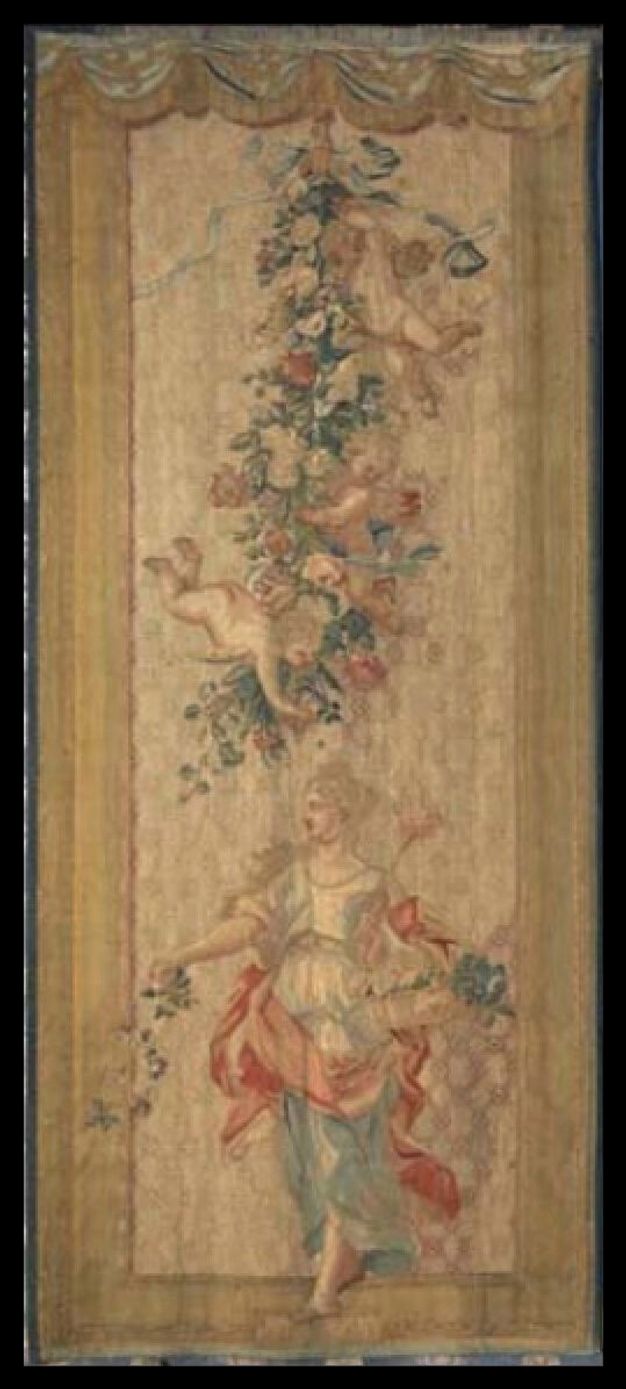
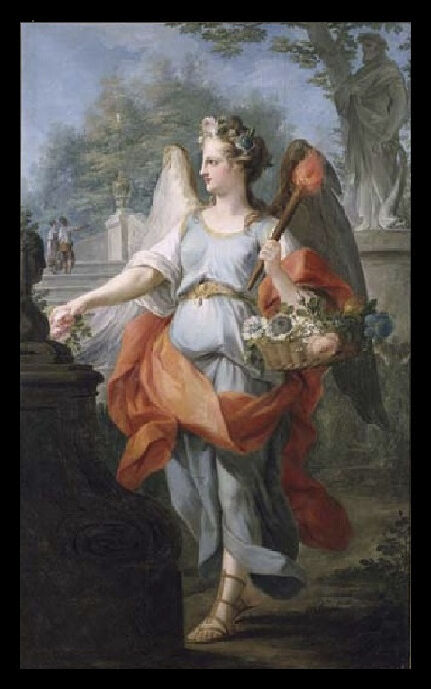
A payment note dated 1763 describes the variety of these supplies. It refers to a “canvas for painting made by Giuseppe Maria Ranzenò called the Philosopher, ordered by the Court Painter D. Giuseppe Bonito to make the frieze of the tapestry by the painter Filippini,” and the canvas is described as “with its good stretcher with the crossbar, prepared with priming the color of lead white” (Spinosa, Aurora. 1979. “Ancora sul Laboratorio di Pietre dure e sull’Arazzeria: I documenti dell’Accademia di Belle Arti di Napoli.” In Le arti figurative a Napoli nel Settecento (Documenti e ricerche), edited by Nicola Spinosa, 325–84. Naples: Società Editrice Napoletana.).
A real restoration is then described of two old modelli for the frieze. Orlando Filippini was in charge of painting the patterns for the floral friezes that adorned the tapestries, the main “stories” of which were then entrusted to Bonito. Indeed, in 1768, the same Ranzenò would still declare he had supplied Filippini with the canvases on which to paint “the flowers for the friezes” (Spinosa, Aurora. 1979. “Ancora sul Laboratorio di Pietre dure e sull’Arazzeria: I documenti dell’Accademia di Belle Arti di Napoli.” In Le arti figurative a Napoli nel Settecento (Documenti e ricerche), edited by Nicola Spinosa, 325–84. Naples: Società Editrice Napoletana.). Evidently, sometimes these oil paintings that served as modelli for the friezes were reused, and this explains the restoration of the “old modello for the frieze” mentioned in the note of 1762: “It has been lined with a single piece of fine canvas and it has been filled in many areas having first flattened it on a larger stretcher; then it was attached to its own stretcher that was in the Arazzeria” (Spinosa, Aurora. 1979. “Ancora sul Laboratorio di Pietre dure e sull’Arazzeria: I documenti dell’Accademia di Belle Arti di Napoli.” In Le arti figurative a Napoli nel Settecento (Documenti e ricerche), edited by Nicola Spinosa, 325–84. Naples: Società Editrice Napoletana.).
The lining procedure is described here with details rarely found in the sources. The document indicates the type of canvas used: “fina” (fine, or thin) and “a single piece” (that is, without seams). It describes the use of a stretcher that we would now call temporary: larger than the original one, prepared specifically for the lining procedure. And it tells us that the lined painting was then placed back on its original stretcher.
We also learn that Ranzenò filled the gaps with “stucco” (filler), and we therefore learn that this phase of the restoration was carried out by the liner himself. In fact, the stucco used at the time for these reparations was of a nature closely related to the mestica—a mixture of oil and pigments with which new canvases were prepared for painting (applied over a layer of animal glue plus other ingredients such as flour, starch, and sugar). And as mentioned, Ranzenò is described precisely as a mesticatore. The profession of one who prepares canvases for painting was evidently already well defined at the time and closely linked to that of the supplier of canvases and stretchers—and finally to that of a liner and repairer of canvases. The profession is what we would call restorer, but it was at the time—and for a long time after—reserved for the operations considered more “noble”: the “restoration” was the pictorial one, of the painting surface, and the specific task of the artist. It was not yet autonomous.
Paradoxically, however—precisely because it belonged to a subordinate profession that lacked pretensions to artistry—the type of restoration that we would call conservative, related to the mending and lining of the canvas, already appears in the mid‑eighteenth century with characteristics and methods that have been perpetuated (with necessary adjustments), up to the present day.
The Eighteenth-Century Restorations for the Royal Museum
In 1758 and 1759, Ranzenò was engaged in the restoration of the paintings from the Royal Collection housed in the Palace of Capodimonte, where he directed two stiratori (ironers), Nicola di Mauro and Pasquale Senzapaura, who in this case worked exclusively on the repairing and relining of canvases (Filangieri di Candida, A. 1902. “La Galleria Nazionale di Napoli (Documenti e ricerche).” In Le Gallerie Nazionali Italiane, vol. 5, 208–354. Rome: Ministero della Pubblica Istruzione.).
In these years, Father Giovanni Maria della Torre was the custodian of the Farnese Collection in the palace, and in charge of setting up the gallery. In a letter in which he gives an account of the work on the paintings, he describes the intervention of the ironers as follows: “The accomodamento [repair] of them consists in tensioning again, repairing, and changing the canvases, and working on them. All this is carried out by manuali [skilled workers].”2
There is a further subdivision of the work. “The other part of the accomodamento consists of filling the holes of which there are many, making good the flaking […] with the utmost diligence and skill by means of the stucco a colore [colored filler].”3 This operation is assigned to Andrea Liano, an artist of limited prestige who dedicated himself to the diligent repair of paint losses, recovering the unity of the paintings; as a result, they are deemed “so perfect that they do not require anything further.”4 Although it is difficult to identify with certainty restorations of this historical moment and situation, we can very frequently identify paintings that contain traces of restorations dating back to the eighteenth century in which the losses are filled with a material composed of oil and earth pigments, completely similar to the preparation applied on the canvases at the time. We can imagine that this phase, carried out with care, effectively recovered the material—and even chromatic continuity, to a certain extent—of the painting.
In contrast to the assessment of the accomodamento, the artistic restoration, entrusted to the court painter Clemente Ruta, is questioned by della Torre, who reports the critical opinion of the connoisseurs (Intendenti): “I therefore do not see what else is desirable for these same paintings, and consequently I do not see any need for the painter D. Clemente Ruta to bring them to the Royal Palace of Naples, if not to give them a brushstroke or two, or some varnish, which in the opinion of all the Intendenti is to alter the old paintings.”5
A distinct intermediate activity was therefore taking shape—if not conservation, exactly, perhaps adjusting or repairing—a field of action somewhere between lining and artistic restoration in which both Ranzenò and his collaborator Senzapaura—the latter also called the Philosopher in his turn—were involved. Between 1762 and 1775, the two were engaged in the restoration of the copper paintings by Domenichino, Ribera, and Stanzione in the Cappella del Tesoro of San Gennaro in Naples Cathedral. The restoration of the paintings on copper would have included a cleaning but also probably consolidation of the flaking layers of paint, a consistently recurring conservation problem throughout the history of the numerous interventions on the seven great altarpieces (Cerasuolo, A. 2010. “I rami della Cappella del Tesoro: Note sulla tecnica esecutiva e sulle vicende conservative.” In Napoli e l’Emilia: Studi sulle relazioni artistiche, atti del convegno internazionale di studi, Santa Maria Capua Vetere (CE), 28–29 maggio 2008, edited by A. Zezza, 105–29. Naples: Luciano Editore.).
A few years later we see the emergence of the telaiolo Pasquale Chiariello, the first exponent of a family of restorers whose names we meet over a very broad span of time, from the late eighteenth to the second half of the twentieth century. In 1796, the latter supplied prepared canvases to the painter Tischbein: “Six tele impresse were delivered by the telajolo Pasquale Chiariello to the Director of the Royal Academy of Painting, D. Guglielmo Tischbein, to paint figures on them” (Cerasuolo, A. 2007. I Chiariello. Sulle tracce di una genealogia familiare per la storia del mestiere di foderatore a Napoli, atti del convegno Lecce 17–19 novembre 2006, edited by Regina Poso, 25–41. Galatina: Congedo.). From that date until almost to our own times, the activity of the Chiariello family as manufacturers of canvases and as liners unfolds seamlessly. From 1826 to 1828, we find repeated references to the “foderatori Raffaele e Antonio Chiariello” engaged in work for the preparation of the Real Museo Borbonico (Catalano, M. I. 2007. “Telaiuoli e quadrari a Napoli nel Settecento.” In Gli uomini e le cose: Figure di restauratori e casi di restauro in Italia tra XVIII e XX secolo, Proceedings of the National Symposium, edited by P. D’Alconzo, 103–17. Naples: ClioPress.).
In the 1820s, in preparation for the opening of the museum in the rooms of the Palazzo degli Studi (the current Museo Archeologico Nazionale di Napoli), an intense campaign of restorations was undertaken, for which many important documents have survived, such as notes drawn up in order to estimate the necessary expenses (D’Alconzo, P. 2003. “Restauri e restauratori di dipinti nel Real Museo Borbonico negli anni venti dell’Ottocento.” In Storia del restauro dei dipinti a Napoli e nel Regno nel XIX secolo, Proceedings of the International Symposium, edited by M. I. Catalano and G. Prisco, 141–67. Bollettino d’Arte, special issue.). For the “canvas paintings of the Neapolitan School,” a summary table lists the paintings (thirty-two works, including ones by Jusepe de Ribera, Luca Giordano, Salvator Rosa, and Aniello Falcone) and links them over three columns to the list of operations envisaged: “Foderatura e tutt’altro occorre al completo” (Lining and anything else is needed in full), “Spianatura a colla e rassetto in telaro” (Glue leveling and rearrangement on the stretcher), and “Telari a zeppe” (Stretchers with wedges)6 (Cerasuolo, A. 2008. “Dalla Galleria dei Pittori napoletani al Museo di Capodimonte. Sul restauro dei dipinti napoletani del XVII e XVIII secolo.” In Museo di Capodimonte, Dipinti del XVII secolo: La scuola napoletana, edited by Nicola Spinosa, 24–42. Naples: Electa Napoli.).
The operations described in the first two columns are obviously alternatives. In fact, in less serious cases, in place of the lining, only the spianatura operation would be performed. From other documents we can better understand what this “flattening” consisted of: the consolidation of the paint layers carried out by applying animal glue—the “strong glue” traditionally used for this purpose and also used for the lining—on the reverse of the canvas, without removing the painting from the stretcher, and then ironing it in this way.
The application on a new stretcher, “a zeppe”—that is, with triangular wedges that allow the canvas to be put back under tension—is almost systematically proposed for lined paintings but could occasionally also be carried out for those subjected to “flattening” only7 (Cerasuolo, A. 2008. “Dalla Galleria dei Pittori napoletani al Museo di Capodimonte. Sul restauro dei dipinti napoletani del XVII e XVIII secolo.” In Museo di Capodimonte, Dipinti del XVII secolo: La scuola napoletana, edited by Nicola Spinosa, 24–42. Naples: Electa Napoli.).
For example, an expense report for the treatment of Ribera’s Drunken Silenus, describes the operation as follows: “flattening from the front of the painting, glue on the back, stretched onto the new frame and fully adjusted.”8
It is interesting to observe that diversified practices are adopted but always implemented with materials compatible with those originally used, and at the same time to note that harmful practices were not employed, even though they were widespread in other contemporary contexts, especially in northern Europe. Such practices include the application of beveroni (Conti, A. 2007. A History of the Restoration and Conservation of Works of Art. Translated by Helen Glanville. London: Taylor and Francis.), oily substances of various natures applied to the reverse of canvases in order to consolidate and revive their colors—which, however, over time caused irreversible darkening of the tones and contraction of the pictorial layers.
For the Real Museo of Naples also, we see that both the lining and the operations relating to the carpentry of the paintings on panel were practiced by professional figures distinct from the “restorers” who were entrusted with the operations deemed more noble, namely, cleaning and pictorial restoration. The work of these operators was often assessed separately, although sometimes the payment was made through the party who took care of the “artistic” part of the intervention (Cerasuolo, A. 2008. “Dalla Galleria dei Pittori napoletani al Museo di Capodimonte. Sul restauro dei dipinti napoletani del XVII e XVIII secolo.” In Museo di Capodimonte, Dipinti del XVII secolo: La scuola napoletana, edited by Nicola Spinosa, 24–42. Naples: Electa Napoli.).
A Family Tradition: The Chiariello
In the middle of the nineteenth century, we meet Francesco Chiariello, who was working for the Real Museo. He was an important person who proudly claimed the rights of the profession of telaiolo. Chiariello became very popular among Neapolitan artists of the time, acquiring a singular reputation and importance—so much so that he is remembered by various writers as an authoritative adviser. In the memoirs of the life of the painter Bernardo Celentano, written by his brother Luigi, for example, we find many references to him. Bernardo buys his canvases from Chiariello—indeed, in a letter from Rome he considers the possibility of having a large canvas sent from Naples, and we learn the address of his shop, in Via Fosse del Grano, in the neighborhood called Museo. An unusual episode then shows the ease with which Chiariello offers himself to help the novice artist Bernardo in solving a problem of perspective, involving for this purpose a very young Domenico Morelli (Cerasuolo, A. 2007. I Chiariello. Sulle tracce di una genealogia familiare per la storia del mestiere di foderatore a Napoli, atti del convegno Lecce 17–19 novembre 2006, edited by Regina Poso, 25–41. Galatina: Congedo.).
A lively description by Vittorio Imbriani also allows us to identify the portrait of Francesco Chiariello—called by the diminutive Ciccio—in a gentleman depicted by Giovanni Ponticelli in the historical painting The Convalescent Cavalier Bajardo, presented in 1867 at the exhibition Quinta Promotrice Napoletana (fig. 5.2). Imbriani produced a booklet to accompany the exhibition (which is later cited by the eminent historian and philosopher Benedetto Croce), and it includes a description of the telaiolo: “Ciccio Chiariello, the medal-winning telaiuolo who supplies canvas to all the painters of Naples, richly disguised as an Italian gentleman of the times, is observing the scene” (Cerasuolo, A. 2007. I Chiariello. Sulle tracce di una genealogia familiare per la storia del mestiere di foderatore a Napoli, atti del convegno Lecce 17–19 novembre 2006, edited by Regina Poso, 25–41. Galatina: Congedo.).
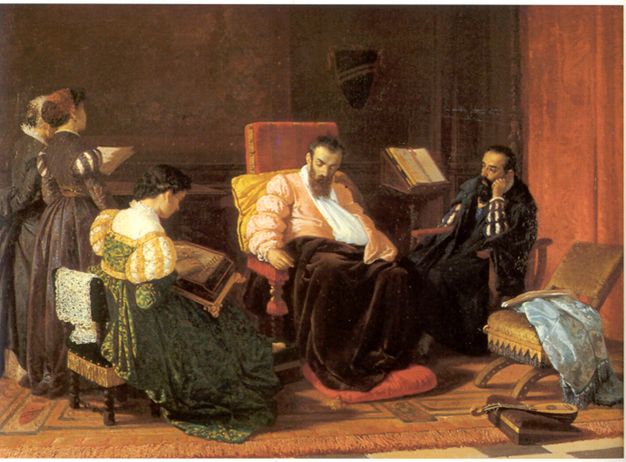
The telaiolo referred to in the description clearly highlights the characteristics that make his figure singular, in some way unique, in the nineteenth-century Neapolitan artistic scene: he provides canvas “to all the painters of Naples,” and he is so highly thought of as to be honored with awards.
Francesco Chiariello had in fact received a silver medal as a prize in the Solenne Mostra Industriale of 1853, the last of the major biannual exhibitions dedicated to the products of the National Industry of the Bourbon Kingdom. These exhibitions, held by the Reale Istituto d’Incoraggiamento, were aimed at encouraging entrepreneurs’ initiative and supporting the manufacturing activities that had once been promoted and financed by the royal court.
The exhibition of 1853 divided the exhibits into five categories: Chiariello exhibited his “tele buone da dipingere” (good canvases for painting) in the class collectively described as “different objects” and was awarded the Silver Medal “for the improvement of canvases for painting,” as we read in the relative Disamina, a report of the examination made by the commission of the Reale Istituto. After an interesting excursus on the various types of canvas congenial to the different inclinations of the artists, the “artiere Chiariello” is praised for his ability to prepare canvases of various fabrics and preparations “corresponding to the wishes of our painters” (Reale Istituto d’Incoraggiamento. 1855. Disamina eseguita dal Reale Istituto d’Incoraggiamento de’ saggi esposti nella solenne mostra industriale del 30 maggio 1853. Naples: Reale Istituto d’Incoraggiamento.; see also Cerasuolo, A. 2007. I Chiariello. Sulle tracce di una genealogia familiare per la storia del mestiere di foderatore a Napoli, atti del convegno Lecce 17–19 novembre 2006, edited by Regina Poso, 25–41. Galatina: Congedo.).
In this context, the social elevation of the “craftsman Chiariello” suggests a new awareness of the dignity of the artisan craft and the value of entrepreneurial skills, and speaks to the personal esteem and friendship of the artists to whom he supplied the “good canvases”—a guarantee of the durability of their works.
Francesco was evidently proud of these medals, so much so that in a plea presented to the king to claim his rights as “manufacturer of canvas for painting, and liner of paintings,”9 he cited the entire text praising him that lay behind his award from the Reale Istituto. In his plea, he asked to be named “Foderatore del Real Museo Borbonico” and claimed as his right—“acquired with great labor”—the exercise of the profession of liner. He also complained that “often restorers”—clearly those who dealt with “artistic” restoration—“allow themselves, to the detriment of art, to put onto canvas paintings that should by rights have been handed to the petitioner.” In addition to the services already offered to the Real Museo, he cited as a credential the “large silver medal” won in the public exhibition.
Francesco Chiariello’s familiarity and friendship with Neapolitan artists—foremost among these Domenico Morelli and Giuseppe Palizzi—would be testified to, at a much later date, by the certificates his son Pasquale obtained in order to promote the elevation in his social status. This enterprising son, in fact, succeeded in obtaining a further prestigious award from King Vittorio Emanuele III in 1901: the concession to “display the Royal Crest on the sign of his studio,” which together with the medals won in public exhibitions would prominently feature on his letterhead (fig. 5.3).
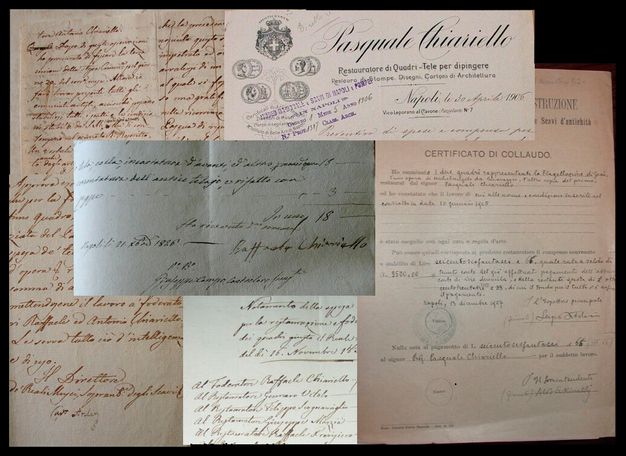
Permission to display the royal crest was gained thanks to an impressive list of accolades by the best-known artists and scholars of the time. Reference letters were signed between 1896 and 1900 by Domenico Morelli, Filippo Palizzi, Giulio De Petra, Vittorio Spinazzola, and Vincenzo Caprile; a group of professors from the Royal Institute of Fine Arts signed a collective document that reads, “for a long time . . . the paintings in need of lining or restorations are entrusted exclusively to him either at the Real Istituto di Belle Arti or by the Museo Nazionale, the Museo di San Martino, and the Pinacoteca Reale of Naples.”10
These letters also refer to Pasquale’s father, and it is emphasized that the son, in the excellence of the results, “even surpassed Francesco Chiariello himself, who was his father and teacher, and was the first in this genre.” They further highlight that “Chiariello always successfully maintained the name of his father as the first preparer of canvases for painting,” and on the quality of these canvases they add interesting observations: “These canvases of special and varied preparations have the characteristics of excellent fabrics, the right amount of material and aging, so that they are not subject to cracking, and the painting that the artist executes on it does not alter with time, as is often seen with poorly prepared and improperly aged canvases.”11
The emphasis is therefore placed on a direct relationship between the guarantee of durability ensured by the excellence of the products prepared by Chiariello and his ability to restore this durability to damaged old paintings.
Knowledge of Materials and Careful Interventions
To great expertise in the practice of lining, Neapolitan liners added a profound knowledge of the materials of painting, which during the nineteenth century advised extreme caution in interventions. We have found evidence—both material and documentary—of interesting interventions in the case of two glue-tempera paintings: Parmigianino’s Holy Family and Bertoja’s Virgin and Child (figs. 5.4, 5.5), respectively (Cardinali, M, M. I. Catalano, A. Cerasuolo, and M. B. De Ruggieri. 2002. “Sulla Sacra Famiglia del Parmigianino: Cautele ottocentesche per una tecnica particolare.” In Parmigianino e il manierismo europeo, atti del convegno internazionale di studi, Parma 13–15 giugno 2002, edited by Lucia Fornari Schianchi and Cinisello Balsamo, 209–12. Milan: Silvana.). Both interventions are notable in their sensitive attention to the behavior of the materials involved. In these two beautiful canvases, the rare qualities provided by the medium have been preserved thanks to the care taken, which ensured their good conservation, and which is still effective today.
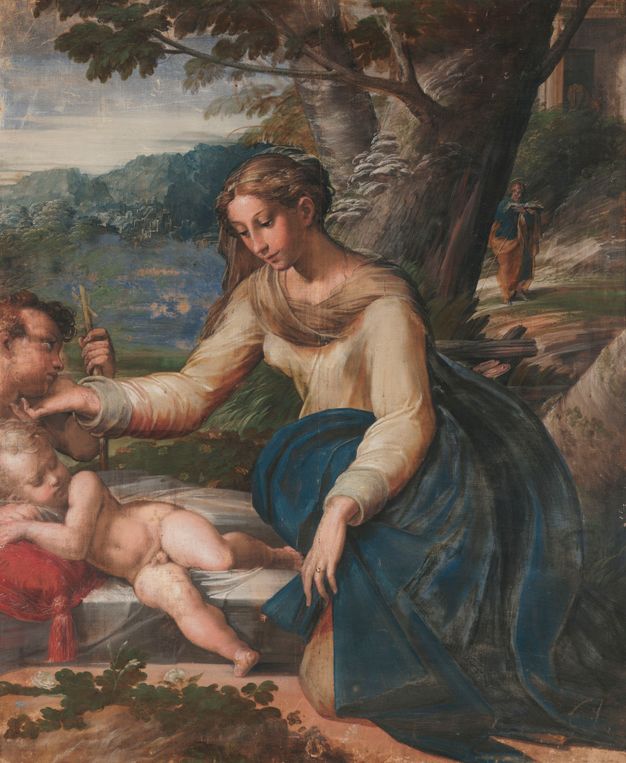
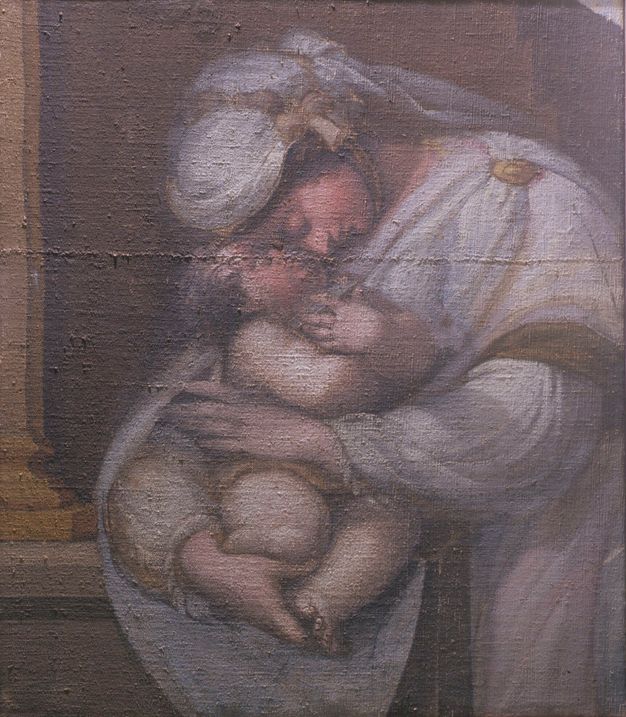
A document signed by the restorer Pasquale Chiariello and dated September 6, 1899, lists the “lining works” he carried out in the National Museum of Naples. In the same list, it is specified that the paintings defined as guazzi (glue-tempera paintings) “were only put behind glass and ‘conditioned’ in order to avoid further damage.”12
The examination of the paintings revealed that the canvases of the Bertoja and of the Parmigianino were not lined but equipped with an additional canvas: both have been “conditioned” in a similar way: using a densely woven fabric, not glued, but only stretched on the reverse for protective purposes, and fixed to the edges with nails that also tension the original canvas (fig. 5.6).
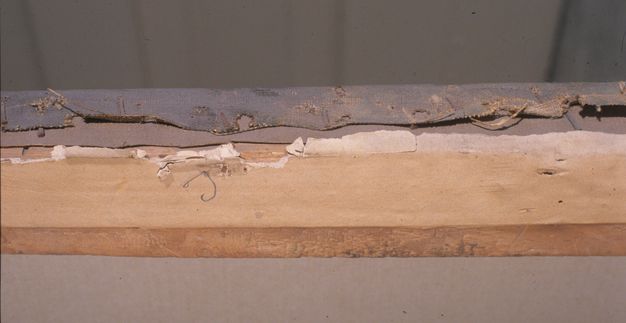
The edges of the canvases were fixed with strips of wood nailed along the perimeter to the stretcher and then wrapped with a glued paper. The stretchers, from different and unspecified periods—that of the Parmigianino is older and could be original—are of the fixed type.
Glue-tempera makes colors look soft and light and is easily spoiled by the application of varnish or oily materials. In fact, glue, although relatively strong as a binder, does not form a continuous, even film on the surface, which therefore is quite porous. As a result, the colors once dried appear lighter and less saturated than when wet (Cerasuolo, A. 2017. Literature and Artistic Practice in Sixteenth-Century Italy. Brill’s Studies in Intellectual History. Boston: E. J. Brill.; Cerasuolo, A. 2019. “The Parable of the Blind and The Misanthrope: Glue-tempera Technique in Bruegel’s Canvases in Capodimonte.” In Bruegel: The Hand of the Master: Essays in Context, edited by A. Hoppe-Harnoncourt, E. Oberthaler, S. Pénot, M. Sellink, and R. Spronk, 64–77. Belgium: Hannibal.).
A conscious and attentive protective intervention driven by the same care was taken with the two Tüchlein by Bruegel, which were placed under glass as a preventive measure, rejecting the choice of more invasive interventions so as not to distort the optical qualities of the medium (Cerasuolo, A. 2017. Literature and Artistic Practice in Sixteenth-Century Italy. Brill’s Studies in Intellectual History. Boston: E. J. Brill.; Cerasuolo, A. 2019. “The Parable of the Blind and The Misanthrope: Glue-tempera Technique in Bruegel’s Canvases in Capodimonte.” In Bruegel: The Hand of the Master: Essays in Context, edited by A. Hoppe-Harnoncourt, E. Oberthaler, S. Pénot, M. Sellink, and R. Spronk, 64–77. Belgium: Hannibal.).
The documents testify to a remarkable awareness of the conservation problems posed by these works, which resulted in efforts of a purely conservative nature, thus avoiding the risks entailed by intrusive interventions. In 1846, Camillo Guerra, a professor of painting, wrote to the director of the museum reporting on the poor condition of the two Bruegels. In an 1847 document in reference to one of the two paintings, he wrote that “as it is painted in glue-tempera it is more easily subject to deterioration.” On May 13, 1853, the Commissione dei Restauri (the commission of artists who supervised restorations at the museum) took the decision “to put behind glass the two tempera paintings by Pieter Bruegel, which are kept in the Dutch school” (Cerasuolo, A. 2019. “The Parable of the Blind and The Misanthrope: Glue-tempera Technique in Bruegel’s Canvases in Capodimonte.” In Bruegel: The Hand of the Master: Essays in Context, edited by A. Hoppe-Harnoncourt, E. Oberthaler, S. Pénot, M. Sellink, and R. Spronk, 64–77. Belgium: Hannibal.).
The Transfer: Ancient Testimonies and Dangerous Practices
Another important aspect of the caution shown by the museum administration concerns the practice of transfer, which was consciously avoided in the nineteenth century in the Museo Borbonico thanks to the awareness of its dangers. We find a clear testimony of this in a document dated 1810: Michele Arditi strongly opposed Paolino Girgenti, who wanted to transfer the Strage degli Innocenti, by Andrea Vaccaro, in order to eliminate the imperfection caused by the seam joining the two pieces of canvas (D’Alconzo, P., and G. Prisco. 2005. “‘Restaurare, risarcire, supplire’: Slittamenti semantici ed evidenze materiali: Alle origini di una ‘vernice’ per i dipinti vesuviani.” Bollettino dell’Istituto Centrale del Restauro, no. 10–11: 3–87.).
The practice of transfer was carried out very early in Naples, since at least the eighteenth century. In 1742, Bernardo De Dominici recounted the skill of two Neapolitan artists, Nicolò di Simone and Alessandro Majello, who specialized in the transfer of flaking paintings on panel onto canvas supports (De Dominici, B. (1742–43). 2003–14. Vite de’ pittori, scultori ed architetti napoletani. Vol. 2, edited by F. Sricchia Santoro and A. Zezza. Naples: Paparo., cited in Conti, A. 2007. A History of the Restoration and Conservation of Works of Art. Translated by Helen Glanville. London: Taylor and Francis.).
The restoration of a painting by Fedele Fischetti, Noli me tangere, from the Church of Santa Caterina da Siena (fig. 5.7a), in 1998,13 enabled us to examine a material example of a partial transfer procedure, probably carried out by the artist himself during the execution of the painting, which can be traced back to 1766–67. There are documents that refer to Fischetti’s activity as a restorer (Nappi, E. 1984. “Le chiese dei Gesuiti a Napoli.” In Seicento napoletano: Arte, costume, ambiente, edited by R. Pane, 318–37. Milan: Ed. di Comunitá.), but in this case it was possible to verify the procedure carried out long ago directly on a painting.
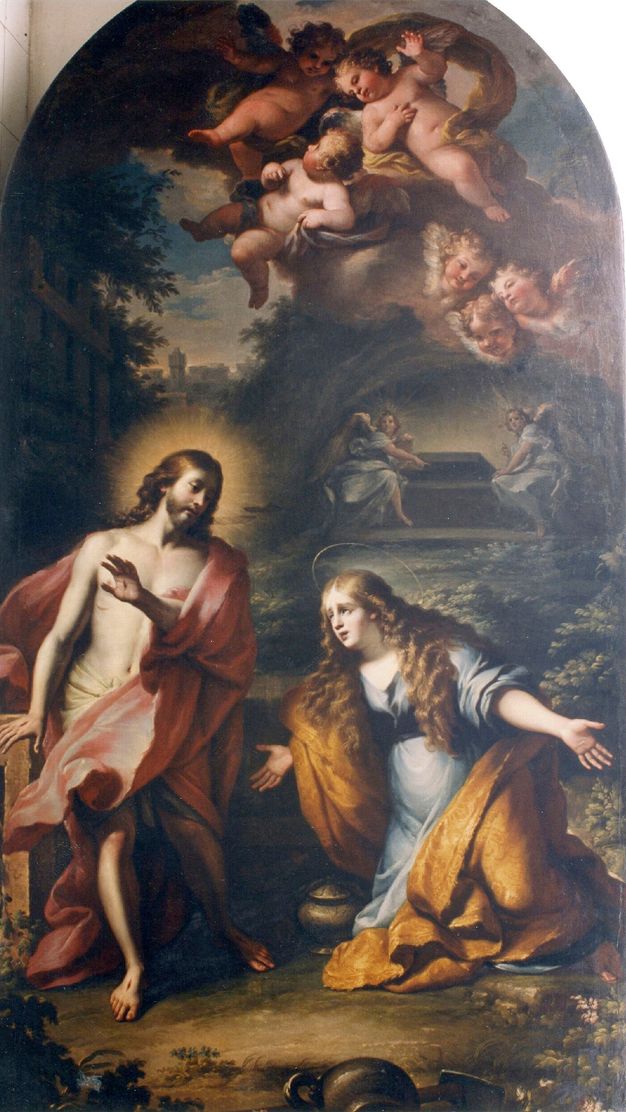
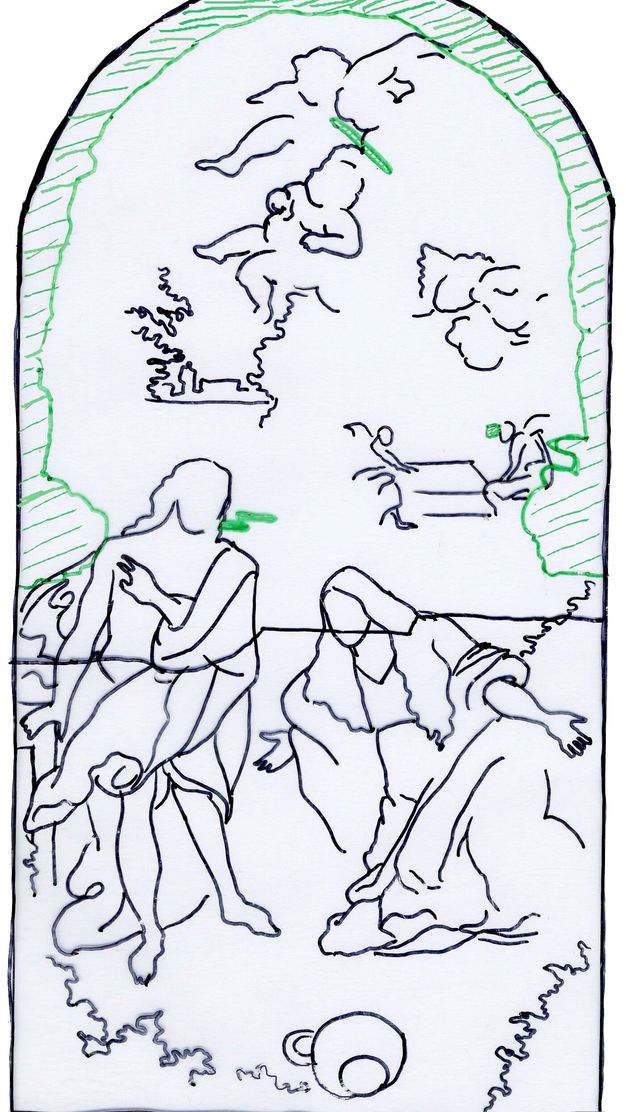
Observation in raking light before restoration showed a clear difference in the surface of the lower part of the painting, which was smoother and more adherent to the canvas, while in the upper part, lifting of the poorly adhering paint layers was visible.
The painting appeared to have been lined a long time ago, and the adhesion of the lining canvas was no longer effective. But when the restorer proceeded to remove the lining canvas, she realized that in reality only the lower part retained the original canvas, while in the upper part the pictorial layers were glued directly to the canvas applied during the old restoration.
Evidently—probably following an accident—the painter needed to restore his own painting, which was adhering poorly to the canvas. He then removed the canvas from the affected part and glued to it a new canvas of a very similar weave to the original, while throughout the lower part he continued gluing over the earlier canvas where it had not been necessary to remove it.
The fact that the intervention was carried out by the artist himself is deduced from the nature of the canvas and from the fact that the gaps in the upper part are filled with an oily mixture quite similar to the original, applied from the back—underneath the lining canvas—and the color applied on the front over these fillings is similar to the original in the handling of the brushstrokes and color scheme, but slightly obscured in these areas. Figure 5.7b shows the areas affected by these “integrations.”
The practice of transfer—often claimed by restorers to be a secret capable of saving deteriorated paintings—causes more problems than it solves, as is now well understood. Although in the nineteenth century it was banned during restoration at the Real Museo Borbonico, it was unfortunately no longer avoided in the early twentieth century. In the years leading up to the 1960s, the transfer of easel paintings was considered a way of giving paintings greater durability (much like the strappo technique used with frescoes), so much so that it was also approved by rigorous ministerial circulars, and indeed it was practiced repeatedly, with questionable results. If the operation could have been carried out without very serious consequences for Neapolitan seventeenth-century paintings, which are characterized by remarkably thick and compact preparatory layers (although even there it actually impoverished the paint layer and its texture), in other cases the consequences of these interventions were truly deleterious. This was the case with Titian’s Paolo III col camauro. Titian famously painted directly onto lightly prepared canvas, and Paolo III was seriously damaged by the transfer carried out by Stanislao Troiano in 1932 (Cerasuolo, A. 2013. “L’attività del Gabinetto Pinacologico: Un’eredità misconosciuta.” In Snodi di critica: Musei, mostre, restauro e diagnostica artistica in Italia (1930–1940), edited by Maria Ida Catalano, 195–223. Rome: Gangemi.).
In the first half of the twentieth century, Pasquale Chiariello and his sons Umberto and Raffaele also carried out many transfers (not always with positive results), while they successfully continued the activities of the family business and extending them to all “restoration” operations—perpetuating the traditional practice of flour-paste lining (Cerasuolo, A. 2007. I Chiariello. Sulle tracce di una genealogia familiare per la storia del mestiere di foderatore a Napoli, atti del convegno Lecce 17–19 novembre 2006, edited by Regina Poso, 25–41. Galatina: Congedo.).
The Twentieth Century: The Experience of Antonio De Mata
Finally, in the second half of the twentieth century, improvements to traditional lining techniques with colla pasta (glue paste) were developed by Antonio De Mata (Cerasuolo, A. 2008. “Dalla Galleria dei Pittori napoletani al Museo di Capodimonte. Sul restauro dei dipinti napoletani del XVII e XVIII secolo.” In Museo di Capodimonte, Dipinti del XVII secolo: La scuola napoletana, edited by Nicola Spinosa, 24–42. Naples: Electa Napoli.).14 De Mata personally took care of the lining and the cleaning and restoration. In his vision, structural conservation was not a subordinate phase but together with the other phases of conservation/restoration contributed to the aesthetic recovery of the materiality of a work. He developed a temporary stretcher with adjustable tie-rods that allowed a canvas’s tension to be controlled by loosening and tightening as necessary. He also devised a procedure for the preventive consolidation of paintings on canvas. After freeing the surface from dust and foreign matter, animal glue was gradually applied on the back, in several stages if necessary, keeping the canvas fixed at the edges. This procedure, which was completed by ironing the painting from the back, reduced the risks of humidity and allowed the improvement of the surface of the paint film without damaging its material qualities.
The procedure is particularly suitable for solving the conservation problems of Neapolitan paintings on canvas of the seventeenth and eighteenth centuries, with their thick, rigid preparation layers. Indeed, the animal glues and flour—materials that have always been used for preparing canvases before applying the oil ground and the oil-bound paint layers (Cerasuolo, A. 2017. Literature and Artistic Practice in Sixteenth-Century Italy. Brill’s Studies in Intellectual History. Boston: E. J. Brill.; Véliz, Z. 1982. “Francisco Pacheco’s Comments on Painting in Oil.” Studies in Conservation, no. 2: 49–57.)—are highly compatible with the original ones, and are able to effectively consolidate old master paintings on canvas.
Comparing the condition of many paintings in the Capodimonte Museum that have been lined in the last fifty years—as well as documented and continuously monitored—makes it possible to evaluate the positive outcome of these linings over time. In many cases, this method continues to be effective, and some restorers who learned directly from De Mata and continued his practice can still teach us much about the behavior of materials and intervention techniques. To preserve a testimony, a meeting was organized in January 2014: an interview with the restorers of that generation, recording their memories and observations, in order to capture a tradition that has been too often left unrecorded.15 The recovery of these procedures, insofar as they can be effective and safe, will hopefully be a task and a legacy of the new generations.
Notes
-
The term telaiolo is found in contemporary documents with different spellings but the same meaning: telaiuolo, telajolo. ↩︎
-
The letter is kept in the “Quaderni di Giovanni Fraccia”: a transcription made in the 1880s by the scholar Giovanni Fraccia of documents already present in a bundle of the Naples State Archive was destroyed during World War II. The ‘notebooks’ containing these transcriptions are now kept in the archives of the National Archaeological Museum of Naples. Archivio Storico del Museo Archeologico Nazionale di Napoli (ASMANN), II inv., 40, II, “Quaderni di Giovanni Fraccia,” 1759, 68; cited by Denunzio, A. E. 2002. “I quadri farnesiani di Parmigianino a Napoli nel Settecento: Notizie e documenti.” In Parmigianino e il manierismo europeo, atti del convegno internazionale di studi, Parma 13–15 giugno 2002, edited by Lucia Fornari Schianchi and Cinisello Balsamo (MI), 263–72. Milan: Silvana.. See also Cerasuolo, A. 2007. I Chiariello. Sulle tracce di una genealogia familiare per la storia del mestiere di foderatore a Napoli, atti del convegno Lecce 17–19 novembre 2006, edited by Regina Poso, 25–41. Galatina: Congedo.. ↩︎
-
ASMANN, “Quaderni di Giovanni Fraccia,” 1759, 68. ↩︎
-
ASMANN, 1759, 68. ↩︎
-
ASMANN, 1759, 68. ↩︎
-
ASMANN, B7, f. 13; June 1822, signed by Ispettore Finati and Controloro Campo. ↩︎
-
ASMANN, B7, f. 13; June 1822. ↩︎
-
ASMANN, B7, f. 13; May 2, 1822. ↩︎
-
Archivio Storico di Napoli (ASN), Ministero della Pubblica Istruzione, Fs. 343, 1858. ↩︎
-
ASMANN, XXI B5, f. 11; 1896–1900. ↩︎
-
ASMANN, XXI B5, f. 11. ↩︎
-
ASMANN, XXI B5, f. 11. ↩︎
-
The intervention was carried out by Giulia Zorzetti, whom I thank for information. ↩︎
-
See https://
www.archiviostoricorestauratori . ↩︎.it /esplora .html ?permalink =%2Frestauratori %2Fdetail %3Furl %3Dhttps %3A %2F %2Fwww .archiviostoricorestauratori .it %2Fapi %2Frestauratori %2F735 .json -
My thanks to Bruno Arciprete, Luigi Coletta, Marisa Cristiano, Bruno Tatafiore, and Francesco Virnicchi, who agreed to participate in the meeting, and to Simonetta Funel, who shot the video documentation. The recording of the interview is kept in the Archivio Storico Nazionale dei Restauratori Italiani of the Associazione Giovanni Secco Suardo. ↩︎