Going back in time through the collections of the National Gallery in Rome, material traces can be found in the ancient linings that are evidence of the modus operandi of the first restorers. However, few examples are preserved from the nineteenth century, probably due to the excessive use of glues. More numerous are the older testimonies, and these show greater care in the choice of canvas, more discreet use of glues, and less impact of pressure and heat. Observation of the material data finally allows us to link a defined modus operandi to restorers hitherto only known by name through documents. The path backward allows us to assess evidence dating back to the mid-seventeenth century. Alongside the in-depth study of minimal methodologies, the study of this method appears to us to be a fundamental premise for a complete reevaluation of traditional methodologies, as they are not only functional to the test of centuries but also environmentally friendly and totally reversible.
34. The Traditional Colla Pasta Lining in the National Gallery in Rome: Examples and Early Evidence
- Chiara Merucci, Head Conservator, National Gallery, Rome
Introduction
Rome’s National Gallery, composed of the Palazzo Barberini and Galleria Corsini, was born at the end of the nineteenth century, the fruit of an institutional will to create a national museum in the capital soon after the creation of the unified Italian state. Its masterpieces have different origins,1 the histories of which it is often difficult to reconstruct. The collection is rich in historical technical material, as in many works in our collection ancient linings are still preserved.2 However, it is not always easy to uncover the archival sources. We have followed two parallel lines of inquiry to better understand the linings from a technical and historical standpoint. On the one hand, we have observed the technical details relating to the canvas and stretcher for works that have never been lined or that have documented ancient linings linked to the Roman context. On the other hand, we have researched the shadowy figures of the craftsmen, who are now difficult to characterize, belonging to anonymous social classes,3 but who back then must have been celebrities. It is among them that we can identify the first restorers.
These two lines of inquiry allow us to reconstruct the work of restorers going back to the seventeenth century and to flesh out these figures. It is not surprising that we find the first restorers in Rome, where many famous collections were concentrated. Not only do these men now have a history and biography, but their technique also can be reconstructed in much the same way that artists are identified by their style, thus bringing life to archival sources.
Starting from the 1950s and going back in time, this paper focuses primarily on the eighteenth century in Rome, which saw a great upsurge in restorations, providing ideal conditions for the development of restoration techniques.
The Twentieth Century: A Focus on Postwar Interventions
Leaving aside the most recent and better-known years, the first period I want to discuss is the massive campaign of restorations that took place after World War II, when works were retrieved from the hiding places where they had been stored. However, if we look at the numbers involved, only a relatively small percentage of these required structural restoration. As a result, many examples of old linings are still in existence.
At the end of the conflict, it proved necessary to repair the damage caused by inappropriate and often inclement conservation conditions. Lists were drawn up indicating urgencies and priorities for restoration. Many works are mentioned several times in these lists, perhaps because they are still awaiting intervention. Documents requesting estimates and assessments for the acquisition of materials provide us with information on the techniques employed in these interventions.
Among the most active restorers were without doubt the Podio family, originally from Bologna. We have at least a dozen documented linings executed by them, and most of these date from the 1950s (fig. 34.1) and are still effective as supports for the paintings.4 In their estimates, the Podio family often indicate hemp as the lining textile used, but more importantly we note that they often repeated the operation they had just concluded with a second lining that involved a double or even a triple layer of glue paste, which would be filtered through the weave and the excess removed by applying great pressure; the ironing operation, on the other hand, was not repeated.5 The result was a lining of great rigidity and of high susceptibility to changes in humidity and temperature because of the amount of glue on the reverse.
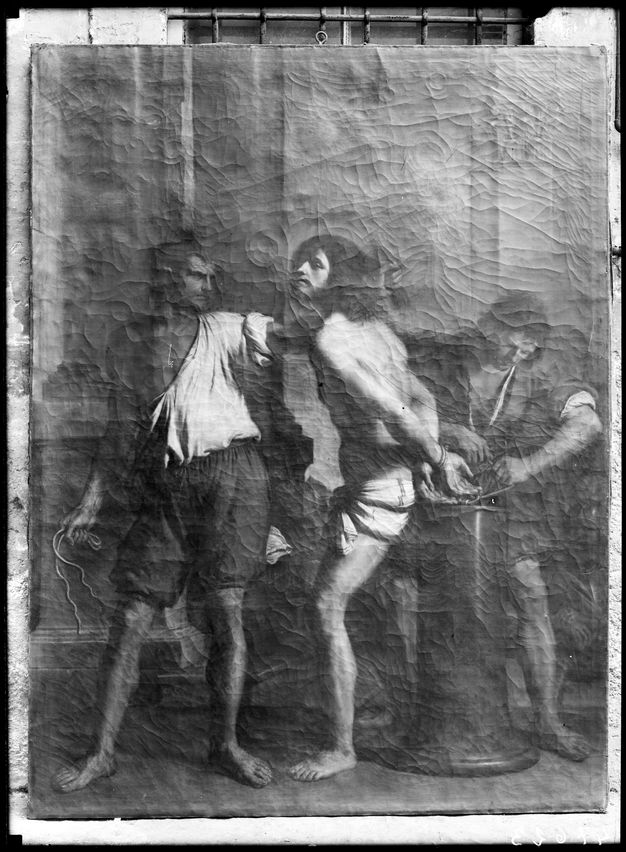
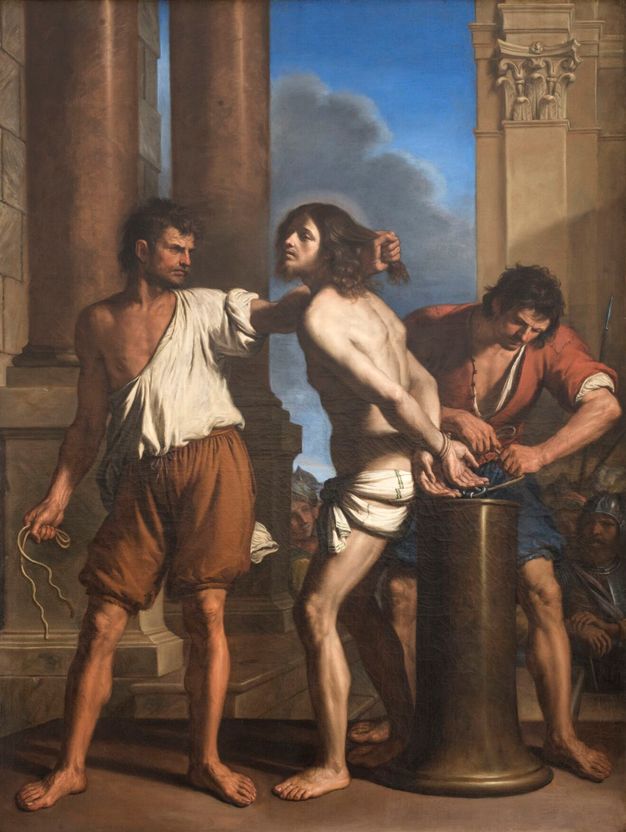
That these linings should still be in place and largely effective is all the more notable. However, it is true that the environment of our galleries is essentially a dry one, with a rather low RH of around 40%—and therefore suitable for the preservation of this kind of restoration. In this context, I should mention a curious estimate given by D. Podio for work to be carried out on a Virgin and Child attributed to Raphael, in the Accademia di San Luca. Having recognized it as a transfer, he proposed an initial lining on a hemp canvas, with the consequent ironing and filling, then a second lining using not less than three hemp canvases and another ironing: “This would give back to the painting the appearance of a painting on wood.” His aim was therefore a rigidity that was not only functional but also aesthetic.6
The Nineteenth Century: Preserved Examples of Linings and of Minimal Intervention
In the nineteenth century, we find an earlier massive campaign of restoration, which occurred at a time of many acquisitions as a result of bequests. The public aspects of Roman restoration during this period are well known due to the activities of the Camuccini brothers: Pietro, a restorer, and Vincenzo, an inspector of public paintings (Giacomini, F. 2007. “Per reale vantaggio delle arti e della storia.” In Vincenzo Camuccini e il restauro dei dipinti a Roma nella prima metà dell’Ottocento. Rome: Quasar.). Among his collaborators, Vincenzo chose Pietro Palmaroli (Köster, C. (1827) 2001. Sul restauro degli antichi dipinti ad olio. Edited by G. Perusini. Udine: Forum.; Rinaldi, S. 2004. “Il Punteggiato Di Pietro Palmaroli: Genesi Tecnica E Teoria Cromatica.” Studi di Storia dell’arte 15:55.) and Giuseppe Candida, who moved to Rome from Venice in 1803. Candida brought with him such cultural knowledge as his experience in the workshop of Pietro Edwards (Conti, A. 2003. Storia del restauro e della conservazione delle opere d’arte. Milan: Electa.; Köster, C. (1827) 2001. Sul restauro degli antichi dipinti ad olio. Edited by G. Perusini. Udine: Forum.).
Restoration practices in various private collections are less well known. Again, archival documents are of help. In those of the Corsini family, we find paintings on which G. B. Beretta worked (Ventra, S. 2016. “Tommaso Minardi ‘Per il miglioramento e buon sistema’ della quadreria Corsini.” In Storie di Palazzo Corsini, edited by A. Cosma and S. Pedone, 39–57. Rome: Campisano.)—a restorer who also collaborated with Minardi—and going back in time, Palmaroli (Cosma, A. 2016. “Verso un nuovo fidecommisso. Vicende del palazzo e della collezione Corsini tra dispersioni, restauri e riallestimenti (1795–1829).” In Storie di Palazzo Corsini, edited by A. Cosma and S. Pedone, 17–38, 175–218. Rome: Campisano.) and Principe (Magnamini, G. 1980a. “Inventari della collezione romana dei principi Corsini: I Parte.” Bollettino d’Arte Roma 65, no. 7: 91–126., Magnanimi, G. 1980b. “Inventari della collezione romana dei Principi Corsini: II Parte.” Bollettino d’Arte Roma 65, no. 8: 73–114.). The same names come up in both the private and public sectors, and through these we will get a better picture of the Roman system.
In the National Gallery, we have few examples of linings dating back to the nineteenth century, even though the period is rather well known through the historical research cited. Such documentation tends to be of a more theorical (almost sterile) nature, and we are unable to match it with the technical evidence. Just a few linings from the nineteenth century or even the earlier part of the twentieth are preserved—a result of the general use of greater quantities of glue paste and of coarser and heavier canvases for linings, which has made them more fragile and more susceptible to changes in RH and temperature (Mecklenburg, Marion F. 2007c. Meccanismi di cedimento nei dipinti su tela: approcci per lo sviluppo di protocolli di consolidamento. Saonara, Italy: Il Prato.; CESMAR7 (Center for the Study of Restoration Materials). 2008. Colour and Conservation: 3rd International Conference: Materials and Methods for Consolidation, and Scientific Methods for Evaluating Their Effectiveness: Proceedings of the Conference in Milan, 10–11 November 2006. Saonara, Italy: Il Prato.; Ciatti, Marco, and Erminio Signorini, eds. 2007. Dipinti su tela: Problemi e prospettive per la conservazione, giornata di studio, Ferrara, 1 aprile 2006 [Canvas paintings: Problems and perspectives in conservation, one-day meeting, Ferrara, April 1, 2006]. Saonara, Italy: Il Prato.; Roche, A. 2003. Comportement mécanique des peintures sur toile. Dégradation et prevention. Paris: CNRS Editions.) than the earlier linings described in some detail in later sections of this paper.
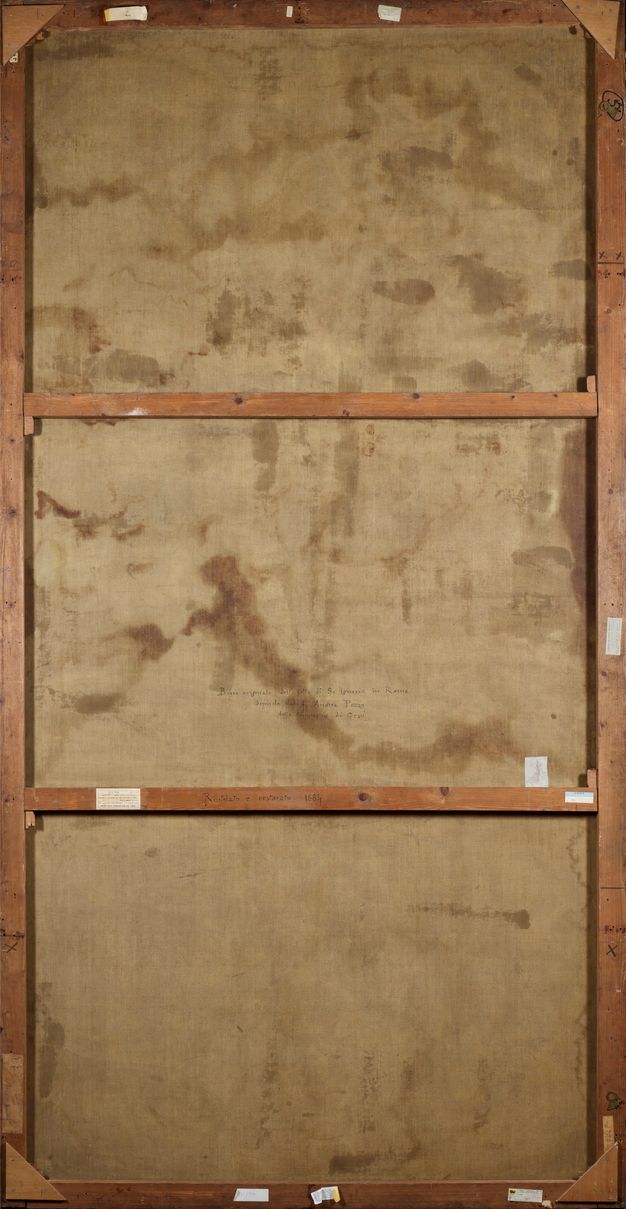
One example of a painting with a nineteenth-century lining is Glory of Saint Ignatius (fig. 34.2), by A. Pozzo (inventory 1426). The restoration is dated 1884 on the stretcher, the canvas is of a heavy and tightly woven herringbone weave, and the adhesive is rich in animal glue. On the canvas are marks that seem to be the result of burns from the application of hot irons. The stretcher is pine, with crossbars and keys, but it is essentially inadequate; clearly evident on the picture surface are the stretcher marks, as well as flattening of the paint. The inscriptions that accompany the restoration, on the stretcher, are grammatically incorrect, once again relegating the restorers to the “mechanical,” uneducated sphere. Another bozzetto for Pozzo’s trompe l’oeil dome of the church of Saint Ignazio (inventory 1425) has very similar characteristics and was also lined in 1884, so one can infer that it was carried out by the same restorer.
Many restorations coincided with the acquisition of the painting, for example, Giordano Luca’s Ritratto di capomasteo (Cratete) (inventory 1254), lined by Luigi Bartolucci in 1898. The stretcher may have been preserved from a previous intervention but adapted to make space for keys. The lining canvas is coarse, thick, and stained and has a large seam. It is interesting to compare this canvas to those in use by painters at the same time: the same kind of canvas was used for Horace Vernet’s Portrait of Filippo Agricola, painted in the 1820s and never lined.
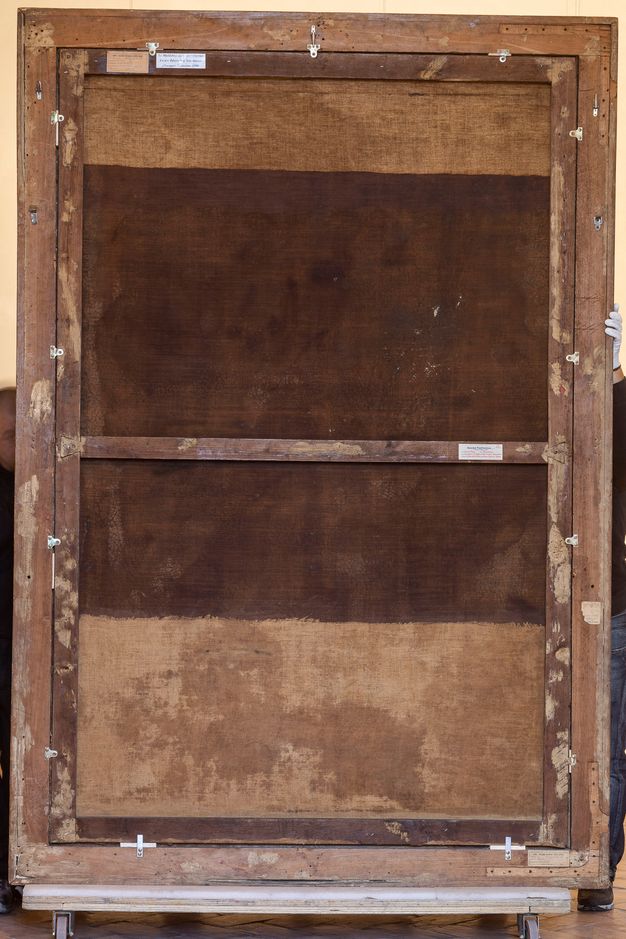
During the nineteenth century (although not as frequently as during the eighteenth century), we find evidence of a desire for minimal intervention, both in mending of tears and in strip-linings. It was also Bartolucci who carried out the 1909 strip-lining of Bernardo Cavallino’s Saint Peter and Cornelius the Centurion (inventory 1485), for which (according to his report) he “consolidated the old lining,” thus wisely preserving a lining dating to the end of the eighteenth century that was still functional. Another example is Guido Reni’s Magdalen (inventory 1437) (fig. 34.3), which was never lined but has a very old strip-lining, surviving at least in the upper section.7
Proceeding backward through the historical stages, and at the same time reconstructing the techniques, we arrive at the turn of the eighteenth century, at a moment when Rome was an important center in the history of restoration. It is not by chance that this was the case. Rome had a very high concentration of private collections, and the first public ones were coming into being. Nor was it by chance that this occurred almost two centuries from the initial diffusion of canvas as a painting support. The central position of Rome for restoration history is highlighted by the fact that it was the place of origin of many restorers who were responsible for the spread of Roman restoration techniques. In 1787, Andres left for Naples, and ten years later Vittorio Sampieri left to join Puccini in Florence, although the two had already met in Rome (Incerpi, G. 2011. “Vittorio Sampieri, il senese che ‘tenne ed insegnò alla toscana il vero modo del restaurare.’” In Semplici e continue diligenze, conservazione e restauro dei dipinti nelle Gallerie di Firenze nel Settecento e nell’Ottocento, 87–120. Florence: Edifir.; Mazzi, C. 2007. “Una luce nuova . . . nuove oscurità . . .” In Restauri pittorici e allestimenti museali a Roma tra Settecento e Ottocento, edited by S. Rinaldi, 123–79. Florence: Edifir.). A few decades later, in 1826, Palmaroli also left, to go to Dresden.
Technical Data: Toward the Eighteenth Century
In contrast to the nineteenth century, in our collection we have a large number of old linings that we can date to the eighteenth century. These are recognizable by their technical characteristics, which we can match with the historical documentation and thus understand the lining process involved.
A first group includes canvases with a more compact and coarser weave that have oxidized and darkened because of the amount of glue used. The canvas weave is impregnated with glue, and the lined painting is typically mounted onto chestnut strainers with half lap joints blocked with either nails or pegs, and with stretcher members that have a rectangular cross section. The joints of these strainers have not always been filled (when used, filler forms a barrier against changes in temperature and humidity).
The wood is not always of top quality; stretcher members with different colorings are often found in the same strainer, an indication of the presence of both heart-wood and sap-wood. This group also includes strainers that are less refined, evidently constructed with remainders of wood, with members made with either chestnut or poplar.
A second group includes older linings, dated to the first half of the eighteenth century, that have rather pale lining canvases. They have a plain, light, open weave not impregnated with glue and are mounted onto chestnut strainers. The stretcher members are rectangular in cross section and have shouldered bridle joints, which have been filled.
The Prestretching of the Lining Canvas
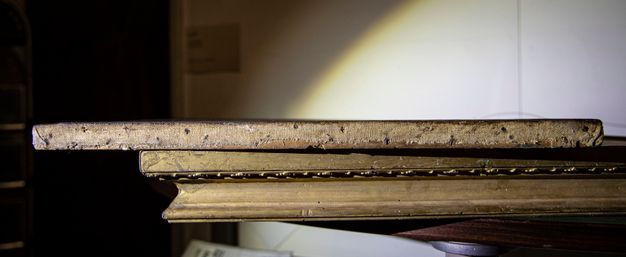
Upon closer observation of paintings in the collection, I deduced that the lining canvas was stretched by attaching it to the strainer with sprigs or brads. The lining would then be wetted to slacken the canvas, which could be made taut again with the same sprigs, hammered back and bent to secure the canvas (fig. 34.4). This preparation of the lining canvas would greatly weaken it, making it more like the original canvas.
I use the term system for lining with glue paste rather than referring to it simply as an adhesive, because the recipe in itself, with all its variants, does not cover the description of the process involved and its effects. In the Roman system, the original canvas is simply attached to the pretensioned lining canvas, which, when impregnated with the glue, acquires a certain rigidity. This entails the transfer of the tensions of the original canvas onto the lining canvas, which therefore truly acts as a new support for the work.8 This is the main difference between the Roman and the Florentine systems, as they are still practiced today.9 As a rule, the lining canvas chosen should be as similar to the original as possible in terms of weight and weave count,10 but preferably finer and thinner. Canvases of the same period that have never been lined have the same characteristics.11
To carry out the lining, the original canvas—probably faced in order to consolidate the paint layers and protect them—would be laid facedown and the adhesive would be spread on the reverse. The lining canvas—already stretched onto the strainer as described above—would then be placed over this and made to adhere to the original canvas simply by massaging the reverse with the hands, which would also exert pressure.
Recipes
Because recipes were considered workshop secrets, we do not know their details, but we can imagine that the main ingredients remained constant while the additives would vary, and these were the elements that were the workshop’s “secret.”
It is likely that the use of animal glue became necessary when serious structural problems were encountered, such as how to reduce serious deformations, tears, or blistering of the paint layers. The adhesive properties of flour-paste glues are linked to the presence of gluten, which is extracted after fifteen minutes of cooking at 70°C–80°C. The addition of glues can therefore only occur after this operation has been carried out, as the temperature used would alter the collagen and therefore its adhesive properties. In the Roman recipe, one uses bone glue, colla cervione. It is rich in impurities, short-chained, and both fragile and stiff, while also having great adhesive strength and resistance to sudden shocks.
The ratio of flour to glue is the critical element in the formulation of the glue-paste adhesive, which will affect its response to changes in humidity and to biological attack (Fuster-López, Laura, Cecil Krarup Andersen, Nicolas Bouillon, Fabien Frohrer, Matteo Rossi-Doria, Mikkel Scharff, Kate Seymour, Ángel Vicente-Escuder, Sofia Vicente-Palomino, and Dolores J. Yusà-Marco. 2017. “Glue-Paste Linings: An Evaluation of Some Biological, Chemical and Mechanical Aspects of a Traditional Technique.” In ICOM Committee for Conservation, 18th Triennial Conference, Copenhagen, Denmark, 4–8 September 2017: Linking Past and Future; Preprints, edited by Janet Bridgland. Paris: ICOM.). It is now clear that all the additives were included in the formulation to render the paste more elastic and to retard its drying (Lavorini, Barbara. 2007. “La foderatura a pasta secondo il metodo fiorentino: Varianti di applicazioni della pasta fiorentina” [Glue-paste lining with the Florentine method: Variants of applications]. In Dipinti su tela: Problemi e prospettive per la conservazione, giornata di studio, Ferrara, 1 aprile 2006, edited by Marco Ciatti and Erminio Signorini, 29–48. Padua: Il Prato.; Laroche, Jacqueline, and Maria Vittoria Saccarello. 1996. “La foderatura dei dipinti: Due tradizioni a confronto.” Kermes 25: 11–24.), and that they also play a role in the aging of the paste (Ackroyd, Paul. 1995. “Glue-Paste Lining of Paintings: An Evaluation of the Bond Performance and Relative Stiffness of Some Glue-Paste Linings.” In Lining and Backing: The Support of Paintings, Paper and Textiles: Papers Delivered at the UKIC Conference, 7–8 November 1995, edited by Andrew Durham, 83–91. London: United Kingdom Institute for Conservation of Historic and Artistic Works.).
That the original basic recipe contained little or no animal glue can be deduced from the color of the adhesive, which in the older linings is very light, although it should be darker because the type of flour used was less refined and therefore full of husks, and itself darker in color. Thus, the lightness of the adhesive must be related to the amount of animal glue present in the recipe. Orlandi, in the Abecedario pittorico, first published in 1704, proposes a flour-paste glue without the addition of animal glue (Orlandi, P. A. 1753. Abecedario pittorico. Venice: Guarienti.). We know that the glue was added soon after; for example, Pietro Edwards, only fifty years later in Venice, suggests adding German glue, that is, strong ox glue (colla forte). Edwards also uses a starch-paste glue for his facings and for localized consolidation; and in his descriptions of works requiring restoration, he refers to patches that are poorly attached because of the inadequacy of the “paste made from gluten” (gluttini) (Tiozzo, V. 2000. Dal decalogo Edwards alla carta del restauro. Saonara, Italy: Il Prato.). The difference in terminology, which alludes to a material difference, continues over time up to the Forni manual, which still reports patches that are either “pasted or glued on” (Bonsanti, G., and M. Ciatti. 2004. Ulisse Forni: Manuale del pittore restauratore, studi per la nuova edizione. Florence: Edifir.).
Ironing
At the very beginning of the use of lining systems, the pressure and heat applied were very light and gentle. But before long the initial massaging of the reverse was associated with heat.
In Orlandi, we learn that the canvases were left beneath a uniform weight provided by a heavy panel, but that the various thicknesses of the paint were nevertheless protected by layers of paper or even felt (Orlandi, P. A. 1753. Abecedario pittorico. Venice: Guarienti.).
The introduction of heat, generally termed stiratura (ironing), is documented by Edwards, who describes an ingenious system in which heated sand was placed on the reverse of the lining. We have found residues of this sand, confirming the practice as recounted in the sources (Tranquilli, G. 1996. “Aspetti tecnici dell’attività di Pietro Edwards: Metodologia di intervento e materiali utilizzati per il restauro dei dipinti su tela.” Bollettino d’Arte 81, nos. 96–97: 173–88.). This system ensures even pressure while at the same time adapting to the material nature and profiles of the paint layers without causing excessive flattening of the texture.
The reference to irons in relation to the stiratura is clearly made in L. Crespi’s 1756 letter to F. Algarotti, in a passage in which he relates what seems to be a consolidation procedure from the reverse. In this passage, Crespi expressly refers to the irons used for starching; therefore, it really is the same irons used in laundering that are meant (Bottari, G. 1822–25. Raccolta di lettere sulla pittura, scultura ed architettura, Roma 1754–1773, vol. III. Milan: S. Ticozzi.).
At this juncture during the lining procedure, after the ironing the original tacking edges were turned over the strainer (but often they were included in the front surface, thus slightly enlarging the dimensions of the picture) and then secured with nails or glue. The old method is easily distinguishable in that the sprigs used to stretch the lining canvas are visible under the painted canvas edges (see fig. 34.4).
The entire procedure described is observable in Adoration of the Shepherds, by Cesari (inventory 1120) (fig. 34.5). The work is part of the Torlonia bequest (one of the cores of the museum collection) and was acquired by the Torlonia from the Soderini family.
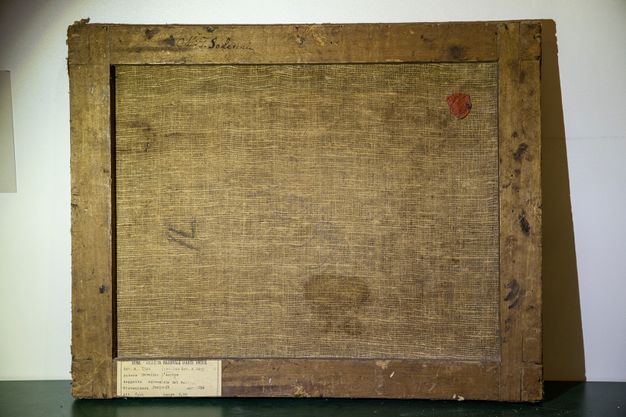
The Soderini were one of the main patrons of Marco Benefial, a painter who always worked with Domenico Michelini, who was the most important restorer in Rome in the first half of the eighteenth century.12 We can therefore infer that Michelini also worked for the Soderini, and we can attribute this lining to him.
It is interesting to observe that in the eighteenth century there were famous “duo” collaborations between restorers and painters, in which the restorer could not paint at all and would carry out the lining, the filling, and sometimes the cleaning,13 while the painter would retouch.14 Such famous duos include D. Michelini and M. Benefial, and later G. Principe and P. Anesi or D. Corvi.15 (See Cerasuolo’s paper in these proceedings for more on this division of labor.)
Documents show the restorer Giovanni Principe, heir and son-in-law of Michelini, working in the same environment where Giovanni Torlonia conducted his business. Therefore, it is easy to imagine that they had business interests in common. However, many of the linings that have been preserved bear the Torlonia seal, which dates from the time when the inventory of the collection was drawn up, at the very beginning of the nineteenth century.
The Seventeenth Century
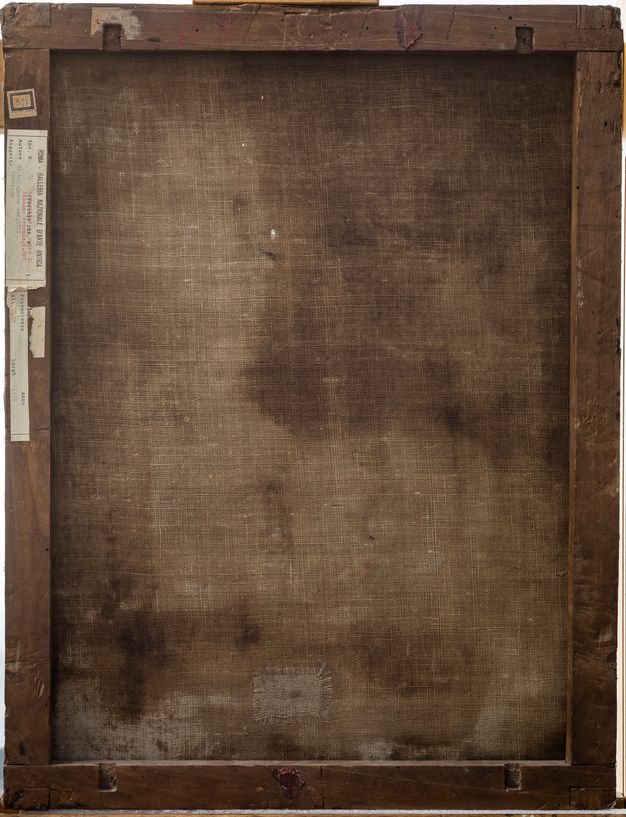
To conclude our survey going back in time, the oldest dated lining in the Barberini Galleries dates to the middle of the seventeenth century. The presence of the seal on the strainer dates its assembly, and therefore the lining of the painting, to 1641–42. The strainer is of chestnut with shouldered bridle joints that are not blocked, and a fine, regularly woven, plain-weave lining canvas is in every way comparable to a contemporary canvas that has never been lined (fig. 34.6).
Conclusion
Among the paintings in our gallery are many works lined with wax resin, a system that was increasingly used during the 1960s, perhaps in pursuit of an ideal of modernity. If we compare two pendants by Benefial, one lined with the wax-resin system (inventory 1182) (fig. 34.7) and the other lined with glue paste (inventory 1183) (fig. 34.8), the difference demonstrates how the wax-resin system has a far greater impact on the perception of the painting. The different saturation of the colors caused the original link between the two paintings to be lost. Therefore, it is essential to consider all the effects of the conservation method used to preserve a painting.
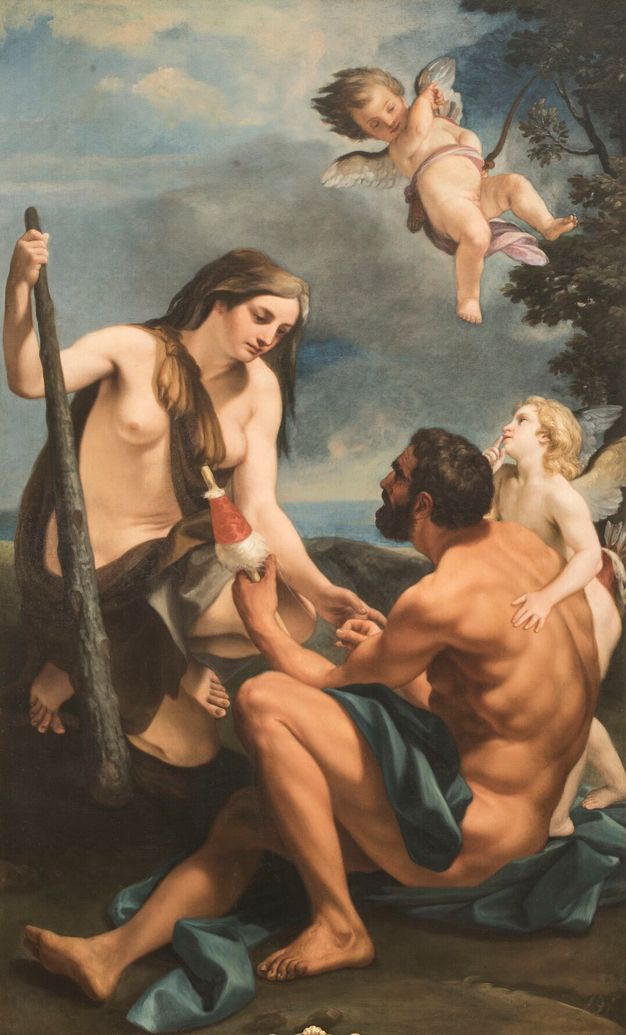
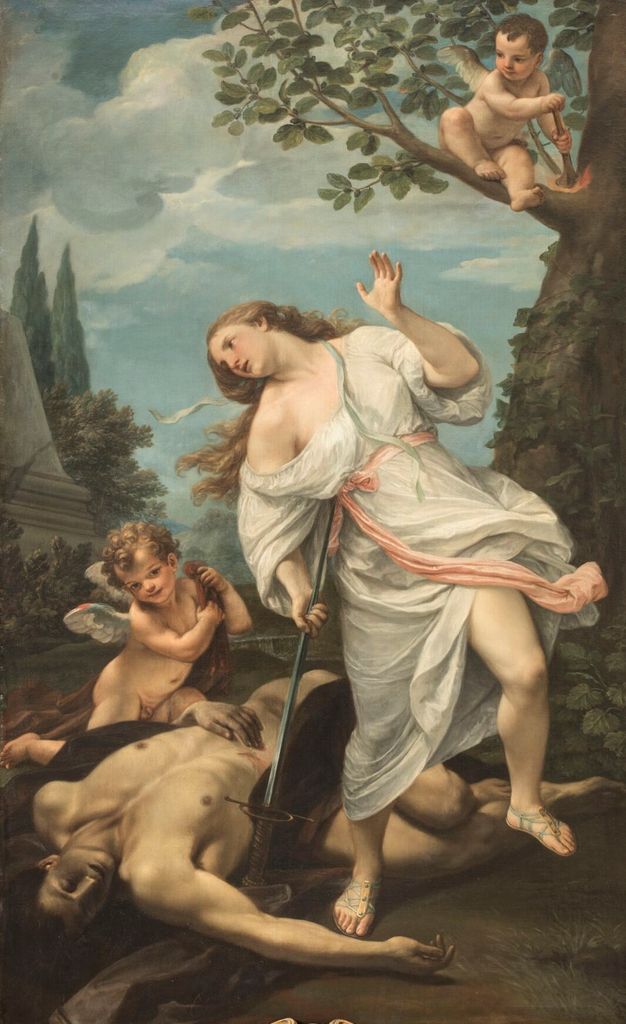
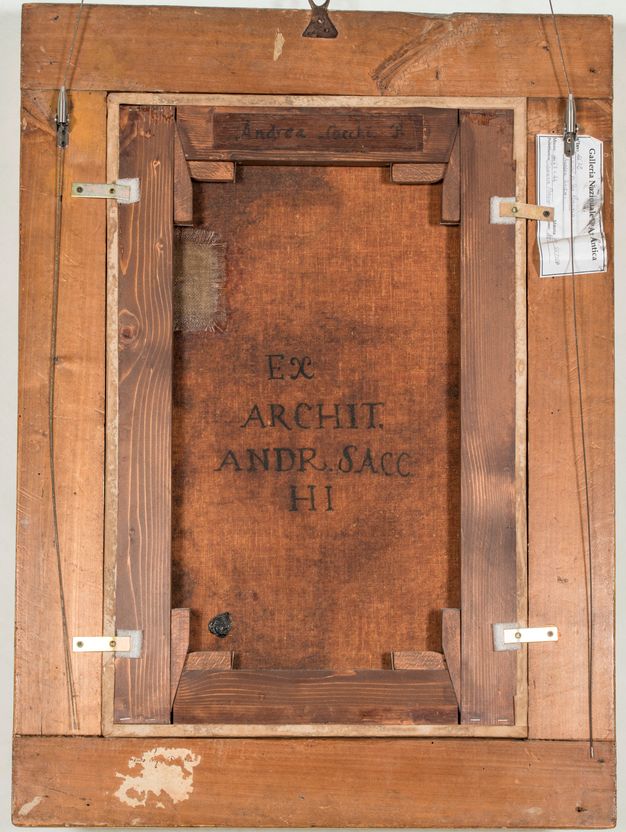
Seeking to implement a minimal structural intervention respectful of the aesthetic qualities of the works in our collection, our studio is focusing on developing thread-by-thread mending techniques for tears, as for Maratti’s Portrait of Cardinal Barberini (inventory 5001), as well as on a program of preventive conservation. This is also what led us to study again the ancient lining systems with glue paste, which are still effective after centuries, sustainable from an environmental point of view, and an almost unique example of a completely reversible intervention, as for instance in the bozzetto for Vision of Saint Romualdo (fig. 34.9), by A. Sacchi (inventory 4632), which has been delined.
Notes
-
For a concise history of the Roman museum system, see Nicita, P. 2009. Musei e storia dell’arte a Roma. Rome: Campisano. and Bernini, D. 1997. “Origini del sistema museale dello stato a Roma.” Bollettino d’Arte 99, supp.. ↩︎
-
I am at present carrying out a full conservation survey of all the gallery’s paintings, which will provide the actual number of “old” linings preserved. ↩︎
-
Their fame made them the object of visits from important personalities. For example, De Brosse paid a visit in 1739–40 to a certain “Domenico,” maybe the very same Michelini mentioned later in this paper, perhaps still hunting for curiosities and secrets. Goethe’s visit to the restorer Andres in Naples on March 15, 1787, however, was undertaken in a completely different spirit. Goethe says he cannot describe the restorer’s art; due to the difficulty of the task, he was unable to describe the happy solutions found by the restorer. (Andres worked in Rome for the Borghese, then went to Naples, invited by Hackert, and became restorer at court.) ↩︎
-
This paper discusses only structural interventions. The aesthetic restoration of the painting surface has been carried out by other restorers—in some instances repeatedly. ↩︎
-
The associated ironing is rather heavy handed, perhaps done with a roller, and it is not unusual to find the imprint of the canvas in the paint layers as a visual effect resulting from this process. ↩︎
-
In the end, the Podio family did not undertake the restoration. ↩︎
-
From documents in the archive, we know that in 1924 the strip in the lower section was exchanged for a wider one to repair a tear. ↩︎
-
Ackroyd, Paul. 1995. “Glue-Paste Lining of Paintings: An Evaluation of the Bond Performance and Relative Stiffness of Some Glue-Paste Linings.” In Lining and Backing: The Support of Paintings, Paper and Textiles: Papers Delivered at the UKIC Conference, 7–8 November 1995, edited by Andrew Durham, 83–91. London: United Kingdom Institute for Conservation of Historic and Artistic Works. highlights rigidity as the aspect that enables the lining canvas to act as the new support. ↩︎
-
Among the different glue-paste lining systems, in the Florentine system the painting is never left free; even when not stretched onto the stretcher, the canvas is always in a state of tension through the attachment of bands of paper glued at the edges. It is clear that this system aims at the control of canvas deformations differently (Lavorini, Barbara. 2007. “La foderatura a pasta secondo il metodo fiorentino: Varianti di applicazioni della pasta fiorentina” [Glue-paste lining with the Florentine method: Variants of applications]. In Dipinti su tela: Problemi e prospettive per la conservazione, giornata di studio, Ferrara, 1 aprile 2006, edited by Marco Ciatti and Erminio Signorini, 29–48. Padua: Il Prato.). ↩︎
-
Pietro Edwards suggests canvases finer than the original ones. In the Obblighi ed incombenze dell’Ispettore al ristauro generale dei pubblici quadri, he writes, “Che non si ometta di foderare il quadro per evitare la spesa delle costose tele e che queste siano sempre di grana più fine della tela vecchia, perché essendo il contrario non legano bene” (Do not omit lining the painting in order to avoid the expense of a lining canvas, which must be finer, because if it is coarser the adhesion will be poor) (Tiozzo, V. 2000. Dal decalogo Edwards alla carta del restauro. Saonara, Italy: Il Prato.). ↩︎
-
For example, Filippo Lauri, Festone (inventory 1934), or the Landscape by an anonymous artist (inventory 2232), both from the end of the seventeenth century. ↩︎
-
There are many references to Michelini working for the most important Roman families; see, for example, Debenedetti, E., ed. 2004. Artisti e artigiani a Roma I, dagli stati delle anime del 1700, 1725, 1750, 1775. Rome: Bonsignori., Debenedetti, E., ed. 2005. Artisti e artigiani a Roma II, dagli stati delle anime del 1700, 1725, 1750, 1775. Rome: Bonsignori.; Bodart, D. 1970. “Domenico Michelini, restaurateur des tableaux à Rome au XVIII siècle.” Revue des archéologues et historiens de l’art de Louvain 3: 136–42.; Ghezzi, P. L. 1744. Il mondo nuovo, Ms. ottoboniano latino 3118, c. 133. Vatican Apostolic Library, Vatican City.; letter from L. Crespi to Francesco Algarotti (Bottari, G. 1822–25. Raccolta di lettere sulla pittura, scultura ed architettura, Roma 1754–1773, vol. III. Milan: S. Ticozzi.); Nougaret, Pierre-Jean-Baptiste, and Nicolas-Thomas Leprince. 1776. Anecdotes des beaux-arts . . . avec des notes par M*** . . . Paris: J. F. Bastien.; and Standring, T. J. 1988. “Some Pictures by Poussin in the Dal Pozzo Collection: Three New Inventories.” Burlington Magazine 130, no. 1025: 608–26.. For a more complete study, with all the biographical notes, see Marinetti, R. 2007. “La foderatura dei dipinti: Documenti e protagonisti.” In Restauri pittorici e allestimenti museali a Roma tra Settecento e Ottocento, edited by S. Rinaldi, 29–46, appendix. Florence: Edifir.. All the works for the Pamphili are cited in De Marchi, A. G. 2016. Collezione Doria Pamphili. Catalogo generale dei dipinti. Milan: Silvana.. In the Palazzo della Cancelleria, Michelini worked with Ventura Lamberti, Benefial’s teacher. For the Ruspoli family, he prepared the canvas for Trevisani to paint a Saint Francis. For the Giustiniani, he restored the first version of Caravaggio’s Saint Matthew. For the Pellegrini church, he cleaned Reni’s Trinity and repaired a panel painted by the Cavalier d’Arpino (Madonna, Saint Francesco, and Saint Agostino). For San Giovanni dei Fiorentini, he worked on Maratti’s copy of the Madonna and Saints. The Albani family introduced him at the Savoy court. Poerson, director of the French Academy in Rome and president of the Academy of Saint Luke, tells of his restoration for the Odescalchi family, together with B. Luti. Finally, he worked also for the Corsini and the Soderini, being the most important restorer of his time in Rome. ↩︎
-
“Signor Domenico Michelini raccomodatore di quadri, che abita in Campo Marzio, è nel suo mestiere bravissimo ma non sa dipingere, ma per ritirarli e ripulirli non ha l’eguale et anche è buonissimo huomo, et à un figliolo che si porta assai bene nel medesimo mestiere. Et io cavaliere Ghezzi ne ho lassata la memoria il 16 luglio 1744” (Domenico Michelini, paintings restorer, who lives in Campo Marzio, is excellent in his work but he cannot paint; but for the restretching and cleaning of a painting he has no equal. He is also a good man, and he has a son who is also very good in the same line of work. And I, Ghezzi, have left this testimony, July 16, 1744” (Ghezzi, P. L. 1744. Il mondo nuovo, Ms. ottoboniano latino 3118, c. 133. Vatican Apostolic Library, Vatican City., cited in Marinetti, R. 2007. “La foderatura dei dipinti: Documenti e protagonisti.” In Restauri pittorici e allestimenti museali a Roma tra Settecento e Ottocento, edited by S. Rinaldi, 29–46, appendix. Florence: Edifir.). ↩︎
-
Edwards, in his set of guidelines, insists on this point in order to define a profession that was quite distinct, and in the process of evolving, emphasizing the mechanical and structural operations. He criticized those who believed that it was sufficient to know how to paint to become a restorer. Where the retouching involved more than simple losses and larger areas of painting were required, he looked for painters whose style was as near as possible to that of the original painting (Tiozzo, V. 2000. Dal decalogo Edwards alla carta del restauro. Saonara, Italy: Il Prato.). ↩︎
-
We know that important painters also worked as restorers, and we know the effectiveness of their structural interventions. For example, Ciro Ferri, a well-known painter who also worked in the art market and as a restorer, did both structural repairs (patches) and retouching (Marinetti, R. 2007. “La foderatura dei dipinti: Documenti e protagonisti.” In Restauri pittorici e allestimenti museali a Roma tra Settecento e Ottocento, edited by S. Rinaldi, 29–46, appendix. Florence: Edifir.). Moreover, Bellori recounts a restoration by the young Maratti, in 1672, on Annibale Carracci’s Nativity (originally in Loreto, now in the Louvre) (Ciatti, M. 2009. Appunti per un manuale di storia e teoria del restauro. Florence: Edifir.; Conti, A. 2003. Storia del restauro e della conservazione delle opere d’arte. Milan: Electa.). It should be noted that these were well-known painters, so this work was not simply a fallback for unknown artists in financial difficulties but reflects a desire to establish an autonomous profession, with its own specific subject matter, independent of the field of painting. ↩︎