The collections of Vienna’s Kunsthistorisches Museum have a long tradition, reaching back at least four centuries. Many large-scale paintings originally were conceived to decorate walls of the castles of the Habsburg family but have lost that function over the centuries, so there are large holdings of oversize paintings in storage. However, many large paintings are still in situ as decorative pieces in offices or museums housed in former imperial palaces and in other public spaces, and a certain number of large-scale paintings are on display in museum galleries. This paper explores various strategies for preserving these holdings, from improving storage conditions to in situ structural interventions to in-depth treatments in the studio. As any treatment of large-scale paintings is a major commitment, consuming space, time, and labor, much remains to be done.
14. Structural Stabilization of Large Paintings on Canvas: A History of Approaches in the Kunsthistorisches Museum Vienna
- Elke Oberthaler, Chief of Paintings Conservation, Kunsthistorisches Museum Vienna
Introduction
In any museum conservation studio, strategies and methods are based on the collection’s condition and demands, so let us start with a brief introduction to the character and history of the paintings collection of the Kunsthistorisches Museum Vienna (KHM). In terms of numbers, only a small selection of its holdings is on display in the galleries of the main museum building at Burgring 5, but large parts of the collection are on view at other locations: the Hofburg Palace, housing the Imperial Treasury; the Imperial Armory and the Collection of Historical Musical Instruments; and the Imperial Carriage Museum, at Schönbrunn Palace. Ambras Castle near Innsbruck houses an important collection of portraits. The KHM has also sent paintings as long-term loans to satellite museums set up by other public organizations—mainly former imperial palaces such as Schönbrunn, Laxenburg, Eckartsau, and Schloss Hof. Around eight hundred paintings are on loan to government offices in historic buildings and Austrian embassies. Located about 20 km south of Vienna, the KHM’s central storage facility houses over three thousand paintings and around a thousand frames.
This paper examines treatments performed during the past decade on paintings measuring over 2 meters, which have been selected to document typical conditions and approaches.1
Rolling, Folding, and Other Provisional Interventions—Conservation Problems of Large Canvas Paintings
Vienna’s first imperial gallery displaying large canvases was established in 1656 at Stallburg Palace, which housed Leopold Wilhelm’s collection after his return from Brussels. Continual changes in selection and display means paintings were (and still are) transported between the main gallery and the other venues (Swoboda, Gudrun. 2008. Die Wege der Bilder eine Geschichte der kaiserlichen Gemäldesammlungen von 1600 bis 1800. Edited by Wilfried Seipel. Vienna: Kunsthistorisches Museum.).
Handling is key in the preservation of large canvas paintings. Canvases are rolled onto tubes for transport. Such manipulations are difficult, and improper handling or storage techniques (kinking, folding) often cause damage and paint losses.
Ideally, a rolled canvas should soon be restretched, but our storage houses numerous rolled paintings: sixty-seven paintings on nineteen rolls, including two ceiling paintings by Nicola Maria Rossi, Pallas Abducts Juventus from the Arms of Venus (1730; 500 × 500 cm, GG 7665) and Allegory of the Human Spirit (GG 7666) from the Harrach garden palace, which was bombed in World War II. They were rolled and acquired by the KHM in 1968.
As early as the eighteenth century, inventories list paintings without a strainer (or stretcher).2 Even today, twenty-nine paintings are stored unstretched and not rolled (flat), including a portrait of Philipp IV by a Spanish artist (210 × 143 cm, GG 9269). Until the 1990s, these paintings had been stored for a long period piled on top of one another in a storage facility formerly used to house the KHM’s tapestry collection in Hofburg Palace. Lacking the resources to stabilize and stretch these damaged paintings properly, in the 1990s we mounted them clamped between sheets of corrugated cardboard.
Canvas paintings with paper facings—partial or covering the entire surface—testify to the lack of time and space for proper conservation treatments. Bonifazio Veronese’s Raising of Lazarus (early sixteenth century; 148 × 205.5 cm, GG 6679) has a typical mid-twentieth-century facing with newsprint paper. In the mid-1980s, Philippe de Champaigne’s Lamentation for Abel (1656; 312 × 394 cm, GG 371)3 was faced with sheets of Japanese paper. However, restoration was delayed much longer than planned, and the facings—applied with an aqueous medium—may have caused damage, such as blanching of the varnishes. Often loose paint chips adhere better to the paper facing than to the support, making the paper’s removal difficult. Our efforts to remove facings and properly consolidate flaking paint layers are ongoing.4 This experience over time has led to a much more critical view of facings.
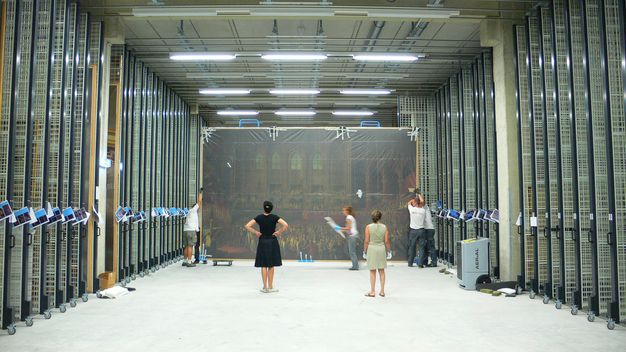
As mentioned, our collection is housed at different locations, but earlier decades saw attempts to centralize all holdings. The KHM’s new central storage facility, built in 2011, proved vital for storing large canvases (Götz, Eva, and Elke Oberthaler. 2013. “The Relocation of the Picture Gallery’s Collection from Inzersdorf to the Central Storage Facility in Himberg.” In Technologische Studien, vols. 9–10, special vol. (Storage), edited by Kunsthistorisches Museum and Sabine Haag, 152–181. Vienna: Kunsthistorisches Museum.). All paintings are now stored on racks and are accessible without direct handling. The racks in the storage room for large-scale canvas paintings measure 5 × 8 meters and can accommodate even the largest canvases, including those still rolled or stored between cardboard sheets (fig. 14.1).5 At present, the KHM storage holds 3,142 paintings and about 1,085 frames. Hopefully, soon all canvas paintings will be accessible and mounted on stretchers.
A significant number of lined canvas paintings suffer from infestation by Stegobium paniceum (biscuit beetle), which primarily affects canvases lined around 1900, when a thick layer of glue paste with a high content of animal glue was used. To avoid new infestations, all objects or paintings are treated in an anoxic nitrogen chamber prior to storage. Both conservators and our building department focus on integrated pest management. We use traps to monitor insect activity, some with lights to attract insects. Since 2011, we have had one case of reinfestation in the central storage building, which we countered with tiny parasitoid wasps, Lariophagus distinguendus, which parasitize the beetle’s larvae, ending the infestation (Querner, Pascal, Elke Oberthaler, and Monika Strolz. 2019. “Biological Pest Control of a Biscuit Beetle (Stegobium paniceum) Infestation in an Old Master Paintings Storage Area.” Studies in Conservation 64, no. 7: 373–80.).
Titian’s Ecce Homo: An Eighteenth-Century Lining—Partial Interventions Instead of Relining
For centuries, lining was used to preserve canvas paintings. Our earliest extant linings presumably date from the late eighteenth century. Their typical loosely woven lining canvas is fixed to the original canvas with glue-paste ironed on from the reverse.6 A recently treated prominent example is Titian’s Ecce Homo (1543; 242 × 361 cm, GG 73).7
We believe the painting was placed facedown on a table, without the strainer, for lining. Then the lining canvas, fixed to the (new) strainer and impregnated with glue paste, was placed on top of the original canvas. The painting’s original tacking edge was affixed with separate nails, covering the earlier rows of tacks and the ironed lining. The multiple rows of nails are visible only in X-ray images and when the painting is removed from its stretcher. If paintings with such linings are removed from the stretcher, the rougher texture of the lining canvas is visible where it has not been ironed, as it was covered by the strainer. The marked bevel of the strainer bars allowed the edges beneath the stretcher to dry better.
Normally these eighteenth-century linings are quite stable, and the surface texture of the original paint layers is well preserved, as on Titian’s Ecce Homo; there only the tacking edges were torn, and the canvas had come loose from the stretcher, suffering some deformations in the corners. Since the damage mainly affected the edges of the lining canvas, we decided to remove the stretcher and stabilize the torn borders but not remove the lining the painting.
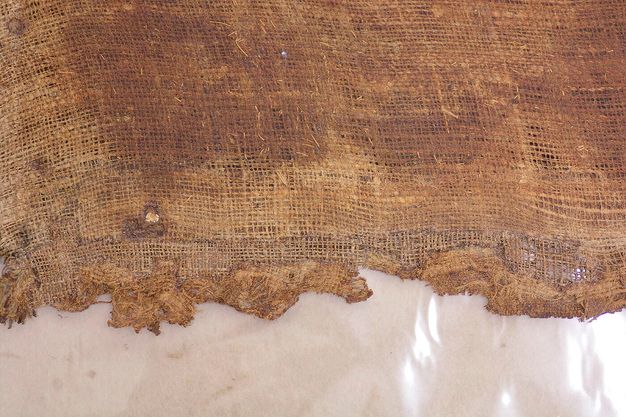
Delaminated areas between the original and the lining canvas were reglued. We used inserts of old or similar canvas to restore the losses and the coherence of the lining (fig. 14.2). Smaller holes from previous insect infestation were filled with a mixture of canvas fibers and sturgeon glue.8 For the strip-lining, which was needed to remount the painting on a stretcher, we glued natural canvas—frayed and thinned to avoid sharp edges—to the lining with an acrylic emulsion.9 The stretcher was structurally stable but much keyed out and too small when assembled; we added strips of wood to align it exactly with the painting’s format. Restretching was done the traditional way (i.e., with small pieces of cardboard beneath the nails to facilitate their removal, if necessary). Structural treatment was followed by cleaning and removal of old overpaints, procedures we hope to publish soon.
Caravaggio’s Rosary Madonna: Relocations and Format Changes
The nineteenth century favored using types of canvas with a finer and denser texture for lining. One example of a painting lined this way is Caravaggio’s Rosary Madonna10 (ca. 1601; 364.5 × 249.5 cm, GG 147), which also exemplifies the frequent format changes imposed over the years to adjust a painting’s size to a new location. In this case, a “revised revision” occurred a century later.
Rubens and other prominent Antwerp artists purchased Caravaggio’s Rosary Madonna, first documented in Antwerp’s Dominican church around 1620. In 1781, the painting was presented to Emperor Joseph II, and in 1786 it was transported to Vienna. The painting was presumably rolled (Prohaska, Wolfgang, and Gudrun Swoboda. 2010. Caravaggio und der Internationale Caravaggismus. Milan: Sylvana Editoriale; Vienna: Kunsthistorisches Museum.) for the 1786 transport from Antwerp to Vienna. In 1809, during the Napoleonic Wars, it was rolled on a big drum for evacuation (to save it from the French troops in case of invasion).11 It was probably relined before being installed at Belvedere Palace in the early nineteenth century. We do not know why its size was reduced by folding about 30 centimeters of the original canvas over the upper strainer edge. This strip remained unlined until 1913, when the format change was reversed.12
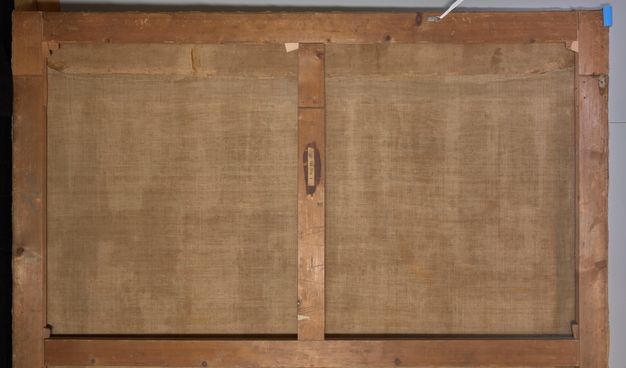
To avoid risk and costs, large-scale paintings are rarely moved. In 2019, when the painting was moved for the exhibition Caravaggio & Bernini, we took the opportunity to thoroughly examine it.13 Unframing revealed damage to the canvas from the tacking edges but also more information on format changes. The 1913 intervention concerned only the top edge, as indicated by the different, more modern tacks used there. The nineteenth-century lining canvas did not cover the entire original canvas, as the strip folded over had remained unlined.14 In 1913, when the strip was reintegrated to the picture plane, the upper stretcher bar was temporarily removed to access the area for treatment. The border of the lining (the area of the previous tacking edge) was removed. This probably helped flatten deformations caused by the former tacking edge. The previously unlined original canvas was partially lined, but only to the edge of the previous lining, and a random strip of original canvas again remained unlined. The side bars of the stretcher were extended to compensate for the missing centimeters in its height, and the old upper bar of the stretcher was reinserted (fig. 14.3). Finally, the upper portion of the painting was restretched, returning the entire composition to its original size.
In 2019, we found that the edges of the older areas of lining, untouched since the early nineteenth century, were frail, with several detached/delaminated or torn pieces of canvas. The paint layers of the previously folded portion were considerably more cupped than those of the well-preserved main picture surface. In addition, the area had suffered deformations in the support. A small, unlined area was smothered in glue remnants from the first lining.
Removing the nails from the upper edge and the upper stretcher bar revealed the top edge (again). The thick glue remnants mentioned above could then be scraped away with a scalpel, and deformations were flattened using local humidification and weight. Unlined areas received small inserts of old canvas of a weight and weave similar to the nineteenth-century lining that were attached to the original canvas with methyl cellulose. Finally, the upper edges were reattached to the stretcher. Other detached canvas pieces along the edges were reglued with a mixture of wheat-starch paste and sturgeon glue and dried under pressure. Without much effort, the painting with its two-hundred-year-old lining was restored to a structurally safe condition.
Salvator Rosa’s Battle of the Romans: Revisiting an Abandoned Treatment— Stabilization of a Canvas with a Lining Damaged by Insect Infestation
We do not know why the cleaning of Salvator Rosa’s Battle of the Romans (1645; 229 × 345 cm, GG 1641) was interrupted—perhaps it proved too difficult or too much work, or priorities shifted, or its condition or quality did not meet expectations.
The painting was stored for more than fifty years until research by Gudrun Swoboda, alongside ongoing attempts to improve the condition of all stored paintings, suggested a reevaluation. Its condition was compromised: the painted surface comprised overpaints, overcleaned areas, and structural problems, including flaking paint layers that were partially covered with paper facings, and fragile tacking edges from earlier (now inactive) insect infestations.15
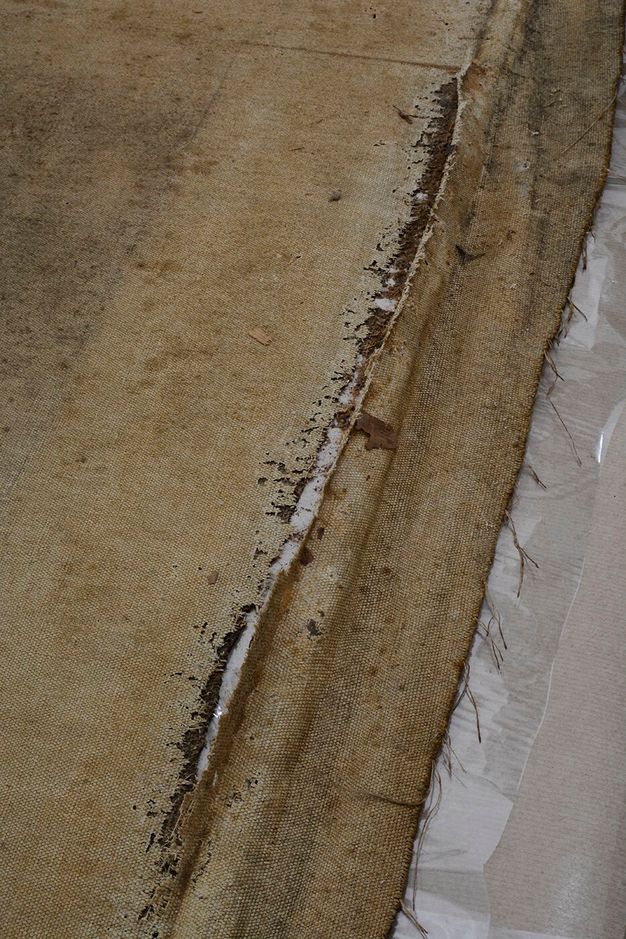
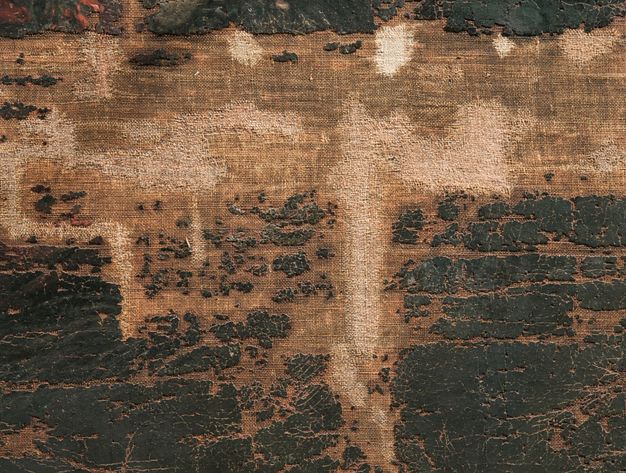
The thick glue layers of linings dating to around 1900 had provided attractive breeding grounds for Stegobium paniceum, which likes to lay its eggs in the narrow, dark, sheltered space between stretcher and canvas, where its larvae can remain hidden. These beetles had damaged the edges of Rosa’s composition so badly that only some areas remained attached to the stretcher. Removal of the stretcher revealed the extent of the infestation: large areas beneath the stretcher were eaten, and most of the lining canvas had degraded to fibers and powder (fig. 14.4). Lining in unaffected areas, however, remained firmly attached. The original canvas, where visible, appeared quite thinned—probably it had been scraped down prior to the lining to obtain a “clean” surface.
We decided to attempt a partial treatment rather than a complete removal of the lining, removing only the eaten areas of the old lining and replacing them with a new strip-lining in order to safely restretch the painting. Removing the entire lining, with its strong adhesion and massive glue layer, would have stressed the original canvas and paint layers and would have required a new lining.
We used a semisolid gel of agar to remove the lining glue along the damaged edges, which peeled off with the old glue embedded. Remnants of glue on the canvas were removed mechanically with a scalpel. We chose acrylic emulsion Lascaux 498-HV as the adhesive. The fringes of the strip-lining were later attached atop the old lining using wheat starch with rabbit-skin glue and pressure. Once cleaning and restoration are completed, we hope to install the painting in the gallery.
Johann Franz Greippel’s Four Daughters of Maria Theresia Performing the Opera Parnasso Confuso by Christoph Willibald Gluck in 1765: In Situ Treatment of Two Large Canvases Lined Around 1900
Many paintings from the collection embellish government offices, the most prominent of which is the Office of the Austrian President in Hofburg Palace, which boasts two large eighteenth-century canvases depicting a performance of Gluck’s Parnasso Confuso at Schönbrunn on January 24, 1765, in which four of Maria Theresia’s daughters participated.
The two monumental paintings were installed after World War II. Over the years, their canvas supports had lost tension and they appeared almost like flapping draperies. We had to organize our interventions carefully, as the Presidential Chancery is closed for only six to eight weeks each summer. It took us two summers, one for each painting.16 We removed all the furniture and placed the canvas carefully on the prepared floor. Removing the stretcher revealed that the lining canvas was not infested by Stegobium paniceum, although the lining was of the type discussed above, but there was some delamination between the original canvas and the lining canvas around the edges.
After cleaning the reverse with a brush and vacuum cleaner, the delaminated parts of the lining and the original canvas were reglued with a paste comprising wheat starch and rabbit-skin glue.17 For strip-lining, we used natural canvas, thinned on the inside by removing threads (parallel to the tacking edge) and by sanding the remaining threads to avoid sharp edges.18 The top-left part of the painting, showing the interior of the opera house (GG 6826), was disfigured by an old, coarse repair of a tear in the original and lining canvases. Following a partial humidity treatment, we opened the overlapping areas of the lining canvas. The threads around the tear in the original canvas were then aligned and mended (fig. 14.5).19 Bridges of hemp threads impregnated with Beva were attached to the original canvas in the torn area using a soldering needle.
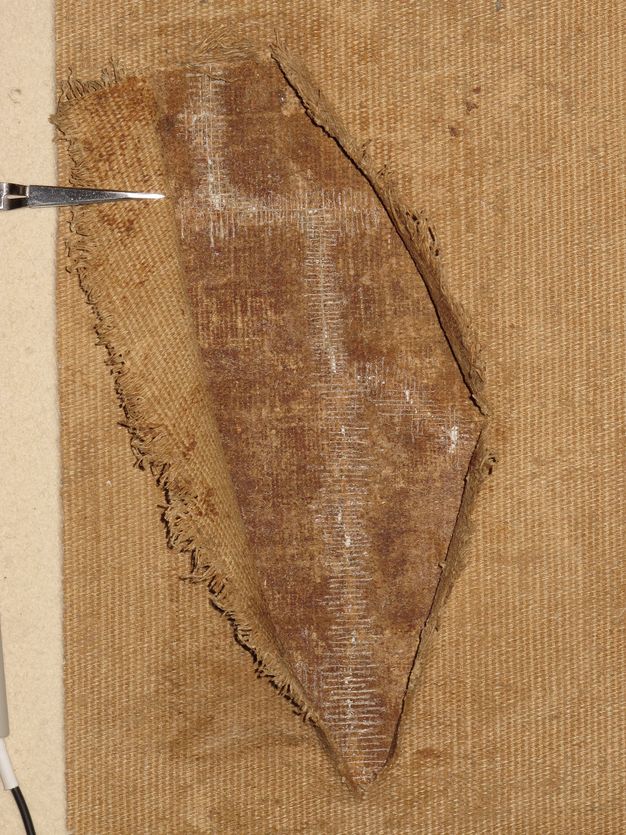
The tear in the lining canvas was closed with stitches sewn by using a semicircular needle and nylon and polyester threads. The bond between lining and original canvas was achieved by injecting starch paste with a syringe and then adding weights while it dried. For additional stability, noncorrosive steel wires (0.3 and 0.38 mm) were attached at several points with thick, adhesive acrylic emulsion (Lascaux 498 HV). The stretcher was numbered and then dismantled in our workshop, where it was stabilized and structurally weak areas repaired. Once the structural canvas treatment was completed, the repaired stretcher elements were returned to Hofburg Palace to be assembled, and the canvas was stretched and the painting reinstalled.
Twentieth-Century Lining Procedures
Lining methods changed little over the centuries—restorers were trained by their predecessors and trained their own successors. For many years, there was a strict division of labor between structural and “artistic” work. Though that is still enforced in some studios, the KHM abandoned it in the early 1980s. So-called artistic restoration work included cleaning, retouching, and varnishing and was the preserve of painter-restorers until 1934, when the conservation program was established at the Academy of Fine Arts Vienna and trained restorers started to take over.20 Structural treatments (lining, cradling, filling) were considered less important and presumably were carried out by technicians who had mostly trained as cabinetmakers and were probably supervised by restorers.
Irons were replaced by a veneer press in the late 1930s. The aim was to minimize the physical impact during lining procedures—humidity, heat, and pressure—by omitting heat. Once cleaned and filled, the paintings were pressed in the veneer press between wooden boards and several layers of felt and molino, a plain cotton cloth. Due to the use of an aqueous lining adhesive, the painting needed to be pressed before the unstretched canvas reacted to humidity—timing was of the essence. For these linings, however, the paintings were pressed repeatedly—apparently, the period favored a flatter surface texture than we do today.
There is very little documentation of such lining procedures. A rare exception is the photographic documentation of the lining of Cagnacci’s Suicide of Cleopatra (1661–62; 153 × 169 cm, GG 260) carried out by Hubert Dietrich and Gerald Kaspar in 1985. The latter stressed the importance of documenting the structural treatment procedures, rather than only the state before cleaning and after restoration, as was the practice before. The existence of photographic evidence from treatment procedures is largely owed to Kaspar.
Lining was routine and something of a go-to conservation treatment for damaged canvas paintings. The storage facility houses many cleaned, lined, and filled—but not restored—paintings, such as Gottfried Libalt’s Garland of Fruits and Carpet (1664; 212 × 195 cm, GG 2933) and Pietro de Pomis’s Archduke Maximilian Ernst on His Deathbed (1616; 118.5 × 227.5 cm, GG 9275).21
Until the 1990s, starch-paste lining remained standard in the KHM Vienna, which is why we have almost no paintings with wax linings or synthetic materials.22 Since then, lining has been almost completely abandoned: from 1980 to 2000, fifty-two paintings were lined; from 2000 to 2020, only four paintings were lined. Conservators in a museum generally prefer a noninvasive approach. Whereas artworks in churches and private homes are often at the mercy of their surroundings, the controlled environmental conditions of museums protect works of art and slow their deterioration. If a conservator can monitor the conditions of a critical painting on a regular basis, treatments can frequently be postponed. This, however, requires a trained conservation staff and—apart from sufficient documentation—a good institutional memory. But a preference for fewer and less-invasive treatments also means the skills to perform in-depth structural interventions are gradually lost.
Gottfried Libalt’s Still Life with A Bust of Archduke Leopold Wilhelm: Structural Stabilization of an Unlined Seventeenth-Century Painting
Although lining was standard practice for centuries, quite a few canvas paintings remained unlined. One such is Gottfried Libalt’s Still Life with a Bust of Archduke Leopold Wilhelm (1660; 253 × 119 cm, GG 7795) (fig. 14.6). Over the years, the painting suffered extensive structural damage: the tears in the original canvas measure 5 meters in total. In storage for centuries, its width was reduced by almost half when large parts of the composition were folded back.
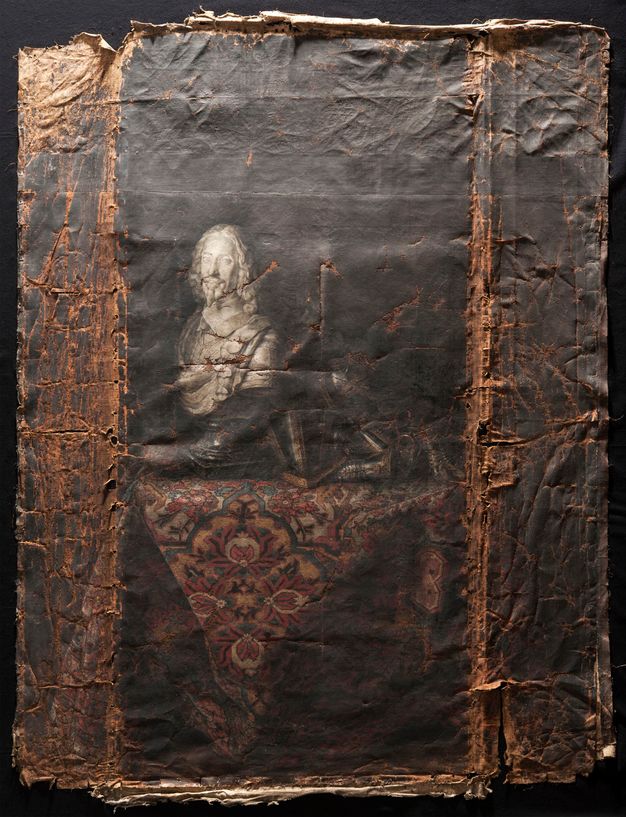
A new installation at the Kunstkammer gave it a new lease on life; it is paired with the bust that is depicted in the painting.23 Libalt’s still life must have been commissioned by Leopold Wilhelm himself. It is listed in his 1659 inventory, though it is dated a year later on the painting itself.
Unlined seventeenth-century paintings are rare and the still life’s surface texture, with its illusionistic, almost 3D-rendering of the carpet, motivated us to find a way to stabilize the picture without lining it. Pressed for time, we collaborated with a specialized freelance team who performed the treatment in time by organizing several round-the-clock shifts of tear-menders.24 (For details of the treatment, see Walde, Gerhard, Simone Wernitznig, and Elke Oberthaler. 2014. “Ein grosses Stukh von Öhlfarb auff Leinwaeth. ‘Zur Konservierung und Restaurierung des Stilllebens mit Büste Erzherzog Leopold Wilhelms.’” In Technologische Studien 11, edited by Kunsthistorisches Museum and Sabine Haag, 172–205. Vienna: Kunsthistorisches Museum..)
To begin, we removed the painting from the strainer and examined the various interventions and format changes (see fig. 14.6). In addition to the painting’s reduced width mentioned above, its height had been extended by the addition of two strips of canvas.25
Because the painting is listed in the archduke’s inventory, this gave us a contemporary record of its original size, although this includes the frame.26 The canvas scalloping and other key features, such as the selvages within the original seam (presumably once in the center) as well as on the left edge and the black paint covering the unpainted canvas at the left edge provided evidence of its original format. Our research also suggested that the top extensions were later additions. This and the size recorded in the inventory allowed a conclusive reconstruction of the original, and we decided to reestablish this format.
To flatten the deformations, the canvas was treated with indirect humidity.27 The most labor-intensive interventions were thread-by-thread tear mending and thread-by-thread inserting (and weaving) new threads to reconstruct the losses of original canvas (fig. 14.7).28 The open areas in the original seam were connected with stitches or bridges from the reverse.29 The strip-lining with a new natural Belgian canvas, prepared by fringing and coated with a layer of self-made Beva film, was then sealed to the original canvas.
To reconstruct the original format, we needed to “lose” the top, nonoriginal strip of canvas. We decided not to remove these nonoriginal (though old) additions but to flip them. To protect both the old canvas and brittle paint layers, a rounded wooden (slightly larger) profile was added to the top edge of the stretcher. The upper edge of the support was fixed to the stretcher on the reverse with adhesive at the strip-lining. The canvas and paint layers on the reverse are protected with acid-free corrugated cardboard. The painting was then framed and glazed for display, with its unlined but fragmentary character preserved.
Concluding Thoughts and Future Outlook
Extensive treatments of large paintings depend on many preconditions, which sometimes are difficult to achieve even in established institutions. These preconditions are free studio space for an extended period of time and the long-term collaboration of trained professionals—conservators, curators, scientists, technicians, directors—making treatment decisions a big commitment. Unfortunately, such commitment is increasingly difficult to attain in times marked by the quick turnover of paintings forced on conservation studios by exhibition schedules and reduced museum staff.
With the focus increasingly on preventive conservation and technical research (and the time needed for administration), museum conservators are in danger of losing their structural intervention skills. In contrast, freelance conservators need to complete conservation treatments, but they may not always be able to carry out the necessary research, resulting in divergent skill sets between restorers working in museums and freelancers. This fact makes it imperative that museum staff and freelancers join forces and institute a regular exchange of ideas. Collaboration between professionals with a wide range of skills and strong institutional support for conservation are key to preserving artworks for future generations.
Acknowledgments
Conservation of large paintings requires teamwork, and many colleagues have contributed to the interventions presented here. I would like to thank Eva Götz, Michael Odlozil, Ina Slama, Gudrun Swoboda, Stefan Weppelmann, Wencke Deiters, Sylvia Ferino, Sonja Kocian, Ingrid Hopfner, Flaminia Rukavina, Markus Geyer, Rudolf Hlava, Monika Strolz, Sanela Antic, Michael Aumüller, Michael Eder, Andreas Uldrich, Katharina Hatzl, Rita Berg, Bernadette Henke, Julie Sutter, Rhe Suykens, Laura Hack, Gerlinde Gruber, Gerhard Walde, Simone Wernitznig, Ute Tüchler, Carmen Lenoir, Helena Brosch, Sarah Danhauser, Jonathan Debik, Sarah Jahns, Mona Konietzny, Joan Lee, Caroline Ocks, Christina Robens, and Herbert Maurer.
Notes
-
More than a thousand (1,046) paintings in the collection are over 200 centimeters in at least one dimension. ↩︎
-
A prominent example is Giorgione’s Three Philosophers, which is listed as stored and without strainer (“ohne Blindrahm”) in the 1772 inventory. ↩︎
-
See https://www.khm.at/en/objectdb/detail/3392/?offset=0&lv=list. ↩︎
-
Facings covering the entire surface were removed on the following paintings: Jacob with Esau, by Johann Heinrich Schönfeld (98 × 181 cm, GG 1145); Georg Castriota, Called Skanderbeg, Duke of Albania, Northern Italian (213.3 × 98.3 cm, GG 7954, treatment by Claire Toussat in 2012); Resurrection of Christ, by Garofalo (314 × 181 cm, GG 9551, treatment by Ingrid Hopfner in 2015); and Franz I Stephan and Maria Theresia with Eleven of their Children, by the School of Martin van Meytens the Younger (200.7 × 179.3 cm, GG 3149). ↩︎
-
The largest canvas is 400 x 800 cm: Pierre Benevault des Mares, Diana Commands to Hunt (1672; GG 6890). It is stored on a roll. ↩︎
-
The same type of lining is seen on Titian’s Nymph and Shepherd, 1570–75 (150 × 187 cm, GG 1825), with an inscription on the reverse: “Hickel rep. 1774” (Oberthaler, Elke. 2008. “Zur Restaurierung von Tizians Nymphe und Schäfer.” In Technologische Studien, vol. 5, 182–207. Vienna: Wilfried Seipel.). ↩︎
-
See https://www.khm.at/en/objectdb/detail/1944/?offset=12&lv=list.
The treatment was performed by Michael Odlozil and Katharina Hatzl in 2013–14, and generously supported by American Bank. ↩︎
-
Filling material: linen fibers cut, precooked, and bound with sturgeon glue (20%) and wheat starch (13%). ↩︎
-
Consolidation of flaking paint layers: sturgeon glue (7%) with surfactant Surfynol 61 (3,5-dimethyl-1-Hexen-3-ol). Strip-lining: natural canvas (flax fibers) and the copolymer butyl methacrylate dispersion Lascaux 498 HV. ↩︎
-
Caravaggio, Rosary Madonna, ca. 1601 (364.5 × 249.5 cm, GG 147). https://www.khm.at/en/objectdb/detail/425/?offset=8&lv=list. Treatment was carried out in September 2019 by Eva Götz, Michael Odlozil, and Ina Slama. ↩︎
-
According to art historian Alice Hoppe-Harnoncourt, the painting was evacuated on a “big drum” (i.e., cylinder) together with seven other Italian and Netherlandish paintings in 1809 (email correspondence, February 27, 2020). I am grateful to Alice Hoppe-Harnoncourt for this information. ↩︎
-
The earliest record of the Rosary Madonna’s size from 1824 (room 6, no. 20) already gives the reduced height, as does the 1837 catalogue (Krafft, Albrecht. 1837. Verzeichnis der kais: Kön. Vienna: Gemälde-Gallerie im Belvedere.). ↩︎
-
Caravaggio & Bernini—The Discovery of Emotion. KHM Vienna, October 15, 2019–January 19, 2020. ↩︎
-
This was indicated by the reduced height of 337 cm in the 1837 catalogue (Krafft, Albrecht. 1837. Verzeichnis der kais: Kön. Vienna: Gemälde-Gallerie im Belvedere.). ↩︎
-
Treatment by Eva Götz and Michael Odlozil; structural assistance by Rhe Suykens and Laura Hack, November 2017–February 2020. ↩︎
-
Each canvas measures 400 × 480 cm (GG 6826 and GG 6829). Treatment by Eva Götz, Elke Oberthaler, Michael Odlozil, Ina Slama, Rita Berg, Julie Sutter, and Bernadette Henke, July–August 2012, respectively. In addition to structural stabilization, the surface was cleaned and discolored retouches were adjusted. ↩︎
-
Ratio of wheat starch (1:4) to rabbit-skin glue (10%) = 10:1. ↩︎
-
Adhesive: Lascaux 498‑20X. ↩︎
-
Adhesive: mixture of sturgeon glue, glucose, glyoxal acid, and tylose. ↩︎
-
Today two institutions in Austria offer academic conservation training programs: the Academy of Fine Arts and the University of Applied Arts, both in Vienna. ↩︎
-
Lining of Gottfried Libalt’s painting is not documented. Pietro de Pomis’s painting was lined in 1963. ↩︎
-
Rare exceptions exist in late acquisitions or treatments performed outside the KHM. ↩︎
-
Jêrome Dusquenois, Archduke Leopold Wilhelm, 1650, marble, KK 8932. ↩︎
-
Treatment performed by the team of Atelier Walde Vienna, October 2012–February 2013. ↩︎
-
Size before treatment was 253 x 119 cm. ↩︎
-
“827. Ein grosses Stuckh von Öhlfarb auff Leinwaeth . . . In einer schmallen, schwartzen Ramen, hoch 10 Spann 9 Finger vnd braidt 9 Spann / 5 Finger./ deponiert” (A large oil painting on canvas . . . in a narrow black frame, ca. 300 by ca. 188 cm / stored). Size listed in 1659 inventory is 226.72 x 197.6 cm, including frame. Size after treatment (stretcher) is 225 x 196 cm. ↩︎
-
Indirect humidification above nonwoven Gore-Tex fabric, and subsequent drying under pressure (sandbags). Severely distorted areas of canvas were rearranged after vaporization using insect pins. ↩︎
-
Thread-by-thread tear mending with sturgeon glue 20% and wheat starch (ratio 1:2). New thread material: linen (flax), color-adjusted to original canvas threads and coated with 3% Kollotex. ↩︎
-
Same adhesives as in tear mending, see preceding note. ↩︎