Chicago
Hackney, Stephen. “1. Understanding Structure, Changing
Practice.” In
Conserving Canvas, by
Cynthia Schwarz, Ian McClure, and Jim Coddington. Los Angeles:
Getty Conservation Institute, 2023.
https://www.getty.edu/publications/conserving-canvas/i-history/1/.
MLA
Hackney, Stephen. “1. Understanding Structure, Changing
Practice.”
Conserving Canvas, by
Cynthia Schwarz et al., Getty Conservation Institute, 2023,
https://www.getty.edu/publications/conserving-canvas/i-history/1/.
Accessed DD Mon. YYYY.
Stephen Hackney,
Head of Conservation Science (retired),
Tate, London
In the latter part of the twentieth century, conservators
questioned the practice of lining paintings on canvas. This
inspired fundamental scientific studies of the structure,
material, and aging of paintings. The implications of
mechanical and chemical aging can now be better predicted.
This knowledge has provided conservators with a wide variety
of alternative treatments, and it supports the concept of
collections care.
By addressing the structure of a painting, we are forced to
consider not only the image intended by the artist but also
the artwork’s physical nature and history. A stretched canvas
is a subtle and delicate construction devised for both
stability and lightness, but if the structure is damaged or
failing, this creates risks for both the appearance and
purpose of a painting.
As any artifact ages and deteriorates, it eventually reaches a
point when its appearance and functions are judged to be no
longer acceptable. Some of these changes demand action in
order to preserve the artifact’s use and prevent further
decay. Some changes are not reversible—for instance, cracks,
which indicate fragility and may cause a disturbing
interference with an image. Yet, in a painting, cracks are
also viewed as a sign of authenticity.
Structural conservation of a canvas painting can be a more
profound intervention than cleaning or varnish removal, and
each intervention presents fundamental aesthetic challenges
for the paint surface and ethical doubts for the concept of
reversibility. A structural treatment may be applied to an
entire painting, perhaps in a single, rapid operation. Like
other aspects of conservation, such a treatment requires
considerable judgment and skill, and success is often
determined by the treatment’s invisibility.
Fifty years ago, a traditional lining method was considered a
normal component of any conservation treatment. The lining
used was defined by the choice of adhesive, and these
materials had a surprisingly wide range of properties, from
water based to water repellent. The goal of lining was to turn
a fragile canvas painting into one that was much more
resilient, but the means and the outcome were not well
defined. The dangers in lining were recognized, however, and
it was normally carried out by skilled and experienced
professionals. But attempts were also made to automate and
deskill the process by using hot tables and vacuum pressure.
For the student, there was little published information except
for some early discussions on reservations about glue lining,
the justification for introducing wax-resin adhesives, and
designs for hot tables (Ruhemann 1953Ruhemann, Helmut. 1953. “The Impregnation and Lining of
Paintings on a Hot Table.”
Studies in Conservation 1, no. 2: 73–76.;
Straub and Rees Jones 1955Straub, R., and S. Rees Jones. 1955. “Marouflage,
Relining and Treatment of Cupping with Atmospheric
Pressure.” Studies in Conservation 2, no. 2:
55–63.). From this background, Westby Percival-Prescott conceived
the Conference on Comparative Lining Techniques, held in
Greenwich (London) in 1974. This ambitious project brought
together experts from various backgrounds, but it succeeded in
uncovering much confusion of purpose and also a genuine desire
to improve the situation (Percival-Prescott 2003bPercival-Prescott, Westby. 2003. “The Lining Cycle:
Causes of Physical Deterioration in Oil Paintings on
Canvas: Lining from the 17th Century to the Present Day.”
In
Lining Paintings: Papers from the Greenwich Conference
on Comparative Lining Techniques, edited by Caroline Villers, 1–15. London: Archetype.
Originally published as W. Percival-Prescott. 1974. “The
Lining Cycle.” In
Lining Paintings: Papers from the Greenwich Conference
on Comparative Lining Techniques, unpaginated. Greenwich: National Maritime Museum,
1974.). Traditional methods were described by practitioners, and
several research projects investigating alternative adhesives
and lining methods were presented. A wide variety of
conservation aims emerged, from restoring the original
appearance of a painting to accepting its existing condition
(Mehra 2003Mehra, Vishwa R. 2003. “A Low-Pressure Cold-Relining
Table.” In
Lining Paintings: Papers from the Greenwich Conference
on Comparative Lining Techniques, edited by Caroline Villers, 121–24. London:
Archetype.). For the first time, the advantages and disadvantages of
all materials and methods were openly debated, including
wax-lining methods (Berger and Zeliger 2003Berger, Gustav A., and Harold I. Zeliger. 2003. “Wax
Impregnation of Cellulose: An Irreversible Process.” In
Lining Paintings: Papers from the Greenwich Conference
on Comparative Lining Techniques, edited by Caroline Villers, 25–27. London:
Archetype.;
Cummings and Hedley 2003Cummings, Alan, and Gerry Hedley. 2003. “Surface Texture
Changes in Vacuum Lining: Experiments with Raw Canvas.” In
Lining Paintings: Papers from the Greenwich Conference
on Comparative Lining Techniques, edited by Caroline Villers, 87–95. London:
Archetype.).
During a period when lining was widely, uncritically accepted,
most practitioners had honed their skills in a narrow lining
specialty based on one specific adhesive and had a limited
range of experience. The establishment of conservation
training courses with academic aspirations has now largely
replaced the former apprenticeship training, which passed on
the strengths and skills of existing practices but had no
mechanism to compare or improve on them. Formal training has
provided an impetus for conservation science, and the study of
conservation methods has influenced the materials and practice
of conservators and even some artists.
Scientific Research
After Greenwich, it was clear that an understanding of the
structure and mechanisms of stretched canvas paintings was
needed. This has since been achieved by a number of
researchers, beginning with Marion Mecklenburg and his
systematic studies that provided measurements of painting
materials under tension and different RH conditions,
identifying the high tension in glue films and grounds at low
humidity. Measurements of breaking strains of oil paint films
led to an explanation of the observed cracking of canvas
paintings (fig. 1.1).
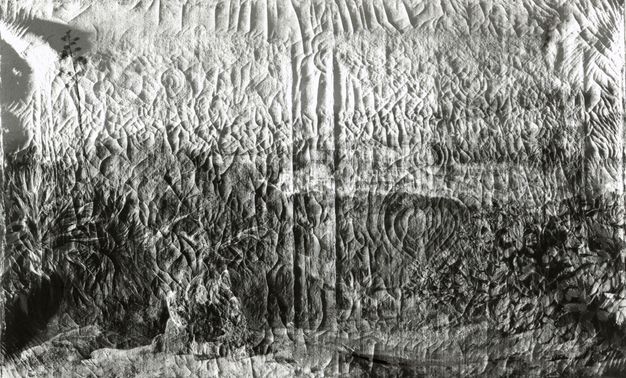
ExpandFigure 1.1Edward Lear,
View of Reggio and the Straits of Messina, 1852.
Oil on canvas, 51.4 × 81.2 cm (20 1/4 × 32 in.). Typical
raised crack pattern, impact cracks, and canvas corner
undulation in raking light.Image: Tate
The response of paintings to moisture had been a particular
concern since the nineteenth century. Mecklenburg’s plot of
tension against RH for all the materials on a stretched and
primed canvas was a major advance (Mecklenburg 1982Mecklenburg, Marion F. 1982. “Some Aspects of the
Mechanical Behavior of Fabric Supported Paintings: Report
to the Smithsonian Institution.” Unpublished report,
Smithsonian Museum Conservation Institute, Washington, DC.
Reprinted in Dawn V. Rogala, Paula T. DePriest, A. Elena
Charola, and Robert J. Koestler, eds.
The Mechanics of Art Materials and Its Future in
Heritage Science, 107–29. Washington, DC: Smithsonian Contributions to
Museum Conservation, 2019.
https://doi.org/10.5479/si.11342126.;
Mecklenburg and Tumosa 1991aMecklenburg, Marion F., and Charles S. Tumosa. 1991a.
“Introduction into the Mechanical Behavior of Paintings
under Rapid Loading Conditions.” In
Art in Transit: Studies in the Transport of
Paintings, edited by Marion F. Mecklenburg. Washington, DC:
National Gallery of Art.). Gerry Hedley explained the mechanism of canvas shrinking
when exposed to water or RH approaching 100%. He also saw the
effect of initial weave crimp transfer from warp to weft
(Hedley 1993Hedley, Gerry. 1993. “Relative Humidity and the
Stress/Strain Response of Canvas Paintings: Uniaxial
Measurements of Naturally Aged Samples.” In
Measured Opinions: Collected Papers on the Conservation
of Paintings, edited by Caroline Villers, 86–96. London: United
Kingdom Institute for Conservation of Historic and
Artistic Works.;
Hedley and Odlyha 1993Hedley, Gerry, and Marianne Odlyha. 1993. “The Moisture
Softening of Paint Samples and Its Implication for the
Treatment of Fabric Supported Paintings.” In
Measured Opinions: Collected Papers on the Conservation
of Paintings, edited by Caroline Villers, 99–102. London: United
Kingdom Institute for Conservation of Historic and
Artistic Works. Also published as
Traitement des support. Travaux interdisciplinaires.
Paris, 2,3 et 4 novembre 1989, 1989, 157–62. Paris: Association des restaurateurs d’art et
d’archéologie de formation universitaire.). The differing influence of pigments on the drying (curing)
of linseed oil explained why the application of moisture and
pressure is not enough to flatten most mature lead white
paints. Temperature response of paintings was also
investigated (Michalski 1991Michalski, Stefan. 1991. “Paintings: Their Response to
Temperature, Relative Humidity, Shock, and Vibration.” In
Art in Transit: Studies in the Transport of
Paintings, edited by Marion Mecklenburg, 223–48. Washington, DC:
National Gallery of Art.). Cracking of otherwise flexible acrylic paintings at
extremely low temperatures was at first surprising. The
concept of glass transition temperature (Tg) clarified why
familiar flexible materials became brittle at these low
temperatures.
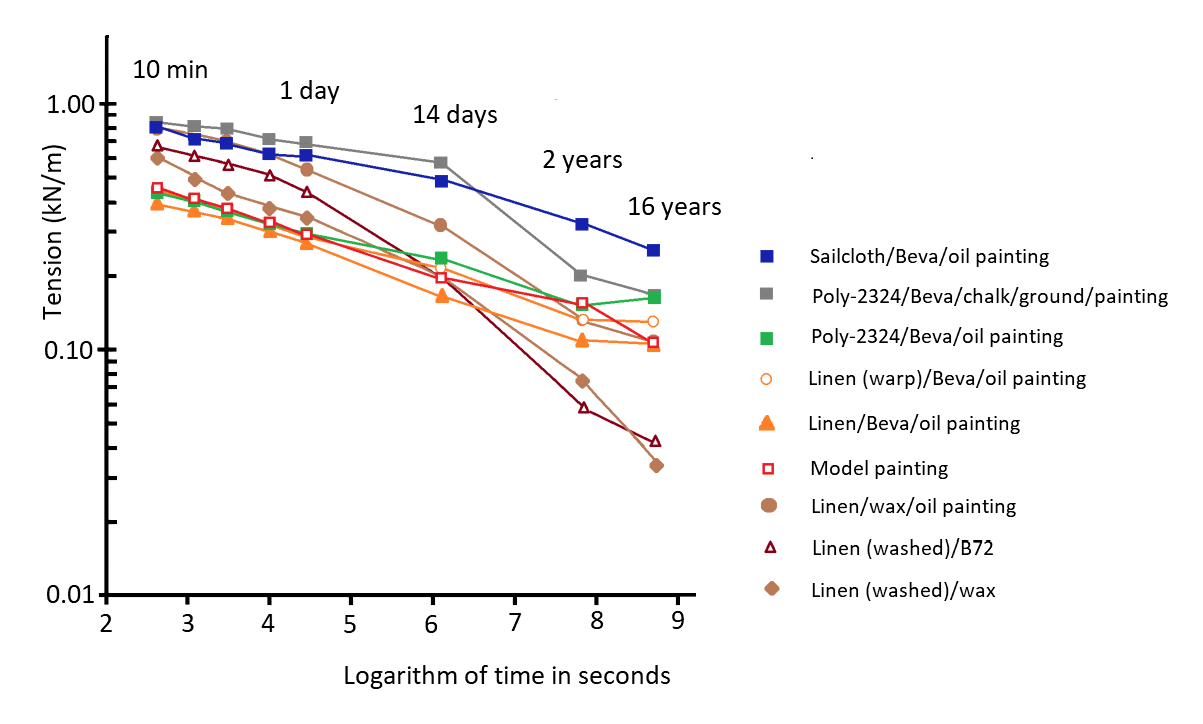
Long-term mechanical behavior, such as relaxation and creep,
has also been measured, providing useful predictions of future
behavior. It took sixteen years to collect the data presented
at the Canadian Conservation Institute, which show the
relaxation (loss of tension) of stretched canvas paintings and
linings over that period of time, plotted on a logarithmic
time axis (fig. 1.2). Such data are
critical when deciding on the best choice of adhesive and
lining material.
ExpandFigure 1.2Long-term relaxation for several canvases and linings
plotted logarithmically against time (Daly Hartin et al.
2011).Image: Stephen Hackney
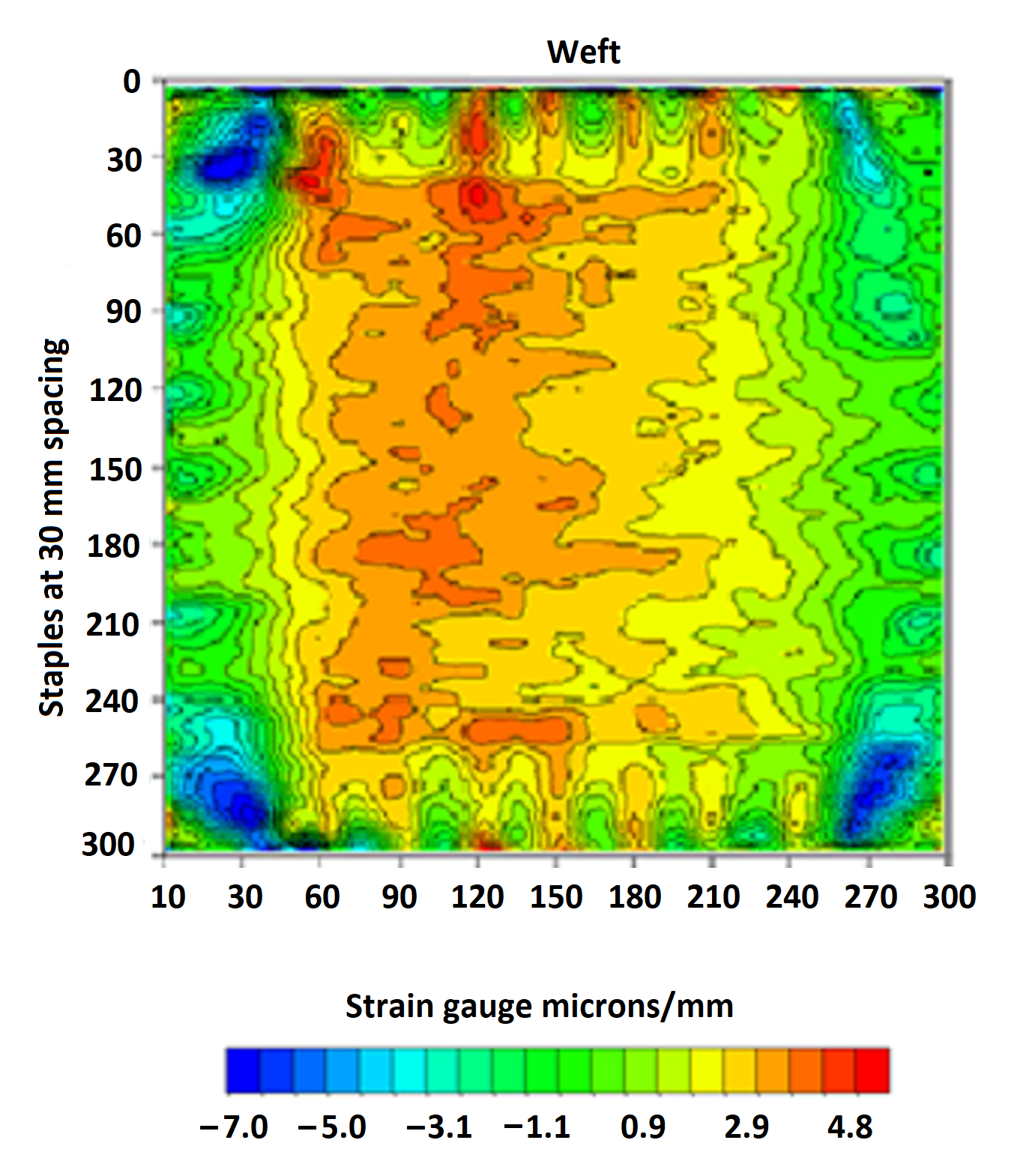
The use of biaxial stretching, first proposed by Berger (Berger and Russell 2000Berger, Gustav A., and William H. Russell. 2000.
Conservation of Paintings: Research and Innovations. London: Archetype.), and electronic speckle pattern interferometry (ESPI) for
strain measurement (fig. 1.3) enabled
Young and Hibberd to look in further detail at conservation
issues and lining practices, such as the strain associated
with stretcher attachments (Young and Hibberd 1999Young, Christina R. T., and Roger D. Hibberd. 1999.
“Biaxial Tensile Testing of Paintings on Canvas.”
Studies in Conservation 44, no. 2: 129–41.;
Young and Hibberd 2000Young, Christina R. T., and Roger D. Hibberd. 2000. “The
Role of Attachments in the Degradation and Strain
Distribution of Canvas Paintings.” In
Tradition and Innovation: Advances in Conservation, edited by Ashok Roy and Perry Smith, 212–20. London:
International Institute for Conservation of Historic and
Artistic Works.). The complex structure of stretched canvas is now
understood in sufficient detail to consider computer modeling
of the mechanical properties of both paintings and linings. It
also offers the opportunity to study in more detail the
effects of minimal treatments on more contemporary paintings
(Hagan et al. 2007Hagan, Eric, Maria Charalambides, Thomas J. S. Learner,
Alison Murray, and Christina Young. 2007. “Factors
Affecting the Mechanical Properties of Modern Paints.” In
Modern Paints Uncovered: Proceedings from the Modern
Paints Uncovered Symposium, edited by Thomas J. S. Learner et al., 225–33. Los
Angeles: Getty Conservation Institute.;
Hagan et al. 2011bHagan, Eric, Maria N. Charalambides, Christina R. T.
Young, Thomas J. S. Learner, and Stephen Hackney. 2011.
“Micromechanics Models for Predicting Tensile Properties
of Latex Paint Films.” In
Time Dependent Constitutive Behavior and
Fracture/Failure Processes, vol. 3, edited by Tom Proulx, 297–306. New York:
Springer.). Temporary solutions and physical protection may prove to
be our best options, but many have not yet been fully assessed
objectively.
ExpandFigure 1.3Strain variations near the canvas edges associated with
the use of tacks for attachment to the stretcher (Young
and Hibberd 1999).Image: Stephen Hackney
Conservation Practice
Transferring research results into conservation practice on
historical objects involves special problems. Understanding
materials in a pristine state is not enough to predict the
behavior of deteriorated old paintings (Ackroyd 2002Ackroyd, Paul. 2002. “The Structural Conservation of
Canvas Paintings: Changes in Attitude and Practice since
the Early 1970s.” Reviews in Conservation 47,
supp. 1: 3–14.;
Hackney 2004bHackney, Stephen. 2004b. “Paintings on Canvas: Lining and
Alternatives.” Tate Papers, no. 2 (Autumn).
https://www.tate.org.uk/research/tate-papers/02/paintings-on-canvas-lining-and-alternatives.;
Phenix 1995Phenix, Alan. 1995. “The Lining of Paintings: Traditions,
Principles, and Developments.” In
Lining and Backing: The Support of Paintings, Paper and
Textiles: Papers Delivered at the UKIC Conference, 7–8
November 1995, UKIC, Hampshire, edited by Andrew Durham, 21–33. London: United Kingdom
Institute for Conservation of Historic and Artistic
Works.;
Reeve 1984Reeve, Anthony. 1984. “A New Multi-Purpose Low-Pressure
Conservation Table for the Treatment of Paintings.”
Studies in Conservation 29, no. 3: 124–28.;
Scharff 2012Scharff, Mikkel. 2012. “Structural Treatment of Canvas
Paintings, Especially Using Low Pressure Suction Tables.”
In Conservation of Easel Paintings, edited by
Joyce Stoner and Rebecca Rushfield, 396–408.
Abingdon-on-Thames, UK: Routledge.). Since an assessment of physical condition and appropriate
treatment requires such knowledge, measuring slow processes
such as “natural” aging is increasingly necessary in order to
make reliable long-term decisions.
Progress in devising and applying new conservation treatments
is made difficult because at some stage practical experience
can be gained only by working directly on unique and valuable
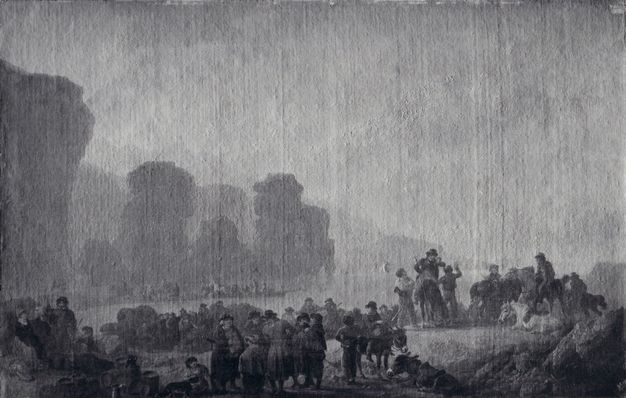
original aged material (fig. 1.4). It
might be argued that this amounts to carrying out scientific
experiments lacking a control. As a consequence, we can choose
our treatment method but cannot be sure it was the best of
several possible options.
ExpandFigure 1.4Julius Caesar Ibbetson,
Smugglers on the Irish Coast, 1808. Oil paint on
canvas, 54.6 × 85.1 cm (21 1/2 × 32 in.). Glue-lined oil
painting, possibly including megilp chosen by the artist
for its fluidity (Ibbetson 1803). The raking light reveals
flattened impasto and weave emphasis from glue
lining.Image: Tate
In the United Kingdom, original nineteenth-century loose
linings have provided a limited source of acceptable
experimental material, but such material has still not been
replicated reliably in all its aspects by artificial aging
methods.
For the conservator concerned with historical paintings, it is
important to be aware of artists’ changing methods, materials,
and intentions. There is much detail, accumulated from the
examination of examples of painting practice, to inform the
conservator of the likely behavior of a specific painting to
be treated. For the period from the latter part of the
nineteenth century until the present, artists were less bound
by academy controls; their aims became more adventurous, and
their materials and methods expanded. As paintings from this
period increasingly demand attention and treatment, the
conservator is presented with a variety of interesting new
problems and conflicts, many of which have already contributed
to modified conservation practice for works on canvas,
currently leading to a more preventive approach. The demands
of much recently created art provide a challenge that requires
radical solutions, and they are pointing to new directions in
conservation of both contemporary and traditional art (Heiber 2003Heiber, Winfried. 2003. “The Thread-by-Thread Tear
Mending Method.” In
Alternatives to Lining: Structural Treatment of
Paintings on Canvas without Lining: A Conference Held
Jointly by the British Association of Paintings
Conservator-Restorers and the United Kingdom Institute
for Conservation Paintings Section, 19 September 2003:
Preprints, edited by Mary Bustin and Tom Caley, 35–48. London:
United Kingdom Institute for Conservation of Historic and
Artistic Works.).
Some developments of lining processes using new materials,
such as sailcloth fabric (Hedley and Villers 1982Hedley, Gerry, and C. Villers. 1982. “Polyester Sailcloth
Fabric: A High Stiffness Lining Support.” In
Science and Technology in the Service of Conservation:
Preprints of the Contributions to the 9th International
IIC Congress, Washington, DC, 3–9 September 1982, edited by N. S. Brommelle and G. Thomson, 154–58.
London: International Institute for Conservation of
Historic and Artistic Works.) and Beva 371 adhesive (Berger 1975Berger, Gustav A. 1975. “Heat-Seal Lining of a Torn
Painting with Beva 371.”
Studies in Conservation 20, no. 3: 126–51.), have so far survived the test of time. Exploring the
properties and stability of possible alternative conservation
structural materials is a major undertaking, made more
difficult by the risk that material manufacturers may
discontinue their supply. Economics also conspire to deter
time-consuming structural treatments. As a consequence, for
many contemporary paintings, restoration often challenges
existing experience and costs much more than preventing damage
(fig. 1.5).
Given the many unavoidable problems encountered in
conservation treatments, protecting canvases from physical and
chemical deterioration is now considered a priority in many
museums. For the conservator, it has always been difficult to
predict the range of conditions to which a painting has been
and could be exposed. The environment that a specific painting
is likely to encounter remains uncertain, even within museums.
Increasingly, we ask what are the true risks for paintings on
canvas, and how should we decide when intervention is
necessary?
Improvements in the environment of modern museums (controlled
and filtered air-conditioning, UV filtration); careful
handling and operating procedures; and protection during
transport and handling have all contributed to more reliable
conditions. Defining exact relative humidity/temperature
(RH/T) conditions is virtually impossible, but the absence of
identifiable damage that can be directly attributed to current
museum conditions is a positive indicator. However, more
recently, an open-ended commitment to long-term protection by
air-conditioning has been challenged as expensive and
unsustainable in energy terms.
In the past, the risks of travel were unpredictable and
thought to be large. Conservators were therefore obliged to
reinforce a painting’s structure to the best of their ability.
With increasing loan and exhibition programs and major
blockbuster exhibitions, this has become an international
problem. The transport environment has now been examined in
terms of shock, vibration, moisture content, and temperature
along with their consequences for paintings in transit.
Criteria for behavior and designs for packing cases to
minimize exposure to risks have become established. An
interesting observation from the Art in Transit research group
was that, by using reliable methods and tight procedures,
transport risks could be reduced below those of handling
within a museum (Mecklenburg 1991Mecklenburg, Marion, ed. 1991.
Art in Transit: Studies in the Transport of
Paintings. Washington, DC: National Gallery of Art.).
By introducing consistent procedures for the physical
protection of works of art, it is easier to avoid much
accidental damage and unnecessary early deterioration.
Successful collections care procedures have together made the
idea that lining is a requirement much less persuasive and
forced us to be more precise about its purpose.
Chemical Aging Processes
For the long-term survival of paintings, the less dramatic yet
equally important chemical degradation of canvas, size,
ground, and paint needs to be considered. However, the exact
condition of aged canvases and their continuing rate of decay
cannot be known in sufficient detail and are not readily
captured in most risk analysis, which is currently concerned
with shorter term, mainly physical activity.
The slow reactions of oxidation and hydrolysis that take place
in degrading cellulose and oil paint are the main reasons that
painting materials become fragile. What were originally stable
structures no longer perform their design function, and
physical damage often follows. Air pollution and light
contribute to this deterioration, involving chemical
interactions between canvas and its immediate environment.
They play a subtle, perhaps unstoppable role in aging.
Between 1900 and 1960, air pollution was at its worst in many
countries. Most museums were not air-conditioned, and until
about 1990 concentrations of particulates and the strong
acidic gas sulfur dioxide remained unacceptably high. In the
last hundred years or so, exposed canvas has adsorbed sulfur
dioxide from air pollution; the sulfur dioxide then reacts
with the cellulose in the canvas. The products are not
volatile and remain in the canvas, facilitating hydrolysis
reactions. All acidity, whether from external and internal
pollution or simply from oxidation, cause measurable weakening
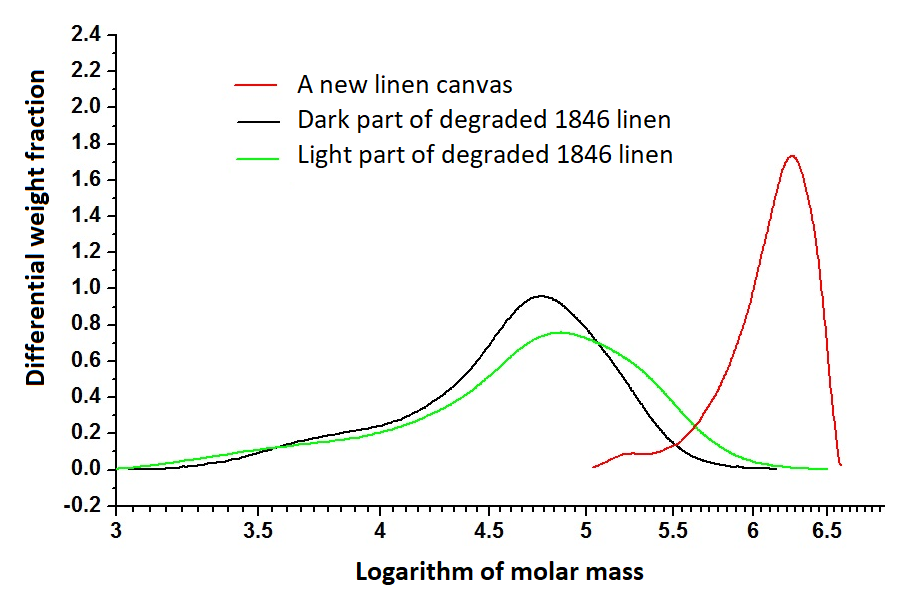
and embrittlement of the canvas (fig. 1.6).
ExpandFigure 1.6Plot of molar mass distribution. A new canvas on the
right with a range of very high molecular weights compared
with two samples of a J. M. W. Turner loose-lining canvas
(painting dated 1846). The peaks (modes) for the Turner
canvas are at much less molar mass and there is a greater
spread of molar masses than for the new canvas, indicating
that the long cellulose molecules have been cleaved at
many points. Also, the darker exposed parts are more
degraded than the lighter parts behind the stretcher.
Canvas samples analyzed at BOKU Vienna during the EU
MEMORI project (Jeong et al. 2013).Image: Myung-Joon Jeong, Manuel Becker, Antje Potthast,
Susana López-Aparicio, and Stephen Hackney
Efflorescence can occur on the surface of oil paintings,
especially unvarnished ones, and on glazed works it is
sometimes transferred onto the glass. This deposit has been
analyzed as fatty acids (Williams 1989Williams, Scott R. 1989. “Blooms, Blushes, Transferred
Images, and Mouldy Surfaces: What Are These Distracting
Accretions on Art Works?” In
Proceedings of the 14th Annual IIC-CG Conference,
Toronto, May 27–30, 1988, edited by Johanna G. Wellheiser, 65–84. Ottawa: IIC
Canadian Group.), which must have been released from the oil paint. The
hydrolysis of oils is well known, and migration of its
reaction products within dried oil paint films explains
efflorescence.
There has been a major advance in understanding the
degradation of oil paint and how it changes the paint’s
optical performance and our perception of a painted image
(Boon, van der Weerd, and Keune 2002Boon, Jaap J., Jaap van der Weerd, and Katrien Keune.
2002. “Mechanical and Chemical Changes in Old Master
Paintings: Dissolution, Metal Soap Formation and
Re-Mineralization Processes in Lead Pigmented
Ground/Intermediate Paint Layers of 17th Century
Paintings.” In
Paintings II: Scientific Study of Paintings (Methods
and Techniques); Preprints of 13th Triennial Meeting,
ICOM Committee for Conservation, Rio de Janeiro, Brazil,
22–27 September 2002, edited by Roy Vontobel, vol. 1, 401–7. London: James
and James.;
Keune 2005Keune, Katrien. 2005. “Binding Medium, Pigments and Metal
Soaps Characterised and Localised in Paint
Cross-Sections.” PhD diss., FOM Institute of Atomic and
Molecular Physics. MOLART Reports 11, chap. 5,
113–64.). We are all familiar with the increase in transparency of
oil paintings and grounds. The impregnation and lining of
paintings with thin grounds can also cause increases in
transparency, especially when wax resin has been used (Bomford and Staniforth 1981Bomford, David, and Sarah Staniforth. 1981. “Wax–Resin
Lining and Colour Change: An Evaluation.”
National Gallery Technical Bulletin 5:
58–65.). We now know that old paint films form an ionomeric
structure that continues to deteriorate by hydrolysis and
oxidation. Saponification reactions of free acids with
alkaline or basic metals present in finer pigments, such as
calcium, magnesium, lead, and zinc, can dissolve pigments into
the paint. Removal of these light-dispersing fine pigments
causes the paint to increase in transparency.
I recently conducted experiments involving mixing acid-base
titration indicators into various fresh white oil paints and
then painting them out. In a few minutes, the pH 4, 4.1, and
4.7 indicators began to change color, but the pH 3.3 and 3.7
indicators remained unchanged for months. For comparison,
samples were removed and exposed to ammonia vapor to return
them to their initial color (for a short time). Similar
control samples in artists acrylic paint did not change color
at all. This demonstrates that oil paint becomes acidic within
a short period of time (Hackney 2020Hackney, Stephen. 2020.
On Canvas: Preserving the Structure of Paintings.
Los Angeles: Getty Publications.).
The acidic nature of dried oil paint is the reason why artists
do not paint directly on canvas but instead protect it with a
coat of glue size. The application of an oil ground or paint
on top of this water-soluble size layer produces many of the
structural and mechanical problems that we have to deal with.
A hot glue size will engulf the canvas, but when applied cold
it can accumulate on the canvas surface (Morgan et al. 2012Morgan, Sarah, Joyce H. Townsend, Stephen Hackney, and
Roy Perry. 2012. “Canvas and Its Preparation in Early
Twentieth-Century British Paintings.” In
The Camden Town Group in Context, edited by
Helena Bonett, Ysanne Holt, and Jennifer Mundy, Tate
Research publication.
https://www.tate.org.uk/art/research-publications/camden-town-group/sarah-morgan-joyce-h-townsend-stephen-hackney-and-roy-perry-canvas-and-its-preparation-in-r1104353.). If and when a glue size cracks, its barrier properties are
reduced and volatile breakdown products (VOCs) may reach the
canvas.
Similarly, if we add a consolidating or lining adhesive that
can become acidic on oxidation, the canvas will be exposed to
more rapid deterioration. These arguments suggest more
research is needed into both conservation adhesives and ways
of achieving adequate deacidification of canvas (Hackney, Townsend, and Wyplosz 1996Hackney, Stephen, Joyce Townsend, and Nicolas Wyplosz.
1996. “Studies on the De-Acidification of Canvas Supports
with Magnesium Methyl Methoxycarbonate (MMC).” In
ICOM Committee for Conservation, 11th Triennial
Meeting, Edinburgh, Scotland, 1–6 September 1996:
Preprints, edited by Janet Bridgland, 271–75. London: James and
James.;
Ryder 1986Ryder, Nichole. 1986. “Acidity on Canvas Painting
Supports: Deacidification of Two Twentieth Century
Paintings.” The Conservator 10: 31–36.).
Enclosure on display or in storage to reduce moisture exchange
and deposition of external pollution, such as nitrogen dioxide
and particulates, is an important conservation measure (McClure 2012McClure, Ian. 2012. “Framing and Microclimate Enclosures
for Panel Paintings.” In
Conservation of Easel Paintings, edited by Joyce
Hill Stoner and Rebecca Rushfield, 733–39.
Abingdon-on-Thames, UK: Routledge.) and a more sustainable alternative to air-conditioning, but
measurements within enclosures demonstrate that we have to be
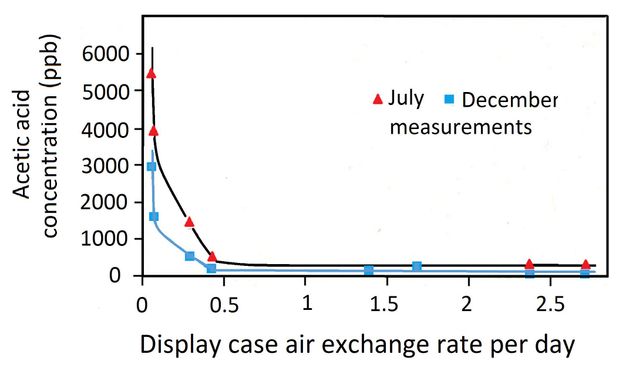
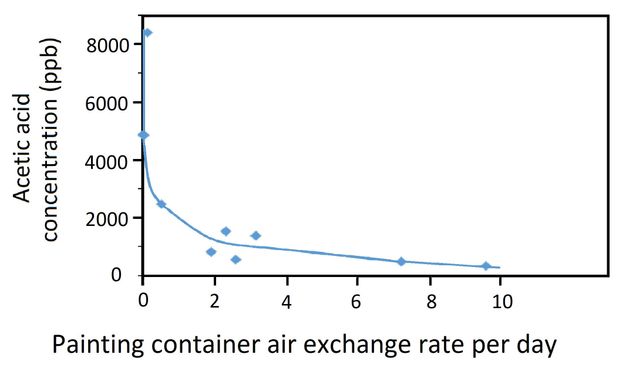
careful in its use (fig. 1.7).
Figure 1.7 Two
separate studies showing that below 0.5–1.0 air exchanges
per day, the air concentration of internally generated
volatile pollution soars. (a) Large-volume display cases
(Thickett et al. 2007). (b) Various narrow painting frames
and cases (Grøntoft et al. 2011). See Hackney 2016. Image:
Stephen Hackney
The concentration in air is not in itself a measure of
reaction rate, but it shows that more molecules are available
to react. Below 0.5 AER (air exchange rate), the rate of
off-gassing of acetic acid, both from the packaging and (some)
from the object, exceeds the combined leakage rate and rate of
deposition or reaction, the latter being slow processes. When
reactive molecules collide, only a small proportion reacts,
but in these circumstances trapped pollution molecules can
collide many times and will eventually react. The introduction
of sacrificial adsorbers or reactants might therefore be
useful, provided they are placed close to the object.
Conclusion
There is still plenty of work to be done, but at last we know
that we can build on a growing body of knowledge. We still
need to turn this knowledge resource into genuine expertise
and practical conservation experience. We also need to embed
in our minds the concept of preventing deterioration, which
will be appreciated by future practitioners who will still be
addressing the same ethical issues. The Conserving Canvas
symposium provided a useful forum to take stock of recent
progress and to assess its contribution to the development of
an agreed way forward.
Figure 1.1Edward Lear,
View of Reggio and the Straits of Messina, 1852. Oil
on canvas, 51.4 × 81.2 cm (20 1/4 × 32 in.). Typical raised
crack pattern, impact cracks, and canvas corner undulation in
raking light. Image: Tate
Figure 1.2Long-term relaxation for several canvases and linings plotted
logarithmically against time (Daly Hartin et al. 2011). Image:
Stephen Hackney
Figure 1.3Strain variations near the canvas edges associated with the
use of tacks for attachment to the stretcher (Young and
Hibberd 1999). Image: Stephen Hackney
Figure 1.4Julius Caesar Ibbetson,
Smugglers on the Irish Coast, 1808. Oil paint on
canvas, 54.6 × 85.1 cm (21 1/2 × 32 in.). Glue-lined oil
painting, possibly including megilp chosen by the artist for
its fluidity (Ibbetson 1803). The raking light reveals
flattened impasto and weave emphasis from glue lining. Image:
Tate
Figure 1.6Plot of molar mass distribution. A new canvas on the right
with a range of very high molecular weights compared with two
samples of a J. M. W. Turner loose-lining canvas (painting
dated 1846). The peaks (modes) for the Turner canvas are at
much less molar mass and there is a greater spread of molar
masses than for the new canvas, indicating that the long
cellulose molecules have been cleaved at many points. Also,
the darker exposed parts are more degraded than the lighter
parts behind the stretcher. Canvas samples analyzed at BOKU
Vienna during the EU MEMORI project (Jeong et al. 2013).
Image: Myung-Joon Jeong, Manuel Becker, Antje Potthast, Susana
López-Aparicio, and Stephen Hackney