This essay provides a personal perspective of a collection the author has studied and worked on over a period of twenty-five years. It discusses the early conservation history of the paintings collection at the V&A, especially preventive conservation, and the impact that has had in their good preservation. The purpose of the collection—to provide excellent examples to improve industrial design—explains the varied nature of the roughly two thousand paintings, which span two thousand years. There is a continuity of purpose: the collection still provides inspiration for the creative industries. How paintings are prioritized for treatment relates largely to the museum’s public program. The paper describes the recent treatment of a selection of canvas paintings that gives an idea of the range of treatments and materials as well as the difference in scale, from an oil sketch by Constable to a theater backdrop designed by Picasso.
33. Conservation of Canvas Paintings at the Victoria and Albert Museum: Past, Present, and Future
- Nicola Costaras, Head Paintings Conservator (retired), Victoria and Albert Museum, London
The V&A History and Collections
Conserving canvas at the Victoria and Albert Museum (V&A) started with its earliest acquisitions. Opened as the South Kensington Museum (SKM) in 1857 and given its current name in 1899, the museum’s purpose was to improve British industrial design by collecting excellent examples. Paintings and other works were lent to art schools throughout Britain for students to copy, an effort organized by the appropriately named Circulation Department. Many paintings were acquired for their suitability as models for copying, and the ensuing years brought gifts and bequests of collections of paintings. Education for a range of audiences is still a primary focus, and the collection is valued as a source of inspiration for those in the creative industries.
This essay discusses setting priorities for treatment and will show how early preventive conservation practices at the SKM have had a profound effect on the condition of the paintings collection. I will describe some recent treatments of a variety of canvas paintings and end with thoughts on their future conservation needs.
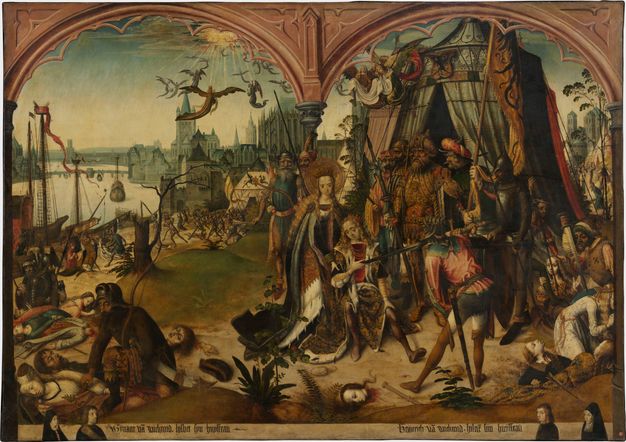
The paintings at the V&A are quite varied. They number around two thousand works and span two thousand years—from first-century Roman frescoes to contemporary paintings from India and Southeast Asia. There are some remarkable German medieval paintings, the fourteenth-century Apocalypse Triptych from Hamburg by Master Bertram (d. 1415),1 and a fifteenth-century oil on canvas from Cologne by the Master of the St. Ursula Legend (fig. 33.1). Italian Renaissance works include panels by Carlo Crivelli (ca. 1430–1495) and Sandro Botticelli (1444/45–1510). There are seventeenth- and eighteenth-century Netherlandish paintings and significant collections of nineteenth-century Continental and British paintings, including ninety-two oil sketches by John Constable (1776–1837). Among the twentieth-century additions are a large collection of theatrical cloths, including backdrops used by the Ballets Russes.
In recent years, paintings have been acquired that have a particular relevance to some other part of the collection or have been bought as a pair of objects; for example, portraits together with the item of clothing or jewelry that the sitter is wearing, such as the Portrait of Edward Curtis (1750), by Marco Benefial (1684–1764) (E.381-2019), together with Curtis’s splendid brocaded silk waistcoat (T.22-2019).
Roughly three-quarters of the paintings in the collection are on canvas. Paintings are displayed throughout the museum, notably in the Medieval and Renaissance Galleries, Europe 1600–1815, and the British Galleries 1500–1900. The Paintings Galleries were reopened in 2003 in a part of the museum that was built to house the first gift by John Sheepshanks (1787–1863) in 1857.
How Paintings Are Prioritized for Treatment
Most of the work of the Conservation Department, roughly 90%, is driven by the museum’s public program: gallery projects (redesigning and refurbishing galleries), exhibitions, displays, and loans to other institutions. We try each year to devote at least 10% of our time to work on the core collection, on objects that have been identified as needing conservation, although there is no plan to display them. Many sections, including Paintings, find this difficult to achieve. With paintings that are requested for loan, we take a minimal approach to try to preserve resources for the museum’s own longer-term projects. In 2019, sixty-seven paintings were requested for loan. Most years, preparing paintings for loan and the associated administration takes up a quarter of my time, for instance.
The rehousing of the V&A’s reserve collection from premises in West London to a new collections and research center in East London, in the Queen Elizabeth Olympic Park at Stratford, has been a major project for the last few years. This planned move spurred the completion of a condition survey of the reserve collection. From the survey we identified just over two hundred paintings that would benefit from some attention before the move. The main issues were flaking paint, very slack canvases, paintings poorly fitted into frames, and frames with no backboard. Remedial work to address these problems was carried out between November 2018 and March 2020 with the help of two colleagues on contract and a technician doing the reframing and backing.2 Without the deadline of the move, the work would not have had the same priority. The paintings in the reserve collection, over 1,500, are only a small part of the 250,000 objects that will have to be moved out of the store. COVID-19 has caused some delays to the move; the new collections and research center is now due to open in 2024.
Early Preventive Conservation
The first curator of paintings at the SKM, Richard Redgrave (1804–1888), had a protocol for dealing with newly acquired paintings that we would now describe as preventive conservation (Costaras, Nicola. 2013. “Richard Redgrave (1804–1888): First Curator of Paintings at the South Kensington Museum.” In Conservation in the Nineteenth Century, edited by Isabelle Brajer, 54–66. London: Archetype.). Redgrave’s acquisition procedure involved cleaning the reverse of paintings as well as the front, and putting a backing on the frame. A few years later, putting glass in the frames became a policy. During the years that I have worked at the V&A, a great many of the paintings in the collection have passed through the studio, and I have had the opportunity to observe their condition. It is striking how many canvases are unlined. I noted, thanks to helpful labels on the reverse, that the treatment of almost all the paintings that were lined was carried out in the 1890s or early 1900s by F. Haines & Sons (more on Haines & Sons later). Redgrave described the state of the Sheepshanks paintings on their acquisition in 1856:
When in the spring of last year the pictures were given over to the Department, the greater number had been left, during the years they had been in Mr. Sheepshanks’ possession, in the state in which they had been purchased direct from the studios of the various artists or elsewhere . . . and all had gradually accumulated dirt and discoloration on their surface, and much dust behind the canvases (a source of mischief too often neglected). (Committee of Council on Education. 1858. Fifth Report of the Science and Art Department of the Committee of Council on Education. London: Her Majesty’s Stationery Office.)
Redgrave went on to describe the measures taken after the dirt had been removed from front and back:
In order to secure the picture on canvas from the injury arising from the accumulation of dust behind them, they have all been protected by painted canvas stretched over them, so as to exclude both damp and dust. (Committee of Council on Education. 1858. Fifth Report of the Science and Art Department of the Committee of Council on Education. London: Her Majesty’s Stationery Office.)
The painted canvas backing has the appearance of imitation leather; it was stretched over the reverse of the painting and tacked to the back of the frame. Narrow wooden fillets were pinned along the edges to improve the seal. An example of this method can be seen on a painting by Johann Gottfried Steffan (1815–1905), The Torrent, 1844/1848 (1545–1869), and probably dates from 1869, the year it was acquired (fig. 33.2).
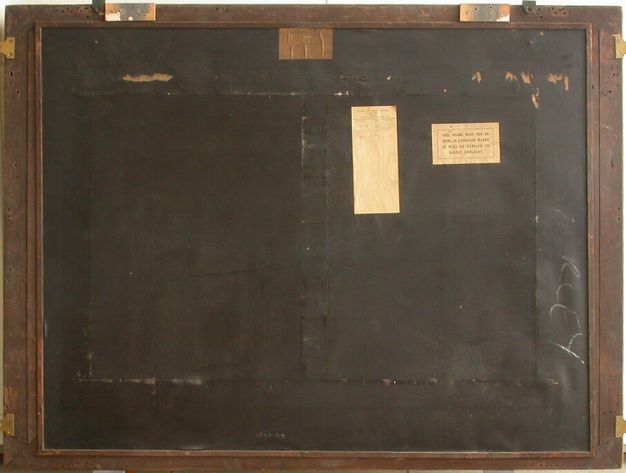
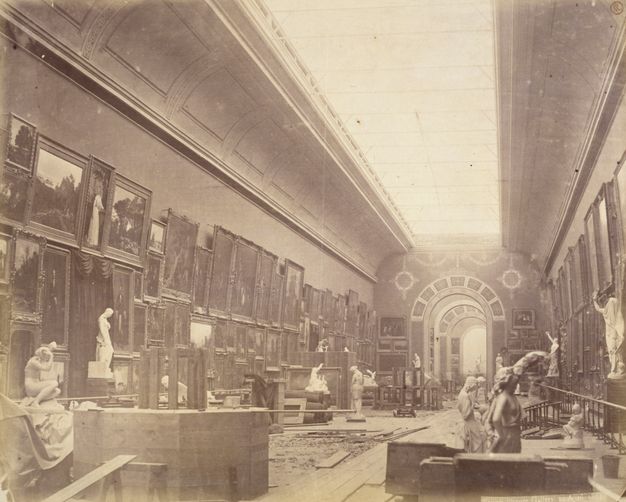
As mentioned earlier, paintings from the collection were regularly sent to art schools around the country for students to copy. The destinations were noted on labels on the reverse, possibly stamped on arrival at the art school. One such label on the reverse of The Torrent records that it went to Northampton and Salford in 1913, and Truro in 1922. An adjacent label contains an injunction not to hang the painting in direct sunlight. The galleries at South Kensington were carefully designed to ensure that the viewer was not disturbed by reflections from the central roof light (skylight), described as “glitter,” including those high up on the walls in a dense double or triple hang (fig. 33.3) (Committee of Council on Education. 1858. Fifth Report of the Science and Art Department of the Committee of Council on Education. London: Her Majesty’s Stationery Office.).
In the recent survey, we found twelve paintings that still had these nineteenth-century painted canvas backings, including two from the Sheepshanks gift in 1856, one of which is The Hermit, ca. 1841, by Charles Landseer (1799–1879) (FA.105[O]). The canvas is in plane and appears sound; until the painting is requested for display or loan or exhibits some structural problem, there seems no pressing need to unframe it.
Treatment History and Philosophy
In the early twentieth century, the use of painted canvas backing gave way to plywood; a thin three-ply was used. In the mid-twentieth century, plywood was superseded by hardboard (the same sort of material as Masonite), which we still use. Since the 1990s, we have been lining the hardboard with Melinex, due to anxiety over its acidity, but I wonder whether, left exposed, the hardboard would be more useful as a buffer against fluctuating RH. An alternative, such as acid-free card, was considered but was too expensive for the project.
With the exception of a limited number of paintings for redesigned galleries, our approach has been for minimal intervention. It is perhaps an advantage of working in a museum that we can take the risk of doing minimal treatments, knowing that if they fail, we can always do something more. We can afford to wait until the more interventive treatment is absolutely necessary. Between the nineteenth-century preventive conservation, which has given the collection an extraordinary number of unlined paintings, and the nineteenth-century glue-paste linings, in the twenty-five years that I have been at the V&A I have only come across one painting that I felt needed lining: on top of weakened canvas, the ground adhesion was poor over the whole surface.
I have carried out many strip-linings, where the tacking edges of the lining canvas were starting to fail. I have been so impressed with the skill of the Victorian liners, F. Haines & Sons, who had premises very close to the museum, off Thurloe Square.3 Haines & Sons carried out various conservation treatments on paintings for the museum, as well as lining, although their treatment of canvas is the focus here. A painting by William Redmore Bigg (1755–1828), A Cottage Interior: An Old Woman Preparing Tea, 1793 (199-1885), came into the studio recently, prior to going on loan. The label on the reverse reads, “199-1885 Bigg / Lined, covered with thin / coat of varnish, new stretcher / by Messrs Haines & Sons / 21st July 1893.” I am a great admirer of these labels with their succinct treatment reports.
The correspondence between the SKM officials and Haines & Sons is in the museum archives and includes many estimates for proposed work.4 In an estimate dated May 25, 1896, section A lists eight paintings for lining (fig. 33.4). The reason for my good opinion of the Haines & Sons’ glue-paste linings is that I have rarely seen weave emphasis, squashed paint, or moating around impasto—damage to the paint surface that could be attributed to the lining. They used a fine linen for the lining canvas, always a finer weave than the original canvas, although admittedly they did remove the original tacking edges. Over one hundred years later, the support within the picture plane is still sound. The only problem I have encountered is that on some paintings the lining canvas is starting to fail along the fold line. The thin fabric that was used and its brittleness where impregnated with the glue-paste adhesive combine to create lines of weakness at the place of closest contact with the wooden stretcher—hence the strip-linings.
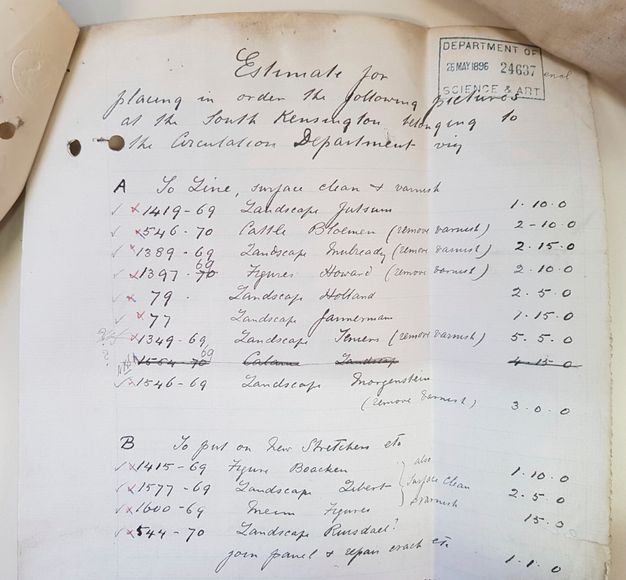
One of the paintings listed in the estimate, by David Teniers the Younger (1610–1690), Rocky Landscape with Figures, ca. 1660–1690 (1349-1869), came into the studio in 2014 prior to going on loan. The canvas support was sound and in plane. The label on the reverse reads, “1349-1869 Lined, the surface cleaned by / sponging. The old varnish removed by / friction and the picture thinly varnished / by Messrs F. Haines & Sons June 27, 1896.” There were two very small areas of lifting paint and a thin film of surface dirt, showing some air exchange into the frame. I fixed the paint with sturgeon glue and removed the dirt from front and back. It is satisfying to be able to link the estimate to the painting and see that the treatment was carried out and was effective.
In the early days, paintings were sent to Haines & Sons’ premises. It was from Jacob Simon’s talk at the British Association of Paintings Conservator-Restorers conference, A Changing Art, held in London in 2016, that I learned of the correspondence with Haines & Sons regarding the equipment for setting up a lining studio within the SKM in 1892 (Simon, Jacob. 2017. “Restoration Practice in Museums and Galleries in Britain in the Nineteenth Century.” In A Changing Art: Nineteenth-Century Painting Practice and Conservation, edited by Nicola Costaras, Kate Lowry, Helen Glanville, Pippa Balch, Victoria Sutcliffe, and Polly Saltmarsh, 5–13. London: Archetype.). The requirements included a 41 1/2 × 33 inch (105.4 × 83.8 cm) slate, four irons, and a set of looms of different sizes—at a cost of £5 for the slate, 25 shillings for each iron, and £6.15s for the looms.5
In an estimate for lining and other treatments for four pictures, dated October 28, 1892, is a painting by John James Chalon (1778–1854), Hastings: Boats Making the Shore in a Breeze, 1819 (168 × 245 cm) (FA.234[O]).6 The cost of the lining was £1.10s; to remove the surface dirt and thinly varnish the painting was to cost £1.5s. The painting is still in good condition; both support and paint layers are sound. Interestingly, Haines & Sons may have preferred to continue to carry out the work on their premises rather than at the museum. A postscript to the estimate states, “The price quoted—for doing them away from the Museum: if done at the Museum the cost would be somewhat more.”
In the Seventh Report of the Science and Art Department, from 1860, Redgrave recorded that he had started to place paintings at eye level under glass to protect them (Committee of Council on Education. 1860. Seventh Report of the Science and Art Department of the Committee of Council on Education. London: Her Majesty’s Stationery Office.). From the frames themselves we can see that the glass was placed in a removable, narrow, gilded frame that was inserted into the picture frame from the front. Protection front and back, even if not fully sealed, appears to have provided a useful buffer to fluctuating RH and significantly slowed the deposition of dirt, particularly on the reverse.
The first donations and bequests in the 1850s to 1880s, which were near-contemporary art at the time, have benefited the most from the preventive conservation practices. Scanning a list of paintings acquired in 1869, the Townshend Bequest, I noted that many were less than ten years old. Similarly, of the ninety-five paintings acquired in 1886, a large number were between ten and twenty years old. It is true that some exhibit drying cracks from the use of materials popular at the time, but the significant point is that no age cracks are yet obvious on many of these paintings. The recent work preparing the reserve collection for its move to East London has shown that most of the paintings with problems are those that either had no backing or had lost it.
I have not been able to establish exactly when the Art Work Room was created, nor how many people worked there, but it was active in the first half of the twentieth century and was the beginning of an in-house conservation department. Harry Rogers was head of Paintings Conservation in 1973, when my predecessor Susannah Edmunds joined the V&A. Rogers had started work at the museum in the Art Work Room (A.W.R.) at sixteen. His employment at the V&A spanned over fifty years, with a break during World War II, when he was in the armed forces. We frequently find handwritten labels on backboards such as “Glazed and backed up, A.W.R.” along with the date. When a painting by Daniel Hardy, Sunday Afternoon (F.16), was prepared for loan a few years ago, I found a label in Rogers’s handwriting on the reverse: “Frame cleaned, re / paired and Backed up / By A.W.R 22.4.21.”
Of the 102 canvases hanging in the Paintings Galleries at the V&A, forty are unlined, while a further eleven have original linings. Within the Paintings Galleries are three rooms dedicated to oil paintings from the Sheepshanks, Dyce, Townshend, Forster, and Ionides gifts or bequests. In many cases, the collectors had bought the paintings directly from the artists (fig. 33.5). I am certain that the reason so many of these paintings are well preserved, with many canvases still unlined and not in need of lining, is due to the early policy of glazing and backing.

Recent Treatments
Having covered the V&A’s treatment history, I’d now like to discuss some recent treatments—both preventive and interventive. With only one exception, the following were undertaken in the last decade.
The Portrait of Frederick Louis (Prince of Wales from 1707 to 1751), painted in 1716 by René Auguste Constantyn (active 1712–26) (627-1901), is an unlined eighteenth-century canvas still on its original strainer. The painting was requested for loan in 2014. As my initial check of its suitability for loan was done in the off-site store without taking the painting out of its frame, it was only when it came into the studio that I saw it was unlined. I repaired the small tear near the upper edge, as well as two tears on the tacking edges using a mixture of wheat-starch paste and sturgeon glue, and treated the slight canvas deformations. There is no doubt that the canvas is weakened: aside from the tears, the strainer bar marks are pronounced, and there is overall cupping of the ground and paint layers. The canvas was also starting to tear around the nails securing it to the strainer.
I used Japanese paper (sekishu), adhered with wheat-starch paste, to give some additional support to the tacking edges after first coloring it with a wash of acrylic emulsion. I felt that these local treatments would be sufficient for the time being. Tastes have changed; we are more tolerant of surface defects as the price of avoiding lining.7
The Opening of the Great Exhibition by Queen Victoria on 1 May 1851 (1851; oil on canvas; 329-1889), by Henry Courtney Selous (1803–1890), has a glue-paste strip-lining rather than a full lining. I recently found a reference to a payment of £3 17s 6d to Haines & Sons in 1904 for repairing and cleaning this painting, so it seems likely that they carried out the strip-lining.8 After three incidents of treating small dents and tears, the Selous has been glazed, despite its size (169.5 × 241.9 cm) and the delicate composition frame. In addition to the backboard, it has a stretcher bar lining of polyester sailcloth. Typically, we give unlined paintings stretcher bar linings, and if there are no cross members, as was the case with Prince Frederick’s portrait, we will attach polyester wadding to the backboard with Velcro so that it is held within the stretcher or strainer window.
The Train Bleu theater cloth (S.316-1978) was commissioned by Diaghilev for the Ballets Russes for the ballet of the same name. The image is an enlarged version of a sketch of Two Women Running along a Beach, painted in 1922 by Pablo Picasso (1881–1973). The sketch measures 32.6 × 41.2 cm (gouache on plywood, Musée National Picasso, Paris). There is a large off-white border around the image on the stage cloth; nevertheless, it represents an extraordinary transformation in scale: the stage cloth measures 10.4 × 12.75 m. It was painted by Prince Alexander Schervachidze (1867–1968), who made designs for several Ballets Russes productions. Picasso was so impressed with the result that he signed it with a dedication to Diaghilev.
The stage cloth proved very popular and was subsequently used as a front cloth and flown before every performance. Usually, stage cloths have a reinforced border with tie points along the upper edge to allow them to be easily attached to a fly bar in each theater. Instead, the Train Bleu front cloth had been nailed directly through the upper edge, often after being folded to adjust its height to fit different theaters. The repeated nailing of the upper edge to battens and subsequent removal had taken its toll, and there were so many tears in the upper 150 centimeters that, added together, they came to 200 centimeters in length. The weight of the canvas and the fact that all the tears were at the top raised fears of a zipper effect if the tears started to propagate.
This was the less recent project: it was twenty years ago that Éowyn Kerr, then a student intern, prepared various adhesive samples for tensile testing, which was carried out by Christina Young at Imperial College.9 The results suggested that repairing the tears with polyamide welding powder10 would be strong enough to support the weight of the canvas without any patches or lining the upper section, which we wanted to avoid. The support is a jute fabric consisting of nine horizontal strips sewn together. It was helpful that the ends of the threads along the tears were frayed, providing more surface area for the adhesive.
At it happened, the loan that started the investigation was canceled, and it was not until 2005 that the treatment took place. It was a joint project with Jim Dimond, who recruited several other colleagues to help.11 The Train Bleu has since been flown in five exhibitions and is holding up so far. It was in the V&A exhibition Diaghilev and the Golden Age of the Ballets Russes 1909–1929, in London in 2012, and at the final venue in Washington, DC, in 2013.
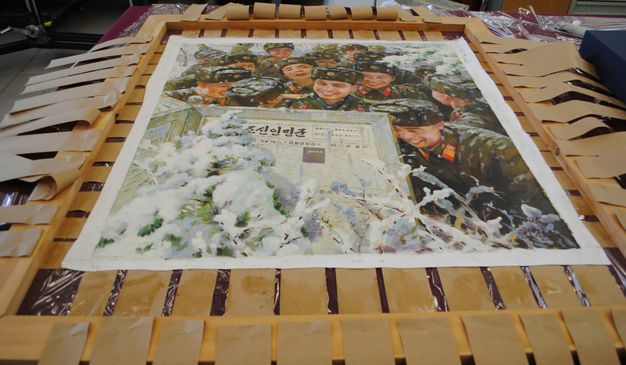
Three Korean paintings on cotton were acquired recently, which date from the early 2000s.12 They arrived rolled and had many distortions. They were returned to plane through moisture treatments while on a loom. Strips of kraft paper were attached to the canvas edges and then wetted and attached to the loom (fig. 33.6). Humidity was introduced to the reverse of the canvas with damp blotting paper through Gore-Tex. The paper shrinkage exerted tension as the whole structure slowly dried. Fiona Rutka, a student intern, did most of the work on these paintings. They were put onto new stretchers over loose-linings of polyester sailcloth.
Preparations for a touring exhibition of the works of John Constable meant that fifty oil sketches passed through the studio in 2010.13 Landscape with Double Rainbow, 1812 (33.7 × 38.4 cm) (328-1888), is on a mixture of supports, paper adhered to canvas as well as an original lining. Constable used a variety of supports for his oil sketches: frequently a homemade paper laminate, primed in different colors. At other times he reused his own canvas paintings, cutting them into small sections (Costaras, Nicola, and Clare Richardson. 2010. “Constable’s Sketches: Technical Observations.” In John Constable: Oil Sketches from the Victoria & Albert Museum, by Mark Evans, 145–57. London: V&A Publications.). It is possible that in this instance he tried to peel off one layer of paper to get a fresh surface to paint on; the surface is irregular, with sections of paper missing. Clare Richardson and I speculated that Constable used the nearest support on hand to capture the fleeting atmospheric effect. An X-ray image shows at least one other composition within the support (Costaras, Nicola, and Clare Richardson. 2010. “Constable’s Sketches: Technical Observations.” In John Constable: Oil Sketches from the Victoria & Albert Museum, by Mark Evans, 145–57. London: V&A Publications.).
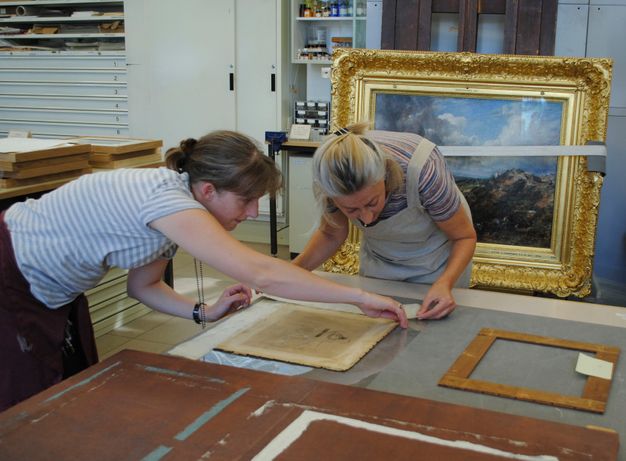
Constable painted over the top of the torn paper and canvas support regardless, lined it, and continued to work on it. When it came to the studio, the canvases were delaminating and the edges were frail. Wheat-starch paste was used to reattach the two canvases and left to dry under weight. With the help of Susan Catcher, our colleague in Paper Conservation, we strip-lined the painting with wheat-starch paste and Japanese paper (fig. 33.7). Wheat-starch paste was also used to attach the paper to the strainer. Serendipitously, the shrinkage of the paper as it dried exerted a gentle tension on the canvas without making it too taut.
The above are just a few examples of types of canvas treatments undertaken at the V&A in recent years, and they give a sense of the variety of the works in the collection.
Access versus Preservation—Finding a Balance
The Ballet Scene from Meyerbeer’s Opera “Robert le Diable,” 1876, by Edgar Degas (76.6 × 81.3 cm) (CAI.19), is another unlined canvas painting; it provided a catalyst for a change in approach to lending. The painting is frequently requested for loan and had traveled to fifteen venues with five exhibitions in eighteen years.
My attitude about what constitutes a suitable condition for a painting to go on loan has changed over time. Once, I would be concerned if a painting already had a documented problem, but then it occurred to me that I should be more protective of paintings that are still in good condition. This led me to propose to my curatorial colleagues that we try to limit the amount that unlined canvases travel. I argued that the Degas has an important quality, in that it has not had any interventive treatment, and that this is a state we should try and preserve. The curators agreed with me, particularly in the context of this group of gifts and bequests from nineteenth-century collectors, and since 2007 that has been our unofficial policy.
Now, if paintings are unlined, this is immediately flagged, often by the loans curator, and an alternative offered if possible. There isn’t always an acceptable substitute, as is the case with the Degas. However, if such a painting is requested for a multivenue loan, we might agree to just one venue, one accessible by a single-truck journey, and decline it for the rest. At the time of the symposium, in October 2019, the Degas was at an exhibition in Paris, and this is the reason it did not go to the second venue in Washington, DC. We receive more loan requests for the Degas than for any other painting in the collection.
Traveling does cause wear and tear. An unlined canvas by Lawrence Alma Tadema (1836–1912)14 had recently gone on loan when it was requested again two years later. On checking it for the second loan, I found tears had developed along the fold line. Even if a well-designed packing case does a good job of reducing shocks and vibration, they can be greater during the movement of paintings on A-frames within museums at either end of the journey, as shock loggers have shown (Saunders, David, Christine Leback Sitwell, and Sarah Staniforth. 1991. “Soft Pack: The Soft Option?” In Art in Transit: Studies in the Transport of Paintings, edited by Marion F. Mecklenburg, 311–22. Washington, DC: National Gallery of Art.). By limiting the number of trips these unlined canvases make, we are trying to postpone the moment when lining or strip-lining becomes necessary, and this is another aspect to our approach to conserving canvas.
Conclusion
Inevitably, the public program sets conservation priorities to a large extent, but we do aim to devote time to the core collection each year. The evidence from the recent survey of the reserve collection highlights the importance of backings in the preservation of canvas paintings. There was a strong correlation between the paintings with evidence of weakened canvas—shown by pronounced cupping, stretcher bar marks, and flaking paint—and those that had no backing. In contrast, many of the canvases that have had backings since they were acquired in the nineteenth century (in a few cases the same backings) appear sound and often have no obvious age cracks.
The decant of the reserve collection provided an opportunity to apply preventive conservation wherever it was lacking. Between the unlined canvases and the nineteenth-century glue-paste linings, with due credit to the work of my predecessors throughout the twentieth century, I have not had to carry out a single lining in the twenty-five years that I worked at the V&A. I carried out many strip-linings and tear repairs. Collaborating with my colleagues in Paper Conservation, I have found many uses for Japanese paper and wheat-starch paste.
In the foreseeable future, I expect The Martyrdom of St. Ursula and the 11,000 Virgins, mentioned earlier, will need relining. This fifteenth-century painting was one of the V&A’s earliest acquisitions, in 1857, and it was already lined when it arrived at the museum. The tacking edges of the lining canvas are frail, and it is fairly large: 163.3 × 232.4 cm (see fig. 33.1). When the time comes that this and other canvases do need lining, will there be anyone who does enough paste-lining to be skilled at it? Although minimal treatments have their place, I am concerned about a gap in skills due to lack of practice.
Beyond paste-lining, it is better still to have experience with a range of different lining techniques—and thus to be able to choose the most appropriate method in each case. After hearing the talks at the 2019 Conserving Canvas symposium, I am hopeful that the Getty Foundation initiative, of which the symposium was a part, will ensure that the expertise continues to exist.
Acknowledgments
I would like to thank all the colleagues past and present who have worked on the projects I have mentioned and who responded so generously to appeals for details of references and sources while access to files and libraries was limited by the coronavirus pandemic lockdown.
Notes
-
The Apocalypse Triptych. Oil on oak panel, transferred to canvas prior to acquisition, 137 × 336 cm (5940-1859). ↩︎
-
Carolina Jiménez Gray and Cerys Fry, with the valuable assistance of Lee Emmett. ↩︎
-
For further information, see the National Portrait Gallery’s index of British picture restorers: https://www.npg.org.uk/research/programmes/directory-of-british-picture-restorers/. ↩︎
-
V&A Collections, Paintings Department, general correspondence ED 84/134, conservation measures 84/375. ↩︎
-
V&A Collections, Paintings Department, general correspondence ED 84/134, 13919. ↩︎
-
V&A Collections, Paintings Department, general correspondence ED 84/134, 13485. ↩︎
-
During the recent survey, we discovered another unlined eighteenth-century canvas, A Member of the Howard Family of Ashstead, by a follower of Sir Godfrey Kneller, ca. 1700, oil on canvas (P.30-1970). The paint surface is cupping on this painting too, and there is a pronounced oval stretcher or strainer mark, but the paint appears secure, and I would not consider it in need of structural treatment at this stage. ↩︎
-
V&A Collections, Paintings Department, general correspondence ED 84/134. ↩︎
-
Éowyn Kerr, Project file: Tear mend testing, 1999. V&A Conservation Department. ↩︎
-
4040 Lascaux Polyamide Textile Welding Powder 5065 (now 5350). ↩︎
-
Julia Nagle, Catherine Nunn, and Sam Hodge. ↩︎
-
Ch’ol Muk Ri (North Korean), Uri chungdae sosik, 2005. Oil on cotton canvas, 81 × 77 cm (FE.89-2009). Hyong Sik Rim (Korean), Ch’ukcheoneul aptugo, 2007. Oil on cotton canvas, 72 × 100 cm (FE. 90-2009). Sang Mun Ri (North Korean), Mount Paektu and Heaven Lake, 2008. Oil on cotton canvas, 91 × 131 cm (FE 93-2009). All dimensions are for paintings after stretching. ↩︎
-
The Constable project funded some assistance, which was provided by Rachel Turnbull and Clare Richardson and for a short time by Kate Stonor. ↩︎
-
Cleopatra at Philae, ca. 1850–1912. Oil on canvas, 149.9 × 106.4 cm (P.40-1921). ↩︎