This short paper describes the treatment of Madonna and Child with the Young St. John the Baptist and Two Angels, a painting attributed to the anonymous “Pittore di Pontignano” and dated about 1650. The canvas, which preserves its original stretching and strainer, recently suffered injury resulting in a 104 centimeter tear. Conservation treatment, developed in discussion with the picture’s owners, was designed to mend the damage yet preserve the artifactual character of the work. Thread-by-thread tear repair was undertaken to rejoin the broken fabric, with some local reinforcement added to reinforce the brittle fibers. Deformations and old varnish in the canvas were both reduced. A modified “stretcher bar lining” and backing board were mounted to the strainer to protect the primary support. The approach questions the necessity of lining and emphasizes the importance and interest in preserving a painting as an object as well as an image.
58. Is Lining Inevitable? Tear Repair of a Seventeenth-Century Canvas on Its Original Strainer
- Matthew Hayes, Director, Pietro Edwards Society for Art Conservation, New York
Introduction
The thread-by-thread method of repairing torn paintings, developed by conservator Winfried Heiber and described in his 1996 article on the subject, is widely known and implemented, especially in the German-speaking world (Heiber, Winfried. 1996. “Die Rißverklebung.” ZKK Zeitschrift für Kunsttechnologie und Konservierung 10, no. 1: 117–46., Heiber, Winfried. 2003. “The Thread-by-Thread Tear Mending Method.” In Alternatives to Lining: Structural Treatment of Paintings on Canvas without Lining: A Conference Held Jointly by the British Association of Paintings Conservator-Restorers and the United Kingdom Institute for Conservation Paintings Section, 19 September 2003: Preprints, edited by Mary Bustin and Tom Caley, 35–48. London: United Kingdom Institute for Conservation of Historic and Artistic Works.; Heiber, Winfried, Carolyn Tomkiewicz, Mikkel Scharff, and Rustin Levenson. 2012. “Tear Mending and Other Structural Treatments of Canvas Paintings, Before or Instead of Lining.” In Conservation of Easel Paintings, edited by Joyce Hill Stoner and Rebecca Rushfield, 384–96. London: Routledge.). While to some degree a familiar technique in U.S. museums, it remains underused in private practice—at least in New York, where lining is still a common treatment for damaged canvases. In my own experience speaking to colleagues, thread-by-thread tear repair can be seen as tedious or untenably time-consuming; for clients it remains an unfamiliar remedy, one met with curiosity. This brief article hence does not present a novel solution but is rather an attempt to encourage a known procedure while presenting it in combination with additional measures—varnish removal from an old canvas and the construction of an insert lining—designed to enhance its results.
The Case
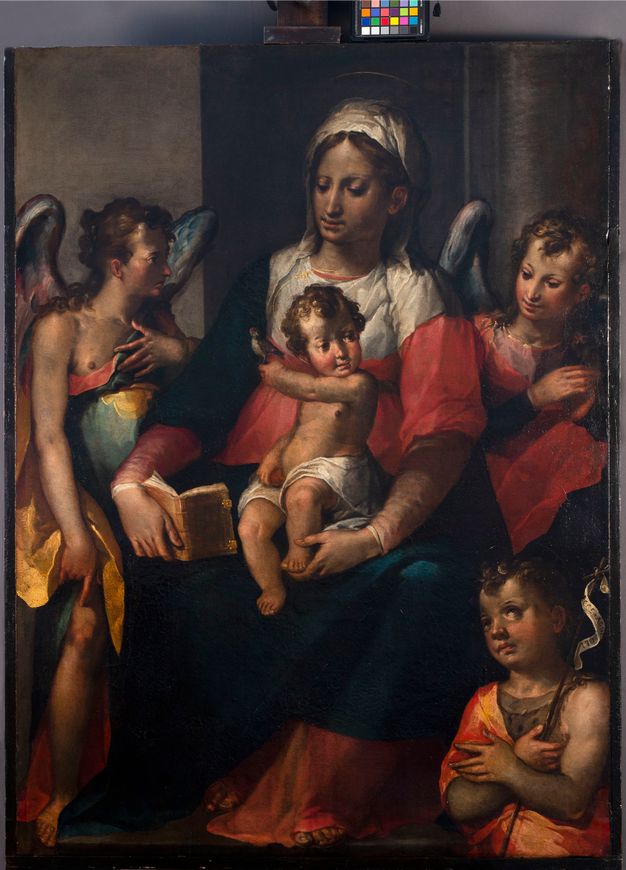
Madonna and Child with the Young St. John the Baptist and Two Angels (ca. 1650), attributed to the anonymous “Pittore di Pontignano” (fig. 58.1), had suffered mechanical damage resulting in a tear some 104 centimeters long.
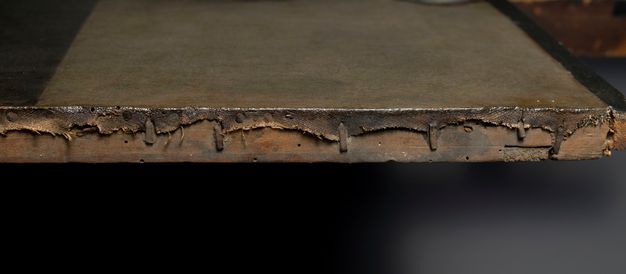
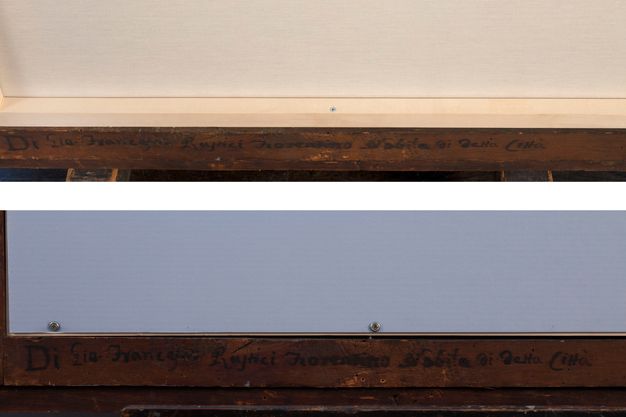
The painting is unlined and stretched on what appears to be its original strainer, with parts of its first stretching intact (fig. 58.2). The strainer is constructed of a medium-density hardwood, perhaps walnut, with shouldered bridle joins at the corners, each secured with a single wooden peg.1 The medium-weight, plain-weave canvas had originally been attached with flat iron nails, driven partway into the strainer and bent down over the narrow tacking edges. Some of these edges had later been reinforced and secured with modern tacks, as well as with additional wooden strips on three sides. The tacking margins appeared secure and were lent support by the cushioned rabbet of the picture’s frame. The canvas itself was not under tension and had a slight overall undulation, rendered less noticeable by the marked texture of the paint film. The painting, apparently executed in oil, had been restored multiple times in the past, including fairly recently.
My suggestion that local tear repair could mend the damage while avoiding lining—and so maintain the valued “object nature” of the artwork—met with a positive response from the owners. Old canvas repairs, notably two patches on the reverse, were not addressed.
Tear Repair and Reinforcement
Loose paint along the tear was first secured with 5% sturgeon glue.
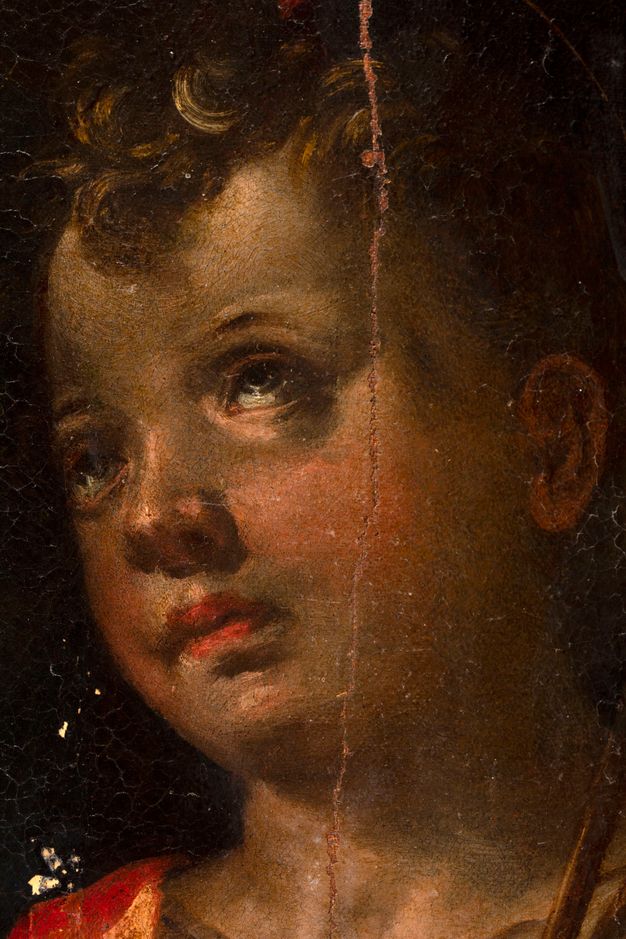
The tear was then repaired using the thread-by-thread method (fig. 58.3). Working under a binocular microscope, broken threads were realigned and rejoined using a 1:1 mixture of 20% sturgeon glue and 10% wheat-starch paste. I used a Weller WD1M soldering station with a micro soldering iron to cure the adhesive mixture. This tool has the benefit of digital temperature control, and exchangeable tips in various precise shapes are available.2
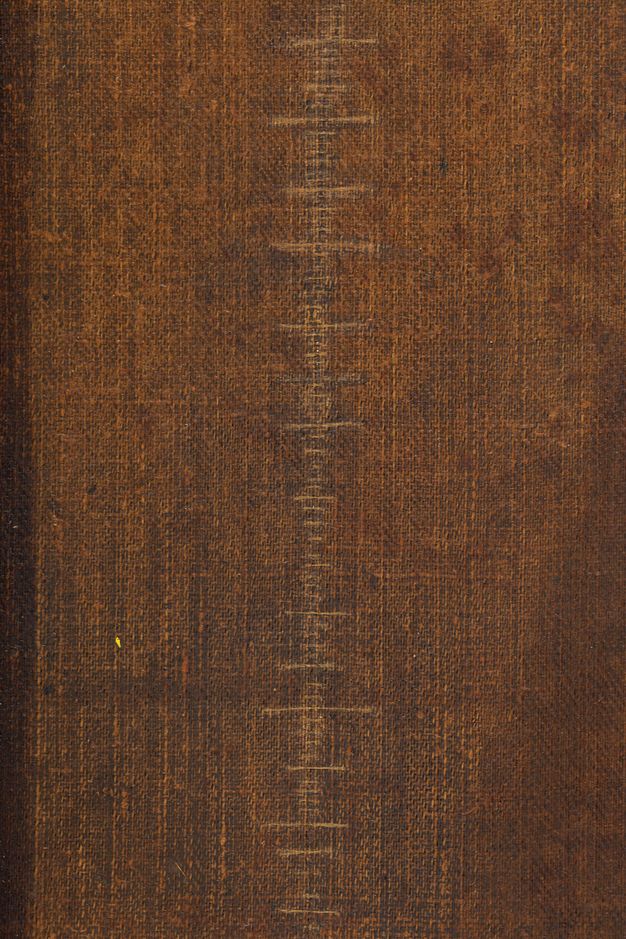
Because the overlap of the torn fibers was not great in some areas—many canvas threads were essentially butt-joined—the tear was reinforced. Using the same glue-paste adhesive, linen threads were attached to the canvas reverse to bridge the tear (fig. 58.4). The spacing of the bridging threads was guided organically by the overlap, and hence stability, of the repaired original fibers. Their length was varied from 0.5 to 2 cm to broaden the area of reinforcement, avoid creating a single line of tension, and attenuate the added material. The introduction of a second adhesive system to attach the bridging threads was considered: polyvinyl acetate emulsions, Beva 371, Paraloid B72 resin, and polyamide welding powder were all potential candidates and might have introduced greater resistance to moisture; however, the easy reversibility of the sturgeon-glue mixture proved more alluring to this conservator.
After securing the tear, humidification of the canvas with drying under weight was performed to reduce deformations. Because the canvas is not under tension, the possibility exists that, although the canvas matrix now appears quite cohesive, future tenting of the support at the tear could occur. It is hoped that the secondary supporting measures discussed below will mitigate this. Additional steps to keep the tear flat, such as the attachment of bridging wires or pins, remain a future treatment option should this prove necessary.
Cleaning of the Canvas
The canvas support had discolored to a ruddy brown and was traced with a dark network of lines mirroring the craquelure of the paint, likely where later varnishes and perhaps consolidants had seeped through from the front. That the canvas was quite brittle appeared to be partly due to its impregnation with these old resins. Reducing the quantity of this oxidized material thus seemed desirable. After normal surface cleaning with brushes and a vacuum, and some testing, the varnish in the canvas was reduced using poultices of ethanol-saturated Evolon CR, a nonwoven microfilament textile made from 70% polyester and 30% polyamide. Pressed onto the reverse, the Evolon drew discolored matter out of the canvas, which was afterward considerably more flexible as well as lighter in color. That the textile support was initially so stiff and brittle was thus due not solely to its own degradation but also, considerably, to the degradation of the varnish it had absorbed.
Attaching an Insert Lining and Backing Board
Although the tear was closed and appeared secure after several weeks of observation, the entire object remained fragile. To lend additional support and stability to the canvas, a type of insert lining was constructed.
For this, a basswood frame was built with an L-shape profile that could rest within an inner lip of the primary strainer; as on a modern stretcher, the edges of the new frame facing the canvas were slightly beveled. Unbleached cotton muslin was then stretched over this frame, secured at its outer edges with staples. The insert lining was fixed to the inner edges of the strainer using six screws, with the stretched muslin placed just behind and barely touching the canvas. An acid-free backing board was attached to the wooden frame of the insert (fig. 58.5). The construction is designed to support the canvas and cushion its movement, provide an environmental buffer for the canvas reverse, and protect from further mechanical damage. It is easily reversible, leaving only the small holes from the attaching screws. The construction is similar to the so-called vibration protectors (Schwingungsschutze) I observed while an intern at the Kunsthistorisches Museum, in Vienna.
Filling, Retouching, and Varnish
Though unrelated to the structural concerns of this volume, the aesthetic treatment of the picture deserves mention. This work was done traditionally. Losses along the tear and throughout the painting were filled with a putty of Champagne chalk and 7% sturgeon glue. The losses were textured with this gesso to match the surface of the surrounding paint. Some additional texturing was added to the surface using Golden Heavy Gel Gloss, a thick, transparent acrylic medium. Initial retouching of the losses was done with gouache, with subsequent inpainting carried out using dry pigments bound in polyvinyl acetate resin (Mowilith 20).
The painting appeared to have been treated not long in the past. Due to its easy solubility in aliphatic hydrocarbons, the uppermost varnish was suspected to be Regalrez 1094. This, interestingly, had become extremely uneven, raising questions about the practical aging of this popular material. A thin spray of 5% mastic varnish in turpentine was applied to unify the surface gloss.
Conclusion
For this work by an anonymous seventeenth-century artist, the artifactual nature of the painting is part of its value, both historical and financial. That I was awarded this commission with a proposal to preserve these features, rather than unstretching the canvas and lining it on a modern stretcher, offers a potent indication that perceptions of lining have shifted considerably since the 1974 Greenwich conference—not just among conservators but also for an art-buying public. The object remains fragile, but this is all the more reason that it should be handled carefully. Secondary, reversible means are available to support such weak canvases. The painting can always be lined in the future should this be judged necessary, and repairing the tear prior to lining would have been required in any case.
While the scope of this damage is perhaps atypical within my practice, I frequently use the thread-by-thread method of tear repair. Even for freelance conservators for whom project times can be particularly limited, it offers a viable and elegant treatment option.
Sources and Materials
Blick Art Materials, New York: Golden Heavy Gel Gloss; Schmincke Horadam gouache.
Kremer Pigments, New York: Champagne chalk, mastic resin, polyvinyl acetate resin (Mowilith 20), sturgeon glue, wheat-starch paste ( Jin Shofu).
Talas, New York: Evolon CR, Heritage Archival Corrugated Board.
Notes
-
Wood identification was not performed. ↩︎
-
Newer models of this tool are available, for instance the Weller WX series workstations with a Pico soldering iron WXPP; see https://weller-tools.com. ↩︎