Changing priorities about the structural treatment of modern and contemporary paintings on canvas mirror the general trend in conservation toward localized or minimal interventions and reflect the lack of consensus among stakeholders—including the artists themselves—about an acceptable degree of aging in these recently made works. Surface perfection rarely coexists with age-related authenticity. While the use of unconventional materials or techniques in an artwork can complicate treatment, some commonly used modern artists materials, such as acrylic paints and grounds, can be exploited for our benefit during treatment. The unique demands of these paintings and our struggle to find suitable and successful treatments for them have generated a welcome increase in scientific research into modern materials as well as specialized training for emerging conservators.
38. The Structural Treatment of Modern and Contemporary Canvas Paintings: Changing Approaches and Considerations
- Mary H. Gridley, Partner, Art Conservation Solutions LLC, New York
Introduction
As a conservator in private practice in New York who specializes in recently created artworks, I have spent a great deal of the last twenty-five years performing structural repairs on canvas paintings, absorbing and adapting to the ever-evolving techniques and goals of these treatments.
Modern and contemporary art is loosely defined as anything made in the last 75 to 125 years, a span that embraces many different styles and “schools.” But for practical purposes, in paintings conservation we think of it as starting with the Abstract Expressionist era, in the 1950s, when artists’ use of nontraditional materials and painting methods dramatically increased. Paintings created with non-artist-grade supports or paint, with unusual media such as chewing gum or molasses, or those with Minimalist surfaces that readily show every damage can be difficult to treat. Monochromatic paintings, a perennial lure for modern artists, in which the subtleties of the surface are paramount, can be particularly challenging.
Works that are intended to be displayed unframed, unglazed, and unvarnished are vulnerable to damage from handling, travel, and installation. Hence, while conservators of these works are rarely faced with failing fabric supports or extreme cupping, they are confronted with impact cracks, tears, and deformations, some of which may be exacerbated by poor materials or inadequate structural supports.
While monochromatic or unconventional surfaces may be challenging to maintain during a structural treatment, some of the other material components of these works are more resilient and less degraded than those found in older, more traditional paintings, greatly improving the odds for successful treatment. Cotton duck, widely used by American artists for the last seventy years, behaves differently than linen. The common use of acrylic gesso and sizing, which retain malleability and are quite responsive to moisture, temperature, and solvents, provide layers that can be exploited in the flattening of cracks and cupping.
Over the last six decades in both private practice and institutional conservation labs, the structural treatment of twentieth- and twenty-first-century canvas paintings has mirrored that of older paintings, moving away from lining as localized solutions became more popular. Conservators have promoted the embrace of minimal intervention, as well as respect for authentic and historical elements and meanings of the artwork, to private collectors, dealers, and artists. Authenticity in this context describes a number of qualities of an artwork other than its outward face. Tangible examples include normally unseen elements, such as stretchers, inscriptions, old tacking holes, studio handling marks, labels, and provenance. More intangible and subjective aspects are age-related patination or historical associations independent of the imagery. The relative value of all these types of authenticity varies widely by time and place and is a reflection of the concerns of the larger culture.
Actual treatments I have carried out are often a compromise between returning the surface of a work close to its original, unblemished state and acknowledging or embracing its evidence of authenticity and age. Many of these works have never been treated, so the treatment methods and materials employed must have an eye to future ramifications.
The rising popularity of contemporary art has greatly impacted the conservation world. There is a fast-growing body of research into modern materials and artists’ techniques. The proliferation of smaller institutions devoted to contemporary art collections feeds the demand for materials and technical research, as well as for care and treatment of this type of painting, and has spurred more specialized training in conservation degree programs. Graduates have spread out across the globe to staff institutions and the private studios devoted solely to treatment and care of these works.
Changing Conservation Priorities
In the private sector, the goal of most treatments is to make an artwork exhibitable—and, depending on the stakeholders, salable. For modern and contemporary paintings, which are still transitioning from brand new to antique, this can mean different things for different artists, for different genres, and for different owners: there is no unilateral agreement on what levels of damage are considered acceptable for display. While there is an obvious desire for a legible surface that clearly demonstrates the artist’s aesthetic intent, there are also varying notions about whether and how to value signs of age or history. Institutions tend to tolerate more evidence of age than the private sector, where these artworks have not only an aesthetic and historic value but also perhaps a significant financial one.
Treatment choices not only depend on what is possible but also can be driven by what is deemed most important for a given artwork by a given collector. If an owner is anxious to obliterate any signs of damage or aging, no cracks are left untreated. Another may want only the eye-catching, prominently placed impact cracks treated, but not those at the turnover edges, and for a third, a moderately cracked and aged paint film is an appropriate expression of the age and history of the object itself. Contemporary artists themselves have strong opinions about what degree of damage is acceptable in their work. In my experience, if asked, they generally say they want it to look “perfect” and are often willing to repair or remake it themselves if it cannot be successfully conserved—an outcome that can open up Pandora’s box. Decisions about how much to treat and what to prioritize are not specific to modern and contemporary art, of course, but have been more open for discussion as the conservation field has evolved from the scattered and relatively isolated group of artist/restorers of old to the degree-trained conservators of today.
What the art world now thinks of as “blue chip” contemporary art was initially collected and promoted by small groups of enthusiasts and was not widely sought after. It was not of very high value compared to works of Cubism or Impressionism or the old masters, for example. Only a few conservators—all of them apprentice-trained or self-taught—performed treatment exclusively on these works. In New York, Daniel Goldreyer, Orrin Riley, Jean Volkmer, and Margaret Watherston all wrestled with the unique demands of modern and contemporary paintings, adapting old techniques or inventing new ones.1 Their clients were often the artists themselves, which allowed for collaboration and experimentation. Their work was influential and sometimes controversial. The apprentice system was alive and well during this period, and many of my colleagues today trained with one or more of these individuals.
Naturally enough, those conservators used the tried-and-true structural repair techniques that succeeded on older paintings. They also enthusiastically embraced the new equipment, lining adhesives, and supports adopted and developed in the 1950s, 1960s, and 1970s, many of which were introduced at the 1974 Conference on Comparative Lining Techniques in Greenwich. These included Gustav Berger’s Beva 371 adhesive (and the subsequent film form), flocked polyvinyl acetate (PVA) adhesive, nap-bond adhesives, fiberglass solid and fabric supports, polyester sailcloth fabric, stiff Mylar interleaves, and low-pressure hot tables. I have seen examples of most of these lining types on paintings that have come through the studio. Some have been very successful, some less so, but their application to modern and contemporary paintings is problematic for some collectors and dealers: there is a perception that a lined contemporary painting is somehow lesser. This could be a genuine aesthetic problem, for example, weave interference or other subtle alterations to the surface created by pressure or heat during the lining process.
More often, it is the verso that is the problem. Paintings lined using heavy Mylar are a case in point. Even if the lining has successfully brought the cracks or tears into plane, the very shiny plastic appearance of the Mylar on the verso is an inescapable reminder that a painting has had fairly extensive conservation treatment. Localized repair of structural damage, while often much more labor intensive and therefore more expensive than a global treatment like lining, satisfies two criteria I think are important: retreatability and a light touch, both of which leave the door open to better future solutions for these young paintings.
The search for better methods and materials for structural treatments in the years leading up to Greenwich was an acknowledgment that lining treatments corrected some types of damage but could also create new ones. After Greenwich, this realization slowly manifested as an ethical dilemma: Was lining too aggressive? Should the many individual issues a lining could resolve—flaking, distortions, cupping, tears, weakening fabric—be dealt with all at once? Or would it be better to deal with them separately and perhaps delay a lining treatment? What began in Greenwich as an exciting, hopeful exchange of new research and techniques on improvements in the structural treatment of canvas paintings was flipped on its head by the realization that perhaps it was not the method of lining, but the act of lining that needed to be reevaluated (Percival-Prescott, Westby. 2003. “The Lining Cycle: Causes of Physical Deterioration in Oil Paintings on Canvas: Lining from the 17th Century to the Present Day.” In Lining Paintings: Papers from the Greenwich Conference on Comparative Lining Techniques, edited by Caroline Villers, 1–15. London: Archetype. Originally published as W. Percival-Prescott. 1974. “The Lining Cycle.” In Lining Paintings: Papers from the Greenwich Conference on Comparative Lining Techniques, unpaginated. Greenwich: National Maritime Museum, 1974.). Subsequently, a period of reflection set in, and many conservators began to pull away from global treatments, opting for more localized, targeted treatments instead.
The ascendancy of “minimal intervention,” as this approach came to be called, had a substantial effect on the continued prevalence of lining. When I was a graduate student at the Courtauld Institute of Art between 1988 and 1991, structural conservation of canvas paintings in London (and perhaps elsewhere) was at a crossroads. Although students were instructed in both structural and cosmetic treatments, there was a separation between the two in the real world at the time—an acknowledgment that only specialized knowledge and experience could confer mastery in one or the other. There were still private studios in London where pictures were sent to be lined, and the National Gallery of London maintained a separate studio and conservation staff that dealt only with structural work. The ample research into better methods, materials, and equipment in the 1970s and 1980s spurred many conservation studios to procure the new equipment needed to offer lining treatments to their clientele. But the equal and opposite move away from global interventions meant these tables were used less and less, until in many studios they became simply flat surfaces on which to do other kinds of work (Hedley, Gerry, and Caroline Villers. 1993. “Lining in 1984: Questionnaire Replies.” In Measured Opinions: Collected Papers on the Conservation of Paintings, edited by Caroline Villers, 37–41. London: United Kingdom Institute for Conservation of Historic and Artistic Works.; Stoner, Joyce Hill. 1994. “The Impact of Research on the Lining and Cleaning of Easel Painting.” Journal of the American Institute for Conservation 33, no. 2: 131–40.). In the first studio where I worked when I returned to New York in 1994, the lining table was used only for moisture and flattening treatments. I have not worked with a lining table since, using instead a portable suction platen or steel weights when flattening was necessary.
This shift toward separate and/or staggered treatments has become deeply embedded in the current conservation culture, and we have passed that philosophy on to a wider public. Conservation as a whole has a much higher profile today thanks to targeted exhibitions, public-facing conservation labs in museums, and treatments carried out in public galleries. One change I have observed over the last few decades is that our more sophisticated clients actually notice past structural treatments and have opinions about them, which is a testament to how much more mainstream conservation and discussion of condition has become. This is in stark contrast to what George Stout, one of the founders of science- and museum-based conservation in America, described as the “contempt for concern about condition” prevalent in his early years in the field (Stoner, Joyce Hill. 2005. “Changing Approaches in Art Conservation: 1925 to the Present.” In Scientific Examination of Art: Modern Techniques in Conservation and Analysis, 40–57. Washington, DC: National Academies Press. https://doi.org/10.17226/11413.). Historically, the importance of an artwork was confined to its surface imagery and art historical importance; whether the painting had had conservation treatment—even treatment that radically altered the surface—was not considered relevant.
Treatments on Modern and Contemporary Paintings
Lining and Patching
Given the practical and existential difficulties of lining, it is not surprising that some examples of early linings of modern and contemporary paintings that have passed through our studio provide cautionary tales. This is particularly true for Minimalist paintings, which have the infuriating characteristics (to the conservator, at least) of being the most in need of structural intervention when cracks appear and having the least tolerance for any intervention. Given the extremely subtle nature of the aesthetics of these paintings, some examples of early linings we have seen exhibit changes to the paint film that we are anxious to avoid repeating, such as locking cracks in place with thick layers of adhesives and auxiliary supports, thus prohibiting access to the reverse. One previously treated, multipanel Minimalist painting I worked on had numerous impact cracks on all five canvases. Two of the panels were unlined while the other three had been lined with thickly flocked PVA. While the cracks in the unlined elements were improved with local flattening treatments to the reverse, the PVA on the other three could not be safely removed, so the cracks could not be retreated.
Although I have seen old linings—of all varieties—that have worked well and remain sturdy, this is not always the case. A great deal of the success relies on the experience of the practitioner. Glue-paste linings in particular seem to require a vast amount of particularized knowledge and skill. On a Minimalist painting, they can be wonderfully successful, but they can also result in weave interference due to lining pressure and small distortions caused by uneven adhesive application or inherent faults in the canvas weave.
Wax-resin and Beva linings are less stiff and unyielding, but that can create problems as well, such as spotty delamination between the original and lining canvases due either to an initial, uneven heat application or to eventual degradation of the adhesive (figs. 38.1, 38.2). The inherent flexibility of these adhesives—so useful in other contexts—is often no match for the paint film’s strong need to equilibrate forces around existing cracks, leading to their reappearance over the long term. I have seen wax-resin linings change the gloss of a surface or darken with time, throwing off the balance of light and dark in the composition.
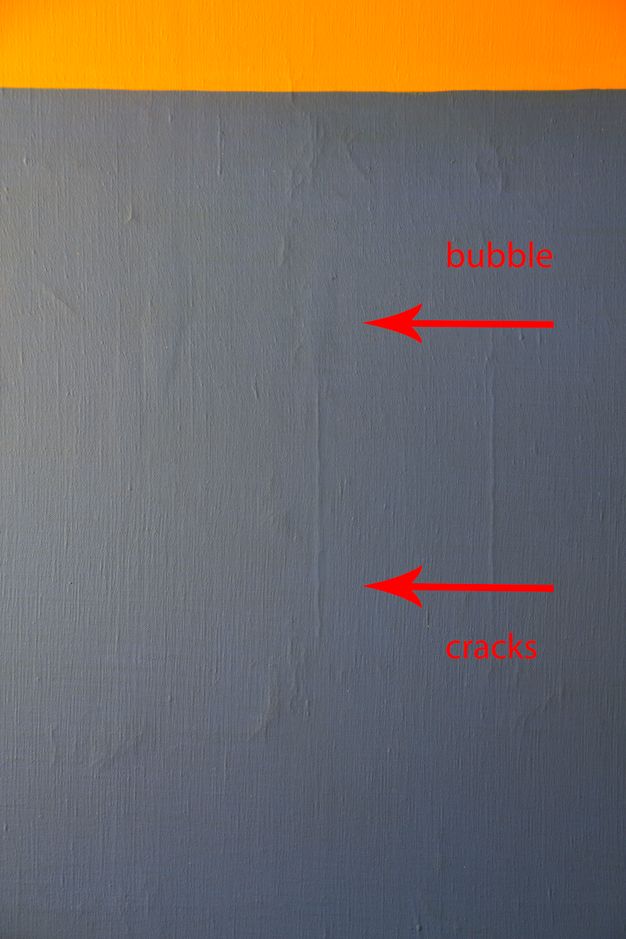
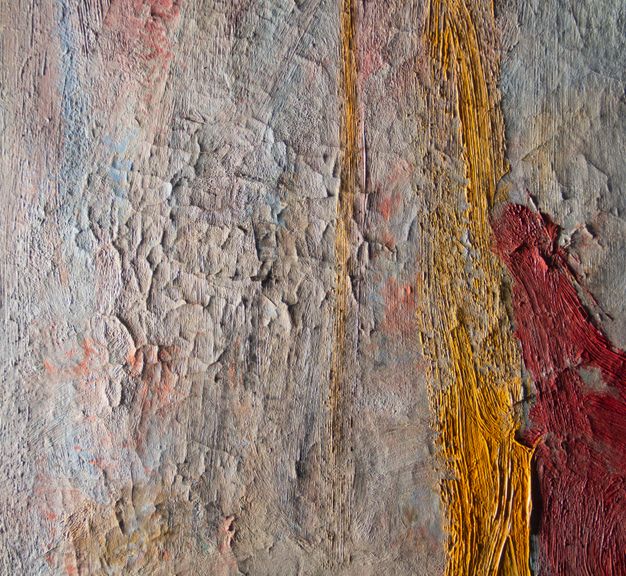
The use of a very stiff lining material or interlayer, such as heavy Mylar, has proved successful in some cases, but in others such interventions only locked the partially flattened cracks in place. The same can be said for thickly flocked PVA adhesives, as noted above. Their stiffness overwhelmed the lining fabrics, and they cannot be reversed without a great deal of mechanical force or solvent (Rabin, B. 1976. “A Poly(vinyl acetate) Heat Seal Adhesive for Lining.” In Conservation and Restoration of Pictorial Art, edited by N. Brommelle and P. Smith, 165–68. London: Butterworths.). Local treatments with patches have resulted in unsightly bulges over time, caused by the shrinking of adhesives combined with realignment of forces between those canvas fibers that are held in place by adhesives and those that are not (fig. 38.3).
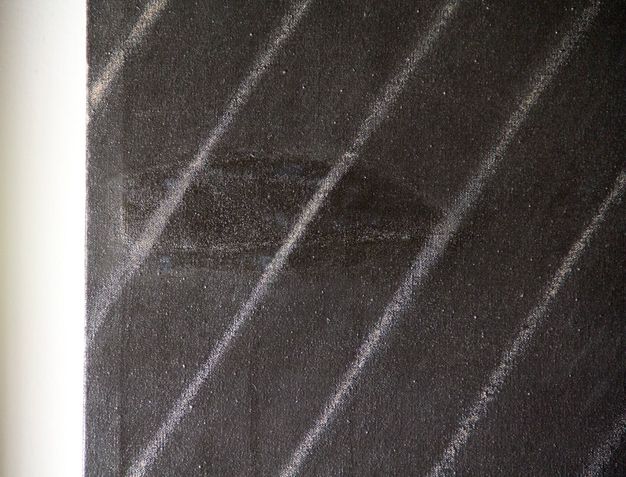
For paintings meant to be displayed without frames or with only modest strip frames, the bulk added by any kind of lining fabric and adhesive can compromise the crispness of a painting’s edges by forcing some of the unpainted tacking edge onto the face of the painting. Many of these treatments are difficult or impossible to reverse, and often lead to devaluation, both aesthetic and financial. Even past treatments sanctioned by the artist are subject to scrutiny. What was once acceptable, maybe even cutting edge, is now often viewed as undesirable in modern and contemporary paintings.
Local Treatment and Preventive Conservation
The most common structural damage we see in our studio is impact-related cracking of the paint film. This type of cracking often takes the form of concentric circles or feather-like shapes, resulting from accidental knocks to the face or the reverse. They also appear as straight lines directly on top of the edges of stretcher lips, rails, and crossbars, caused by repeated contact with the sub-support, or as smaller systems along the crossbars where people have distended the back of the canvas while grabbing the bars in transit.
While aesthetically disturbing, these impact damages do not always pose an actual threat to the overall stability of the painting. Successful flattening of such damage has always depended on softening or reforming both the paint and ground layers while simultaneously stiffening the canvas layer. Doing this successfully through localized treatment is possible, but the history and literature on treating cracks without resorting to lining is scant and the conclusions often discouraging. Moisture, solvent, heat, and pressure have been explored in various combinations (Gridley, Mary. 2017. “Notes on the Treatment of Cracks in Canvas Paintings.” In AIC Paintings Specialty Group Postprints, Vol. 27, 2014, 1–19. Washington, DC: AIC.). Experiments have been carried out in which the reverse of the canvas is treated in various ways to equilibrate the distortion caused on the face by local breaks in tension (Hough, Mary Piper, and Stefan Michalski. 1999. “Preliminary Results of a Research Project Exploring Local Treatments of Cupped Cracks in Contemporary Paintings.” In Paintings I: Conservation and Restoration of Paintings, 303–11. Lyon: ICOM Committee for Conservation.; Dimond, Jim, and Christina Young. 2003. “Reducing Cupping without Lining?” In Alternatives to Lining: The Structural Treatment of Paintings on Canvas without Lining: A Conference Held Jointly by the British Association of Paintings Conservator-Restorers and the United Kingdom Institute for Conservation Paintings Section: 19 September 2003: Preprints, edited by Mary Bustin and Tom Caley, 29–34. London: United Kingdom Institute for Conservation of Historic and Artistic Works.; Hough and Michalski in this volume), but there are practical challenges, and local treatments are not always less time-consuming than global interventions.
Treating numerous similar damages one by one can be both labor intensive and expensive. However, there are collectors for whom an “untouched” or minimally treated artwork commands a premium, so there is value in underwriting the cost and time such treatments consume. This attitude has allowed our studio to develop expertise in carrying out such treatments. Treatment of impact cracks is often the first structural intervention in a modern or contemporary painting’s life, and it is very important to acknowledge that better future treatments may be possible only if we tread lightly now.
As noted earlier, the current and widely adopted approach to structural repair of modern and contemporary paintings is one where a desire for local or minimal intervention meets a growing respect for authenticity. For example, there is perceived value in an unlined painting, with its original wooden auxiliary support and the verso of the canvas available for viewing. For eyes now accustomed to localized treatment of cracks or thread-by-thread tear mends, linings can appear heavy-handed. The occasional request to remove old linings without replacing them does not always occur because the lining has failed. More often, the lining itself is viewed as an undesirable condition of the painting. The many types of values embraced by stakeholders—unblemished surface, stable condition, age-appropriate damage, retention of hidden original or authentic components, unease with evidence of past conservation—are often contradictory, if not actually mutually exclusive, and present thorny ethical dilemmas when discussing treatment.
While minimal intervention and authenticity often complement each other in a treatment, that is not always the case. Removing a lining to reveal the original verso is not a minor treatment. Unstretching a painting to replace or modify an original subsupport that is inadequate or actively damaging the painting is not without risk and may end with an unsatisfactory compromise (fig. 38.4).
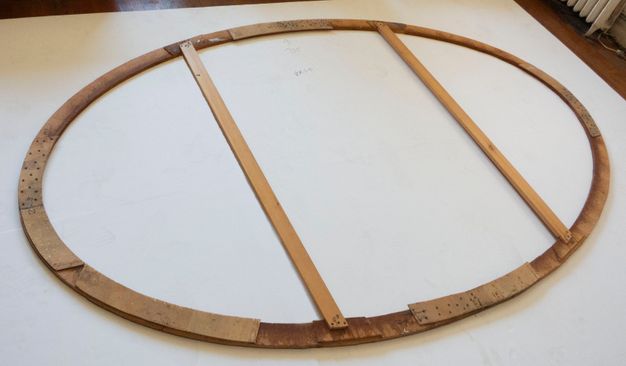
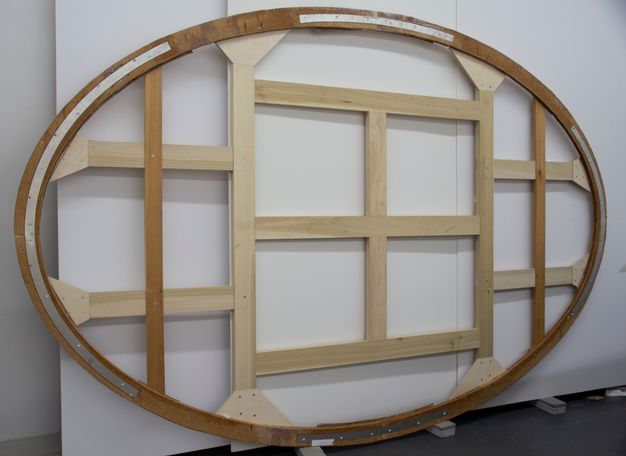
An important strategy for mitigating against the return of old cracks or the creation of new ones involves preventive conservation. The installation of backing boards and handles prevents knocks from the reverse or edges being gripped during transport and installation. More complex interventions include stretcher bar linings or loose-linings for individual paintings. Where appropriate, framing and glazing are good protection, as are wrapping and crating to prevent contact with the face of the painting. Preventive conservation, while perhaps not understood by galleries or collectors to be a whole subspecialty of our profession, is something of which they are very aware. Proper storage, professional shipping, and environmental controls are not just institutional priorities; they have worked their way into the mindsets of commercial galleries, private collectors, and art handling and storage facilities.
Modern Materials
Successful local treatment relies to some extent on the material integrity of the painting itself. If the canvas still has adequate strength and the paint films remain relatively coherent and well adhered to the support, minimal intervention can both solve the current problem and leave the door open to future treatments. While some artists have incorporated unpredictable and problematic non-art materials into their works, generally the increased use of synthetic polymer-based materials and cotton supports in modern and contemporary paintings has advantages in problem-solving localized treatments.
Perhaps the most significant material difference between older and newer paintings is the widespread use of acrylic grounds and synthetic sizing. I would estimate that 90% or more of the post-1965 paintings I have examined, regardless of the type of support fabric or paint medium, are painted on acrylic grounds. The fast-drying, nontoxic qualities of acrylic grounds and sizing are very appealing to painters. In a nod to both this and to conservation research, one American manufacturer, Gamblin Colors, has even discontinued sales of rabbit-skin glue sizing and its proprietary traditional gesso (which also contained rabbit-skin glue). In doing so, Gamblin cited scientific research by the Smithsonian Conservation Lab that deemed these materials to perform poorly on canvas paintings over the long term due to the high reactivity of the glue and fabric to changes in RH. The more brittle paint layer(s) do not swell and contract as easily, and this incompatible elasticity can result in cracking or delamination of the paint (Gamblin. n.d. “Sizes and Grounds.” Accessed May 20, 2022. https://gamblincolors.com/oil-painting/sizes-and-grounds/.).
In the past two decades, significant analysis and research has been done on acrylics. Much of it has centered on the various paint components and additives, as well as their aging properties, and what that means for cleaning,2 but from a structural repair perspective, acrylic has some unique features. Its continued sensitivity to moisture, heat, and commonly used solvents such as alcohols and ketones makes it an ideal candidate for reforming (Zumbühl, Stefan, Francesca Attanasio, Nadim C. Scherrer, Wolfgang Müller, Nicolai Fenners, and Walter Caseri. 2007. “Solvent Action on Dispersion Paint Systems and the Influence on Morphology: Changes and Destruction of the Latex Microstructure.” In Modern Paints Uncovered, edited by Thomas J. S. Learner, Patricia Smithen, Jay W. Krueger, and Michael Schilling, 257–68. Los Angeles: Getty Conservation Institute.). When the acrylic is confined to the ground and size layer, with other media in the image layers, there are additional opportunities to manipulate its properties, allowing less interference with the paint and canvas layers.
Since World War II, when imported linen was hard to come by, cotton duck has been widely used in the United States, and to a lesser degree elsewhere. It became popular due to availability of large bolt sizes and comparatively low cost. It is unclear what the widespread use of cotton supports will bring us in terms of future structural problems, but in my experience they seem to suffer less embrittlement than linen during aging, even though the shorter and fluffier fibers are harder to work with individually, as required in a thread-by-thread tear mending. Linen, still widely used globally, retains its strength and resiliency for decades, allowing conservators to delay lining or other major structural interventions. Ongoing research into the materials and structure of aging contemporary primed canvases remains necessary to guide us in the future (see Carter et al. in this volume).
Conclusion
Structural treatment of modern and contemporary canvas paintings presents both technical and aesthetic challenges. In the private sector, treatments are judged not only by improved aesthetics or stability but sometimes also by how readily detectable a treatment may be to a future observer. While the various stakeholders—collectors, artists, and conservators—all wish for a work to be exhibitable, their definitions of that may not be identical, and furthermore are bound to change as the artworks and their components naturally age and new treatments evolve. The struggle to achieve a near-perfect surface while exercising restraint in intervention continues to drive innovations in treatment. The field has come a long way in the last seventy-five years: refined technical abilities, in-depth materials analysis, and a shared philosophical framework have allowed us to bring a more nuanced understanding to our work.
Notes
-
Daniel Goldreyer was in private practice, active from approximately 1950 to 1995. Orrin Riley was at the Guggenheim Museum and in private practice from about 1960 to 1986. Jean Volkmer was at the Museum of Modern Art ca. 1958 to 1983. Margaret Watherston was at the Whitney Museum of American Art and in private practice from around 1965 to 2005. ↩︎
-
For a foundational overview of modern paints, see Learner, Thomas J. S. 2004. The Analysis of Modern Paints. Los Angeles: Getty Conservation Institute.. For a brief summary of cleaning research, see Ormsby, Bronwyn, and Thomas J. S. Learner. 2016. “Recent Developments in the Cleaning of Modern Paints.” Conservation Perspectives: The GCI Newsletter, Fall. http://www.getty.edu/conservation/publications_resources/newsletters/31_2/feature.html.. ↩︎