Chicago
Dobrzańska, Katarzyna, and Magdalena Lentowicz. “55.
Conservation and Restoration of
The Crucifixion, an Eighteenth-Century Canvas Painting:
Challenges of the Large-Scale Lining, Complicated Tear Repair,
and Verification of the Authorship.” In
Conserving Canvas, by
Cynthia Schwarz, Ian McClure, and Jim Coddington. Los Angeles:
Getty Conservation Institute, 2023.
https://www.getty.edu/publications/conserving-canvas/viii-posters/55/.
MLA
Dobrzańska, Katarzyna, and Magdalena Lentowicz. “55.
Conservation and Restoration of
The Crucifixion, an Eighteenth-Century Canvas Painting:
Challenges of the Large-Scale Lining, Complicated Tear Repair,
and Verification of the Authorship.”
Conserving Canvas, by
Cynthia Schwarz et al., Getty Conservation Institute, 2023,
https://www.getty.edu/publications/conserving-canvas/viii-posters/55/.
Accessed DD Mon. YYYY.
55.
Conservation and Restoration of The Crucifixion, an
Eighteenth-Century Canvas Painting: Challenges of the
Large-Scale Lining, Complicated Tear Repair, and Verification of
the Authorship
55. Conservation and Restoration of
The Crucifixion
Katarzyna Dobrzańska,
Jan Matejko Academy of Fine Arts, Kraków, Poland
Magdalena Lentowicz,
Jan Matejko Academy of Fine Arts, Kraków, Poland
This paper describes the conservation treatment performed on
a large-scale eighteenth-century canvas painting from the
collection of the Museum of John Paul II Catholic University
of Lublin, Poland. The conservation and accompanying
research was executed at Jan Matejko Academy of Fine Arts,
Kraków. The former altar painting, depicting the crucifixion
based on the composition Coup de Lance by Peter
Paul Rubens, had been subjected to numerous unprofessional
repair attempts, resulting in its extremely poor and fragile
condition. The large scale of the object influenced the
decisions made during the conservation process. The damages
were fully addressed during an extended, multistep
treatment, which included removal of the overpainting,
repair of canvas tears, relining, and reconstruction of the
incomplete composition. Additionally, research into the
authorship of the painting, which was attributed to Polish
painter Jan Bogumił Plersch (1732–1817) was conducted in an
attempt to verify the historical sources.
KEYWORDS: canvas
painting, painting conservation, eighteenth-century art,
Polish art
Background
The painting titled The Crucifixion originates from
the neoclassical parish church of Saint Mary Magdalene in
Serniki, a village in eastern Poland. Construction of the
church, designed by architect Jakub Fontana, was funded by
Eustachy Potocki (1720–68), a Polish magnate (Gombin 2009Gombin, Krzysztof. 2009.
Inicjatywy artystyczne Eustachego Potockiego,
Lublin, Poland: Scientific Society of the Catholic
University of Lublin and John Paul II Catholic University
of Lublin., 123). Formerly a main altar painting,
The Crucifixion was attributed by local tradition to
Jan Bogumił Plersch (1732–1817), one of the most important
Polish painters active during the rule of Stanisław August
Poniatowski (1732–1798), the last king of Poland (Król-Kaczorowska 1981Król-Kaczorowska, Barbara. 1981. “Plersch Jan Bogumił.”
In Polski Słownik Biograficzny, vol. 26, 718–20.
Wrocław: Ossolineum.). The painting depicts Christ on the cross with figures
surrounding him and was modeled after the composition
Coup de Lance, which was painted in 1620 for the
Convent of the Friars Minor in Antwerp by Peter Paul Rubens.
Rubens’s composition was reproduced in a popular graphic print
by Boetius à Bolswert. The print itself was based not on the
painting but on a later drawing prepared in Rubens’s studio
(Art Institute of Chicago n.d.Art Institute of Chicago. n.d. “The Crucifixion (Coup de
Lance).” The Collection. Accessed April 28, 2022.
https://www.artic.edu/artworks/181067/the-crucifixion-coup-de-lance.).1
This print appears to have served as a direct inspiration for
the author of the Serniki painting.
The Crucifixion was painted with oil paint on a
primed linen canvas that was sewn together from two main and
four additional smaller pieces. It was once mounted on a
traditional wooden stretcher, which no longer existed at the
time of the conservation. Due to the painting’s rapidly
declining condition, numerous damaging alterations, and
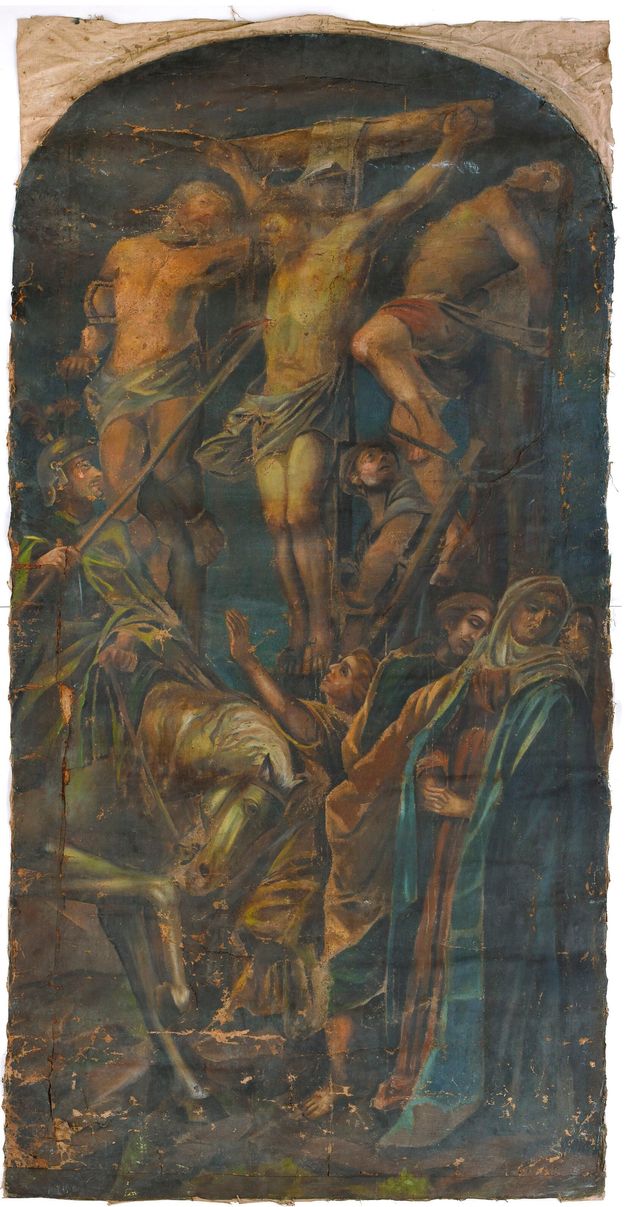
extensive overpaintings done throughout its history (fig. 55.1), the painting was removed from permanent display in the
main altar during the second half of the twentieth century
(Brykowski 1975, 239Brykowski, Ryszard. 1975. “Stan zachowania zabytków
powiatu lubartowskiego.” In Ochrona Zabytków 28,
nos. 3–4: 228–47.). It was then kept in a storage room, where it was subjected
to further decay, awaiting future conservation treatment.
ExpandFigure 55.1Attributed to Jan Bogumił Plersch (Polish, 1732–1817),
The Crucifixion, ca. 1750–1800. Oil on canvas.
Muzeum Katolickiego Uniwersytetu Lubelskiego Jana Pawła II
(Museum of John Paul II Catholic University of Lublin).
The condition of the painting before conservation.Image: Muzeum Katolickiego Uniwersytetu Lubelskiego Jana
Pawła II
As the project of conserving and restoring
The Crucifixion exceeded the capabilities of a small
parish, in 2014 the painting was handed over to the collection
of the Museum of John Paul II Catholic University of Lublin.
It then became the subject of a joint master’s thesis executed
at the Faculty of Conservation and Restoration of Works of Art
at the Jan Matejko Academy of Fine Arts, Kraków, from 2015 to
2017 (Dobrzańska and Lentowicz 2017Dobrzańska, Katarzyna, and Magdalena Lentowicz. 2017.
“Próba potwierdzenia autorstwa obrazu na płótnie
‘Ukrzyżowanie’ z 2. połowy XVIII wieku przypisywanego
Janowi Bogumiłowi Plerschowi na podstawie badań i
konserwacji obiektu.” MA thesis under supervision, Jan
Matejko Academy of Fine Arts, Kraków.).
Condition and Treatment Goals
The condition of the painting, which spent many years in the
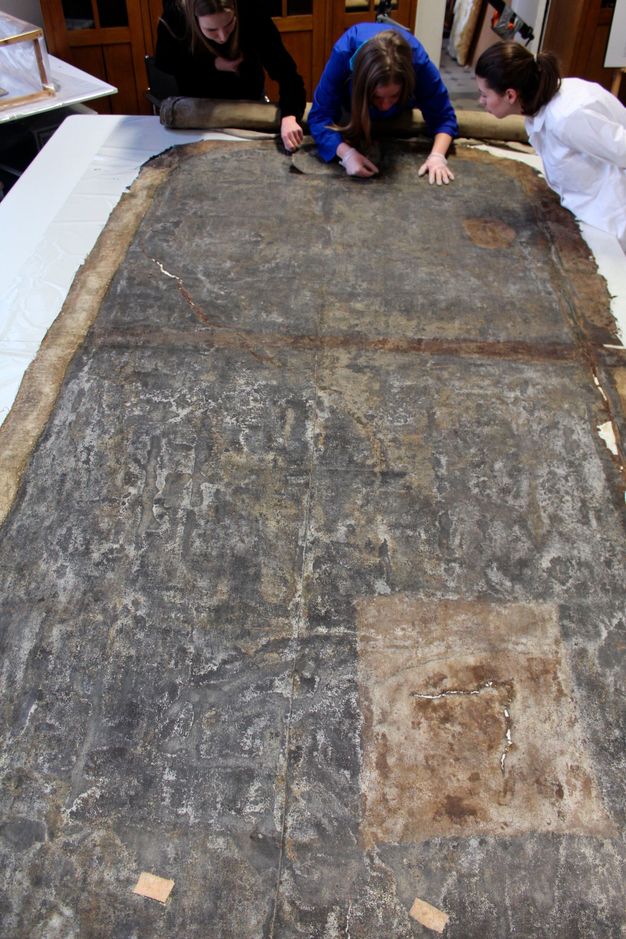
attic of a church, can be described as extremely poor (fig. 55.2). Many unprofessional conservation attempts contributed to
the dismal state of the artwork. The original support was
lined to a linen canvas with a starch-based adhesive. The
lining was almost completely detached from the painting.
Underneath the lining, an attempt at strip-lining was
discovered; it had been done using a very coarse canvas and
with a thick layer of rigid gluten glue and chalk gesso
serving as an adhesive.
ExpandFigure 55.2The Crucifixion, back of the canvas support
before conservation.Image: Muzeum Katolickiego Uniwersytetu Lubelskiego Jana
Pawła II
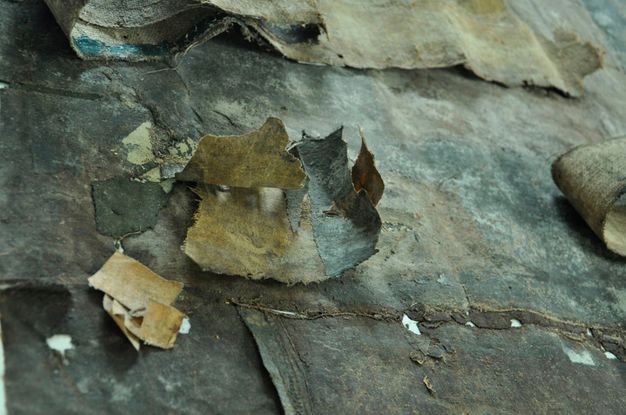
There were also numerous stratified fabric patches (fig. 55.3, top) attached with beeswax to the back of the original
canvas, which was also almost entirely covered with a black
impregnating substance (most probably various oil paints and
bitumen) (see fig. 55.2). In addition,
the canvas support was torn in many places, and its parts were
roughly sewn together with twine, pierced through the front of
the painting and all its layers (see
fig. 55.3, bottom). The original paint
and ground layers had poor adhesion to the canvas support,
which resulted in many losses. The painting had been
overpainted several times with thick layers of oil paint. The
whole structure was rigid yet fragile, and seriously deformed.
ExpandFigure 55.3The Crucifixion, back of the canvas support
before conservation, detail.Image: Muzeum Katolickiego Uniwersytetu Lubelskiego Jana
Pawła II
The main goal of the conservation was to remove all harmful
transformations. This was essential in order to recover the
original painting. It should be noted that none of the
alterations carried any historic or artistic value. The major
overpainting was done around 1945–46. After that, due to the
painting’s poor condition, it was displayed only occasionally.
All of the other repairs could only be interpreted as rather
makeshift attempts at stabilizing the painting’s structure,
and they undoubtedly were not executed by a professional.
Treatment Plan
The treatment plan called for the removal of the old lining
and patches, cleaning of the back of the canvas, consolidation
of the paint layer, flattening of deformations, removal of
overpainting, and filling and reintegration of losses. Due to
the condition of the painting and the severity of the damages,
each step took several weeks or months to complete.
The stage of addressing the consequences of the structural
damage of the canvas support proved to be a particularly
challenging part of the process, as the integrity of the
material was almost completely lost. The most serious tear ran
diagonally; it measured 2 meters in total and was amateurishly
sewn together with twine (see
fig. 55.3, bottom). When the twine
weakly holding the torn parts of the canvas was removed, it
became clear that it was impossible to reassemble the pieces
correctly without causing a great deformation. The diagonal
tear reached about two-thirds the height of the whole
painting, creating two almost separate “branches” of canvas,
which became unevenly distorted after being subjected to
changes in humidity: the gap between the parts reached 2.5 cm.
Despite this, the mutual edge of the torn parts was still
identifiable.
It would have been possible to maintain the existing
arrangement by adhering the torn pieces together with the
addition of the necessary inlay. However, the consequent
distortion of the composition would have been so significant
that this option was not pursued.
Treatment Steps
To gradually change the structure of the canvas support
without causing stress to the already fragile paint layer, it
was very gently subjected to higher humidity levels. The
problematic areas of the canvas were moistened with blotters
and relaxed, which enabled structural corrections. Single
linen threads were temporarily adhered with Vinavil NPC to the
edges of the torn parts to form a loose bridging, and the
structure was secured with locally placed weights. The whole
procedure was repeated several times, with the temporary
bridging “braces” being reapplied in order to form a tighter
join (Rouba 2000, 65Rouba, Bogumiła. 2000.
Podobrazia płócienne w procesie konserwacji.
Toruń, Poland: Nicolaus Copernicus University Press.). With such a large-scale tear, it was impossible to
reconstruct the course of the original weave pattern
completely by using a thread-by-thread approach. Nonetheless,
the final results were still satisfactory; the remaining gap
was not larger than 4 mm. The torn parts of the canvas were
glued together with Vinavil NPC, matching their mutual edge,
and this procedure did not cause any structural deformations.
Only small inlays were inserted in places where the tear edge
was destroyed and not possible to reweave. The repaired tears
were secured from the back with Beva Tex.
The next challenging step of the structural conservation of
the canvas support was to apply a new lining in order to
stabilize and secure the original canvas, which could no
longer withstand its own weight. It was decided to make it a
fully reversible lining using high-quality linen canvas and 65
µm Beva 371 film. Because of the dimensions of the painting,
the process was carried out in phases. The adhesive film was
placed on the lining canvas impregnated earlier with a
solution of Vinavil NPC. The lining canvas was placed on the
back of the painting and ironed with hand irons to create the
initial bond.
The whole structure was then transferred to a heated suction
table, where the lining was performed in three stages. As the
size of the object was much larger than the dimensions of the
suction table, it was treated in three separate sections with
the remaining length of the painting secured on a roller. A
modified version of a vacuum envelope was used during this
process. The painting was placed facedown, as the original
canvas support was sewn from parts with protruding stitches.
In this way, the danger of deepening distortions trailing the
course of stitches was minimized. The whole process in its
essence did not differ from a standard lining procedure.
However, the dimensions of the painting required that
additional thought be put into the handling of the object. The
stability of the painting was ensured by mounting it on a
specially designed constant tension metal stretcher. The
stretcher was designed and made by Henryk Arendarski, using a
patented construction method.2
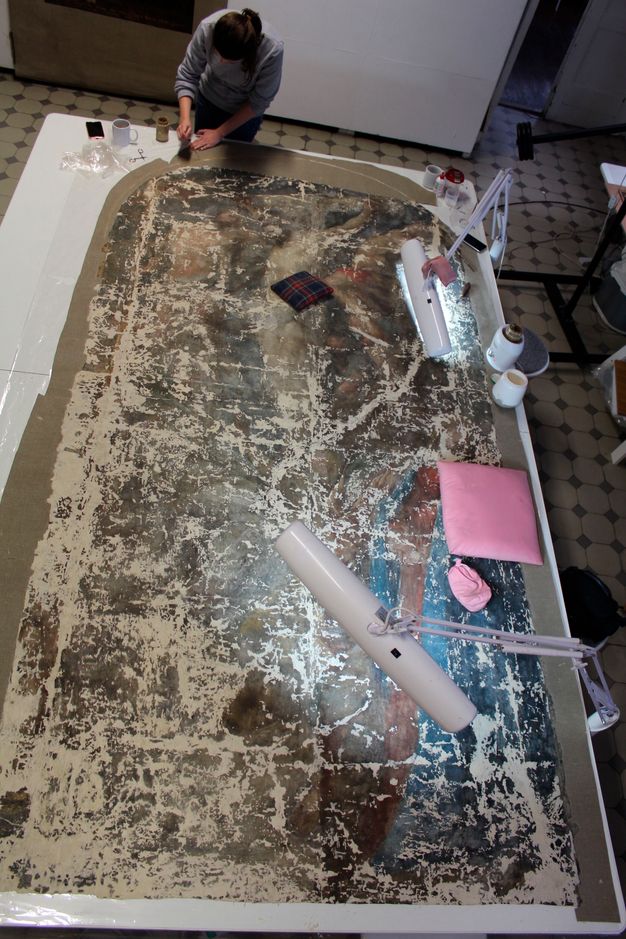
It was decided that the conservation of
The Crucifixion should be finalized with a complete
and reversible reconstruction of the composition executed on
the basis of the graphic print by Boetius à Bolswert. Without
retouching, the overwhelming number of losses made the
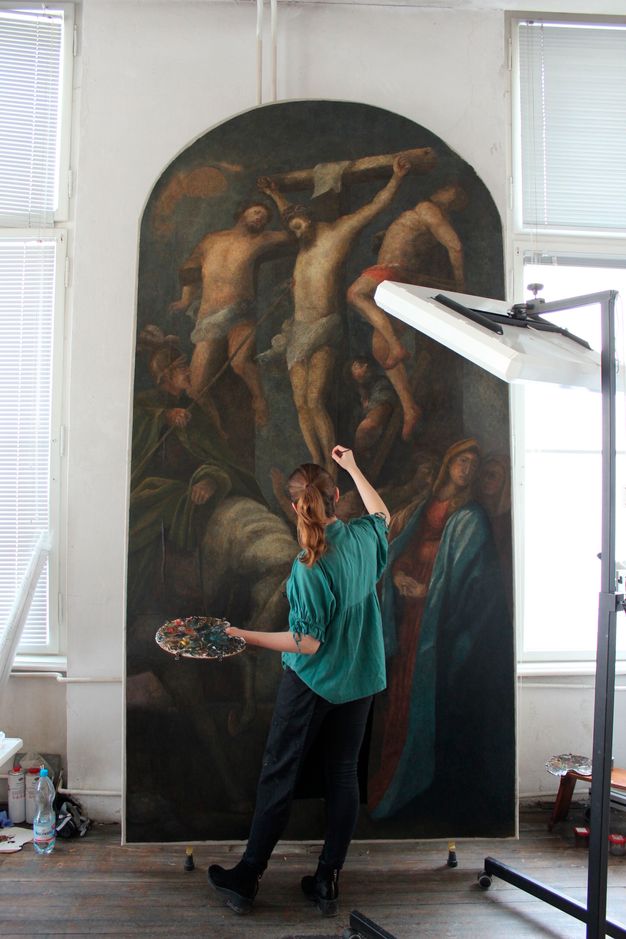
composition almost illegible to a viewer (fig. 55.4). Although this process could not be described as one
strictly following the rule of minimal intervention, we
believe it was the only chance for The Crucifixion to
regain its aesthetic value (fig. 55.5). As the painting will become part of a museum collection,
thorough information about the conservation process will be
provided with its exhibition.
ExpandFigure 55.4The Crucifixion, face of the painting during
conservation: filling in losses to the ground.Image: Muzeum Katolickiego Uniwersytetu Lubelskiego Jana
Pawła IIExpandFigure 55.5The Crucifixion during conservation:
retouching.Image: Muzeum Katolickiego Uniwersytetu Lubelskiego Jana
Pawła II
Verification of Authorship
Research concerning the verification of authorship was
conducted simultaneously with the conservation process.
Because of the poor condition of the original paint layer (see
fig. 55.4), it was almost impossible
to perform a comparative, formal, or stylistic analysis with
any other of Plersch’s paintings. No archival documents
concerning the creation of the painting have survived, nor
have any signatures or inscriptions been found. Extensive
research and field studies were conducted, together with a
comparative analysis of samples obtained from other paintings
by Plersch done using scanning electron microscopy–energy
dispersive X-ray analysis (SEM-EDX). Chemical and physical
examinations indicate that the ground composition in
The Crucifixion is similar to another painting
originating from the same church:
The Visitation of the Blessed Virgin Mary, painted
and signed by Plersch in 1760. Although the study remained
inconclusive, it has allowed formation of a hypothesis for
further investigation, which is being performed by Katarzyna
Dobrzańska as part of her postgraduate research at the
Doctoral School of Jan Matejko Academy of Fine Arts, Kraków.
Conclusion
The conservation of large-scale paintings comes with unique
challenges. Many logistical matters require consideration,
such as the handling of the object, the configuration of the
workspace, and accessibility to certain areas of the artwork.
Even basic treatments and procedures when performed on a
large-scale object are unusually prolonged. Every aspect of
addressing the consequences of structural damages to the
canvas support required additional preparation. The
conservation and restoration treatment of
The Crucifixion was a challenging process; however,
it laid the foundation for future research. The structural
conservation of the canvas support, performed by two students
at the beginning of their careers, was a valuable experience
and an inspiration for future development.
Figure 55.1Attributed to Jan Bogumił Plersch (Polish, 1732–1817),
The Crucifixion, ca. 1750–1800. Oil on canvas. Muzeum
Katolickiego Uniwersytetu Lubelskiego Jana Pawła II (Museum of
John Paul II Catholic University of Lublin). The condition of
the painting before conservation. Image: Muzeum Katolickiego
Uniwersytetu Lubelskiego Jana Pawła II
Figure 55.2The Crucifixion, back of the canvas support before
conservation. Image: Muzeum Katolickiego Uniwersytetu
Lubelskiego Jana Pawła II
Figure 55.3The Crucifixion, back of the canvas support before
conservation, detail. Image: Muzeum Katolickiego Uniwersytetu
Lubelskiego Jana Pawła II
Figure 55.4The Crucifixion, face of the painting during
conservation: filling in losses to the ground. Image: Muzeum
Katolickiego Uniwersytetu Lubelskiego Jana Pawła II
Figure 55.5The Crucifixion during conservation: retouching.
Image: Muzeum Katolickiego Uniwersytetu Lubelskiego Jana Pawła
II