Chicago
Hodkinson, Ian, Gianfranco Pocobene, and Corrine Long. “12.
Puvis de Chavannes’s
Philosophy Mural: Tactics for the Reversal of a Beva 371b
Marouflage Lining from an Aluminum Honeycomb Panel.” In
Conserving Canvas, by
Cynthia Schwarz, Ian McClure, and Jim Coddington. Los Angeles:
Getty Conservation Institute, 2023.
https://www.getty.edu/publications/conserving-canvas/ii-present-practice/12/.
MLA
Hodkinson, Ian, et al. “12. Puvis de Chavannes’s
Philosophy Mural: Tactics for the Reversal of a Beva 371b
Marouflage Lining from an Aluminum Honeycomb Panel.”
Conserving Canvas, by
Cynthia Schwarz et al., Getty Conservation Institute, 2023,
https://www.getty.edu/publications/conserving-canvas/ii-present-practice/12/.
Accessed DD Mon. YYYY.
During the 2016 conservation of Pierre Puvis de Chavannes’s
Philosophy mural, one of nine canvases commissioned
for the Boston Public Library and marouflaged to the wall in
1896, it was discovered that water infiltration had resulted
in detachment of up to 80% of the canvas from the wall.
After successful stabilization, facing, and removal from the
wall, the painting was prepared with a fabric interleaf for
marouflage onto a custom-built aluminum honeycomb panel for
reinstallation into its niche. The failure of the panel,
however, necessitated complete reversal of the marouflage
and replacement of the panel constructed with a stronger
epoxy adhesive. In this paper, the procedure to safely
remove the faced but stiff and brittle mural from the panel
is described. The difficulty of carrying out the reversal
led to the modification of the Beva 371 formula for the
reattachment of the mural in order to facilitate future
reversal, should the need arise.
KEYWORDS: Pierre Puvis
de Chavannes, Boston Public Library, Beva 371b, aluminum
honeycomb panel, lining failure, rigid support lining
reversal
Introduction
Since its introduction by Gustav A. Berger in the early 1970s,
Beva 371 has been widely used as an adhesive for the lining of
easel paintings and the mounting of murals onto rigid supports
(Berger and Russell 2000Berger, Gustav A., and William H. Russell. 2000.
Conservation of Paintings: Research and Innovations. London: Archetype.). As it is a relatively recent introduction to the field of
paintings conservation, the necessity of reversing a Beva 371
lining is an uncommon occurrence. While the reversal of
paintings lined onto canvas supports with Beva 371 can be
somewhat demanding, the removal of a large-scale mural
painting adhered to a rigid support with Beva 371 presents the
conservator with an extraordinary set of challenges.
With the application of heat and solvents, canvas lining
fabrics can be peeled away from the reverse of an easel
painting, but rigid support panels cannot, therefore different
strategies must be devised. The strong adhesive properties of
Beva 371 and its rather high activation temperature further
complicate the procedure. The adhesive used for the marouflage
procedure described in this essay is Beva 371b, which replaced
the original Berger formulation in 2010. Laropal K80 (BASF), a
tackifier in the original adhesive, was discontinued in 2008.
In the reformulated Beva 371b, “an aldehyde ketone resin” was
substituted (Conservator’s Products Company 2010Conservator’s Products Company. 2010. “Announcement: BEVA
371 Reformulated in 2010.”
http://www.conservators-products.com/pr01.htm.).
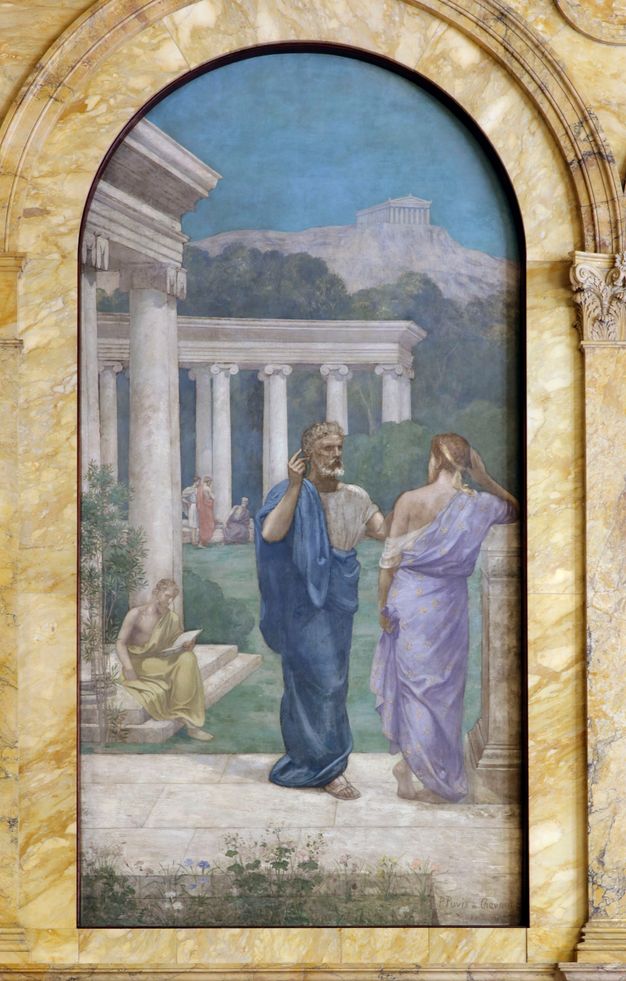
In 2016, Pierre Puvis de Chavannes’s Philosophy mural
(fig. 12.1), one of nine monumental
murals the artist painted for the grand staircase of the
Boston Public Library in 1895–96, underwent a major
conservation campaign. Delamination of the 436 × 218 cm mural
canvas and failure of the underlying plaster necessitated
emergency removal of the mural from the wall, mounting of the
canvas onto a rigid support panel, and reinstallation in its
niche. The project was presented by the authors at the 2017
American Institute of Conservation Conference General Session
in Chicago; however, time constraints did not permit a
thorough discussion of the unexpected failure of the aluminum
honeycomb panel support during the lining procedure. This
necessitated the reversal of the marouflage lining and
replacement of the panel with one of better design and
materials.
ExpandFigure 12.1Pierre Puvis de Chavannes (French, 1824–1898),
Philosophy, 1895. Oil-on-canvas mural originally
marouflaged onto plaster wall, 436 × 218 cm (171 5/8 × 85
7/8 in.). Boston Public Library. The mural is shown
mounted onto new aluminum honeycomb panel and set into its
niche after the 2016 conservation campaign.Image: Gianfranco Pocobene Studio
In addition to describing the procedure implemented to reverse
the marouflage and the successful remounting of the mural
canvas, the logistical complications of undertaking such a
procedure are presented in this paper. The difficulty of
carrying out the reversal led to a reassessment of using Beva
371b as recommended by the manufacturers. Tests conducted on
mock-up panels led to a modification of the adhesive to reduce
its strength, tack, and melting point—and by extension
increased its reversibility—while still retaining its
essential properties as a suitable marouflage lining adhesive.
Project Overview
The murals in the grand staircase of the Boston Public Library
were painted on canvas by Puvis de Chavannes in Paris. The
artist achieved his famed fresco-like surfaces by using
various innovative techniques, including painting on a coarse,
plain-weave linen canvas; priming the canvas with animal-glue
size; applying an extremely thin, absorbent chalk ground bound
in animal glue; draining his oils by placing them on blotting
paper; thinning his paints with turpentine; adding extensive
amounts of white lead to his color mixtures; and leaving the
mural surfaces unvarnished (Hensick, Olivier, and Pocobene 1997Hensick, T., Olivier, K., and G. Pocobene. 1997. “Puvis
de Chavannes’s Allegorical Murals in the Boston Public
Library: History, Technique, and Conservation.”
Journal of the American Institute for Conservation
36, no. 4: 59–81.).
Upon completion, the reverse of each mural was primed with red
lead in oil, rolled, shipped to Boston, and mounted to the
plaster walls using the marouflage technique (fig. 12.2). The original method of attachment was to adhere the canvas
to the wall with a paste of lead white in linseed oil applied
to both the wall and the back of the canvas painting, which
was then pressed onto the wall with rollers. While the
adhesive was curing, the canvas was secured around the
perimeter by a series of metal tacks.
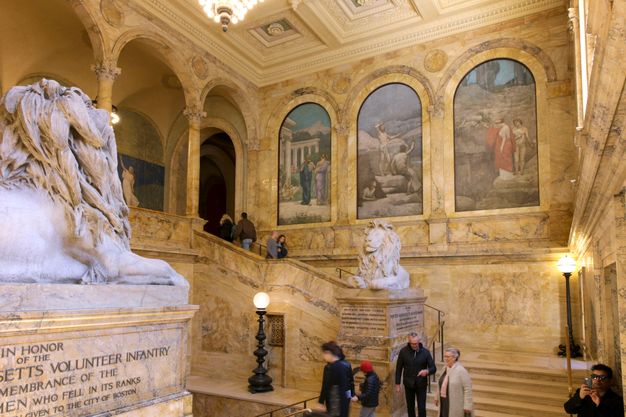
ExpandFigure 12.2Puvis de Chavannes’s mural cycle above the grand
staircase of the Boston Public Library.Image: Gianfranco Pocobene Studio
In late 2014, a large canvas bulge and undulations were
discovered in the upper portions of the mural. Salt
efflorescence observed on the surrounding marble confirmed
moisture infiltration. None of this was a surprise, as the
mural has had a history of moisture problems, as noted in 1993
when the Puvis de Chavannes murals were last conserved by the
Straus Center for Conservation, Harvard Art Museums (Hensick, Olivier, and Pocobene 1997Hensick, T., Olivier, K., and G. Pocobene. 1997. “Puvis
de Chavannes’s Allegorical Murals in the Boston Public
Library: History, Technique, and Conservation.”
Journal of the American Institute for Conservation
36, no. 4: 59–81.). Mapping of the mural surface revealed that nearly 80% of
the canvas had separated from the plaster substrate, yet along
the left and bottom edges, the canvas was still very firmly
attached to the wall.
Furthermore, a large area of the plaster substrate had also
detached from the wall structure and was exerting considerable
outward pressure on the canvas, raising fears of catastrophic
failure. The plaster substrate consisted of expanded metal
lath coated with three plaster layers: scratch coat, brown
coat, and finishing coat, all composed of lime plaster of
approximately 2.2 cm total thickness. Inserting a microspatula
between the canvas and plaster instantly shattered the paint
film, indicating that the canvas and ground were extremely
brittle. This also confirmed that the adhered portions of
canvas could not be separated from the plaster without
incurring considerable damage to the paint surface.
Given the brittleness of the mural layers, the stiff white
lead marouflage adhesive, and the strong bond where the canvas
remained adhered to the wall, detaching and rolling the mural
canvas off the plaster was clearly impossible. To prevent
damage, the only viable approach was to totally detach the
mural canvas along with the attached plaster portions from the
metal lath substrate while keeping it as much in plane as
possible.
The basic concept of detaching the mural is straightforward:
support the mural at the top while detaching it starting at
the bottom. Though the approach is simple in concept, numerous
challenges became immediately evident.
As the mural was in a recess, the edges of the canvas
could not be accessed.
Limited access could be provided at the bottom, but only
if the marble fascia below the mural was removed.
It was unclear how to support the painting and failed
plaster in the arch area while separating the mural from
the wall to reveal the bottom edge.
It would be necessary to coordinate application of facings
and removal of the oak trim within the arch without
collapse of the structure.
At some point, the plaster would need to be severed to
release the mural where it was still firmly attached to
the metal lath.
The best type of protective facing materials and adhesives
to use to protect the painting during the trauma of
removal and subsequent structural work had to be
determined.
As rolling the mural off the wall was deemed to be too
dangerous, a system had to be devised to keep the mural in
plane as much as possible during detachment. After
considerable testing and experimentation with scaled mock-ups,
the process of detaching the mural from the wall was carried
out. The mural was faced first with Kozo (Usu Mino) paper
sheets (after thorough testing for reversibility on mock-ups)
and a specially formulated emulsion adhesive consisting of the
following:
20 parts Golden MSA-UVLS Matte Varnish (chosen for its
relatively low toxicity, ease of removal, and
detectability under UV light)
2 parts odorless mineral spirits
1 part distilled water
The adhesive was emulsified with water to wet the paper fibers
so they could conform to the paint topography.
Belgian linen was chosen as the primary facing material for
the mural. Strips measuring 1 x 4 feet were adhered using the
same MSA-UVLS mixture used for the Kozo paper facing,
strengthened by incorporating 20% Beva Gel. Where maximum
stress was anticipated, such as the perimeter of the mural and
the vertical joins of the linen facing, additional linen
reinforcement strips were adhered with Beva 371b.
At this point, the most nerve-wracking component of the
project could begin: the detachment of the mural from the
wall. The mural was secured at the top with padded plywood
forms and pressure clamps. Working from the bottom up, the
mural portions still firmly attached to the plaster wall were
detached by severing the plaster from the metal lath substrate
using modified slate rippers and vibration applied with a
rubber mallet through a padded plywood sheet.
As the mural became detached, linen facing flaps extending
beyond the perimeter of the mural were wrapped and stapled to
the lightweight support panels. As the work proceeded up the
surface, more panels were affixed and locked together to keep
the mural in plane. Finally, with much of the mural supported
by the locked panel supports, the section within the arch was
detached. Once the entire mural was fully detached,
full-length vertical and horizontal wood stiffeners were
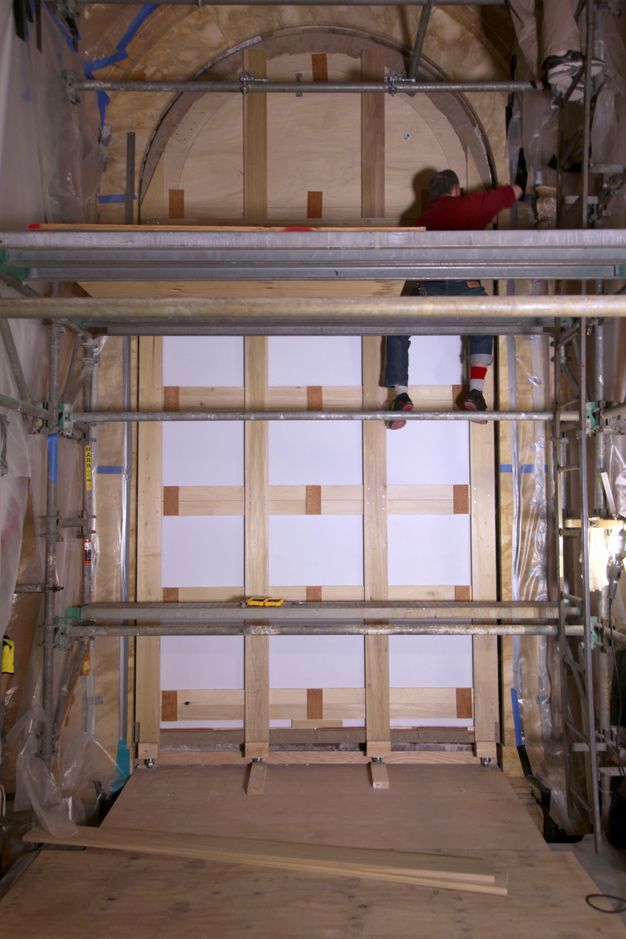
attached to the panel support system (fig. 12.3). A block-and-tackle system was connected from the staging
to the rigid frame support on the mural to guide it out. The
supported mural was then lowered, slowly coming to rest
facedown on the staging deck. The mural was then removed from
the deck and transported to a specially modified treatment
space within the Boston Public Library.
ExpandFigure 12.3The mural faced with support panels and stiffening wood
members.Image: Gianfranco Pocobene Studio
The history of water leaks behind the mural precluded the
possibility of remounting the mural onto a new plaster wall,
so the decision was made to marouflage the mural onto a rigid
panel support that could be easily installed and deinstalled
in the future, if necessary. The plaster remnants on the verso
were removed using first a reciprocating multitool to cut
through the bulk of the plaster, followed by mechanical
removal of the harder 3 mm–finish coat using chisels. The
lead-white adhesive was well bound and uniform and strongly
adhered to the reverse of the mural canvas, leaving none of
the canvas exposed, thus it was left undisturbed. In
preparation for lining, the reverse of the mural canvas was
sealed with one coat of warm Beva 371b diluted with
low-aromatic mineral spirits following the manufacturer’s
instructions.
Belgian linen canvas (8.7 oz) was then prepared as an
interleaf for the lining assembly. A stiffer, synthetic
material with a bonded weave (such as polyester sailcloth or
Sunbrella fabric) would have been preferable, but fabric wide
enough to span the width of the mural was not available. The
Belgian linen was stretched on a wood frame and then sized and
stiffened with a mixture of equal parts Titebond wood glue and
water. A coat of warm Beva 371b was then rolled onto one side
of the Belgian linen and allowed to dry. The fabric was then
positioned over the back of the mural, adhesive side down, and
secured with heat from an iron applied through silicone-coated
polyester film (Mylar). A layer of warm Beva 371b was then
applied to the exposed side of the linen interleaf and allowed
to dry. This surface would be bonded to the honeycomb panel.
The canvas mural, with the linen interleaf attached to it and
still on its panel support structure, was then turned faceup
and placed onto a specially constructed worktable. The wood
braces and support panels were removed to reveal the faced
surface of the mural. The canvas facings were removed from the
mural surface with combinations of mineral spirits and xylenes
to dissolve the Golden MSA-based adhesive and Beva 371b, but
the Kozo paper facings were left on the mural for the time
being.
Adhesion to the New Rigid Support
Considerable thought was given to the approach and materials
to be used for remounting the mural. From the outset it was
decided to reattach the mural to a rigid support. This would
respect the artist’s intent to marouflage and would provide
continuous support for the heavy canvas. For this, an aluminum
honeycomb panel was specially fabricated. In addition to
providing the necessary rigidity, the conductivity of the
aluminum would also facilitate the transfer of heat through
its structure for lining at the recommended temperature of
65°C.
Given the size of the mural, the marouflage was to be carried
out in four successive sections. A 122 x 244 cm
temperature-controlled, silicone rubber heat sheet placed
beneath the panel would deliver the required heat to each
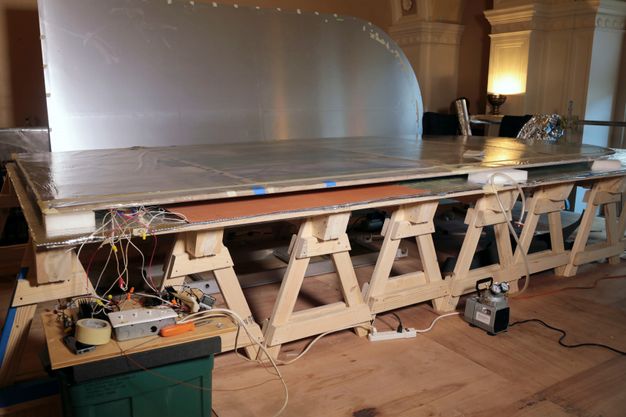
section (fig. 12.4). Before heat was
applied, trial runs were performed to ensure that enough
vacuum pressure could be applied over the entire Dartek film
envelope. This was achieved using two small vacuum pumps
placed on either side of the panel, which were connected with
plastic tubing to 1.25 cm polypropylene cord running along the
outer edge of the panel. In the final trial, the mural and all
the adhesion components were sealed with Dartek film, and the
required suction successfully applied. Once we were confident
that this method would work as intended, marouflage of the
mural could proceed.
ExpandFigure 12.4Lining system employed to marouflage Philosophy.
The mural is shown on its aluminum honeycomb panel in a
vacuum envelope suspended above an orange silicone rubber
heat sheet.Image: Gianfranco Pocobene Studio
In preparation for lining, the worktable was covered with
sheets of double reflective insulation (Reflectix) to reduce
heat loss during the heating process. The
temperature-controlled silicone rubber heat sheet was
positioned for the adhesion of the first section at the bottom
of the mural. Lastly, a coat of warm Beva 371b was applied to
the face of the honeycomb panel, thus ensuring that the
surfaces to be bonded were coated with a layer of the
adhesive.
The mural was positioned onto the honeycomb panel, sealed with
Dartek film, and then transferred onto the silicone rubber
heat sheet. The vacuum pumps were attached with quick-release
vacuum connectors, the heat sheet was turned on, and
metallized reflective Mylar was placed over the section to
retain heat. Once the paint surface temperature of all areas
of the section reached 65°C, the heat was turned off and the
bonded area allowed to cool down.
Everything appeared to have gone exactly as intended, but when
the reflective Mylar was pulled back, a series of small bulges
not present at the beginning of the heating process had
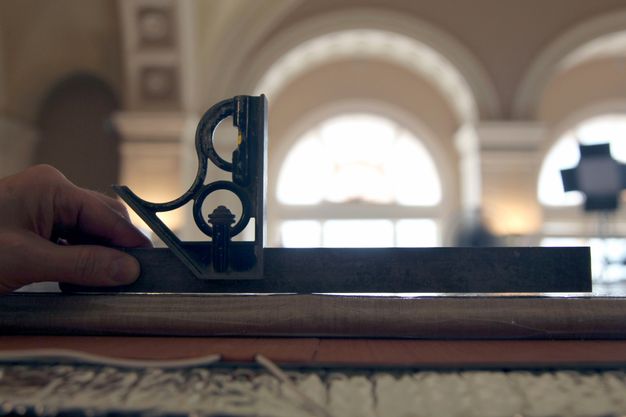
developed along the center structural join of the panel (fig. 12.5). The cause of the deformations was delamination of the
aluminum skins. The same problem was also discovered on the
reverse of the panel, raising questions about what had caused
the panel failure and how to proceed. Would we continue with
the process in the hope that the rest of the panel would
remain intact, or should the procedure be abandoned? Because
the panel was intended to support the mural over the long
term, we could not in good conscience continue to adhere the
mural to what was clearly a structurally compromised support.
ExpandFigure 12.5A straight edge placed on the failed structural seam of
the aluminum honeycomb panel, revealing the protrusion of
the aluminum panel skin.Image: Gianfranco Pocobene Studio
The Boston Public Library was informed of this unfortunate
setback, and in collaboration with the panel manufacturer we
began to investigate the cause of the problem. At the same
time, we started to formulate a strategy for the removal of
the mural from the failed panel for remounting onto a new,
structurally sound rigid support.
Reversal of the Failed Beva 371b Marouflage
The first order of business was to detach the 122 x 213.5 cm
section of mural canvas now adhered to the failed panel. As
the linen facing layer had been removed prior to the lining
procedure, the section was refaced with linen to protect and
support the paint layers. The fact that almost 2.8 square
meters of the mural was adhered to the panel while the rest
was not greatly complicated the approach to reversing the
adhesion. Whereas solvents can be applied to the back of
canvas-lined paintings to dissolve Beva 371b, in this case
that would not be possible. The notion of delivering heat
through the front of the mural to release it was rejected
because of the excessive temperature needed to penetrate the
paint layers and melt the adhesive.
Some thought was given to the possibility of turning the mural
on its face and dismantling the panel behind it down to the
aluminum skin it was attached to, but that would be easier
said than done. Attempting to then release the remaining
adhered aluminum skin with heat from the reverse would have
proven extremely difficult, as only a small area could be
detached at a time. This approach was also rejected because of
the difficulty of handling the aluminum skin and the
considerable risk of damage to the brittle paint and ground
layers.
The only feasible approach was to reheat the entire bonded
portion of mural and then to roll the canvas off the panel
when the Beva 371b adhesive reached its release temperature.
Before any such attempt was made, however, small-scale
replicas of the partially adhered mural were made, and from
these tests a suitable approach was devised. Affixing the
bottom edge of the linen interleaf under the mural to the
equivalent of a very large diameter Sonotube, and then slowly
rolling back the mural when the release temperature was
reached, was deemed the most sensible tactic: it would support
the canvas, minimize distortion, and reduce stress to the
paint layers.
It was empirically calculated that a tube with a diameter of
3.7 m would be required to accomplish the task. That being
impractical, we decided to fabricate a section of such a tube
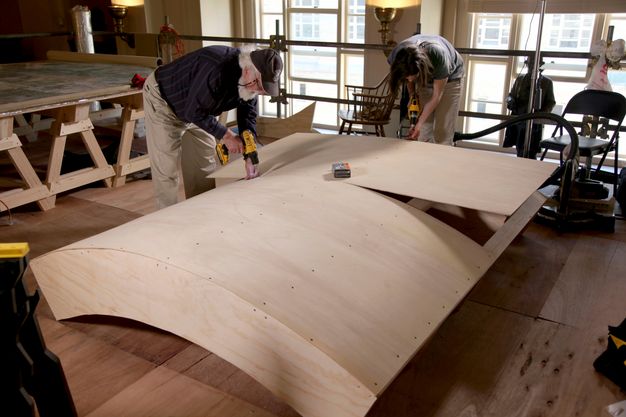
large enough to cover the area of the adhered section. A form
was fabricated by cutting 1.9 cm plywood into curved ribs
attached to a frame (fig. 12.6). Lauan
board (0.64 cm thick), chosen for its pliable characteristics,
was then attached to the ribs to create the outer, curved
surface of the form, against which the mural would be
supported during the adhesion reversal.
ExpandFigure 12.6Conservators constructing a curved form to be used to
roll the partially adhered section of the mural off of the
aluminum honeycomb panel.Image: Gianfranco Pocobene Studio
The curved plywood form was set over the mural and tied to 5 ×
10 cm framing supports on either end with block-and-tackle
pulleys. This arrangement would enable the operators at the
four corners to slowly roll the curved form away from the
bottom edge in a controlled manner, until the entire section
was released. With the interleaf and linen facing tabs along
the bottom of the mural secured to the bottom edge of the
curved plywood form, the silicone heat sheet was turned on and
the surface temperature of the aluminum honeycomb panel raised
to 65°C.
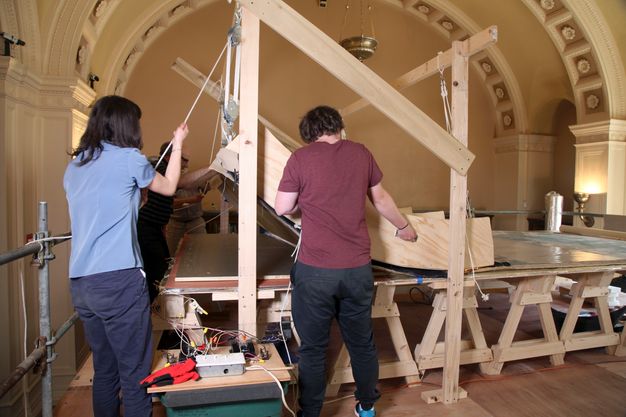
As the Beva 371b began to release, the bottom edge of the
curved panel form was slowly raised while the other end was
lowered, enabling the mural to be gently pulled away from the
honeycomb panel (fig. 12.7). This went
according to plan; however, cool air flowing between the
surface of the panel and the underside of the linen interleaf
caused stringing of the Beva 371b adhesive, a well-known
occurrence in the hot-melt glue industry. As the strings
cooled, the resulting hardening of the adhesive impeded the
effort to pull the mural off the panel at an effective pace.
Severing the strings with a metal spatula as they formed
enabled the procedure to continue. The total time to reverse
the lining, from the moment of lifting the curved form to
complete detachment, took only four minutes. Critical to the
success of the reversal process was the presence of the linen
interleaf, which provided much needed support for the mural
and took the brunt of the applied stress.
ExpandFigure 12.7Technicians releasing the mural from the aluminum
honeycomb panel curved form and block-and-tackle pulley
system. Pairs of ropes at either end of the adhered
section were used to control the lifting of the canvas
from the panel.Image: Gianfranco Pocobene Studio
Honeycomb Panel Redesign
With the mural successfully detached from the honeycomb panel,
the next step in the process was to determine why the panel
had delaminated. The failed panel was fabricated with aluminum
skins (0.8 mm) supported with poplar strips for the outer
straight edges and medium-density fiberboard (Medex) edges cut
to the shape of the arch. The width of the mural, which
exceeded the width of available aluminum sheets, required a
vertical seam in the center of the panel, which had been
reinforced with a 7.6 × 1.9 cm rectangular aluminum tube. The
core of the panel was filled with aluminum honeycomb to
provide rigidity and heat transfer. When the panel was
commissioned, it was made clear to the manufacturer that the
panel would be heated to 65°C–70°C and that an epoxy adhesive
able to tolerate that temperature needed to be used in the
fabrication of the panel.
After a review of the specifications and materials used to
make the panel, it was determined that several factors led to
its failure, including the type and amount of epoxy adhesive
applied to the various surfaces and the choice of edge
materials. In preparation for the fabrication of a stronger
panel, the manufacturer produced numerous small mock-ups with
various combinations of epoxies and edge materials. These were
then heated to the lining temperature under vacuum and
assessed for their structural integrity. Initially, many of
these failed, but based on the results of the experiments two
major changes were made to the construction of the panel.
First, an epoxy adhesive that would tolerate temperatures of
up to 80°C was obtained and successfully tested on mock-up
panels. Second, the poplar and Medex edging materials were
replaced with aluminum tubing along the edges, which was also
used for cross bracing. Additionally, the center vertical seam
was reinforced with a 10 cm composite plate that spanned the
inside of the seam; it was composed of 1.27 cm Hexcel aluminum
honeycomb sandwiched between 1/8 inch aluminum sheets. This
composition greatly stiffened the structure, and the new panel
was custom fabricated for the lining of the mural.
Modification of the Beva 371b Adhesive
The challenges encountered during reversal of the partially
adhered portion of the mural led to a reconsideration of the
properties of Beva 371b: namely, its high strength and the
temperature needed to release it. Recently, Ploeger et al.
considered the strength of Berger’s adhesive formulation and
proposed the need for further research and development of
adhesives with reduced strength and activation temperature
(Ploeger, McGlinchey, and de la Rie 2015Ploeger, R., C. W. McGlinchey, and E. René de la Rie.
2015. “Original and Reformulated BEVA® 371:
Composition and Assessment as a Consolidant for Painted
Surfaces.” Studies in Conservation 60, no. 4:
217–26.). As the entire Puvis de Chavannes marouflage may need to be
reversed at some point in the future, thought was given to how
conservators would go about doing this and what could be done
during the present procedure to make that task less
challenging. Once mounted onto its rigid support panel, the
mural canvas would be in a relatively stress-free state, so
such a high-strength adhesive would not be necessary. The
question was how to go about reducing the strength and tack of
Beva 371b while still providing sufficient adhesion.
Additionally, lowering the activation temperature of the
adhesive was deemed a desirable characteristic, especially for
the brittle paint and ground layers.
As supplied by the manufacturer, paraffin wax makes up 9% of
Beva 371b. It was deduced that the addition of a
low-temperature paraffin wax to the stock solution would
reduce not only the activation temperature of the adhesive but
also the percentage of the other resins and tackifiers in the
solution, thereby reducing the adhesive’s strength. Empirical
tests were performed to determine if a modified adhesive with
these desirable properties could be produced. Using Beva 371b
dry resin mix, batches of the adhesive were weighed out and
dissolved in solvents according to the manufacturer’s
directions. They were then modified by adding 5% and 10% by
weight of paraffin wax. A paraffin wax with a melting
temperature of 50°C–54°C was chosen for testing. A control
sample of unmodified Beva 371b was also prepared for
comparison. Scrap samples of thick nineteenth-century
decorative canvas, along with linen interleaf fabrics, were
adhered to small honeycomb test panels. From the tests, it was
determined that it was possible to sufficiently adhere the
test samples at a much lower temperature of 54°C measured at
the paint surface. The tests also indicated that at the
interface between the aluminum panel and linen interleaf, the
temperature remained below 60°C.
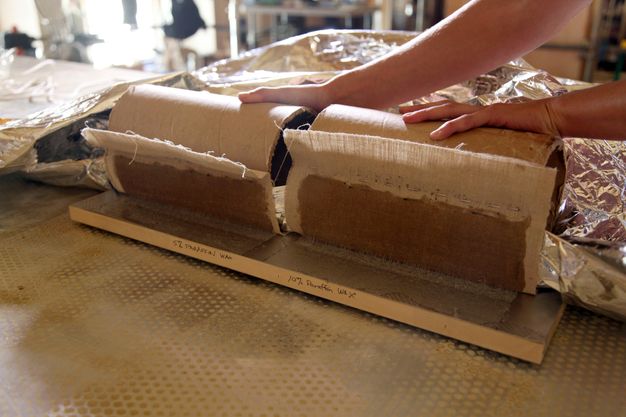
To determine if the adhered samples could be released with
less force, small, rigid cardboard tubes were attached to one
edge of the test samples and the panels heated until the
surface of the paint reached 54°C. Whereas it was not possible
to roll back the unmodified Beva 371b at that temperature, the
5% and 10% samples both released from the aluminum panel,
especially the latter, which could be rolled back using
relatively little force (fig. 12.8).
Based on these empirical tests, it was decided to adhere the
mural with a Beva 371b solution modified with the addition of
10% paraffin wax by weight. Because the lead-white adhesive on
the reverse of the mural acted as a barrier, there was little
concern that the modified adhesive would darken the canvas
because of its increased flow.
ExpandFigure 12.8Mock-ups made using different amounts of paraffin wax to
find the best mixture to lower the melting point of Beva
371b.Image: Gianfranco Pocobene Studio
Completion of the Marouflage Procedure
Assured that the new, redesigned honeycomb panel would
tolerate the lining process, the mounting of the mural
proceeded as originally conceived. A coat of the modified Beva
371b solution was applied to the surface of the new honeycomb
panel and allowed to dry. The linen and Kozo paper facings
were then removed from the mural surface. As previously
described, the mural assembly was wrapped in its Dartek vacuum
envelope. The first section of the mural was successfully
adhered to the panel using the modified Beva 371b adhesive at
a paint surface temperature of 54°C. Once cooled to room
temperature, the panel was temporarily lifted onto foam blocks
to reposition the silicone heat sheet under the next section
of the mural (see fig. 12.4). Section
by section, the entire mural was successfully adhered using
this system. The Belgian linen edges extending beyond the
perimeter of the mural canvas were then wrapped around the
edges and over the back of the honeycomb panel and adhered
with Beva 371b using warm irons. Four heavy-duty metal
right-angle brackets (two on each side) were mounted with
epoxy and screws to the panel edges and back.
After selective filling and retouching, the mural was
transported back to the staging area for reinstallation. With
just 3 mm of play on either side, the panel slid easily into
its niche. The mural was positioned and checked for level, and
the angle brackets were then screwed securely into
corresponding wood blocking mounted in the niche recess (see
fig. 12.1).
Conclusions and Further Research
Although the reversal of Beva 371 adhesion from rigid support
panels is a challenging process, the treatment undertaken on
the Philosophy mural demonstrates that methods can be
devised to carry out this type of procedure. While the
midtreatment setback caused by the failed panel was in the end
successfully resolved, it raised questions about the present
formulation of Beva 371b and its working properties. Research
to date has explored certain properties of Beva 371, such as
its stability and its potential use on other types of art. The
process of reversing adhesion to rigid supports and the
resulting effects on the canvas and paint layers, however,
have not been thoroughly investigated.
The original formula Beva 371 was specifically developed for
the lining and consolidation of paintings on canvas and has
been used with apparent success for that purpose for over half
a century. The revised formula, Beva 371b, continues to be an
invaluable adhesive in the conservation field, but it has its
own problems and limitations. Reevaluation of the adhesive,
along with systematic testing, is much needed. The replacement
of some of its components with new materials and resins could
lead to the production of adhesives with properties tailored
more appropriately to the job at hand, including adhesives of
various strengths. Moreover, an adhesive with a lower
activation temperature would be a welcome addition to the
lining and consolidation materials at our disposal.
Acknowledgments
For the conservation treatment, the authors would like to
thank Liza Leto-Fulton, Peggy Waldron, Alexa Beller, Piero
Pocobene, Lorraine Bigrigg, and T. K. McClintock; and for the
mural deinstallation/reinstallation, Ivan Myjer, David Kalan,
Matteo Pocobene, Derek Fisher, Bill Barry, and Marr
Scaffolding Company. Finally, thanks to Meghan Weekes, Ellen
Donaghey, and Jim Meade at the Boston Public Library.
Dartek C-917 Film (nylon 6,6 film modified with a
heat-stabilizing adhesive), TALAS.
https://www.talasonline.com
Golden MSA Matte Varnish with UVLS (isobutyl and n-butyl
methacrylate resin solution with amorphous silica matting
agent and hindered amine UV light absorber and stabilizer),
Golden Artist Colors.
https://www.goldenpaints.com
Figure 12.1Pierre Puvis de Chavannes (French, 1824–1898),
Philosophy, 1895. Oil-on-canvas mural originally
marouflaged onto plaster wall, 436 × 218 cm (171 5/8 × 85 7/8
in.). Boston Public Library. The mural is shown mounted onto
new aluminum honeycomb panel and set into its niche after the
2016 conservation campaign. Image: Gianfranco Pocobene
Studio
Figure 12.2Puvis de Chavannes’s mural cycle above the grand staircase of
the Boston Public Library. Image: Gianfranco Pocobene
Studio
Figure 12.3The mural faced with support panels and stiffening wood
members. Image: Gianfranco Pocobene Studio
Figure 12.4Lining system employed to marouflage Philosophy. The
mural is shown on its aluminum honeycomb panel in a vacuum
envelope suspended above an orange silicone rubber heat sheet.
Image: Gianfranco Pocobene Studio
Figure 12.5A straight edge placed on the failed structural seam of the
aluminum honeycomb panel, revealing the protrusion of the
aluminum panel skin. Image: Gianfranco Pocobene Studio
Figure 12.6Conservators constructing a curved form to be used to roll
the partially adhered section of the mural off of the aluminum
honeycomb panel. Image: Gianfranco Pocobene Studio
Figure 12.7Technicians releasing the mural from the aluminum honeycomb
panel curved form and block-and-tackle pulley system. Pairs of
ropes at either end of the adhered section were used to
control the lifting of the canvas from the panel. Image:
Gianfranco Pocobene Studio
Figure 12.8Mock-ups made using different amounts of paraffin wax to find
the best mixture to lower the melting point of Beva 371b.
Image: Gianfranco Pocobene Studio