As part of a master’s program, the author examined a recently acquired collection of contemporary Congolese paintings at the Africa Museum in Tervuren, Belgium. After describing the context in which the paintings were made and their methods of production, often involving the use of unconventional materials, this paper considers the challenges for the collection’s long-term safe handling, display, and storage. Possible approaches to its conservation are considered, including the use of transparent linings, as many of the paintings have important information on the reverse. Different techniques for transparent linings were researched. A representative treatment case study, where an appropriate transparent lining was required, is presented.
25. Issues with Congolese Paintings in Belgium’s Africa Museum: Condition Assessment and Research in Transparent Lining
- Emilie Desbarax, Freelance Conservator, Brussels, Belgium
Introduction
As part of the master’s program at the École Supérieure des Arts (ESA) Saint-Luc University in Liege, I had the opportunity to research the collection of contemporary Congolese paintings at the Africa Museum in Tervuren, Belgium. This unique collection of two thousand paintings, including works by well-known artists such as Ange Kumbi, Chéri Samba, Tshibumba, Shula, Moke, Chéri Cherin, Thango, and Lubaki, chronicles the lives of Congolese citizens from 1968 to 2012. They were collected by Bogumil Jewsiewicki-Koss1 and purchased in 2012 by the Africa Museum.
The first year of my master’s thesis focused on historical research and the assessment of the recently acquired collection, including entering details of inscriptions and condition into a database. The main objective was to gain an understanding of the overall condition of the collection. This eclectic collection consists of paintings made with both typical and local recycled materials. The second year of my thesis involved the research of appropriate structural treatments to preserve the paintings for the future. (This led me to the studio of Olivier Nouaille2 to follow Marion Guillermin’s research on Petex and Nitex, synthetic, transparent canvases (Guillermin, M. 2012. “Etude de la transparence de certains matériaux de consolidation des supports de peinture en vue de la mise au point d’un rentoilage transparent.” Mémoire de fin d’études, restauration conservation de biens culturels, École de Condé, Paris.).3 Many of the paintings have inscriptions on the back, making the transparency of the lining materials a primary concern. A range of test samples was made and tested with synthetic adhesives, and the most promising results were used to treat one of the paintings in the collection.
This article is divided into three main sections. The first introduces the collection—its historical background, themes, and materials. The second outlines the collection’s current condition. The third describes the treatment of one painting and its lining onto a transparent support.
The Collection
Popular Art—Art about People
The term popular art comes from me; it’s to say that our artwork is about the people’s lives and will always be understood by everyone wherever they come from. You don’t have to have been in academic school, because the message is direct and easy to understand. I wish I would have found a better word, because after a few years I realized that it was misunderstood. In the Western world, this word popular has another meaning, without any thoughts behind it, something without any research, and I was upset about it, because there is a research! Concerning the paintings, I’d like that everyone looks at the paintings without any judgment, prejudice, or anything and wherever they come from.
—Chéri Samba (Our Choices Art. 2017. Interview with Chéri Samba. Three-part video: “Congo Imagination,” “Assert Your Style,” and “From Africa to the World.” https://www.youtube.com/watch?v=0loCX-b8hGQ.)
Congolese popular art originated from street advertising art (billboards), which began to appear in the late 1910s to early 1920s. The artists Lubaki and Djilatendo, whose work was noticed by gallerists in 1926, used natural pigments on the walls of houses that were made with clay and leaves. Unfortunately, these pictures didn’t last, due to the fragile supports and materials chosen. They were painted to publicize stores or to denounce something in particular: painful, moral, and historical events that had caused concern. The biggest production of mural art was in Kinshasa. Through this art, the city—known as “Kin trash can” because of the quantity of waste materials found in the street—was revitalized.
The popular mural artists were encouraged to paint on canvases instead of the walls of houses, and that was the beginning of easel paintings in Congo. They were displayed in front of houses to attract clients. Once sold, the paintings were usually nailed to walls in bars or houses, and each painting sold funded the purchases of new painting materials.
Because the paintings were now portable, they were also able to travel around the world. Their inclusion in the Universal Exhibition of Brussels in 1958 attracted wide interest both locally and abroad. The Congolese became more aware of the importance of taking care of and conserving their paintings. At this time, the artists began to sign their artworks, and many exhibitions were organized to display these fascinating paintings throughout the United States and Europe. Concurrently, several academies of art were established.
-
In the south of the country, the French artist Pierre Romain Desfossés (1887–1954) created the Elisabethville4 School in 1946. Bela, a famous artist, was its first member. This was more a studio than a school, where everyone was free to paint what they wanted. Twenty years after the discovery of Lubaki, the precursor, Desfossés created the Hangar School with other well-known artists such as Pili-Pili, Mwenze, and Kibwanga. Desfossés died in 1954, and the Hangar fused with the Academy of Fine Arts of Lubumbashi.
-
The Belgian artist Victor Wallenda (Frere Marc-Stanislaus) created the Saint-Luc School in 1943, in the western part of Congo. In 1948, the artist Laurent Moonens (1911–1991) arrived from Belgium, and the Saint-Luc School moved to Leopoldville (now Kinshasa). In 1957, it was renamed the Academy of Fine Arts.
-
Farther north, in Brazzaville, the French collector Pierre Lods created the Poto Poto School in 1949.
As a result of these different schools, two categories of artists appeared: the self-educated and the academically educated. These artists were put under the spotlight by many patrons (Gilungula Pela Koy, Ibongo. 1995. “L’imagerie religieuse dans la peinture populaire urbaine.” Mémoire, faculté de théologie, Faculté Catholique de Kinshasa.; Turine, Roger-Pierre. 2007. Les arts du Congo: d’Hier à nos jours. Brussels: La Renaissance du Livre.).
Ongoing Research
Jewsiewicki-Koss published extensively on Congolese art in the 1990s during his trips to many cities, including Kinshasa, Bunia, and Lubumbashi. He noted that the cities looked like huge art galleries of paintings. Three documentaries describing the artists’ working conditions were made: two by Jewsiewicki-Koss in 1991, and one by the Flemish film director Dirk Dumont in 1989. Prints of these documentaries are stored in the Africa Museum in Tervuren, Belgium.
While many other relevant publications about Congolese popular art exist, I found few studies and little research focusing on the exact type of materials used and the deterioration of these paintings. The Africa Museum’s collection was only recently acquired, and as there had been no prior condition assessments, I had the opportunity to take a closer look. I recorded the extent of the damage to the paintings in a database to focus any research on future conservation. My desire was to provide a conservation approach based on materials, rather than primarily theoretical art history.
To learn more about the deterioration of the collection, I needed more information about the materials these artists used and their techniques: How did they work? How did they choose their materials? Why did they choose these types of canvases? How did they apply their mixtures, and in which order? How did they view their artwork? What were their purpose and expectations? To answer these questions and others, I interviewed Jewsiewicki-Koss (Desbarax, Emilie. 2016. “Interview with Bogumil Jewsiewicki-Koss.” In Congo Art Works: Peinture populaire, edited by Bambi Ceuppens and Sammy Baloji, 5–8. Exhibition catalogue. Brussels: Africa Museum and Éditions Racine.), the previous owner, and Ange Kumbi,5 one of the famous artists represented in the collection. It was essential for me to understand the collection before undertaking the research.
Themes in the Collection
I was mimicking comic scenes. There was a magazine that everyone loved called Jeunes pour jeunes, and I would copy scenes from it and sell the drawings to my friends at school. But I told myself that drawing didn’t allow me to earn much more money, so maybe I should do painting. Editors were looking for somebody who used a style that could be found in billboards in their paintings, and what I was doing was putting writing in my paintings.
I named this kind of style the Sambain style. It meant paintings with writing. It seems that before me, such paintings didn’t exist. Each of us has to have a specific style and be considered as a model, and my aim was to make what hasn’t been made before. I noticed that people who were walking in the street didn’t stop to look at the paintings, so I had to find a way to catch people’s attention, to be more attractive. The real connoisseurs, my audience, was in the street. Especially those who stood in front of my paintings for a long time. If they read more slowly than me, they would stay a lot of time in front of it, so it was a success! What I’m interested in is to call conscience to mind and to give a moral meaning. I paint a reality that everybody knows. If it leads me to getting arrested because I tell the truth, it doesn’t upset me, because this is what I want to paint.
—Chéri Samba (Our Choices Art. 2017. Interview with Chéri Samba. Three-part video: “Congo Imagination,” “Assert Your Style,” and “From Africa to the World.” https://www.youtube.com/watch?v=0loCX-b8hGQ.)
The museum’s collection features famous self-educated artists such as Ange Kumbi, Chéri Samba, Tshibumba, Shula, Moke, Chéri Cherin, and others from the Academy of Fine Arts, including Thango and Lubaki. The paintings by self-educated artists depict historical and moral topics (fig. 25.1) as well as the daily lives of the Congolese. The subjects represent the real lives of people: colonialism, prostitution, scenes of violence, AIDS and other diseases, political views, and the opinions, feelings, and sensitivities of people, as well as moments of daily lives—a visit to the hairdresser, an argument between a husband and his wife, a battle against mosquitoes, and many more quotidian scenes. They also show the humor in some situations.
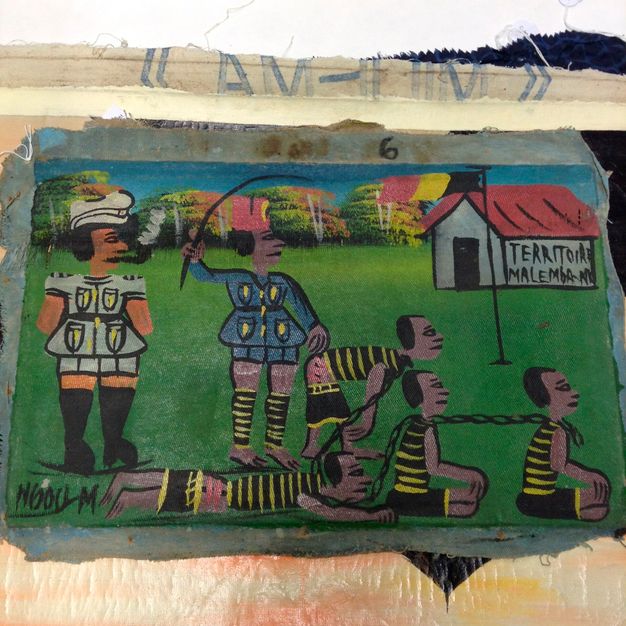
The artists used very bright swaths of colors and painted pictures that expressed their own feelings and life experiences. Their messages were clear and direct, and they expressed themselves very simply to make sure that everyone could understand. This popular art is more experimental—and entirely opposed to—academic art, which has many rules and requires formal training. In contrast, the artists who graduated from academies preferred to paint botanical and animal subjects.
Materials and Condition
Several supports
You know the working conditions were very bad before. I couldn’t buy any canvases in art stores, because it was too expensive. I bought empty flour sacks with the money I got from working in serigraphy for a company.
—Ange Kumbi6
I learned from Jewsiewicki-Koss that the artists had to sell a few paintings a week to survive. Their clients were poor. Jewsiewicki-Koss compared the price of a painting to the price of a few beers. This limited artists’ choice in materials to what they could afford. They worked outside or in indoor areas, mostly using discarded materials that were found locally (Desbarax, Emilie. 2016. “Interview with Bogumil Jewsiewicki-Koss.” In Congo Art Works: Peinture populaire, edited by Bambi Ceuppens and Sammy Baloji, 5–8. Exhibition catalogue. Brussels: Africa Museum and Éditions Racine.).
The supports in the collection varied from flour sacks and other used fabrics, from curtains or tablecloths to torn clothing such as jeans. They were made from different types of yarn—cotton, flax, or hemp—of different thicknesses, density, colors, and states of preservation. There were both small- and large-size formats.
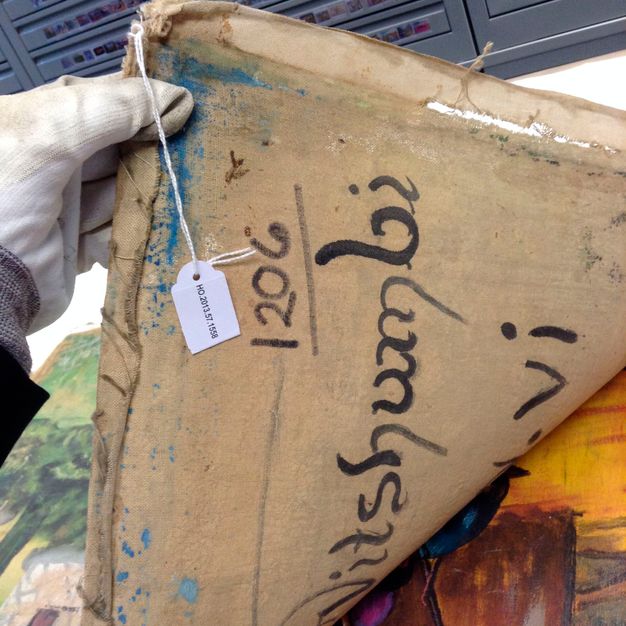
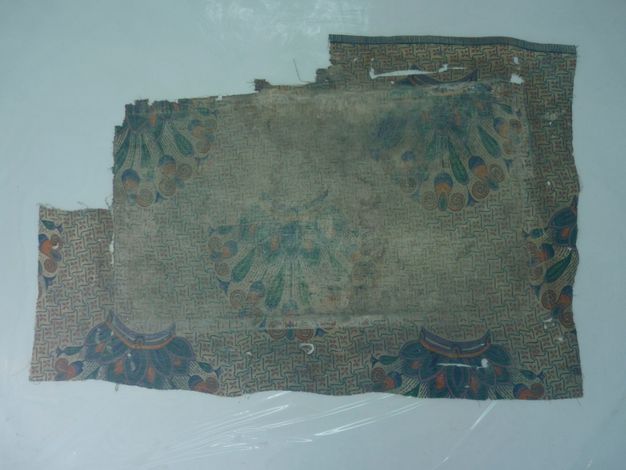
It is impressive that the backs of the paintings contain so much important historical information (fig. 25.2)—and sometimes the faces do as well—showing dates, inscriptions about the purchase, patterns, and brand details such as the trademark on flour sacks. Often the canvas had been crudely repaired by the artists, to strengthen the support before painting on it. When the support was already damaged and weakened, these tears form an integral part of the paintings. Fortunately, the unstretched paintings are now preserved in a stable environment and stored flat in large drawers.
Paint layer and techniques
I stretched the flour sack during the process, and I put one or two layers of cold glue and let it dry. The second layer was a layer of house paint, which was watercolor. The meditation could start at this time; it wasn’t easy to find a subject. I sang and went into a trance sometimes to be in my own world. When I’m inspired with a good theme it’s like a gift, I’m so glad when it comes to me. I drew some shapes with a pencil, and after that, I used my brushes and painted with some inks found at the printer shop. It took a few months to finish a painting, because I liked to paint slowly, and with the inks it needed a few layers to be bright enough.
—Ange Kumbi7
According to Jewsiewicki-Koss (Desbarax, Emilie. 2016. “Interview with Bogumil Jewsiewicki-Koss.” In Congo Art Works: Peinture populaire, edited by Bambi Ceuppens and Sammy Baloji, 5–8. Exhibition catalogue. Brussels: Africa Museum and Éditions Racine.), a few artists made their own brushes and strainers. A painting without a strainer is cheaper, thus many of the paintings were unstretched. They didn’t use varnish because it was too expensive. Apparently, some artists also used manioc flour mixed with water to make a ground layer, but often this coat cracked very quickly. Jewsiewicki-Koss reported that sometimes the artists made their own mixtures composed of acrylic or gouache, most likely house paint and maybe other unknown constituents added to palm oil. They mixed paint in pails and freely and quickly applied it to the canvas, the edges of which often show drips of paint. Paint layers were either thinly applied or had thick layers of impasto. Often the paint layer penetrated through the canvas due to the lack of a ground layer or because of the thinness of the support.
By the way, I never tried to make my own brushes, because I bought them at the art store, not even the paint mixture with manioc flour or oil palm as Bogumil told. The famous artists, such as Moke, Bodo, Chéri Cherin, and others from the Academy of Fine Arts used the same paint found at the printer shop.
—Ange Kumbi8
The heterogeneous mixture used looked plastic and grainy. The artists, in particular Chéri Samba, occasionally added fabrics with patterns or glitter that was stuck onto the paint layer. Since their aim was to spread a message, they didn’t prioritize longevity in choosing their materials or focus on how the paintings were conserved or stored.
The most important thing was the image, and everyone knew that the paintings lasted just a few years. When the paintings became too damaged, they were discarded.
—Bogumil Jewsiewicki-Koss (Desbarax, Emilie. 2016. “Interview with Bogumil Jewsiewicki-Koss.” In Congo Art Works: Peinture populaire, edited by Bambi Ceuppens and Sammy Baloji, 5–8. Exhibition catalogue. Brussels: Africa Museum and Éditions Racine.)
The Collection’s State of Deterioration
It was expensive to exhibit my work in galleries, so I often had to display my paintings at the famous Bikeko market in Kinshasa-Gombe. The paintings were exposed to the hot sun the whole day, and the problem is that the inks I used weren’t resistant to the sunlight, so the paint cracked very quickly. I think that was the reason behind the accelerated deterioration of the paint.
—Ange Kumbi9
The consistent features of these artists’ technique are that the supports are used without any preparation, and they are often frayed; the ground layer is a mixture that cracks quickly; and the paint layer is ink from a printer or composed of a heterogeneous mixture of house paint, palm oil, and other compounds. This combination has considerable potential for rapid degradation. To date, my observations are based on close visual examination, but this has led to a better understanding of the damage. Due to the diverse techniques and materials found, each of the paintings is unique and the alterations and the effects of deterioration differ greatly.
The paintings have aged and changed quickly over time. They are ephemeral, which is understandable considering the artists’ intent was simply to spread their message and communicate with people through their art. However, this poses a real problem for conservation due to the use of recycled materials, which are not designed to be stable over time and not strong enough to support the variable movement of the materials during handling and climate fluctuations.
Supports
Supports were used as found and contained a lot of dust and grime. There are surface distortions, sagging, and loosening. There are corner draws and tension cusping. The edges and corners are frayed. The artists used what they could find for the canvas, and so the substrates are damaged from the beginning, many with significant tears. All these tears are made worse by frequent transportation and repetitive blows. There are a few networks of punctures and holes from nails. Generally, supports were not strong enough to support the weight of the painting.
Paint Layer
The materials used are not compatible enough to construct a stable painting. The composition and the conditions of the paint layers cause many issues, such as significant adhesion deterioration, leading to a loss of pictorial matter. The artists often painted on a canvas that was not cleaned before use and sometimes lacked a ground layer, so the paint layer didn’t adhere well to the support or underlayers. There are many cracks in the paint layer and over the many seams. It is possible that those cracks are due to the mixtures used or to numerous movements during handling of the painting. Abrasions can be observed on the surface, as well as imperfections such as stains, drips, and grime. There are many lacunae in addition to flaking, powdering, or lifting, suggesting the paint mixture is probably underbound. As with much contemporary art, the conservation of such paintings is challenging and requires a new approach, in contrast to more traditional works where there is a series of layers that function more or less predictably and respond consistently to treatment.
Treatment Proposals
The origin of the supports, frequent transportation, and poor handling of the paintings have caused serious tears and cracks. Often the canvases were hung with nails in bars and houses, and they were moved without precaution. The artists exhibited the paintings on stretchers in front of their houses, then removed the stretcher and rolled up the canvases to be transported. Afterward, these paintings were not kept in a stable environment.
We know that there is never a standard recipe or procedure for treating a painting, and we are constantly being introduced to new materials, techniques, and insights to preserve paintings for the future. We also know that contemporary art conservation can be different from traditional forms of conservation. The paintings in this collection were not designed to last, and I saw that the collection was in desperate need of conservation. The main challenge for the conservation of ephemeral art is devising a treatment that will avoid changing the appearance of the artwork, which presents a huge range of issues. Many of the paintings have an adhesion problem that requires consolidation, and others need a strip-lining or a lining to stabilize the whole painting.
During my study, and after seeing the extent of the damage, I decided to focus my research on structural conservation in hopes of finding a suitable lining. The lining is necessary for the safe handling of these paintings for a loan—or even to remove the canvas from the sliding drawer for examination—and is essential to enable their future transportation. I selected one of the paintings in the collection, Mami Wata by Nkulu Tommy Emman, because it had a paint layer still in a good state, which allowed me to focus on a unique problem: the consolidation of the support.
Case Study: Mami Wata by Nkulu Tommy Emman
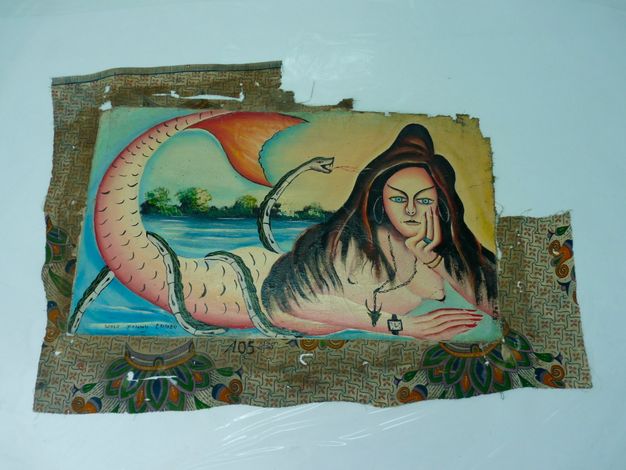
The painting chosen from the collection is a depiction of the water spirit Mami Wata (fig. 25.3) dating from 1960. It is signed by Nkulu Tommy Emman, an unknown artist. Jewsiewicki-Koss said that the name Nkulu was used by many painters, and it was a common name in Lubumbashi. The artists changed their signatures frequently, which makes attributions complicated. This painting might have been bought by a Congolese owner, probably in the Kasumbalesa market in the Democratic Republic of the Congo. Mami Wata is the goddess of rivers, revered in Congo, other parts of Africa, and Haiti and Brazil—and feared by fishermen. In the painting, she looks like a European mermaid, with white skin and blue eyes, the temptress of Western luxury, her idealistic beauty further signified pictorially by her wristwatch and jewelry.
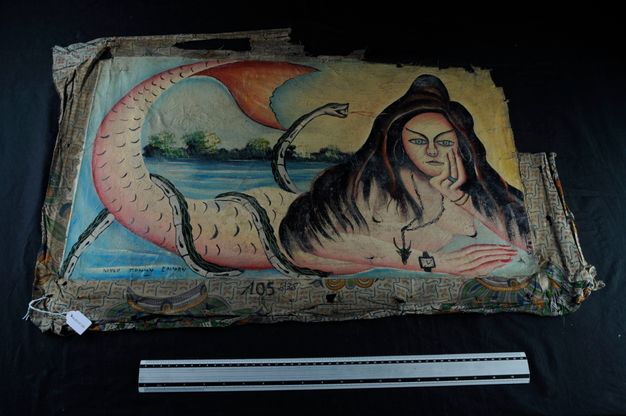
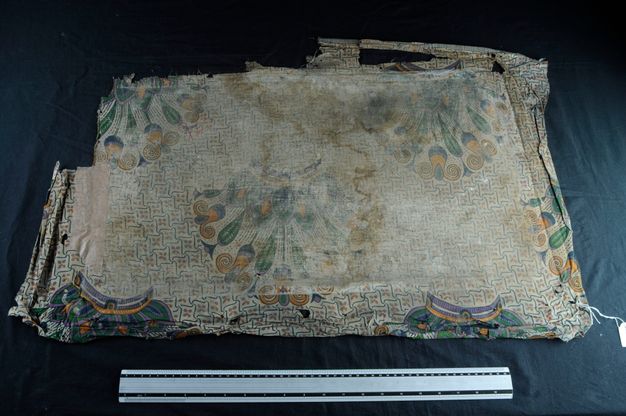
The painting is executed on a thin cotton support patterned with flowers and measures 83 × 54 cm. Some information is written on the back: numbers, details of acquisitions, and notes (fig. 25.4). The paint layer appears to be acrylic that was thinly applied. There is no ground layer, varnish, or stretcher. It is currently stored and laid flat in a sliding drawer.
State of Preservation
A large area of the support was missing from the upper right corner, making handling difficult. There were also many rusted punctures due to the nails used to hang it. The edges and corners were frayed. There were some small tears to mend, lacunae in the paint layer, and some surface imperfections on the front side. The painting was grimy, there were a lot of cracks, and the canvas was distorted. The painting needed to be cleaned and lined (see fig. 25.4). The fact that we needed to keep the inscriptions on the back visible precipitated my research into transparent lining.
Transparent Lining: Past and Continuing Research
Some of the past research about transparent lining provided me with valuable information. In Knut Nicolaus’s book, we read that in 1961 Boissonnas10 proposed the use of fiberglass with a wax-resin lining or with Beva 371 (Nicolaus, Knut. 1999. Manuel de restauration des tableaux. Also published as The Restoration of Paintings. Edited by Christine Westphal. Translated by Judith Hayward et al. Cologne: Konemann.). But fiberglass has some disadvantages: it is not stretchy enough, and it is almost impossible to repair holes or damage to the substrate. In 1981, Pacoud-Reme, with “three types of transparent linings done by G. Ten Kate for the paintings for the National Museum,” tested the fiberglass canvas with wax resin and a rigid support of methyl methacrylate (Pacoud-Reme, E. 1981. “Trois cas de rentoilage transparent faits par G. Ten Kate au service de la restauration des peintures des musées nationaux.” In ICOM Committee for Conservation: 6th Triennial Meeting, Ottawa, Canada, 21–25 September 1981: Preprints. Paris: ICOM.). In 1996, Berger referenced different kinds of synthetic canvases, such as Pe-Cap (polyester monofilament screen), but they were not transparent enough (Berger, Gustav A. 1996. “Transparent Lining of Paintings.” In ICOM Committee for Conservation: 11th Triennial Meeting, Edinburgh, Scotland, 1–6 September 1996: Preprints, vol. 1, edited by Janet Bridgland, 239–44. London: James & James.).
In 2015, I followed the research by Marion Guillermin at Olivier Nouaille’s studio in Paris (Guillermin, M. 2012. “Etude de la transparence de certains matériaux de consolidation des supports de peinture en vue de la mise au point d’un rentoilage transparent.” Mémoire de fin d’études, restauration conservation de biens culturels, École de Condé, Paris.). She used Petex11 (polyester PET) and Nitex12 (nylon PA), synthetic canvases that are monofilament open-mesh fabrics from Sefar Inc.13 From the material properties provided by the manufacturer, both are stable in solvents. For abrasion and alkaline resistance, Nitex is better, whereas Petex is more resistant to acid. Unfortunately, their stability to light exposure is poor. However, the synthetic canvases are thin, elastic, easy to use, and almost completely transparent. Guillermin tested them with natural glue, but she didn’t apply her tests to real paintings.
For the paintings in the Africa Museum’s collection, I eliminated natural adhesives and traditional canvases due to their yellowing tendency and their lack of transparency, opting for the Sefar synthetic canvases and synthetic adhesives. The aim was to find a lining that had the necessary compatibility with the materials used in the paintings. The lining fabric had to be transparent, reversible, resistant to solvents, elastic, and inert (like Petex and Nitex), and the adhesive needed to be stable and reversible, transparent after drying, and easy to apply, such as Beva 371 film (65 µm) or Plextol B500 synthetic adhesive. One of the issues was to find a technique that did not smudge the ink on the back of the painting.
Accelerated Aging and Tensile Tests
Some samples were made in cotton with inscriptions written on the back in different types of ink to imitate the original painting. Some of these were adhered with Plextol B500 and others with Beva 371 film, and onto both Petex and Nitex. To control and assess the stability and sustainability of the materials for the lining, the samples were tested using Climacell accelerated aging equipment and through tensile testing with a dynamometer. The Climacell equipment simulates environmental conditions, and I chose to run the tests with 55% RH at 70°C over two weeks. Conducting these tests in extreme conditions—beyond what is normally recommended in conservation—allows us to quickly observe ambient changes due to heat and moisture.
After the period of exposure in the Climacell, noticeable changes were observed in dimensions, such as shrinkage, as well as change in appearance, such as yellowing, uncontrolled peeling, cracking, blistering, and other alterations. The results showed that Plextol B500 is not stable enough: the adhesive peeled off the canvas and air bubbles formed between adhesives and substrate. Beva 371 film stayed stable and uniform but yellowed slightly. With both adhesives, Nitex shrank slightly more than Petex. For the tensile tests, Plextol B500 on Nitex was more resistant; however, when I tested Nitex and Petex without adhesive and cotton, Petex was more resistant. These results helped me to choose Petex as a lining fabric for its good stability and strength, with Beva 371 film as adhesive for its good tackiness and uniformity. The painting was treated based on these results.
Treatment of the Painting
To prepare for the lining, the face of the painting was treated (see fig. 25.3). The first step was to smooth out local distorted areas using moisture, pressure, and heat, in particular on the face and around the edges. Afterward, I removed the dirt and dust and cleaned the paint layer with swabs moistened with demineralized water. The reverse was cleaned with a dry latex sponge.
For the lining, I laid the Petex on the hot table with one layer of Beva 371 film (65 µm), cut to the same dimensions as the painting. These two coats were heated for twenty-five minutes at 65°C, then I let them cool down to seal them. Next, I carefully positioned the original painting on the synthetic layers (Petex and Beva 371 film) and heated it at the same temperature and for the same duration. This treatment was successful. The lining is thin, easy to apply, transparent, and resistant to degradation over time (figs. 25.5, 25.6).
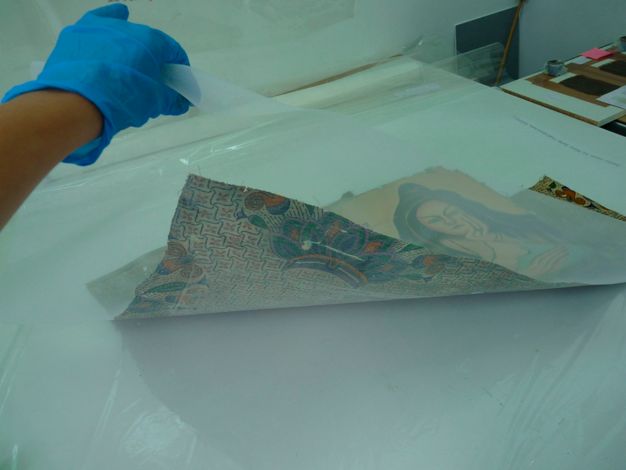
As a last step, I continued with the restoration: filling lacunae with the synthetic compound Modostuc and texturing some of the losses. The retouches were made with Gamblin Conservation Colors. From now on, the painting can be handled safely and easily. The support is consolidated, and the extra layer supports the whole painting without hiding the inscriptions (fig. 25.7).
Conclusion
The Africa Museum’s collection is fascinating due to the many characteristics and issues involved. The most important problem to solve was safe handling, which is why the research concentrated on the structural treatment. The trial samples in cotton made with the transparent canvases Petex and Nitex, Plextol B500, and Beva 371 film were assessed using accelerated aging and tensile tests to discover the strength and the sustainability of these materials. Beva 371 film with Petex showed good properties. The results obtained were determined through the treatment of one of the paintings from the collection, which worked very well.
As this conservation treatment was unusual and atypical, my research allowed me to question my views on traditional methods of conservation and restoration. It also underlined the importance of painting materials and the importance of handling artworks with care for their future preservation. Today, restoring contemporary art is all about research and innovation, and we will always have to battle with ethics to find the best way to restore a painting. It was challenging to treat this ephemeral painting, and I gave it my best.
Acknowledgments
I would like to thank the Africa Museum in Belgium for their trust and belief in me, which helped to make this work possible. Thanks to its paintings restorer, Françoise Van Hauwaert, for her knowledge and experience and for encouraging me to participate in the Conserving Canvas symposium. I would also like to express my special thanks and gratitude to the Getty Foundation and Conservation Institute and Yale University Art Gallery. They gave me the golden opportunity to display and publish this research.
In addition, for the amazing experience at Olivier Nouaille’s studio with Marion Guillermin, I thank them both for sharing their research in transparent lining. My warmest thanks to Bogumil Jewsiewicki-Koss and Ange Kumbi for their interviews, which informed me about the collection. Thanks also to my professors, especially to M. Broers for his guidance and advice during the project. Finally, thanks to my precious reader, Martha Cox, for reviewing my text.
Notes
-
Bogumil Jewsiewicki-Koss was born in 1942 in Poland. He is a historian, archivist, and art collector, and a specialist on Central Francophone Africa. He is also emeritus professor of history at Laval University, in Québec, and a researcher at Laval’s Cultures–Arts–Societies Research Center. See Desbarax, Emilie. 2016. “Interview with Bogumil Jewsiewicki-Koss.” In Congo Art Works: Peinture populaire, edited by Bambi Ceuppens and Sammy Baloji, 5–8. Exhibition catalogue. Brussels: Africa Museum and Éditions Racine.. ↩︎
-
Nouaille is a French teacher in art conservation at École de Condé in Paris. ↩︎
-
Nitex and Petex are brand names of open-mesh fabrics from Sefar Inc. ↩︎
-
Named for the city, now called Lubumbashi. ↩︎
-
Ange Kumbi, interview with the author, April 4, 2019. Kumbi, a Congolese artist, was born in Kinshasa, and in 1970 was the first contemporary artist to set up a studio in Kinshasa. ↩︎
-
Kumbi interview. ↩︎
-
Kumbi interview. ↩︎
-
Kumbi interview. ↩︎
-
Kumbi interview. ↩︎
-
H. P. Boissonnas (1894–1966) was an artist, art restorer, and photographer from Geneva. ↩︎
-
Polyester = polyethylene terephthalate (PET). ↩︎
-
Nylon = polyamide (PA). ↩︎
-
Sefar Inc. headquarters are located in Switzerland. See https://www.sefar.com/en/. ↩︎