Chicago
Iurovetskaia, Elena, Anastasia Yurovetskaya, Maria Churakova,
and Artyom Romanov. “57. The Challenges of Treating and
Displaying Two-Sided Oil Paintings.” In
Conserving Canvas, by
Cynthia Schwarz, Ian McClure, and Jim Coddington. Los Angeles:
Getty Conservation Institute, 2023.
https://www.getty.edu/publications/conserving-canvas/viii-posters/57/.
MLA
Iurovetskaia, Elena, et al. “57. The Challenges of Treating and
Displaying Two-Sided Oil Paintings.”
Conserving Canvas, by
Cynthia Schwarz et al., Getty Conservation Institute, 2023,
https://www.getty.edu/publications/conserving-canvas/viii-posters/57/.
Accessed DD Mon. YYYY.
57.
The Challenges of Treating and Displaying Two-Sided Oil
Paintings
57. Treating and Displaying Two-Sided Oil Paintings
Elena Iurovetskaia,
Conservator,
Department of Scientific Conservation of Oil Paintings,
State Research Institute for Restoration (GOSNIIR),
Moscow
Anastasia Yurovetskaya,
Research Fellow,
Department of Scientific Conservation of Oil Paintings,
State Research Institute for Restoration (GOSNIIR),
Moscow
Maria Churakova, Head,
Department of Scientific Conservation of Oil Paintings,
State Research Institute for Restoration (GOSNIIR),
Moscow
Artyom Romanov,
Conservator,
Department of Scientific Conservation of Oil Paintings,
State Research Institute for Restoration (GOSNIIR),
Moscow
In this paper, conservators from GOSNIIR offer several
techniques for displaying and treating two-sided
paintings without giving preference to one as the main side.
They have adapted a method of tear mending for the process
of strip-lining. The edging margins of the painting
are connected to the new canvas strips thread-by-thread with
polyvinyl butyral in isopropanol. Its strong, elastic film
allows application of gentle pressure to stretch the
painting on a special frame. The joint can be strengthened
by stitching. For restretching, a manually controlled system
is offered consisting of two frames: an inner extensile one,
to which the painting is attached, and an outer frame with
rigidly fixed edges with screws that move forward and
backward toward the bushings and change the tension by
pulling and pushing the inner frame. The techniques are
discussed using case studies as examples.
A shift from nineteenth-century academic painting to the
modern approach of the twentieth century changed not only
painting technique but also the attitude toward the whole
structure of the picture. In order to save materials, artists
would more often create their works on old canvases,
disregarding sketches or studies in oil on the other side.
Sometimes even finished oil paintings would become a support
for a new artwork. Over the course of time, the problem of
displaying and treating such two-sided paintings became
evident to curators and conservators.
Strip-Lining
The task of restretching such pictures without giving
preference to one “principal” side is a serious challenge.
Even if the artist had a certain intent about which side
should be presented, nowadays we often selfishly want both
sides to be accessible to the public and researchers.
Conservators at the State Research Institute for Restoration
(GOSNIIR), in Moscow, adapted a method of tear mending for the
strip-lining process in order to avoid overlaps, especially
for pictures that have images of the same size on both sides.
A common method of tear mending in Russia developed in 1978
treats tears and cuts of the textile painting supports with a
5% solution of polyvinyl butyral (PVB) in ethanol or
isopropanol. Saturated threads are woven together, and after
drying are fixed by hot spatula (Surovov and Yashkina 1979Surovov, Ivan, and Larisa Yashkina. 1979. “Methods of
Treating Tears, Losses in Canvas and Edges on Easel Oil
Paintings Edge-to-Edge.”
Artistic Heritage: Storage, Research, Restoration
5, no. 35: 117–21.).
PVB has been widely used in conservation practice in Russia
since the 1950s (Rumyantsev 1953Rumyantsev, Evgeniy. 1953. “Applying Synthetic Resins at
Archeological Excavations.”
Brief Reports of the Institute for the History of
Material Culture
49: 133–38.), especially for treating murals, ceramics, and fabric
painting supports. Its glass transition temperature is
approximately 60°C–70°C. “PVB films are resistant to light and
heat-sealable at temperatures above 120°C. . . . PVB films are
noted for their biostable and abrasion resistance properties
as well as for good colourfastness against ultra-violet light,
low static generation, and low water absorption” (Sannikova 2018, 106Sannikova, Evgeniia. 2018. “Polyvinyl Butyral:
Composition, Properties and History of Use in Conservation
and Restoration.”
International Institute for Conservation of Historic
and Artistic Works. Austria. Papers in Conservation
35: 103–21.).
For the issue of two-sided paintings, conservators from
GOSNIIR offered this technique to attach new canvas strips
thread-by-thread to the original supports of the pictures
(Yashkina and Churakova 2013Yashkina, Larisa, and Maria Churakova. 2013. “Methods of
Tear Mending, Filling Losses in Canvas and Edges on Easel
Oil Paintings by Jointing Threads: 1978–2008.” In
Artistic Heritage: Storage, Research, Restoration
27 (57).). PVB is a polymer with strong, elastic films and stable
properties (Sannikova 2018Sannikova, Evgeniia. 2018. “Polyvinyl Butyral:
Composition, Properties and History of Use in Conservation
and Restoration.”
International Institute for Conservation of Historic
and Artistic Works. Austria. Papers in Conservation
35: 103–21.), and when used for such type of strip-lining it allows the
painting to be stretched on a special frame by applying gentle
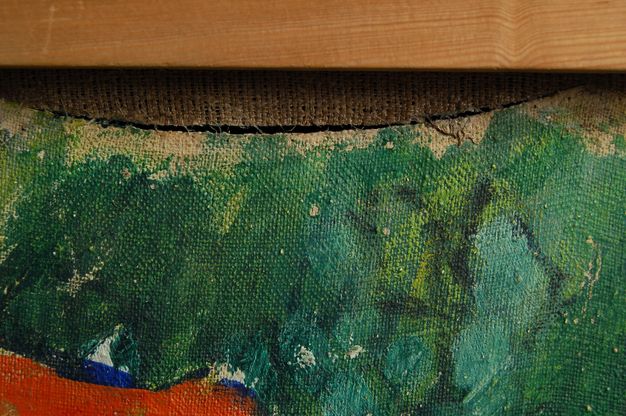
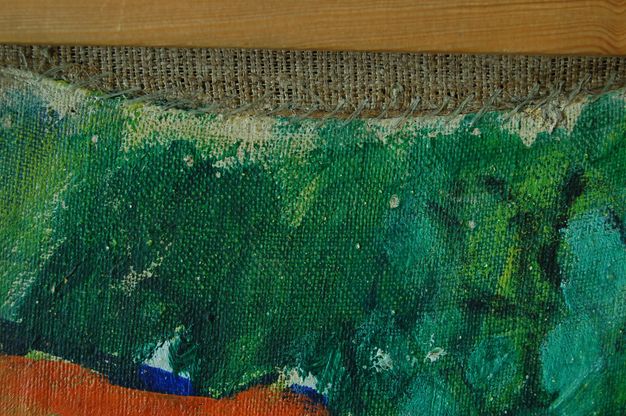
pressure. The joint can also be slightly reinforced by
applying some linen fibers mixed with the adhesive or by
stitching (fig. 57.1). This method
can be especially useful for cases in which the paintings do
not have any original margins.
Figure 57.1 Vladimir
Tatlin (Russian, 1885–1953),
Still-Life with Melon and Apples/Green Leaves in a
Jar, 1912. Oil on canvas, 77 × 67 cm (30 1/3 × 26 3/8 in.).
Moscow, Russian State Archives of Literature and Art. (a)
Fragment before treatment. (b) Fragment after the tear was
fixed with PVB solution and reinforced with stitching.
Images: Russian State Archives of Literature and Art
Stretchers
According to modern conservation standards, new stretchers
must be extensible, and in the case of double-sided pictures,
systems with wedges, screws, and springs all may be suitable.
But if conservators do not wish to give preference to one side
of the picture, a system must be developed that results in a
situation where the painting does not have a verso. The
stretching should be performed using the same standards as for
an ordinary, one-sided picture: the tension should be evenly
distributed along the perimeter and in the corners to keep the
painting in plane for optimal viewing and display (Zaycev 1977Zaycev, Alexander. 1977. “Stretchers.” In
Restoration of Easel Oil Paintings, 206–12.
Moscow: Iskusstvo.). But now we also have a goal to prevent stretcher bars from
obscuring the paint layer on both sides of the artwork,
eliminating the need for crossbars. Following are technical
details for an example of a two-sided picture that underwent
structural treatment in our studio at GOSNIIR.
Case Study: Andrey Vasnetsov’s New Village
New Village, by Andrey Vasnetsov (1924–2009), had
been kept unstretched in the storage of Abramtsevo
museum-reserve for a few decades. Each side of the canvas was
painted with a finished landscape, oriented in a different
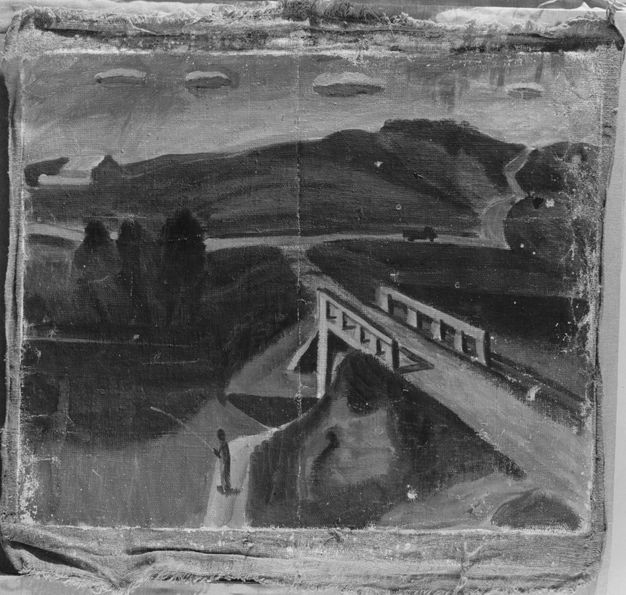
direction. One of these paintings is also approximately 10
centimeters larger than the other (fig. 57.2). The painting was brought to our institution for research
and restoration. Conservators consolidated the matte paint
layer with copolymer of polyvinyl acetate with ethylene (Fedoseeva et al. 2016, 88Fedoseeva, Tatyana, Olga Belyaevskaya, Valentina
Gordushina, Elena Malachevskaya, and Svetlana Pisareva.
2016. Conservation Materials: Course of Lectures.
Lecture series. Moscow: Indrik.). Then strip-lining was performed. In this particular case,
we didn’t have to attach new linen margins thread-by-thread
because one of the paintings was slightly smaller, so there
was enough space to do a traditional variant with an overlap.
After these operations, the painting had to be stretched.
ExpandFigure 57.2Andrey Vasnetsov (Russian, 1924–2009),
New Village, 1950–1960s. Oil on canvas; obverse
side is 79 × 99.5 cm (31 1/8 × 39 1/6 in.); reverse side,
89 × 99 cm (35 × 39 in.). Moscow region, Museum-reserve
“Abramtsevo.” Obverse side before conservation. Note the
visible difference in size.Image: Museum-reserve “Abramtsevo”
Conservator Artyom Romanov developed a system for doing so
that was influenced by a constant tension system suggested by
Barry B. Bauman of the Chicago Conservation Center. In 1982,
Bauman designed a device for stretching and framing a
double-sided painting that had an adjustable spring mechanism
to ensure continuous canvas tension (Bauman 1982Bauman, Barry. 1982. “A Technique for Stretching and
Framing a Double-Sided Canvas.”
Journal of the American Institute for Conservation
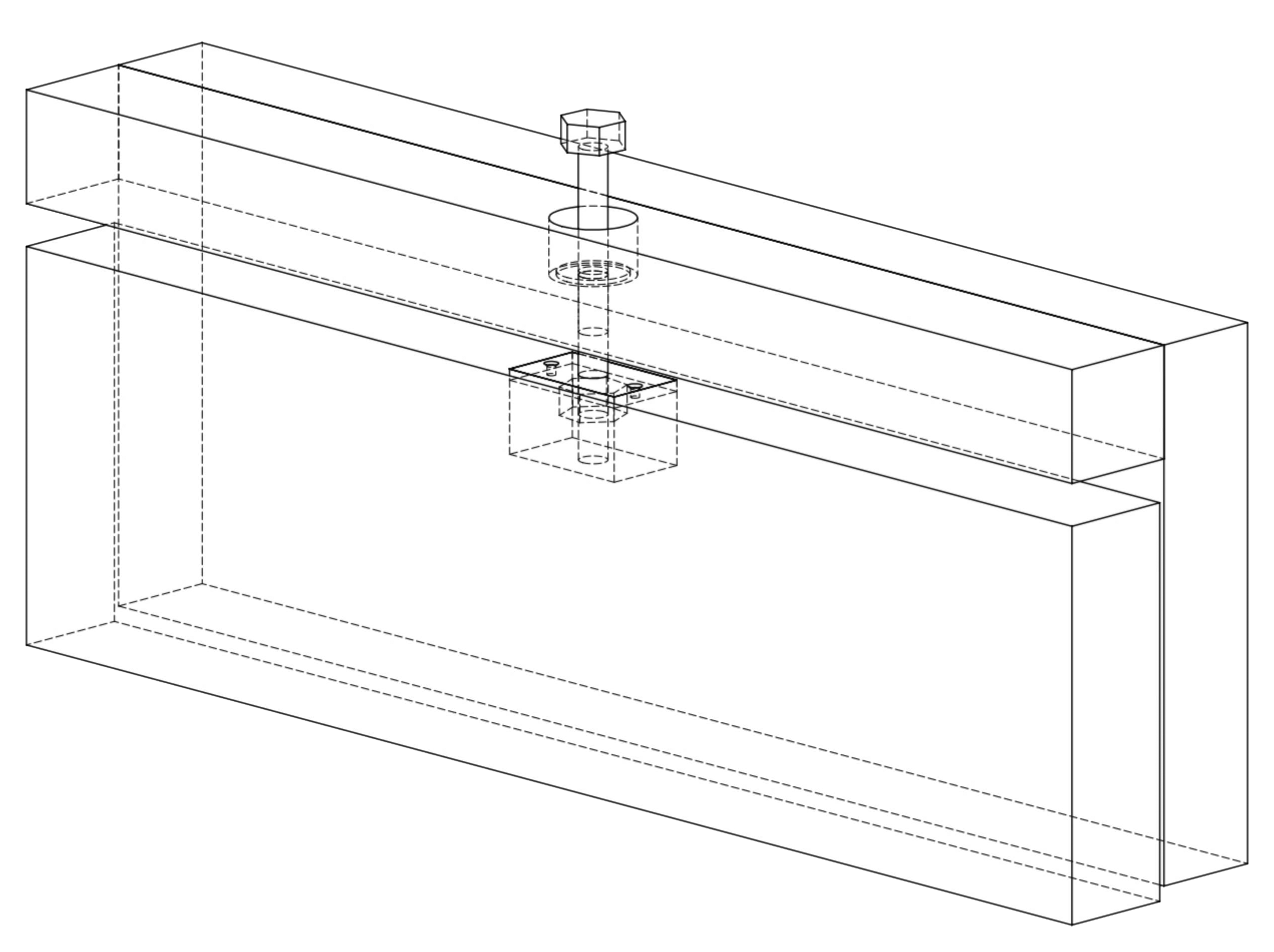
21: 77–79.). In our case, the museum and conservators decided to make
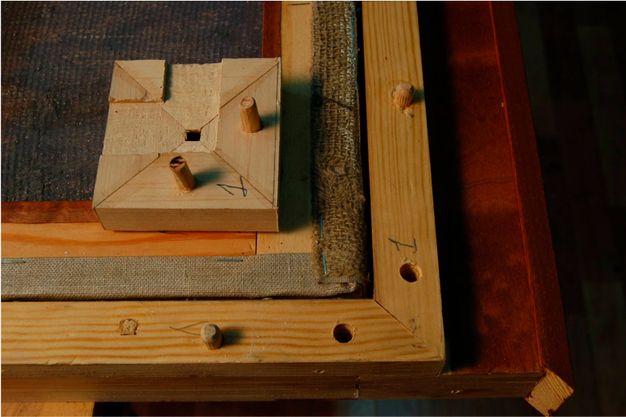
the system manually controllable (fig. 57.3). The stretcher for New Village consisted, in fact,
of two frames. The inner, extensile one, to which the painting
was attached, had furniture bushings around the perimeter on
its side ends. The outer frame, with rigidly fixed edges, had
tension screws that moved forward and backward toward the
bushings and changed the tension by pulling and pushing the
inner frame (Romanov 2013Romanov, Artyom. 2013. “Practice of Making Stretchers for
Two-Sided Paintings.”
Artistic Heritage: Storage, Research, Restoration
27 (57).
https://www.gosniir.ru/files/62be0cd4-5394-4e5c-a488-9bf3d212e1ef.epub.). Instead of springs and wall grips, the screws went
directly into the furniture bushings. The number of tension
screws may vary depending on the size of the picture and the
condition of canvas. In this particular case, a linen
sackcloth with a weaving density of about 8 by 8 threads per
square centimeter was used as the painting support. For the
smaller stretcher, Romanov installed bushing in threes on the
long sides and in pairs on the shorter ones.
ExpandFigure 57.3Schematic of screw mechanism installed by Artyom Romanov
for tensioning Vasnetsov’s two-sided painting
New Village.Image: GOSNIIR
For display, the structural features of the stretchers should
be hidden in order not to distract attention from the
painting. Decorative elements on the two sides can be made in
distinct styles to match a particular image. Moreover, if the
images on the different sides of the painting are presented in
different sizes or even formats, the outer frame can be
designed to compensate for the difference, as in the case of
the Vasnetsov picture (fig. 57.4). The
inner frame, which carried the original support, was created
based on the measurements of the bigger painting, making it
possible to cover the areas of blank canvas on the smaller
side with decorative elements.
ExpandFigure 57.4New Village, process of installing decorative
elements of the frame.Image: GOSNIIR
Case study: Diego Rivera’s Glorious Victory
Another interesting example was designing a stretcher for a
large-scale (260 × 450 cm) painting titled
Glorious Victory, by Diego Rivera (1886–1957), from
the Pushkin Museum, in Moscow. The picture is actually
one-sided, but there is an unfinished art piece on the
reverse, which was shown in the exhibition
Viva la Vida: Frida Kahlo and Diego Rivera at Moscow
Manege in 2018. The size of the painting and the intention to
arrange a two-sided view led to the decision to present it on
a stand with an integrated exhibition frame.
The screw stretching system was hidden inside the frame, which
was attached to the wood-decorated metal post. As the
temperature and humidity conditions were not very stable, the
curators were worried that strains could appear on the
picture. The oak panels of the frame had holes on the sides
that allowed access to the screw elements, and these let the
conservators easily change the tension without deinstallation
of the whole structure.
Conclusion
For decades, the problem of presenting both recto and verso of
two-sided paintings was troubling to the artistic and
scientific communities. Nowadays, modern restoration provides
conservators with a wide variety of opportunities for treating
such objects without sacrificing a part of the whole (Runeberg 2019Runeberg, Ulrick. 2019. “Between Rejection, Ignorance,
and Preference: The History and Dilemma of Modern
Double-Sided (Recto/Verso) Paintings with Regard to Issues
of Conservation and Presentation.” In
Conservation of Modern Oil Paintings, edited by
Klaas Jan van den Berg, Ilaria Bonaduce, Aviva Burnstock,
Bronwyn Ormsby, Mikkel Scharff, Leslie Carlyle, Gunnar
Heydenreich, and Katrien Keune, 383–90. Cham, Switzerland:
Springer.). The major step of accepting the challenge has been taken
up in the past; today our aim is to improve and modernize
conservation techniques to make our work more effective. The
projects presented in this paper contribute to the discussion
about conservation and presentation of double-sided paintings.
Figure 57.2Andrey Vasnetsov (Russian, 1924–2009), New Village,
1950–1960s. Oil on canvas; obverse side is 79 × 99.5 cm (31
1/8 × 39 1/6 in.); reverse side, 89 × 99 cm (35 × 39 in.).
Moscow region, Museum-reserve “Abramtsevo.” Obverse side
before conservation. Note the visible difference in size.
Image: Museum-reserve “Abramtsevo”
Figure 57.3Schematic of screw mechanism installed by Artyom Romanov for
tensioning Vasnetsov’s two-sided painting
New Village. Image: GOSNIIR
Figure 57.4New Village, process of installing decorative
elements of the frame. Image: GOSNIIR