Chicago
Garza Villegas, Claudia Alejandra, and Naitzá Santiago Gómez.
“26. Eighteenth-Century Canvases of Easel Painting from New
Spain: The Case of the Apostolate Series of Atizapan, Mexico.”
In Conserving Canvas,
by Cynthia Schwarz, Ian McClure, and Jim Coddington. Los
Angeles: Getty Conservation Institute, 2023.
https://www.getty.edu/publications/conserving-canvas/iv-case-studies/26/.
MLA
Garza Villegas, Claudia Alejandra, and Naitzá Santiago Gómez.
“26. Eighteenth-Century Canvases of Easel Painting from New
Spain: The Case of the Apostolate Series of Atizapan, Mexico.”
Conserving Canvas, by
Cynthia Schwarz et al., Getty Conservation Institute, 2023,
https://www.getty.edu/publications/conserving-canvas/iv-case-studies/26/.
Accessed DD Mon. YYYY.
26.
Eighteenth-Century Canvases of Easel Painting from New Spain:
The Case of the Apostolate Series of Atizapan, Mexico
26. Eighteenth-Century Canvases from New Spain
Claudia Alejandra Garza Villegas,
Head Conservator,
Archdiocese of Tlalnepantla and Mexico
Naitzá Santiago Gómez,
Conservator,
Garza & Santiago Restauración, Mexico
The Church of Saint Francis of Assisi Atizapan, located in
the Mexican state of Mexico, houses a series of
mid-eighteenth-century easel paintings made in the
Viceroyalty of New Spain representing eleven apostles, Saint
Paul, Christ, and the Virgin Mary. The paintings all
correspond with one another aesthetically and technically.
The artworks were restored during a six-month period in
2018, during which time it was possible to study them in
depth. It was noteworthy to be able to analyze this
pictorial set from a single anonymous author who was in tune
with artists such as Miguel Cabrera, Francisco Vallejo, and
Patricio Morlete, among others. The paintings are
exceptional documents that give us very specific information
on the technical and material challenges faced by an artist
from New Spain in the middle of the eighteenth century.
KEYWORDS: art, easel
painting, canvas, conservation, New Spain
Introduction
A series of mid-eighteenth-century easel paintings depicting
eleven apostles, Saint Paul, Christ, and the Virgin Mary,
housed in the Church of Saint Francis of Assisi Atizapan, in
the Mexican state of Mexico, were restored in 2018. This
afforded the authors the opportunity to study the set of
paintings in depth.
The paintings, which appear to be the work of a single artist,
date from Mexico’s Viceregal period, and it is important to
consider them in that context. The Spanish arrived in the
Mexican territory in 1519, and two years later conquered the
Aztec Empire. In 1524, the Franciscans reached the
Americas—launching the Catholic evangelization process in the
former Aztec capital of Mexico-Tenochtitlan (now Mexico City)
and surrounding territories (López Mora 2011, 14López Mora, Rebeca. 2011.
Otomíes y Mexicanos en la tierra de en medio: Pueblos
indios en el norponiente del Valle de México. Mexico City: Universidad Nacional Autónoma de
México.).
Immediately after their arrival, the Franciscans started their
evangelizing to the north of Mexico City, reaching the lands
of Tlalnepantla, where they constructed their first church—the
Church of the Corpus Christi—in the 1530s. About ten chapels
that belonged to the Corpus Christi church were built some
decades later. One of them was the chapel of San Francis of
Assisi Atizapan, although the first chapel with that name was
later demolished. The current church of Saint Francis was
built in the 1750s.1
That decade corresponds with the creation of the paintings,
which suggests that the Apostolate series was made for the new
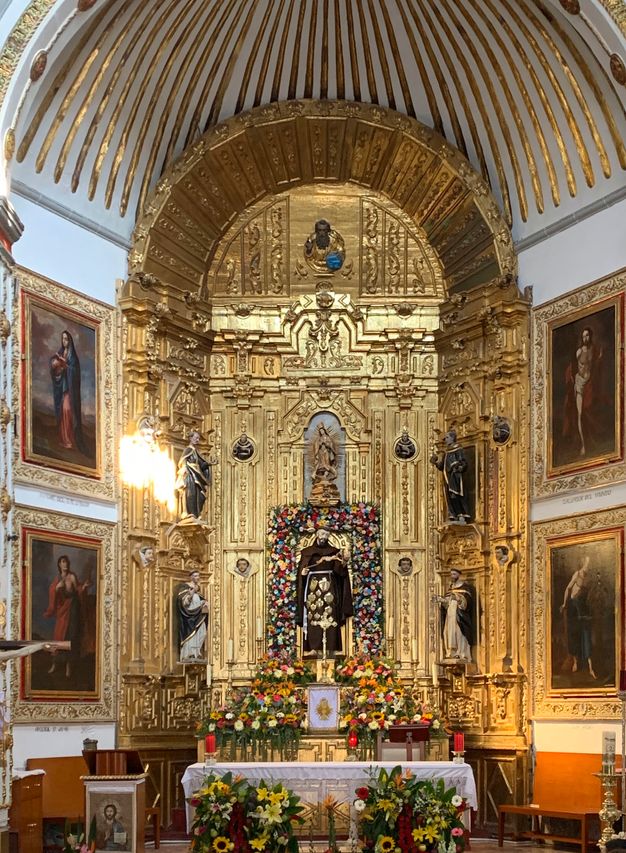
church (fig. 26.1). In addition to
these paintings, the church houses another group depicting
saints known as the Doctors of the Church, which was painted
by Carlos Clemente Lopez, a cacique2
artist active during the eighteenth century (Ramírez Montes 2001Ramírez Montes, Mina. 2001. “En defensa de la pintura.
Ciudad de México, 1753.”
Anales del Instituto de Investigaciones Estéticas
78: 103–28., 106).
ExpandFigure 26.1Interior of the Church of Saint Francis of Assisi
Atizapan with four of the Apostolate series flanking the
altar.Image: Claudia Garza / Archdiocese of Tlalnepantla
The Apostolate Series
We restored the apostolate easel paintings from June to
November of 2018, during which time we were guided by the
words of Cesare Brandi: “The restoration—always understood in
the professional field—is the ideal methodological moment to
ask new questions to the works and, with it, add knowledge
around them” (Brandi 2000, 6Brandi, Cesare. 2000.
Teoria del restauro. Turin: Einaudi.).
The opportunity to analyze a pictorial set painted by a single
anonymous author—not just a single painting—was remarkable.
Among the advantages that a group of works such as this
presented us were summarized by conservator and researcher
Elsa Arroyo: “The artistic process and the way the materials
were prepared for each strata of the paintings are indicative
factors of the tradition of every artist and workshop of New
Spain; therefore, technical studies are more relevant when
they consider analysis of pictorial series, from the same
artist or from the same context” (Arroyo Lemus 2017, 42Arroyo Lemus, Elsa Minerva. 2017. “La ‘presencia’ de la
imagen. Estudios sobre las técnicas y los materiales de la
pintura novohispana.” In
De la latencia a la elocuencia. Diálogos entre el
historiador del arte y la imagen, edited by Mónica Pulido, 21–57. Morelia: Universidad
Nacional Autónoma de México, Escuela Nacional de Estudios
Superiores.).
The series represents the apostles with the instruments of
their martyrdoms: Saint Peter, Saint Andrew, Saint James the
Greater, Saint James the Lesser, Saint Bartholomew, Saint
Philip, Saint John, Saint Jude Thaddeus, Saint Matthew, Saint
Simon, and Saint Thomas. In addition to the apostles, Saint
Paul, the Virgin Mary, and Jesus Christ were also painted.
After cleaning the paintings, we realized that each included a
part of the Apostles’ Creed. According to a legend based on
the Acts of the Apostles, while gathered for Pentecost, they
began to recite each of the articles of the Creed one by one
(Schäfer 1983, 14Schäfer, Phillip. 1983. El credo de nuestra fe.
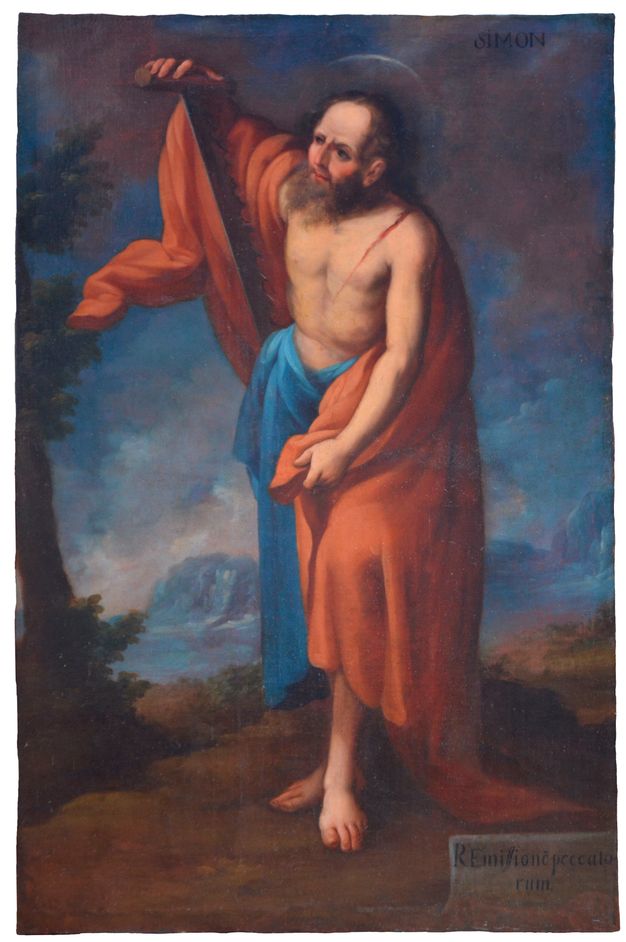
Santander, Spain: Sal Terrae.) (fig. 26.2). (In addition to this
series, a painting of Pentecost by Antonio de Torres hangs in
the church, completing the discourse, even though it is the
work of a different artist.)
ExpandFigure 26.2Saint Simon painting with part of the Apostles’
Creed in the lower right corner.Image: Claudia Garza / Archdiocese of Tlalnepantla
The paintings correspond with one another aesthetically and
technically and share the same basic materials. In each
painting, the character appears full length and occupying the
foreground and most of the composition. This type of
representation recalls the way in which the Spanish painter
Francisco de Zurbarán painted some of his characters, and it
stands as one of the key features inherited from the Spanish
pictorial tradition.
Research and Analysis
The artist began the composition and the coloring of the
paintings on the reddish iron oxide ground layer. The
brushstrokes are soft, and the artist used glazes in dark
tones and more painting in the light colors despite the fact
that the pictorial layer is very thin and has no impastos. As
well as these features, the way in which the compositions were
solved, along with the technical and pictorial sequence,
correspond to eighteenth-century painting production (Mues Orts 2017, 57Mues Orts, Paula. 2017. “Tradition and Innovation in New
Spain.” In
Painted in Mexico. 1700-1790. Pinxit Mexici,
edited by Ilona Katzew, 52–75. Los Angeles: Los Angeles
County Museum of Art; Mexico City: Fomento Cultural
Banamex.). Among the material evidence that helped us date the
paintings is the presence of Prussian blue.3
Although it is unknown when the pigment was first used in New
Spain, a painting studied by the Diagnostic Laboratory of
Works of Art at the National University of Mexico evidenced
its presence by the mid-eighteenth century (Zavala Cabello 2013, 144Zavala Cabello, Mónica Marisol. 2013. “La paleta del
pintor novohispano. Los pigmentos y la representación del
color.” Master’s diss., Universidad Nacional Autónoma de
México, Mexico City.). This anonymous series is also similar in painting
technique to the works of contemporary artists such as Miguel
Cabrera, José de Alzibar, Francisco Vallejo, and Patricio
Morlete.
As some researchers have pointed out, information is lacking
about the practice of painters in documents, so approaching
the subject through material analysis is the best way to
expand our knowledge of New Spanish artists’ techniques (Mues Orts 2017, 57Mues Orts, Paula. 2017. “Tradition and Innovation in New
Spain.” In
Painted in Mexico. 1700-1790. Pinxit Mexici,
edited by Ilona Katzew, 52–75. Los Angeles: Los Angeles
County Museum of Art; Mexico City: Fomento Cultural
Banamex.). For this reason, during the restoration we collected all
the information we could about the paintings’ materials and
technique: they have the same format and measurements,
stratigraphy—strainers, priming layers, color layers, and
varnishes—and chromatic palette. All the paintings have a
linen textile support attached with animal glue to the edge of
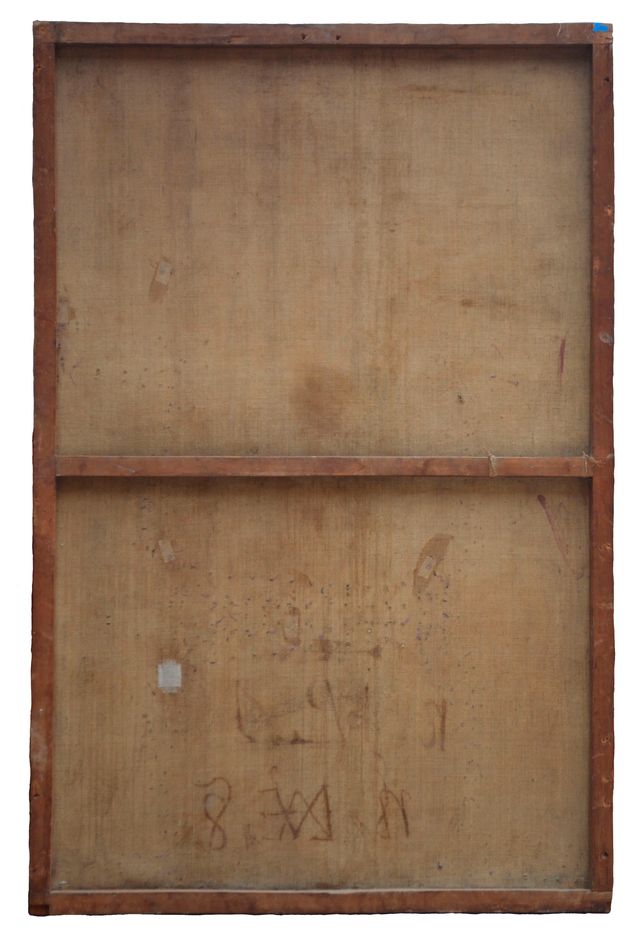
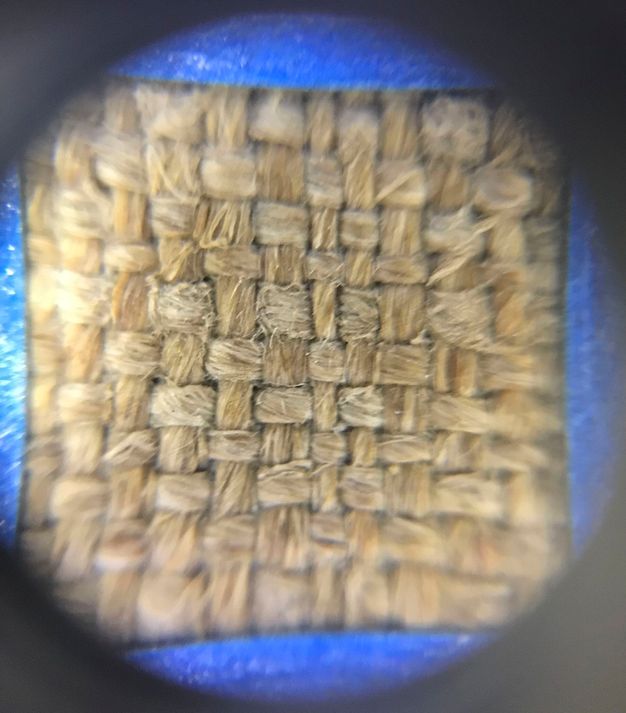
wooden strainers composed of five elements (fig. 26.3). Forming the fabric are 12 × 11 threads per square
centimeter, and there is a Z-twist in the threads in both warp
and weft (fig. 26.4).
ExpandFigure 26.3Canvas and strainer of the
Saint Simon painting.Image: Claudia Garza / Archdiocese of TlalnepantlaExpandFigure 26.4Saint Simon painting with fabric formed by 12 ×
11 threads/c2.Image: Claudia Garza / Archdiocese of Tlalnepantla
We also noted very specific information regarding the
technical and material challenges our mid-eighteenth-century
artist faced and solved, specifically the relation of the
textile support to other elements of the paintings, including
the following:
The artist used the same method for all the paintings to
attach the support to the strainer—using glue to adhere
the support to the edge—but in some paintings he had to
apply the original ground to the wood of the strainer to
level the edges, because the fabric did not reach the
outer edge of the strainer. This is painted over by the
artist, so this process gives us important information
that the paint was applied directly onto the canvas fixed
to the permanent strainer. There are no extended edges in
any painting.
He also had to stitch together two different pieces of
fabric to achieve the desired size to fit the strainer.
All the paintings measure 160 × 120 cm.
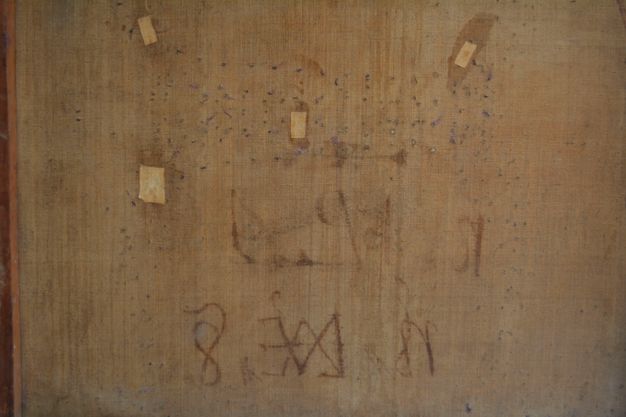
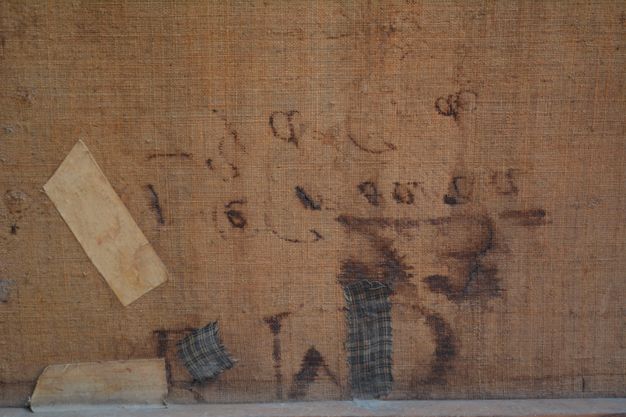
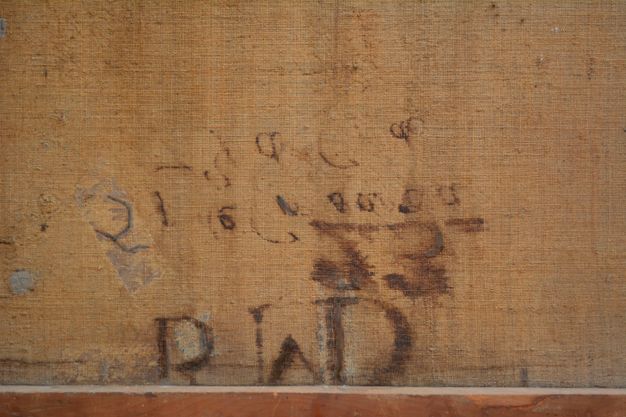
Twelve of the paintings have regular patterns of
perforations and marks made with iron gall ink (fig. 26.5).
All the perforations and sewing were covered with
cotton-rag paper by the artist.
ExpandFigure 26.5Saint Simon canvas showing ferro-gallic ink
marks and patterns of perforations.Image: Claudia Garza / Archdiocese of Tlalnepantla
After registering all these characteristics and doing
additional research, we realized that the analysis of canvases
had not been granted the importance it deserves. For example,
many invasive processes have been carried out unnecessarily,
such as wax-resin relining, practiced in Mexico since the
1970s, which resulted in important information being hidden or
lost. The same thing happened to the original strainers: in
almost every conservation treatment applied to a painting,
they were discarded and a new one was substituted.
It is also important to establish the context of the canvases
in New Spain as background, which refers back to the history
of canvases in Spain. Rocío Bruquetas, in her important book
The Technique of Painting in the Spanish Golden Age,
writes that almost all the canvases used in Spain were
imported from Germany, France, and the Netherlands, although
some regions of Spain produced linen, such as Galicia, El
Bierzo, and Medina de Rioseco (Bruquetas Galán 2007, 104Bruquetas Galán, Rocío. 2007.
Técnicas y materiales de la pintura española en los
Siglos de Oro.
Madrid: “Fundación de Apoyo a la Historia del Arte
Hispánico.”).
Panel painting was gradually replaced by easel painting
starting in the reign of Charles I (1516–56), but contracts
and other documents are not very specific regarding the
material characteristics of the canvases. However, it is
possible to find allusions to certain processes, such as the
tension of the canvas to the frame or strainer and the
construction of corners and crossbars (Bruquetas Galán 2007, 232, 248Bruquetas Galán, Rocío. 2007.
Técnicas y materiales de la pintura española en los
Siglos de Oro.
Madrid: “Fundación de Apoyo a la Historia del Arte
Hispánico.”).
In late seventeenth-century New Spain, some artists still
painted on wood panels, depending on the painting’s intended
placement. If it were to be placed in an altarpiece, a wood
panel probably would have been preferred. About such
preferences, the painters’ guild ordinances of 1587 mentioned
that canvases shouldn’t be reused and prohibited painting over
an existing painting (Carrillo y Gariel 1946, 95Carrillo y Gariel, Abelardo. 1946.
Técnica de la pintura en la Nueva España. Mexico
City: Universidad Nacional Autónoma de México.).
With regard specifically to canvases in Viceregal Mexico, art
conservator Rita Súmano is the only person to have studied in
detail the canvases of New Spanish paintings. Her research was
enriched by the analysis of more than a hundred paintings
restored in the National School of Conservation. Thanks to her
research, we know now that almost all New Spanish canvases
from the seventeenth and eighteenth centuries were made from
linen (Súmano González 2010, 4, 5Súmano González, Rita. 2010. “Estudio de la técnica de
factura de los soportes textiles de la pintura de
caballete en México, siglos XVII al XIX.” Bachelor’s
diss., Escuela Nacional de Conservación, Restauración y
Museografía, Mexico City.). We also know that 13% of the canvases analyzed from the
eighteenth century have patterns of perforations and, of that
percentage, 40% do not have selvages, which she interpreted as
a sign of a lack of materials (Súmano González 2010, 33Súmano González, Rita. 2010. “Estudio de la técnica de
factura de los soportes textiles de la pintura de
caballete en México, siglos XVII al XIX.” Bachelor’s
diss., Escuela Nacional de Conservación, Restauración y
Museografía, Mexico City.). Importantly, the information we can obtain from the
analysis of canvases also gives us information about their
origin, distribution, and the loom that was used to make the
textiles (Siracusano 2005, 18Siracusano, Gabriela. 2005.
El poder de los colores: De lo material a lo simbólico
en las prácticas culturales andinas: Siglo XVI–XVIII. Buenos Aires: Fondo de Cultura Económica.).
Trade between Spain and New Spain was fundamental in many
aspects. Textiles were exported from Spain and other parts of
Europe to New Spain, as were other materials, including
pigments, lacquers, oils, and brushes (Arroyo Lemus 2017, 37Arroyo Lemus, Elsa Minerva. 2017. “La ‘presencia’ de la
imagen. Estudios sobre las técnicas y los materiales de la
pintura novohispana.” In
De la latencia a la elocuencia. Diálogos entre el
historiador del arte y la imagen, edited by Mónica Pulido, 21–57. Morelia: Universidad
Nacional Autónoma de México, Escuela Nacional de Estudios
Superiores.). In the case of the canvases we studied, twelve of the
fourteen paintings have reused textile supports, evidenced by
the patterns of perforations and ferro-gallic ink marks
already mentioned. These features provide specific clues as to
the fabrics’ acquisition by the artist: as mentioned, the
paintings.
Objects traded between Spain and New Spain were marked by the
cargador (importer). For example, lightweight sculptures made
of cornstalks from the sixteenth and seventeenth centuries in
New Spain are found in Spain. Pablo Amador found the mark of
the cargador who brought such a sculpture of Christ from New
Spain to Spain in 1673 (Amador Marrero 2012, 744Amador Marrero, Pablo Francisco. 2012. “Imaginería ligera
novohispana en el arte español de los siglos XVI–XVII.”
PhD diss., Universidad de Las Palmas de Gran
Canaria.). Many goods at the time were transported in bales wrapped
in fabric (including linen), which were numbered and marked
with the importer’s initials. Artists obtained the linen
wrappings to use as the canvas supports for their paintings.
A painting titled The Customs Yard from 1775, by
Nicolas-Bernard Lépicié, depicts traders with their
merchandise bundled in bales that have similar marks.4
Another painting, one from the Basilica de la Virgen de la
Soledad in Oaxaca, painted in 1740, depicts an ex-voto (votive
offering) that expressed the donor’s gratitude to the Virgin
for her intercession after an earthquake. The donor of this
interesting painting was a wealthy merchant, and, in
accordance with his trade, the scene takes place inside his
house, where some marked bales lie on the floor.
In light of this evidence, we concluded that the canvases of
the Apostolate paintings were made from the linen coverings of
bales, which the artist bought to paint on. These merchant
marks are also found in other important New Spanish paintings,
such as The Release of Saint Peter by Pedro Ramirez
and Miguel Cabrera’s Holy Family (both in the
National Museum of the Viceroyalty), in works by Juan Correa,
and in other, anonymous paintings, such as a Virgin of
Guadalupe from the Convent of Santa Brígida in Mexico City.
In addition to the merchant marks, perforations in the
canvases are related to the supports’ original use. According
to Paula Mues, “Repurposing canvases was also a common
practice, whether by painting over existing works or by using
fabrics that had defects or had been reclaimed from industrial
processes. This explains why we often find canvases with a
regular pattern of perforations, which were generally repaired
by covering the holes with pieces of paper” (Mues Orts 2017Mues Orts, Paula. 2017. “Tradition and Innovation in New
Spain.” In
Painted in Mexico. 1700-1790. Pinxit Mexici,
edited by Ilona Katzew, 52–75. Los Angeles: Los Angeles
County Museum of Art; Mexico City: Fomento Cultural
Banamex., 57).
These features provided the guidelines to the conservation
treatments applied to the canvases.
Treatment
We started by cleaning the surface of the canvas by removing
dust and debris using a vacuum and brushes. Then we proceeded
to eliminate newer interventions on the canvases, such as
several patches made from different types and colors of
textiles. When we removed them, we realized many were not the
appropriate size, and some weren’t even covering a hole or
tear but were simply adhered to strengthen the surface. Over
some small holes we applied linen fibers with glue paste.
Most of the canvases had deformations. To eliminate them, we
applied moisture and pressure, allowing the canvas to return
to its original flat state.
The corrosive nature of the iron gall ink markings on the back
of the supports caused some deterioration and tears in the
textile. To care for this damage, we had to find a method that
allowed for the stabilization of the canvas without covering
the information in the marks (fig. 26.6a). We used silk crepeline, with Beva as an adhesive. As a
thin, transparent textile with good mechanical resistance, the
silk crepeline made it possible to conserve both the materials
and the information (fig. 26.6b).5
Finally, for the holes of the paintings without iron gall ink
marks, we used linen patches with frayed edges, adhered with
glue paste.
Figure 26.6Saint Matthew painting: canvas with iron gall ink
marks. (a) Before treatment. (b) After treatment. Image:
Claudia Garza / Archdiocese of Tlalnepantla
Conclusion
Conservators usually treat isolated paintings or less numerous
sets than the Apostolate series. In this case, having in our
hands a series of fourteen paintings, we were able to find
similarities and correspondences between technical and
material solutions. Although several of these characteristics
are common in the pictorial production of New Spain, it is
very important to emphasize that these features determine the
kind of intervention to be performed, which must always
respect the original materials and should strive for minimal
intervention.
Most studies on Viceregal painting focus on the works by
important known painters. However, as our case study
demonstrates, anonymous paintings have much to offer as well.
This series, which could have gone otherwise unnoticed, has
allowed us to collect important information that provides
valuable historical data concerning the artist, how he worked,
and the ways in which he obtained his materials almost three
hundred years ago. Finally, we would like to emphasize the
importance of sharing knowledge and experiences in
publications such as this one, which allows us to disseminate
results, both positive and negative, because it enriches us
not only as individuals but also as a community.
Acknowledgments
We would like to thank the organizers of the Conserving Canvas
symposium, Yale University and the Getty Foundation, for their
efforts and interest in our work. We are also very grateful to
Monsignor Carlos Samaniego, who was the parish priest of the
church that houses the series of paintings discussed in this
presentation. Our thanks also to Cardinal Carlos Aguiar Retes
for his trust, and to Dr. Pablo Amador for being a friend and
for sharing his knowledge with us.
Notes
Documents about the construction of the new church are
housed in the Historical Archive of Tlalnepantla; they
deal with a lawsuit involving the benefactors of the
church. Personal communication with Rebeca López Mora,
historian in charge of the archive and a specialist in
the history of Tlalnepantla, May 5, 2018.
↩︎
In 2017, we visited the studio of Matteo Rossi-Doria, in
Rome. He kindly shared his knowledge and materials with
us for the treatment of textile supports, and we are
very grateful to him for sharing this silk crepeline
technique with us.
↩︎
Figure 26.1Interior of the Church of Saint Francis of Assisi Atizapan
with four of the Apostolate series flanking the altar. Image:
Claudia Garza / Archdiocese of Tlalnepantla
Figure 26.2Saint Simon painting with part of the Apostles’
Creed in the lower right corner. Image: Claudia Garza /
Archdiocese of Tlalnepantla
Figure 26.3Canvas and strainer of the Saint Simon painting.
Image: Claudia Garza / Archdiocese of Tlalnepantla
Figure 26.4Saint Simon painting with fabric formed by 12 × 11
threads/c2. Image: Claudia Garza / Archdiocese of
Tlalnepantla
Figure 26.5Saint Simon canvas showing ferro-gallic ink marks
and patterns of perforations. Image: Claudia Garza /
Archdiocese of Tlalnepantla