The paper discusses novel approaches and targeted structural treatments of paintings on canvas made possible by a precision temperature management methodology for mild heat transfer based on flexible mats. Flexible silicone mats and carbon nanotube–enabled IMAT prototypes and the associated mobile MAT and IMAT electronic temperature management consoles were designed specifically for the field to offer accuracy and mobility for new smart approaches to conserving paintings on canvas, setting new standards in precision, steadiness, uniformity, and control in mild heat transfer. The varied dimensions of mats and their thin, flexible profile, combined with accuracy in the low-energy range, allow conservators to formulate novel “low and slow” targeted treatments that exploit the effects of well-controlled, precision low-energy heat transfer over time on previously treated/lined paintings. Even more critically for unlined and extremely fragile modern or contemporary works, this methodology allows them to be treated without removing them from their stretchers or exposing them to unnecessary stress and the uncontrolled high-heat-transfer risks of the past.
37. Low and Slow: The Role of Targeted Precision Heat Transfer and Innovative Flexible Mat Technology for New Methodologies in the Conservation of Paintings on Canvas
- Nina Olsson, Paintings Conservator and Precision Mat Co-founder, Nina Olsson Art Conservation and Precision Mat, LLC, Portland, Oregon
- Tomas Markevičius, Paintings Conservator, Doctoral Researcher, and Precision Mat Co-founder, University of Amsterdam and Precision Mat, LLC, Portland, Oregon
Introduction
Conservation treatment methodologies have historically exploited heat as an essential factor for the effective remediation of structural damage in paintings on canvas. However, past interventions were not without considerable risk, since heat was applied with rudimentary tools that provided quite limited control over the set temperature, steadiness of delivery, and uniformity of distribution over the treatment surface area, leading to highly undesirable results ranging from incomplete treatments to irreversible changes in surface morphology of the paint and ground layers.
During the 1974 Greenwich Conference on Comparative Lining Techniques, concerns over the effects of excessive heat during lining processes were raised, and this contributed to the overall conclusion that treatments should adhere to goals of minimal intervention and reversibility. The then-new “cold lining” methodologies were seen as an alternative to heat-driven methods with poorly managed or uncontrolled—and therefore damaging—temperature ranges, and the call for a moratorium on lining in 1975 was a result of the dissatisfaction with the status quo in treatment outcomes (Percival-Prescott, Westby. 2003a. “Foreword: Origins and Outcome of the Lining Conference.” In Lining Paintings: Papers from the Greenwich Conference on Comparative Lining Techniques, edited by Caroline Villers, v–x. London: Archetype.). In response to those monitions, conservators have since sought to limit or eliminate the application of heat, humidity, and pressure (which they could not control well due to limited technical means) in order to minimize the harmful impact of structural treatments.
Precise and well-controlled heat, humidity, pressure, and associated time factors, however, do not have equally effective alternatives in structural treatments due to the inherent viscoelastic nature of painting materials: paint, ground, and canvas support. Without the option of exploiting the physical factors of heat, humidity, and pressure, treatment choices become extremely limited. Control over time, temperature, and humidity allows the manipulation of Young’s modulus to temporarily plasticize the painting materials during the treatment and shift their physical properties toward the “safe zone” of viscoelastic dynamics, which is essential for both effective treatment and minimal risk.
This aspect has always been intuitively understood by practitioners, who continue to use hand irons and ad hoc heating setups such as hot-water bladders, heat guns, and similar tools designed for household use, despite their lack of precise, safe control of temperature and heat transfer. In fact, the real issue has not been the heat, moisture, or pressure but the extremely poor control over these physical factors, in particular fluctuating and excessively high temperatures, which exacerbate the effects of moisture and pressure, and which were the main source of stress on constituent painting materials in structural treatments in the past.
The 2019 Conserving Canvas symposium affirmed the field’s paradigm shift away from lining to a broader consideration of multiple material and intangible authenticity aspects and targeted structural treatment of traditional and unlined modern and contemporary paintings, as well as the challenges of the expanding types of new media used in twentieth- and twenty-first-century paintings on canvas. Since Greenwich, the approach of minimal intervention has fully matured in the field as a principal guiding ethos, yet technological advancements in heat-transfer instrumentation and temperature-based methodology have lagged, leaving conservators without an essential temperature management technology to bridge theory and bench practice.
An innovative approach that aims to overcome this gap involves a new low-temperature-optimized treatment methodology that employs flexible low-energy silicone-clad heating mats and associated precision temperature-management technology. Research, experimentation, and treatments have been conducted by the authors using the low-energy heating mats since 2003, and the design features of the technology have evolved to permit conservators to precisely apply heat, in particular in a low temperature range—from ambient temperatures to those customarily used for adhesive activation (25°C–65°C)— for localized and targeted methodologies to allow for minimal treatments to address the expanding needs in the laboratory (Olsson, N., and T. Markevičius. 2017. “Studio Tip: Innovative Applications of Heating Mat and Low-Pressure Systems for Lining and Minimal Structural Treatment of Paintings.” In Postprints of the Painting Specialty Group, American Institute for Conservation Meeting, Chicago, edited by W. Partridge, 127–35. Washington, DC: AIC.). In particular, gaining control over steady, accurate heat transfer in the low-energy and temperature range (21°C–40°C) over an extended time period is the essential novelty of the new “low and slow” approach, an option that was previously inaccessible due to technological limitations.
Heat Transfer in Conservation of Paintings on Canvas: History, Approaches, and Lessons from the Past
The examination of paintings on canvas with prior lining treatments often involves identification of visual evidence of unwanted alterations that can be attributed to the effects of uncontrolled heat that exceeded the required or safe temperatures and were combined with equally uncontrolled and unsafe levels of humidity and wetting, all of which together caused irreversible changes in canvas and paint surface morphology.
The execution of traditional flour-paste or wax-resin linings requires elevated and sustained heat transfer. Historically, it was performed with thermally uncontrolled methods such as hot sand or water bags, flat irons, or self-heating box irons, which relied on the reliner to monitor and regulate the temperature by touch. The introduction of electric irons in the early twentieth century led to their adoption for relining treatments, and they continue to be among methods employed to the present day (Bomford, David. 2003. “The Conservator as Narrator: Changed Perspectives in the Conservation of Paintings.” In Personal Viewpoints: Thoughts about Painting Conservation: A Seminar Organized by the J. Paul Getty Museum, the Getty Conservation Institute, and the Getty Research Institute at the Getty Center, Los Angeles, June 21–22, 2001, edited by M. Leonard, 1–12. Los Angeles: Getty Conservation Institute.). Most electric hand irons used by conservators today are not precision tools: they lack steadiness in heat transfer, as they are regulated by thermostatic on-off mechanisms that deliver only an average set temperature, which in actuality is a fluctuating series of over- and undershoots that trigger the on-off function. Variance as high as ±1°C has been observed on hand irons (fig. 37.1).
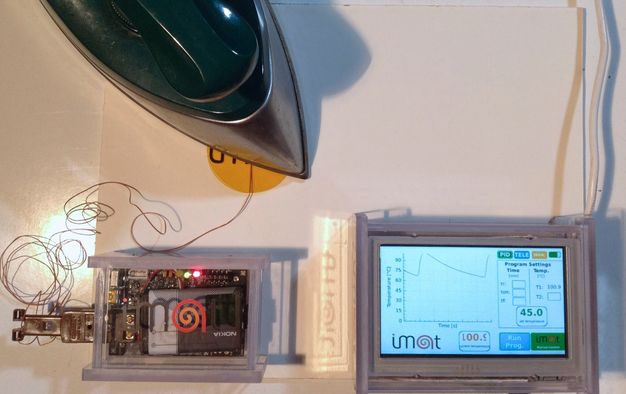
This lack of steadiness is even more problematic when the conservator attempts to heat a larger area with sweeping movement of the iron, which requires the set temperature to be considerably higher than the desired surface temperature. Furthermore, most hand irons are designed for household textiles and therefore have operational parameters between 120°C and 180°C, far above the safe, low-energy range needed for painting materials. Other temperature controls, such as rheostats, measure energy output and are not corrected by local temperature readings, so the actual surface temperature is unknown.
The primacy of lining as the most significant structural remediation method motivated conservators in the mid- to late twentieth century to develop custom-fabricated hot tables to address the difficulties of heating a larger surface area than possible with a hand iron. The earliest of these were guided by the desire to improve impregnation at 65°C or higher when performing the prevailing method of wax-resin lining (Ruhemann, Helmut. 1953. “The Impregnation and Lining of Paintings on a Hot Table.” Studies in Conservation 1, no. 2: 73–76.; Plenderleith, H. J. 1956. The Conservation of Antiquities and Works of Art: Treatment, Repair, and Restoration. London: Oxford University Press.; Bomford, David. 2003. “The Conservator as Narrator: Changed Perspectives in the Conservation of Paintings.” In Personal Viewpoints: Thoughts about Painting Conservation: A Seminar Organized by the J. Paul Getty Museum, the Getty Conservation Institute, and the Getty Research Institute at the Getty Center, Los Angeles, June 21–22, 2001, edited by M. Leonard, 1–12. Los Angeles: Getty Conservation Institute.; Rees Jones, S., A. Cummings, and G. Hedley. 2003. “Appendix 1: Relining Materials and Techniques; Summary of Replies to a Questionnaire.” In Lining Paintings: Papers from the Greenwich Conference on Comparative Lining Techniques, edited by Caroline Villers, 137–39. London: Archetype.; Berger, Gustav A., and Harold I. Zeliger. 2003. “Wax Impregnation of Cellulose: An Irreversible Process.” In Lining Paintings: Papers from the Greenwich Conference on Comparative Lining Techniques, edited by Caroline Villers, 25–27. London: Archetype.; Ackroyd, Paul. 2002. “The Structural Conservation of Canvas Paintings: Changes in Attitude and Practice since the Early 1970s.” Reviews in Conservation 47, supp. 1: 3–14.; Falvey, D. 2008. “The Evolution in the Lining of Paintings: To Line or Not to Line: A Preliminary Study.” In Postprints of the Paintings Specialty Group, 2007, edited by Helen Mar Parkin, vol. 20, 17. Washington, DC: AIC.). Refinements were made to the design of multipurpose heating tables from the 1980s on, to be used in combination with thermoplastic synthetic adhesives for linings that are activated at 65ºC. Nonetheless, many heating tables lack uniformity in heat transfer over the table surface area, which is easily identified by thermal imaging cameras, and users come to know the idiosyncratic hot and cold spots present on their device (Olsson, N., and T. Markevičius. 2010. “Flexible Thermal Blanket and Low-Pressure Envelope System in the Structural Treatment of Paintings on Canvas.” In Postprints of the Paintings Specialty Group, American Institute for Conservation Meeting, Milwaukee, edited by B. Buckley, 63–71. Washington, DC: AIC. ).
From the 1970s to the 1990s, various low-pressure envelope methods were combined with infrared lamps for heat transfer (Hedley, Gerry A., Stephen Hackney, and Alan J. Cummings. 2003. “Lining in a Vacuum Envelope with a Traversing Infrared Heat Source.” In Lining Paintings: Papers from the Greenwich Conference on Comparative Lining Techniques, edited by Caroline Villers, 83–86. London: Archetype.)—or even heat guns—with the inevitable obstacles to accuracy and control, although these methods also aimed to achieve the customary 65°C heat activation temperatures for synthetic thermoplastic consolidating and lining adhesives. These large, costly devices do not resonate with the fundamental shift in conservation methodology to prioritize targeted, minimally invasive treatments, today performed by conservators rather than specialized reliners. The application of heat transfer expanded to localized remedial treatments, such as tear mending, consolidation, stabilization of cracked and lifted paint, and reduction of diverse deformations and planar distortions. In the absence of alternatives, these treatments are performed with spatulas and tacking and hand irons (Olsson, N., and T. Markevičius. 2010. “Flexible Thermal Blanket and Low-Pressure Envelope System in the Structural Treatment of Paintings on Canvas.” In Postprints of the Paintings Specialty Group, American Institute for Conservation Meeting, Milwaukee, edited by B. Buckley, 63–71. Washington, DC: AIC. ).
Paintings on Canvas as Viscoelastic Systems: The Role of Temperature
The risks and beneficial effects of heat transfer in conservation treatments must be assessed within a comprehensive understanding of the nature of paintings and painting as physical systems. This understanding is crucial to evaluating paintings’ materials, condition, potential response to treatment, and long-term sustainability and stability of the intervention—and to formulating treatment protocols. In 1991, Mecklenburg published experimental data indicating that artists paints are viscoelastic systems (Mecklenburg, Marion F., and Charles S. Tumosa. 1991b. “Mechanical Behavior of Paintings Subjected to Changes in Temperature and Relative Humidity.” In Art in Transit: Studies in the Transport of Paintings, edited by Marion F. Mecklenburg, 137–72. Washington, DC: National Gallery of Art.). The viscoelastic behavior of paintings has been investigated in the context of their cleaning and mechanical properties (Hedley, Gerry, and Marianne Odlyha. 1989. “The Moisture Softening of Paint Samples and Its Implication for the Treatment of Fabric Supported Paintings.” In Traitement des support. Travaux interdisciplinaires. Paris, 2,3 et 4 novembre 1989, 1989, 157–62. Paris: Association des restaurateurs d’art et d’archéologie de formation universitaire.; Michalski, Stefan. 1991. “Paintings: Their Response to Temperature, Relative Humidity, Shock, and Vibration.” In Art in Transit: Studies in the Transport of Paintings, edited by Marion Mecklenburg, 223–48. Washington, DC: National Gallery of Art.; Hagan, Eric, Maria Charalambides, Thomas J. S. Learner, Alison Murray, and Christina Young. 2007. “Factors Affecting the Mechanical Properties of Modern Paints.” In Modern Paints Uncovered: Proceedings from the Modern Paints Uncovered Symposium, edited by Thomas J. S. Learner et al., 225–33. Los Angeles: Getty Conservation Institute.; Hagan, Eric W. S. 2017. “Thermo-Mechanical Properties of White Oil and Acrylic Artist Paints,” Progress in Organic Coatings 104 (March): 28–33. https://doi.org/10.1016/j.porgcoat.2016.10.019.; Phenix, Alan. 2011. “Thermal Mechanical Transitions in Artists’ Oil Paints and Selected Conservation Materials: A Study by Dynamic Mechanical Analysis (DMA).” In Postprints of the Paintings Specialty Group, American Institute for Conservation Meeting, Los Angeles, 2009, edited by B. Buckley, 72–89. Washington, DC: AIC.), and the effects of temperature and humidity have been investigated in the contexts of art transportation and preventive conservation. However, the effects of temperature and viscoelastic behavior have been investigated less in the context of structural treatments of paintings on canvas. These aspects were addressed by Berger and others (Russell, William H., and Gustav A. Berger. 1982. “The Behavior of Canvas as a Structural Support for Painting.” In Science and Technology in the Service of Conservation: Preprints of the Contributions to the Washington Congress, 3–9 September 1982, edited by N. S. Brommelle and Garry Thomson, 139–45. London: International Institute for Conservation of Historic and Artistic Works.; Berger, Gustav A., and William H. Russell. 1984. “The New Stress Tests on Canvas Paintings and Some of Their Implications on the Preservation of Paintings.” In ICOM Committee for Conservation: 7th Triennial Meeting, Copenhagen, 10–14 September 1984: Preprints, 84/2/7–9. Paris: ICOM., Berger, Gustav A., and William H. Russell. 1986. “Investigations into the Reactions of Plastic Materials to Environmental Changes, Part I: The Mechanics of Decay of Paint Films.” Studies in Conservation 31: 49–64., Berger, Gustav A., and William H. Russell. 1988. “An Evaluation of the Preparation of Canvas Paintings Using Stress Measurements.” Studies in Conservation 33, no. 4: 187–204.; Goddard, P. 1989. “Humidity Chambers and Their Application to the Treatment of Deformations in Fabric-Supported Paintings.” The Conservator 13: 20–24.; Olsson, N., and T. Markevičius. 2010. “Flexible Thermal Blanket and Low-Pressure Envelope System in the Structural Treatment of Paintings on Canvas.” In Postprints of the Paintings Specialty Group, American Institute for Conservation Meeting, Milwaukee, edited by B. Buckley, 63–71. Washington, DC: AIC. , Olsson, N., and T. Markevičius. 2017. “Studio Tip: Innovative Applications of Heating Mat and Low-Pressure Systems for Lining and Minimal Structural Treatment of Paintings.” In Postprints of the Painting Specialty Group, American Institute for Conservation Meeting, Chicago, edited by W. Partridge, 127–35. Washington, DC: AIC.; Markevičius, T., H. Meyer, K. Saborowski, N. Olsson, and R. Furferi. 2013. “Carbon Nanotubes in Art Conservation.” International Journal of Conservation Science, 4, special issue: 633–46., Markevičius, T., N. Olsson, R. Hegelbach, R. Furferi, H. Meyer, K. Seymour, K. Saborowski, L. Borgioli, L. Amorosi, L. Conti, R. Šimaitė, E. Kielė, S. Lenaerts, and J. Bierings. 2017. “New Approaches to an Old Problem: A Precision Mild Heat Transfer Method for the Nuanced Treatment of Contemporary and Modern Art Works.” In ICOM Committee for Conservation: 18th Triennial Conference, Copenhagen, 4–8 September 2017: Linking Past and Future: Preprints, edited by Janet Bridgland, art. 1308. Paris: ICOM.).
Once fully dry, paint films behave as elastic, viscoelastic, or viscoplastic materials, depending on the chemical nature of their components. With aging variations in the pigments used, oil films acquire a greater degree of cross-linking and stiffness, with a corresponding rise in glass transition temperature (Tg) from ambient temperature (0°C–50°C) to as high as 75°C–100°C for paints containing lead white (Phenix, Alan. 2011. “Thermal Mechanical Transitions in Artists’ Oil Paints and Selected Conservation Materials: A Study by Dynamic Mechanical Analysis (DMA).” In Postprints of the Paintings Specialty Group, American Institute for Conservation Meeting, Los Angeles, 2009, edited by B. Buckley, 72–89. Washington, DC: AIC.). Glass transition temperatures of acrylic, alkyd, and oil primers were found to be in the range of 21°C–44°C (Hagan, Eric, Maria Charalambides, Thomas J. S. Learner, Alison Murray, and Christina Young. 2007. “Factors Affecting the Mechanical Properties of Modern Paints.” In Modern Paints Uncovered: Proceedings from the Modern Paints Uncovered Symposium, edited by Thomas J. S. Learner et al., 225–33. Los Angeles: Getty Conservation Institute.).
In structural conservation treatments of paintings on canvas, the constituent viscoelastic materials, such as paint films, may suffer structural failure caused by the rapid application of force while in a stiff, glassy state. However, it is possible to shift from a strain causing failure to one avoiding failure by temporarily rendering the viscoelastic material more plastic (enabling it to adapt to the required rate of deformation) in various ways: by adding moisture or other agent that acts as a plasticizer or increasing the amount of energy in the system, that is, raising the temperature. The relationship of stress and strain (Young’s modulus) is influenced by plasticizers, such as water (humidity treatments) and thermal energy (expressed in temperature). By tailoring the introduction of thermal energy to the required rate of deformation of the material during treatment, the stiffness of the system may be temporarily reduced, allowing planar distortions to be manipulated in the more malleable state. Optimal control of heat energy transfer is therefore paramount, as beneficial heat effects cannot be safely exploited without the precision instrumentation.
Targeted Precision Heat-Transfer Treatment Methodology Using Nanotube-Enabled and Other Conductive Flexible Mats
Development and Functionality of a Flexible Mat System
As previously discussed, the heat-transfer instrumentation used historically and currently available lacks accuracy in the low-temperature range, as well as steadiness and uniformity, and this deficit limits options and treatment approaches. The surface areas of heat-transfer instruments are limited to the small size of spatula heads, tacking irons, hand irons, and extra-large heating tables, with no alternatives in between.
In response to the omissions and gaps in currently available instrumentation, a precision heat-transfer technology in the form of flexible silicone-clad heating mats and associated temperature control consoles was developed specifically for art conservation applications. The mats provide the conservator with novel control in the low-energy range (ambient to 40°C) making prolonged heat transfer possible and allowing implementation of a low-and-slow approach that permits conservators to gain control over the heat transfer and innovate safe, nuanced treatments of both lined and unlined paintings. The mats are designed to deliver heat at the temperatures slightly above those customarily used to activate thermoplastic adhesives (to 70°C) and they provide access the low-energy range below 40°C, which was previously inaccessible.
For the novel treatment methodology, heating mat systems were designed to provide an accurate, versatile, mobile low-energy heat-transfer technology. All are based on three key components: the heating mat, the thermocouple (TC), and the temperature control console (fig. 37.2). The heating mat is the thermal output surface. The mats are laminates composed of resistive elements embedded within an exterior cladding of vulcanized silicone. In 2010, the authors first proposed using carbon nanotubes (CNTs) for precision low-energy heat transfer (Markevicius, T., H. Meyer, N. Olsson, and R. Furferi. 2011. “Conductive Transparent Film Heater as Alternative to Heating Table: Towards New Intelligent Mobile Accurate Thermo-electrical (IMAT) Device for Structural Conservation of Paintings.” In Art’11: 10th International Conference on Non-destructive Investigations and Microanalysis for the Diagnostics and Conservation of Cultural and Environmental Heritage. Brescia, Italy: Foresti.). The resulting heating mats are very flexible, with a nontack surface and thin profile that can be inserted between the wood strainer and canvas verso for treatment of a painting in situ on the stretcher.
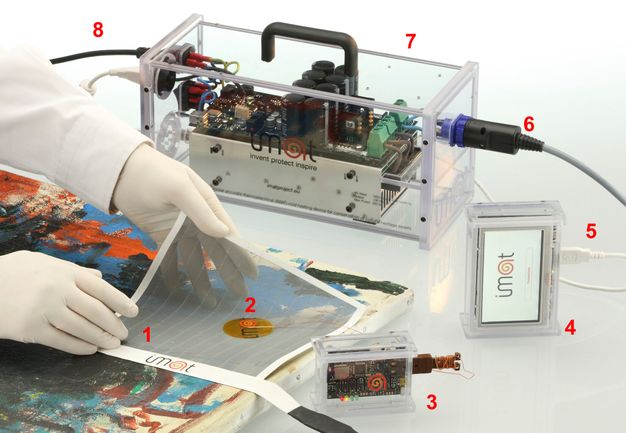
The thermocouple is the sensor used to measure the actual temperature at its tip, which provides feedback to the temperature controller. The TC (type T) is made of two metallic wires that conduct heat, copper, and constantan (nickel-copper alloy), which are joined at one end. The type T thermocouple has a sensitivity of 43 µV/°C and is accurate to 0.5°C. It was selected for its temperature range, high degree of reliability, and accuracy. The TC is positioned in direct contact with the heating mat surface, or it can be placed strategically on any surface as needed.
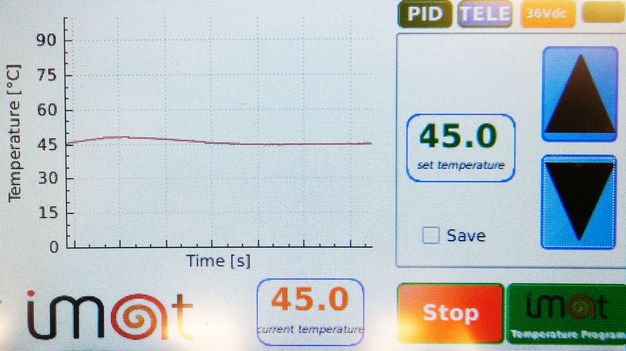
The control console is a unit composed of a PID (proportional-integral-derivative) temperature controller, which employs a control loop mechanism to continuously calculate an error value as the difference between the desired setpoint temperature and a measured process variable and applies a correction based on proportional, integral, and derivative terms. Depending on the PID controller, the temperature feedback loop may be corrected between four and forty times per second, resulting in ultrasteady heating patterns (fig. 37.3).
First Practical Applications
The first prototype heater was adopted from existing industrial technology in 2003 and manufactured for use in the lining treatment of two large-format New Deal murals by Howard S. Sewell in Oregon City, Oregon. The silicone heating mat was made with wound copper and fiberglass resistance wire elements plotted in a dense linear pattern at 1/4-inch intervals. It was custom made to accommodate the height of the murals. The relining process also employed a Dartek vacuum envelope with two outflowing points connected to a Gast vacuum pump. The mural sections were bonded with a Beva interleaf to the backing by heating them in sections, positioning the thermocouple between the heating mat and the backing surface. The portability of the mat allowed all of the work to be conducted on site (Olsson, N., and T. Markevičius. 2010. “Flexible Thermal Blanket and Low-Pressure Envelope System in the Structural Treatment of Paintings on Canvas.” In Postprints of the Paintings Specialty Group, American Institute for Conservation Meeting, Milwaukee, edited by B. Buckley, 63–71. Washington, DC: AIC. ).
IMAT: Innovation Using Carbon Nanotubes
In 2010, the authors first proposed using carbon nanotubes for precision heat transfer in art conservation (Markevicius, T., H. Meyer, N. Olsson, and R. Furferi. 2011. “Conductive Transparent Film Heater as Alternative to Heating Table: Towards New Intelligent Mobile Accurate Thermo-electrical (IMAT) Device for Structural Conservation of Paintings.” In Art’11: 10th International Conference on Non-destructive Investigations and Microanalysis for the Diagnostics and Conservation of Cultural and Environmental Heritage. Brescia, Italy: Foresti.). From 2011 to 2014, the European Commission’s IMAT Project (Intelligent Mobile Multipurpose Accurate Thermo-Electrical Device1), coordinated by the University of Florence, considerably refined the design of flexible heating laminates for art conservation. The IMAT mats were created with innovative e-textiles woven with integrated yarns coated with CNTs, as heating elements. Various prototypes were developed, including a transparent mat and a breathable version that allowed for permeability when humidity was used during treatment. The significant advantages of using CNTs lie in their ultra-low mass and extremely high electrical and thermal conductivity, which allows rapid thermal response (essential for accuracy) and safe, ultra-low voltage (36V). The project’s final deliverable was proof-of-concept IMAT prototypes, which continue to be used for diverse conservation and research projects. As of this writing, the project is awaiting further investment for upscaling and production for use in bench practice (as shown in fig. 37.2).
Interim MAT System: Mobile Accurate Temperature Management
In order to advance research and treatment methodologies of precision heat transfer, available wound wire technology has also been employed in the design of a series of silicone heating mats and associated consoles for conservation use. The first MAT system for cultural heritage applications was commercialized in 2022.2 Operational parameters and design features have been further adapted to prioritize performance in the low-energy range, increase portability, and function with standard domestic power input. The standardized mat dimensions range from 2 × 5 inches (5 × 13 cm) to 25 × 30 inches (64 × 76 cm), with a maximum size of 30 × 40 inches (76 × 102 cm; 230V only), and the units function at 120V for North American use or 230V for EU use; larger-than-standard mats require more powerful consoles and a power input of 240V or higher.
From Precision Heat Transfer to New Low-and-Slow Targeted Treatment Methodology
Overview: The Use of Time, Temperature, and Moisture to Manipulate Failure Criteria and Remain within the “Safe Zone”
In practice, remedial treatment to reduce planar distortions, such as cupped paint and surface deformations of the paint, ground, and canvas layers, may be conducted by exploiting their viscoelastic properties with controlled increase in temperature to cause the paint film to transition from a glassy state to a pliable state, when pressure may be applied safely and effectively. The transition temperature may be reduced by introduction of a temporary plasticizer, such as humidity or heat energy. Accuracy is critical for safe and effective heat treatment in order to maintain a steady set temperature for the duration of treatment within the Tg range and achieve the transition to a compliant state while avoiding undesirable overheating of the paint surface. Thick or aged films may require a longer period of heat transfer to achieve even warming throughout the entire painting stratigraphy. With aging and given variations from the effects of pigments, oil films acquire a higher degree of cross-linking and stiffness with a corresponding rise in Tg from ambient temperature (0°C–50°C) to as high as 75°C–100°C for paints containing lead white (Phenix, Alan. 2011. “Thermal Mechanical Transitions in Artists’ Oil Paints and Selected Conservation Materials: A Study by Dynamic Mechanical Analysis (DMA).” In Postprints of the Paintings Specialty Group, American Institute for Conservation Meeting, Los Angeles, 2009, edited by B. Buckley, 72–89. Washington, DC: AIC.). Therefore, in many instances the ideal operational temperature will be in the low or ambient temperature range, and in some cases even a small viscoelastic response can be significant.
Integration into Existing Treatment Methods and Development of New Treatments: Case Studies
The case studies described below illustrate the application of the mats with mild heat transfer for minimal structural and lining treatments of diverse paintings conducted over a seventeen-year span (2003–20). The operational parameters and practical advantages offered by the new warming nanotechnology and targeted approaches taken in each particular treatment show the broad versatility of the new method and how easily it could be tailored to the specific needs of each case, opening new opportunities for art conservators to refine their treatments within the margins of minimal intervention and risk.
Case Study 1: Stabilizing Cracks, Addressing Planar Distortions, and Strip-Lining
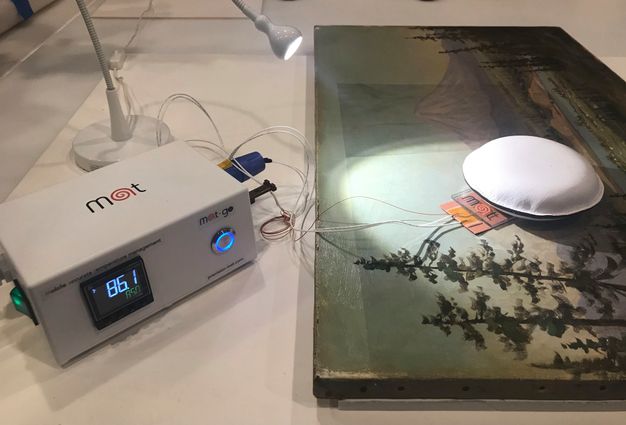
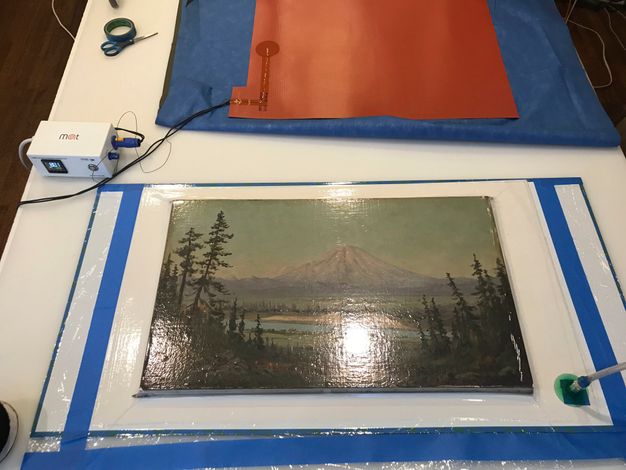
Our first example is John E. Stuart’s Mt. St. Helens from a Hill Back of Portland (1885).3 Planar distortions from cracks and severe cupping had formed in extremely brittle paint and ground layers, and the tacking edges were degraded at the return edge. The scope of structural treatment was to stabilize cracks, reduce or eliminate planar distortions, and reinforce the tacking edges with a strip-lining. Lascaux P550 (20% in naphtha) was introduced into the cracks from the recto in an area with particularly unstable paint and ground cracks. Following full evaporation of the solvent, localized humidification with a small chamber preceded application of localized mild heat transfer at 30ºC for forty minutes, which produced a pliable state, allowing mild pressure to be used for consolidation (fig. 37.4).
Once unstable areas were treated, the painting was removed from the stretcher for a general structural treatment. The same P550 resin was applied to the reverse and allowed to dry. The verso was then lightly humidified for thirty minutes using a moistened blotter with an interleaf of Polartec microporous membrane. A custom-cut platform of museum board and 1/2-inch foam core was created to support the fragile tacking edges. The painting was then placed in a low-pressure envelope and warmed to 40°C for forty minutes (fig. 37.5). The museum board was replaced after twenty minutes to capture introduced moisture. Finally, strip-lining supports of crepeline were prepared with Beva film prior to bonding them to the tacking edges using an angled support to prevent flattening of the fold edge during adhesion.
Case Study 2: Sustainable Treatment of Paintings with Glue-Paste Linings
André Bouys’s A Woman Knitting (ca. 1700)4 had been flour-paste lined in a prior treatment dating to the late nineteenth century, and that lining was still stable and well adhered. However, the recto had several areas of lifted, cupped, and curled paint caused by animal-glue residues from the facing, probably dating to the relining treatment.
The recto was humidified through a microporous Polartec membrane with a moist blotter. Subsequently, mild heat of 36°C was applied to the recto for forty minutes. Once the paint layers had transitioned to a compliant state, the cupped and curled paint was brought into plane with a heated spatula. Once planarity had been regained, the animal-glue residues were removed from the paint layer.
Case Study 3: Targeted Remedial Treatment of Indentations and Tears
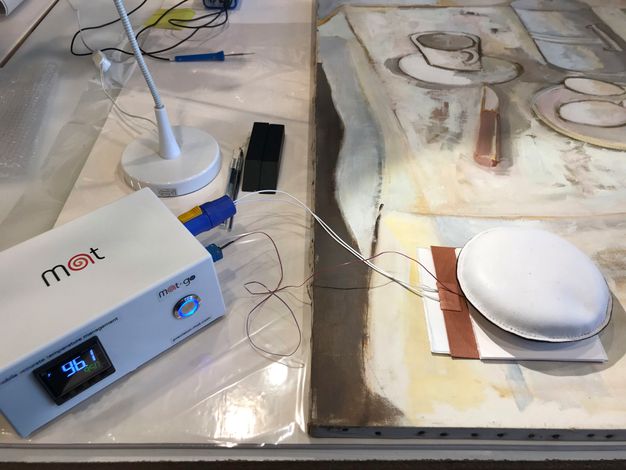
Clifford Gleason’s Still Life in Whites (1939)5 had several indentations and canvas tears, including one large complex H-shape tear. The scope of treatment was to perform remedial treatment while the painting remained on the stretcher. Prior to thread-by-thread mending, the flap edges were temporarily joined with tape bridges. Localized humidification of the verso was followed by mild heat transfer at 40°C for twenty minutes; this was also done at dent sites and in buckled corners. Following the tear repair, humidification and mild heat transfer were again used to achieve planarity of the tear site (fig. 37.6).
Case Study 4: Targeted Remedial Treatment of Wax-Resin Lined Works
Wax-resin adhesive was widely used for structural treatments until the 1974 Greenwich conference and continued after. When paintings with this treatment history require consolidation or treatment of planar deformations, intervention is problematic without an accurate mild heat source, due to the thermal sensitivity and melting behavior of crystalline waxes where the safe treatment temperature range is just above room temperature (~20°C) and the critical upper limit is 40°C or lower. The lack of adequate low-temperature devices has led to invasive treatments to reverse the wax-resin linings.
Testing of mild heat transfer on wax-treated paintings is nascent and has been limited to simulated treatments (Markevičius, T., N. Olsson, R. Hegelbach, R. Furferi, H. Meyer, K. Seymour, K. Saborowski, L. Borgioli, L. Amorosi, L. Conti, R. Šimaitė, E. Kielė, S. Lenaerts, and J. Bierings. 2017. “New Approaches to an Old Problem: A Precision Mild Heat Transfer Method for the Nuanced Treatment of Contemporary and Modern Art Works.” In ICOM Committee for Conservation: 18th Triennial Conference, Copenhagen, 4–8 September 2017: Linking Past and Future: Preprints, edited by Janet Bridgland, art. 1308. Paris: ICOM.). The preliminary results indicate that gradual mild heat transfer over an extended period of time allows safe and efficient treatment of deformations and dents and reactivation of wax-based adhesives.
Case Study 5: Targeted Remedial Treatment of Beva-Lined Paintings
Robert Motherwell’s Open No.16 in Ultramarine with Charcoal Line (1968)6 was damaged during transport, leaving a 13-centimeter concave dent in the center of the composition and two areas of surface distortions in the lower corners. The work had been previously cold-lined with Beva Gel onto cotton canvas.
A thin profile mat was introduced between the wood stretcher and the canvas verso and heated to 40°C for ten minutes to soften the lining adhesive and relax the canvas and paint layers in a safe range for acrylic paint, for this particular artwork. Based on practical experience, temperatures below 40°C appear to be relatively safe, but this is not always the case. The range is specific to both the material and treatment and needs to be assessed together with other factors, such as applied pressure, physicochemical characteristics of specific paint, and amount of moisture used, which acts as a temporary plasticizer in a complex viscoelastic system (Hagan, Eric W. S., Maria N. Charalambides, Christina R. T. Young, and Thomas J. S. Learner. 2015. “The Effects of Strain Rate and Temperature on Commercial Acrylic Artist Paints Aged One Year to Decades.” Applied Physics A 121, no. 3: 823–35. https://doi.org/10.1007/s00339-015-9423-6.).
Once softened and smoothed, the deformation sites were cooled between two heat sink plates held in place for thirty seconds from either side. The same procedure was used to smooth the large concave dent in the center (Markevičius, T., N. Olsson, R. Hegelbach, R. Furferi, H. Meyer, K. Seymour, K. Saborowski, L. Borgioli, L. Amorosi, L. Conti, R. Šimaitė, E. Kielė, S. Lenaerts, and J. Bierings. 2017. “New Approaches to an Old Problem: A Precision Mild Heat Transfer Method for the Nuanced Treatment of Contemporary and Modern Art Works.” In ICOM Committee for Conservation: 18th Triennial Conference, Copenhagen, 4–8 September 2017: Linking Past and Future: Preprints, edited by Janet Bridgland, art. 1308. Paris: ICOM.).
Case Study 6: Sustainable Lining Using Diverse Adaptive Lining Systems
Since 2003, flexible mats have been used in numerous lining treatments: in combination with low-pressure vacuum envelopes for the lining of a seventeenth-century painting by Orazio Gentileschi (Olsson, N., and T. Markevičius. 2017. “Studio Tip: Innovative Applications of Heating Mat and Low-Pressure Systems for Lining and Minimal Structural Treatment of Paintings.” In Postprints of the Painting Specialty Group, American Institute for Conservation Meeting, Chicago, edited by W. Partridge, 127–35. Washington, DC: AIC.) (fig. 37.7), a series of six paintings by Kenneth Hudson (Markevičius, T., N. Olsson, R. Hegelbach, R. Furferi, H. Meyer, K. Seymour, K. Saborowski, L. Borgioli, L. Amorosi, L. Conti, R. Šimaitė, E. Kielė, S. Lenaerts, and J. Bierings. 2017. “New Approaches to an Old Problem: A Precision Mild Heat Transfer Method for the Nuanced Treatment of Contemporary and Modern Art Works.” In ICOM Committee for Conservation: 18th Triennial Conference, Copenhagen, 4–8 September 2017: Linking Past and Future: Preprints, edited by Janet Bridgland, art. 1308. Paris: ICOM.), and in the 2010 loomed treatment of Veronese’s Petrobelli altarpiece at the National Gallery of Canada (Olsson, N., and T. Markevičius. 2010. “Flexible Thermal Blanket and Low-Pressure Envelope System in the Structural Treatment of Paintings on Canvas.” In Postprints of the Paintings Specialty Group, American Institute for Conservation Meeting, Milwaukee, edited by B. Buckley, 63–71. Washington, DC: AIC. ).
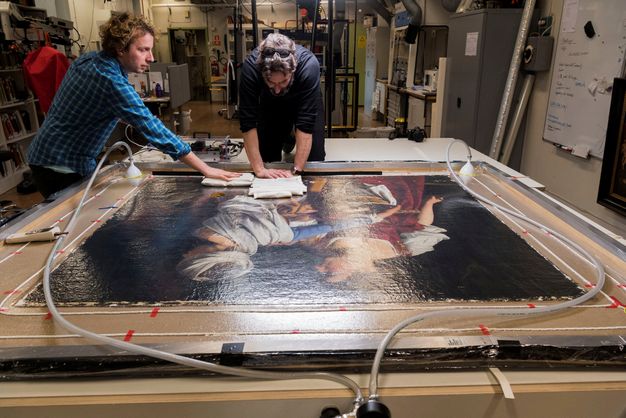
Silicone mats can be made in large dimensions and conveniently rolled and stored while not in use. Alternatively, if the work is contained within a vacuum envelope during treatment, heat may be applied in sections and easily integrated into traditional and innovative lining treatments.
Conclusions
In the aftermath of the 1974 Greenwich conference, and especially since the 1990s, conservators have wrestled with the question of if, when, and how to undertake structural remediation of paintings on canvas, often preferring postponement rather than treatments employing heat and humidity despite the real conservation needs of paintings in their care. After all, conservators are tasked with designing thoughtful treatments that effectively resolve the problem at hand without repeating the errors of the past. It goes without saying that in this pursuit, the creation of new conservation materials and sophisticated instrumentation is of fundamental importance.
Ongoing studies provide a new understanding of the viscoelastic properties of constituent polymer materials in paintings on canvas, and identify behavioral changes caused by external forces such as time, heat, and humidity and how these factors may be exploited to shift aged and brittle materials into physical states that allow safe remedial treatment. This new knowledge can be applied by conservators to improve safety and effectiveness of structural treatment outcomes with the proposed methodology using MAT and IMAT heat-transfer technology for low temperature ranges (25°C–40°C) and up to those customarily used for thermoplastic adhesive activation (65°).
The new methodology represents a radical shift from low-tech, poorly controlled heating methods to an approach where the heat transfer is targeted, safe, and commensurate with the desired result. While traditional tools such as hand irons threaten to overheat the paint surface and operate at temperatures higher than is safe, the MAT’s precision and even heat diffusion over large areas allows for a novel low-and-slow approach—the use of safe, low temperatures over an extended period of time, tailored to each specific treatment—and provides the means for conservators to address conditions previously considered untreatable.
Beyond temperature control, novel access to sophisticated microporous membranes that enable better control when humidification is used as a plasticizing agent provides conservators with alternatives to help formulate new structural treatment methodologies of paintings on canvas and more—within the margins of minimal intervention and risk—while achieving the maximum result.
The variety of case studies shows the broad spectrum of application for mild heat-transfer technology in structural treatment and beyond, from the use of mild heat over an extended period to treat planar and surface distortions (the low-and-slow approach) to safe treatment of works previously treated with natural and synthetic crystalline waxes to the utility of the thin, flexible profile to reach between canvas and stretcher bars for treatments that conserve the original mounting and structural integrity of the piece. The compact dimensions and portability of the MAT device allow the conservator to easily work in the laboratory or conduct state-of-the-art treatments in the field, advancing best practices in art conservation and treatment of artworks.
It is the authors’ hope that further study will provide a better understanding of how to exploit the beneficial effects of low-energy heat transfer applied to structural treatment, while the introduction of precision heating mats and the low-and-slow approach developed and advocated by the authors, as well as numerous collaborators and colleagues who contributed to this research, will make future treatments on canvas more efficient, sustainable, and safer.
Notes
-
Call ID 283110. ↩︎
-
Precision Mat, LLC, Portland, Oregon. http://www.precision-mat.com. ↩︎
-
Oil on canvas, 45.7 × 76.2 cm. Oregon Historical Society Museum 75-1.72. ↩︎
-
Oil on canvas, 90.8 × 71.4 cm. Gift of the Podemski family in memory of their parents and grandparents, Max and Anna Podemski. Portland Art Museum, Portland, Oregon, 2017.60.1. ↩︎
-
Oil on canvas, 93.9 × 73.7 cm. Collection of the Hallie Ford Museum of Art, Willamette University, Gift of the Maurice Hudkins Collection in memory of C. Ronald Hudkins and Betty-Mae Hartung Hudkins, 2005.019.027. ↩︎
-
Acrylic on canvas, 252.7 × 473.7 cm. Previously Dedalus Foundation collection. ↩︎