This paper discusses the situation in Denmark before the Greenwich conference on lining of canvas paintings and how the subsequent period of fifteen to twenty years was filled with curiosity, eagerness to try out new ways and ideas, testing of methods and materials, contemplating failures, building of new and glorious equipment—and a longing for better understanding of treatments and the structural behavior of paintings. In the 1990s, the focus gradually changed. Interventions became more limited, techniques and materials changed, and development of new treatment methods and materials was deemphasized, while better understanding of the structural behavior of canvas painting and its consequences came to the forefront through increased scientific study of the subject.
3. To Treat or Not to Treat, That Is the Question: Structural Treatment of Canvas Paintings from a Danish Perspective
- Mikkel Scharff, Associate Professor, Institute of Conservation, The Royal Danish Academy
Introduction
The paintings conservation community in Denmark in the mid-twentieth century, as in many other countries, was composed of, on one hand, individual practitioners working privately for smaller collections and museums and for historic buildings, and on the other, a few conservators working at larger institutions, primarily museums, in permanent positions.
Paintings conservators considered themselves craftspersons. Most had a background in the house painting craft1 or were trained artists from the Royal Danish Academy of Fine Arts School of Painting. Training as paintings conservators usually followed an apprenticeship in a conservation studio or work in historic buildings.
House painting or artistic training constituted the background for the approach to treatments, choice of materials, and recipes for treatment. This produced a somewhat conservative approach based on generations of experience, but it was sometimes open to new approaches or novel materials. For example, newly available commercial materials were adopted, and after World War II internships with and visits by a generation of young conservators to conservation studios across Europe provided inspiration. In this way, for example in the 1950s, the idea of simple material analysis and photographic documentation gradually found its way to Denmark from Belgium’s Royal Institute for Cultural Heritage (KIK-IRPA) (Coremans, Paul B. 1953. L’Agneau mystique au laboratoire: Examen et traitement. Volume 3, issue 2 in Les Primitifs flamands: Contributions à l’étude des primitifs flamands. Oostmalle: De Sikkel.).
Conservators, in general, mainly undertook treatments without making note of methods and materials, although some books and journals about methods and materials did exist. Danish conservators could draw on a tradition of apprenticeship going back to the early nineteenth century (Scharff, Mikkel. 1998. “Training in Paintings Conservation.” In Royal Danish Academy of Fine Arts, School of Conservation: The Jubilee Symposium Preprints, edited by K. Borschersen, 131–38. Copenhagen: Royal Danish Academy of Fine Arts, School of Conservation., Scharff, Mikkel. 2000. “Insight into Nineteenth-Century Paintings Conservation in Denmark.” In Tradition and Innovation: Advances in Conservation, IIC, Contributions to the Melbourne Congress, edited by Ashok Roy and Perry Smith, 177–81. London: IIC.), including some treatment descriptions written in Danish (Greve, F. R. 1855. Om restauration af malerier: Samt kortfatttet anviisning til at rense og blege kobberstik, lithographier, tegninger o.d.l. Roskilde: Hanssons.). Recipe books for house painters or artists were also available, as well as books on gilding and varnishing. Danish paintings conservators in the mid-twentieth century knew about and practiced the main trends and techniques of structural treatments from the nineteenth century onward, including glue-based, glue-paste, and wax-resin treatments, though the latter were not practiced very much until the 1960s, when they were in regular use at the Statens Museum for Kunst (Royal Danish Museum of Fine Arts) (Andersen, Cecil Krarup, Marion Mecklenburg, Mikkel Scharff, and Jørgen Wadum. 2014. “With the Best Intentions: Changed Response to Relative Humidity in Wax-Resin Lined Early 19th-Century Canvas Paintings.” In ICOM 17th Triennial Conference Preprints: Melbourne, Australia, 17–19 September 2014, edited by Janet Bridgland. Paris: ICOM Committee for Conservation.). Structural treatments were divided between primary treatments (first linings) and secondary retreatments (relinings), and (much less frequently) more radical treatments such as transfers or marouflage.
State of the Art in the 1970s—Considerations, Choices, Consequences
When summing up his overview of structural treatments and choice of methods and materials in his influential “Lining Cycle” introduction to the 1974 Greenwich conference, Westby Percival-Prescott stated that “the purpose of this conference is to see that our choice is a wise one” (Percival-Prescott, Westby. 2003. “The Lining Cycle: Causes of Physical Deterioration in Oil Paintings on Canvas: Lining from the 17th Century to the Present Day.” In Lining Paintings: Papers from the Greenwich Conference on Comparative Lining Techniques, edited by Caroline Villers, 1–15. London: Archetype. Originally published as W. Percival-Prescott. 1974. “The Lining Cycle.” In Lining Paintings: Papers from the Greenwich Conference on Comparative Lining Techniques, unpaginated. Greenwich: National Maritime Museum, 1974.).
This aim could well stand as the general effect of the Greenwich conference on the established paintings conservation field in the 1970s and onward and describes the impact on young conservators making their way into the field. A number of publications have dealt with the conference and its major influence, and they often discuss historical developments preceding and following the conference, for example, the introduction to the 2003 postprint publication (Villers, C. 2003. “Introduction.” In Lining Paintings: Papers from the Greenwich Conference on Comparative Lining Techniques, edited by Caroline Villers, xi–xvi. London: Archetype.), most recently Hackney’s overview book On Canvas (Hackney, Stephen. 2020. On Canvas: Preserving the Structure of Paintings. Los Angeles: Getty Publications.), and elsewhere (Bomford, David. 2017. “Three Days That Changed Conservation.” In The Picture So Far: 50 Years of Painting Conservation, edited by Abigail Granville, Laura Hinde, Sophie Plender, Hayley Tomlinson, and Nancy Wade, 1–8. London: Archetype.; Burnstock, A. 2017. “The Influence of Science and Technology on the Conservation and Technical Study of Paintings in the Last 50 Years: A Personal Viewpoint.” In The Picture So Far: 50 Years of Painting Conservation, edited by Abigail Granville, Laura Hinde, Sophie Plender, Hayley Tomlinson, and Nancy Wade, 32–58. London: Archetype.; Hackney, Stephen. 2012. “Lining Easel Paintings.” In The Conservation of Easel Paintings, edited by J. H. Stoner and R. Rushfield, 415–16, 423–24, 433–38. New York: Routledge.). Given this background, this paper focuses on information preceding the Greenwich conference that is relevant to developments in Denmark during the 1970s in particular—a decade with a number of defining events in paintings conservation that have had a lasting impact for the future.
The experiences and events of the 1960s formed the immediate background. A new generation of postwar conservators with new experience and ideas gained from abroad was in a position to carry out various structural reforms in their institutions—and to review the approach to treatments followed in most paintings conservation studios in Denmark.
For a while in the 1960s, wax-resin treatments were seen as a major improvement and were widely used in combination with the innovative equipment: the new vacuum hot table (Andersen, Cecil Krarup, Marion Mecklenburg, Mikkel Scharff, and Jørgen Wadum. 2014. “With the Best Intentions: Changed Response to Relative Humidity in Wax-Resin Lined Early 19th-Century Canvas Paintings.” In ICOM 17th Triennial Conference Preprints: Melbourne, Australia, 17–19 September 2014, edited by Janet Bridgland. Paris: ICOM Committee for Conservation.). Another milestone occurred when the river Arno inundated a major part of the medieval city of Florence and its artwork. Subsequently, conservators from abroad, including eighteen paintings conservators from the Nordic countries, participated in the immediate rescue and undertook conservation and restoration treatments (Plahter, L. E. 1999. “Nordisk center for restaurering i Firenze.” In Conservare necesse est: Festskrift til Leif Einar Plahter på hans 70-årsdag, edited by International Institute for Conservation of Historic and Artistic Works, Nordic Group, 68–72. Oslo: Nordisk Konservatorforbund, IIC Nordic Group.). The disaster itself—and the observation that treatment approaches between conservators differed vastly—caused many in the assembled conservation community to reconsider materials, methods, and approaches and to realize that for the future of conservation it would be essential to obtain a more consistent entry to the profession.
Formal educational programs could be one of the means, but few existed at that time in Europe and the Americas. In Denmark, a government commission was formed in 1965. In 1969, it produced a report aimed at establishing new legislation on the protection of heritage in Denmark.2 The report considered a revision of the conservation strategy and improved conservation facilities in Danish museums, as well as plans to establish an educational program that would supply the museums and the private market with qualified conservation staff. Concurrently, UNESCO was preparing the World Heritage Convention,3 which was widely adopted in 1972 (including by Denmark) with a broad impact.
The Danish conservation community held seminars, lectures, and courses on various subjects while awaiting the inauguration of the School of Conservation, including the development of new equipment and approaches and the testing of alternative materials or methods. These were presented and discussed at the Nordisk Konservator Forbund (NKF), at the IIC Nordic Group, and at international forums including IIC and ICOM congresses, and especially at the ICOM Committee for the Care of Paintings—later to become part of the ICOM Committee for Conservation. The proposal by Percival-Prescott at ICOM-CC in Venice in 1975 to halt lining treatments pending a full review (Percival-Prescott, Westby. 1975. “Report on the Greenwich Lining Conference.” In ICOM Committee for Conservation, 4th Triennial Meeting, Venice, 13–18 October 1975: Preprints. Paris: ICOM.) was discussed as well, but it did not have a lasting effect in Denmark. It did, however, encourage consideration and testing of alternative and perhaps less intrusive treatment methods.
In 1973, Steen Bjarnhof, head of the Statens Museum for Kunst conservation studio, answered a questionnaire distributed by Stephen Rees Jones, head of the technology department of the Courtauld Institute of Art, University of London, in advance of the Greenwich and ICOM-CC conferences. His answers4 revealed the conservation studio’s use of traditional materials and methods and noted the deficiencies of wax-resin linings: canvases becoming slack after wax-resin lining, and hygroscopicity even in wax-resin linings. Bjarnhof also reported on experiments with EVA dispersion using “laminations”5 and further information about the experiments and developments, such as those described by Hacke in the 1960s (Hacke, B. 1963–64. “En utraditionel metode til vacuumrentoilering af temperamaleri på lærred.” Meddelelser om konservering 1, no. 4: 42–48.) and Bøgh and Ketnath’s experiments with EVA as adhesive (Bøgh, Lone, Artur Ketnath, and Majken Thorvildsen. 1975. “Om forsøg med Vinnapas Dispersion EP 1.” Meddelelser om konservering 2, no. 5: 135–43.; Ketnath, A., and L. Bøgh. 1975. “Om anvendelsen af EP 1-dispersion ved doublering.” Meddelelser om konservering 2, no. 5: 144–51.). In 1974, Bjarnhof and other Danish paintings conservators attended the Greenwich conference.
Real Changes—The School of Conservation Is Established
At the time of the Greenwich conference, the Royal Danish Academy of Fine Arts School of Conservation had been functioning for about a year. The founding of the educational program in 1973 resulted in a major planned change to the field of paintings conservation in Denmark—not at first, perhaps, but gradually over the following years.
I entered the paintings conservation program as part of the third admission of undergraduate students in conservation, in late August 1977. There had been many challenges in setting up a training program during the first four years, but the class of 1977 found a three-year educational program with quite a structured curriculum. We attended lectures, undertook a lot of practical work and exercises, and practiced extensive documentation, including photographic and X-ray techniques. Microscopy was the main analytical technique available to study a painting, its surfaces, and layered structure. The thorough process of documenting observations, reflections, descriptions, and errors was considered a major leap forward in the professionalization of the field and underscored the importance of compiling empirical knowledge for future use. Coursework was based on established treatment techniques, but we were also introduced to new techniques and materials as directed by teachers.
The available literature was limited. Descriptions of established techniques were provided by copies of the small Greenwich offprints, including the useful Handbook of Terms (see Percival-Prescott, W., and G. Lewis, eds. 2003. Glossary. In Lining Paintings: Papers from the Greenwich Conference on Comparative Lining Techniques, edited by Caroline Villers, 155–70. Originally published as Handbook of Terms Used in the Lining of Paintings, edited by Westby Percival-Prescott and Gillian Lewis. Conference on Comparative Lining Techniques, Greenwich, London, 1974. London: Archetype. ). Hacke and others presented new developments, discussing the outcomes of the Greenwich conference and the innovations of Mehra and Berger. Hacke had experimented with suction-table techniques (termed low-pressure techniques) since the 1960s (Hacke, B. 1963–64. “En utraditionel metode til vacuumrentoilering af temperamaleri på lærred.” Meddelelser om konservering 1, no. 4: 42–48., Hacke, B. 1976. “Et lav-tryks apparat til behandling af malerier.” Meddelelser om konservering 2, no. 7–8: 197–222., Hacke, B. 1978. “A Low-Pressure Apparatus for Treatment of Paintings.” In ICOM Committee for Conservation 5th Triennial Meeting: Zagreb, 1–8 October 1978: Preprints. Paris: ICOM.), and in 1979 the School of Conservation received its first custom-built low-pressure table, which he had designed. Hacke held a seminar in September of that year for the students on suction-table techniques, in which we tried out the equipment and discussed “requirements” or options for treatments. These requirements were similar to those proposed by Mehra (see Andersen in this volume) and consisted of a set of principles, requirements, options, and methods guided by a philosophy that had formed over the previous years and constituted the basis for the equipment’s design as well as the techniques employed. The seminar caused quite a stir, as the new equipment, the new techniques, and the whole approach offered interesting alternatives to the techniques we had tried during the previous years of coursework—and had, we understood, been intensively discussed at Greenwich.
We had also begun to follow conservators who were beginning to publish post-Greenwich information on canvas painting behavior and its response during treatment. Everything taken together, to be honest, made us feel somewhat lost at times. We were trying to understand the real impact of the more established techniques as well as understand how the new techniques worked. It was obvious that more information or knowledge was needed, but we tried to follow the publications and the views expressed, though they at times conflicted somewhat with the views of our teachers and tutors. There was a clear trend toward less intervention or even no intervention, raising the question of whether to treat or not to treat a given painting. And if treatment was preferable, how were we to approach it?
Case Study—Bachelor’s Thesis Work, 1979–80
The Thesis Proposal
To illustrate the introduction of the new techniques for the conservation community in Denmark, I have retrieved my bachelor thesis report, which was based on thesis work done over six months in 1979 and 1980 (Scharff, Mikkel. 1980. “Klimaskadet maleri fra Badstuehuset.” Bachelor’s thesis, Royal Danish Academy of Fine Arts, School of Conservation, Copenhagen.). It may serve as an example of the knowledge and understanding used at the time for making decisions—from a student’s point of view. The thesis subject was a small seventeenth-century painting in rather deteriorated condition that had been lined with glue paste. Structurally, the lining no longer served a function, the paint layers were cupped all over the surface, and the varnish had become opaque. Having established and documented the condition and the problems, the student was to propose a treatment: either an established method using well-known materials, where arguments were less necessary, as it was the normal choice; or one of the new, somewhat experimental (not well established) methods, which would need to be supported by arguments in its favor and references to publications and the recommendations they made. To seriously propose not to treat was not yet an option for a student thesis. My suggestion, to try a new approach, was accepted, and I began a quest for the literature and arguments.
In addition to a few 1950s publications on the subject of the then-new hot tables and vacuum hot tables (e.g., Ruhemann, Helmut. 1953. “The Impregnation and Lining of Paintings on a Hot Table.” Studies in Conservation 1, no. 2: 73–76.),6 select publications from the 1960s provided critical views on the new lining techniques and specific issues of vacuum hot table treatment practice (Brachert, T. 1965. “Probleme bei der Doublierung von Leinwandbildern.” Maltechnik 71, no. 3: 80–81.; Linard, H. 1965. “Amélioration, dans certains cas, du procédé de rentoilage à la cire-résine par l’emploi de “someline.” Studies in Conservation 10, no. 1: 24–26.; Straub, R. E. 1965. “Nachteile des Doublierens af dem Vakuumheiztisch und Wege zu ihrer Behebung.” Maltechnik restauro, no. 4: 97–102.). Alternative solutions to the drawbacks of established or newer lining techniques were published (Berger, Gustav A. 1965. “A Vacuum Envelope for Treating Panel Painting.” Studies in Conservation 10, no. 1: 18–23., Berger, Gustav A. 1966. “Weave Interference in Vacuum Lining of Pictures.” Studies in Conservation 11, no. 4: 170–80.; Etchinson, B. 1969. “Radiant Heat for Vacuum Tables.” Studies in Conservation 14, no. 4: 170–73.; Hacke, B. 1963–64. “En utraditionel metode til vacuumrentoilering af temperamaleri på lærred.” Meddelelser om konservering 1, no. 4: 42–48.; Wales, Carroll. 1968. “Lining Torn Paintings on Aluminum Panel.” Bulletin of the American Group, International Institute for Conservation of Historic and Artistic Works 8, no. 2: 15–17.). Some publications took a different approach that was new to me: attempting to define some of the deterioration mechanisms (e.g., Keck, S. 1969. “Mechanical Alteration of Paint Films.” Studies in Conservation 14, no. 1: 9–30.) and indirectly pointing toward a different or better practice in treatment.
The more recent part of the literature review, through the 1970s, was easier, as most of the literature (not least the Greenwich conference papers) was relatively accessible and had been recently discussed in the student group. Alternative structural treatments appeared in publications from international organizations such as IIC and ICOM-CC and in national organizations like the NKF and the American Institute for Conservation; a few authors presented ongoing work throughout the decade in journals or at conferences. While some publications were based on a more scientific approach, most were still based on assumptions, a few experiments, practical experience, and tacit knowledge, making it somewhat difficult for students to evaluate the decision-making, as they lacked experience and had few examples of a more stringent approach.
Examination of the thesis painting, the literature review, and my considerations resulted in a treatment proposal that was primarily based on treatment philosophy and techniques related to Mehra and Hacke—their publications as well as the lectures and workshops with Hacke.
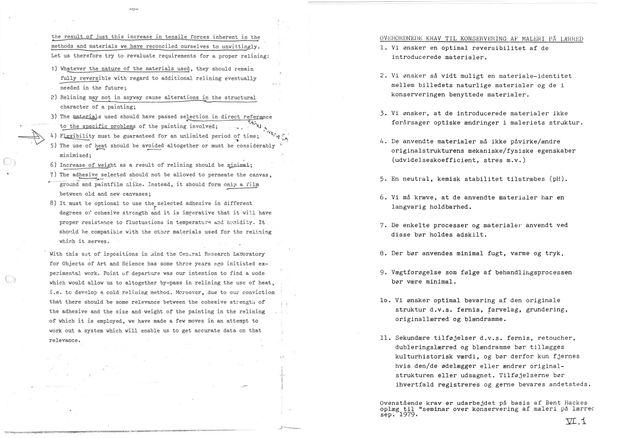
The alternative “low-pressure table” equipment to be used, the “lamination” adhesives and technique, and the underlying philosophy rested on a new approach that Mehra and Hacke shared to a considerable degree but not entirely. There were significant differences between the two, and it is interesting to compare Mehra’s statements (treatment options) from 1972 (see Andersen in this publication) and his subsequent publications in the 1970s with Hacke’s statements published during the same decade (Hacke, B. 1976. “Et lav-tryks apparat til behandling af malerier.” Meddelelser om konservering 2, no. 7–8: 197–222., Hacke, B. 1978. “A Low-Pressure Apparatus for Treatment of Paintings.” In ICOM Committee for Conservation 5th Triennial Meeting: Zagreb, 1–8 October 1978: Preprints. Paris: ICOM.), and compiled in 1979 (fig. 3.1; table 3.1). The second column of table 3.1 presents a set of options for proper lining treatment that came out of a seminar Hacke held at the School of Conservation in September 1979. The list was compiled by the students based on the seminar and Hacke’s previous publications (Hacke, B. 1976. “Et lav-tryks apparat til behandling af malerier.” Meddelelser om konservering 2, no. 7–8: 197–222., Hacke, B. 1978. “A Low-Pressure Apparatus for Treatment of Paintings.” In ICOM Committee for Conservation 5th Triennial Meeting: Zagreb, 1–8 October 1978: Preprints. Paris: ICOM.).
| Mehra 1972* | Hacke 1979† | |
|---|---|---|
| 1 | Whatever the nature of the materials used, they should remain fully reversible with regard to additional relining eventually needed in the future. | Optimal reversibility of the materials introduced (or added) |
| 2 | Relining may not in any way cause alterations in the structural character of a painting. | As far as possible a material identity between the natural materials in the original painting and the materials used in the conservation (process). |
| 3 | The materials used should have passed selection in direct reference to the specific problems of the paintings involved. | Introduced materials should not cause optical changes in the painting structure. |
| 4 | Flexibility must be guaranteed for an unlimited period of time. | Materials used should not affect/change the mechanical/physical characteristics of the original materials (expansion coefficient, stress, etc.). |
| 5 | The use of heat should be avoided altogether or must be considerably minimized. | A neutral chemical stability is to be endeavored. |
| 6 | Increase of weight as a result of relining should be minimal. | Materials used should have long-term durability. |
| 7 | The adhesive selected should not be allowed to penetrate the canvas, ground, or paint-film alike. Instead, it should form only a film between old and new canvases. | Individual processes (and materials used for these individual processes) should be kept separate. |
| 8 | It must be optional to use the selected adhesive in different degrees of cohesive strength, and it is imperative that it will have proper resistance to fluctuations in temperature and humidity. It should be compatible with the other materials used for the relining which it serves. | Water/humidity, raised heat, and pressure should be kept at a minimum. |
| 9 | Increase of weight as a result of the conservation treatment should be minimal. | |
| 10 | Optimal preservation of the original structure is aimed for, such as varnish, paint layers, ground, original canvas, and stretcher / strainer. | |
| 11 | The cultural history of secondary additions should be recognized, including additional varnish, retouches, lining canvas, and stretcher. Such materials or items should only be removed or replaced in case they deteriorate or change the original structure or the appearance. If need be removed, they ought to be registered and preferably kept elsewhere. |
Sources:
* Scharff 1980, 1: 23.
† Compiled by students based on Hacke 1976, Hacke 1978, and the 1979 seminar given by Hacke. (Translated from Danish by the author.)
Table: © Mikkel Scharff, Institute of Conservation, The Royal Danish Academy
In the thesis, both Mehra and Hacke are referred to, but only the Hacke-inspired (unpublished) statement is listed as an appendix to the thesis. In table 3.1, the Mehra and the Hacke statements are shown side by side with their original numbering. They appear mostly to agree, although some statements appear in different order and some do not appear in both lists. The main difference is probably regarding the use of heat or raised humidity or liquid water in the treatments, along with a difference of opinion as to the consequences. In the main thesis text, I summed up my opinion regarding each of the statements, listing which option I chose to follow in a condition list (table 3.2). My condition list was introduced with acknowledgments of the ideal nature of the list and the fact that it would probably not be possible to fulfill all of the options. Likewise, I expected that as the treatment progressed the selection of treatment methods and materials most likely would involve compromises compared with the ideal situation.
| 1. | Optimal reversibility. |
| 2. | — |
| 3. | No optical changes in the painting structure. |
| 4. | Mechanical/physical characteristics of painting structure unchanged by materials. |
| 5. | Chemically neutral stability of materials. |
| 6. | Long-term durability of materials. |
| 7. | Individual processes should be kept separate. |
| 8. | Minimal use of humidity, heat, and pressure. |
| 9. | — |
| 10. | Preservation of original structure. |
| 11. | Acknowledge the cultural history of all constituents. |
Source: Scharff 1980, 1:23.
Table: © Mikkel Scharff, Institute of Conservation, The Royal Danish Academy
A closer look at the treatment options for the thesis work reveals that item 1 (reversibility) was qualified as “optimal” rather than “full” as Mehra has it. At the student seminar, the unrealistic option of full reversibility was discussed, while attempting optimal reversibility was accepted to include a possible failure situation.
Item 2 (“material identity”) was deselected as a treatment condition to avoid material identity between the natural glue materials in the painting and an aqueous animal glue commonly used as a treatment constituent in consolidation. The use of aqueous glue would counter the demands of items 4 and 8. It is further noted in the thesis that item 9 (minimal increase of weight) was also deselected as it was assumed to be of minor significance on the small painting that was the designated thesis subject.
Mehra’s conditions 4, flexibility, and 5, to fully avoid heat, were not included. Nor was Mehra’s term compatible (item 8) used in the arguments for or against the selected materials. In all, where the Mehra and Hacke prescriptions differed, the treatment proposal had a greater affinity with the Hacke statements, for example, by keeping heat as low as possible but not fully ruling it out. A prominent principle listed by Hacke (item 7 in table 3.1) was that each treatment step be kept discrete, and Mehra promotes the principle as well in his Venice ICOM publication (Mehra, Vishwa R. 1975a. “Further Developments in Cold-Lining (Nap-Bond System).” In ICOM Committee for Conservation 4th Triennial Meeting, Venice, 13–18 October 1975: Preprints, 75/11/5/1-26. Paris: International Council of Museums.).
The treatment proposal could be seen as trying alternate means to counter the more traditional treatment solutions and their inherent problems, not least by including the new treatment options employing a low-pressure/suction table. In this way, the proposal followed up on the many discussions that came out of the Greenwich conference and subsequent experiments, discussions, and publications that followed over the next five to six years.
Thesis Outcome—Results of the Planned Treatment
As expected, the actual treatment as described in the thesis did not turn out fully as planned. The final treatment ended up as a selection of compromises to some extent, where some of the ideal demands had to be partly diluted, deselected, or dismissed.
For instance, the application of facing paper with an acrylic solution that had been proposed did not work as planned. At the suggestion of the tutors, it was replaced with a thin layer of wax-resin paste applied at a temperature of no higher than 45°C. In the end, however (according to the thesis documentation), a temperature of 65°C had to be used to ensure the adhesion of the facing paper—thus compromising the idea of keeping the temperature as low as possible.
Subsequent removal of the previous glue-paste lining went well (figs. 3.2, 3.3) and so did the flattening procedure. A humidification chamber setup on the low-pressure table was used, with a tabletop temperature of 35°C and pressure at 50 millibars (mbar). To avoid liquid water in the structure, consolidation was done with an acrylic solution, and after solvent evaporation the consolidant was “activated” by heating the painting on the low-pressure table at 100 mbar and 42°C. The linen lining canvas was coated with a layer of thickened acrylic dispersion, and after a drying period the dry acrylic layer on the lining canvas and the consolidated painting were activated at 100 mbar and 42°C. After cooling, the proper lamination was obtained, basically following directions in Hacke and Ketnath (Hacke, B. 1976. “Et lav-tryks apparat til behandling af malerier.” Meddelelser om konservering 2, no. 7–8: 197–222.; Ketnath, A. 1976. “Acrylhartser ved konservering af malerier på laerred under anvendelse af ‘heat seal’ metoden.” Meddelelser om konservering 2, nos. 7–8: 223–35.).
A final, unplanned step in the structural treatment was added at the suggestion of the tutor to remedy a certain canvas structure enhancement and moating—most likely stemming from the previous glue-paste lining. The prescription was a final treatment of the painting, facedown on a vacuum hot table at 500 mbar and 42°C. The resulting painting surface after this treatment did not exhibit any canvas structure at all, and the painting was ready for the restoration part of the thesis project. However, neither the facedown treatment nor the 500 mbar pressure was fully in line with the ideas of the planned treatment. Nevertheless, the restoration went well, and in the summer of 1980 I obtained my bachelor’s degree in conservation and went on to the master’s program.
Consequences—Evaluation of a Treatment and Its Consequences
In general, it is interesting to note how much the new treatment concepts and material choices influenced the treatment design of the thesis work for me and my fellow students, and how little actual knowledge about the impact of the treatment and the choice of materials to use was available to us at the time. Most choices were based on the then-current “demands” or “recommendations,” but they were also partly based on the critique of bygone treatments and materials as discussed in publications during the 1970s and especially after the Greenwich conference in 1974. The Greenwich offprints were also mostly based on assumptions, common sense, and empirical and tacit knowledge.
It was also interesting to see how treatment inadequacies or shortcomings in the conglomerate of new techniques and materials were addressed by reverting to better-known techniques and materials during the thesis treatments—eventually once again reverting to empirical and tacit knowledge. However, this was to gradually change over the ensuing ten to twenty years. At the time of the first thesis, to treat or not to treat was perhaps not yet a mature question to pose, but it would turn out to be an issue of increasing debate in the next couple of decades.
Further Developments—The 1980s and Onward
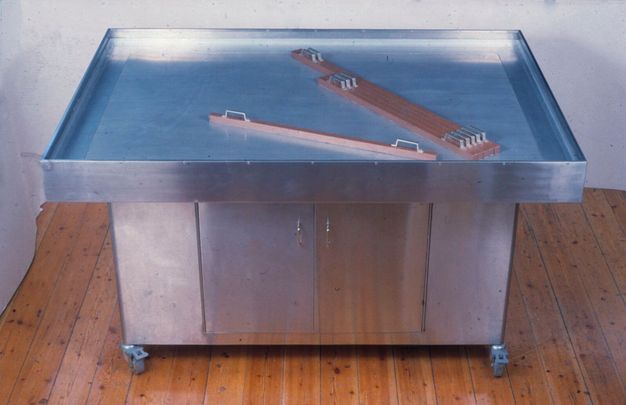
In the 1980s, after the relatively new suction table was added as new equipment at the School of Conservation and other conservation studios in Denmark, conservators across the country began to further develop the equipment, as it seemed a useful tool for the treatment of many canvas paintings. The first suction table at the school was rather small, so an all-aluminum suction frame was developed based on the design of larger wooden frames at the National Museum of Denmark and the Museum of Fine Arts. It was constructed to fit the surface of the larger vacuum hot table and could utilize its heat capacity if need be. This made it possible to treat larger paintings with suction-table techniques.
Construction of minisuction equipment was the result of one student thesis during these years (Mitka, W. 1985. “Portable Mini Low-Pressure Apparatus for the Treatment of Paintings.” Studies in Conservation 30, no. 4: 167–70.). A different student thesis included the construction of a large suction table (Petéus, T. 1984. “En lågtrycksapparat för använding på värme-vaccuumbordet.” Meddelelser om konservering 3, no 8: 295–302.), and another large, experimental table was built by Mitka at the School of Conservation. All these tables had built-in heating capacity, and the latter included conditioned air which flowed in from below or via a chamber above the painting during treatment on the suction table. Built-in sensors enabled the user to follow and record temperature and humidity on paper tape.
Similar new—and even larger—low-pressure tables were designed and built ad hoc for special projects in situ in manor houses or for general use in the Danish conservation studios. Comparable activities took place in many countries, with either in-house designed equipment or commercial suction tables (Reeve, Anthony. 1984. “A New Multi-Purpose Low-Pressure Conservation Table for the Treatment of Paintings.” Studies in Conservation 29, no. 3: 124–28.). The interest in the techniques and equipment (see Coddington in this publication) and the results of the construction and use of suction tables were reported and discussed at conferences such as ICOM-CC, including the 1984 ICOM-CC conference in Copenhagen.
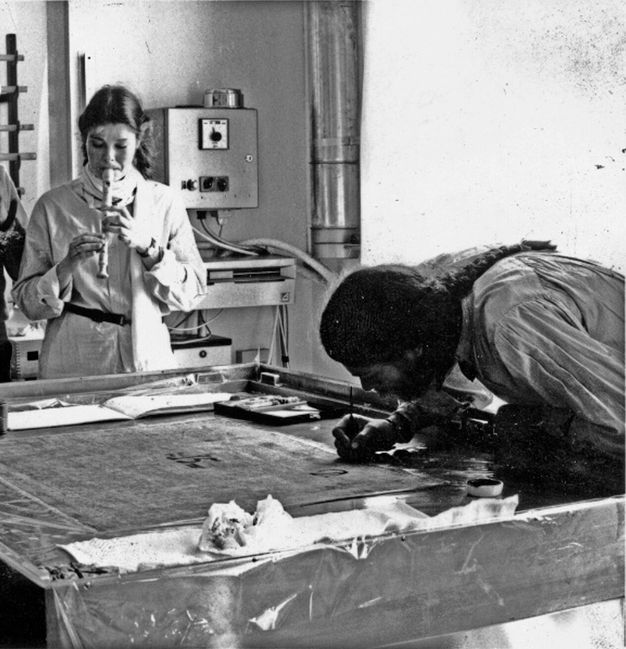
In the following six years, summer programs on the subject were organized at the School of Conservation (in collaboration with ICCROM) to introduce and discuss suction-table techniques and principles and making it possible for numerous participants over the years to try out selected techniques (fig. 3.4). Discussions were lively (figs. 3.5, 3.6) and included technical and ethical debates on the specific aspects of the techniques and the use of new materials. Such topics included nap-bond acrylic dispersion-adhesives, EVA-based adhesives (e.g., Beva 371), fiberglass cloth, limited interventions, temperature, humidity, strip-linings, loose-linings, and much more. In tune with the prevailing discussions in paintings conservation in general, the idea of how much treatment was really necessary—and if so, what kind—was discussed as well, and Percival-Prescott’s 1974 concept of the lining cycle and whether to treat or not to treat was a regular part of conversations.
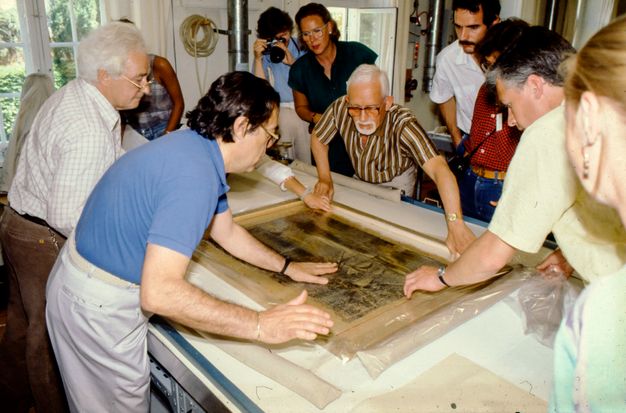
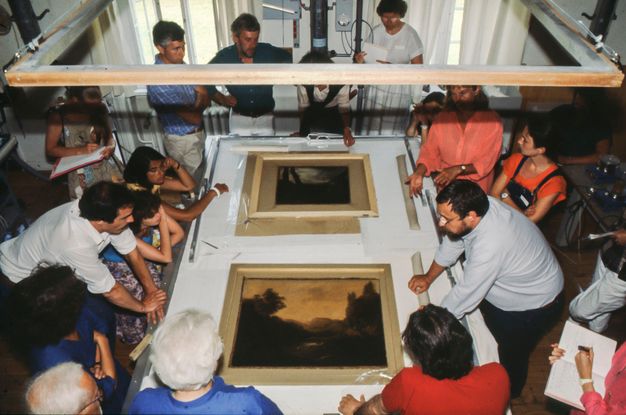
In parallel with the summer schools, a set of visual teaching aids was being produced in collaboration with the Getty Conservation Institute. The aim was to produce step-by-step images of the recently developed lining techniques, along with a detailed description of each step, as a didactic tool for teachers in canvas paintings conservation. The aids were used at each summer program and in regular courses at School of Conservation before being finalized in 1990 (Scharff, Mikkel. 1995. “The Development and Present Status of Structural Conservation Treatments of Canvas Paintings in Denmark.” In Lining and Backing—The Support of Paintings, Paper and Textiles: Papers Delivered at the UKIC Conference, 7–8 November 1995, edited by Andrew Durham and United Kingdom Institute for Conservation of Historic and Artistic Works. London: United Kingdom Institute for Conservation of Historic and Artistic Works.).
The production of the aids turned out to be a real challenge, since the treatment steps needed to be explained and, if possible, supported by recent knowledge. As the understanding of canvas paintings’ reactions to treatments was very limited at the beginning of the 1980s—and only gradually became supported by publications during the second half of the decade and beyond—it was not always possible to present a well-supported argument for some of the treatment steps or material choices. However, the process for developing the aids was designed to let any teacher using a given treatment add new and relevant information as it became available, as well as to discuss the logic of the approaches with the students or to dismiss some treatment steps as obsolete. In this way, the treatment rationale and background for the treatments could be updated.
While some parts of these teaching aids appear outdated today, thirty years later other parts remain useful, and the whole set serves as both a legacy and documentation of a major evolution in the philosophy and practical approach to canvas paintings conservation in the two decades following the Greenwich conference.
Teaching in paintings conservation programs has changed in many respects since the 1980s and 1990s. Less emphasis is now placed on learning a complete set of treatment techniques in favor of a greater concentration on principles and a better understanding of the materials and structures that a painting is composed of, with the aim of better understanding deterioration mechanisms and the properties and impact of treatments and associated materials. Experimental work plays an increasing role, as it further enhances the understanding of the concepts. Hopefully, it will have an impact on whether the future profession concentrates mainly on hands-on treatments or develops a more general approach to entire collections.
The development of a better scientific understanding of the behavior of canvas painting structures themselves, as well as treatment techniques and materials, took place in parallel with the practical experiments and experiences among a limited number of researchers and conservators. Results were published and discussed at conferences, not least at the ICOM-CC working group on structural treatment of canvas paintings that was active at the second half of the 1980s and into the 1990s, as presented in more recent accounts (Hackney, Stephen. 2020. On Canvas: Preserving the Structure of Paintings. Los Angeles: Getty Publications.). In particular, publications from Hedley, Mecklenburg, and Michalski provided new insights; Hedley regularly published on the behavior of canvas paintings with a special interest in studying the interaction with humidity (Hedley, Gerry. 1993. “Relative Humidity and the Stress/Strain Response of Canvas Paintings: Uniaxial Measurements of Naturally Aged Samples.” In Measured Opinions: Collected Papers on the Conservation of Paintings, edited by Caroline Villers, 86–96. London: United Kingdom Institute for Conservation of Historic and Artistic Works.). Mecklenburg and Michalski provided new and valuable insights in painting structure behavior, for example at the Art in Transit conference and its subsequent publication (Mecklenburg, Marion, ed. 1991. Art in Transit: Studies in the Transport of Paintings. Washington, DC: National Gallery of Art.; Michalski, Stefan. 1991. “Paintings: Their Response to Temperature, Relative Humidity, Shock, and Vibration.” In Art in Transit: Studies in the Transport of Paintings, edited by Marion Mecklenburg, 223–48. Washington, DC: National Gallery of Art.). Such advances originated from or gradually fed into the educational programs in Denmark and abroad, in collaboration with the steadily growing group of practitioners with strong interests in canvas behavior. Without continued research supporting and advancing the field, it would have been impossible to gain a proper understanding of the structure of a painting, its mechanics, and the impact of environment and treatments.
The interest in and experiments with new equipment, methods, and materials in the 1980s that resulted from recognizing the need for changes in canvas conservation gradually faded away as a different approach to canvas painting treatments evolved and became accepted. The new approach placed more focus on preventive means, perhaps following principles of more limited interventions, and coincided with the growing popularity of EVA-based adhesives and adhesive sheets and several proposed nap-bond application techniques (although still using a relatively high temperature of 65°C).
Thus, gradually, as treatment methods evolved, a better understanding of the impact of structural treatments emerged, and as interest in preventive conservation grew, an increasing number of practitioners became more reluctant to carry out the number of treatments that had been customary in the past. Little by little, practitioners began leaning toward the more limited interventions that many have identified collectively using the term minimalism (see, e.g., Ackroyd, Paul, and Caroline Villers. 2003. “The Problem with Minimalism.” In Alternatives to Lining: Structural Treatment of Paintings on Canvas without Lining: A Conference Held Jointly by the British Association of Paintings Conservator-Restorers and the United Kingdom Institute for Conservation Paintings Section, 19 September 2003: Preprints, edited by Mary Bustin and Tom Caley, 9–14. London: United Kingdom Institute for Conservation of Historic and Artistic Works.). The increasing impact of preventive conservation and risk management/assessment (Antomarchi, C., A. Brokerhof, S. Michalski, I. Verger, and R. R. Waller. 2005. “Teaching Risk Management of Collections Internationally.” Collections: A Journal for Museum and Archives Professionals 2, no. 2: 117–40.) in decision-making may also influence the approach to the preservation of canvas paintings in the future.
While further development of treatment methods and materials seems largely to have been on hold over the past twenty years, research into canvas paintings’ material structure and mechanics has increased: How is the structure affected by the environment during exhibition or storage? What is the impact of conservation treatments—past and present? A growing number of conservators and scientists are working together in national and international research groups, taking advantage of the steadily growing availability of analytical equipment and methods, including the use of computer modeling to predict behavior. A steady increase in publications in the field also provides everyone in conservation studios and conservation students in educational institutions with an ever-expanding trove of relevant information. Hopefully, in the future, all of this will lead to a better understanding of material behavior and deterioration phenomena, and we will be able, ultimately, to predict the future response of canvas paintings under given conditions and develop better means to preserve them—either by active treatment procedures or by preventive measures—and thus maintain our cultural heritage for future generations.
Today, we may have passed the point where there were only two options: to treat or not to treat at all. Perhaps the question now should be whether to line or not to line. Luckily, the advances in the field in practice, as well as research since the Greenwich conference, have given us a sounder basis for selecting better options to preserve canvas paintings. Nonetheless, there is still much to learn, and we hope that it will be conducted in the spirit of the Greenwich conference, which laid the groundwork for nearly fifty years of progress in canvas paintings conservation.
Notes
-
Training as house painters in Denmark up to the 1970s included learning a variety of techniques, such as decorative paint finishes, faux marbling, and graining. ↩︎
-
Danish Ministry of Culture, Betænkning om organisation af konserveringsvirksomheden ved museer, arkiver og biblioteker samt om oprettelse af en konservatorskole, Parliamentary Report 525, 1969. ↩︎
-
UNESCO, Convention Concerning the Protection of the World Cultural and Natural Heritage, 1972. https://whc.unesco.org/en/conventiontext/. ↩︎
-
A copy exists in the museum archives. ↩︎
-
The term lamination used in Denmark at the time was later referred to in some publications as “nap bond.” ↩︎
-
Ruhemann suggested the design to Stephen Rees Jones, who constructed the table. ↩︎