In this paper, Vishwa Mehra’s eight requirements for linings—as written in a report from 1972—are reviewed in a contemporary context nearly fifty years later. Special emphasis is placed on concepts like flexibility, compatibility, and physical integrity, which are still part of conservation discussions. Some of the concepts discussed by Mehra did not have a clear definition, or his understanding of them either was not given or differed from a more contemporary understanding. This means that his concepts can be used for many different purposes and to justify many different actions. Requirements in conservation were perhaps necessary at a time when the profession was undergoing significant change, but now requirements are generally replaced with recommendations, guidelines, or analysis of the risks involved in a considered action. A way of looking at risk analyses for structural paintings conservation is proposed as a way forward for assessing these treatments.
21. Mehra’s Eight Requirements for Linings, Revisited: Evaluation of Linings for Canvas Paintings—Then and Now
- Cecil Krarup Andersen, Associate Professor, Head of Paintings Conservation, The Royal Danish Academy of Fine Arts, School of Conservation, Copenhagen
Introduction
The aim of this paper is to revisit and evaluate some early requirements for linings of canvas paintings proposed by Vishwa Mehra (Mehra, Vishwa R. 1972. “Comparative Study of Conventional Relining Methods and Materials and Research towards Their Improvement.” Unpublished interim report for the Central Research Laboratory for Objects of Art and Science, Amsterdam, and ICOM Committee for Conservation. Published in Interim Report of ICOM Conference, Committee for the Care of Painting, 18–19, and ICOM Committee for Conservation: 3rd Triennial Meeting, Madrid, Spain, 1972: Preprints, 72/21/4. Paris: International Council of Museums; Amsterdam: Central Research Laboratory for Objects of Art and Science.) and review them in a contemporary context. The requirements have been very influential within the field of conservation. They were used as guidelines for working conservators and teachers in structural conservation (see Mikkel Scharff’s paper in this publication), and the recommendations have been referenced in normative discussions about conservation praxis. Mehra’s ideas inspired a whole generation of conservators and influenced best practice considerations in structural conservation of canvas paintings for decades (Beltinger, Karoline. 1995. “Reversible Supports for Paintings as an Alternative to Lining.” In Lining and Backing: The Support of Paintings, Paper and Textiles: Papers Delivered at the UKIC Conference, 7–8 November 1995, London, United Kingdom, edited by Andrew Durham, 111–18. London: United Kingdom Institute for Conservation of Historic and Artistic Works.; Hackney, Stephen, Joan Riefsnyder, Mireille Te Marvelde, and Mikkel Scharff. 2012. “Lining Easel Paintings.” In Conservation of Easel Paintings, edited by Joyce Hill Stoner and Rebecca Rushfield, 415–52. Abingdon: Oxon; New York: Routledge.; Phenix, Alan. 1995. “The Lining of Paintings: Traditions, Principles, and Developments.” In Lining and Backing: The Support of Paintings, Paper and Textiles: Papers Delivered at the UKIC Conference, 7–8 November 1995, UKIC, Hampshire, edited by Andrew Durham, 21–33. London: United Kingdom Institute for Conservation of Historic and Artistic Works.; van Och, Jos, and René Hoppenbrouwers. 2003. “Mist-Lining and Low-Pressure Envelopes: An Alternative Lining Method for the Reinforcement of Canvas Paintings.” Zeitschrift für Kunsttechnologie und Konservierung 17, no. 1: 116–28.).
Vishwa Mehra is an Indian conservator of paintings and an art historian born in 1931. He studied conservation in India, Yugoslavia, and Rome and worked in Israel before he acquired a position at the Central Research Laboratory for Objects of Art and Science, in Amsterdam.1
Through the 1960s there was an increased effort to strengthen and professionalize the field of conservation of cultural heritage. The first ethical guidelines for conservators, the Murray Pease report, were written for IIC-American group (later the American Institute for Conservation [AIC]) in 1963 (Pease, Murray. 1964. “The Murray Pease Report.” Studies in Conservation 9, no. 3: 116–21. https://doi.org/10.1179/sic.1964.018.), and in 1964 the Venice charter expanded on these thoughts (charter and introduction can be found in Jokilehto, Jukka. 1998. “The context of the Venice Charter (1964).” Conservation and Management of Archaeological Sites 2, no. 4: 229–33.). The founding of ICOMOS (International Council on Monuments and Sites) in 1965 and of ICOM-CC in 1967 and the adoption of the 1972 UNESCO World Heritage Convention are also key events in the effort to protect cultural heritage, in light of which Mehra’s paper should be seen.
One event that also had enormous influence on this development was the catastrophic flooding of Florence on November 4, 1966. It became a milestone in the history of conservation for many reasons, one of them being that the need for education and conservation norms became evident as a result (Federspiel, Beate Knut. 2015. “Oversvømmelsen I Firenze.” Sfinx 38, no. 2: 58–64.). At the second plenary ICOM-CC meeting in Amsterdam, the Italian conservator Giovanni Urbani called for a more systematic and rational approach to lining canvas paintings (Urbani, G., ed. 1969. “Propositions pour un programme de recherches sur la conservation des peintures sur toile” [Proposals for a Research Program on the Conservation of Paintings on Canvas]. ICOM Report 69/45. Paris: ICOM.). In 1972, Mehra presented his eight requirements for linings in an interim report for the ICOM-CC meeting in Madrid on behalf of the Central Research Laboratory, “Comparative Study of Conventional Relining Methods and Materials and Research towards Their Improvement” (Mehra, Vishwa R. 1972. “Comparative Study of Conventional Relining Methods and Materials and Research towards Their Improvement.” Unpublished interim report for the Central Research Laboratory for Objects of Art and Science, Amsterdam, and ICOM Committee for Conservation. Published in Interim Report of ICOM Conference, Committee for the Care of Painting, 18–19, and ICOM Committee for Conservation: 3rd Triennial Meeting, Madrid, Spain, 1972: Preprints, 72/21/4. Paris: International Council of Museums; Amsterdam: Central Research Laboratory for Objects of Art and Science.). In this report, Mehra discussed concepts that to this day remain essential to conservation. Some concepts were relevant for the general field of conservation-restoration, such as structural integrity of objects, reversibility, and compatibility of treatments. Other concepts in Mehra’s paper, including flexibility/stiffness, hygroscopicity, and permittivity, were especially important for lining paintings.
Mehra argued that traditional lining techniques using glue paste and wax resin were too invasive and nonreversible, as they caused the whole painting structure to become embedded in adhesive. Furthermore, he warned against the use of heat in linings, the forces exerted by retensioning a painting, and the extra weight of a wax-resin lining.
The Eight Requirements and the Intentions Behind Them
In his paper, Mehra proposed eight basic requirements for linings. Table 21.1 lists the requirements as they were formulated in the report fifty years ago. The questions that drive this paper are whether they are still useful and what they can tell us about our present attitude toward structural treatment of canvas paintings.
| 1. | Whatever the nature of the materials used, they should remain fully reversible with regard to additional relining eventually needed in the future |
| 2. | Relining* may not in anyway cause alterations in the structural character of a painting |
| 3. | The materials used should have passed the selection in direct reference to the specific problems of the painting involved |
| 4. | Flexibility must be guaranteed for an unlimited period of time |
| 5. | The use of heat should be avoided altogether or must be considerably minimized |
| 6. | Increase of weight as a result of relining should be minimal |
| 7. | The adhesive selected should not be allowed to permeate the canvas, ground and paintfilm alike. Instead, it should form only a film between old and new canvases |
| 8. | It must be optional to use the selected adhesive in different degrees of cohesive strength and it is imperative that it will have proper resistance to fluctuations in temperature and humidity. It should be compatible with the other materials used for the relining which it serves |
Source: Mehra 1972 (verbatim).
*Relining means lining; see Andersen 2012.
Table: Cecil Krarup Andersen
This paper was presented at the 2019 Conserving Canvas symposium held at the Institute for the Preservation of Cultural Heritage at Yale University.2 The symposium title, Conserving Canvas, echoes the core of the discussions around Mehra’s paper. Mehra, in the Netherlands, and Bent Hacke (Hacke, B. 1963–64. “En utraditionel metode til vacuumrentoilering af temperamaleri på lærred.” Meddelelser om konservering 1, no. 4: 42–48.), in Denmark, became advocates for treatment strategies that were designed to treat one problem at a time rather than the complete range of problems in a painting at once. Problems related to the canvas were now seen as a separate part of the canvas painting, and the treatments proposed (nap bond in the Netherlands and lamination in Denmark) were designed to deal with this layer. The ideas behind this concept of separation were presented in Mehra’s paper (Mehra, Vishwa R. 1972. “Comparative Study of Conventional Relining Methods and Materials and Research towards Their Improvement.” Unpublished interim report for the Central Research Laboratory for Objects of Art and Science, Amsterdam, and ICOM Committee for Conservation. Published in Interim Report of ICOM Conference, Committee for the Care of Painting, 18–19, and ICOM Committee for Conservation: 3rd Triennial Meeting, Madrid, Spain, 1972: Preprints, 72/21/4. Paris: International Council of Museums; Amsterdam: Central Research Laboratory for Objects of Art and Science.), where he warned against the long-held tradition of linings impregnating the structure. In this paper, the specific requirements written by Mehra are discussed in a contemporary context.
Reversibility
The first requirement is that the materials used should remain fully reversible (see table 21.1). According to Appelbaum, the “principle of reversibility” was written into the AIC Code of Ethics and it was advised that the conservator “should avoid the use of materials which may become so intractable that their future removal could endanger the physical safety of the object. He also should avoid the use of techniques the results of which cannot be un-done if that should become desirable” (Appelbaum, Barbara. 1987. “Criteria for Treatment: Reversibility.” Journal of the American Institute for Conservation 2, no. 26: 65–73. .). However, fully reversible treatments are rarely possible, and the concept has been subject to much discussion. Muñoz Viñas has argued that the greater the reversibility, the less the conservator’s responsibility (Muñoz Viñas, S. 2005. Contemporary Theory of Conservation. Oxford: Butterworth-Heinemann.). Concepts such as removability and retreatability (Appelbaum, Barbara. 1987. “Criteria for Treatment: Reversibility.” Journal of the American Institute for Conservation 2, no. 26: 65–73. .; Charteris, L. 1999. “Reversibility—Myth and Misuse.” In Reversibility—Does It Exist?, edited by A. Oddy and S. Carroll, 141–45. London: British Museum.) have been suggested as alternatives, but these still require an understanding of issues including surface tension, penetration, solubility with age, and peel strength—all topics that are still not properly investigated with respect to lining techniques. Despite the debates around the concept, reversibility is still written into the E.C.C.O. Professional Guidelines, in article IX of the Code of Ethics (E.C.C.O. (European Confederation of Conservator-Restorers Organisations). 2003. Professional Guidelines (II): Code of Ethics. https://www.ecco-eu.org/wp-content/uploads/2021/03/ECCO_professional_guidelines_II.pdf.).
Changing the Structure
The second requirement is that lining, or relining as Mehra called it (Andersen, Cecil Krarup. 2012. “Lining, Relining and the Concept of Univocity.” E-Conservation Magazine 23 (March): 47–56.), may not in any way cause alterations to the structural character of a painting. Although it is not completely clear what he means by “the structural character,” it is known that he wanted to avoid heat and high pressure, which may change the shape of the paint. He therefore described the nap-bond treatment that targeted the needs of the canvas specifically.
The reality, now and then, is probably that most active treatments change the structure slightly, but some changes are more invasive than others, and some create more potential for future damage than others. The traditional adhesives for lining, glue paste and wax resin, were intended to penetrate the painting structure, but Mehra’s new thoughts were to avoid the penetration.
The seventh requirement—that the adhesive selected should not be allowed to permeate the canvas, ground, and paint film—is closely related to Mehra’s second requirement. Mehra wanted the adhesive to form only a film between old and new canvases, instead of penetrating the structure. This idea has prevailed in many traditions, and the nap-bond lining (or, in Scandinavia, lamination, inspired by Bent Hacke) became popular among progressive conservators of the time. The nap-bond technique was considered minimal intervention and was intended to ensure reversibility. Saving the physical integrity of an object is written into E.C.C.O.’s Professional Guidelines, in article V of the Code of Ethics (E.C.C.O. (European Confederation of Conservator-Restorers Organisations). 2003. Professional Guidelines (II): Code of Ethics. https://www.ecco-eu.org/wp-content/uploads/2021/03/ECCO_professional_guidelines_II.pdf.) as well as AIC’s Code of Ethics, article 21 of the Guidelines for Practice (AIC (American Institute for Conservation). n.d. Code of Ethics: Guidelines for Practice. https://www.culturalheritage.org/about-conservation/code-of-ethics.). Thus, the requirement could probably still be seen as having significant weight, even though both glue paste and wax-resin lining are still practiced, as is impregnation of canvas paintings with glue and Beva.
This is much in line with the sixth requirement that increase of weight due to lining should be minimal. This, of course, was in comparison to a wax-resin lining, which was very heavy. A large format could be deformed simply by the weight of a heavy lining material if it was not supported. Lightweight treatments are still preferable, including stretchers and backing boards—especially for large formats—in light of increased loan activity between museums. In these situations, extra weight makes the painting more difficult to handle and increases the risk of high forces due to impact if the painting is dropped during transportation. Furthermore, a heavy structure can increase the risk of failure in the hanging system.
The Flexibility Requirement
The fourth requirement (see table 21.1) is that flexibility must be guaranteed for an unlimited period of time. It is not specified if Mehra means in the complete lining structure or in the canvas, the adhesive, or a possible interleaf. An argument for a flexible lining adhesive was mentioned as early as 1931, when the Canadian painter and sculptor Percyval Tudor-Hart advised that a lining adhesive should provide unlimited flexibility and recommended the “Dutch” adhesive (Tudor-Hart, P. 1931. “Nettoyage, rentoilage et vernissage des peintures.” Mouseion 15, no. 3: 23–40.), and that same year two American conservators remarked that a wax-lining is “the best that is yet found for relining . . . It is flexible, never becoming brittle” (Durham, Charles, and Fulton Leser. 1931. “American Viewpoints on the Care of Paintings.” International Studio 99: 37–39, 74.). The unlimited flexibility mentioned by Mehra should be seen in light of these sources and the long historical experience with brittle glue-paste linings. However, flexibility in lining adhesive and flexibility in lining as a whole are two very different concepts. In his requirements, Mehra mentioned the lining as a whole and not just the adhesive. In 1981, he contradicted this requirement in a paper on lining canvases, where he wrote that lining canvases should be as stiff as possible (Mehra, Vishwa R. 1981b. “Minimizing Strain and Stress in Lining Canvas Paintings.” In ICOM Committee for Conservation: 6th Triennial Meeting: Ottawa, Canada, 21–25 September 1981: Preprints, 81/2/14-1–8. Paris: ICOM.).
A year later, Mecklenburg summed up his approach to providing stability in a painting: “to support a painting, the material chosen must: 1) be capable of developing and maintaining a large percentage of the total force of a stretched painting; 2) be able to restrain in-plane displacement as developed by desiccated glue and paint films; 3) restrain out-of-plane distortion such as cupping and buckling” (Mecklenburg, Marion F. 1982. “Some Aspects of the Mechanical Behavior of Fabric Supported Paintings: Report to the Smithsonian Institution.” Unpublished report, Smithsonian Museum Conservation Institute, Washington, DC. Reprinted in Dawn V. Rogala, Paula T. DePriest, A. Elena Charola, and Robert J. Koestler, eds. The Mechanics of Art Materials and Its Future in Heritage Science, 107–29. Washington, DC: Smithsonian Contributions to Museum Conservation, 2019. https://doi.org/10.5479/si.11342126.). He furthermore advised that a high modulus3 of the lining material was preferable and that thickness would provide support against out-of-plane distortions.
Thus, research has shown that stiff linings can reduce the risk of further cracks and cupping in a painting (Mecklenburg, Marion F. 1982. “Some Aspects of the Mechanical Behavior of Fabric Supported Paintings: Report to the Smithsonian Institution.” Unpublished report, Smithsonian Museum Conservation Institute, Washington, DC. Reprinted in Dawn V. Rogala, Paula T. DePriest, A. Elena Charola, and Robert J. Koestler, eds. The Mechanics of Art Materials and Its Future in Heritage Science, 107–29. Washington, DC: Smithsonian Contributions to Museum Conservation, 2019. https://doi.org/10.5479/si.11342126.; Hedley, Gerry. 1988. “Relative Humidity and the Stress/Strain Response of Canvas Paintings: Uniaxial Measurements of Naturally Aged Samples.” Studies in Conservation 33, no. 3: 133–48. https://doi.org/10.2307/1506206.; Andersen, Cecil Krarup. 2013. “Lined Canvas Paintings: Mechanical Properties and Structural Response to Fluctuating Relative Humidity, Exemplified by the Collection of Danish Golden Age Paintings at Statens Museum for Kunst (SMK).” PhD diss., School of Conservation, KADK Royal Danish Academy of Fine Arts.), which contradicts Mehra’s 1972 report. However, it is worth remarking that Mehra had been measuring the bending stiffness of the linings he tested, as opposed to the later studies, which measured stiffness in tension. For paintings, this means the difference between in-plane and out-of-plane forces.
With this development in mind, it is interesting to observe how Mehra’s early thoughts on flexibility have inspired conservators to require flexible linings (Heiber, Winfried. 1987. “Die Doublierung mit Geweberasterhaftung.” ZKK Zeitschrift für Kunsttechnologie und Konservierung 1, no. 2: 72–76.; van Och, Jos, and René Hoppenbrouwers. 2003. “Mist-Lining and Low-Pressure Envelopes: An Alternative Lining Method for the Reinforcement of Canvas Paintings.” Zeitschrift für Kunsttechnologie und Konservierung 17, no. 1: 116–28.). Thus, the properties of lining canvases remained a cause for disagreement within the conservation profession for many years after Mehra’s report, despite the fact that he was the first to change his statement.
Degradation Agents—What Is Worse?
The fifth requirement (see table 21.1) was that the use of heat should be avoided altogether, or at least must be considerably minimized. Heat could deform the painting and increase the chemical degradation rate. While this is true, high moisture/water, pressure, and solvents can also have a lasting negative effect on paint layers, and all are used in paintings conservation. The question of what is causing more degradation remains unanswered and relies heavily on the materials and properties of each individual painting. Solvents can cause swelling and leaching in paint and ground layers (Phenix, Alan. 2002. “The Swelling of Artists’ Paints in Organic Solvents, Part 2: Comparative Swelling Powers of Selected Organic Solvents and Solvent Mixtures.” Journal of the American Institute for Conservation 41, no. 1: 61–90.), and the development of metal soaps can be accelerated by moisture (Garrappa, Silvia, Eva Kočí, Silvie Švarcová, Petr Bezdička, and David Hradil. 2020. “Initial Stages of Metal Soaps Formation in Model Paints: The Role of Humidity.” Microchemical Journal 156: 104842. https://doi.org/10.1016/j.microc.2020.104842.). However, all of this is a question of the extent and duration of exposure to these factors. The discussion of what is worse for a paint layer—exposure to fluctuating climate or exposure to water or solvents while cleaning, lining, or other conservation treatments—is still unresolved. New research is, however, starting to tackle these questions with, for example, nanoindentation, which allows for the study of the mechanical properties of paint surfaces (Andersen, C. K., A. Freeman, M. N. Mortensen, V. Beltran, M. Łukomski, and A. Phenix. 2019. “Mechanical and Moisture Sorption Properties of Commercial Artists’ Oil Paint by Dynamic Mechanical Thermal Analysis (DMA), Nanoindentation, and Dynamic Vapour Sorption (DVS).” In Conservation of Modern Oil Paintings, edited by K. J. Van den Berg, I. Bonaduce, A. Burnstock, B. Ormsby, M. Scharff, L. Carlyle, G. Heydenreich, and K. Keune, 403–18. Cham, Switzerland: Springer.).
Choice of Materials for Specific Purposes
Mehra’s requirements for linings were widely seen as an argument for nap-bond linings only, but the third and the eighth requirements are actually pointing to the need to adapt each treatment to the specific problem at hand. Thus, the last requirement is that it must be optional to use a selected adhesive, in different degrees of cohesive strength, and that it is imperative that it has the proper resistance to fluctuations in temperature and humidity.
Mehra advised that the materials used in conservation should have passed selection in direct reference to the specific problems of the painting involved. While this is a nice principle, more specific failure/success criteria are needed in order to make such decisions. Very little advice is provided for choosing the amount of strength, stiffness, moisture, solvent, pressure, and so forth needed; thus, the choice of materials and methods largely remains a matter of practical experience and tacit knowledge.
Consider the case of a very torn canvas painting with frayed tacking edges. Different conservation traditions would imply different solutions to this problem. Everything from tear mending to glue-paste, wax-resin, and synthetic adhesive linings would be used and justified as the right treatment for this specific problem, depending on the tradition in which the conservator was trained. This is a testament to the reality that conservation is still a craft when it comes to structural treatments and that very little science-based consensus is found.
Compatibility
In the eighth and last requirement, Mehra wrote that the lining adhesive should “be compatible with the other materials used for the relining which it serves.” The meaning of “compatible” is not clear, and Mehra does not define it. It remains an open question whether poor compatibility means that the material does not bond well, that it is historically or ethically wrong, or perhaps that it has different properties from the original materials. It is also not clear how compatibility may be judged in a scientific manner. And yet the word is frequently used.
In E.C.C.O.’s Code of Ethics article IX, compatibility is included as a requirement, but it remains undefined. The European Committee for Standardization (CEN) standard defining the most important general terms used in conservation of cultural heritage, EN 15898:2011, defined compatibility as the “extent to which one material can be used with another material without putting significance or stability at risk” (CEN (European Committee for Standardization). 2011. “Conservation of Cultural Property—Main General Terms and Definitions.” Standard EN 15898:2011. Brussels: CEN.). Acknowledging that this was still a rather vague definition, Revez proposed the following definition: “Compatibility corresponds to the extent to which a product, method or action may be used upon a heritage object without putting its present or future significance at risk” (Revez, Maria João Cassis Valadas. 2016. “Compatibility Matters: Assessing the Risks of Built Heritage Cleaning.” PhD diss., Universidade Nova de Lisboa.). In the updated version of the CEN standard from 2019 (EN 15898:2019), the definition was clarified further: “extent to which one material can be used with another material without compromising significance or stability of the object. Note 1 to entry: this relates to conservation materials or to components of the object” (CEN (European Committee for Standardization). 2019. “Conservation of Cultural Property—Main General Terms and Definitions.” Standard EN 15898:2019. Brussels: CEN.).
Useful compatibility indicators have been proposed for stone conservation and the conservation of archaeological sites by Rodrigues and Grossi (Rodrigues, J. Delgado, and Antonella Grossi. 2007. “Indicators and Ratings for the Compatibility Assessment of Conservation Actions.” Journal of Cultural Heritage 8, no. 1: 32–43.), but due to the difference in materials, these are not easily translated to paintings conservation. One indicator that might be useful, however, is physical content, which represents “intrinsic properties responsible for the performance of the intervention action, considered in its material side” (Rodrigues, J. Delgado, and Antonella Grossi. 2007. “Indicators and Ratings for the Compatibility Assessment of Conservation Actions.” Journal of Cultural Heritage 8, no. 1: 32–43.). The other indicators are the operational background, the sociocultural context, and the environmental constraints. Assuming that compatibility is a multifaceted concept that can be broken down into a number of simpler categories, Rodrigues and Grossi propose a rating system (from 1 to 10) for each action taken, which would then be translated to an incompatibility degree for a proposed treatment of stone and buildings. The question remains whether this concept works for structural paintings conservation.
It seems that in the context of Mehra’s paper, the physical indicator was probably what was more on his mind. If for the sake of simplicity one stays with this concept, it may be possible to propose compatibility indicators for mechanical and structural properties of conservation materials. Problems with the concept of compatibility in the context of canvas paintings include that the materials of canvas paintings (canvas, glue, ground, paint, etc.) have very different properties, and research suggests that lining material should not have the same mechanical and structural properties as the original canvas, as described above. Stiffer and less hygroscopic materials have been found to provide better supports, so perhaps compatibility of structure should be considered in relation to the paint and ground layers. Another, and possibly more comprehensive, approach to assessing treatment options is risk assessment, which is considered in the next section.
Evaluation of Risk for Linings
In structural conservation of canvas paintings, very little research progress has been made in the last decades, especially when it comes to predicting the risks of structural conservation treatments. Instead, the tendency has been to avoid treatments. However, one tool that can help us move toward rational risk assessment is computational finite element modeling to predict stresses and the resultant strain and failure in the painting structure with fluctuating ambient climate conditions. A comprehensive computational model and subsequent parametric studies are missing for lined paintings, as is validation of the results through epidemiological paintings collection studies.4 Computer-generated prediction requires not only detailed model design but also reliable experimental data on material properties that can help answer specific questions about structure and mechanical properties. The potential is promising and can point the way to more solid guides for conservators, but until such a tool exists—with validated results—the best option we have is to rely on risk assessment for guidance.
In cleaning literature, the concept of star diagrams for evaluating specific parameters was developed and used repeatedly (Daudin-Schotte, Maude, Madeleine Bisschoff, Ineke Joosten, and Henk van Keulen. 2013. “Dry Cleaning Approaches for Unvarnished Paint Surfaces.” In New Insights into the Cleaning of Paintings: Proceedings from the Cleaning 2010 International Conference, Universidad Politécnica de Valencia and Museum Conservation Institute, edited by Marion F. Mecklenburg, A. Elena Charola, and Robert J. Koestler, 209–19. Washington, DC: Smithsonian Institution Scholarly Press. https://doi.org/10.5479/si.19492359.3.1.; Chung, J. Y., B. Ormsby, A. Burnstock, K. J. Van den Berg, and J. Lee. 2017. “An Investigation of Methods for Surface Cleaning Unvarnished Water-Sensitive Oil Paints Based on Recent Developments for Acrylic Paints.” In ICOM Committee for Conservation: 18th Triennial Conference, Copenhagen, 4–8 September 2017, Copenhagen: Linking Past and Future: Preprints, edited by Janet Bridgland. Paris: ICOM.; Ormsby, B., J. Lee, I. Bonaduce, and A. Lluveras-Tenorio. 2019. “Evaluating Cleaning Systems for Use on Water Sensitive Modern Oil Paints: A Comparative Study.” In Conservation of Modern Oil Paintings, 11–35. Cham, Switzerland: Springer.; Bartoletti, Angelica, Rachel Barker, David Chelazzi, Nicole Bonelli, Piero Baglioni, Judith Lee, Lora V. Angelova, and Bronwyn Ormsby. 2020. “Reviving WHAAM!: A Comparative Evaluation of Cleaning Systems for the Conservation Treatment of Roy Lichtenstein’s Iconic Painting.” Heritage Science 8, no. 1: 9.). This approach could be useful for other conservation treatments as well, and would follow the trend of preventive conservation that moves away from requirements and recommendations or guidelines and toward risk assessments.
Linings and related structural treatments are still performed widely, and the different alternatives should be evaluated when choosing a treatment option or considering paintings that have already been lined. A star diagram shows risk factors situated around the center (fig. 21.1). A value from 1 through 5 is given for each risk factor, with 1 as low risk and 5 as high risk. This is different from the approaches proposed in the articles referenced above in that it is intuitive that the higher the rating number, the higher the risk, and vice versa. Thus, a smaller shape means lower risk, as shown in figure 21.1. Of course, the scale is a matter of interpretation and must be discussed for each factor.
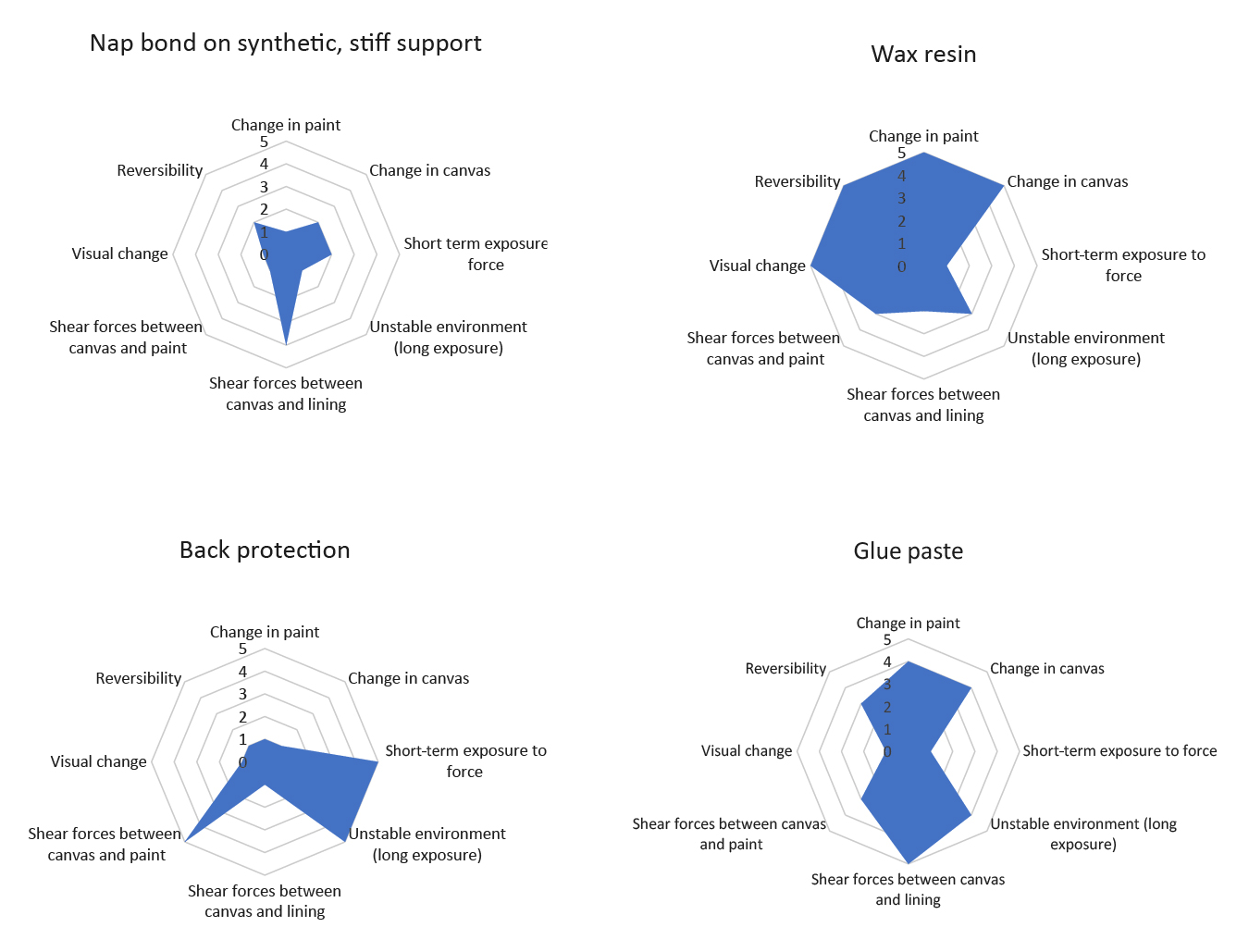
The first step is to identify the risks. Using Mehra’s guidance and some updated information, the list in table 21.2 could be proposed as examples of eight factors that may imply an increased risk of change in a lined canvas painting. The chosen parameters are inspired by current discussions in the field, such as stresses, color change, change in properties, and so forth.
|
Change in paint properties or structure—due to solvent exposure (including water) or temperature change
|
|
Change in canvas properties or structure—due to impregnation of adhesive or moisture/water exposure
|
|
Unstable environment (long exposure)—creep due to lack of support
|
|
Short exposure to forces—lack of support with fast climate events, keying out or restretching
|
|
Shear forces between canvas and lining—due to stiffness in lining and shrinkage forces in canvas
|
|
Shear forces between canvas and paint—due to free movement of the canvas and stiffness in paint
|
|
Visual change—due to impregnation and subsequent change of refraction index
|
|
Reversibility—due to materials used or construction of structural treatment
|
In the example of star diagrams for a lining in figure 21.1, the risk for each parameter for a particular painting has been assessed. The nature of specific paintings and treatments will change the nature of the risk, of course. Risk factors can be added or subtracted as appropriate, and different options can then be compared. Other risks, such as weight change, out-of-plane forces, infestation, and mold growth can also be assessed as needed. In some cases, the values for various parameters can be measured in a lab, and the outcome can then be adapted to the same scale, as seen in Fuster-López et al. in this publication.
Conclusion
Fifty years after Mehra formulated his requirements, the concepts he discusses largely remain relevant, even though the context and the understanding of some of them have changed. The eight requirements became very influential, but they must be seen in the context of the lining techniques in use at that time, when wax-resin and glue-paste linings dominated. However, the imposition of requirements for conservation treatment is not a contemporary way of approaching conservation—partly because each painting is different, as Mehra acknowledges, and partly because best practice requirements call for a common understanding of the concepts they codify.
Many of the concepts used in conservation are elastic. They can be interpreted in various ways and have multiple meanings, and this can prompt endless discussions. The specific interpretation in each case can be attributed to differences in culture, social parameters, stakeholders, technical knowledge, and practical indicators. This means they can be bent and understood differently depending on the context. In case of misinterpretations of the concepts used, requirements may be worthless or even misleading. Tacit knowledge is deeply embedded in local conservation traditions, which, of course, complicates the matter further.
Until a comprehensive prediction tool is created, assessment of risks remains the best option. An update of Mehra’s approach was proposed in this paper, in which risks are assessed from certain criteria for each case individually by the conservator who needs to decide between different options.
Notes
-
Funded by the Getty Foundation. ↩︎
-
E-modulus is derived from a stress/strain test representing change of stress divided by the change in strain in the elastic (Hookean) region. High modulus can be understood as high stiffness. ↩︎
-
Since this paper was written, we have proposed a computer model for untreated paintings; see Lee, D.-H., N.-S. Kim, M. Scharff, M. Nielsen, M. Mecklenburg, L. Fuster-López, L. Bratasz, and C. Andersen. 2022. “Numerical modelling of mechanical degradation of canvas paintings under dessication.” Heritage Science 10: 1–13.. ↩︎