Chicago
Sterp Moga, Emanuel, and Alicia Sánchez Ortiz. “59. Magnetic
Systems as an Alternative to Traditional Methods for the
Conservation-Restoration of Painted Canvas Supports: A Proposal
of Minimal Intervention Protocols.” In
Conserving Canvas, by
Cynthia Schwarz, Ian McClure, and Jim Coddington. Los Angeles:
Getty Conservation Institute, 2023.
https://www.getty.edu/publications/conserving-canvas/viii-posters/59/.
MLA
Sterp Moga, Emanuel, and Alicia Sánchez Ortiz. “59. Magnetic
Systems as an Alternative to Traditional Methods for the
Conservation-Restoration of Painted Canvas Supports: A Proposal
of Minimal Intervention Protocols.”
Conserving Canvas, by
Cynthia Schwarz et al., Getty Conservation Institute, 2023,
https://www.getty.edu/publications/conserving-canvas/viii-posters/59/.
Accessed DD Mon. YYYY.
59.
Magnetic Systems as an Alternative to Traditional Methods for
the Conservation-Restoration of Painted Canvas Supports: A
Proposal of Minimal Intervention Protocols
59. Magnetic Systems as an Alternative
Emanuel Sterp Moga,
PhD Researcher,
Department of Painting and Conservation-Restoration,
Faculty of Fine Arts, Complutense University of Madrid,
Spain
Alicia Sánchez Ortiz, Professor,
Department of Painting and Conservation-Restoration,
Faculty of Fine Arts, Complutense University of Madrid,
Spain
This research shows the application of neodymium magnets in
the conservation/restoration of paint on canvas,
establishing minimal intervention as the main criterion. In
an innovative way and with the aim of respecting the
authenticity of the original, a new tool has been designed
consisting of an internal auxiliary frame equipped with a
magnetic system (IAFMS). Its use contributes to facilitating
and improving the operation during some procedures, such as
thread-by-thread sutures, textile intarsia, and
thread-bridge reinforcement.
During the past decades, the criterion of minimal intervention
has acquired great importance and continues to guide the
actions of conservative practitioners aiming to keep open
options for retreatment (Appelbaum 1987Appelbaum, Barbara. 1987. “Criteria for Treatment:
Reversibility.”
Journal of the American Institute for Conservation
2, no. 26: 65–73. .). In the specific field of painted canvas supports, progress
has been constant as a result of the search for new
operational methodologies that continue to provide better
responses to the problem of deterioration. Neodymium magnets
have a wide field of application in the assembly of objects in
permanent and temporary exhibitions, especially graphic works,
textiles, and decorative arts collections (Spicer 2019Spicer, Gwen. 2019.
Magnetic Mounting Systems for Museums and Cultural
Institutions. Delmar, NY: Spicer Art Books.), but specific applications for pictorial works are still
scarce (Bestetti 2005Bestetti, Roberto. 2005. “Risarcimento strutturale
trattamento delle lacune il caso del dipinto giardini
romani di Giacomo Balla.” In
III Congresso Nazionale IGIIC—Lo Stato dell’Arte,
edited by Cristina Acidini Luchinat, 336–43. Palermo:
Nardini.;
Rella and Saccani 2006, 17–19Rella, Luigi, and Lucia Saccani. 2006.
Un restauro ragionato. La Crocifissione di Stephan
Kessler, Cuaderno 3 CESMAR7. Saonara, Italy: Il Prato.;
Sterp Moga and Sánchez Ortiz 2019Sterp Moga, Emanuel, and Alicia Sánchez Ortiz. 2019.
“Imanes de neodimio como propuesta de mínima intervención
para procesos de conservación en soporte de tela pintados:
corrección de deformaciones.” Ge-Conservación 1,
no. 15: 65–75.) .
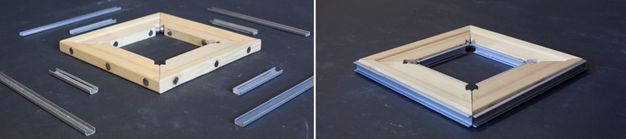
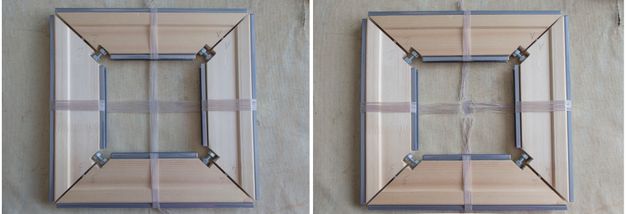
An internal auxiliary frame equipped with a magnetic system
(IAFMS) has been developed by the authors to assist the
conservator in maintaining tension during conservation
procedures involving thread-by-thread suture for tear mending,
textile intarsia, and reinforcement with thread bridges. The
frame is equipped with a magnetic system on the inner and
outer edges, consisting of different magnets embedded flush
with each edge and a U-shape iron gutter, adequately protected
(fig. 59.1). The magnets holding the
gutter allow the gutter to be raised and lowered to bring the
threads closer to the surface of the damaged canvas. Different
magnets are housed in the gutter; these act as a clamp and
allow the textile material (the necessary threads with the
warp and weft) to be held according to the needs of the tear,
gap, or break in the textile support. In addition, the system
allows the application of a minimum tension by means of the
tensioners composed of stainless-steel dowels and threaded
rods and nuts placed in the four corners of the frame. In
short, the IAFMS allows the tension of the threads to be
maintained and exactly positioned during treatment, thus
facilitating the adhesion of the suture. At the end of the
procedure, the frame and the excess threads are removed from
the treated area.
ExpandFigure 59.1Internal auxiliary frame with magnetic system
(IAFMS).Image: Emanuel Sterp Moga
Materials and Methods
Tension Value Studies
The continuous environmental changes to which paintings on
canvas are subjected are one of the main agents of
deterioration, as the constituent materials respond in very
different ways. As a result of mechanical stress and the
release of this stress, the canvas becomes loose and deformed,
with the consequent appearance of folds and other
deformations.
In 1950, Roberto Carità carried out the first studies on the
quantification of the mechanical tension forces and made the
first prototype of a frame with springs (Carità 1955Carità, Roberto. 1955. “Aggiunta sui telai per affreschi
trasportati.”
Bollettino dell’Istituto Centrale del Restauro
23, no. 24: 165–70.). Gustav Berger and William Russell carried out experimental
tests showing that canvases are capable of withstanding a
maximum tension of 100 N/m when exposed to environmental
conditions of 21°C and 60% RH (Berger and Russell 2000Berger, Gustav A., and William H. Russell. 2000.
Conservation of Paintings: Research and Innovations. London: Archetype.).
In more recent research, Antonio Iaccarino Idelson has
analyzed what could be the most suitable tension parameters
for paintings on canvas mounted on frames modified with a
spring system. According to the results, the tensions should
be between 1.5 N/cm and 2.6 N/cm, with some cases being
acceptable up to 3.4 N/cm (Iaccarino Idelson 2009Iaccarino Idelson, Antonio. 2009. “About the Choice of
Tension for Canvas Paintings.”
CeROArt: Les dilemmes de la restauration, no. 4.
https://doi.org/10.4000/ceroart.1269.).
Thread Tension Tests
Different threads were selected for testing, both synthetic
and natural: Lipari, 260 g/m²; Ispra, 130 g/m²; cotton,
320 g/m²; and linen 2297, 170 g/m². A selection of block-shape
neodymium magnets with a protective nickel coating (NiCuNi),
of varying dimensions and grades (magnetization), were also
tested: 8 × 8 × 4 mm (N45), 10 × 10 × 3 mm (N42), 25 × 6 ×
2 mm (45SH), and 20 × 10 × 2 mm (N45). Each thread was
stretched between two magnets by means of a high-quality
digital balance for forty-eight hours.
Elaboration of the Models
Three samples of each of four types of models were made: (A)
Lipari synthetic fabric, 260 g/m², and a preparation of Talens
acrylic gesso; (B) Lipari synthetic fabric, 130 g/m², and a
preparation of plaster (calcium sulfate) and rabbit-skin glue;
(C) cotton fabric, 320 g/m², and a preparation of plaster,
chalk, and PVA latex; and (D) linen 2297, 170 g/m², and
industrial preparation with vinyl resin (Modostuc). Different
damages were inflicted on the samples. They were subjected to
different cycles of artificial aging by means of UV from
sixteen Ultra Vitalux lamps (300 W/230 V), at a temperature of
50°C and RH of 20%–25%, for 700 hours. The aging protocol
followed the ISO 4892-2 standard.
Tension Measurement
The tears caused by artificial aging were treated using two
methods: first, without tensioning the new threads, and
second, by subjecting them to slight tension using the IAFMS
tool. Measurements were taken before and after the operation
to see which method was more effective using a HT-6510N
tension meter. The models were also subjected to RH
oscillations between 50% and 80%.
Creation of the Frame and Selection of the Magnets
The IAFMS measures 25 × 25 × 2 cm and is made of laminated
spruce. The four corners of the frame are cut at 45 degrees
and consist of a tensioning mechanism composed of
stainless-steel pins, threaded rods, and nuts.
To carry out the local treatments on the
support—thread-by-thread suture, textile intarsia, and
thread-bridge reinforcement—IAFMS has a magnetic system
located on the edges of the slats. It is composed of an iron
chute with an anti-rust coating and has three magnets on the
outer edges and two on the inner edges. The system acts as a
clamp holding the warp and weft threads according to the needs
of the damage to be treated (see
fig. 59.1). The new threads are held
to the mechanism with the different axial magnets mentioned
above.
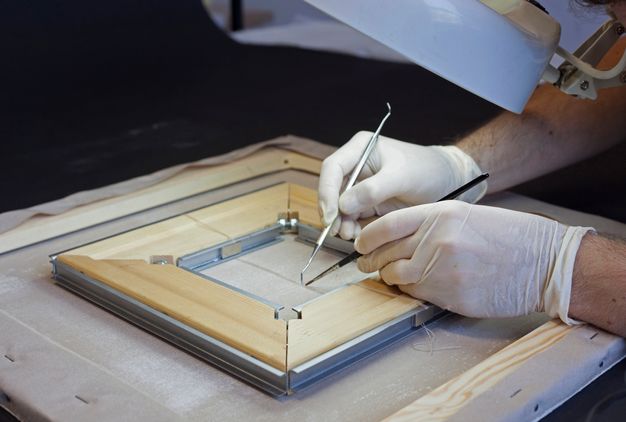
Textile Microsurgery
Yarns extracted from the textile used for each model were
used. They were laid by both the traditional method and by
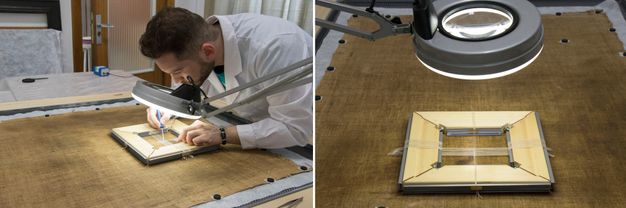
IAFMS (fig. 59.2). The adhesive
selected for the sutures and the textile intarsia was 10%
starch paste and 20% sturgeon glue; a small drop was deposited
with a brush on each thread to be sutured. In the case of the
reinforcement bridges, the threads were impregnated with
Plextol B500. Each new thread was aligned and placed in its
exact position and kept taut at a value of 1 N/cm as the
adhesive was reactivated with a thermal spatula.
Measurement of Wire Tension and Tension of Painting Canvas
The results obtained are shown in
table 59.1. The N45 magnets
measuring 20 × 10 × 2 mm were selected for their dimensional
characteristics, which better adapt to the magnetic system of
the frame. These magnets have approximately 20.6 N in direct
contact with each other, and when used to tension the thread,
they produce a maximum tension of 2.64 N. As shown in
table 59.2, after the intervention
with the neodymium magnets on the models, a tension of between
2.8 and 3.5 N/cm was achieved. This tension was kept constant
after twenty-four hours of having been subjected to RH
oscillations. Therefore, this is an adequate tension for the
desired conditions during conservation of paintings.
Table 59.1 Variables of the tension of different threads by
means of several types of magnets
Type of canvas
Magnet grade
Size (mm)
Clamping force (N)*
Maximum operating temperature (°C)
Initial force (kG)
Force after 24 hours (kG)
N
Lipari (synthetic)
260 g/m²
N45
8 × 8 × 4
14.7
80
0.200
0.200
1.96
N42
10 × 10 × 3
16.7
80
0.390
0.390
3.82
45SH
25 × 6 × 2
16.7
150
0.310
0.310
3.03
N45
20 × 10 × 2
20.6
80
0.270
0.270
2.64
Ispra (synthetic)
130 g/m²
N45
8 × 8 × 4
14.7
80
0.255
0.255
2.49
N42
10 × 10 × 3
16.7
80
0.390
0.390
3.82
45SH
25 × 6 × 2
16.7
150
0.310
0.310
3.03
N45
20 × 10 × 2
20.6
80
0.235
0.235
2.30
Cotton (natural)
320 g/m²
N45
8 × 8 × 4
14.7
80
0.200
0.200
1.96
N42
10 × 10 × 3
16.7
80
0.360
0.360
3.52
45SH
25 × 6 × 2
16.7
150
0.340
0.340
3.33
N45
20 × 10 × 2
20.6
80
0.315
0.315
3.08
Flax 2297 (natural)
170 g/m²
N45
8 × 8 × 4
14.7
80
0.235
0.235
2.30
N42
10 × 10 × 3
16.7
80
0.330
0.330
3.23
45SH
25 × 6 × 2
16.7
150
0.235
0.235
2.30
N45
20 × 10 × 2
20.6
80
0.290
0.290
2.84
*The approximate maximum force between two magnets when
they are in direct contact.
Table: Emanuel Sterp Moga
Table 59.2 Tension measurements of traditional and magnet
interventions, before and after RH
oscillations
Tension before intervention
(N/cm)
Tension after traditional intervention
(N/cm)
Tension of traditional intervention after RH
oscillations*
(N/cm)
Tension after intervention with N45†
magnets
(N/cm)
Tension of intervention with N45 magnets†
after RH oscillations*
(N/cm)
Model A: Lipari synthetic fabric (260 g/m²) and a
preparation of Talens acrylic gesso
Thread-by-thread suture
0.1
0.8
0.5
3.0
2.9
Textile intarsia
0.0
1.0
0.7
2.8
2.6
Thread-bridge reinforcements
0.2
0.7
0.5
3.2
3.0
Model B: Lipari synthetic fabric (130 g/m²) and a
preparation of plaster (calcium sulfate) and
rabbit-skin glue
Thread-by-thread suture
0.1
1.1
0.6
3.1
3.0
Textile intarsia
0.0
0.9
0.4
3.0
2.8
Thread-bridge reinforcements
0.0
0.8
0.5
2.9
2.8
Model C: Cotton fabric (320 g/m²) and a
preparation of plaster, chalk, and PVA
latex
Thread-by-thread suture
0.1
0.9
0.6
3.3
3.1
Textile intarsia
0.2
1.0
0.6
3.5
3.3
Thread-bridge reinforcements
0.1
0.7
0.4
3.1
2.9
Model D: Linen 2297 (170 g/m²) and industrial
preparation with vinyl resin (Modostuc)
Thread-by-thread suture
0.1
0.6
0.3
2.9
2.8
Textile intarsia
0.0
0.8
0.4
2.8
2.6
Thread-bridge reinforcements
0.0
0.7
0.4
3.1
2.9
*RH was varied from 50% to 80%
†20 × 10 × 2 mm
Table: Emanuel Sterp Moga
Thread-by-Thread Suture
When the traditional thread-mending method was used, the
tension values remained between 0.1 and 0.3 N/cm. After the
model was subjected to fluctuations in RH, the treated area
experienced a general detensioning. The tension applied to the
new yarns with IAFMS allowed us to achieved better results
while providing adequate tension (2.5–3.5 N/cm) in the area of
the treated textile support. During the RH oscillation tests,
the tension values were maintained in this range, so the
intervention was considered adequate for the intended purpose.
Textile Intarsia
With nontensioned thread, tension values are between 0.3 and
0.5 N/cm. When the models were subjected to fluctuations in
RH, the area being worked on relaxed. During the process of
laying the threads, if the threads are held in place at a
tension of 1 N/cm, the treated area has a tension of 2.5–3.5
N/cm, and the whole remains stable.
Thread-Bridge Reinforcements
Without adding tension, the treatment carried out with the new
threads did not achieve good results. The model showed a
tension of 0.5–0.8 N/cm—a value insufficient to guarantee the
stability of the textile support. When using IAFMS, the yarns
are kept at a tension of 1.5 N/cm and the tension is 2.8–3.4
N/cm. These values remained stable.
Real-World Applications
Two anonymous works were chosen to test the IAFMS tool in
practice. Both works showed a generalized weakening of the
fibers of the support due to oxidation and to the existence of
various tears in the fabric as a result of adverse exposure
and storage conditions.
Case Study 1
The first painting was an eighteenth-century representation of
the Virgin and Child rendered in oil on linen, measuring 104 x
76 cm. The textile support has a plain weave and a traditional
preparation of plaster and glue.
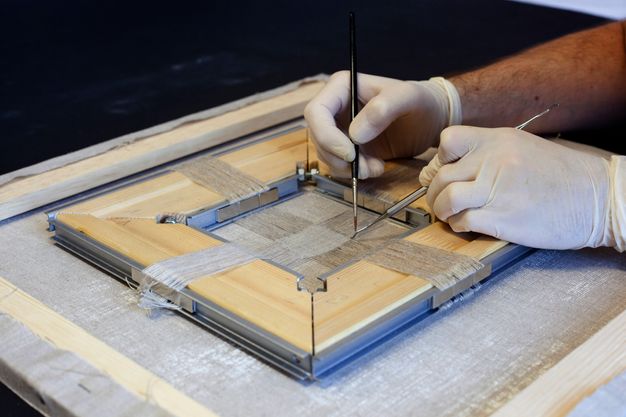
The adhesive was chosen for suturing thread by thread: 10%
starch paste and 20% sturgeon glue in water (1:1). Natural
linen threads 2297, 170 g/m², were used and maintained at a
tension of 1 N/cm thanks to the IAFMS (fig. 59.3). At the end of the operation, the textile support showed a
tension of 3.2 N/cm in the treated area. For the reinforcement
bridges, the same natural linen threads were used, but
impregnated with Plextol B500. The tension applied with
Q-20-10-02-N magnets and the IAFMS was 1.5 N/cm. Once the
treatment was finished, the treated area maintained a tension
value of 3.0 N/cm.
Case Study 2
The second work was an oil painting on cotton cloth, dating
from the twentieth century, whose motif is a still life. It is
supported with a taffeta ligament, is industrially prepared,
and measures 98 × 48.5 cm.
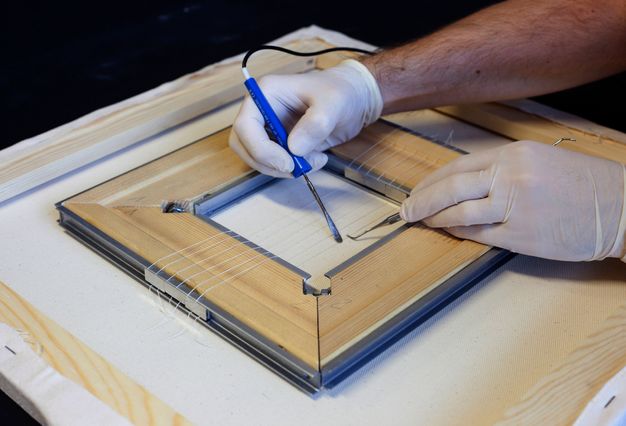
Cotton fabric threads, 320 g/m² (fig. 59.4), were used, along with 10% starch paste and 20% sturgeon
glue in water (1:1) as adhesive for the textile intarsia.
Because a water-based adhesive was used, small dots were
applied to the ends of each thread. The tension of the new
threads was 1 N/cm, and after the operation was completed, the
treated area had a tension of 3.5 N/cm.
ExpandFigure 59.3Performing the thread-by-thread suture using the
IAFMS.Image: Emanuel Sterp MogaExpandFigure 59.4Realization of the textile intarsia by means of the
IAFMS.Image: Emanuel Sterp Moga
Conclusions
Experimental tests demonstrate the validity of using neodymium
magnets as an alternative to traditional procedures in the
conservation of painted fabric supports. The magnetic IAFMS
allows one to make treatments of sutures thread-by-thread or
using textile intarsia, or thread-bridge reinforcement,
minimizing the manipulation of the work and with it the risks.
It is important to remember that the method of assembly of the
magnetic system, the holding and tension force, and the size
and weight of the magnets are factors that must be evaluated
by the restorer. This method is simple, low-cost, effective,
reversible, and respectful of the original work of art.