The 1974 Greenwich conference participants reviewed both past and current techniques of lining paintings with adhesives such as flour paste, animal glue, wax resin, Beva 371, and Plextol B500, using hand irons, hot tables, vacuum pressure, low-pressure suction tables, and vacuum envelopes. They also discussed declaring a moratorium on lining.
42. The Greenwich Conference on Comparative Lining Techniques, April 23, 24, and 25, 1974: Three Days That Changed Conservation
- Joyce Hill Stoner, Director of the Preservation Studies Doctoral Program, University of Delaware / Winterthur Museum, Garden & Library
Introduction
In 2017, in the article that provided the subtitle for this paper, David Bomford wrote the following with 20/20 hindsight:
The [1974] Greenwich Lining Conference had two profound and contradictory effects, one immediate and practical, the other philosophical and slow-burning. The first was to open the eyes of many of those present to the advances in the technology of lining, including machinery and materials . . . The second effect was to set in motion something quite different—a debate that questioned the whole basis of lining. Westby Percival-Prescott’s keynote “The Lining Cycle” conjured up a graphic picture of the spiral of repeated treatment, deterioration, and re-treatment in which canvas paintings become trapped once they are lined for the first time. (Bomford, David. 2017. “Three Days That Changed Conservation.” In The Picture So Far: 50 Years of Painting Conservation, edited by Abigail Granville, Laura Hinde, Sophie Plender, Hayley Tomlinson, and Nancy Wade, 1–8. London: Archetype.)
This paper presents vignettes related to this landmark conference, accompanied by quotes from interviews from the Foundation for Advancement in Conservation (FAIC) Oral History File.
Greenwich: Recorded Thoughts from the Participants
Westby Percival-Prescott (1923–2005) (fig. 42.1) was a major force in bringing about the reexamination of traditional structural treatments. Delegates from twenty-four countries were present at the conference he organized at Greenwich, London, in 1974. From 1975 to 1978 Percival-Prescott served as coordinator of the Lining and Stretchers Working Group of the International Council of Museums – Committee for Conservation (ICOM-CC); the group’s name changed to Structural Restoration of Canvas Paintings in 1978, at which point Percival-Prescott became co-coordinator with Pierre Boissonnas.
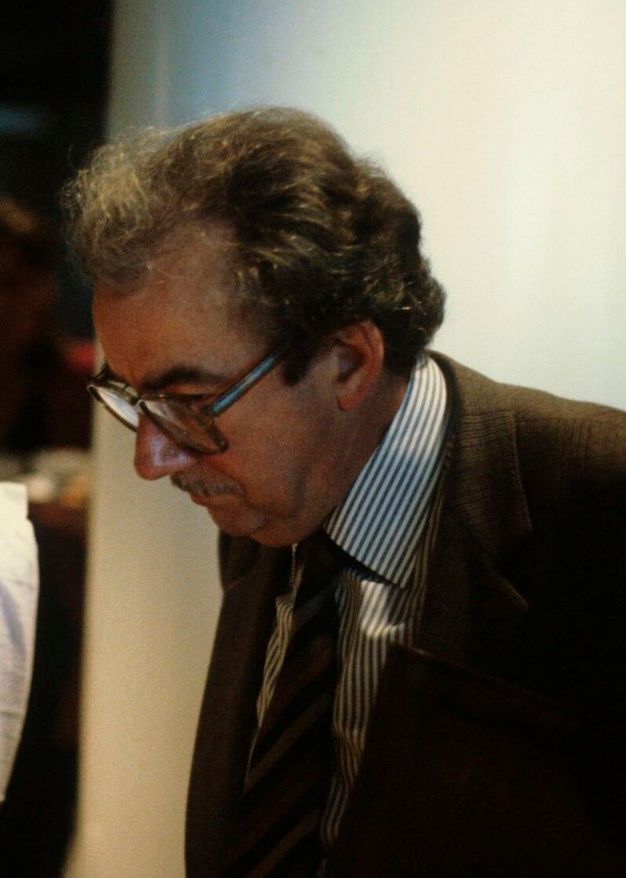
In 1975, Percival-Prescott reported that the lectures and/or demonstrations at Greenwich fell into three main categories (Percival-Prescott, Westby. 1975. “Report on the Greenwich Lining Conference.” In ICOM Committee for Conservation, 4th Triennial Meeting, Venice, 13–18 October 1975: Preprints. Paris: ICOM.). The first was traditional hand-linings: Russian sturgeon glue; Italian flour paste and animal glue; British “compo” glue; Belgian and Polish natural beeswax and resin; and National Gallery, London hand-lining. The second was hot-table linings: Swiss Lascaux synthetic wax on fiberglass fabric, vacuum hot tables, and Beva. The third category was dubbed “new alternatives” and included Courtauld vacuum envelopes using wax resin; Berger vacuum envelopes using the verso of the painting as the top of the envelope; Mehra’s prototype cold-vacuum lining table and Plextol B500; and how to prevent the need for lining at all.
In the United States, we quickly heard about a “moratorium on lining.” As Gillian Lewis told me:
A call for a moratorium was made by Westby at the closing address at the end of the Greenwich conference. There was a show of hands—mostly in favor. It took us all by surprise and appeared impromptu, but in fact he had been pondering it for some years and had talked informally to several people about it. I think he kept quiet about it until the conference itself had taken place, as he anticipated that some contributors might not be so open in their descriptions of techniques had they known this could be the outcome.1
Suddenly, as a professor of paintings conservation in the 1970s, I had to be ready to teach many more lining techniques than I had learned in the 1960s. At Greenwich, Gerry Hedley (1949–1990), Stephen Hackney, and Alan Cummings delivered “Lining in a Vacuum Envelope with a Traversing Infrared Heat Source,” and Cummings and Hedley delivered “Surface Texture Changes in Vacuum Lining: Experiments with Raw Canvas.” Alan Cummings described the experience in his FAIC interview:
We became a kind of three musketeers: myself, Gerry Hedley, and Stephen Hackney. We were all at Courtauld at the same time. Our particular interest was in the structural treatment of canvas paintings in lining. I did my final-year research project at Courtauld on texture changing and vacuum lining of paintings. We gave the papers at the lining conference in 1974. I think that whole conference was quite significant, including the colorful character Gustav Berger, the birth of Beva, and Vishwa Mehra. All of the debates about vacuum lining versus other kinds of lining. Yeah, it was a very significant period.2
Stephen Hackney talked about the vacuum-envelope experiment in his FAIC interview:
Professor [Stephen] Rees Jones had originally given me a project, essentially to rebuild and get the old hot table working again and to give the department the capability of doing wax-linings. It started as a technical challenge with machinery, no budget, and cramped conditions. Gerry Hedley then joined me and brought his mechanical engineering talents, and we started doing some radical work, deconstructing the whole process of wax-lining, especially the use of vacuum. Westby, Gillian, and Ronald Chittenden [all from the Greenwich Maritime Museum] came to visit us more than once.3
In 1993, Hackney wrote about Hedley’s contributions (fig. 42.2):
It was clear that there was little fundamental understanding of the properties of materials used in paintings and their conservation. The complex structure of an old stretched canvas painting had not been considered from an engineering standpoint. As a consequence, at the Greenwich lining conference some very strong contradictory opinions were expressed. It was Gerry’s gift that he could quickly analyze an argument and identify its premises, frequently enabling him to resolve a dispute or misunderstanding (Hackney, Stephen. 1993. “Introduction.” In Measured Opinions: Collected Papers on the Conservation of Paintings, edited by Caroline Villers. London: United Kingdom Institute for Conservation of Historic and Artistic Works.).
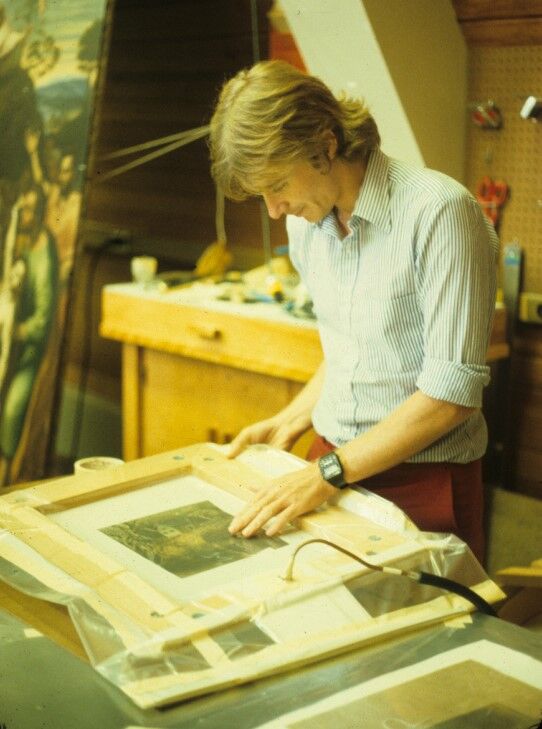
Turning to the contributions from the Italian delegation, Andrea Rothe (1936–2018) (fig. 42.3) had translated and delivered in English the paper by Umberto Baldini and Sergio Taiti, “Italian Lining Techniques: Lining with Pasta Adhesive (and Other Methods) at the Fortezza da Basso, Florence.” He gave me the history in his FAIC interview.
I had been doing only pasta linings. A little wax-lining every now and then. In 1974, I gave the talk [on Italian lining], and I answered questions. I got so carried away I fell off the stage and fell into the people sitting on the first row. I didn’t fall very far. It wasn’t a high stage, but it was sort of embarrassing. After that, everybody knew me as the guy who had fallen off the stage . . . It was a very useful conference. From what I’ve seen afterwards, no other conferences really had the quality of that lining conference. There was a lot going on: Mehra with his technique, Gustav with his wife—she kept giving him instructions. John Brealey says he met me in Greenwich.4
John Brealey (1925–2002) chaired a panel at Greenwich and mounted a photographic display of his treatments of the nine huge (nine-foot-square) paintings on canvas by Mantegna in Hampton Court, a series known as the Triumphs of Caesar. Commissioned in 1484, they were “very thinly painted, on fine linen, with practically no ground . . . like gouache.”5 They were overpainted in oil in the eighteenth century and again with oil by Roger Fry in the nineteenth, and then wax-lined in the 1930s by Stanley Kennedy-North (1887–1942), who used 15-pound irons that created “welts” in the paintings. In interviews and lectures, Brealey told our students about removing a “ton” of wax.6 His treatments took more than nine years. Brealey spoke against wax-lining in his interviews and celebrated unlined paintings in his lectures. For a time, Brealey supported Robert Fieux’s research and Fabri-Sil lining (more on this below).
Beva 371 (Berger’s ethylene vinyl acetate) was first formulated in 1970 and presented at the Congress of the International Institute for Conservation of Historic and Artistic Works in Lisbon in 1972. Two years later, Gustav Berger (1920–2006) presented demonstrations, a film, and four papers at Greenwich: “Effects of Consolidation Measures on Fibrous Materials,” “Wax Impregnation of Cellulose: An Irreversible Process,” “Lining of a Torn Painting with BEVA 371,” and “Some Effects of Impregnating Adhesives on Paint Film.” Only a decade later, in 1984, Gerry Hedley received ninety-three replies to his international questionnaire on lining, and Beva 371 was found to be the most widely used lining adhesive (Hedley, Gerry, and Caroline Villers. 1984. “Lining in 1984: Questionnaire Replies.” ICOM-CC, Copenhagen, preprints, 84.2.22-84.2.25.).
In his 1995 FAIC interview, Berger noted:
The movement against lining is foolish. I have shown, through my experiments and lining demonstrations, that I can line butterflies. For if you can line a butterfly, then really I don’t think you would damage a painting when you line it. So paintings can be lined without damaging them. You only have to know how, and to do it properly, and have the right materials.7
Berger had the verso of the butterfly collage on canvas serve as the top of the vacuum envelope. In 1976, he told me, “There is another little thing that I developed . . . that you can use the painting itself as a membrane and reline it without any pressure from the top.”8 During the opening session in Greenwich, The Guitar, a freshly painted collage, oil, and mixed media work on primed canvas by Raphael Berger, with high impasto and preserved butterfly specimens, was lined in a public demonstration. The lining left the high impasto and the butterflies intact (Berger, Gustav A., and William H. Russell. 2000. Conservation of Paintings: Research and Innovations. London: Archetype.).
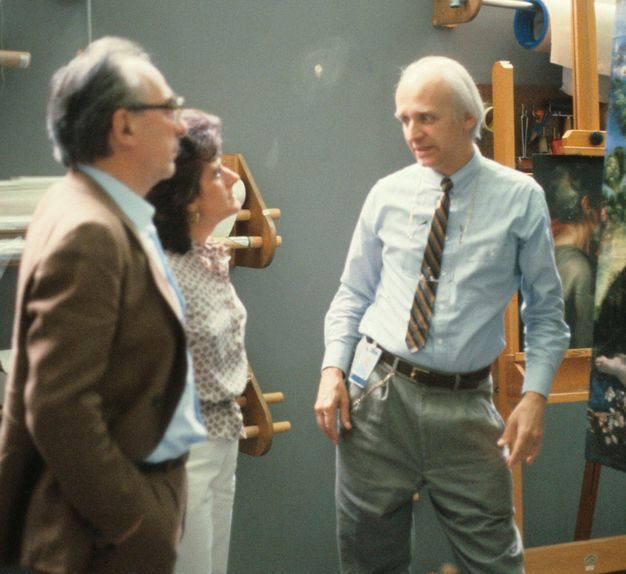
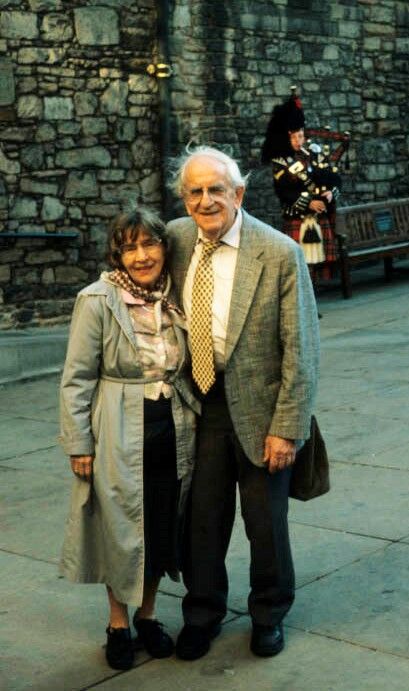
New terminology and key personalities emerged at Greenwich. Caroline Villers noted that Berger coined the term weave interference (Villers, C. 2003. “Introduction.” In Lining Paintings: Papers from the Greenwich Conference on Comparative Lining Techniques, edited by Caroline Villers, xi–xvi. London: Archetype.), while Percival-Prescott had invented the portmanteau shrinkle to describe what happens when moisture causes the canvas to shrink and the paint to wrinkle. I was among the many audience members over the following years who were treated to conference talks featuring Gustav Berger at the podium while his wife, Mira, moved up and down the aisles passing out squares of Kleenex tissue “lined” with other squares of Kleenex using Beva 371 (with no resultant staining). Mira would sometimes call out instructions from the back of the auditorium: “No, no, Gustav—wrong slide!” (fig. 42.4).
At ICOM-CC’s 1972 triennial meeting, in Madrid, Vishwa Raj Mehra (b. 1931) had presented a radical review of lining methodology, in which he began to argue for a more graduated approach to structural treatment and to question assumptions about the cohesive strength required of lining adhesives and the tensile forces in the painting composite. Percival-Prescott wrote in 2003:
The atmosphere in the Greenwich Conference will never be forgotten and led to many substantial developments. . . . One of the greatest of these was Vishwa Mehra’s low-pressure cold table; this invention took its place in lining history and was to be copied extensively throughout the world, including for use with paper and textile conservation. Mehra had brought a prototype lining table, transported specially to the conference in order to demonstrate lining with Plextol B500 cold-setting adhesive and woven polypropylene fabric. (Percival-Prescott, Westby. 2003a. “Foreword: Origins and Outcome of the Lining Conference.” In Lining Paintings: Papers from the Greenwich Conference on Comparative Lining Techniques, edited by Caroline Villers, v–x. London: Archetype.)
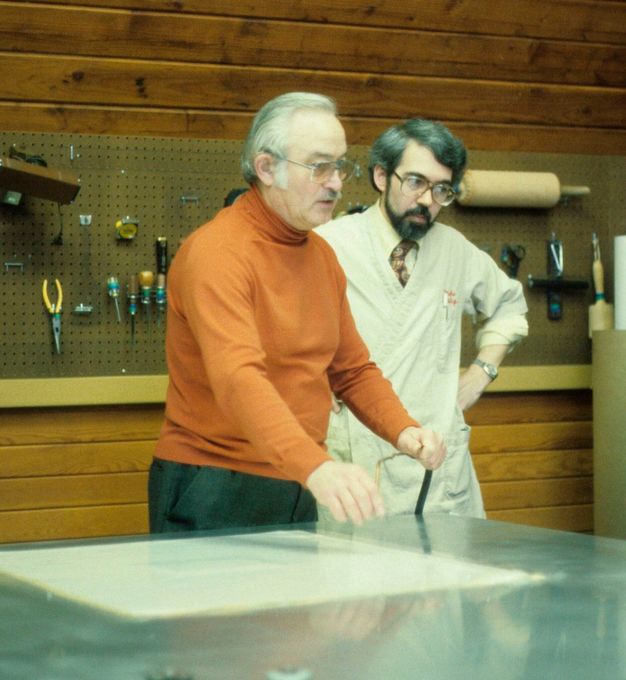
Robert Fieux (1919–1991) (fig. 42.5) presented a paper at Greenwich reporting on a meeting in Cooperstown, New York, in summer 1973, hosted by Sheldon and Caroline Keck, comparing wax resin, glue paste, Beva, and polyvinyl acetate. Fieux gave papers in Ottawa in 1976 and at ICOM-CC 1978, in Zagreb, titled “Electrostatic Cling as a Pressure Source in Lining of Paintings.” He invented Fabri-Sil linings: silicone adhesive on Teflon-coated fiberglass fabric, which required only gentle hand pressure for attachment. This seemingly gentle technique was adopted at New York’s Metropolitan Museum of Art and at the Museum of Fine Arts, Boston, for a time but was later abandoned.
Acknowledgments
I am grateful to the twenty-first-century Getty project Conserving Canvas (nicknamed Greenwich 2.0) for reconsidering the historical techniques of pasta and wax-linings in addition to presenting newer ideas that have since been introduced, and to all the contributors to the FAIC Oral History Project.
Notes
-
Gillian Lewis, National Maritime Museum, Greenwich, email correspondence with the author, August 1, 2019. ↩︎
-
Alan Cummings, FAIC interview by Alison Richmond, Winterthur Museum and Libraries, October 1, 2009. ↩︎
-
Stephen Hackney, FAIC interview by Kari Rayner, July 15, 2016. ↩︎
-
Andrea Rothe, FAIC interview by the author, July 9, 1985. ↩︎
-
John Brealey, FAIC interview by the author, January 1, 1976. ↩︎
-
Brealey interview; lectures to students in the Winterthur / University of Delaware Program in Art Conservation, 1980–88. ↩︎
-
Gustav A. Berger, FAIC interview by Jean D. Portell, August 3, 1995. ↩︎
-
Gustav A. Berger, FAIC interview by the author, September 20, 1976. ↩︎