Lining treatments and ideas about these treatments are reviewed, with a focus on the innovative period following the 1974 Greenwich conference. Three decades of research at the Canadian Conservation Institute on the mechanics of paintings and the mechanics of linings are summarized. The relevance of peel testing and the results of recent tests of the bond strength of Beva 371b film by a colleague at the Centre de Conservation du Québec are also included. The text focuses on the perspective of the conservator: lessons learned from theory and data, from direct observation of samples, and from real structural treatments, as well as perspectives gained regarding the role for preventive conservation strategies.
19. The Influence of Research and Innovative Development on Laboratory Practice in the Structural Treatment of Paintings over Four Decades
- Debra Daly Hartin, Senior Conservator (retired), Fine Arts, Canadian Conservation Institute, Ottawa
- Stefan W. Michalski, Senior Conservation Scientist (retired), Canadian Conservation Institute, Ottawa
- Eric Hagan, Senior Conservation Scientist, Canadian Conservation Institute, Ottawa
Introduction
The developments in the structural treatment of paintings in the late 1970s and early 1980s had a tremendous influence on subsequent practice and research. Conservators trained during the late 1970s, including Debra Daly Hartin, an author of this paper, were immersed in the content of the 1974 Greenwich Conference on Comparative Lining Techniques and its follow-up, Lining of Paintings—A Reassessment, held in Ottawa in 1976. Recognition of the deficiencies of past lining treatments, combined with the rise of preventive conservation, led to a less interventive, less aggressive, and more considered approach to structural treatments. New methods, equipment, adhesives, and lining supports were introduced. New research into the mechanical behavior of paintings sought to inform the aims and impact of our treatments. Written from the point of view of a paintings conservator working with conservation scientists at the Canadian Conservation Institute (CCI), this paper will discuss specific examples of how research influenced laboratory practice.
Overview of Developments in the Structural Treatment of Paintings during the 1970s and 1980s
It is important to recognize the research and innovation that influenced the field in the 1970s and 1980s, setting the stage for our own research program and treatment development at CCI.
Papers and discussion during the 1975 ICOM-CC conference in Venice led to a reevaluation of treatment practices. “All at once” structural treatments, using heat and significant vacuum pressure, were the norm before the 1970s. Vishwa Mehra countered with a much less interventive, stepwise approach (Mehra, Vishwa R. 1975a. “Further Developments in Cold-Lining (Nap-Bond System).” In ICOM Committee for Conservation 4th Triennial Meeting, Venice, 13–18 October 1975: Preprints, 75/11/5/1-26. Paris: International Council of Museums., Mehra, Vishwa R. 1978. “Cold-Lining and the Care of the Paintlayer in a Triple-Stretcher System: Also: Answers to Some Questions and Doubts about the Cold-Lining System.” In ICOM Committee for Conservation: 5th Triennial Meeting, Zagreb, Yugoslavia, 1–8 October 1978: Preprints, 78/2/5/1–19. Paris: International Council of Museums., Mehra, Viswha R. 1981a. “The Cold Lining of Paintings.” The Conservator 5, no. 1: 12–14.). Each painting was considered as structurally unique, each aspect of the structural treatment (out-of-plane distortions, tears, flaking, flattening, lining, etc.) was a separate step, and only the necessary treatment steps were undertaken.
As part of his system, Mehra used a low-pressure “cold” table.1 Like the tables introduced by Bent Hacke in the 1960s, it pulled high volumes of air through a perforated surface into a plenum below. This enabled drying of an aqueous adhesive while maintaining (low) pressure on the painting (Hacke, B. 1978. “A Low-Pressure Apparatus for Treatment of Paintings.” In ICOM Committee for Conservation 5th Triennial Meeting: Zagreb, 1–8 October 1978: Preprints. Paris: ICOM., Hacke, B. 1981b. “Low-Pressure—Heat, Moisture, Stretching: Notes on Further Developments.” In ICOM Committee for Conservation: 6th Triennial Meeting, Ottawa, Canada, 21–25 September 1981: Preprints, 81/2/8/1–11. Paris: ICOM.). The design of these “suction” tables proliferated, allowing for controlled humidification for relaxation and flattening treatments of paintings, both on and off their auxiliary supports. (See Jim Coddington’s article in these proceedings.)
New lining fabrics and new adhesives were also introduced. Mehra used a woven polyester fabric and a thickened acrylic dispersion (Mehra, Viswha R. 1981a. “The Cold Lining of Paintings.” The Conservator 5, no. 1: 12–14.). Conservators in Europe turned to acrylic dispersions for cold or low heat, nap-bond linings; Alois Diethelm commercialized these adhesives under the mark Lascaux. In the United States, conservators turned to heat-seal adhesives: Rabin developed a nap-bond system based on PVA adhesives,2 and Berger developed Beva 371 based on ethylene vinyl acetate. Fieux developed Fabri-Sil linings, a pressure-sensitive silicone adhesive cured onto Teflon-impregnated fiberglass (Fieux, Robert. 1978. “Electrostatic Hold: A New Technique of Lining.” In ICOM Committee for Conservation: 5th Triennial Meeting, Zagreb, Yugoslavia, 1–8 October 1978: Preprints, 78/2/7/1–10. Paris: ICOM.; John G. Shelley Co. 1985. “Conserv-Art: A Scientific System for the Preservation and Restoration of Works of Art.” Product brochure.). (Initially, Fabri-Sil looked like an excellent option, but bonds failed within a few years [Schwartzbaum, Paul. 1993. “Fieux Linings from the 1980s.” Paper presented at the Gerry Hedley Memorial Forum—Mechanical Behaviour of Paintings: Experience and Theory, Ottawa, October 22–23, 1993.; Belloli, Lucy. 1993. “Fieux Linings from the 1980s.” Paper presented at the Gerry Hedley Memorial Forum, Mechanical Behaviour of Paintings: Experience and Theory, Ottawa, October 22–23, 1993.].)
To avoid the use of heat or moisture to activate adhesives, solvent activation was studied (Phenix, Alan, and Gerry Hedley. 1984. “Lining without Heat or Moisture.” In Preprints of ICOM 7th Triennial Meeting, Copenhagen, 10–14 September 1984, edited by Diana de Froment, 84.2.38–44. Paris: ICOM, in association with the J. Paul Getty Trust., Phenix, Alan, and Gerry Hedley. 1993. “Lining without Heat or Moisture.” In Measured Opinions: Collected Papers on the Conservation of Paintings, edited by Caroline Villers. London: United Kingdom Institute for Conservation of Historic and Artistic Works.). Unfortunately, safety issues with electric blowers and pumps prevented us from fully incorporating this into our practice at the time. With the current mist-lining techniques of Jos van Och, we see the resurgence of solvent activation (van Och, Jos, and René Hoppenbrouwers. 2003. “Mist-Lining and Low-Pressure Envelopes: An Alternative Lining Method for the Reinforcement of Canvas Paintings.” Zeitschrift für Kunsttechnologie und Konservierung 17, no. 1: 116–28.).
Mehra, Hedley, and Villers began systematic studies of available synthetic fabrics and their properties (Hedley, Gerry, Caroline Villers, and Vishwa R. Mehra. 1980. “Artists’ Canvases: Their History and Future.” Paper presented at the Symposium on the Conservation of Contemporary Art, National Gallery of Canada, Ottawa, July 7–12, 1980., Hedley, Gerry, Caroline Villers, and Vishwa R. Mehra. 1993. “Artists’ Canvases: Their History and Future.” In Measured Opinions: Collected Papers on the Conservation of Paintings, edited by Caroline Villers, 50–56. London: United Kingdom Institute for Conservation of Historic and Artistic Works.). They encouraged a manufacturer to produce a wide, heat-set sailcloth without the usual impregnants (Hedley, Gerry, and C. Villers. 1982. “Polyester Sailcloth Fabric: A High Stiffness Lining Support.” In Science and Technology in the Service of Conservation: Preprints of the Contributions to the 9th International IIC Congress, Washington, DC, 3–9 September 1982, edited by N. S. Brommelle and G. Thomson, 154–58. London: International Institute for Conservation of Historic and Artistic Works.). In Canada and the United States, respectively, Roger Roche (Roche, R. 1976. “New Materials for Lining.” In Lining of Paintings—A Reassessment: Proceedings of a Seminar Held at the National Gallery of Canada, Ottawa, April 6–8, 1976, edited by Mervyn Ruggles, 1–5. Ottawa: National Gallery of Canada.) and Blakney and Sutton introduced industrial monofilament fabrics and stiff filter and belt fabrics (Blakney, Susan, and M. Sutton. 1983. “A Sensual Lining Comparison.” Poster presented at 1983 AIC Annual Meeting, Baltimore, Maryland.; Blakney, Susan. 1993. “The Successful Use of Soft-Faced Monomesh as the Lining Support for a 14’ by 17’ Mural.” In AIC Paintings Group Postprints, Denver, Colorado, 25.).3 Methods of stiffening fabrics by using sizing or retaining Mylar on the reverse of linings were explored. Marouflage onto aluminum honeycomb supports was common, and laminates to increase rigidity were explored.4
The Influence of Research by Others
In 1982, Mecklenburg’s unpublished report “Some Aspects of the Mechanical Behavior of Fabric Supported Paintings: Report to the Smithsonian Institution” circulated widely (Mecklenburg, Marion F. 1982. “Some Aspects of the Mechanical Behavior of Fabric Supported Paintings: Report to the Smithsonian Institution.” Unpublished report, Smithsonian Museum Conservation Institute, Washington, DC. Reprinted in Dawn V. Rogala, Paula T. DePriest, A. Elena Charola, and Robert J. Koestler, eds. The Mechanics of Art Materials and Its Future in Heritage Science, 107–29. Washington, DC: Smithsonian Contributions to Museum Conservation, 2019. https://doi.org/10.5479/si.11342126.). This had us thinking about how everything fit together; the hygro-thermo-mechanical properties of the individual materials and their contribution to the behavior of the painting as a whole; the influence of the geometry and behavior of the wood stretcher, and the effects of our interventions, such as lining and stretching.
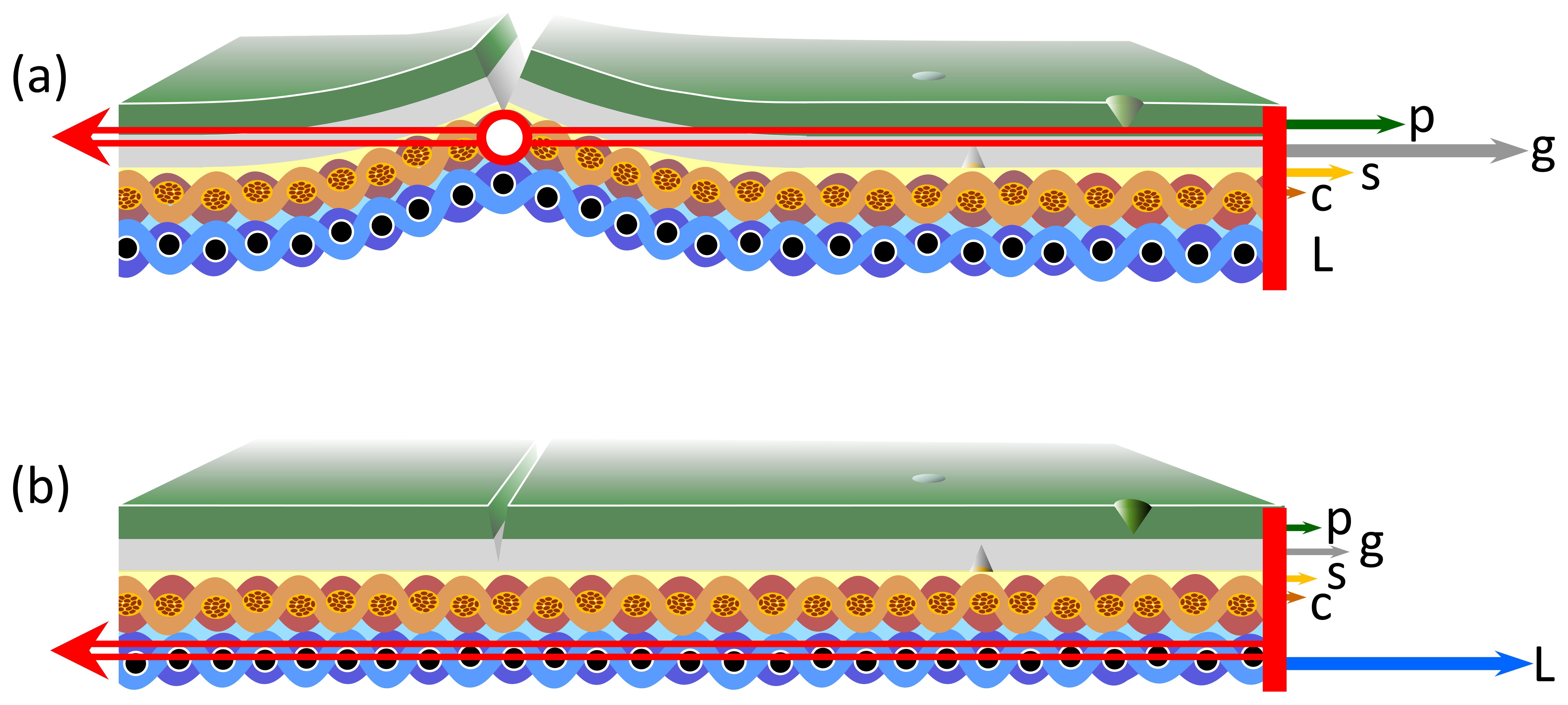
Mecklenburg introduced three concepts: First, that the total tension in a painting (the double red arrow running across the painting in fig. 19.1) was simply the sum of the individual tensions in each layer (the smaller arrows on the far right in fig. 19.1). Second, that the response of each layer to changes in RH was not simply a change in dimension but also a change in stiffness. And third, that “force realignment” (later phrased as stress alignment) could explain many deformations of paintings while under tension, as in figure 19.1a. (Curl, a separate mechanism for cupping, is described by Hough and Michalski in these proceedings.)
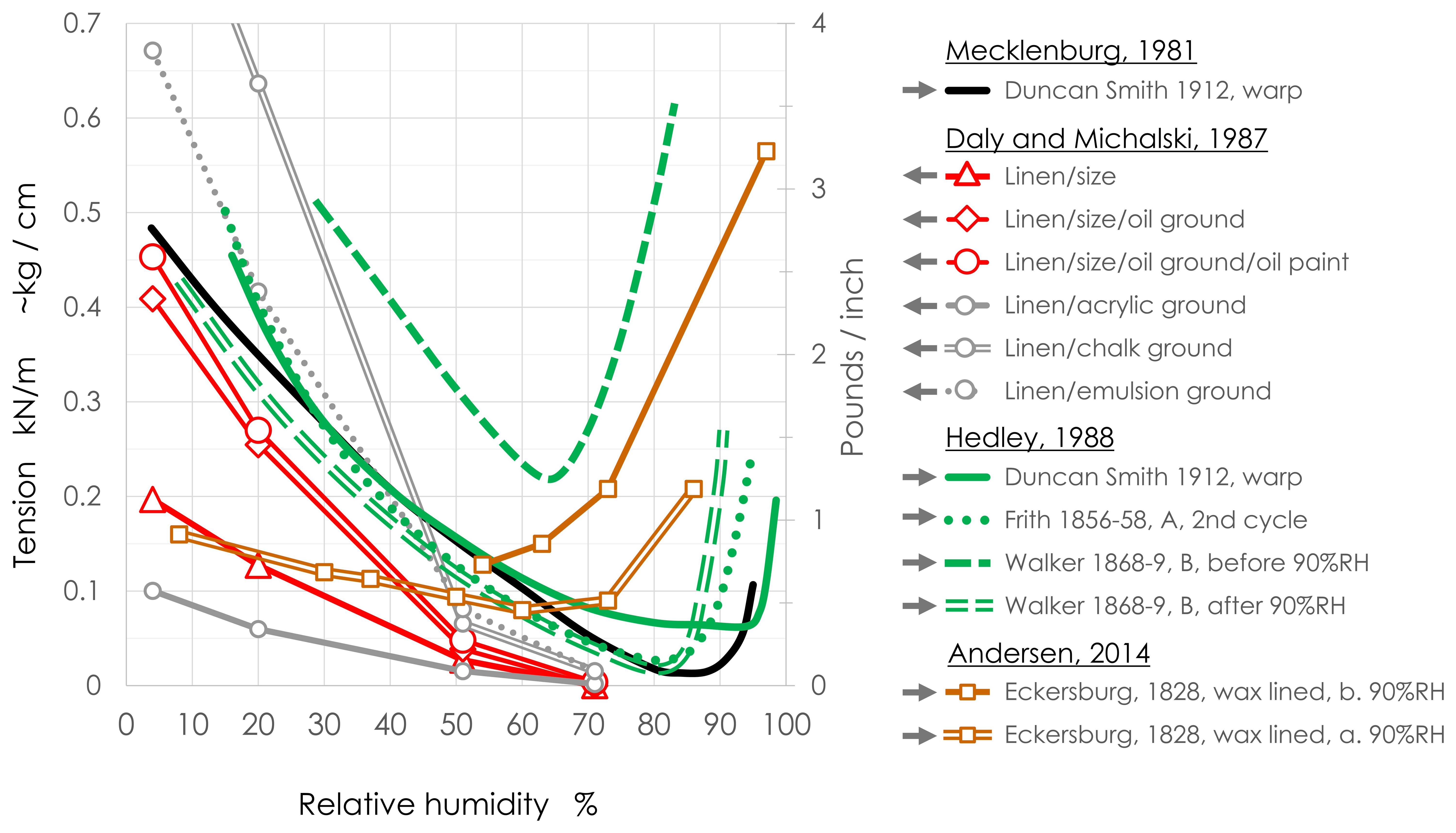
Mecklenburg demonstrated the power of his model by predicting the response of a painting to wide swings in RH; his plot of tension in a sample from a 1912 painting is shown in figure 19.2 (solid black line). Within a few years, various authors had repeated this measurement, including another sample from Mecklenburg’s 1912 painting, measured by Hedley while at CCI (solid green line). Although different authors used different materials and different procedures, the result was a universal “hockey stick” curve, with a minimum somewhere between 65% RH and 95% RH, depending on prior history and the amount of prestrain.
This new knowledge informed our decisions; specifically, it influenced our pursuit of better lining supports and improvements in noninterventive options, such as backing boards, enclosed case/frame design, and protection during transit. At that time, conservators and conservation scientists at CCI and other institutions were focusing on noninterventive preventive conservation measures for the broad heritage community, recommending best practices to improve the management of the museum environment and the handling, display, storage, and transit of museum objects. Controlling the physical risks and environment around the painting—with minimal alteration of the painting’s appearance or its materials—was an important option in the conservator’s repertoire.
In terms of lining, however, the question was whether the new materials were capable of preventing deformation or fracture of the painting. This question led to the CCI Lining Project, a collaboration between a conservator (Daly Hartin) and a scientist (Michalski) that lasted over a thirty-year period.5
The Influence of the CCI Lining Project
Humidification and Canvas Shrinkage
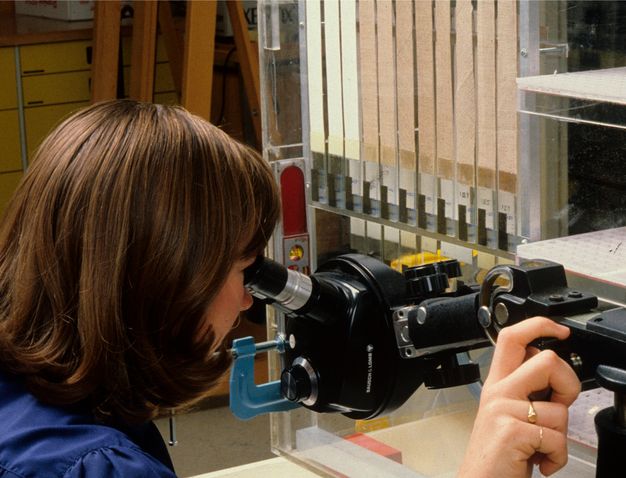
In the first phase of the Lining Project (1980s), we prepared samples with successive layers applied: linen canvas, linen canvas + size, linen canvas + size + oil ground, linen canvas + size + oil ground + oil paint. At the time, we used manual testing equipment to measure the weight, length, and tension of the samples during changes in RH (Daly, D., and S. Michalski. 1987. “Methodology and Status of the Lining Project, CCI.” In ICOM Committee for Conservation: Preprints: 8th Triennial Meeting, Sydney, Australia, 6–11 September 1987, 145–52. Los Angeles: Getty Conservation Institute.), and it was the conservator who made the measurements (fig. 19.3). This intimate tactile and visual engagement of the conservator with the samples as they underwent rapid changes influenced her practice as much as the measurements being collected.
In our dimensional response study of 1985–86, we were surprised to see that samples taken from 47%–71% RH did not stabilize at their peak but began to shrink after only two hours at 71% RH. This was significantly lower than the ~85% RH we had presumed for onset of shrinkage based on tension studies prior to that date. By 1987, however, Hedley’s measurements (Hedley, Gerry. 1988. “Relative Humidity and the Stress/Strain Response of Canvas Paintings: Uniaxial Measurements of Naturally Aged Samples.” Studies in Conservation 33, no. 3: 133–48. https://doi.org/10.2307/1506206., Hedley, Gerry. 1993. “Relative Humidity and the Stress/Strain Response of Canvas Paintings: Uniaxial Measurements of Naturally Aged Samples.” In Measured Opinions: Collected Papers on the Conservation of Paintings, edited by Caroline Villers, 86–96. London: United Kingdom Institute for Conservation of Historic and Artistic Works.) in our labs at CCI confirmed that a severe “shrinker,” when significantly prestressed, and before experiencing the permanent relaxation that occurs at 90% RH, could experience onset of shrinkage as early as 65% RH (see fig. 19.2, double green broken line [10]). Such potential for shrinkage led to great caution in our use of humidity treatments in general.
When using humidification tables for relaxation and flattening treatments, it is easy to produce higher humidity conditions than intended, particularly when that is combined with heat, even at low levels. Early monitoring of the Willard Multipurpose Table6 at CCI showed that even with a moderate setting of 76% RH and duct heating at 30°C, the humidity under the painting can rise to 90% RH and higher, due to the temperature difference between the warmer ducts and the cooler table surface. To reduce this risk, the conservator requested a monitoring system for RH under the painting (Daly Hartin, Debra, Eric Hagan, Stefan Michalski, and Mylène Choquette. 2011. “CCI Lining Project: Testing of Lined Model Paintings from Fractions of a Second to Decades.” In ICOM-CC Lisbon 2011: Preprints, 16th Triennial Conference, Lisbon, 19–23 September 2011, edited by Janet Bridgland and Catherine Antomarchi, paper 1309, 288–96. Almada, Portugal: Critério Produção Grafica; Paris: ICOM Committee for Conservation., Daly Hartin, D., T. Strang, E. Hagan, and P. Marcon. 2015. “Studio Tip: Use of the CCI Octoprobe with the Willard Multipurpose Table.” In AIC Paintings Specialty Group Postprints 28, edited by Barbara Buckley, 169–73. E-book. Washington, DC: AIC.). By glancing at the computer display of conditions under an experimental painting—placed to one side of the painting being treated—the conservator could adjust the table settings to maintain safe levels of humidification.
Sensitivity of the Size Layer and Preventive Conservation Measures
The response of the linen + size sample was fast, whether there was a change in weight, dimension, or tension. When exposed to a jump in RH, half the eventual change of length occurred within five to seven minutes, and total change happened within one to two hours. Under the binocular microscope, one could literally see the scale attached to the end of each sample moving past the reference point (see fig. 19.3). This instilled a deep appreciation of the reactivity of sized canvas, and the consequent importance of backing boards and enclosed frames to reduce RH fluctuations.
Controlled humidification is sometimes used to reactivate glue size in paintings, re-adhering incipient cleavage without adding another adhesive. During one such treatment on the Willard table, areas of missing paint allowed us to observe the glue-size bridging canvas interstices. Before humidification, the glue size was fractured; during humidification, the fractures disappeared. The size coalesced into a continuous film that moved under slight pressure from a probe. While that was a desired outcome, the reactivated size layer was once again a source of stresses. As demonstrated in previous research (e.g., Mecklenburg, Marion F. 1982. “Some Aspects of the Mechanical Behavior of Fabric Supported Paintings: Report to the Smithsonian Institution.” Unpublished report, Smithsonian Museum Conservation Institute, Washington, DC. Reprinted in Dawn V. Rogala, Paula T. DePriest, A. Elena Charola, and Robert J. Koestler, eds. The Mechanics of Art Materials and Its Future in Heritage Science, 107–29. Washington, DC: Smithsonian Contributions to Museum Conservation, 2019. https://doi.org/10.5479/si.11342126.; Daly, D., and S. Michalski. 1987. “Methodology and Status of the Lining Project, CCI.” In ICOM Committee for Conservation: Preprints: 8th Triennial Meeting, Sydney, Australia, 6–11 September 1987, 145–52. Los Angeles: Getty Conservation Institute.; Hedley, Gerry. 1988. “Relative Humidity and the Stress/Strain Response of Canvas Paintings: Uniaxial Measurements of Naturally Aged Samples.” Studies in Conservation 33, no. 3: 133–48. https://doi.org/10.2307/1506206.), the coherent size is reactive to low RH conditions and thereby particularly vulnerable to stretching and shock under these conditions. This understanding further reinforced our emphasis on the passive control of RH by enclosures, that is, the importance of preventive conservation.
Bond Strength of the Lining
In the 1980s and early 1990s, conservators reported bond strengths of the newly introduced fabrics and adhesives using peel tests. In our peel tests, we often found it difficult to reproduce results even within our own studies (Daly Hartin, D., S. Michalski, and C. Pacquet. 1993. “Ongoing Research in the CCI Lining Project: Peel Testing of BEVA 371 and Wax-Resin Adhesives with Different Lining Supports.” In ICOM Committee for Conservation: 10th Triennial Meeting, Washington, DC, 22–27 August 1993: Preprints, edited by Janet Bridgland, 128–34. Paris: ICOM Committee for Conservation.), and inferring comparison between studies or from one lab to another is even more difficult. We concluded that although published results could provide guidance, trial mock-ups of new materials and procedures in one’s own lab are essential. For example, when trying to reproduce the results of solvent activation tests described by Phenix and Hedley (Phenix, Alan, and Gerry Hedley. 1984. “Lining without Heat or Moisture.” In Preprints of ICOM 7th Triennial Meeting, Copenhagen, 10–14 September 1984, edited by Diana de Froment, 84.2.38–44. Paris: ICOM, in association with the J. Paul Getty Trust., Phenix, Alan, and Gerry Hedley. 1993. “Lining without Heat or Moisture.” In Measured Opinions: Collected Papers on the Conservation of Paintings, edited by Caroline Villers. London: United Kingdom Institute for Conservation of Historic and Artistic Works.)—with Gerry Hedley himself present to guide us—we were unable to obtain the acceptable results that he had published. We had to use mock-ups, modifying the procedure by varying the amount of solvent used and allowing time for swelling of the adhesive, to obtain an adequate bond. We learned that peel tests provide guidelines, but they do not necessarily reflect actual practice. Peel tests can inform us which combinations of materials and procedures do not work and which do work or have the potential to work. Trial linings, using test or model paintings and the equipment and procedures in one’s own lab, must be undertaken to refine the method and ensure the resulting lining will be satisfactory.
Trial or mock-up linings are not only important when new materials or procedures are used, or when there is a change in lab equipment such as purchase or refurbishment of a new hot table, but they have become increasingly important with our design of more customized linings for the specific needs of a particular painting. To allow for repetition or improvement to the trial, or mock-up, lining, there must be careful attention to, and documentation of, all details of the lining materials and procedures. This includes the amount of adhesive used, details of its application to the lining fabric, the method and conditions of adhesive activation (activation temperature, time of heating, time at activation temperature, time of cooling), and the lining pressure.
Conservators were aware of the high sensitivity of bond strength to temperature, particularly when attempting to heat a thermoplastic such as Beva 371 until it is tacky while avoiding its nearby melting point. Monitoring the temperature uniformity of hot tables during peel tests heightened our awareness that hot tables were notoriously uneven in heat distribution over the surface. This instigated practical measures to ensure appropriate temperatures over the work area, and multiple-point monitoring of the surface became essential.
An example of the importance of mock-ups and of monitoring temperature uniformity of hot table surfaces was adapting to the change in Beva 371 film from its original formulation to Beva 371b. In 2010, we were informed by the manufacturer that despite this change, the new product had the same properties.7 Many conservators, however, had found differences in performance.
Élisabeth Forest, a paintings conservator at the Centre de Conservation du Québec, had used peel tests to study Beva 371 film while a student (Forest, Élisabeth. 1997. “BEVA 371 Film Linings: Variables Affecting Bond Strength.” Research Project, Master of Art Conservation, Queen’s University, Kingston, Canada.). She found that 65°C and a ten-minute holding time gave an acceptable bond.8 This formed the guideline for many successful linings. However, using the new formulation under the same conditions, she found there was a high probability of local detachment during restretching of both linings and strip-linings.
In 2018, Forest compared the two formulations in a study undertaken at the Centre de Conservation du Québec (Forest, Élisabeth. 2019. “Le nouveau film BEVA® 371b et la formulation originale: Comparaison de la force d’adhésion lors du doublage des peintures” [Linings with the New BEVA® 371b Film and the Original Formulation: Comparison of Bond Strength]. Poster presented at the 45th Annual Canadian Association for Conservation Conference, Halifax, Nova Scotia, May 28–June 1, 2019.). As in the previous tests, two reactivation temperatures (65°C and 70°C) and two holding times (0 and 10 minutes at the activation temperature) were used (fig. 19.4). The nap-bond strength of both formulations was strongly influenced by temperature, more than doubling in force between 65°C and 70°C. Based on what was considered a reliable bond, 0.33–0.41 kN/m,9 shown by the red lines in figure 19.4, only lining at 70°C with a duration of ten minutes was successful.
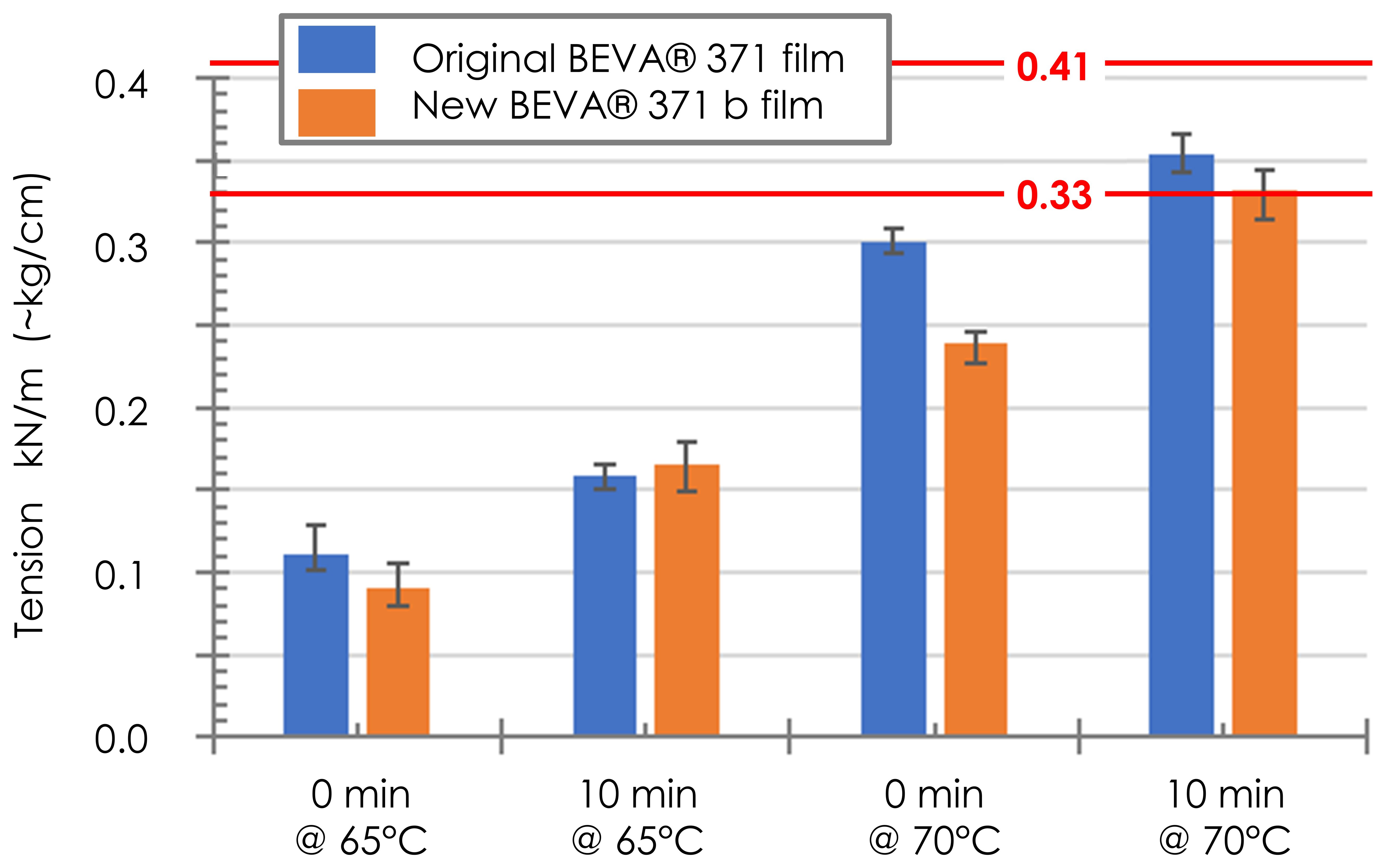
These results corroborate an earlier study by Ploeger et al. of the two formulations used in solution as a consolidant for painted surfaces (Ploeger, R., C. W. McGlinchey, and E. René de la Rie. 2015. “Original and Reformulated BEVA® 371: Composition and Assessment as a Consolidant for Painted Surfaces.” Studies in Conservation 60, no. 4: 217–26.). The original Beva 371 was shown to have a larger tack window with a gradual increase in tack, while Beva 371b had a narrow tack window with a sudden increase in tack. In summary, if the tack window (of any adhesive) becomes too narrow, or if time at the activation temperature is a determining factor in obtaining an acceptable bond, then temperature uniformity and monitoring become even more critical.
Stress Relaxation of Linings and Paintings
The overall goal of the Lining Project, besides understanding the fundamental mechanics of a painting plus a lining, was to determine whether linings can actually be considered a support for the painting: Can they reduce cupping and cracking, or can they only be considered as a bridge for ruptures in brittle and broken canvas?
The primary measurement for answering this question is stress relaxation—the loss in tension of a restrained sample over time. The primary concept within which to place such measurements is that of viscoelasticity in polymers (see also Hagan and Hough and Michalski in this volume). Conservators intuit this concept in their use of the terms relaxation and memory of deformations. In the initial research on mechanical properties of paintings, such as the tension versus RH studies (see fig. 19.2), or stress-strain plots, authors were not overly concerned with reporting time issues: How fast was the test? How much time had passed since the initial stretch? Tension and its underlying parameter elasticity depend on time, not just temperature and RH.
By 1991, we were placing our review of published data on the mechanics of paints within the framework of polymer viscoelasticity. Specifically, we introduced the primary tool of that framework—the “master curve”—which plotted elasticity over the full range of a polymer’s behavior, from glassy through leathery to rubbery as a function of temperature, plasticizer, and time (Michalski, Stefan. 1991. “Paintings: Their Response to Temperature, Relative Humidity, Shock, and Vibration.” In Art in Transit: Studies in the Transport of Paintings, edited by Marion Mecklenburg, 223–48. Washington, DC: National Gallery of Art.).
To understand whether a lining will actually support the painting and by how much, analysis of results focused on whether the lining is at higher tension than the painting during stretching, during shock and vibration, and during fluctuations in RH and temperature—and on whether the lining can maintain this support over many years. Sample preparation and experimental procedures have been published elsewhere (Michalski, Stefan, and Debra Daly Hartin. 1996. “CCI Lining Project: Preliminary Testing of Lined Model Paintings.” In ICOM Committee for Conservation: 11th Triennial Meeting, Edinburgh, Scotland, 1–6 September, 1996: Preprints, edited by Janet Bridgland, 288–96. London: James & James; ICOM Committee for Conservation.; Daly Hartin, D., E. Hagan, P. Marcon, S. Michalski, and T. Strang. 2010. “Research and Development into Structural Treatments of Paintings: CCI Lining Project & CCI Octoprobe.” In ICOM Committee for Conservation Paintings Group Workshop: Current Practice and Recent Developments in the Structural Conservation of Paintings on Canvas Supports. DVD. Helsinki: Metropolia University of Applied Sciences., Daly Hartin, Debra, Eric Hagan, Stefan Michalski, and Mylène Choquette. 2011. “CCI Lining Project: Testing of Lined Model Paintings from Fractions of a Second to Decades.” In ICOM-CC Lisbon 2011: Preprints, 16th Triennial Conference, Lisbon, 19–23 September 2011, edited by Janet Bridgland and Catherine Antomarchi, paper 1309, 288–96. Almada, Portugal: Critério Produção Grafica; Paris: ICOM Committee for Conservation., Daly Hartin, Debra, Stefan Michalski, Eric Hagan, and Mylène Choquette. 2015. “Overview of the CCI Lining Project: Do Linings Prevent Cracking and Cupping in Paintings?” In AIC Paintings Specialty Group Postprints 28, edited by Barbara Buckley, 137–50. E-book. Washington, DC: AIC.; and Michalski, Stefan, Debra Daly Hartin, Eric Hagan, and Mylène Choquette. 2014. “The CCI Lining Project Final Results: Extreme Temperatures, Extreme Humidities and Complete Master Curves.” Poster presented at ICOM Committee for Conservation 17th Triennial Conference, Melbourne, Australia, September 19–23, 2014.). The 2015 article also summarizes the results of the project and their implications for linings.
Tension was measured continuously over time. If the sample is undergoing stress relaxation, then the tension drops over time, as shown by all curves in figure 19.5. The process of building these master curves that extend to very short and very long times is described by Hagan in this volume.
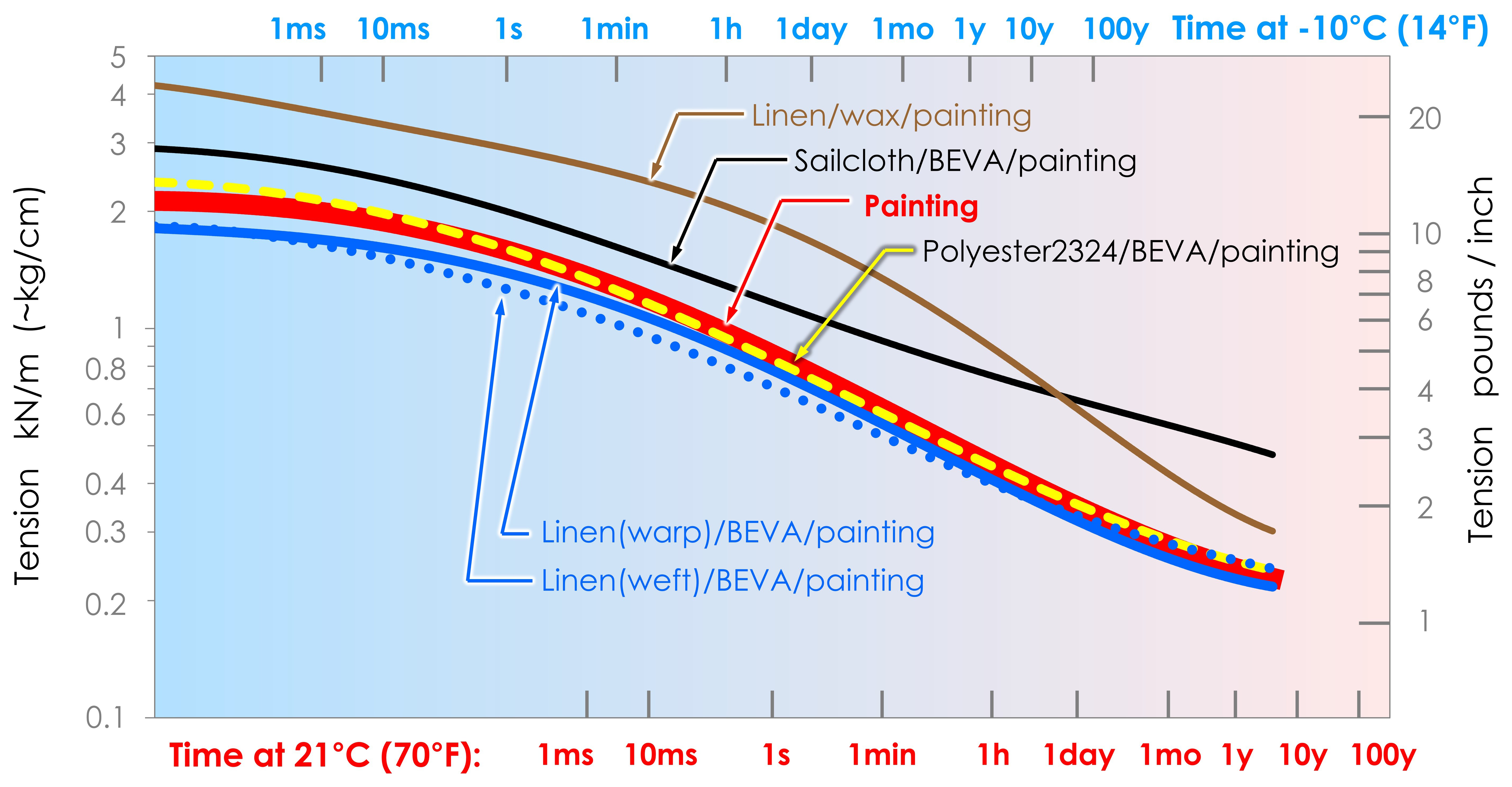
The big takeaway from figure 19.5 is that one group of linings had curves that differed only slightly from the red curve for the unlined painting, whereas a second group lifted the curve significantly. The first group, nap-bond Beva linings onto linen and onto multifilament, non-heat-set polyester, represents linings providing negligible tension/support (see fig. 19.1a). The second group—sailcloth + Beva and linen + wax—represents linings that add significant tension/support (see fig. 19.1b). Wax impregnation changes both the linen lining and the original canvas into a significant reinforced composite, quite unlike linen adhered simply with Beva. However, even though the linen + wax-lining initially contributes more support (additional tension) than the sailcloth + Beva lining, at around one second it starts to quickly lose tension, and at one day it is providing less support than the sailcloth + Beva lining.
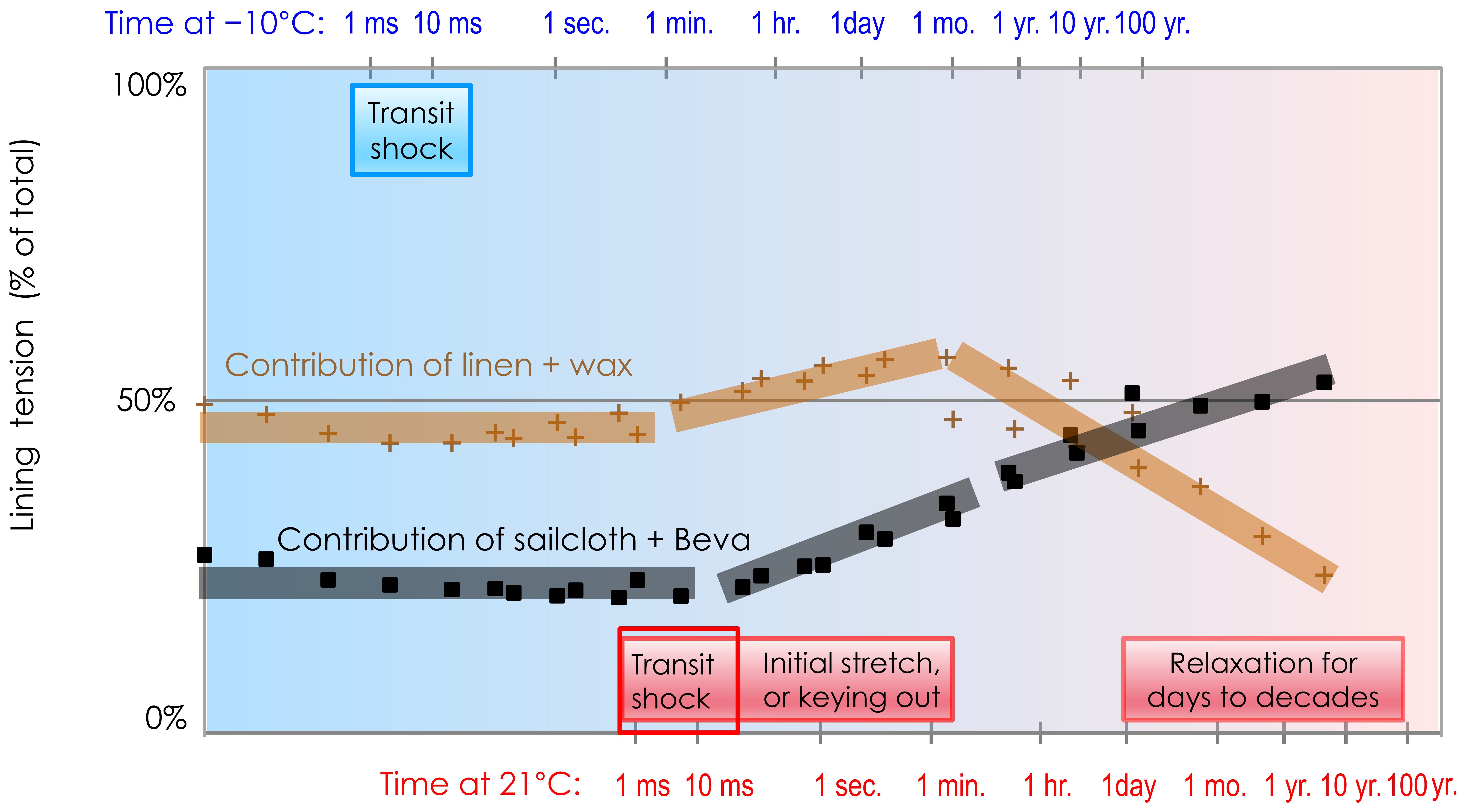
The question of whether these stiffer linings provide enough support to reduce defects in a painting is examined in figure 19.6. What percentage of the total tension is the lining alone contributing to the lined composite? In the region of transit shock, whether at room temperature or low temperature, linen + wax has double the contribution of sailcloth + Beva, but both linings offer some support, thus cracking may be reduced. For slightly slower events, such as initial stretching or keying out, both linings gain in percentage, offering slightly more support. As days and years pass at room temperature, the contribution of linen + wax collapses. The supportive contribution of sailcloth + Beva continues to increase, but never enough to dominate tension (see fig. 19.1b). To dominate tension and to reduce defects in the painting, the lining (not the painting) must contribute over 50% of the tension. Although sailcloth + Beva is relatively better in the long term, neither sailcloth + Beva nor a linen + wax-lining truly dominates tension; neither does much better than reach half of the total tension.
The influence of the lining in reducing cupping was studied using a set of square samples prepared with a T-shape cut in the center of the model painting prior to a nap-bond Beva lining (Daly Hartin, Debra, Stefan Michalski, Eric Hagan, and Mylène Choquette. 2015. “Overview of the CCI Lining Project: Do Linings Prevent Cracking and Cupping in Paintings?” In AIC Paintings Specialty Group Postprints 28, edited by Barbara Buckley, 137–50. E-book. Washington, DC: AIC.). After eighteen years, the model painting lined with Beva onto a rigid aluminum plate showed no cupping as depicted in figure 19.1b. The cupping along the “tear” of the sailcloth lining could be described as minimal to none; the sailcloth lining did not prevent cupping along the tear as well as the rigid aluminum, but it performed much better than the loosely woven linen and polyester linings which appeared in figure 19.1a. This is consistent with sailcloth’s performance over days and years (see fig. 19.6).
RH Change
We measured the response of samples to RH fluctuations up to 70% RH to give comparative data on the ability of the lining to support the stress in a painting during daily humidity cycles (Daly Hartin, Debra, Stefan Michalski, Eric Hagan, and Mylène Choquette. 2015. “Overview of the CCI Lining Project: Do Linings Prevent Cracking and Cupping in Paintings?” In AIC Paintings Specialty Group Postprints 28, edited by Barbara Buckley, 137–50. E-book. Washington, DC: AIC.). Some of these data are shown elsewhere in these proceedings (see fig. 2.4 in Hagan in these proceedings). The sailcloth + Beva lining, unaffected by RH, provides a constant absolute level of support during RH fluctuations, but during periods of very low RH (20%), rising tension in the oil painting overwhelms that of the sailcloth + Beva (i.e., the system goes from fig. 19.1b to fig. 19.1a). Linen + wax is very different; it completely blocks response to one hour of 70% RH, and blocks response to a twelve-hour exposure by two-thirds. (It is not our intent to promote wax linings, but to understand them as historic treatments with advantages as well as known disadvantages.)
This ability of wax linings to reduce sensitivity to short RH fluctuations (1–12 hours) must be placed alongside the increased sensitivity to longer RH fluctuations shown by Andersen and colleagues (Andersen, Cecil Krarup, Marion Mecklenburg, Mikkel Scharff, and Jørgen Wadum. 2014. “With the Best Intentions: Changed Response to Relative Humidity in Wax-Resin Lined Early 19th-Century Canvas Paintings.” In ICOM 17th Triennial Conference Preprints: Melbourne, Australia, 17–19 September 2014, edited by Janet Bridgland. Paris: ICOM Committee for Conservation.). They showed that a restrained sample of an old wax-lined painting that had not yet been exposed to the permanent relaxation that occurs at 90% RH (fig. 19.2, double brown line) increased dramatically in tension at RH above ~60% when exposed for at least eighteen hours. Whereas our short-term data showed the moisture barrier effects of wax linings, Andersen’s data showed the transformation of the canvas from porous yarns, which need to swell considerably before they tighten the textile, into a composite of fibers embedded in a wax matrix that tightens as soon as any fiber swelling occurs. The longer exposure permitted this to happen. Andersen’s eighteen-hour exposures also showed a second phenomenon: in the second cycle, after the exposure to 90% RH (fig. 19.2, dashed double brown line), the V-shape response seen in the graph reverted to more of a hockey-stick shape. Something was transformed irreversibly in the canvas by a single exposure to high RH while restrained.
We can see a similar but slightly less pronounced example of these two phenomena in a painting that was not wax lined: the Walker 1868–69 painting (fig. 19.2; compare before exposure to 90% RH, single dashed green line, to after exposure to 90% RH, double green dashed line). In both cases, when a canvas is impregnated with a liquid that solidifies, whether wax or size, it becomes a composite of fibers in a matrix. If the size, wax, or any adhesive just sits on top, we have instead a laminate. In practice, in a painting, one probably has a hybrid. The increase in tension (due to fiber swelling and crimp) of a restrained textile as RH climbs will occur at lower RH if those fibers are locked within a matrix. But if the tension in this composite gets high enough for long enough, a viscoelastic matrix will irreversibly slip, slide, and even exude, leading to a change in subsequent behavior.
Conclusion
Of the different types of linings we tested, though some offer more support than others, all share the load with the stiff layers of the painting. A support with mechanical properties similar to the heat-set sailcloth may reduce defects in certain situations: cupping over the years, and cracking in ground and paint from initial stretching, keying out, shock and vibration, and cold temperatures. However, sailcloth will not totally eliminate defects. The best choice combines a sailcloth lining, or its mechanical equivalent, with passive RH control. Loosely woven multifilament fabric supports will bridge ruptured layers—but alone will not reduce cupping and cracking.
Linings have decreased over the last twenty years due to the desire for less intervention with the painting and due to the development of effective, noninterventive options that provide support and protection. Where linings are necessary, research on the mechanical behavior of lined paintings has informed us of the limitations and benefits of the materials available to us, allowing us to assess and select the best option available. Our research has shown that to prevent defects in a painting, we are forced to integrate lining choices with preventive conservation choices—specifically, the use of passive RH control strategies, such as backing boards and tight enclosures, which fortunately coincide with efforts to develop more sustainable solutions.
Research over the past forty years, by CCI and others, has provided us with the knowledge to assess and refine our practices, such as relaxation, flattening, and lining, so they are undertaken with greater effectiveness combined with less intervention and less risk to paintings. Though institutions with more control over their environments and painting enclosures can avoid lining in many instances, there are situations, such as extensive damage or instability and little control over the painting’s environment, when lining is necessary. As a result of our studies, sailcloth has been considered and used as a lining support, though it does present practical difficulties such as its inauthentic appearance and problems along the tacking margin fold. We do not have the perfect option, but we are more aware of what a lining can and cannot do.
Our profession is in the position to observe the impact and effects of treatments undertaken in the past decades and to develop even better solutions with the knowledge, materials, and tools available to us today. We are fortunate that our field encourages and enables conservators and conservation scientists to work together to address the technical issues and observations arising in the conservation lab. This collaboration and direct involvement in practical research promotes appropriate, practical, knowledge-based solutions.
Acknowledgments
Our thanks to Élisabeth Forest, paintings conservator, Centre de Conservation du Québec, for her willingness and collaboration in the use of her Beva film study as an example of research influencing laboratory practice.
Notes
-
Diane Falvey, who worked with Mehra during her training, introduced this system into practice at CCI around 1979. ↩︎
-
Formula: 454 g AYAA and 454 g AYAC, dissolved in 1.4 l toluene. Add per 1 liter proportion, 4 g melted microcrystalline Multiwax 445; stir until dissolved. Source: unpublished notes and precis by Caroline Keck from Conservation Practitioners Course, Cooperstown Art Conservation Center, New York, summer 1973. ↩︎
-
The 1993 paper had previously been introduced at the 1986 American Institute for Conservation poster session and was presented at the Toronto Area Conservation Guild by Margaret Sutton in 1991. ↩︎
-
To achieve rigidity and increased stiffness, laminates could consist of multiple layers of fiberglass fabric, or linen and Mylar, or layers of woven polyester, possibly with the addition of monofilament fabrics. ↩︎
-
The CCI Lining Project was initiated in 1983 by Debra Daly Hartin and Stefan Michalski, with the input of Ian Hodkinson. There were three major testing phases: testing of model paintings, peel testing, and testing of lined model paintings. ↩︎
-
Now the Multi Function Suction Table; see https://www.willard.co.uk/product-page/multi-function-suction-tables. ↩︎
-
Conservator’s Products Company, “Announcement: BEVA 371 Reformulated in 2010,” http://www.conservators-products.com/pr01.htm. ↩︎
-
The hot table was quick to heat (13 minutes to 65°C and 18 minutes to 70°C) and quick to cool to 25°C (20–21 minutes). During heating and cooling, the samples remained under low pressure (the Dartek membrane could be easily lifted from the linings with the fingers). ↩︎
-
Forest referenced two articles that described adequate bond strengths; a bond strength between 0.33 and 0.41 kN/m was considered reliable without being excessive, and 0.1 N/mm was a minimum, very weak lining adhesive bond (Phenix, Alan, and Gerry Hedley. 1993. “Lining without Heat or Moisture.” In Measured Opinions: Collected Papers on the Conservation of Paintings, edited by Caroline Villers. London: United Kingdom Institute for Conservation of Historic and Artistic Works.). A bond strength of 0.5 kN/m was considered strong; and 0.7 kN/m, too strong (Daly Hartin, D., S. Michalski, and C. Pacquet. 1993. “Ongoing Research in the CCI Lining Project: Peel Testing of BEVA 371 and Wax-Resin Adhesives with Different Lining Supports.” In ICOM Committee for Conservation: 10th Triennial Meeting, Washington, DC, 22–27 August 1993: Preprints, edited by Janet Bridgland, 128–34. Paris: ICOM Committee for Conservation.). ↩︎