The poster summarizes the morphology and function of two dozen double-sided processional painted flags and epitaphs on fabric and discusses the technical context of their current material degradation, studied in conjunction with their storage condition and cultic, itinerant purpose in eighteenth- and nineteenth-century Byzantine Orthodox ecclesiastic ritual. Such objects need to preserve their cultic function after conservation. The examples of processional artifacts discussed belong to various distinctive collections in Romania and will be analyzed to characterize the properties of their technique and materials. This analysis will further affect discussions on decision-making regarding treatment options, tools, materials, and useful techniques to consolidate both the delicate pictorial surface of the majority of double-sided painted cultic objects and their flexible, and sometimes very fragile, canvas supports.
56. An Approach to Conservation Treatment Options for Double-Sided Painted Canvases with Ritual Functions
- Filip Adrian Petcu, Director, Regional Center of Research and Expertise in Restoration and Conservation of Cultural Heritage, Faculty of Arts and Design, West University of Timișoara, Romania
Introduction
The paper describes a theoretical and practical approach to the remedial conservation of double-sided canvas paintings, cultic flags, and epitaphs on fabric with ritual functions, dating from the eighteenth and nineteenth centuries in Romania. Double-sided painted flags and banners call back to an ancient archetype, the Constantinian labarum, a semantic reconversion of the Roman vexillum—the flag of the Roman cavalry—to a symbol of Christianity. Painted cloth artifacts are known from Egyptian antiquity through the medieval period in Europe,1 with the gonfalone, the heraldic flags of the Renaissance and beyond to banners of ‘professional guilds in Europe. Asian thangka paintings are another example.
Double-sided painted textiles have been used since ancient times in the Orthodox Church during processions, ecclesiastic feasts, and litanies. The identity of double-sided painted canvases with ritual function marks a particular chapter of challenges for paintings conservators, starting from the cultural perspective and extending to the very specific technical aspects that define such complex objects, defined typologically as paintings on canvas or as painted textiles (Pollak, Nancy R. 2003. “Moving Pictures: Adapting Painting Conservation Techniques to the Treatment of Painted Textiles.” In Tales in the Textile: The Conservation of Flags and Other Symbolic Textiles, Preprints of the NATCC, Albany, 6–8 November 2003, edited by Jan Vuori, 127–34. New York: North American Textile Conservation Conference.).
The conservation of such painted banners has rarely been addressed in the literature yet is a subject of interest to conservators of liturgical objects. The Bibliography of Romanian Vexilology (Mureșan, Augustin, and L-Șt. Szemkovics. 2018. Bibliografia vexilologiei românești. Arad, Romania: Vasile Goldiș University Press.) mentions sixty-nine titles referring to conservation aspects of flags and banners; however, most of the references address textile artifacts and embroideries, rather than painted banners. The Getty Conservation Institute’s online database AATA Online2 reveals ninety-eight results over a broad search on the topic. In this study, the technical examination of twenty-five of these banners is used to inform research into consolidant choices for the treatment of these objects.
Context
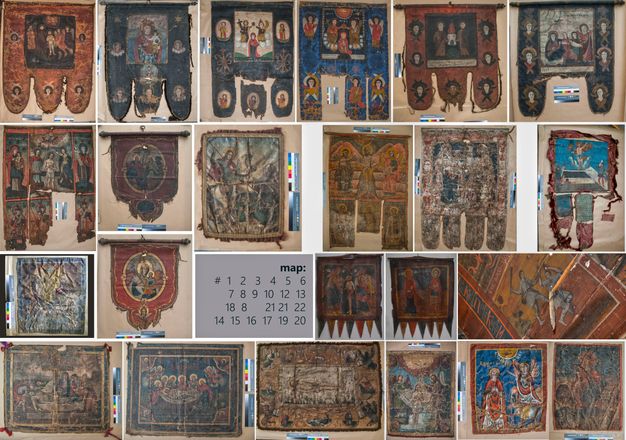
This study addresses eighteenth- and nineteenth-century processional ecclesiastic objects painted on canvas supports, double-sided painted banners called prapori, and painted epitaphs, originating from wooden churches (fig. 56.1). The majority of these objects are stored in the collection of the Orthodox Archdiocese of Timișoara, in the Metropolis of Banat.
| Materials added to fibers of banner and epitaph fabric | ||||||
|---|---|---|---|---|---|---|
| Sample banners/epitaphs | Proteic compound | Lipids | Kaolin | Gypsum | Calcium carbonate | Calcium oxalate |
| 2 | + | |||||
| 3 | (+) | + | + | |||
| 4 | (+) | + | + | |||
| 5 | + | + | ||||
| 6 | + | + | ||||
| 7 | + | + | + | |||
| 8 | (+) | + | (+) | |||
| 9 | + | |||||
| 10 | + | + | ||||
| 12 | + | + | + | |||
| 14 | + | + | + | |||
| 15 | + | |||||
| 16 | + | + | ||||
| 17 | + | |||||
| 22 | + | |||||
Note: FTIR was done by Cristina Carșote.
Table: Cristina Carșote and Filip A. Petcu
In the Christian ecclesiastic space, double-sided painted banners are always stored vertically, hanging from a pole in the narthex or the nave of the church. Banners are mounted on a special designed T-shape suspension pole, which is associated with the holy cross; this pole functionally supports a second horizontal wooden pole, called a drug, on which the painted fabric is draped. The wooden poles are attached to the structure of the rows of standing pews along the north and south perimeter aisles of the architectural space, except for once a year, when they are carried in processions. The display as a function of the scenography inherent to the specific moment of the ecclesiastic year induces significant stresses to the canvas due, basically, to the action of gravity and the weight of the canvas itself, leading to deformation and other mechanical damage.
By comparison, painted epitaphs are generally laid horizontally on flat surfaces, which protects the canvas from many of the mechanical stresses to which banners are subjected. In both cases, however, the integrity of the painted image, the religious icon, is related to the liturgical presence of the depicted subjects and has to be considered essentially as an argument during strategies for a conservation planning.
Materials and Technique
Twenty-five different painted liturgical textiles were studied; they are constructed of a variety of materials (see fig. 56.1). The horizontal wooden top poles are occasionally polychromed and have profiled bulbs mounted on their ends. The textile supports are either a single piece of plain-weave linen or hemp or composed of two different pieces of the same fabric, sewn together along the vertical axis of the banner. In addition, there may be a variety of ornamental accessories such as lappets, fringes, tassels, textile ribbons, and braids. Generally, in the case of the banners, the canvas surface is entirely covered with paint. In rare cases in the epitaphs, the fabric is only partly painted. Metal leaf is used for gilding halos and the painted frames that structure the composition.
In most examples, with rare exceptions, the canvas supports carry a sizing and/or a ground layer of different thickness and layer structure all over the canvas surface. However, sometimes the ground only covers the rectangle corresponding to the central image of the composition and not the lappets of banners. The layering of paint strata is simple, thinly applied on heterogeneous ground layers,3 using the pigments available at the time, which provided a generally matte surface finish.
Strips of material sewn all around on three of four margins of the banners’ perimeter were used as structural reinforcements to protect the regular perforated edges of the fabric; this indicates that the canvas was prestretched. Occasionally, the perimeters are decorated with patterned ribbon or, rarely, fringes of wool. Some of the painted banners carry dyed wool tassels mounted on carved wooden elements that hang from the lappets,4 the rectangular, triangular, or rounded bottom panels descending from the banners.
Epitaphs (and, less often, banners) are painted on satin-weave dyed textiles, and the pattern of the textile is included as an element of texture in relationship with the painted surface of the composition. The painting media are proteinaceous and/or lipidic (table 56.1) and may be associated with similar binder and pigments used to decorate wooden churches of the same period, where primed canvas strips are commonly used to secure the joints between neighboring wooden panels.
Degradation
The itinerant purpose of painted banners and epitaphs for ecclesiastic display, as well as their technique and constitutive shape, are factors that contribute to their degradation. Mechanical stress and strain develop unevenly within the textile support in conjunction with the horizontal upper suspension pole of banners and their inherent lack of a strainer. The structural presence of heavy lappets cut out from the larger fabric surface also contributes to these stresses. The objects are used outdoors and exposed to severe weather conditions and UV radiation. Inside churches, they are exposed to environmental conditions such as air currents, high fluctuations of ambient parameters, and occasionally direct contact with water. They are also exposed to fatty components and soot from oil lamps, candles, and censers. Handling during rituals, inappropriate storage, transportation, and routine maintenance can all lead to mechanical damage. Biological damage can be caused by birds, bats, and moths and other insects. Technical issues inherent to the paintings’ manufacture include rigid layering, critical or high pigment volume concentration (PVc), chemical alterations due to pigment-media interaction, unstable pigments or dyes, embrittlement of the paintings’ strata, loss of adhesion or cohesion due to failure of the binding media within the layers, and other technical issues regarding the painting technique, such as structural losses, tears in the fabric, and biochemical degradation of canvas threads.
Instrumental Analysis
Digital photography and portable handheld digital microscopy with UV, visible, and infrared spectra illumination were used to document the objects. A consistent number of microsamples were collected for technical examination purposes, generating large quantities of data that are still being studied.
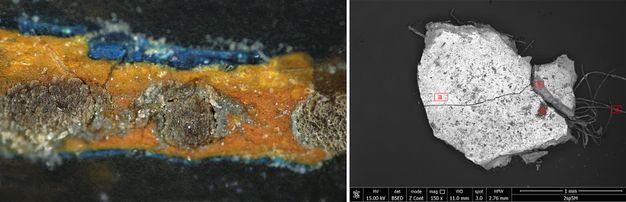
The samples were observed with light microscopy under high magnification with a Zeiss Axio Imager A1m and Olympus BX51 microscopes, and some samples were analyzed using scanning electron microscopy–energy dispersive X-ray analysis (SEM-EDX)5 to provide more in-depth information on the surface of the samples and the presence of various specific elements in different strata. Three banners were inspected using a noninvasive portable X-ray fluorescence (XRF) spectrometer.6 More insight into the samples’ crystalline nature came to light using X-ray powder diffraction (XRD) examination. The identity of some pigments and media was confirmed by analysis of the samples using micro-Raman spectroscopy,7 an Olympus BX-51 microscope, and attenuated total reflectance–Fourier transform infrared spectroscopy (ATR-FTIR).8 Canvas threads were investigated with ATR-FTIR using a portable Alpha spectrometer from Bruker Optics equipped with an ALPHA Platinum ATR module. Spectra were recorded in the 4000–650 cm−1 spectral range with a 4 cm−1 resolution, using thirty-two scans (fig. 56.2; see table 56.2). The data from samples of the referred objects were compared with measurements taken on a sample of painted canvas, cloth glued over the face of the joint, from a painted wooden church from Curtea, dated 1806, to confirm that painters of wooden churches used similar materials—canvas and ground layer composition—to paint banners.
| Compounds for adhesive/consolidant solutions | Solution (% or w/w) | Solvent 1/w for 100 g | Solvent 2/w for 100 g | Prewetting of the surface prior to application | Re-adhesion of loose paint flakes | Impregnation, stabilization of decohesive paint | Electric conductivity |
|---|---|---|---|---|---|---|---|
| Celluforce NCC CNC | 1% | DIW 99 | — | Yes, DIW:IMS (1:1) | — | ✓ | 174 µS/cm |
|
PVOH: Mowiol 4-88 |
10% | DIW 90 | — | Yes, DIW:IMS (1:1) | ✓ | ✓ | — |
| Aquazol 200 | 10% | Isopropanol 90 | — | Yes; DIW:IMS (1:1) | ✓ | ✓ | — |
| Aquazol 200 | 5% | Isopropanol 47.5 | Naphtha 47.5 | No | — | ✓ | — |
| Plexisol P550 (30%) | 5% | — | Naphtha 95 | No | — | ✓ | — |
| Paraloid B72 5% BAC + Aquazol 200 10% IP | 9:1 | Butyl acetate 95 | IP 90 | No | — | ✓ | — |
| Methocel A4M | 2% | DIW 98 | — | Yes; DIW:IMS (1:1) | — | ✓ | 198 µS/cm |
| Culminal 2000 | 3% | DIW 48.5 | IP 48.5 | Yes, nonpolar solvent for surface sealing | ✓ | — | 79 µS/cm |
| Aquazol 500: Culminal 2000 |
1:1 w/w | Isopropanol 56.25 | DIWater 32.25 | Yes, nonpolar solvent for surface sealing | ✓ | — | — |
| Aquazol 500 | 20% | Isopropanol 64 | DIWater 16 | Yes, DIW:IMS (1:1) | ✓ | — | — |
| Aquazol 500 + Celluforce NCC CNC* | 1:1 w/w | Isopropanol 40 | DIWater 72 | Yes, DIW:IMS (1:1) | ✓ | ✓ | — |
*1 part by weight of Aquazol 500 (20%) solution in 4:1 of isopropanol to deionized water, plus 1 part by weight nanocellulose (1%) in deionized water.
Abbreviations: BAC = butyl acetate; CNC = cellulose nanocrystals; DIW = deionized water; IMS = industrial methylated spirits; IP = isopropanol
Table: Filip A. Petcu
Consolidation Tests
In preparation for future interventions in cases where the degraded canvas carries a heavy load of paint strata on both sides, consolidation tests were performed on canvas, ground, and/or paint layers. Different formulated products were assessed to stabilize flaking paint, improve the strength of the layers and their adhesion to the substrate, and structurally reinforce the weakened canvas. Testing was performed on a surviving fragment of a banner and on a damaged area of a second banner that presented severe craquelure, deformation of the detached paint layers in the interface support ground, cleavage of paint layer from ground, and displaced flakes of paint stratigraphy (table 56.3).
| No. | Location* | Face A | Face B | Dimensions | Lappets/streamers | Date/provenance |
Canvas weave count per (cm2) |
Horizontal wooden suspension pole (drug) |
|---|---|---|---|---|---|---|---|---|
| 1 | MBT | Dormition of the Theotokos with 5 Seraphs | Theophany (Baptism) of Jesus Christ + 1 Saint, 3 Seraphs | 109 × 91.5 cm | 3, oval, seraphs | 19th century | 15 × 13 | Lost |
| 2 | MBT | The Virgin Mary as Empress of the Heavenly Hosts with Jesus Christ Child, Star, Triangle. Medallion with St. H. Nicholas of Myra, 5 Cherubs | Holy Archangels Michael and Gabriel, sun and moon, medallion with St. Paraskeve of the Balkans, 5 Cherubs |
157 × 130 cm Canvas: 114 cm |
3, oval, cherubs |
1848 Poeni, Timiș county |
14 × 18 | Profiled (3 bulbs), painted red |
| 3 | MBT | Pentecost, flanked by the 2 Archangels. Lappets: Saint Emperors Constantine and Helen; central lappet detached (Ascension of the Lord Jesus), Nativity of the Theotokos | Coronation of the Virgin Mary with medallions of Saint Ap. Peter and Paul, 2 floral ornaments, lappets: 3 Evanghelists, | 144 × 107 cm | 3, oval; central lappet broken |
1876 Poeni, Timiș county |
14 × 16 | Lost |
| 4 | MBT | Coronation of the Virgin Mary, flanked by Archangels. Lappets: Seraph, St. M. George, St. M. Dimitrios, Seraph | Theophany-Baptism of Jesus Christ, flanked by the Mother of God with Christ Child and St. Paraskeve of the Balkans, on the lappets: St. H. Nicholas of Myra, St. H. John Chrisostomos (St. H. Basil the Great), St. H. Gregory Bogoslov. | 142 × 108 cm | 4, not distinguishable; one lappet lost |
1812 Poeni, Timiș county |
15 × 15 | Lost |
| 5 | MBT | Apostles Peter and Paul, 2 Seraphs, 2 Cherubs. Lappets: 3 Seraphs | Coronation of the Virgin Mary, 4 Seraphs, on the lappets: 3 Seraphs |
93 × 89 cm Canvas: 75 cm |
3, oval, seraphs |
1881 (Crivina de Sus, Timiș county) |
12 × 12 | Profiled, 3 bulbs |
| 6 | MBT | Mother of God flanked by 4 seraphs. Lappets: 3 seraphim | Nativity of the Virgin Mary, flanked by 4 seraphs |
90 × 90 cm Canvas: 77 cm |
3, oval, seraphs; central lappet missing |
1882 Crivina de Sus, /Timiș |
13 × 13 | Profiled, 3 bulbs |
| 7 | MBT | Theophany-Baptism of Jesus Christ. Left: Virgin Mary with Christ Child. Right: St. Paraskeve of the Balkans. Lappets: St. Apostle Paul, St. Gregory Bogoslov (St. Basil the Great), St. John Chrisostomos | Coronation of the Theotokos, flanked by 2 archangels | 137 × 107 cm | 4, rectangular shape lappets; 1 missing |
1867 Poeni, Timiș county |
8 × 10 | Lost |
| 8 | MBT | Mother of God with Jesus Christ Child and Cherub | Holy Trinity, with medallion and inscription |
73 × 73 cm Canvas: 54 cm |
Pennant has the shape of a chalice |
1848 Hezeriș, Timiș county |
14 × 14 | Profiled, masterful fixing system of the canvas to the wooden pole |
| 9 | MBT | Pentecost | Saint M. George | 56 × 43 cm | — | 20 × 27 | Lost | |
| 10 | MBT | Theophany, Baptism of Jesus Christ | Archangel Michael. Lappets: St. Paraskeve of the Balkans, St. Nicholas of Myra, St. Demetrios |
132 × 102 cm Canvas: 92 cm |
3, rectangular shape, saints |
1777 Zolt, Timiș county |
13 × 8 | Wooden pole |
| 12 | MBT | Theophany, Baptism of Jesus Christ | Theotokos with Christ Child, Saint Apostle Peter | 140 × 100 cm | 4, rectangular shape, cherubs and seraphim | 1779 | 10 × 13 | Wooden pole (new, improvised) |
| 13 | MBT | Resurrection of Jesus Christ | Nativity of Jesus Christ | 99 × 75 cm | 3, oval shape | 1875, Clopodia, Timiș county | — | Lost |
| 14 | MBT | Epitaph | Burial of Jesus Christ | 75.5 × 62cm | — | 1848, Nerău | 16 × 17 | — |
| 15 | MBT | Epitaph | Burial of Jesus Christ | 70.5 × 55.5 cm | — | 1824, Govojdia, Timiș county | 14 × 15 | — |
| 16 | MBT | Epitaph with scenes and symbols from the cycle of the Passions of Christ | Burial of Jesus Christ | 120 × 87 cm | — | — | — | — |
| 17 | MBT | Theophany, Baptism of Jesus Christ | Dormition of the Theotokos | 111 × 88 cm | — | — | — | Lost |
| 18 | MBT | The Holy Trinity | The Annunciation | 56 × 51 cm | — | Jupânești, Timiș county | 12 × 11 | Lost |
| 19 | Private | Saint M. George | The Annunciation | 63 × 53 cm | — | Cubleșu, Sălaj | 11 × 11 | Lost |
| 20 | MBT | Theophany, The Baptism of Jesus Christ | Virgin Mary Theotokos(?) | 75 × 59 cm | — | Jupânești, Timiș county | 12 × 11 | Lost |
| 21 | Private | Theophany, The Baptism of Jesus Christ | Saint M. Tryphon and St. Paraskeve of the Balkans | 108 × 85 cm | 7, triangular shape |
1848 Socu, Gorj county Authors: George, Kostandin, Kostandin |
11 × 13 | Original shape of the wooden pole to which the textile is sewn around with a rope |
| 22 | MBT | Interstitial canvas from wooden church St Paraskeve of Curtea | Photographic detail from the scenes of the Parables of Jesus Christ. | — | — |
1806 Curtea, Timiș county |
— | — |
| 22 | Private | The Holy Trinity | Nativity of Lord Jesus Christ | — | — | Cubleșu, Sălaj county | — | Fragment |
| 23 | MArT | Theophany, Baptism of Jesus Christ, Saints Evangelists John and Luke, Saints Bishops Basil, Gregory, John | Saint Archangel Michael, Saint Evangelists Mark, Saint M. Theodore Tiron, Saint M. Nestor | — | 5, rectangular shape | 18th–19th century | — | Profiled wooden pole |
| 24 | MBT | The burial of Jesus Christ on the Great Friday (with cherubs) | Apostles Peter and Paul (with cherubs) | — | 3 lappets; central lappet lost | ca. 1882, Crivina de Sus, Timiș county | — | Only surviving wooden pole with 1 bulb, with painted canvas / Fragment from a deteriorated banner cut off and stolen from its pole |
| 25 | MBT | Theotokos with Jesus Christ Child | The Holy Trinity |
79 × 56 cm Canvas: 65 cm |
The pennant has the shape of a chalice; lappet missing | Pogănești, Timiș county | — | Profiled fixing system of the canvas to the wooden pole |
Abbreviations: MBT = Museum of the Orthodox Archdiocese of Timișoara; MArT= Timișoara Museum of Art; Private = private collection. This table details the banners and epitaphs in the study shown in fig. 56.1.
Table: Filip A. Petcu
Research on previous consolidation campaigns with similar objects reveal the use of protein glues and carboxymethyl cellulose (Dumitran, Ana, and Ioana Rustoiu. 2007. Steagul bisericesc. Alba Iulia, Romania: Altip Publishing House.). Beva 371b formulations were previously used (Petcu, Filip Adrian. 2017. “Retouching a Double-Sided 19th-Century Processional Flag-Icon.” In International Meeting on Retouching of Cultural Heritage, Rech4-Split, 4th ed., edited by Ana Bailão and Sandra Sustic. Split, Croatia: Academy of Arts, University of Split.), but some of the ingredients may raise concerns for conservators. Water-based consolidation systems and adhesives prone to severe shrinkage, as protein glues are, were not considered here due to the fragility of the untensioned canvas and paint as well as the presence of metal soaps.9 Potential cross-linking materials were also excluded from the list.
The properties of the chosen materials were researched with recommendations from the available literature,10 and further mixtures were selected, including particular additives. The eleven formulas chosen included polyethyloxazoline (PEOX) solutions, including Aquazol 200 and 500; polyvinyl alcohol (Mowiol 4-88), acrylic solutions such as Degalan P 550 and Paraloid B72, nonionic cellulose ethers such as MC and MHEC, and Celluforce NCC cellullose nanocrystals (Bridarolli, Alexandra, Oleksandr Nechyporchuk, Marianne Odlyha, Marta Oriola, Romain Bordes, Krister Holmberg, Manfred Anders, Aurelia Chevalier, and Laurent Bozec. 2018b. “Nanocellulose-based Materials for the Reinforcement of Modern Canvas-supported Paintings.” Studies in Conservation 63, sup. 1: 332–34. https://doi.org/10.1080/00393630.2018.1475884.) (see table 56.2). Aquazol was selected given its versatility, nontoxicity, minimal interaction with the constituent materials of paintings, and good reversibility (Bosetti, Elisabeta. 2012. “A Comparative Study of the Use of Aquazol in Paintings Conservation.” E-Conservation, no. 24: 73–87. https://issuu.com/elisabettabosetti/docs/a_comparative_study.). To enhance the diffusion of the consolidant and its efficiency, surface cleaning and prewetting were carried out selectively.
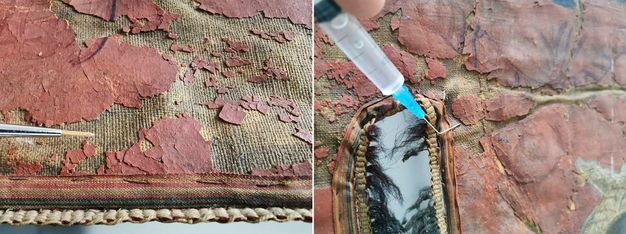
Considering the dry environment of current storage, Aquazol 500—stronger than Aquazol 200 (Mecklenburg, Marion F., L. Fuster-López, and Silvia Ottolini. 2012. “A Look at the Structural Requirements of Consolidation Adhesives for Easel Paintings.” In Adhesives and Consolidants in Painting Conservation, edited by Angelina Barros D’Sa, Lizzie Bone, Rhiannon Clarricoates, and Alexandra Gent, 7–23. London: Archetype.) but with lower penetration (Arslanoglu, Julie, and Carolyn Tallent. 2003. “Evaluation of the Use of Aquazol as an Adhesive in Painting Conservation.” Western Association for Art Conservation Newsletter 25, no. 2: 12–18. https://cool.culturalheritage.org/waac/wn/wn25/wn25-2/wn25-205.pdf.)—was used instead of protein glues, assuring optimum penetration, plasticization, and the necessary workability to reattach the flakes. The addition of 1% Celluforce NCC helped improve the interlayer adhesion and grip while simultaneously reinforcing the degraded canvas. Culminal 2000, a methyl cellulose derivative, was added to impart gelled consistency to the adhesive, decreasing the RH responsiveness (Arslanoglu, Julie. 2004. “Aquazol as Used in Conservation Practice.” Western Association for Art Conservation Newsletter 26, no. 1: 10–15. https://cool.culturalheritage.org/waac/wn/wn26/wn26-1/wn26-105.pdf.) and better performance in filling gaps between shrunken ground and canvas threads. Repeated applications by brush and syringe and cold mechanical pressure using a silicon tool and the heated spatula proved useful in achieving satisfactory adhesion and a stabilization of canvas and paint on both sides of the banner (fig. 56.3).
Over time, however, the impact of the weight of the lappets on the overall mechanical behavior of the canvas might further require local reinforcement with an adhesive that provides an additional bonding capacity to the paint layers before further necessary structural interventions can be carried out on the support. Polyamide welding powder was preferred for structural repairs on the heavy lappets, yet interventions were postponed due to a need for immediate stabilization of the flaking. Previous research has shown that Beva 371 presents good bonding properties11 and that the cohesive properties remain fairly stable over a wide range of humidity. This is significantly interesting considering that these artworks are usually stored in uncontrolled environments. Being a thermoplastic adhesive, Beva 371 should also stay flexible in the long term.
Acknowledgments
This study would not have been possible without the expertise, goodwill, and active participation of Nicoleta Ploșnea (Mitropolia Banatului), Petru Negrea and Oana Buriac (Universitatea Politehnica Timișoara, Institutul de Cercetări pentru Energii Regenerabile: XRF, SEM-EDX), Marinela Miclău and Melinda Vajda (Institutul Național de Cercetare – Dezvoltare pentru Electrochimie și Materie Condensată: XRD), Zoltan Szabadai and Andrei Racu (Laboratorul de Energii Regenerabile – Fotovoltaic: micro-Raman, UV-VIS spectrometry), Cristina Carșote (Muzeul Național de Istorie al României: FTIR), Ksynia Marko (National Trust), and James Black (International Academic Projects).
Notes
-
For tüchlein paintings, scenic backcloths, and theatrical cloths, see Villers, Caroline. 2000. The Fabric of Images: European Paintings on Textile Supports in the 14th and 15th Centuries. London: Archetype. and Costaras, Nicola, and Christina Young. 2000. Setting the Scene: European Painted Cloths, 1400–2000. London: Archetype.. ↩︎
-
As described by Cennino Cennini, The Book of the Art, and by Dionysius of Fourna, Hermeneia. ↩︎
-
Sometimes called streamers (Hourihane, Colum. 2013. “Flags and Standards.” In The Grove Encyclopedia of Medieval Art and Architecture, 514. New York: Oxford University Press.). ↩︎
-
Quanta Feg-250 equipped with an EDAX Apollo silicon drift detector, 15 kV. ↩︎
-
ThermoFisher Scientific Niton XL3t GOLDD+. ↩︎
-
Argon Laser Stellar-Pro Select 150 with adjustable emission at 514 nm. ↩︎
-
Andor Shamrock 500i Detector with iDus 420 CCD spectroscopy camera and a Bruker Vertex 70 FT-IR spectrometer. ↩︎
-
The introduction of water can lead to formation of metal soaps inside of paint layers. See van Loon, Annelies, Petria Noble, and Aviva Burnstock. 2021. “Ageing and Deterioration of Traditional Oil and Tempera Paints.” In Conservation of Easel Paintings, edited by Joyce Hill Stoner and Rebecca Rushfield, 329–56. London: Routledge.. ↩︎
-
Adding 10% Aquazol 200 to Paraloid B72 improves qualities of B72 in acetone (Wolbers, Richard. 2008. “Short Term Mechanical Properties of Adhesives: Solvent and Plasticizer Effects.” In The Care of Painted Surfaces: Materials and Methods for Consolidation, and Scientific Methods to Evaluate Their Effectiveness; Proceedings of the Conference, Milan, 10-11 November 2006; Third International Congress on Color and Conservation, Materials and Methods of Restoration of Movable Polychrome Works, CESMAR7: The Center for the Study of Materials Restoration. Saonara, Italy: Il Prato.). ↩︎
-
The adhesive and cohesive properties of Beva 371 are assessed in depth compared to other conservation products (Mecklenburg, Marion F., L. Fuster-López, and Silvia Ottolini. 2012. “A Look at the Structural Requirements of Consolidation Adhesives for Easel Paintings.” In Adhesives and Consolidants in Painting Conservation, edited by Angelina Barros D’Sa, Lizzie Bone, Rhiannon Clarricoates, and Alexandra Gent, 7–23. London: Archetype.). ↩︎