Additional Contributors: Aurélia Azéma, Jane Bassett, Manon Castelle, Laurence Garenne-Marot, Andrew Lacey, Emmanuel Lamouche, Carol Mattusch, Sreyneath Meas, Lorenzo Morigi, Dominique Robcis, Donna Strahan, Brice Vincent, Jean-Marie Welter
This chapter overviews the different ways in which measurements such as weight, volume, and size are useful in the study of , and aims to guide the reader in how to make a variety of measurements correctly.1 How to best report measurements (accuracy, et cetera) is mainly addressed in II.1§4. Micro-scale measurements of tool marks on a bronze surface, such as those obtained with digital microscopes, are dealt with in II.2§2.1. How to measure the thickness of surface layers, including and , is covered in II.6§1.
1 What can we learn from measurements? And what kinds of measurements are useful?
1.1 Overall dimensions
Overall dimensions (height, width, depth) are important, and standard, components of a sculpture’s description. Such basic measurements, and those of individual parts (arms, head, and so on) may yield important clues to the generational relationships between works related to a similar model.
1.1.1 Shrinkage and internal measurement
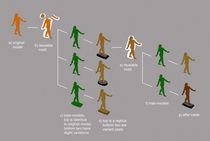
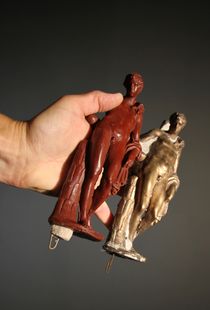
Because metal and wax both shrink slightly as they cool from molten to solid states, precise measurement of dimension may assist in identifying contemporaneous versions from the same , or later or copies (fig. 1). In theory, the former should be nearly identical in size, while the latter should be smaller.
For this type of analysis, it is important to focus on so-called internal measurements, as coined by Ann Allison in her study of bronzes by the Renaissance sculptor Antico (Italian, ca. 1455–1528).2 “Internal” refers to measurements taken within areas that do not contain wax-to-wax or metal-to-metal joints, and so should not (in theory) be subject to significant distortion due to assembly of the model or casting. Allison used internal measurements such as width across the chest, length from chin to crown of head, eye to eye, and so on to assist in establishing a “family tree” of different versions after the same model (and potentially from the same ).
Even when internal measurements are used, caution should be exercised. is a complex physical phenomenon that is difficult to model or predict with accuracy, particularly for elaborate hollow forms. Clearly, a variety of processes other than shrinkage can affect final dimensions, including steps taken during model or production as well as cold work undertaken after casting.3 For instance, it is important to consider that wax models can be bent or distorted (intentionally or unintentionally) prior to , resulting in castings that are deformed in comparison to the artist’s original model. In contrast, (normally using a rigid pattern) tends to produce a more accurate and undistorted casting.
When evaluating published literature, it is important to distinguish between volumetric shrinkage and linear shrinkage. In the technical literature, volumetric shrinkage usually refers to the change in volume of a solid mass upon cooling; this may have a complex and unpredictable relationship with the change in volume of a hollow sculpture or wax model. Linear shrinkage normally refers to the change in exterior dimension of a solid mass of material on cooling; again, the relationship with actual shrinkage of a hollow sculpture or wax model may not be straightforward. For waxes and copper alloys, linear shrinkage should theoretically be about one-third the magnitude of volumetric shrinkage.
Commonly cited estimates of shrinkage suggest that wax, poured as liquid into hard molds, will shrink around 2.5–3% in linear dimension.4 During metal casting, copper alloys shrink somewhat less and can be expected to shrink linearly on cooling by around 1–1.5% (fig. 41).5 In general, sand- and gypsum-plaster-based investment molds will not shrink appreciably after forming (plaster actually expands slightly on hardening); ceramic shell molds may shrink around 0.5% when fired;6 and clay molds (rarely encountered) can shrink dramatically, 4–5% or more in linear dimension.
1.1.2 Variations in overall shape
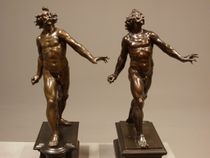
Measurement can also help determine how versions of the same model were assembled by highlighting differences in the relative orientation of different sections (fig. 76). This can provide insight into original fabrication techniques as well as into the relationships between different versions.7 Measurements may also be useful in puzzling out the correct assembly of fragmentary pieces of sculptures found in archaeological contexts.8
1.2 Weight and surface area
The weight of the metal, the overall volume, and the surface area of a figure may provide useful information about the life of the sculpture and the context of its fabrication. The total metal weight may give insights into both the cost of the raw materials and the type of furnace required,9 and consequently insights into the economic and/or social status of the workshop. (Although outside the scope of the present Guidelines, weight could be helpful in determining logistics related to a work’s transportation, and/or the kind of mount and base it had or would need.) It should be considered, of course, that material other than the cast copper alloy may contribute to the weight of the sculpture, such as residual material, , repairs, et cetera. The weight of the statue is increasingly measured by modern in order to track illegal copies. Diana Widmaier Picasso systematically weighs the bronzes for the Pablo Picasso (Spanish, 1881–1973) catalogue raisonné.10 Measurements of surface area are less common, but could be used, for example, in calculating the amount of gold needed for the of a statue, to provide historical context, or in planning the restoration of a monument.
1.3 Wall thickness
In hollow castings, the thickness of the metal wall and its homogeneity can be crucial for understanding how a bronze was cast. The conformality of the inner and outer surfaces can provide important clues about the fabrication process (for example direct or indirect process, see I.1). Localized, well-defined areas of greater or lesser thickness may correspond to repairs. Thickening in select areas may represent intentional adjustments to control a sculpture’s center of gravity and thereby ensure its stability.11
1.4 Dimensions of technical features
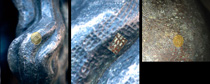
The form and dimensions of technical features such as , armatures, repair , tool marks (fig. 242), and so on may help to characterize the nature of the production and tell us something about workshop practices and the skills and habits of the craftspeople. For instance, a workshop might routinely use a particular kind of iron nail for core pins.12 Threaded may also be of great technical interest. Prior to widespread industrialization, thread-making tools were made individually and were not standardized, and so the specific dimensions of threaded fasteners may be characteristic of early workshops.13 Numerous standardized thread gauges became common over the course of the nineteenth century and can also be helpful for dating or characterizing workshop production (see I.4§1.1.2).14
1.5 Risks of misinterpretation
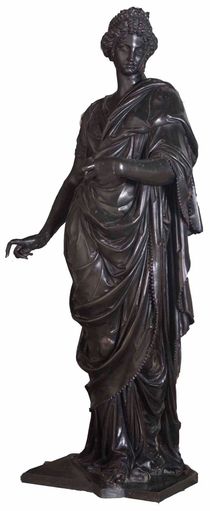
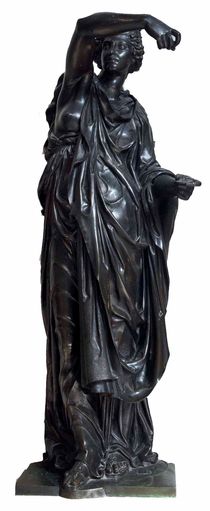
Though we assume that practitioners develop certain preferences and patterns in their practices and use of materials, it is always possible that situations or conditions may arise that require improvisation and the use of whatever is available. For example, of the four bronze Virtues of Henri II and Catherine de Medici’s funerary monument in the Basilica of Saint-Denis, France (figs. 405, 406), the main armatures of three statues were made with a hexagonal section, but the fourth had a round section rod. All other technical features clearly point to the same foundry.15 This holds true for all the fabrication steps, including repairing.
2 How to measure
The following measurement procedures are generally used for sculpture (not specifically bronzes). As a rule, international units (metric) should be used to record dimensions. Imperial units may, of course, be used as well if desired.
2.1 Measuring external dimensions
Sculptures vary greatly in form, and perhaps surprisingly, there are no standard rules on how to go about measuring them. This can, and often does, result in discrepancies between measurements taken by different operators.16 A consistent methodology is therefore advisable, and the following basic guidelines are designed to assist.
2.1.1 Height
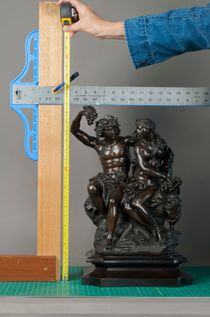
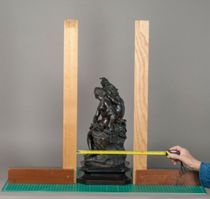
The maximum height of a sculpture resting on a flat surface such as a pedestal or the floor is easily determined by positioning a level (also known as a spirit level or bubble level) on its uppermost tip and establishing the distance between the level and the base by means of a ruler or rigid tape measure. In the case of a figure with an upraised arm or other feature that is higher than the head, measurement should be taken from there. Alternatively, two straightedges may be used together with a tape measure (fig. 407). More than one person may be required to take the measurement depending on the scale of the object.
If a sculpture is mounted on a separately made base (as opposed to an integrally cast one), it is standard practice to provide two height measurements: one with the base and one without. The same measurement process should be used as described above. If pins, , or other elements of the casting extend below the visible sculpture (into the base), the nature of the height measurement should be clearly described in text to avoid confusion.
2.1.2 Width and depth
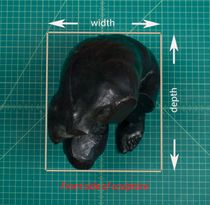
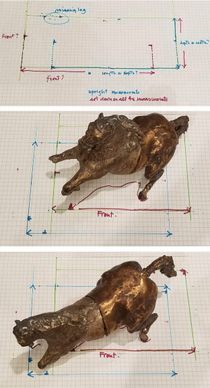
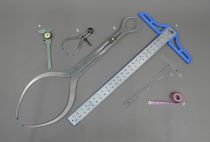
When measuring a sculpture in the round, it is not always clear what constitutes the “front.” In cases where the sculpture has an integrally cast rectangular base, one of its straight edges may help to determine this. The width and depth may be thought of as the internal dimensions of a box (whose sides are parallel to the base) into which the sculpture will fit. The width (sometimes referred to as length) is designated as the side-to-side measurement. The depth is the longest front-to-back measurement (fig. 408). Tools such as a pair of framing squares and a tape measure can be helpful (fig. 409). If the base is round or irregularly shaped, or if there is no base, it will be important to document which side of the sculpture is being considered the front for purposes of the examination. The “internal box measurement” process applies in these cases. Where the integral base extends beyond the sculpture, a decision needs to be made whether this element is to be considered part of the sculpture and thus included in the width and depth measurements. It may be desirable to report dimensions for base and sculpture separately. Keep diagrams of where measurements were taken as part of the sculpture’s documentation.
Measuring a fragmentary bronze presents challenges, especially if it is not clear what the piece’s original position was intended to be. Its incomplete state may also get in the way of adequately comparing its measurements with those of a related (fig. 410). Annotated visuals are particularly important in such cases to help describe where the measurements were taken.
2.2 “Internal” measurements and measurements for
comparison
2.2.1 Classical methods
So-called internal measurements (see II.4§1.1.1 above) can be made manually using calipers, a measuring tape, or a string (fig. 366). Digital calipers now often have direct recording capacities via connection to a computer. Imprints of specific features using plaster or silicone casts may prove useful for comparison of measurements as well, and are quite easy to carry out (fig. 411).

2.2.2 3D computer modeling
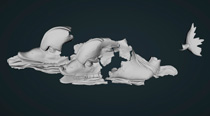
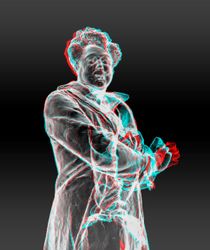
3D computer modeling offers a more sophisticated means of making measurements (fig. 379), and in particular of comparing measurements across similar casts (fig. 378). A variety of software exists that can assist in identifying innumerable points of comparison in an intricate web.17 While requiring a certain degree of technical and scientific skill, especially for quantitative calculations, 3D is becoming increasingly user-friendly and affordable.
Three main methods are currently in use for 3D modeling: photogrammetry, structured light scanning, and laser scanning. For basic descriptions of these methods, see II.2§5. There are no hard rules to determine which method is best for creating suitable 3D models for bronze sculpture. The measurement precision of each method can vary tremendously depending on the specific equipment used, the experience of the user, and the nature of the subject. Photogrammetry, for instance, depends heavily on the camera resolution and the software, but even with a 6–7 megapixel camera, Anestis Koutsoudis et al. showed that skilled practitioners can produce models accurate to better than ±1% for measurements 25–120 cm.18 Professional-grade structured light and laser scanners vary in precision according to manufacturer and model and usually have a specific size range for which they are optimized to scan. Within the target range, precision of both methods can be very high, with accuracies better than the ±0.01% claimed by manufacturers.
In the end, the best method of 3D modeling for any given examination will depend on the desired end use of the measurements (how much precision is necessary) as well as the available equipment and expertise. In practice, most studies on objects in the cultural heritage realm have used either photogrammetry or structured light scanners, while laser scanning has been dominant for sites and architectural applications.
2.2.3 Cost
The cost of the digital camera used in photogrammetry can, of course, vary tremendously depending on resolution, lens quality, and features. Software packages to extract 3D data are evolving and improving rapidly, and several universities are working on 3D reconstruction algorithms.19 The cost of photogrammetry software depends on one’s needs and output expectations. Free software is very easy to use but offers relatively low quality in regards to point accuracy and overall geometric and visual quality. Professional software can cost up to US$4,000 and allows for the greatest possible quality available but requires high-end computing power and technical expertise to achieve quality results.
Consumer-grade structured light scanners are available for less than US$1,000, but professional-grade scanners more appropriate for technical study usually cost between US$15,000 and $50,000. Operating software (which may require an annual license fee) is normally provided with the scanner, but other software may be desired for additional model manipulation or comparison purposes. This can range from free and open-source packages such as Meshlab or Blender to proprietary packages costing more than US$10,000 and/or requiring annual license fees of many hundreds of dollars.
In the late 2010s, the price of laser scanners certified for metrology ranged from about US$15,000 to $150,000 depending on the resolution and the precision. In addition, proprietary software associated with the scanners can cost from US$10,000 to $50,000, though some free or low-cost data processing software is available.
2.2.4 Duration
The speed of data acquisition and processing has increased dramatically in recent years. Using any of the three methods discussed above, an experienced operator can normally accomplish standard-resolution scanning/imaging of a one-meter-high bronze sculpture and generate a finished 3D model in half a day.
2.3 Measuring metal wall thickness
There are four primary approaches to measuring the wall thickness of a hollow bronze sculpture: direct physical measurement on the bronze; radiography or tomography; ultrasonic testing; and 3D scan. Each method has advantages and limitations (table 13 Open viewer).
2.3.1 Direct measurement
In instances where there is direct access to both inner and outer walls of the cast, outside calipers (sometimes called external calipers) may be used to make direct measurement of wall thickness. Electronic outside caliper gauges can be useful, as they give an electronic readout of the dimension in real time and do not require that the caliper be removed to record the measurement. Depending on size, calipers do not allow measurement very far away from the access zone, thus limiting the regions that can be measured. In addition, features such as casting , repairs, and may alter the original thickness in the area where the measurement is carried out. In the end, the representativeness of the measurement may be difficult to assess.
2.3.2 Radiography and tomography
Accurate measurement by radiography can be challenging for two key reasons. First, divergence of the X-ray beam inevitably results in some magnification of the image on the sensor, requiring careful calibration of the image using geometric calculation or reference scales placed in the image. Second, the walls of a sculpture are often curved, which can lead to indistinct edges in X-radiographs.
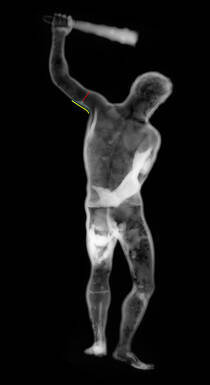
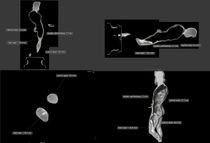
To complicate matters further, the exterior edge of a roughly cylindrical metal form will present the thinnest cross section in a radiograph. This means that the surface contour of a sculpture may be easily overexposed, thus disappearing in the image and giving the impression of a thinner wall than actually exists (fig. 63). Measurement by X-ray or gamma-ray tomography will generally be more reliable (figs. 379, 398), though precision of the measurement will depend greatly on the equipment used (see II.3).
2.3.3 Ultrasonic testing (UT)
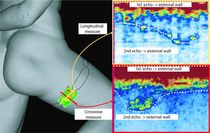
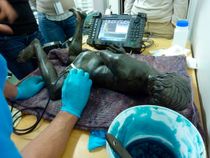
Ultrasonic testing (UT) has proved an efficient method of measuring the thickness of metal. Although used widely in industry, it has only rarely been applied to bronze sculpture (figs. 230, 231).20 UT has the advantage that no dangerous radiation is produced, facilitating on-site and in-lab analysis. UT can also measure very thick metal that might be difficult or impossible to measure with standard X-ray equipment. Unfortunately, UT requires the application of coupling gels to the surface of the object to be inspected, and for any loose paint or corrosion to be removed. In addition, UT signals from metal walls of irregular thickness or with rough surfaces are difficult to interpret, requiring careful attention from experienced technicians.
2.3.4 3D scanning
To the extent that the interior of a sculpture is accessible for 3D scanning or photogrammetry, it may be possible to merge interior and exterior surface models and create an accurate model of the wall thickness for at least a portion of a hollow sculpture.
2.3.5 Reporting and interpreting wall thickness
measurements
Once wall thickness measurements are made, reporting and interpreting results may not be straightforward. Wall thickness will almost certainly vary considerably from area to area. What, then, is the wall thickness to report? Of course, all measurements that have been made should be recorded individually, but for the purposes of characterizing a bronze and comparing it with other castings, providing some summary value(s) is necessary. Unfortunately, but unavoidably, this is bound to be a somewhat subjective process.
First of all, it may be useful to distinguish the different elements of a casting (separately prepared sections of the wax model, for instance, or separately cast sections) and treat them individually. If many measurements are possible for any given element, calculating the median value may be a useful way of characterizing the thickness. If not, then it may be up to an investigator’s judgment to choose a “typical” thickness measurement to report. Some researchers suggest that investigators attempt to determine a “targeted thickness” representing the founder’s envisioned thickness,21 though this has not yet been widely accepted.
In addition to reporting quantitative results, some qualitative descriptors of a sculpture’s thickness may be useful. “Homogeneous,” “regular,” and “conformal” are all terms that convey important information about wall thickness, though their definitions are imprecise. The thickness of the wall may be said to be homogeneous if it is more or less the same throughout the sculpture. The thickness may be termed regular if it does not show any sharp discontinuities or changes (as observed at wax-to-wax joints). The metal wall is said to be conformal if the inner and outer contours match closely such that the thickness remains constant as the form meanders.
2.4 Measuring weight, volume, and surface area
The overall weight of a sculpture can be measured rather straightforwardly using floor scales, pallet jacks with scales, or hoists. In some cases, however, it may prove more complex to deduce the weight of the bronze sculpture alone from the total weight of the object. Bases that cannot be removed pose an obvious problem. If core material remains in the interior, this may contribute dramatically to the overall weight. The weight of the sculpture may also be affected by repairs, armatures, or mounting materials. If the volume of extraneous materials can be determined with some precision, it is possible in some cases to estimate weight by using a standard average density value.
Volume and surface area measurements are most efficiently and accurately made using 3D scanning or photogrammetry. Most 3D modeling software will readily generate these measurements from a model.
3 How to compare measurements
When making rigorous comparisons between different versions, or copies, of the same model, best practice is to take the measurements using the same tools and techniques for each example. While in theory, direct measurements should be comparable to measurements made from (for instance) 3D scans, it is possible that using different measurement techniques can lead to minor systematic biases that could distort the results. At least, make sure a scale has been used and properly characterized.
Remember as well that there are many reasons why an individual pair of measurements may differ between sculptures (see II.4§1.1 above). If point-to-point measurements are being made (either directly or using 3D models), many pairs of measurements should be compared and the differences recorded as a percentage. The average percent difference may be a useful metric of comparison, but consider it with respect to the standard deviation of the individual values to ensure that it represents a real difference and is not just the result of random variation.
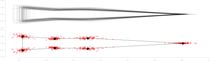
Where many versions or copies of a model exist, variability may be assessed and groupings may be made by making multiple dimensional measurements of each example and then analyzing the results according to the coefficient of variation (CV) or geometric morphometric analysis (GMM) (fig. 412).22 These methods are commonly used in archaeology to compare large groups of objects and to quantify standardization.
A relatively new but potentially very powerful means of visualizing and quantifying overall differences in form and scale across different versions of an individual model is through 3D modeling software. Accurate models of two versions can be made, imported into the same virtual space, and aligned automatically to optimize registration. Different software packages offer somewhat different tools and procedures, but, particularly if the models are rendered as partially transparent, differences in the alignment of certain sections can be made clearly evident (fig. 378). In scanning sculptures that have been assembled from different pieces, one may have to switch initial alignment points to obtain good registration for the various areas.
Another useful visualization tool is to display cross section contours on corresponding planes of different versions. Many 3D modeling software packages also offer the capability to quickly calculate volume measurements and surface area measurements. These tools are useful to quantify shrinkage between versions, particularly if individual sections of the sculpture, excluding wax or metal joint lines, are compared independently.
Notes
-
For basic definitions on measurement see ISO. 2007. “International Vocabulary of Metrology — Basic and General Concepts and Associated Terms (VIM).” ISO/IEC Guide 99:2007. Geneva: International Organization for Standardization. https://www.iso.org/standard/45324.html.. ↩︎
-
Allison, Ann Hersey. 1993. “The Bronzes of Pier Jacopo Alari-Bonacolsi, Called Antico.” Jahrbuch der kunsthistorischen Sammlungen in Wien 89/90:35–310.; see also Perrault, Gilles. 2006. “Les contrefaçons de l’œuvre de Diego Giacometti.” Revue Experts 71 (May): https://www.gillesperrault.com/les-contrefacons-de-lœuvre-de-diego-giacometti/.. ↩︎
-
See Motture, Peta. 2019. The Culture of Bronze: Making and Meaning in Italian Renaissance Sculpture. London: V&A Publishing., 229. ↩︎
-
See for example Rome, Richard, and Hamish Young. 2003. Fine Art Metal Casting: An Illustrated Guide to Mould Making and Lost Wax Processes. London: Robert Hale., 289. Some modern pattern waxes are engineered for minimal shrinkage. ↩︎
-
See for example Beale, Arthur. 1975. “A Technical View of Nineteenth-Century Sculpture.” In Metamorphoses in Nineteenth-Century Sculpture, 28–55. Cambridge, MA: Harvard University Press., 54. ↩︎
-
For a highly technical investigation into the relationship between the dimensions of the pattern and the final casting in ceramic shell casting see Cannell, Nick, and Adrian S. Sabau. 2007. “Predicting Pattern Tooling and Casting Dimensions for Investment Casting, Phase III.” In Final Technical Report ORNL/TM-2007/204. Oak Ridge, TN: US Department of Energy, Oak Ridge National Laboratory. https://www.osti.gov/bridge.. ↩︎
-
Beale, Arthur. 1975. “A Technical View of Nineteenth-Century Sculpture.” In Metamorphoses in Nineteenth-Century Sculpture, 28–55. Cambridge, MA: Harvard University Press.; Boulton, Ann. 2007. “The Making of Matisse’s Bronzes.” In Dorothy Kosinski, Matisse: Painter as Sculptor, 73–95. Baltimore: Baltimore Museum of Art; Dallas: Dallas Museum of Art and Nasher Sculpture Center; New Haven, CT: Yale University Press.. ↩︎
-
Combined with metal composition, dimensions proved decisive in relating two life-size Roman bronze statues of riders to two horses (Augst, Switzerland, first century CE), see Mille, Benoît. 2019b. “Les fragments de statues équestres découverts à Augst / Augusta Raurica (Suisse).” In Nouveaux regards sur le Trésor des bronzes de Bavay, edited by Laure de Chavagnac and Benoît Mille, 248–59. Milan: Silvana Editoriale.. ↩︎
-
Welter, Jean-Marie. 2014. “Keller and His Alloy: Copper, Some Zinc, and a Little Bit of Tin.” In French Bronze Sculpture: Materials and Techniques 16th–18th Century, edited by David Bourgarit, Jane Bassett, Francesca G. Bewer, Geneviève Bresc-Bautier, Philippe Malgouyres, and Guilhem Scherf, 95–106. London: Archetype.. ↩︎
-
Elisabeth Lebon, personal communication. ↩︎
-
Beentjes, Theodorus Petrus Cornelis. 2019. “Casting Rodin’s Thinker – Sand Mould Casting, the Case of the Laren Thinker and Conservation Treatment Innovation.” PhD diss., Universiteit van Amsterdam. https://dare.uva.nl/search?identifier=69db04ce-74ba-4e9c-95e1-a05f69e9d694., 221. ↩︎
-
The dimensional similarity of iron core pins proved decisive in establishing that a bronze finger held by the Louvre Museum in Paris (fig. 172) was the missing finger from the monumental hand of Constantine at the Capitoline Museum in Rome (Azéma, Aurélia, Sophie Descamps-Lequime, and Benoît Mille. 2018. “Fragment de doigt colossal et Main colossale.” In Un rêve d’Italie: la collection du marquis Campana, edited by Françoise Gaultier, Laurent Haumesser, and Anna Trofimova, 43–44. Paris: LienArt.). See Case Study 5 for how specific may help in characterizing a sculptor. ↩︎
-
For guidance on measuring threaded forms see Camm, Frederick James. 1942. Screw-Thread Manual. Brooklyn: Chemical Publishing. https://catalog.hathitrust.org/Record/001616194., 92–106. ↩︎
-
For tables describing many standard types of thread gauges see Camm, Frederick James. 1942. Screw-Thread Manual. Brooklyn: Chemical Publishing. https://catalog.hathitrust.org/Record/001616194., 136–45. ↩︎
-
Castelle, Manon. 2016. “Les techniques de la fabrication de la grande statuaire en bronze entre 1540 et 1660 en France.” PhD diss., Université Paris-Saclay / Versailles Saint-Quentin-en-Yvelines.. ↩︎
-
Carol Mattusch found the measurement of ancient bronzes so problematic that she chose to designate dimensions in general terms such as “life size” and “over life size” rather than with precise measurements (Mattusch, Carol C. 2005. The Villa dei Papiri at Herculaneum. Life and Afterlife of a Sculpture Collection. Los Angeles: J. Paul Getty Museum., 126–27). ↩︎
-
Sequenzia, Gaetano, Gabriele Fatuzzo, and Salvatore Massimo Oliveri. 2021. “A Computer-Based Method to Reproduce and Analyse Ancient Series-Produced Moulded Artefacts.” Digital Applications in Archaeology and Cultural Heritage 20 (March): e00174. https://doi.org/10.1016/j.daach.2021.e00174.. ↩︎
-
Koutsoudis, Anestis, Blaž Vidmar, George Ioannakis, Fotis Arnaoutoglou, George Pavlidis, and Christodoulos Chamzas. 2014. “Multi-Image 3D Reconstruction Data Evaluation.” Journal of Cultural Heritage 15 (1): 73–79.. ↩︎
-
Find useful information about photogrammetry at http://culturalheritageimaging.org/Technologies/Photogrammetry/. For more on algorithms see Verma, A. K. 2019. “A Method Based on Structure-from-Motion Photogrammetry to Generate Sub-Millimetre-Resolution Digital Elevation Models for Investigating Rock Breakdown Features.” Earth Surface Dynamics 7:45–66.. ↩︎
-
For the Marcus Aurelius bronze at the Capitoline Museum in Rome, see Marabelli, Maurizio. 1994. “The Monument of Marcus Aurelius: Research and Conservation.” In Ancient and Historic Metals: Conservation and Scientific Research, edited by David A. Scott, Jerry Podany, and Brian B. Considine, 1–19. Los Angeles: Getty Conservation Institute. https://www.getty.edu/publications/virtuallibrary/0892362316.html.. For the Apollon Piombino at the Louvre in Paris, see Mille, Benoît, and Sophie Descamps-Lequime. 2017. “A Technological Reexamination of the Piombino Apollo.” In Artistry in Bronze: The Greeks and Their Legacy: XIXth International Congress on Ancient Bronzes, edited by Jens M. Daehner, Kenneth Lapatin, and Ambra Spinelli, 349–60. Los Angeles: J. Paul Getty Museum and Getty Conservation Institute. http://www.getty.edu/publications/artistryinbronze/conservation-and-analysis/42-mille-descamps/., also Scott, David A. 2002. Copper and Bronze in Art: Corrosion, Colorants, Conservation. Los Angeles: Getty Publications., 394. ↩︎
-
One nice and large-scale application of this concept resides in the Hephaistos database on large antique bronzes (Descamps-Lequime, Sophie, and Benoît Mille. 2017. “Progrès de la recherche sur la statuaire antique en bronze.” Technè 45:4–13.). ↩︎
-
Birch, Thomas, and Marcos Martinón-Torres. 2019. “Shape as a Measure of Weapon Standardisation: From Metric to Geometric Morphometric Analysis of the Iron Age ‘Havor’ Lance from Southern Scandinavia.” Journal of Archaeological Science 101:34–51.; Okumura, Mercedes, and Astolfo G. M. Araujo. 2019. “Archaeology, Biology, and Borrowing: A Critical Examination of Geometric Morphometrics in Archaeology.” Journal of Archaeological Science 101 (January): 149–58.. ↩︎