Additional Contributors: Aurélia Azéma, Ann Boulton, Joachim Kreutner, Andrew Lacey, Kenneth Lapatin, Elisabeth Lebon, Carol Mattusch, Benoît Mille, David J. Reid, David Scott, Donna Strahan, Jean-Marie Welter
This chapter overviews the composition and properties of the copper alloys used to make cast sculptures and sculptural objects, and presents the reasons why it might be helpful to identify them as part of the technological investigation of a sculpture. The text aims to explain and unravel common approaches to the varied nomenclature applied to such alloys, and introduces two main parameters by which metals can be characterized: their chemical elemental composition and their microstructure. These two parameters control an alloy’s chemical properties (for example its resistance) and physical properties (for example its color and strength). This chapter will also outline the reasons why and how elemental analysis and metallography, among other analytical techniques, can contribute to a technological study of bronze. The more complex discussions will be most relevant to those who are directly involved in the technical investigation of bronzes. Recommendations for determining metal composition are set out in II.5.
1 What is bronze?
The term “bronze” has various meanings. It may designate a copper alloy that has tin as the primary added element, or any other copper-based alloy. In fact, in common parlance, “bronze” is used to describe most copper alloy sculptures regardless of the actual elemental composition of the alloy. Either inherently or by design, bronze sculptures generally include a number of other elements, but we recommend reserving the term specifically for copper-tin alloys, as will be explained.
1.1 Why create an alloy?
Adding different metallic elements to copper makes it possible to control the resulting alloy’s properties (for instance , strength, resistance to corrosion, workability) as desired by the sculptor or (see table 6 Open viewer, I.2§2 below, and Case Study 7§9). Cultural influences, the cost of raw materials, the desired color, and/or the need for the to take may also play a role in the choice of alloy. Historically, except for , copper alloys were produced by combining the different metals in a crucible or furnace.1
1.2 Elemental composition of metals
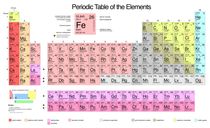
Elemental composition should be distinguished from both structural composition (see II.6§2.1) and isotopic composition (see II.5§5). Most metals occur in nature as ores in a mineral form, and are extracted from the earth. Even when refined, the extracted metal is rarely 100 percent pure; other elements will be present in small amounts as impurities, described as the “impurity pattern.” The elements are set out in the periodic table, where each is given a symbol (table 7 Open viewer, fig. 131)—for example, Cu for copper, Sn for tin—so that scientists can quickly discern its properties. Analysis of any historic or contemporary bronze sculpture will likely reveal a variety of elements even within a simple alloy. In addition to the impurities or trace elements present within each metal, other elements may have been deliberately added for practical or aesthetic reasons.2 There is also the common practice—even today—of adding metal that has been previously used, for instance the and casting cups cut off of previous casts.
1.3 Alloy nomenclature
1.3.1 Different users, different nomenclatures
“Bronze” has become a generic term to describe sculpture that may in reality have been made from a large variety of copper alloys, from non-alloyed copper to high-zinc brasses as well as ternary and quaternary alloys (those made up of primarily three or four elements, respectively). The usage and understanding of alloy nomenclature varies considerably across historical sources, as used by craftspeople and modern industry and/or by those studying bronze sculpture.3 The complexity and lack of uniformity of terminology in modern industry alone exemplifies the situation.4 Technical studies of large groups of related copper-based items tend to show that alloys and their uses evolve greatly over time and place, and thus our nomenclature for them varies accordingly.5
The discrepancies are partly related to varying viewpoints on the percentage at which an element present in the metal (lead, tin, zinc, arsenic, et cetera) should be considered an alloying element (intentionally added or kept in the metal) or an impurity (unintentional). The still-loose understanding of the effect of the different elements on the properties of alloys is partly responsible for the lack of clarity.6
1.3.2 Pragmatism should be the rule
The present Guidelines do not aim to impose any norm and cannot address all issues, but the following are some parameters:
-
“Bronze” is used extensively in this volume, and continues to be the preferred term for many artistic objects or sculptures from copper alloys regardless of their actual composition, even if they are known to be technically different (for example brass) or more nuanced (for example leaded bronze, quaternary alloy).
-
When writing a report or publication it is important to detail the results of analysis (if any) and identify which alloy definition (if any) will be used, either referring to existing formulas or defining new ones.7
-
The alloy nomenclature compiled by scholars for the present Guidelines is intended as a useful starting point (see table 8 Open viewer).
-
The terms “major,” “minor,” and “trace” in reference to elements do not convey any judgment regarding whether an element is present intentionally or not, unlike the terms “alloying elements” and “impurities.” As such, these terms might be a good compromise. Symbolic thresholds are often put forward in both industry and cultural heritage fields to define these three terms:
-
1wt% (1 percent of the total weight) is considered a major element, however, a copper containing 1wt% lead is not necessarily leaded copper (see table 8 Open viewer).
-
Under 1% means the lead (or any other element) is considered a minor element.
-
Under 0.01% (100 ppm), the lead is considered a trace element.8
-
1.4 Chemical symbols and formulas
Scientists generally use the chemical formula to describe the known alloy content (for example, after analysis). Using a chemical formula to describe an alloy could avoid misunderstandings, although even then, various nomenclatures coexist, and nonscientists may not be familiar with chemical symbols (table 7 Open viewer). For a generic designation, Cu-Sn can be used for copper-tin alloys, Cu-Zn for brasses, Cu-Sn-Zn for ternary alloys, and so on. For semi-quantitative compositions, the ECS (European Committee for Standardization) and ISO (International Standardization Organization) norms are often used, for example CuZn7Sn3Pb2 when the number refers to the rounded %wt. Note that only whole numbers are reported, which means that any chemical element in an amount lower than 0.5wt% is not represented.
2 What are the main physical and chemical properties of copper alloys?
Leaving aside the impact that cultural influences and availability of raw materials may have on the choice of alloy, key considerations will be its melting temperature, castability, hardness, , and suitability for and/or . Other properties that may be factored in are linked to the function and life cycle of the statue, such as its color, luster, strength, and symbolic properties.9 These properties may vary greatly across different copper alloys.10 While the influence of the composition on copper alloy properties is far from being fully characterized, especially for historical alloys, it is worth attempting to describe the role of the alloying elements in a qualitative rather than quantitative manner in the following sections and in table 6 Open viewer.11
2.1 Melting temperature
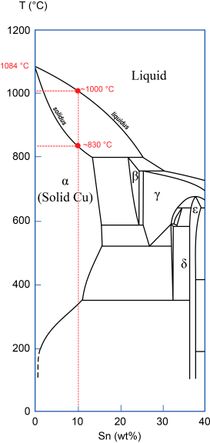
The melting temperature of copper alloys varies from 1084°C (pure copper) to approximately 1000°C for a copper bearing 10wt% tin (fig. 132) or 20wt% zinc, and down to 955°C for a highly leaded copper (36% lead). Melting temperatures as low as 900°C can be reached, for example, with 20wt% tin or 40wt% zinc. These temperatures hold for “normal” pressure conditions, namely 1 bar. Low melting temperatures are a distinct advantage for casting, as long as the other desired properties are not compromised.
2.2 Castability
The castability of a metal or alloy is best defined as its ability to fill in and pick up every detail of a . The castability will be affected by two main parameters, namely the metal properties and the mold characteristics, and of course the pouring temperature. Numerous metal properties, mainly controlled by the alloy composition, impact the castability. As an example, because unalloyed copper easily oxidizes, it is difficult to cast.12 Conversely, lead is known to greatly enhance castability.13
2.3 Color
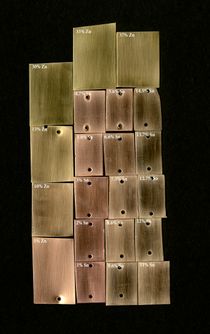
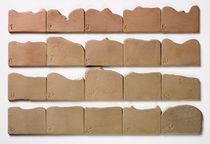
While all metals are opaque, and more or less shiny when polished, only gold and copper are not white or whitish. The color palette of copper and its alloys depends primarily on the alloy composition (see table 6 Open viewer).14 The addition of zinc to copper has a particularly pronounced impact on its color, lending it a gold-like appearance (fig. 133). The addition of silicon or aluminum yields similar colors. The visual differences between tin bronzes with different tin contents are not necessarily marked (fig. 134), unless high quantities (more than 15wt% of tin) are added, such as those used for mirrors and bells.
The color palette of copper and its alloys, and their visual appearance more generally, depends also on the surface texture. For this reason, and because metals are glossy, determining how to characterize or describe the color of copper alloys is quite complex, not to mention the various alterations of the surface, including the patina (for more on color measurement, see II.2§4).
2.4 Hardness: cold working and/or machinability, wear
resistance
Cold working includes , , , and polishing (see I.6§1.2). Cutting and compressing are the main actions involved. The principal related material property is hardness, and what modern metal handbooks report as “machinability” (the ease with which a material can be formed with a cutting tool).15 The hardness of a metal depends greatly on its composition (see table 9 Open viewer). As will be seen below, microstructure also greatly impacts hardness, but by definition cast bronzes are mainly in an as-cast state, and thus do not generally show large variations in microstructure. Soft metals such as unalloyed copper are particularly difficult to cut; they tend to smear under a cutting tool or during polishing. For hard metals, such as 10% tin bronzes, a small addition of lead improves machinability.16 Several standardized tests are available to measure hardness; sampling is usually necessary.17
2.5 Suitability for patination, gilding, and metal
plating, and/or corrosion resistance
The chemical composition of an alloy controls its reactivity to chemical attack—in other words, what might be called its suitability for patination (see I.8§1.1.1). This property is also directly linked to corrosion resistance.18 An alloy’s suitability for plating (for example gilding and tinning) depends on both the technique used and the metal. For example, tinning based on tin sweat can obviously only be performed on tin-bearing alloys (see I.7§1.3.2). Also, leaded alloys are thought not to be adapted to fire gilding although this is not a universal rule (see I.7§1.1.2).
2.6 Mechanical ductility and strength
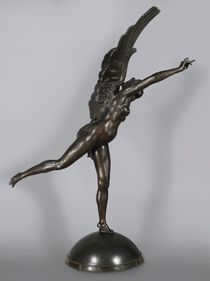
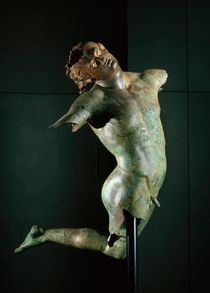
Most common metals, and notably copper alloys, offer one remarkable property when compared to stone: they are ductile, as opposed to brittle. Metals can be heavily deformed before breaking. In addition, a number of copper alloys, including bronzes, have relatively high tensile strengths: much effort is needed to deform a bronze sword by stretching or bending (and even more so a statue).19 The direct consequence of these two properties—ductility and strength—is that bronze sculptures can support heavy loads, allowing artistic compositions of considerable freedom (figs. 135, 136). While a support is often integral to the composition of a stone or marble sculpture—such as a tree trunk attached to the legs of a standing figure, or a large strut beneath a rearing horse—the bronze equivalent will not require such a support.20
A finished bronze sculpture is rarely supported by its internal , as its own metallic structure is sufficient. Hollow statues are even more resistant because of their tube-like shape; a tube is much harder to bend than a solid rod. A number of large sculptures, including Greek and Roman bronzes, demonstrate this, as the armatures (if they once existed) were usually removed before the separately cast sections were assembled (figs. 137, 138).
Other mechanical properties include elasticity, fracture toughness, and more, but these are of little interest in relation to most bronze sculptures.21


2.7 Weldability
The ability of copper alloys to be assembled, particularly by welding, is an important consideration, as founders select metals for the cast and the weld. This must have been as true for metalsmiths using flow fusion welding during antiquity (see I.5§1.1.1, Case Study 1) as it is for welders in modern-day foundries.
2.8 Symbolic properties
In certain cultures, metals, and notably copper alloys, have been (and still may be) imbued with specific spiritual powers. These may be attributed to the metal and ascribed to various intrinsic properties, such as color or smell.22 Rarer metals and other materials may also be added to the melt as part of a symbolic or spiritual ritual.23
2.9 Is there an “ideal” copper alloy for bronze sculpture?
The variety of alloys encountered in bronze sculpture throughout history tends to show that there is no ideal alloy. There are a variety of reasons for this, starting with the potential competition between properties—including hardness and castability—depending on the requirements of the finished work. The destination of the sculpture and the way it is worked (amount of chiseling, nature of the patina, gilding, et cetera) are key, not to mention tradition and habits (see Case Study 7).
However, very satisfying compromises may be found. Bronze with approximately 10% tin provides a good balance between castability, corrosion resistance, mechanical strength, and hardness. This alloy became a standard as early as the Late Bronze Age for tools and weapons,24 and for large bronzes during antiquity.25 That said, copper alloys containing zinc are also widespread, notably in modern times.26
3 What is microstructure? What does it reveal about the making of a bronze? And how might it influence some of the alloy properties?
3.1 How can we distinguish whether a sculpture has been
left as cast or has been cold worked, and why is this
significant? Dendritic versus recrystallized
microstructure
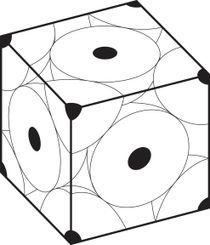
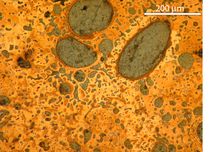
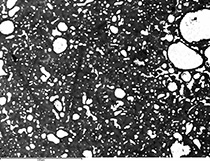
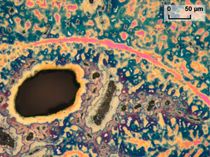
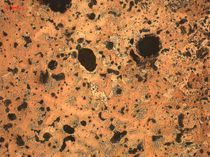
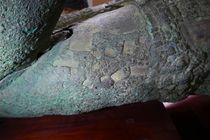
The atoms that make up a metal or an alloy align themselves in geometric patterns, as opposed to most glass types, whose atoms are distributed randomly. These patterns are cubes for copper and copper alloys (fig. 139), with various displays of the atoms depending on the composition of the alloy: these are the phases. These patterns in turn form specific structures called microstructures. Once in a while, one might encounter a fine textile- or branch-like pattern (fig. 140) or a geometrical one (fig. 141) within the surface of a bronze. This is the microstructure of the metal, and is not to be confused with the mineralized remains of organic materials (pseudomorphs) that may form upon contact with a bronze surface during prolonged burial.
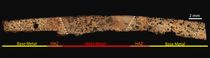
As when studying the crystalline structure of a rock, a cross section with specific preparation is necessary to investigate the microstructure of a metal sample through metallography (see I.2§3.3 below; also II.5§6). This structure can give clues as to whether the sculpture has been reworked or not, and potentially whether there are . Two very different metallurgical states—and consequently microstructures—are found in cast bronze sculpture. The first corresponds to the as-cast state and exhibits a dendritic microstructure (figs. 142, 143, 144, 145). The second reflects disturbance of the dendritic structure by cold working, and sometimes by subsequent heating (metallurgists use the term “annealing”), in the areas closest to the worked surface. This may result in a recrystallized granular microstructure (figs. 144, 146, 147, 148). The microstructure affects physical and chemical properties dramatically, particularly corrosion resistance and mechanical properties. For this reason, for instance, hammered-in repair may stand out from the surrounding cast bronze setting because their crystallized microstructure oxidizes or otherwise patinates in a different way (fig. 125). The hardness of an as-cast bronze may be greatly increased by distorting the dendritic as-cast microstructure through hammering (see I.6§3.3).




3.2 Primary versus secondary casting: welding, soldering,
cast-on repairs
In addition to cold working, the metallic microstructure may record another type of technical process, namely the addition of a metal melted onto the primary cast. Such cast-on additions may occur as repairs (see I.4§1.2) and/or assemblies such as , welding, or . However, the microstructure of the primary cast will only be impacted if the incoming metal is hot enough. This only occurs with welding.
3.3 Are metallographic investigations necessary?
Sampling for the purpose of metallographic study should only be considered in order to address very specific questions. Some assembly techniques and repairs may be advantageously investigated through metallography. Metallographic investigations have so far proven the only way to positively confirm the use or not of flow fusion welding and to characterize the degree of mastery involved (see I.5§2.2). Similarly, in some instances only metallography can distinguish between cast-on and mechanical repairs (see I.4§2.1).
Metallography also provides excellent evidence of the presence or absence of cold and/or hot working.27 Theoretically, it might also provide evidence of conditions during casting.28 Metallographic sampling is not readily done on relatively pristine works, especially since the areas that would be most interesting to sample tend to be on the outer surface, in clearly visible areas. Less invasive methods are available, but there are limitations to their ability to answer certain questions (see notably thermography in II.2§3.2).
4 Why investigate metal composition and properties? and other FAQs
4.1 Why analyze the metal composition?
A number of questions may be addressed by investigating the metal composition. Alloy determination may be required for broad documentation—defining whether a sculpture is bronze or brass, for instance. Some specific alloys may be associated with specific periods, production centers, or workshops, and/or may refer to specific constraints (technical, economic, political, cultural).29 Impurity patterns in the metal may help to group statues or fragments of statues (in conjunction with other data),30 tackle the provenance of the raw metal,31 and/or detect particular applications and processes.32 See table 10 Open viewer and II.5§1 for a discussion about limitations.
4.2 Can metal composition help to authenticate a bronze
sculpture?
Both alloy composition and impurity patterns may be used for authentication,33 although the ubiquity of compositions in both space and time often renders the task complex.34 A combination of technical markers and archaeological and/or historical information is often necessary.
4.3 Can metal recycling be detected analytically?
There are no specific characteristics of metal composition useful for definitively distinguishing fresh metal from recycled. One way to detect the probable occurrence of metal recycling is to investigate the evolution of metal composition within a large group of well-contextualized bronzes. This has been tested for archaeological bronze artifacts, since some chemical elements such as arsenic are volatile, and their content may slowly decrease with repeated recycling (remelting).35 But the authors do not know of any such studies on bronze sculpture. Archives such as commission contracts sometimes specify that scrap metal should be used, or, conversely, that it should not be used (although such documents cannot be blindly trusted as reliable).36
4.4 Is it useful to know the physical and chemical
properties of the metal in a sculpture?
Leaving aside conservation issues, there are a good number of reasons to want to understand the properties of the metal, for all the aforementioned points (I.2§2 above) and more. Knowing a given property may add to the discussion of the intentionality of the presence and/or the amount of a given element, and the objective targeted by the commissioner, the artist, and/or the founder. For example, one may be able to discuss the presence of high amounts of lead in a given sculpture: if intentional, was it to enhance castability, to lower the cost of the metal, or because of tradition or beliefs? This may then open up large avenues for research (transfer of know-how and knowledge, trade in materials, et cetera).
Notes
-
In Europe, brass was once made by so-called cementation, a relatively complex process where metallic copper was mixed with zinc ore. The use of metallic zinc to create brass was not mastered until the mid-nineteenth century (see Bourgarit, David, and Nicolas Thomas. 2015. “Ancient Brasses: Misconceptions and New Insights.” In Archaeometallurgy in Europe III, Proceedings of the 3rd International Conference, Deutsches Bergbau-Museum Bochum, June 29–July 1, edited by Andreas Hauptmann and Diana Modarressi-Tehrani, 255–62. Bochum, Germany: Deutsches Bergbau Museum.). ↩︎
-
Young, Suzanne M. M., and Ernst Pernicka, eds. 1999. “Trace Element Fingerprinting of Ancient Copper: A Guide to Technology or Provenance?” In Metals in Antiquity, edited by Suzanne M. M. Young, A. Mark Pollard, Paul Budd and Robert A. Ixer, 163–71. BAR International Series 792. Oxford: Archaeopress.. ↩︎
-
See Motture, Peta. 2019. The Culture of Bronze: Making and Meaning in Italian Renaissance Sculpture. London: V&A Publishing., 18–21, for a brief summary of medieval and Renaissance terminology and issues around the different interpretation of early sources, including the interchangeability of the use of aes (bronze) and aurichalcum (brass, but literally “golden copper”). See also Thomas, Nicolas. 2009. “Les ateliers urbains de travail du cuivre et de ses alliages au bas moyen âge: Archéologie et histoire d’un site parisien du XIVe siècle dans la Villeneuve du Temple (1325–1350).” PhD diss., Université Paris 1., 498–510, and Welter, Jean-Marie. 2018. “Medieval and Renaissance Italian Statuary Copper Alloys.” In Cuivre, Bronzes et Laitons Médiévaux: Histoire, Archéologie et Archéométrie Des Productions En Laiton, Bronze et Autres Alliages à Base de Cuivre Dans l’Europe Médiévale (12e–16e Siècles) = Medieval Copper, Bronze and Brass: History, Archaeology and Archaeometry of the Production of Brass, Bronze and Other Copper Alloy Objects in Medieval Europe (12th–16th Centuries), edited by Nicolas Thomas and Pete Dandridge, 271–83. Études et Documents, Archéologie 39. Namur, Belgium: Agence wallonne du Patrimoine.. The nomenclature of copper alloys is an old issue among scholars (see Rickard, T. A. 1932. “The Nomenclature of Copper and Its Alloys.” Journal of the Royal Anthropological Institute of Great Britain and Ireland 62:281–90.). ↩︎
-
For example, in modern industry, the term “red brass” designates two very different alloys depending on its use. For wrought alloys, red brass is a binary alloy, typically CuZn12-15, sometimes called tombak. For cast alloys it is a quaternary alloy, typically CuSn5Zn5Pb5. ↩︎
-
For example, two different sets of nomenclatures have been proposed for medieval common metalware found in London (Bayley, Justine. 1991. “Alloy Nomenclature.” In Medieval Finds from Excavations in London. Vol. 3, Dress Accessories c. 1150–c. 1450, edited by Geoff Egan and Frances Pritchard, 13–17. London: HMSO.) and in Paris (Bourgarit, David, and Nicolas Thomas. 2012. “Late Medieval Copper Alloying Practices: A View from a Parisian Workshop of the 14th Century AD.” Journal of Archaeological Science 39 (10): 3052–70.). Note that in both cases, compositions with up to 2–3wt% of zinc, tin, and lead are still considered unalloyed copper. ↩︎
-
For cultural heritage copper alloys, some answers are given in Young, Suzanne M. M., and Ernst Pernicka, eds. 1999. “Trace Element Fingerprinting of Ancient Copper: A Guide to Technology or Provenance?” In Metals in Antiquity, edited by Suzanne M. M. Young, A. Mark Pollard, Paul Budd and Robert A. Ixer, 163–71. BAR International Series 792. Oxford: Archaeopress.. See also Welter, Jean-Marie. 2007. “Negative and Positive Impact of Minor Elements up to the 0/00 Range on Downward Properties.” In First Meeting on Minor Element Contaminants in Copper Metallurgy, edited by Jaime Alvarez, 95–102. Concepción, Chile: University of Concepción.. ↩︎
-
Nomenclatures published to date for historic coppers are mainly related to medieval and modern European contexts (Bayley, Justine. 1991. “Alloy Nomenclature.” In Medieval Finds from Excavations in London. Vol. 3, Dress Accessories c. 1150–c. 1450, edited by Geoff Egan and Frances Pritchard, 13–17. London: HMSO.; Glinsman, Lisha A., and Lee-Ann C. Hayek. 1993. “A Multivariate Analysis of Renaissance Portrait Medals: An Expanded Nomenclature for Defining Alloy Composition.” Archaeometry 35 (1): 49–67.; Motture, Peta. 2001. Bells and Mortars and Related Utensils: Catalogue of Italian Bronzes in the Victoria and Albert Museum. London: V&A Publishing.; Bourgarit, David, and Nicolas Thomas. 2012. “Late Medieval Copper Alloying Practices: A View from a Parisian Workshop of the 14th Century AD.” Journal of Archaeological Science 39 (10): 3052–70.). Modern standards can be used as well (ASM, AFNOR, et cetera), although they may not be as appropriate for historic alloys. For example, for the ASM, 2.5% lead would be a so-called extra-high leaded alloy, whereas in ancient Greek and Roman sculptures such alloys would be characterized as unleaded (high-leaded bronzes bear up to 30% lead in Roman statues). Similarly, a 10% zinc alloy is called a commercial bronze. Although terms such as “leaded bronze” or “brass” are used, they should always be followed by a summary of the alloy by percentage if available. ↩︎
-
An interesting definition of “minor element” has been proposed (Welter, Jean-Marie. 2007. “Negative and Positive Impact of Minor Elements up to the 0/00 Range on Downward Properties.” In First Meeting on Minor Element Contaminants in Copper Metallurgy, edited by Jaime Alvarez, 95–102. Concepción, Chile: University of Concepción., 95): “Elements which by amount range between the intentionally added major elements to adjust the properties of copper and the unavoidable trace elements which are basically considered as a nuisance.” However, these guidelines are not standard, and not always adhered to in the art historical literature, for example. ↩︎
-
There are a plethora of references on this subject; see for example Stewart, Andrew. 2014. “Why Bronze?” In Power and Pathos: Bronze Sculpture of the Hellenistic World, edited by Jens M. Daehner and Kenneth Lapatin, 34–47. Los Angeles: J. Paul Getty Museum.; Motture, Peta. 2019. The Culture of Bronze: Making and Meaning in Italian Renaissance Sculpture. London: V&A Publishing.. ↩︎
-
Cottrell, A. H. 1967. “The Nature of Metals.” Scientific American 217 (3): 90–100., 39, neatly explains that all these properties specific to metals (when compared to other materials such as stone or ceramic) are due to the “pervasive glue” stemming from the specific metallic bond between atoms. See also Smith, Cyril Stanley. 1981. “On Art, Invention and Technology.” In A Search for Structure: Selected Essays on Science, Art, and History, 325–31. Cambridge, MA: MIT Press.. ↩︎
-
Metal handbooks provide the most comprehensive synthesis for industrial alloys; see for example Davis, Joseph R., ed. 1998 Metals Handbook. 2nd ed. Materials Park, OH: ASM International.. ↩︎
-
However, unalloyed copper sculptures of various sizes and from diverse cultures were successfully cast, as for example an anthropomorphic solid figure dated from the early second millennium BCE, India, H. 45cm (Musée des Arts Asiatiques de Nice, inv. 2002.2.1, see “C2RMF Internal Report.” 2002. #3086.), some of the Tibetan statuettes from the seventeenth and eighteenth centuries in the British Museum collections (Craddock, Paul T. 1981. “The Copper Alloys of Tibet and Their Background.” In Aspects of Tibetan Metallurgy, edited by W. Andrew Oddy and Wladimir Zwalf, 1–33. British Museum Occasional Paper 15. London: British Museum.), and the sixteenth-century Wolsey Angels in the Victoria and Albert Museum (V&A A.1 to A.4-2015; h. between 101 and 108 cm each; see Motture, Peta. 2019. The Culture of Bronze: Making and Meaning in Italian Renaissance Sculpture. London: V&A Publishing., 197–98, with additional references) (as yet unpublished analysis undertaken as part of the collaborative V&A Wolsey Angels Research Project, forthcoming). ↩︎
-
A comprehensive description of which metal and mold properties control castability is beyond the scope of the present guidelines; please refer to the specialized literature (Lesoult, G. 1986. “Solidification – cristallisation et microstructure.” Techniques de l’ingénieur. Matériaux métalliques, M58.; Beeley, Peter. Foundry Technology. Oxford: Butterworth-Heinemann, 2001., 17–25; Campbell, John. 2003. Castings: The New Metallurgy of Cast Metals. 2nd ed. Oxford: Butterworth-Heinemann., 75–95). A very clear synthesis has been proposed by Mille, Benoît. 2017. “D’une amulette en cuivre aux grandes statues de bronze, évolution des techniques de fonte à la cire perdue, de l’Indus à la Méditerranée, du 5e millénaire au 5e siècle av. J.-C.” PhD diss., Université de Paris-Nanterre et Université de Fribourg. http://www.theses.fr/2017PA100057., 378–404, including the role of lead in castability of protohistoric and historic copper alloys. This latter topic has been long debated among archaeometallurgists. A recent experimental development (Mille, Benoît. 2017. “D’une amulette en cuivre aux grandes statues de bronze, évolution des techniques de fonte à la cire perdue, de l’Indus à la Méditerranée, du 5e millénaire au 5e siècle av. J.-C.” PhD diss., Université de Paris-Nanterre et Université de Fribourg. http://www.theses.fr/2017PA100057.) has demonstrated, for the first time, the influence of high lead content (above 10wt%) on the castability of copper alloys under specific conditions (mold made of low thermal diffusivity material such as clay or plaster, preheated mold). ↩︎
-
For ancient copper, see Mödlinger, Marinne, Maikel H. G. Kuijpers, Dennis Braekmans, and Daniel Berger. 2017. “Quantitative Comparisons of the Color of CuAs, CuSn, CuNi, and CuSb Alloys.” Journal of Archaeological Science 88:14–23.. For the most recent measurement attempts and an updated bibliography, see Radivojević, M., J. Pendić, A. Srejić, M. Korać, C. Davey, A. Benzonelli, M. Martinón-Torres, N. Jovanović, and Z. Kamberović. 2018. “Experimental Design of the Cu-As-Sn Ternary Colour Diagram.” Journal of Archaeological Science 90:106–19.. ↩︎
-
According to US standards, machinability is scaled against the most machinable alloy, namely the “free-cutting brass C3600” (35.5% Zn, 3% Pb) for copper-based alloys; see Tyler, Derek E., and William T. Black. 1992. “Introduction to Copper and Copper Alloys.” In ASM Handbook. Vol. 2, Properties and Selection: Non-Ferrous Alloys and Special-Purpose Materials, 759–839. Materials Park, OH: ASM International., 760. Hardness is reported either quantitatively (Tyler, Derek E., and William T. Black. 1992. “Introduction to Copper and Copper Alloys.” In ASM Handbook. Vol. 2, Properties and Selection: Non-Ferrous Alloys and Special-Purpose Materials, 759–839. Materials Park, OH: ASM International., 779) or qualitatively according to the metallurgical state, annealed, et cetera (hard, 1/2 hard, 1/4 hard, etc.); see Tyler, Derek E., and William T. Black. 1992. “Introduction to Copper and Copper Alloys.” In ASM Handbook. Vol. 2, Properties and Selection: Non-Ferrous Alloys and Special-Purpose Materials, 759–839. Materials Park, OH: ASM International., 817. ↩︎
-
This was notably clear on the Greek Vix crater (Châtillon-sur-Seine, France, sixth century BCE, one of the largest bronze vessels known in antiquity). It was shown that around 1wt% lead had been deliberately added to the 10% tin bronze to facilitate of the cast elements of the frieze and handles (Mille, Benoît, and David Bourgarit. 2003. “Composition élémentaire des bronzes de la tombe de Vix.” La tombe princière de Vix, edited by Claude Rolley, 253–54. Paris: Picard.). ↩︎
-
Revankar, G. 2000. “Introduction to Hardness Testing.” In ASM Metal Handbook. Vol. 8, Mechanicial Testing and Evaluation, 416–28. Materials Park, OH: ASM International.; François, Dominique. 2004. “Essais mécaniques des métaux: introduction.” In Techniques de l’ingénieur. Essais mécaniques sur les métaux et alliages TIB531DUO (m4150). https://www.techniques-ingenieur.fr/base-documentaire/materiaux-th11/essais-mecaniques-sur-les-metaux-et-alliages-42531210/essais-mecaniques-des-metaux-m4150/.. ↩︎
-
It is beyond the scope of this essay to discuss when, where, and how founders paid attention to the alloy composition with respect to patination. ↩︎
-
Most weapons and tools were made of bronze during the Middle Bronze Age and Late Bronze Age. ↩︎
-
Actually this is a complex matter, and the presence (or not) of struts is now understood as not simply a question of bronze versus marble, notably for Greek and Roman sculpture. Bronzes can have struts too, although it is not clear why (see for example the statue of a young Dionysos from the Chicago Art Institute, published in Mattusch, Carol C. 1996. The Fire of Hephaistos: Large Classical Bronzes from North American Collections. Cambridge, MA: Harvard University Art Museums., no. 23, 224–31). And marbles can have them or not (see Hollinshead, Mary Berg. 2002. “Extending the Reach of Marble: Struts in Greek and Roman Sculpture.” In The Ancient Art of Emulation, edited by Elaine K. Gazda, 117–52. Ann Arbor: University of Michigan Press.; Anguisola, Anna. 2018. Supports in Roman Marble Sculpture: Workshop Practice and Modes of Viewing. Cambridge, UK: Cambridge University Press.), as kindly indicated by Carol Mattush, June 2019. And it is not clear whether all marbles really need the struts that appear; in some instances they may be due to workshop practice (Anguisola, Anna. 2018. Supports in Roman Marble Sculpture: Workshop Practice and Modes of Viewing. Cambridge, UK: Cambridge University Press.). ↩︎
-
For more on mechanical properties of cast metals, see Campbell, John. 2015. Complete Casting Handbook: Metal Casting Processes, Metallurgy, Techniques, and Design. 2nd ed. Amsterdam: Butterworth-Heinemann., chapter 9. ↩︎
-
See the “red gold” in Africa (Herbert, Eugenia W. 1984. Red Gold of Africa: Copper in Precolonial History and Culture. Madison: University of Wisconsin Press.); the evil properties of copper in the pre-Hispanic Caribbean (Martinón-Torres, Marcos, Roberto Valcárcel Rojas, Jago Cooper, and Thilo Rehren. 2007. “Metals, Microanalysis, and Meaning: A Study of Metal Objects Excavated from the Indigenous Cemetery of El Chorro de Maíta, Cuba.” Journal of Archaeological Science 34 (2): 194–204.); the cosmological and gender connotations of copper in Colombia due to color and smell (Falchetti, Ana Maria. 2003. “The Seed of Life: The Symbolic Power of Gold-Copper Alloys and Metallurgical Transformations.” In Gold and Power in Ancient Costa Rica, Panama, and Colombia, edited by Jeffrey Quilter and John W. Hoopes, 345–81. Washington, DC: Dumbarton Oaks Research Library and Collection. http://www.humanas.unal.edu.co/colantropos/files/5414/7422/2423/The_seed_of_life__Falchetti.pdf.); and the curative properties of the Khmer samrit (Vincent, Brice. 2012. “Samrit. Étude de la métallurgie du bronze dans le Cambodge angkorien (fin du XIe–début du XIIIe siècle).” PhD diss., Université Paris 3. http://www.theses.fr/2012PA030032., 297–301). See also Stewart, Andrew. 2014. “Why Bronze?” In Power and Pathos: Bronze Sculpture of the Hellenistic World, edited by Jens M. Daehner and Kenneth Lapatin, 34–47. Los Angeles: J. Paul Getty Museum. for ancient Greece; Motture, Peta. 2019. The Culture of Bronze: Making and Meaning in Italian Renaissance Sculpture. London: V&A Publishing., esp. 15–17, for Renaissance; and Droth, Martina, Frits Scholten, Michael Wayne Cole, Penelope Curtis, and Henry Moore Institute. 2005. Bronze: The Power of Life and Death. Leeds, UK: Henry Moore Institute. generally. ↩︎
-
Gold and jewelry are added in the melt for Buddhist statues today. The metal of church bells is still blessed before casting in various countries, including France (see http://www.youtube.com/watch?v=5gg3THv4vfI, thanks to Alice Chéron, Ecole du Louvre). Also still common today is the practice of adding remelted metal that has been previously used, as recommended for example by Pliny the Elder for its “seasoned brilliance . . . tamed by perpetual use” (Pliny the Elder. 1857. Natural History, translated by John Bostock and Henry Thomas Riley. London: H.G. Bohn. https://www.google.com/books/edition/The_Natural_History_of_Pliny/9zwZAAAAYAAJ?hl=en&gbpv=0., 34.20, p. 199) and by Pomponius Gauricus (Italian, 1482–1530): Gauricus, Pomponius. 1504 (1886). De Sculptura. Translated by Heinrich Brockhaus. Leipzig, Germany: F. A. Brockhaus., 222–23; Gauricus, Pomponius. 1504 (1969). De Sculptura. Translated by André Chastel and Robert Klein. Geneva and Paris: Droz., 218–19; Gaurico, Pomponius. 1504 (1999). De Sculptura. Translated by Paolo Cutolo. Florence, Italy: Filippo Giunta., 228–29. ↩︎
-
Pernot, M. 2000. “Forming Bronze by Plastic Deformation around the 1st Millennium BC in Western Europe.” In J. J. Jonas Symposium on Thermomechanical Processing of Steel, edited by S. Yue and E. Essadiqi, 615–26. Montreal, Quebec: Metallurgical Society of the Canadian Institute of Mining, Metallurgy and Petroleum.. ↩︎
-
Mille, Benoît. 2012. “The Casting Techniques of Antique South Arabian Large Bronze Statues.” In Scientific Research on Ancient Asian Metallurgy: Proceedings of Fifth Forbes Symposium at the Freer Gallery of Art, Washington, Smithsonian Institution, 28–29/10/2010, edited by P. Jett, B. McCarthy, and J. G. Douglas, 225–47. London: Archetype.; Mille, Benoît. 2017. “D’une amulette en cuivre aux grandes statues de bronze, évolution des techniques de fonte à la cire perdue, de l’Indus à la Méditerranée, du 5e millénaire au 5e siècle av. J.-C.” PhD diss., Université de Paris-Nanterre et Université de Fribourg. http://www.theses.fr/2017PA100057.; Descamps-Lequime, Sophie, and Benoît Mille. 2017. “Progrès de la recherche sur la statuaire antique en bronze.” Technè 45:4–13.. Zinc is detrimental to welding, and since welding was systematically carried out on ancient large bronzes, the works never contain more than 1% zinc. ↩︎
-
Although related to decorative arts gilt bronzes rather than statuary, an innovative study carried out by French chemist Jean-Pierre-Joseph d’Arcet (Arcet, Jean-Pierre-Joseph d’. 1818. Mémoire sur l’art de dorer le bronze au moyen de l’amalgame d’or et de mercure. Paris: De l’imprimerie de Mme. Veuve Agasse.) to determine which brass would meet most technical requirements is of interest in this context. Eight alloys were tested by craftspeople involved in the production, namely founders, , turners, and gilders. Only one was rated very good, which happens to be very similar to the alloy found in eighteenth- and nineteenth-century French gilt bronze (Heginbotham, Arlen. 2014. “Bronzes Dorés: A Technical Approach to Examination and Authentication of French Gilt Bronze.” In French Bronze Sculpture: Materials and Techniques 16th–18th Century, edited by David Bourgarit, Jane Bassett, Francesca G. Bewer, Geneviève Bresc-Bautier, Philippe Malgouyres, and Guilhem Scherf, 150–65. Paris: Archetype.). ↩︎
-
The authors do not know of such investigations on bronze sculpture but are aware of some on other types of prehistoric and historic bronzes (see notably Chase, W. Thomas 1994. “Chinese Bronzes: Casting, Finishing, Patination, and Corrosion.” In Ancient and Historic Metals: Conservation and Scientific Research, edited by David A. Scott, Jerry Podany, and Brian B. Considine, 85–117. Los Angeles: Getty Conservation Institute. https://www.getty.edu/publications/virtuallibrary/0892362316.html.; Pernot, M. 2000. “Forming Bronze by Plastic Deformation around the 1st Millennium BC in Western Europe.” In J. J. Jonas Symposium on Thermomechanical Processing of Steel, edited by S. Yue and E. Essadiqi, 615–26. Montreal, Quebec: Metallurgical Society of the Canadian Institute of Mining, Metallurgy and Petroleum.; Scott, David A. 2014. “Metallography and Microstructure of Metallic Artifacts.” In Archaeometallurgy in Global Perspective: Methods and Syntheses, edited by Benjamin W. Roberts and Christopher P. Thornton, 67–89. New York: Springer.). ↩︎
-
The investigation of the microstructure (such as grain size, the interdendrite spacing, and the composition of the various phases, see I.2§3 in the present chapter) may provide a lot of information about the casting conditions (pouring temperature, mold materials, and so on). Yet given the number of parameters potentially controlling the microstructure, the task of distinguishing which parameters are responsible for the observed microstructure is very complex. Given the invasive aspect of metallography, it is understandable that no such study has been carried out on bronze sculpture. ↩︎
-
See Case Study 5 and a number of other studies on ancient large bronzes (Mille, Benoît. 2012. “The Casting Techniques of Antique South Arabian Large Bronze Statues.” In Scientific Research on Ancient Asian Metallurgy: Proceedings of Fifth Forbes Symposium at the Freer Gallery of Art, Washington, Smithsonian Institution, 28–29/10/2010, edited by P. Jett, B. McCarthy, and J. G. Douglas, 225–47. London: Archetype.; Mille, Benoît. 2017. “D’une amulette en cuivre aux grandes statues de bronze, évolution des techniques de fonte à la cire perdue, de l’Indus à la Méditerranée, du 5e millénaire au 5e siècle av. J.-C.” PhD diss., Université de Paris-Nanterre et Université de Fribourg. http://www.theses.fr/2017PA100057.; Descamps-Lequime, Sophie, and Benoît Mille. 2017. “Progrès de la recherche sur la statuaire antique en bronze.” Technè 45:4–13.); Khmer bronzes (Vincent, Brice, David Bourgarit, and Paul Jett. 2012. “Khmer Bronze Metallurgy during the Angkorian Period (12th–13th Centuries): Technical Investigation of a New Selected Corpus of Artifacts from the National Museum of Cambodia, Phnom Penh.” In Scientific Research on Ancient Asian Metallurgy, edited by Paul Jett, Blythe McCarthy, and Janet G. Douglas, 124–53. London: Archetype.); and Venetian sixteenth- to seventeenth-century bronzes (Motture, Peta, 2003b. “The Production of Firedogs in Renaissance Venice.” In Large Bronzes in the Renaissance, edited by Peta Motture, 277–308. New Haven, CT, and London: Yale University Press.). For composition of Renaissance bronzes see for example Motture, Peta. 2019. The Culture of Bronze: Making and Meaning in Italian Renaissance Sculpture. London: V&A Publishing., 22–25. ↩︎
-
Numerous examples are available for a variety of periods: Bouquillon, Anne, Sophie Descamps, Antoine Hermary, and Benoît Mille. 2006. “Une nouvelle étude de l’Apollon Chatsworth.” Revue Archéologique 42 (2): 227–61.; Azéma, Aurélia, Benoît Mille, Fabien Pilon, Jean-Claude Birolleau, and Laurent Guyard. 2012. “Étude archéométallurgique du dépôt de grands bronzes du sanctuaire gallo-romain du Vieil-Evreux (Eure).” ArcheoSciences. Revue d’archéométrie, no. 36, 153–73. https://doi.org/10.4000/archeosciences.3670.; Vincent, Brice, David Bourgarit, and Paul Jett. 2012. “Khmer Bronze Metallurgy during the Angkorian Period (12th–13th Centuries): Technical Investigation of a New Selected Corpus of Artifacts from the National Museum of Cambodia, Phnom Penh.” In Scientific Research on Ancient Asian Metallurgy, edited by Paul Jett, Blythe McCarthy, and Janet G. Douglas, 124–53. London: Archetype.; CAST:ING. 2018. “Angkorian Founders and Bronze Casting Skills: First Technical Investigation of the West Mebon Viṣṇu.” Bulletin de l’École française d’Extrême-Orient 104 (1): 303–41.. See also Case Study 1 and Case Study 5. Note that in all cases, elemental composition alone was not sufficient to ascertain the grouping; other analysis () and/or approaches (style, archaeology) proved necessary. ↩︎
-
Bourgarit, David, and Benoît Mille. 2014. “Provenance du cuivre et alliages.” In Circulation et provenance des matériaux dans les sociétés anciennes, edited by Philippe Dillmann and Ludovic Bellot-Gurlet, 103–30. Sciences Archéologiques. Paris: Editions des archives contemporaines.. ↩︎
-
For example, the presence of phosphorous in the welding metal on the monumental Roman bronze foot from Clermont-Ferrand (fig. 68) has revealed the use of flux (Darblade-Audoin, Maria Pia, and Olivier Tavoso with the collaboration of Guy Alfonso and Benoît Mille. 2008. “Le pied de bronze colossal de Clermont-Ferrand.” Monuments et mémoires de la Fondation Eugène Piot, no. 87, 31–68.). ↩︎
-
For example, an alloy containing zinc can hardly be dated to an Angkorian production or found in a large antique bronze. And silicon bronzes and additions of phosphorous did not appear until the mid-twentieth century. ↩︎
-
The same bronze composition may be found in a Javanese ninth-century statuette and a French sixteenth-century large bronze (see Case Study 3, Case Study 5). ↩︎
-
For example Bray, Peter J., Aurélie Cuénod, Chris Gosden, Peter Hommel, Ruiliang Liu, and A. Mark Pollard. 2015. “Form and Flow: The ‘Karmic Cycle’ of Copper.” Journal of Archaeological Science 56 (supplement C): 202–9.. ↩︎
-
See for example Welter, Jean-Marie. 2014. “Keller and His Alloy: Copper, Some Zinc, and a Little Bit of Tin.” In French Bronze Sculpture: Materials and Techniques 16th–18th Century, edited by David Bourgarit, Jane Bassett, Francesca G. Bewer, Geneviève Bresc-Bautier, Philippe Malgouyres, and Guilhem Scherf, 95–106. London: Archetype.. ↩︎