This chapter aims to guide the reader in preparing for a technical examination and its subsequent reporting and publication. Regardless of the intended outcomes and products of a technical study, it is useful to build an effective interdisciplinary team, prepare the appropriate tools and equipment, and think carefully in advance about how the results will be collected and managed.
1 Initial planning
Before initiating a technological study of a sculpture, we recommend establishing a multidisciplinary examination team. Such a group would ideally include at a minimum a specialist from the humanities (for instance a curator, art historian, or archaeologist), a materials or conservation scientist, and a conservator whose expertise encompasses some of both in addition to a good knowledge of artistic processes. Together they can clarify the questions surrounding the sculpture that the study should aim to answer and also identify which examination and analytical methods are likely to provide informative results. Additional questions may arise in the course of the examination.
Also essential is to identify the background research needs and literature to be reviewed in advance or in parallel to the technological investigation, and clarify desired outcomes and outputs, particularly with respect to the reporting of results (for instance in monographic studies or journal publications, or for integration in shared databases). Budget considerations and a desired schedule for completion are likewise important up-front elements of planning.
Given the broad range of questions to address and clues to look for on a bronze sculpture, it can be extremely useful to begin with an examination checklist that enumerates subjects to be investigated. A checklist, or report template, can facilitate the systematic recording of observations that may ultimately help answer questions about the sculpture under study. Therefore, when designing an examination checklist or report template, it is critical to consider the specific questions and desired research outcomes that underlie the study. Several useful examples of examination checklists/reports developed in the past by bronze sculpture researchers are presented in “Appendix: Document Library”. It is noteworthy that there is considerable variation in the length and specificity of the documents presented here; the particular circumstances of any given research program will determine which type of checklist may be most useful. Note that electronic notebooks are increasingly used by conservation scientists and archaeologists in the field.
As those who engage in such research can attest, it is crucial that the various team members involved in the project be kept abreast of—if not actually personally involved in—the various steps of the technical examination and analysis to ensure that as new discoveries and observations are made, each participant may contribute their interpretations and identify potential new lines of inquiry.
The amount of time required to conduct a technical examination of bronze sculpture can vary dramatically. The simple examination of a small statuette without the application of any scientific analysis might be completed in less than a week, including reporting, while an in-depth technical study of a series of large bronzes from different international collections might take years to organize and execute. Some indication of the time required to pursue technical studies may be gleaned from several of the case studies presented in this work (see the “Synopsis of Technical Parameters” sections at the end of Case Studies 2, 3, 4, and 5).
2 Lighting the examination space
Normally, the physical study of a bronze sculpture begins with a close visual examination. Lighting conditions in galleries, in storage rooms, and even in dedicated laboratories are often insufficient to observe surface details properly (an activity that is often key for understanding the work) or subtle variations in . Both the intensity and the spectral distribution of examination lighting are important.
2.1 Light intensity
For an optimum examination environment that allows full visualization of color and detail, a minimum illuminance of 1,500 lux is recommended.1 This is substantially higher than the 500 lux that is typical for office light levels.
2.2 Type of light
The color perceived by the eye depends fundamentally on the spectral distribution (or “color”) of the incident light. Light with a smooth, continuous distribution, similar to sunlight, is optimal for human color perception. The color rendering index (CRI, a measure of how close the spectral content of a light source is to a perfect black-body radiator) is now commonly used to measure the quality of a light source for optimal color perception. In industry, a CRI higher than 95 is considered mandatory for precise color work (for color measurement, see II.2§4).
Three main types of electric lighting are now commonly available: tungsten, LED, and fluorescent. Tungsten halogen bulbs or standard incandescent bulbs offer the best CRI (100) and are excellent for examination purposes, though they can produce significant radiant heat. LED light sources are highly variable in CRI, though so-called high CRI and ultra-high CRI LEDs are now available with ratings from 95 to 99. These can provide suitable light while minimizing heat. Few fluorescent or compact fluorescent bulbs can provide CRIs of 95 or above, making them generally less desirable for examination purposes.
3 Examination tool kit
Some tools and equipment are nearly indispensable in the initial visual examination of a bronze sculpture. Following are recommendations from experienced examiners:
-
Overall lighting. A bright and evenly lit room is a tremendous asset (see above).
-
Notebook and/or audio recording device.
-
Gloves. Gloves protect the sculpture from fingerprints and soiling. Nitrile gloves are widely preferred, though latex and cotton are commonly used.2
-
Flashlights or other directional light sources. Intense, focused light is important for seeing into and through dark patinas as well as for creating localized raking light.
-
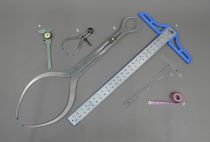
Measuring tools. A cloth measuring tape, as used by tailors, is useful for measurements directly on objects, and a traditional, stiff measuring tape is also essential. A variety of calipers can be helpful, including Vernier, dial, or digital calipers for fine measurements, as well as different sizes of outside and inside calipers for measuring wall thicknesses, void dimensions, and so on (fig. 366). For overall measurements, a drafting or framing square, combined with square sheets of cardboard or foam core, and a bubble level are useful to make accurate measurements. See II.4.
-
Camera with macro capability and tripod. See II.2§1.
-
Color reference card, a scale bar, and a pointer are necessary for good photo documentation (see II.2§1.1).
-
Magnifying eyewear. A wide range of specialized head-mounted magnification systems are available. Reading glasses with magnification of +7 are a low-cost alternative.
-
Tools for macro and microscopic examination. Higher magnification than is available as eyewear is often desirable. Tools can range from an affordable hand lens (loupe) to very expensive articulated stereomicroscopes or high-end digital microscopes. Relatively low-cost USB microscopes or cell phone adapters may be an attractive option. The ability to record images of good quality is advantageous for documentation.
-
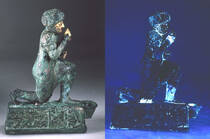
Ultraviolet light (and protective eyewear). For initial examination, a handheld ultraviolet lamp is usually satisfactory (see II.2§3.1, I.4§1.3, I.8§3.1, fig. 191) Relatively low-cost LED flashlights are now available, with even distribution and high intensity; the most useful emit at 365 nm. The ability to darken the examination room is important.
-
Mirrors. A selection of small inspection mirrors of different sizes can be useful for looking under or inside sculptures. Inspection mirrors often have an adjustable swivel mount at the end of a telescoping handle.
-
Magnets. A strong magnet is useful for detecting and other ferrous components (see I.1§3). Many practitioners place a small rare-earth magnet into a folded piece of tape. This provides a “handle” for the magnet and prevents direct contact with the object’s surface. Even slight attraction of the magnet can be detected by observing flexing of the tape handle.3
-
Simplified line drawings or photographs from different angles are useful for graphic documentation of features such as joints, repairs, or damage. Printed images can be marked up with colored pencils or marker, and digital files can be annotated digitally.
-
Tools and containers for sample collection. These will vary depending on the type of sample to be collected. See II.5§3.5, II.6§3.1, II.7§3, II.8§1.4, II.8§2.4.
4 Guidelines for reporting technical results
4.1 How to report raw data
Although intended for a wide audience, including nonspecialists, the results obtained from a technological study should be recorded and reported in a scientifically reliable and useful manner for future researchers and for integration in shared databases. Therefore, it is strongly suggested that technical reports follow several basic rules observed in academic papers in the natural sciences.
4.1.1 Report on the operating conditions
Operating conditions shall be recorded and reported as precisely as possible, including all reference materials used for analysis, if relevant. Based on the report, another team of researchers should be able to carry out the same investigations using the same approaches to confirm the reliability of the results.
4.1.2 Raw results should be made available
Raw data should be made publicly available as much as possible, particularly measurements and analytical results. For quantitative data, tables are preferred to text files to allow for further processing (statistics, databases, and so on; see below). Attention should be paid to reporting significant figures based on the precision of the method.4
4.1.3 Distinguish objective physical evidence from
interpretive data
As was made clear in volume I, the interpretation of physical evidence in the technical examination of bronze sculpture is rarely simple or straightforward. Different experts may draw different conclusions from the same X-radiograph or alloy analysis. For this reason, it can be beneficial to separate the reporting of results and observations from discussion and interpretation (as is standard practice in scientific publications).
4.1.4 Define your technical vocabulary
As is evident from a careful reading of the Vocabulary section of this publication, the terminology used to describe technical aspects of bronze sculpture can have different meanings to researchers from different disciplines or areas of specialization. Technical terms used in reports and publications should therefore be clearly defined within the document, and preferably refer to published authorities.
4.2 A picture is worth a thousand words
In natural sciences there is a rule of thumb that a report should be understandable by only looking at the illustrations, images, and diagrams, which means that illustrations and captions should be both clear and complete. The following four types of graphics are commonly provided in technical reports on bronze sculpture. For each, some general guidance is provided:
4.2.1 Image scale
For documentary photography of all types, a scale bar or indicator is of great importance. This is particularly true for macro photography and photomicrography.
4.2.2 Annotated figures
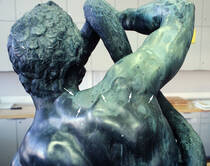
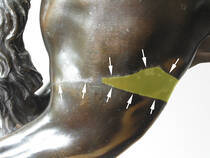
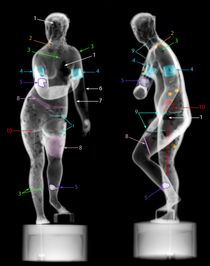
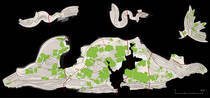
Annotated photographs, radiographs, line drawings, and other images, using arrows and/or shapes to focus attention on specific features, are highly recommended (see figures 159 and 188 for examples of simple annotations, and figures 65 and 367 for more complex annotations).
Make digital annotations using software that allows for superposition of an unlimited number of vector-based layers. In this manner, many different features may be recorded in a single, scalable file (for instance in green, mechanical joints in red, in blue). Other image types may be included as layers, such as UV photographs (fig. 191) or radiographs. Each layer can be made visible or not to create different versions of the annotated image. In such documents a legend is crucial; as much as is possible, keep the legend consistent from one study to another.
4.2.3 Graphs synthesizing analytical results and/or
measurements
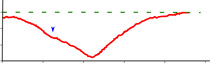
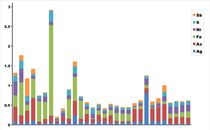
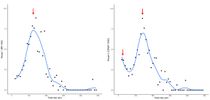
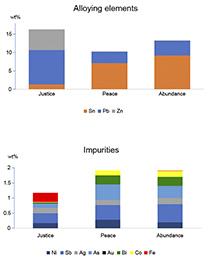
Whereas a table is useful to check details or for the investigator to recheck their own calculations, graphs are well adapted to synthetize complex data sets and to highlight particular trends. Clear captions are mandatory (see Case Study 4, figs. 512, 518; and Case Study 5, figs. 525, 528).
4.3 Samples, images, and data management
Management of sample material, images, and data is key. This covers two aspects, namely conservation and record keeping, for which serious efforts are being made in the cultural heritage field.5 The ideal way to document samples, technical images, and data for easy retrieval and further processing is to integrate them in structured databases.6 The most important aspects to bear in mind before creating a database are:
-
Define the scope of the database. What will the data be used for? For simple cataloguing for the operator and institution, or for exchanges with other teams and/or databases? In the latter case, what will be the purpose of the exchange? Do you really need a database?
Ensure data reliability.
-
Ensure data “interoperability” (readable and processable by other teams).7
Structure the data as much as possible.
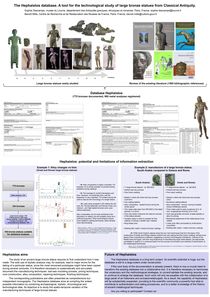
A simple spreadsheet may already constitute a database as soon as all these requirements are met. A number of databases related to cultural heritage may be used as examples.8 The Hephaistos database is to date the only example of a large technical database dedicated exclusively to bronze sculpture (fig. 368).9
4.4 Statistics
One use for a large set of data may be statistical analysis. If the body of data is large enough, statistics may help characterize and quantify observed trends.10 This may start with simple correlations (for instance between date and composition) and progress to more sophisticated approaches (cluster analysis, principal component analysis, machine learning, or artificial intelligence). For bronze sculpture, most statistical analysis carried out so far has been applied to chemical composition.11 So-called unsupervised methods can be used to discover previously unrecognized patterns in data sets.12 Before engaging in statistical analysis, confirm that the data to be analyzed are truly reliable and comparable. If statistical analysis becomes significant in the context of a technical examination, and especially if it is to be published, it is highly recommended to engage the assistance of a qualified statistician.
4.5 Publication
The dissemination of technical investigation of bronzes suffers currently from two handicaps. First, while the technical investigation of bronzes builds upon multidisciplinary teams and the results are normally directed toward a multidisciplinary audience, peer-reviewed publications that reach a broad, multidisciplinary audience are rare. Fortunately, in recent years, technical essays within exhibition catalogues have been used successfully to disseminate the results of technological studies.
Second, many studies remain as unpublished internal reports or as non-peer-reviewed conference publications due to restricted time allocated for research and publication. Some attempts have been made to facilitate access to this so-called gray literature,13 and we hope these initiatives will multiply. That said, every effort should be made to place the results of technical studies in peer-reviewed publications. The transition to peer-reviewed publication will be facilitated by adhering to the aforementioned basic rules while preparing internal reports.
Notes
-
Ezrati, Jean-Jacques. 2015. Éclairage d’exposition: Musées et autres espaces. Paris: Eyrolles.. ↩︎
-
When selecting nitrile gloves, see Stephens, Catherine H., Eric M. Breitung, Corina Geiculescu, and Thomas Strange. 2022. “Determination of Nitrile Gloves Appropriate for Use When Dry Handling Art.” Journal of the American Institute for Conservation 61 (3): 162–71. https://doi.org/10.1080/01971360.2021.1913543.. ↩︎
-
Warning: 0.5 wt% of iron in a bronze is enough to attract magnets. Note that in the late eighteenth century, spelter were preferred to cementation brasses for compasses because they are lower in iron and thus less magnetic (Watson, R. 1786. Chemical Essays. Vol. 4. Cambridge, UK: J. Archdeacon.). ↩︎
-
For a concise and clear discussion of significant figures and rounding see Bevington, Philip R., and D. Keith Robinson. 2003. Data Reduction and Error Analysis for the Physical Sciences. Boston: McGraw-Hill., 4–5. ↩︎
-
For image management see Warda, Jeffrey, ed. 2011. The AIC Guide to Digital Photography and Conservation Documentation. 2nd ed. Washington, DC: American Institute for Conservation of Historic and Artistic Works., chapter 5. For sample management see the ongoing Heritage Samples Archives Initiative: https://www.iccrom.org/projects/heritage-samples-archives-initiative. ↩︎
-
Specific labels are given to collections of data according to their structure and complexity: thesauruses, ontologies, and so on. For simplicity’s sake, the term “database” is used here. ↩︎
-
A key aim of the present Guidelines is to help researchers produce interoperable data. It is beyond our scope to guide on all the steps necessary to build a sound database (structure standards; interfaces for management, retrieval, and use). For more on databases see the introduction for nonspecialists in Baca, Murtha, ed. 2008. Introduction to Metadata. Los Angeles: Getty Research Institute.. ↩︎
-
See for example the FLAME database at https://flame.arch.ox.ac.uk/ (Pollard, A. M., P. Bray, A. Cuénod, P. Hommel, Y.-K. Hsu, R. Liu, L. Perucchetti, J. Pouncett, and M. Saunders. 2018. “The Flame GIS-Database.” In Beyond Provenance: New Approaches to Interpreting the Chemistry of Archaeological Copper Alloys, edited by A. M. Pollard, 171–86. Studies in Archaeological Sciences 6. Leuven, Belgium: Leuven University Press. https://doi.org/10.2307/j.ctv7xbs5r.10.); http://grossbronzenamlimes.de/database/begruessung; http://rembrandtdatabase.org/; https://www.getty.edu/projects/appear-project/; https://arachne.dainst.org/. ↩︎
-
It has notably allowed comparison of Greek and south Arabian casting techniques of large bronzes (Mille, Benoît. 2012. “The Casting Techniques of Antique South Arabian Large Bronze Statues.” In Scientific Research on Ancient Asian Metallurgy: Proceedings of Fifth Forbes Symposium at the Freer Gallery of Art, Washington, Smithsonian Institution, 28–29/10/2010, edited by P. Jett, B. McCarthy, and J. G. Douglas, 225–47. London: Archetype.) and inference regarding new ideas about transfers of know-how (Mille, Benoît. 2017. “D’une amulette en cuivre aux grandes statues de bronze, évolution des techniques de fonte à la cire perdue, de l’Indus à la Méditerranée, du 5e millénaire au 5e siècle av. J.-C.” PhD diss., Université de Paris-Nanterre et Université de Fribourg. http://www.theses.fr/2017PA100057.). ↩︎
-
Baxter, Michael J. 2003. Statistics in Archaeology. London and New York: Oxford University Press.. ↩︎
-
See for example Glinsman, Lisha A., and Lee-Ann C. Hayek. 1993. “A Multivariate Analysis of Renaissance Portrait Medals: An Expanded Nomenclature for Defining Alloy Composition.” Archaeometry 35 (1): 49–67.; Bourgarit, David, Benoît Mille, Thierry Borel, Pierre Baptiste, and Thierry Zéphir. 2003. “A Millennium of Khmer Bronze Metallurgy.” In Scientific Research in the Field of Asian Art: Proceedings of the First Forbes Symposium at the Freer Gallery of Art, edited by Paul Jett, 103–26. London: Archetype.; Heginbotham, Arlen, Robert Erdmann, and Lee-Ann C. Hayek. 2018. “The Dating of French Gilt Bronzes with ED-XRF Analysis and Machine Learning.” Journal of the American Institute for Conservation 57 (4): 149–68.. For an overview of the subject see Baxter, Michael J. 2001. “Statistical Modelling of Artefact Compositional Data.” Archaeometry 43 (1): 131–47.. ↩︎
-
Baxter, Michael J. 2006. “A Review of Supervised and Unsupervised Pattern Recognition in Archaeometry.” Archaeometry 48 (4): 671–94.. ↩︎
-
See for example CHARISMA, an initiative involving twenty-two European institutions: https://cordis.europa.eu/project/id/228330. ↩︎