Chicago
Dandridge, Pete. “Case Study 2. Exquisite Objects, Prodigious Technique: Aquamanilia, Vessels of the European Middle Ages.” In
Guidelines for the Technical Examination of Bronze
Sculpture, by David Bourgarit, Jane Bassett, Francesca G. Bewer, Arlen
Heginbotham, Andrew Lacey, and Peta Motture. Los Angeles: J.
Paul Getty Museum, 2025.
https://www.getty.edu/publications/bronze-guidelines/case-studies/2/.
MLA
Dandridge, Pete. “Case Study 2. Exquisite Objects, Prodigious Technique: Aquamanilia, Vessels of the European Middle Ages.”
Guidelines for the Technical Examination of Bronze
Sculpture, by David Bourgarit et al., J. Paul Getty Museum, 2025,
https://www.getty.edu/publications/bronze-guidelines/case-studies/2/.
Accessed
DD Mon. YYYY.
Case Study 2. Exquisite Objects, Prodigious Technique: Aquamanilia, Vessels of the European Middle Ages
Pete Dandridge
Introduction
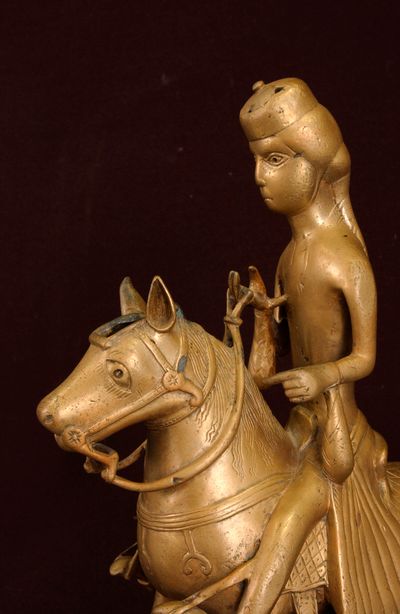
(figs. 469, 470, 471, 486)
Aquamanilia are zoomorphic or anthropomorphic vessels
for the washing of hands at the table.
CastDefinition: cast (v.): In the sculptural
context, the verb refers to pouring a slurry or
liquefied material (e.g., plaster, wax, metal) into
a hollow matrix or mold that will determine the
shape of the material in order to produce a cast
(n.).More
from copper alloys, they emerged as a distinct artistic
form in the twelfth century in Lower Saxony and
continued to be fabricated in various areas of Germany
for the next three centuries.
They were filled via lidded openings, generally at the
tops of the animal’s or rider’s head, with the spouts
either integrally cast as part of the figure’s mouth or
separately fabricated as a spigot and mechanically set
into its chest.
They represent an important stage in the evolution of
European casting technology, being the first hollow,
fully three-dimensional sculptural forms produced since
antiquity. More than three hundred aquamanilia are known
to have survived through the centuries, some inspiring
nineteenth-century
replicasDefinition: replica: Here used to describe the
precise reproduction of a bronze made by the same
artist or foundry as the original bronze. Also
refers to same-scale reproductions of a model made
at different stages in the casting process (e.g., a
wax replica, …More, and all are unique.
Context for the technical study
(figs. 469, 470, 471, 472)
The collection of aquamanilia and associated medieval
German metalwork in New York’s Metropolitan Museum of
Art became the focus of an exhibition that integrated
art historical analyses with technical examinations of
the vessels in the Met’s collections and related cast
objects in other collections around the world. Several
dozen works formed the focal point of this study, though
information from many others also fed into the research.
Invaluable insights were also gleaned from the
experimental replication of one of the Met’s lion
aquamanilia that followed closely the processes
prescribed by the medieval monk Theophilus in his
twelfth-century treatise
On Divers Arts: The Foremost Medieval Treatise on
Painting, Glassmaking, and Metalwork. Written around the time when aquamanilia first
appeared, the treatise describes, among other things,
the casting of a complex sculptural censer—a hollow,
copper-alloy object.
The mane questions (pardon the pun)
(fig. 470)
How were these fantastical objects fabricated?
How does their facture compare to the processes
outlined in Theophilus’s twelfth-century treatise?
Might those descriptions help in the interpretation
of the technical evidence preserved in the vessels?
Do they apply to the fabrication of aquamanilia as
well?
Ultimately, with data from a large enough sampling
pool, would it be possible to start tracing the
evolution of this casting technology as the centers
of production shifted over time?
Might it be possible to establish idiosyncratic
patterns in techniques or materials that would help
to identify and characterize the products of
particular workshops or regional production centers?
This case study focuses predominantly on the first two
questions.
Lost-wax casting
(fig. 473)
All technical evidence points to medieval aquamanilia
being cast by the
lost-waxDefinition: lost-wax casting: A technique in
which a model made of wax is embedded in a
refractory mold that is heated, thereby melting out
the wax and creating a void to be filled with molten
metal. Two primary variations of the technique are
referred to as “direct” …More
process. This basically entails fashioning a
modelDefinition: model: The creation of a bronze
may involve a series of models and molds that can
differ in size and material depending on the
artist’s design process, and ultimately also on the
casting process chosen to create the bronze version.
The model is a …More
of the desired form in wax with which to create a hollow
impression in a fire-resistant
moldDefinition: mold: A three-dimensional negative
form made of one or more parts that serves as a
matrix for the production of a positive by casting
or pressing malleable material into it. Molds allow
for the production of one or more copies of an
original …More
material that will serve as a matrix for the liquefied
metal (see
GI§2.2.1
and
fig. 13).
The uniqueness of each known example suggests that
aquamanilia were directly modeled over earthen
coresDefinition: core: The portion of the
refractory mold that defines the internal space in a
hollow bronze sculpture. It may be formed in a
variety of ways and is usually (but not always) made
of similar material as that used for the outer
portion of the mold. …More. The internal surfaces are all relatively smooth, and
there are no waxy drip marks or other physical
indicators that they were formed by an indirect process.
Core (replication)
(fig. 474, video 4)
The internal volume of any hollow
bronzeDefinition: bronze: Depending on the user,
“bronze” may designate a copper alloy that has tin
as the primary added element or any other
copper-based alloy. We recommend using the term
“bronze” specifically for copper-tin alloys unless
qualified by another …More
is defined by a core made of fire-resistant material.
Theophilus describes shaping a well-kneaded and sifted
mixture of sandy clay and dried dung into more or less
the desired form, integrating many of its physical
features. The sand would temper the clay, reducing
shrinkageDefinition: shrinkage: The contraction of
molten metal as it cools and solidifies after
casting, resulting in a reduction of the overall
dimensions of the cast as well as possible casting
defects. See
II.4§1.1.1.More
and cracking during firing. The organic material would
provide “green” strength or cohesiveness to the mixture
and create a more porous body that could help absorb any
vapors that might evolve during the
pourDefinition: pour: The operation of pouring or
casting metal into the refractory mold.More.
The core would be finished to closely mirror the desired
shape of the vessel. Relatively simple forms such as
this one didn’t require an internal
armatureDefinition: armature: Assemblage of joined
metal rods, tubes, and/or wires (and/or other
materials such as wood) that provides a structural
framework for a sculpture and usually attaches to a
base. Though generally internal, it may also include
external …More
to support the weight of the clay, while evidence of
such supports was found in larger and more complex
structures. After casting, the core material and
armature were generally removed to clear the hollow of
the vessel for use.
Core (examination)
(fig. 475)
Traces of the earthen mixture preserved in
harder-to-access areas of several of the aquamanilia
were sampled and prepared as thin sections for
petrographic analysis (see
II.7§2.2) and scanning electron microscopy (SEM; see
II.7§2.2.3) imaging to characterize their material makeup.
Several examples included the identifiable forms of
organic inclusions. The mineral content pointed to a
metamorphic rock source, but overall these analyses were
(as yet) inconclusive regarding the identification of
the clays’ geological origin, and therefore the
geographical location of the aquamanilia’s production.
Wax layer (replication)
(fig. 476, video 5)
The model for the censer Theophilus describes was
created by first overlaying the cured core with pieces
of sheet wax rolled out to a specific depth, cut into
“small pieces according to the spaces which you have cut
in the clay of the censer.” These were warmed and
applied with the aid of a hot iron, then trimmed and
smoothed out, taking care that the thickness of the wax
layer was “not thicker or thinner in one place than
another.” Such evenness helps to ensure that the metal
cools and shrinks at an even rate, avoiding distortions.
The fine modeling of details can then begin. This same
process was applied to the replication of the Lion
aquamanile.
ExpandFigure 476A wax sheet is cut and applied over the core with
seams secured with a hot spatula. Ubaldo Vitali
(American, b. 1944), Reproduction of a Lion
Aquamanile, Maplewood, New Jersey, 2006, H. 19 cm,
after Aquamanile in the Form of a Lion,
probably northern Germany, 12th century, H. 19.5 cm
(Metropolitan Museum of Art, gift of Irwin
Untermyer, 1964, inv. 64.101.1491).
Wax model
(figs. 469, 477, 478, 479, 480, 481, 482)
The physical evidence points to the aquamanile being
directly modeled in wax as described by the monk. The
many fine details have the quality of a malleable
material, and many were ultimately added in the wax. In
some instances, elements such as the sculptural handles
would have been formed separately and then joined to the
body of the vessel.
Radiographs were invaluable in assessing the overall
form of the aquamanile’s core and how the wax layer
(translated into metal) was built up. In such images,
the denser, more X-ray-opaque materials show up whiter.
The consistent opacity observed in the central part of
both lions’ bodies points to their modeling in a single
layer of sheet wax. The slimmer parts of the legs were
modeled in solid wax.
In the X-ray of the lion-shaped aquamanile from North
Germany, the details of the mane are denser, showing
that they were built up from an additional layer of wax.
In contrast, the undulating shapes of the mane in the
flame-tailed lion aquamanile from Nuremberg were already
formed in the core and overlaid by an even layer of wax
as prescribed. The darker areas in this second lion’s
mane may have resulted from pressing the wax sheet onto
the more complex core shapes, or from revisions in the
final modeling that might have thinned the wax and
resultant metal
castDefinition: cast (n.): A sculpture or more
generally an object that is shaped by pouring a
molten material or a slurry into a mold in which it
will solidify. Plaster of paris, metal, and wax are
among the cast-forming sculptural materials
routinely involved in …More.
The more complex and larger aquamanilia required a more
sophisticated construction, which could entail joining
separately modeled figures (and cores) and/or the
additional support of localized armatures. The retained
core of the falconer, for instance, appears from the
radiographs to be continuous with that of the horse. The
slightly irregular darker area in the falconer’s abdomen
may be the location of an armature made of less dense
organic material.
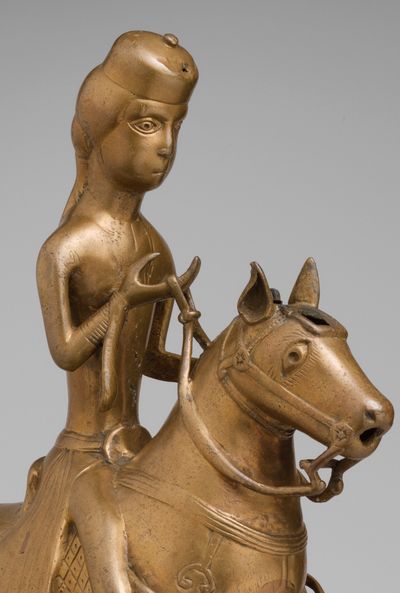
ExpandFigure 479Detail.
Aquamanile in the Form of a Falconer on
Horseback, northern Germany, 13th century, H. 34.7 cm
(Metropolitan Museum of Art, The Cloisters
Collection, 1947, inv. 47.101.55). See Dandridge
2006.
Conversely, the X-ray image of the small Samson
wrestling on the back of the lion shows that the core of
the human figurine extended only to his knees and beyond
his shoulders into his head. Samson was modeled in wax
separately before being joined to the back of the wax
lion. A fine wire armature can be detected coming down
from his head into the left calf.
Theophilus does not refer to armatures as the openwork
form of the censer, and the bell-like shape of its two
halves provided sufficient surface area for contact
between the core and the
investmentDefinition: investment: The term can refer to
the refractory mold used in the lost-wax casting
process or to the material used to make that mold.
It also denotes the process of coating or embedding
the wax model in this material and is applicable to
clay-based, …More
to not require the use of armatures, but fine wires and
other materials were certainly used in more complex
objects. Again, these were often removed from the body
of the vessel after casting, but were left in other,
less accessible areas.
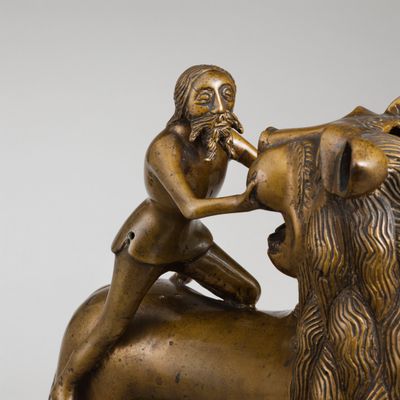
ExpandFigure 481Detail.
Aquamanile in the Form of Samson and the Lion, northern Europe (?), possibly Germany, ca.
1380–1400, H. 34.1 cm (Metropolitan Museum of Art,
Robert Lehman Collection, 1975, inv. 1975.1.1412).
See Dandridge 2006.
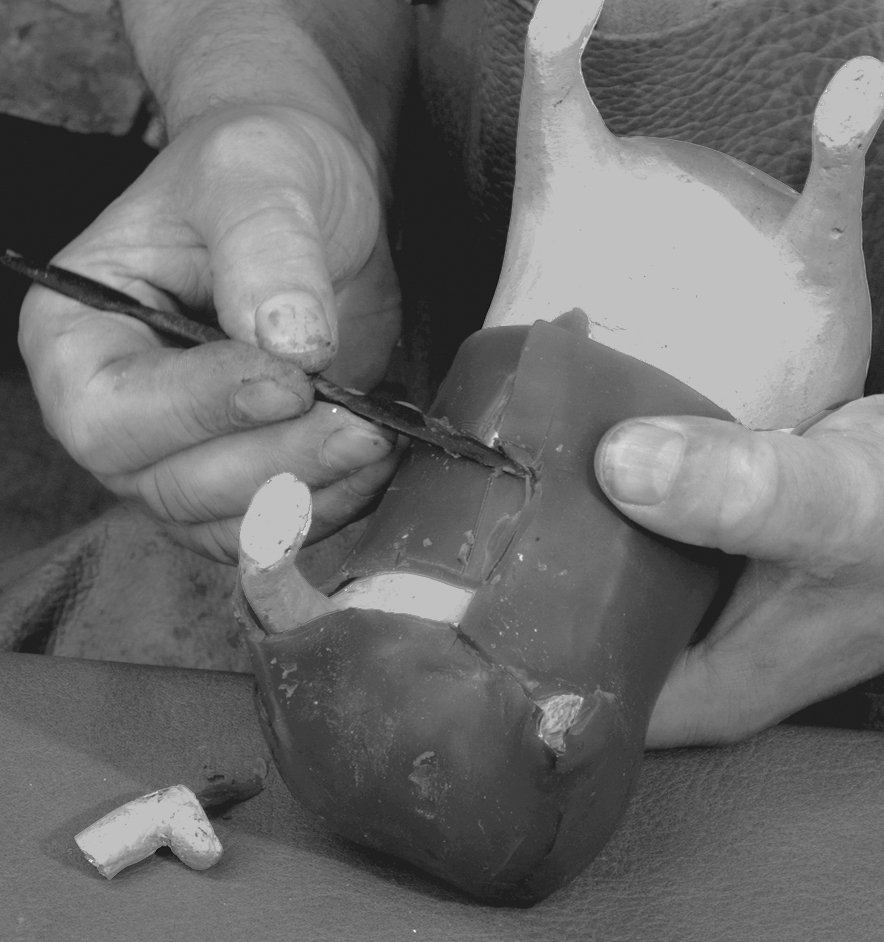
Core pins, sprueing, and investing (replication)
(figs. 483, 484, video 8)
Once the modeling was complete, metal
core pinsDefinition: core pin: A metal rod, nail, or
wire that is embedded in both the core and the outer
mold and serves to secure the core in place during
the pour. Core pins have traditionally been made of
copper alloys, iron, or steel, and today are
generally made …More
were partially inserted through the wax and into the
core to secure the registration of the aquamanile’s core
within its outer mold or investment (see
video 5). Next, the model would be fitted with a network of
spruesDefinition: sprue: Any channel that feeds
metal to the mold, in contrast to a vent, which lets
air escape. Both sprues and vents make up the “sprue
system,” which circulates bronze from the pouring
cup through the refractory mold and allows air and
casting …More
through which to melt out the wax, feed the liquefied
metal into the mold, and allow the gas and air to
escape.
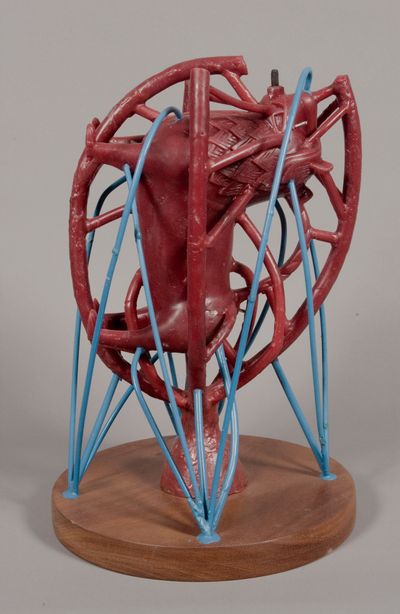
ExpandFigure 483Fully sprued wax model for an experimental casting.
Solid wax sprues and pouring cup that feed the metal
through the mold are in red. Vents that allow gases
to escape from the mold are in blue. Ubaldo Vitali
(American, b. 1944), Reproduction of a Lion
Aquamanile, Maplewood, New Jersey, 2006, H. 19 cm,
after Aquamanile in the Form of a Lion,
probably northern Germany, 12th century, H. 19.5 cm
(Metropolitan Museum of Art, gift of Irwin
Untermyer, 1964, inv. 64.101.1491).
When possible, connections helping with that flow were
integrated into the design of the sculptural form
itself, as can be seen in the falconer.
ExpandFigure 484Detail from an aquamanile illustrating the
rod-shaped strut extending out of the chest and
supporting the falconer’s right arm, as well as the
exaggerated length of the glove flap on his opposite
arm, enabling the circular flow of metal during the
pour.
Aquamanile in the Form of a Falconer on
Horseback, northern Germany, 13th century, H. 34.7 cm
(Metropolitan Museum of Art, The Cloisters
Collection, 1947, inv. 47.101.55). See Dandridge
2006.
Then, as Theophilus describes, multiple layers of
earthen mold material (similar to that of the core) were
gradually built up over the sprued wax model. This clay
investment mold containing the sprued model would be
heated to melt out the wax, which, being an expensive
material, would, according to the treatise, be recovered
and presumably recycled. Heating the mold would also
serve to get rid of all moisture because, the monk
warns, “if the inside cores experience dampness, they
immediately swell and all your work will break apart.”
The mold is then heated until it is red hot and buried
in a pit, casting cup up, ready to receive the liquefied
metal, which is poured from a crucible in which it has,
meanwhile, been alloyed.
Core pins and core plugs
(figs. 180, 485, 486, 487, 488)
Examination of the aquamanilia revealed that these were
made of copper or iron, and some out of bent copper
sheet. The use of one type did not preclude the other.
ExpandFigure 485Detail showing a core pin fabricated from a folded
piece of copper sheet.
Aquamanile in the Form of a Lion, probably
northern Germany, ca. 1200, H. 21.2 cm (Metropolitan
Museum of Art, The Cloisters Collection, 1947, inv.
47.101.52). See Dandridge 2006.
Should the core pins fuse to the metal during casting,
they were cut down to the level of the outer surface and
smoothed over with some surrounding metal. But the
internal portion is often still preserved on the inside,
and visible in radiographs or in accessible areas.
ExpandFigure 487Interior detail showing the protruding tip of a
surviving core pin that was fused to the surrounding
metal. Aquamanile in the Form of a Lion,
Germany (Lower Saxony), late 13th–early 14th
century, H. 21.0 cm (Metropolitan Museum of Art,
gift of Irwin Untermyer, 1964, inv. 64.101.1490).
See Dandridge 2006.
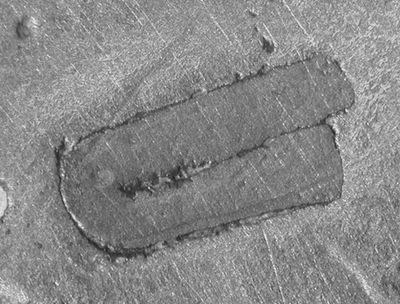
If it could be loosened, however, the core pin was
removed and the resulting hole filled with a
plugDefinition: plug: A type of repair that fills
a flaw that extends through the full thickness of
the metal wall, specifically those that occur with
the removal of core pins and armature rods. Circular
plugs are often threaded in order to mechanically
lock …More, which was often a tapered, hammered-in copper pin.
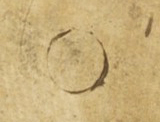
ExpandFigure 488Detail of circular disc inserted as a core plug and
secured with solder.
Aquamanile in the Form of a Lion,
Nuremberg, Germany, ca. 1400, H. 31.9 cm
(Metropolitan Museum of Art, The Cloisters
Collection, 1994, inv. 1994.244). See Dandridge
2006.
Patterns may be found in the treatment of core pins and
may prove characteristic of a particular workshop. In
the Nuremberg aquamanilia studied here, when core pins
were removed, the ensuing holes rounded with files and
plugged with shallow discs of metal similar to the cast
(probably cut from a sprue), and their joints secured
with
solderingDefinition: soldering: In bronze sculpture, a
technique for joining separately cast parts, inlays,
overlays, or repairs, or for filling casting
defects, by adding a metal with a lower melting
temperature than that of the primary cast. For the
purpose of visual …More.
Metal
(fig. 489)
Theophilus describes coloring copper by the cementation
process using “a stone of yellowish color, sometimes
reddish.” This stone was, in fact, the zinc ore calamine
and the process that of alloying “latten,” a brassy
metal containing zinc as the primary alloying agent and
tin and lead in levels above 1%. (Zinc as a metal had
not yet been isolated or identified in his time.) This
is the golden-colored metal predominantly used for
aquamanilia. Workshops in northern Germany and Lower
Saxony, and later in Nuremburg, were close to the source
of these raw materials.
Each ore source has distinctive trace minerals that can
help identify where the metal comes from. To what extent
the tin and lead contents were intentional cannot be
readily determined, as both were also contained in
copper ores. And given that metals were often recycled,
with each remelting, the zinc concentration might be
reduced due to the evaporation of zinc vapor. With so
many variables to consider and a relatively small
statistical group to work from, the results thus far of
the metal analysis are far from conclusive.
That said, over the span of production of aquamanilia,
the techniques used to alloy the calamine with copper
became more sophisticated, which allowed for an enhanced
absorption of zinc. Such an increase can be seen in the
alloy analysis of aquamanilia produced in Nuremberg at
the beginning of the fifteenth century compared to
earlier casts.
Fettling
(figs. 104, 277)
Once the metal had cooled in the mold, the investment
was broken away to reveal the casting.
FettlingDefinition: fettling: Steps carried out
directly after casting to remove unwanted features,
including oxidized metal, sprues, core pins,
flashing, etc. Fettling may entail the use of power
tools and/or hand tools such as saws, chisels,
hammers, coarse files, …More
was the initial step in finishing the raw casting with
the retained sprueing system (runners and risers) and
core pins cut back with
chiselsDefinition: chiseling: Act of using a chisel
and hammer to remove metal. With each strike of the
hammer the tool jumps, often leaving a visible
“step.” Chiseling may be part of either fettling or
chasing.More
and files. Once these features were removed, the artist
had greater access to the
as-cast surfaceDefinition: as-cast surface: Refers to the
surface immediately after removal from the mold,
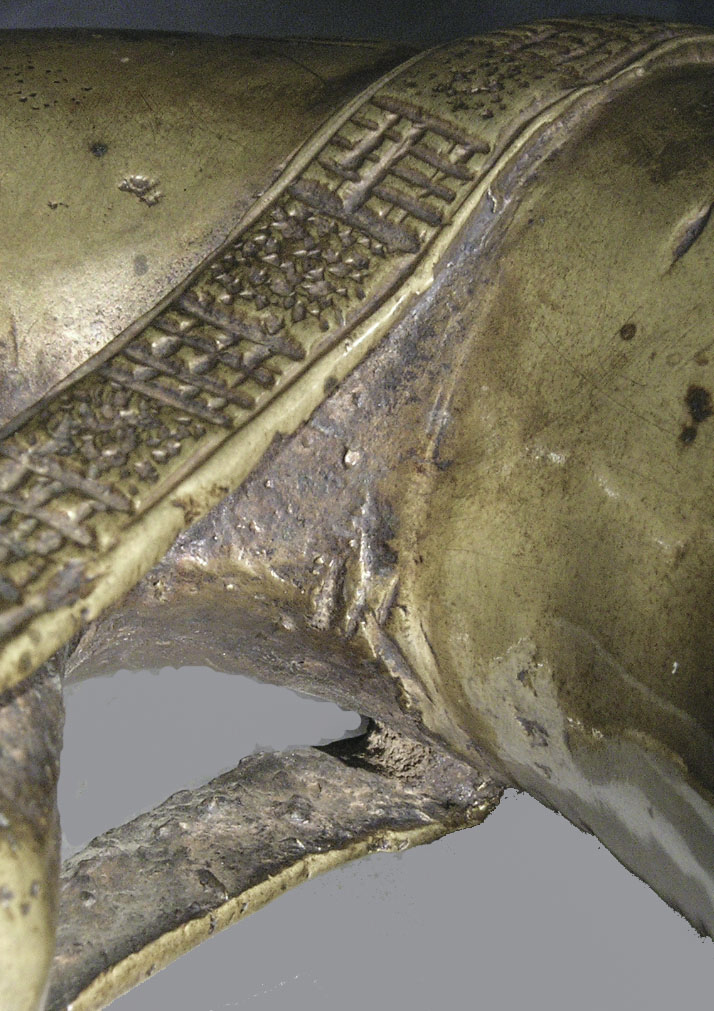
before fettling and chasing.More, which in medieval western Europe was generally coarse
and required significant finishing. One can get a better
sense of this in areas inaccessible to tooling, like the
undersides of handles, or animals’ indented paws or
hooves.
ExpandFigure 277Detail showing the transition between the retained
as-cast surface beneath the horse’s neck and the
adjacent chased surface of the metal.
Aquamanile in the Form of a Knight on
Horseback, Germany (Lower Saxony?), ca. 1350, H. 45.2 cm
(Metropolitan Museum of Art, Robert Lehman
Collection, 1975, inv. 1975.1.1409). See Dandridge
2006.
Cast-in repairs
(fig. 490)
Imperfections and casting flaws seem to have been an
anticipated outcome for medieval metalworkers.
Theophilus suggests using a localized lost-wax casting
process for making repairs. “If there is any flaw, due
to neglect or accident, . . . thin out that place by
filing around it. Apply wax and likewise add clay on top
and when it is dry, heat it, and so pour over it until
the liquid bronze flows into that place and what you
have poured on top adheres. If, when you examine it, it
is not strong enough, solder with burnt wine-tone and
the filings of mixed silver and copper as we have
described above.”
Many of the aquamanilia show evidence of such cast-in
repairs. The metal-to-metal joint lines are generally
faint on the outer surface, but the denser masses of
metal that flowed into the hollowed core area are
clearly defined in the X-rays.
Patches and plugs
(figs. 478, 488, 492)
Hammered-in copper-alloy plugs or
patchesDefinition: patch: A type of repair most often
mechanically set into the bronze surface, but which
may also be soldered, welded, or cast into place
(see
I.4). Patches are most often made of cut-out pieces of
copper alloy that are the same as …More
were used on smaller flaws with no evidence of solder
reinforcement. Such reinforcement is, however, apparent
in aquamanilia cast in Nuremberg where plugs made of
small discs of an alloy similar to the body metal
(probably from a sprue) were inset into carefully
prepared holes left by the core pins and soldered into
position.
ExpandFigure 488Detail of circular disc inserted as a core plug
and secured with solder.
Aquamanile in the Form of a Lion,
Nuremberg, Germany, ca. 1400, H. 31.9 cm
(Metropolitan Museum of Art, The Cloisters
Collection, 1994, inv. 1994.244). See Dandridge
2006.
ExpandFigure 492Detail of side showing the location of the core
plug illustrated in
fig. 488. Aquamanile in the Form of a Lion,
Nuremberg, Germany, ca. 1400, H. 31.9 cm
(Metropolitan Museum of Art, The Cloisters
Collection, 1994, inv. 1994.244). See Barnet and
Dandridge 2006.
Chasing
(figs. 493, 494, 495, 496, 497)
ChasingDefinition: chasing: The process of fine
detailed “cold work” after casting and fettling that
serves to correct or enhance the cast surface by
removing and/or compressing metal using hand tools
by punching, engraving, and/or chiseling, and in
modern times also …More
required a variety of tools, including claw chisels,
punchesDefinition: punch: A tool usually made of a
steel rod that may be struck with a hammer at one
end in order to create a pattern in the surface of
the sculpture with the other end by compressing the
metal.More, scrapers, and burnishers to reduce marks from
fettling and to close up surface porosity and small
blemishes. Decorative details would be introduced or
reinforced with
engravingDefinition: engraving: In relation to bronzes,
the process of decorating the surface by removing
material with a chisel, burin, or graver that
creates a V-shaped groove.More
tools and punches, and a final finish might be achieved
with a series of graded polishing agents.
ExpandFigure 495Detail from centaur’s chest showing the use of a
scorper to define U-shaped designs with the series
of steps within each cut corresponding to the strike
of the mallet or hammer.
Aquamanile in the Form of a Crowned Centaur
Fighting a Dragon, possibly Hildesheim, Lower Saxony, Germany,
1200–1225, H. 36.5 cm (Metropolitan Museum of Art,
Rogers Fund, 1910, inv. 10.37.2). See Dandridge
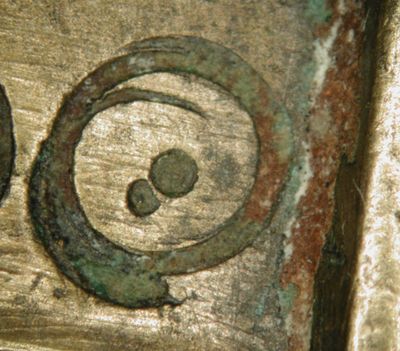
2006.ExpandFigure 496Detail showing double strike of a circle and dot
punch used to ornament the belt.
Aquamanile in the Form of Phyllis and
Aristotle, southern Netherlands, late 14th or early 15th
century, H. 32.5 cm (Metropolitan Museum of Art,
Robert Lehman Collection, 1975, inv. 1975.1.1416).
See Barnet and Dandridge 2006.
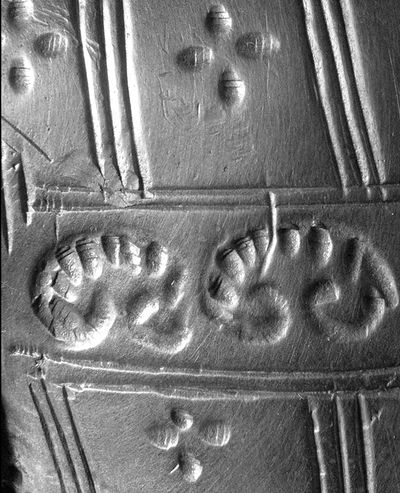
Tool marks retained on the surfaces of the aquamanile
suggest their transformation closely followed
Theophilus’s description that “you first file over all
the grounds with various files—square, triangular, and
round, then engrave with the engraving tools and scrape
with scrapers. Finally, . . . clean . . . it all over
with sand and with sticks slightly rushed at the top.”
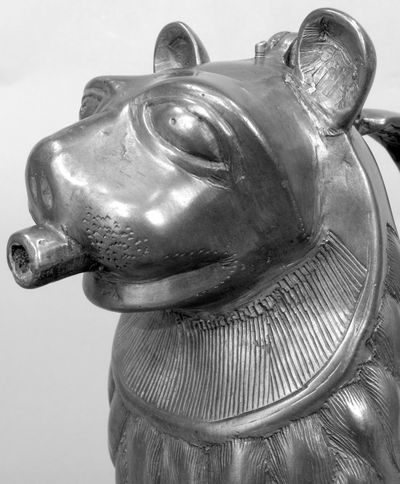
ExpandFigure 494Detail of head illustrating where a V-shaped graver
defined the lion’s mane, a flat chisel refined the
ear, and punch marks made whisker holes in the
cheek. Aquamanile in the Form of a Lion,
Germany (Lower Saxony), late 13th–early 14th
century, H. 26.1 cm (Metropolitan Museum of Art, The
Friedsam Collection, bequest of Michael Friedsam,
1931, inv. 32.100.198). See Barnet and Dandridge
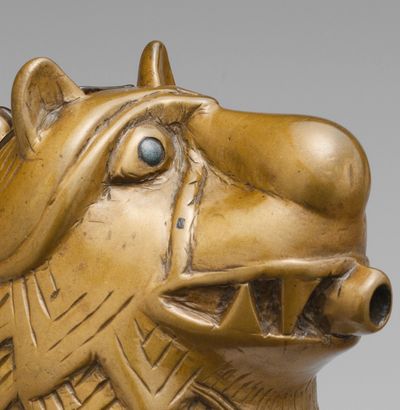
2006.ExpandFigure 497Detail showing inlaid eye made of colored glass.
Aquamanile in the Form of a Lion, probably
northern Germany, 12th century, H. 19.5 cm
(Metropolitan Museum of Art, gift of Irwin
Untermyer, 1964, inv. 64.101.1491). See Barnet and
Dandridge 2006.
Summary of findings
(figs. 44, 469, 470, 471)
The physical evidence encountered during the technical
study of the representative grouping of aquamanilia and
a few related objects in this study resonates with
Theophilus’s description of the casting of a censer. By
adopting as closely as possible the practices and
materials described in the treatise, the experimental
reproduction of one of the Met’s lion aquamanilia
allowed us to better understand the technical parameters
of the originals, even the re-creation of an unintended
casting flaw.
Techniques and materials used in casting aquamanilia
remained fairly consistent over the course of their
creation, but as their forms became more complex,
adaptations were made. And some regional variations in
methodology were noted. For instance, in addition to the
idiosyncratic core plugs, the aquamanilia cast in
Nuremberg sported separately cast spigots, and the
brassDefinition: brass: A copper alloy with zinc as
the primary added element. As with bronzes, there
are a wide variety of brass alloys.More
alloy used was consistently high in zinc.
Synopsis of technical parameters
(figs. 469, 470, 471)
The research was undertaken in collaboration with the
Bard Graduate Center for Studies in the Decorative Arts,
Design, and Culture and culminated in a 2006 exhibition
in New York at the Bard Graduate Center accompanied by a
catalogue:
Lions, Dragons, and Other Beasts: Aquamanilia of the
Middle Ages, Vessels for Church and Table. The various aspects of the technical examination were
conducted as part of the day-to-day responsibilities of
the Objects Conservation Department at the Metropolitan
Museum. While no specific log was kept of time spent,
the research, associated teaching, travel, and writing
represented the better part of two years’ work. Unless
otherwise stated, the examination and analysis was
undertaken at the Met:
endoscopic and microscopic examination of interior
and exterior surfaces: Pete Dandridge
visible-light photography of exterior and interior
surfaces: Pete Dandridge
surface analyses by qualitative X-ray fluorescence
(XRF) analysis of disparate elements incorporated
either at the time of manufacture or as part of a
later restoration: Pete Dandridge
X-radiography: Pete Dandridge
scanning electron microscopy (SEM) and polarized
light microscopy of core and investment material:
Richard Newman (Scientific Research Lab, Museum of
Fine Arts, Boston)
X-ray diffraction (XRD) analyses of discrete samples
of the polishing compounds and pigments: Pete
Dandridge
inductively coupled plasma mass spectrometry
(ICP-MS) analysis of metal samples: Josef Riederer
(Rathgen-Forschungslabor, Berlin)
replication casting: Ubaldo Vitali
video documentation and editing: Han Vu (Bard
Graduate Center for Studies in the Decorative Arts,
Design, and Culture)
Further questions
Many aquamanile and other cast medieval objects
examined in European collections retain
significantly more core material than the
corresponding material in US collections. What might
we learn from the analysis of a broader selection of
core samples? Might further analysis corroborate
some of the groupings made on stylistic grounds? Are
there detailed enough geological maps of Germany to
allow for the identification of geologic sources for
the materials comprising their clays? And what
additional information might be gleaned from the
shape and size of the component grains?
What technical relationships might we find between
aquamanilia, other small-scale cast objects, and
monumental works of art from the same period?
Further resources
Barnet and Dandridge 2006Barnet, Peter, and Pete Dandridge, eds. 2006.
Lions, Dragons, and Other Beasts: Aquamanilia of
the Middle Ages, Vessels for Church and Table. New Haven, CT: Yale University Press.
and the DVD insert: Ubaldo Vitali and Pete Dandridge,
Medieval Alchemy and the Making of a Lion
Aquamanile, documenting the replication of a lion aquamanile
Bourgarit and Thomas 2015Bourgarit, David, and Nicolas Thomas. 2015.
“Ancient Brasses: Misconceptions and New Insights.”
In
Archaeometallurgy in Europe III, Proceedings of
the 3rd International Conference, Deutsches
Bergbau-Museum Bochum, June 29–July 1, edited by Andreas Hauptmann and Diana
Modarressi-Tehrani, 255–62. Bochum, Germany:
Deutsches Bergbau Museum.
Cellini [1568] 1967Cellini, Benvenuto. 1568 (1967).
The Treatises of Benvenuto Cellini on
Goldsmithing and Sculpture. Translated by Charles Robert Ashbee. New York:
Dover Publications.
Dandridge 2018Dandridge, Pete. 2018. “The Hildesheim Baptismal
Font: A Window into Medieval Workshop Practices.” In
Cuivre, bronzes et laitons médiévaux: histoire,
archéologie et archéométrie des productions en
laiton, bronze et autres alliages à base de cuivre
dans l’europe médiévale (12e–16e siècles) =
Medieval Copper, Bronze and Brass: History,
Archaeology and Archaeometry of the Production of
Brass, Bronze and Other Copper Alloy Objects in
Medieval Europe (12th–16th Centuries), edited by Nicolas Thomas and Pete Dandridge,
205–18. Études et Documents, Archéologie 39. Namur,
Belgium: Agence wallonne du Patrimoine.
Magnus 1967Magnus, Albertus. 1967. Book of Minerals.
Translated by Dorothy Wyckoff. Oxford:
Clarendon.
Mende 2013Mende, Ursula. 2013.
Die mittelalterlichen Bronzen im Germanischen
Nationalmuseum: Bestandskatalog. Nuremberg, Germany: Germanisches
Nationalmuseum.
Theophilus [ca. 1122] 1979Theophilus. (ca. 1122) 1979.
On Divers Arts: The Foremost Medieval Treatise on
Painting, Glassmaking, and Metalwork. Translated by John G. Hawthorne and Cyril Stanley
Smith. New York: Dover.