See figs. 7, 27, 101, 112, 542, 549, 557.
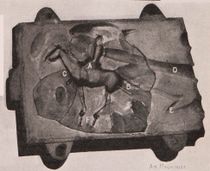
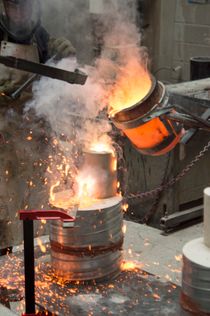
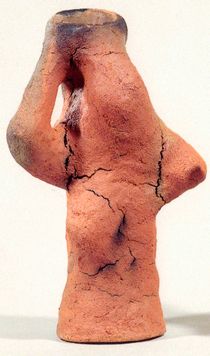
A three-dimensional negative form made of one or more parts that serves as a matrix for the production of a positive by casting or pressing malleable material into it. Molds allow for the production of one or more copies of an original sculpture.
Note: Molds of varying types may be used at different stages of the casting process (e.g., to make a , a wax , or , or to a bronze). See I.1.
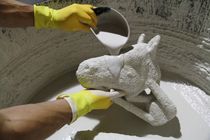 Open viewer
Figure 7
Open viewer
Figure 7
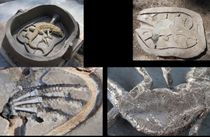 Open viewer
Figure 27
Open viewer
Figure 27
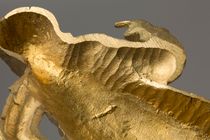 Open viewer
Figure 101
Open viewer
Figure 101
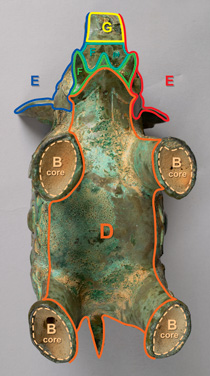 Open viewer
Figure 112
Open viewer
Figure 112
 Open viewer
Figure 542
Open viewer
Figure 542
 Open viewer
Figure 549
Open viewer
Figure 549
 Open viewer
Figure 557
Open viewer
Figure 557
Sources
Cultural Heritage: Bassett, Jane, and Peggy Fogelman. 1997. Looking at European Sculpture: A Guide to Technical Terms. Los Angeles: J. Paul Getty Museum in collaboration with the Victoria and Albert Museum.; Beale, Arthur. 1975. “A Technical View of Nineteenth-Century Sculpture.” In Metamorphoses in Nineteenth-Century Sculpture, 28–55. Cambridge, MA: Harvard University Press.
Art and Craft Textbook: Reliance Foundry. n.d. “Foundry Glossary.” https://www.reliance-foundry.com/castings/glossary-casting.
General Dictionary: https://www.merriam-webster.com/dictionary/mold [definiton 1a(1)]
Synonym
- mould (UK spelling)
Translations
French:
moule
Terme générique désignant toute forme en creux destinée à la production d’une forme en positif. Plusieurs types de moules faits de matières différentes (plâtre, argile, sable, silicone, etc.) peuvent intervenir dans la fabrication des différents voire des précédant la sculpture en bronze.
Note: Dans l’industrie moderne, le moule désigne généralement le .
Sources
Cultural Heritage: Baudry, Marie Thérèse, and Dominique Bozo. 1978. La sculpture: Méthode et vocabulaire. Principes d’analyse scientifique. Paris: Impr. nationale., 562
Copper Industry: Cuénin, Pierre. 1994. “Moulage – noyautage.” Techniques de l’ingénieur fonderies et moulages: aspects généraux TIB352DUO (m3512). https://www.techniques-ingenieur.fr/base-documentaire/materiaux-th11/fonderies-et-moulages-aspects-generaux-42352210/moulage-noyautage-m3512/., 5
Historical: Boffrand, Germain. 1743. Description de ce qui a été pratiqué pour fondre en bronze d’un seul jet la figure équestre de Louis XIV, élevée par la ville de Paris dans la place de Louis le Grand, en 1699. Paris: Guillaume Cavelier. https://archive.org/details/gri_33125010863229/page/n3., 17–20; Mariette, Pierre-Jean. 1768. Description des travaux qui ont précédé, accompagné et suivi la fonte en bronze d’un seul jet de la statue équestre de Louis XV, le Bien-Aimé, dressée sur les mémoires de M. Lempereur. Paris: Imprimerie de P. G. Le Mercier. https://archive.org/details/gri_33125010908289/mode/2up., 27–35; Diderot, Denis, Jean le Rond d’Alembert et al. 1751. Encyclopédie; ou Dictionnaire raisonné des sciences, des arts et des métiers. 17 vols. Paris: Briasson. http://enccre.academie-sciences.fr/encyclopedie/., 2:436–39, entry « bronze »
Art and Craft Textbook: Lambert, Daniel. 2002. Moulage et fonderie d’art: Du modèle au bronze final. Dourdan, France: Vial., 272
Alternate Translation
-
creux
Source: Cultural Heritage: Baudry, Marie Thérèse, and Dominique Bozo. 1978. La sculpture: Méthode et vocabulaire. Principes d’analyse scientifique. Paris: Impr. nationale., 759
German:
Form / Negativform
Source
Müller, Stephanie, ed. 2014. Gebrochener Glanz: römische Großbronzen am UNESCO-Welterbe Limes. Mainz, Germany: Nünnerich-Asmus, 170–71
Alternate Translations
-
Negativformteile
-
Hilfnegative
Italian:
calco
Sources
“Treccani - La Cultura Italiana - Enciclopedia.” n.d. Accessed April 4, 2023. https://www.treccani.it/enciclopedia/., under calco [definition 1]; Battaglia, S. 1961. Grande dizionario della lingua italiana. Edited by Giorgio Bárberi Squarotti. Turin, Italy: Unione tipografico-editrice torinese. http://www.gdli.it/., under calco [definition 1, vol. 2, 529]
Alternate Translations
-
cavo
General term for a negative impression, or hollow; Cellini uses it as “cavo di gesso,” which is specifically a mold of plaster.
Source: Cellini, Benvenuto. (1568) 1983. Due Trattati: Uno Intorno Alle Otto Principali Arti Dell’oreficeria: L’altro in Materia Dell’arte Della Scultura, Dove Si Veggono Infiniti Segreti Nel Lavorar Le Figure Di Marmo, & Nel Gettarle Di Bronzo. Edited by Antonio Altomonte. Modena: Edizioni Aldine., 11, fols. 45v–46
-
forma
General and also mold
Sources: “Treccani - La Cultura Italiana - Enciclopedia.” n.d. Accessed April 4, 2023. https://www.treccani.it/enciclopedia/., under forma [definition 6]; Biringuccio, Vannoccio. (1540) 1977. De la pirotechnia. Edited by Adriano Carugo. Milano: Edizioni Il Polifilo., fols. 77v, 80v; Bruni, Francesco. 1994. La fusione artistica a cera persa. Venezia-Marghera: Edizioni Arte., 85–86
-
stampo
General term for an impression
Source: “Treccani - La Cultura Italiana - Enciclopedia.” n.d. Accessed April 4, 2023. https://www.treccani.it/enciclopedia/., under stampo [definition 2c]
Chinese: 范
Source
Zhang Changping et al. | 张昌平. 2010. “二里冈文化至殷墟文化时期青铜器范型技术的发展 = Development of Clay Mold-Making Technology for Bronze Casting from Erligang Culture to Yinxu Culture.”考古 = Kaogu 8:79–86. Republished in English in Chinese Archaeology 11 (2011): 148–54.