See figs. 5, 13, 557, 558.
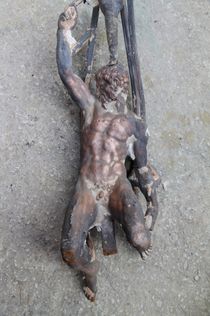
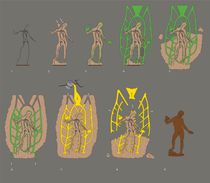
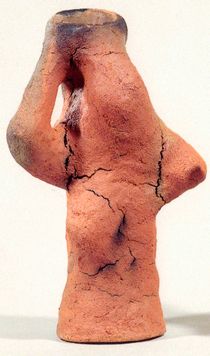
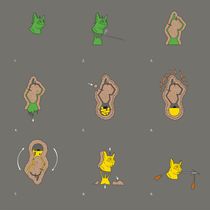
The term can refer to the used in the process or to the material used to make that mold. It also denotes the process of coating or embedding the wax in this material and is applicable to clay-based, plaster-based, and ceramic shell molds. In all of these, the first layers have a special, fine consistency that is designed to pick up the detail and avoid problems during casting; the later layers are coarser. Clay-based investment may also be referred to as “loam.” The investment is destroyed to free the case .
Sources
Cultural Heritage: Motture, Peta. 2019. The Culture of Bronze: Making and Meaning in Italian Renaissance Sculpture. London: V&A Publishing., 35; Salter, C. J., and B. J. J. Gilmour. n.d. “Glossary of Terms Used in the Study of Ancient Metal-Working and Associated Processes.” Materials Science-Based Archaeology Group, Department of Materials, University of Oxford.
Art and Craft Textbook: Untracht, Oppi. 1982. Jewelry: Concepts and Technology. London: Robert Hale.
Translations
French:
moule de potée
Terme réservé à la . Désigne la partie externe du , qui peut être à base de plâtre ou d’argile, notamment.
Note: La potée désigne le mélange argileux servant -à l’origine- à fabriquer le moule (Félibien, André. 1690. Des principes de l’architecture, de la sculpture, de la peinture et des autres arts qui en dépendent: Avec un dictionnaire des termes propres à chacun de ces arts. 2nd ed. Paris: Chez la veuve de Jean Baptiste Coignard et Chez Jean Baptiste Coignard fils. https://archive.org/details/principesdelarch00fl., 327; Lambert, Daniel. 2002. Moulage et fonderie d’art: Du modèle au bronze final. Dourdan, France: Vial., 216), mais peut aussi parfois désigner le moule réfractaire (Rama, Jean-Pierre. 1988. Le bronze d’art et ses techniques. Dourdan, France: Editions H. Vial., 375; Lambert, Daniel. 2002. Moulage et fonderie d’art: Du modèle au bronze final. Dourdan, France: Vial., 274). En anglais, potée et moule de potée sont désignés par le même terme (investment).
Sources
Cultural Heritage: Baudry, Marie Thérèse, and Dominique Bozo. 1978. La sculpture: Méthode et vocabulaire. Principes d’analyse scientifique. Paris: Impr. nationale., 625; Bewer, Francesca G., David Bourgarit, and Jane Bassett. 2008. “Les bronzes français (XVIe–XVIIIe siècle): Notes techniques.” In Bronzes français de la Renaissance au Siècle des lumières, edited by Geneviève Bresc-Bautier and Guilhem Scherf, 28–41. Paris: Musée du Louvre, Somogy.
Historical: Boffrand, Germain. 1743. Description de ce qui a été pratiqué pour fondre en bronze d’un seul jet la figure équestre de Louis XIV, élevée par la ville de Paris dans la place de Louis le Grand, en 1699. Paris: Guillaume Cavelier. https://archive.org/details/gri_33125010863229/page/n3., 44–46; Diderot, Denis, Jean le Rond d’Alembert et al. 1751. Encyclopédie; ou Dictionnaire raisonné des sciences, des arts et des métiers. 17 vols. Paris: Briasson. http://enccre.academie-sciences.fr/encyclopedie/., 2:436–43, entry « bronze terme de fonderie »; Mariette, Pierre-Jean. 1768. Description des travaux qui ont précédé, accompagné et suivi la fonte en bronze d’un seul jet de la statue équestre de Louis XV, le Bien-Aimé, dressée sur les mémoires de M. Lempereur. Paris: Imprimerie de P. G. Le Mercier. https://archive.org/details/gri_33125010908289/mode/2up., 79–84
Art and Craft Textbooks: Rama, Jean-Pierre. 1988. Le bronze d’art et ses techniques. Dourdan, France: Editions H. Vial., 260; Lambert, Daniel. 2002. Moulage et fonderie d’art: Du modèle au bronze final. Dourdan, France: Vial., 216
Alternate Translations
-
(Terme non univoque.)
Sources: Copper Industry: Association Technique de Fonderie, Commission Ingénieurs et Techniciens. 1979. Dictionnaire idéologique de fonderie / Indexed Foundry Dictionary / Systematisches Giessereiwörterbuch. Meudon: Techniques des industries de la Fonderie.; Historical: Félibien, André. 1690. Des principes de l’architecture, de la sculpture, de la peinture et des autres arts qui en dépendent: Avec un dictionnaire des termes propres à chacun de ces arts. 2nd ed. Paris: Chez la veuve de Jean Baptiste Coignard et Chez Jean Baptiste Coignard fils. https://archive.org/details/principesdelarch00fl., 329
-
moule de coulée
Sources: Cultural Heritage: Rolley, Claude. 1994. La sculpture grecque. Vol. 1, Des origines au milieu du Ve siècle. Les manuels d’art et d’archéologie antiques. Paris: Picard., 69; Mille, Benoît, and Dominique Robcis. 2012. “Le cas des grands bronzes antiques. Etudier pour restaurer ou restaurer pour étudier?” In La restauration des peintures et des sculptures. Connaissance et reconnaissance de l’œuvre, edited by Pierre-Yves Kairis, Béatrice Sarrazin, and François Trémolières, 101–15. Paris: Armand Colin.; Azéma, Aurélia, and Benoît Mille. 2013b. “Un point sur la technique de fabrication des grands bronzes antiques.” L’actualité chimique 377:43–44.; Historical: Gonon, E. 1876. “L’art de fondre en bronze à cire perdue.” Paris. https://inha.revues.org/3522., 6; Art and Craft Textbook: Dubos, Jean. 2003. “Fondeur d’art Aujourd’hui.” Techné 18:49–56.
-
potée
Art and Craft Textbooks: Rama, Jean-Pierre. 1988. Le bronze d’art et ses techniques. Dourdan, France: Editions H. Vial., 375; Lambert, Daniel. 2002. Moulage et fonderie d’art: Du modèle au bronze final. Dourdan, France: Vial., 274
German:
Formmantel
Source
Alscher, Ludger, ed. 1987. Lexikon der Kunst: Architektur, Bildende Kunst, Angewandte Kunst, Industrieformgestaltung, Kunsttheorie. Vol. 1. Leipzig, Germany: E. A. Seemann., 554
Alternate Translation
-
Gussmantel
Source: Maaz, Bernhard. 2010. Skulptur in Deutschland zwischen französischer Revolution und erstem Weltkrieg. Berlin and Munich: Deutscher Kunstverlag., 706
Italian:
forma
The variety of terms is due to regional differences in foundry terminology. Forma is the total of all layers of investments ready to cast. Camicia or tunica are the first fine refractory clay layer applied directly on the wax. Mantello or cappa are the second, coarser layer, often made of refractory clay, thick cloths, or iron belts to help contain the pressure developing during the . See .
Sources
Morigi, Giovanni. 1990. Fusione a cera persa con tecnica parzialmente indiretta. Tecnica impiegata nei bronzi a tutto tondo della Fontana del Nettuno di Giambologna, 1566. Bologna, Italy: Commune di Bologna, Assessorato alla cultura., quaderni di restauro, vols. 1–3; Pecchioli, Roberto. 1999. “Indagine radiografica sulla statua in bronzo da Punta del Serrone (Brindisi).” In I grandi bronzi antichi: Le fonderie e le tecniche di lavorazione dall’età arcaica al rinascimento: Atti dei Seminari di Studi ed Esperimenti, Murlo 24–30 luglio 1993 e 1–7 luglio 1995, edited by Edilberto Formigli, 191–202. Siena, Italy: Nuova Immagine., 193; Leonardo da Vinci. 1490. The Madrid Codices. Translated by L. Reti. New York: McGraw-Hill., fols. 154v, 142v; Biringuccio, Vannoccio. (1540) 1977. De la pirotechnia. Edited by Adriano Carugo. Milano: Edizioni Il Polifilo., fols. 77v–78
Alternate Translations
-
camicia
Literally “shirt”
Source: Biringuccio, Vannoccio. (1540) 1977. De la pirotechnia. Edited by Adriano Carugo. Milano: Edizioni Il Polifilo., fol. 95
-
cappa
Layer of the
-
chappa
Early Tuscan spelling of cappa
Source: Leonardo da Vinci. 1490. The Madrid Codices. Translated by L. Reti. New York: McGraw-Hill., fol. 156v
-
mantello (di fusione)
Used in the way defined here under the long entry “fusione” for the casting of bells under the paragraph “formatura” in Treccani
Sources: “Treccani - La Cultura Italiana - Enciclopedia.” n.d. Accessed April 4, 2023. https://www.treccani.it/enciclopedia/., under mantello (di fusione); Carruba, Anna Maria. 2006. La Lupa capitolina: Un bronzo medievale. Rome: De Luca., 24; Formigli, Edilberto, and Nele Hackländer. 1999. “Resocento della ricostruzione sperimentale di una fossa di fusione ellenistica e della cottura du un modello dell’adorante di Berlino.” In I grandi bronzi antichi: le fonderie e le tecniche di lavorazione dall’età arcaica al rinascimento: atti dei Seminari di Studi ed Esperimenti, Murlo 24–30 luglio 1993 e 1–7 luglio 1995, edited by Edilberto Formigli, 299–316. Siena, Italy: Nuova Immagine., 301
-
refrattario
Refers to the investment material and investment mold
Source: Bruni, Francesco. 1994. La fusione artistica a cera persa. Venezia-Marghera: Edizioni Arte., 75
-
terra da forme
Refers to the investment material
Source: Biringuccio, Vannoccio. (1540) 1977. De la pirotechnia. Edited by Adriano Carugo. Milano: Edizioni Il Polifilo., fols. 76v, 80v
-
tunica
Tonaca di terra, and even more often: involucro
Source: “Treccani - La Cultura Italiana - Enciclopedia.” n.d. Accessed April 4, 2023. https://www.treccani.it/enciclopedia/., under tunica
Chinese: 熔模
Alternate Translations
-
熔模材料
Source: Ming Juxin | 明举新. 2001. 汉英冶金工业词典 = Han ying yejin gongye cidian = A Comprehensive Chinese-English Dictionary of Metallurgical Industry. 3rd ed. 长沙市: 中南大学出版社 = Changsha shi: Zhongnan daxue chuban she [Zhong Nan University Press]., 1214
-
耐火材料
Sources: Ming Juxin | 明举新. 2001. 汉英冶金工业词典 = Han ying yejin gongye cidian = A Comprehensive Chinese-English Dictionary of Metallurgical Industry. 3rd ed. 长沙市: 中南大学出版社 = Changsha shi: Zhongnan daxue chuban she [Zhong Nan University Press]., 1036; Hua Jueming |华觉明. 2013. “技术史的研究方法——以失蜡法学案为例 = Research Methodology for History of Technology: Using Lost-Wax Casting as an Example.” 自然科学史研究 = Studies in the History of Natural Sciences 32 (3): 347–59. https://www.ixueshu.com/document/214c9856c461100728794d8529613e51318947a18e7f9386.html., 347