Chicago
Mechling, Mathilde, and David Bourgarit. “Case Study 4. The Technical Investigation of Eighth-, Ninth-, and
Tenth-Century Statuettes from Indonesia.” In
Guidelines for the Technical Examination of Bronze
Sculpture, by David Bourgarit, Jane Bassett, Francesca G. Bewer, Arlen
Heginbotham, Andrew Lacey, and Peta Motture. Los Angeles: J.
Paul Getty Museum, 2025.
https://www.getty.edu/publications/bronze-guidelines/case-studies/4/.
MLA
Mechling, Mathilde, and David Bourgarit. “Case Study 4. The Technical Investigation of Eighth-, Ninth-, and
Tenth-Century Statuettes from Indonesia.”
Guidelines for the Technical Examination of Bronze
Sculpture, by David Bourgarit et al., J. Paul Getty Museum, 2025,
https://www.getty.edu/publications/bronze-guidelines/case-studies/4/.
Accessed
DD Mon. YYYY.
Case Study 4. The Technical Investigation of Eighth-, Ninth-, and
Tenth-Century Statuettes from Indonesia
Mathilde Mechling
David Bourgarit
Introduction
(figs. 504, 505, 506, 507, 508)
The technical study of a group of thirty-nine statuettes
in the collection of the Musée national des arts
asiatiques – Guimet, Paris, was the first comprehensive
examination undertaken of Hindu and Buddhist
bronzeDefinition: bronze: Depending on the user,
“bronze” may designate a copper alloy that has tin
as the primary added element or any other
copper-based alloy. We recommend using the term
“bronze” specifically for copper-tin alloys unless
qualified by another …More
statues from Indonesia. The wide array of visual and
analytic methods utilized has provided a preliminary
characterization of Indonesian bronze casting
traditions. In addition, the study probed the possible
exchange in technical know-how between the Indonesian
islands and other regions of South and Southeast Asia,
previously suggested on the grounds of stylistic
connections. The research was part of a PhD project on
Indonesian bronze sculpture combining traditional art
historical research with technical studies.
The main questions
Is there consistency in technical features such as
the facture and alloy composition of Indonesian
bronze statuary? If so, how distinctive are these
features?
Is it possible to refine the stylistic and
chronological grouping of these objects by taking
technical features into consideration?
Given the stylistic connections found within bronze
statuary across multiple regions of Asia, might
there also be connections in their material and
casting features?
Casting technique
Lost-wax casts with numerous wax assemblies
(figs. 67, 54)
Naked-eye observation of the statuettes provides
evidence that they were made by the
lost-wax castingDefinition: lost-wax casting: A technique in
which a model made of wax is embedded in a
refractory mold that is heated, thereby melting out
the wax and creating a void to be filled with molten
metal. Two primary variations of the technique are
referred to as “direct” …More
technique. This is evident in the general nature of the
modeling, and in particular in the decorative elements
on the outer surface, whose undercuts suggest direct
modeling.
And close examination of the hollow interior surfaces
provides incontrovertible evidence that the figures were
affixed to their pedestals before casting and that the
bases were constructed from separately assembled wax
sections: the uneven ridges at the level of the lotus
blossoms and base are wax-to-wax joints.
Solid-cast figures
(figs. 126, 510)
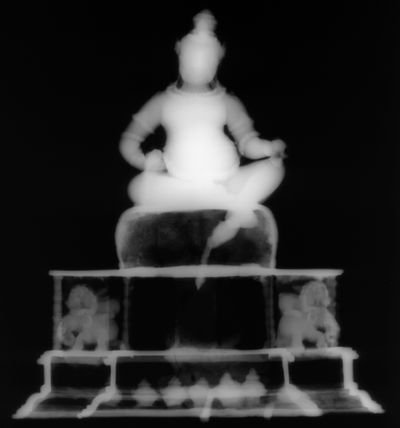
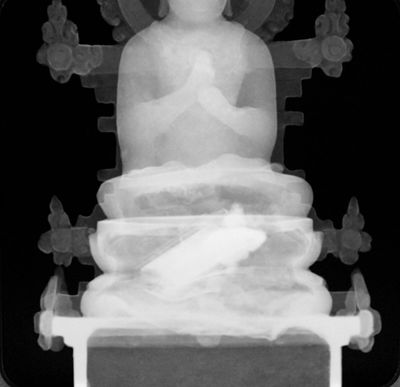
The X-radiographs confirm that the figurines, including
the largest ones (30 cm tall) are mostly solid, with
open pedestals.
ExpandFigure 510X-radiograph of frontal view.
Statuette of Jambhala, central Java, first
half of the 9th century, H. 28 cm (Musée national
des arts asiatiques – Guimet, Paris, inv. MG 3814).
See Mechling et al. 2018.
Cold work
(figs. 276, 511)
Naked-eye and microscopic observation of the outer
surfaces of many of the statuettes found crisply defined
decorative details and textures that are characteristic
of cold working of the metal. (Exactly how much detail
was already present in the wax
modelDefinition: model: The creation of a bronze
may involve a series of models and molds that can
differ in size and material depending on the
artist’s design process, and ultimately also on the
casting process chosen to create the bronze version.
The model is a …More
is hard to say.)
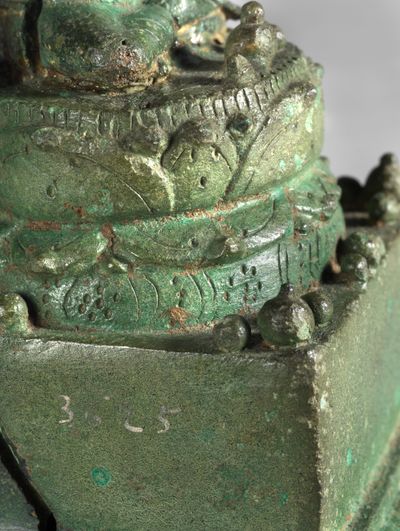
ExpandFigure 511Detail showing engraving and punch marks.
Kubera/Jambhala, Java, first half of the
10th century, H. 18 cm (Musée national des arts
asiatiques – Guimet, Paris, inv. MG 3625). See
Mechling et al. 2018.
Engraving, as suggested by reflectance transformation
imaging (RTI)
(fig. 241)
Reflectance transformation imaging (RTI; see
II.2§2.3) allowed for close documentation and study of the
incised patterns. Under certain lighting conditions, the
interrupted, stepped pattern along the interior walls of
each incision was brought into relief. These are
characteristic of
engravingDefinition: engraving: In relation to bronzes,
the process of decorating the surface by removing
material with a chisel, burin, or graver that
creates a V-shaped groove.More, formed by successive strikes on the graver as it is
worked through the metal. The tapering ends of the
incised lines are also consistent with engraving.
Metal punching confirmed by digital microscopy
(figs. 285, 286)
Close examination of
punchDefinition: punch: A tool usually made of a
steel rod that may be struck with a hammer at one
end in order to create a pattern in the surface of
the sculpture with the other end by compressing the
metal.More
marks (0.8 mm diameter) by digital microscopy (see
II.2§2.1) revealed that the smooth, compressed surface
inflected by the punch and the dimple of displaced metal
around the edge resulted from cold working. In addition,
on one statue, a 3D reconstruction of the dots and
consequently of the active part of the punch showed a
systematic defect in the sphere, clearly testifying to
the use of the same tool for all the motifs
investigated.
ExpandFigure 285Digital microscopy detail of a punch mark (0.8 mm
in diameter) on the lotus of a Buddha Vairocana.
Note the smooth, compressed surface produced by the
punch and the ridge of displaced metal around the
edge. Buddha Vairocana, Indonesia, first
half of the 10th century, H. 12 cm (Musée national
des arts asiatiques – Guimet, Paris, inv. MA 3475).
See Mechling et al. 2018.
Metal engraving over preparatory drawing on wax
confirmed by digital microscopy
(figs. 273, 512)
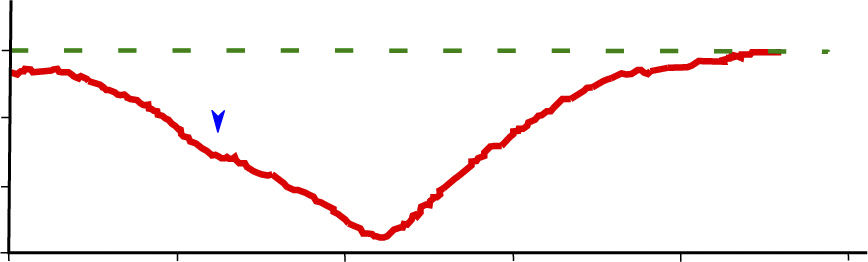
Digital microscopy was used to map the topography of
various tool marks. The indented lines on several
statuettes showed the V profiles and slightly raised
edges (or burrs) along the tops characteristic of
engraved rather than punch marks. In some instances, the
presence of two lines very close to each other may
testify to a preparatory drawing on the wax model.
ExpandFigure 512Profile of an engraving made in the metal on the
front piece of the cloth of the
Statuette of Jambhala, as measured by
digital microscopy. The vertical axis reports the
depth and the horizontal axis the width of the
engraving (both in µm). The surface of the bronze is
represented by the horizontal green dotted line. The
cross section of the engraving and its dimensions
are represented by the red curve. The maximum depth
appears to be ~0.6 mm (600 µm), and the width at the
surface is ~2 mm (2000 µm). See the altered V shape
of the imprint (blue arrow), which demonstrates that
the engraving in the metal was made by following a
line already in the wax model.
Statuette of Jambhala, central Java, first
half of the 9th century, H. 28 cm (Musée national
des arts asiatiques – Guimet, Paris, inv. MG 3814).
See Mechling et al. 2018.
Concealed offerings revealed
Cavities filled with dense material
(fig. 513)
X-radiography has revealed in a number of statuettes a
cavity extending from the top of the base up into the
legs and the abdomen of the deity. This cavity is filled
with a denser material than the metal of the statuette,
making that area more radio-opaque (and consequently
whiter in the film) and effectively masking all
structural details. X-ray fluorescence analysis (XRF;
see
II.5§2.1) of the embedding alloy on several statuettes revealed
them to be tin-based with smaller amounts of lead
(90–95wt% tin, 5–10wt% lead). Such
low-melting-temperature alloys are very radio opaque
(i.e., difficult for X-rays to penetrate).
Consecration deposits visible from underside
(figs. 54, 514)
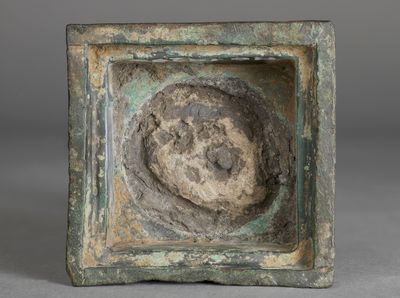
In one of the statuettes, damage to the pedestal
resulted in the partial loss of the metal fill. One can
catch a glimpse of what remains embedded in the
remaining metal matrix: several folded metal foils, the
rim of a silver coin, a stone bead, and several more
unidentified objects. These constitute a deposit to
consecrate the statue before it could be used for
worship. Such addition of a consecration deposit
embedded in a metal matrix would have been a common
feature within the group of statuettes studied, though
today few of these objects preserve their interior
contents. Might there be a way to learn more about these
hidden contents without further disrupting them?
ExpandFigure 514Bottom view showing areas of the preserved
conservation deposits poking out of the metal fills.
Vairocana, Java, first half of the 10th
century, H. 15.5 cm (Musée national des arts
asiatiques – Guimet, Paris, inv. MG 18290). See
Mechling et al. 2018.
Consecration deposits revealed by neutron radiography
and tomography
(figs. 401, 404, 403, 516)
Access to a neutron reactor allowed for the neutron
radiography and tomography (see
II.3§3) of several Javanese sculptures that still preserved
their consecration materials embedded in metal matrices.
This works because metals such as copper, tin, and lead
may be X-ray opaque, but they are relatively transparent
to neutrons.
ExpandClick and drag to rotateFigure 403Neutron radiography. This series of thirty-seven
neutron radiographs was made as the sculpture was
rotated through 180° on a turntable. Most
consecration offerings (coins, beads, folded metal
sheet) can be observed (white shapes under the
seat). Vairocana, Java, first half of the
10th century, H. 15.5 cm (Musée national des arts
asiatiques – Guimet, Paris, inv. MG 18290). See
Mechling et al. 2018.
The resulting images clarified the shape and location of
the interior contents. Among other things, they enabled
researchers to identify the typically Javanese
piloncito-type cubic coins. Neutron radiography
does not, however, allow for the precise
characterization of materials that these consecration
deposits were made of.
ExpandFigure 516Annotated neutron radiograph of side view, showing
more clearly than the X-radiograph (fig. 515) the contours of the sealing material (red
overlay) and some of the consecration offerings. For
an even better visualization of the consecration
offerings, see tomographic images of a related
figure (figs. 403,
404). Kubera/Jambhala, Java, first half of
the 10th century, H. 18 cm (Musée national des arts
asiatiques – Guimet, Paris, inv. MG 3625). See
Mechling et al. 2018.
Alloy composition
Bulk metal
(fig. 517)
Inductively coupled plasma atomic emission spectrometry
(ICP-AES; see
II.5§3.1) analysis of the bulk metal composition of the bronzes
revealed that most of the thirty-nine statues analyzed
are made of unleaded bronze alloys—copper-tin alloys
with less than 2–3wt% lead (Pb). Zinc (Zn) is present
only in traces. With some variations, median values for
each time period are higher than 8wt%. Nine statues have
relatively high (12–20wt%) tin (Sn) content.
Impurities in the metal
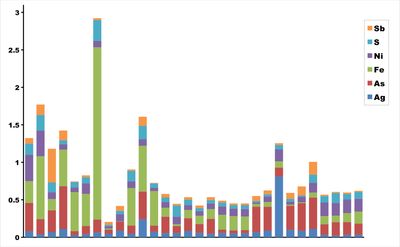
(fig. 518)
ICP-AES allowed us to determine that the main impurities
found in these alloys are silver (Ag), arsenic (As),
iron (Fe), nickel (Ni), sulfur (S), and antimony (Sb).
Summary of findings
Consistent features of Indonesian production
(figs. 504, 505, 506, 507, 508)
In all of the Indonesian statues investigated, even the
largest ones, the figures themselves are mostly solid.
All were made via lost-wax casting, with extensive
modeling and assembling work on the wax. All were
originally likely consecrated with sacred objects, and
therefore have a cavity in the supporting pedestal or
cushion.
The systematic use of a liquefied metal, namely a
tin-based alloy, to seal the consecration deposits
constitutes another consistent feature of Indonesian
production. Copper-based sheets hammered over the base
are often encountered for Buddhist statues in other
regions, notably in Tibet (Reedy 1991aReedy, Chandra L. 1991a. “The Opening of
Consecrated Tibetan Bronzes with Interior Contents :
Scholarly, Conservation and Ethical Considerations.”
Journal of the American Institute for
Conservation
30 (1): 13–34.) and China (figs. 225,
226).
Most statues are made of unleaded tin-bronze, with
relatively high levels of tin. This is not very
surprising given the vast and accessible resources of
the Southeast Asian tin belt, running from central Burma
down the Thai-Malay Peninsula to Bangka Island east of
Sumatra, in the Indonesian archipelago.
Toward a chronological and stylistic serialization
supported by metal composition
(figs. 518, 519)
Despite the common technical features apparent in the
whole study group, the lowest levels of tin were found
exclusively in the statues attributed to the first half
of the ninth century. Tin content increased markedly in
the statues attributed to the early tenth century,
despite several exceptions to the rule. Some periods are
marked by very specific and homogeneous alloy
composition and impurity patterns. This is particularly
true for two groups, namely the group attributed to the
second half of the ninth century and the group
attributed to the early tenth century.
ExpandFigure 518Main impurities in the metal of the Javanese
statuettes from the Musée national des arts
asiatiques – Guimet, Paris. One bar represents one
statuette, sorted by chronological group (wt%,
ICP-AES analysis on drillings). See Mechling et al.
2018.
Alloy connections between Java and mainland Southeast
Asia
(figs. 509, 521, 522)
The high tin content may pertain to technical
connections with contemporaneous casting traditions in
mainland Southeast Asia, namely the Mon culture of
Dvāravatī in central and northeast Thailand (notably the
Prasat Hin Khao Plai Bat II bronzes in Buriram
province). High-tin bronze alloys are also found in the
Khmer bronze-casting tradition for objects from various
periods (the first to the tenth century). Conversely,
coeval bronze statuary from the Indian subcontinent
shows much lower tin content, except some examples from
Sri Lanka (Polonnaruwa) and northeast India (Nalanda).
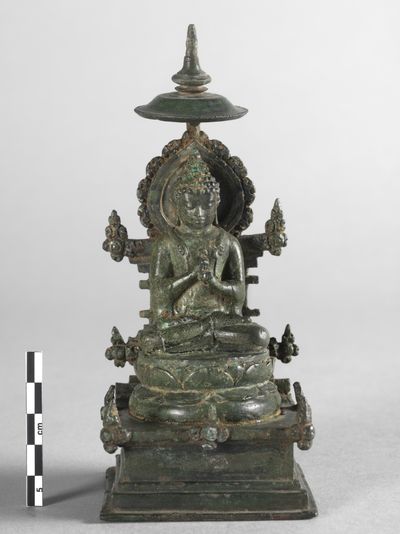
ExpandFigure 509Front view. Vairocana, Java, first half of
the 10th century, H. 15.5 cm (Musée national des
arts asiatiques – Guimet, Paris, inv. MG 18290). See
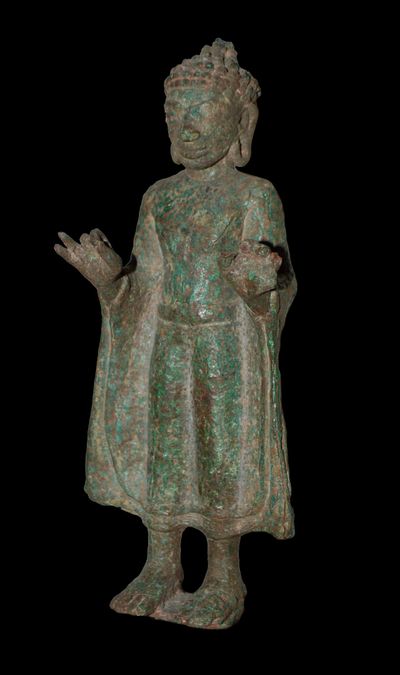
Mechling et al. 2018.ExpandFigure 521Example of a Thai statuette cast in an unleaded
high-tin bronze (16wt% Sn, 0.4wt% Pb, ICP-AES
analysis). Buddha in Vitarkamudrā, Mon
culture of Dvāravatī, central Thailand, 7th–8th
century, H. 19 cm (Musée national des arts
asiatiques – Guimet, Paris, inv. MA 3785). See
Bourgarit et al. 2003; Mechling et al. 2018.
Characterization of consecration deposits thanks to
neutron tomography
(fig. 401)
Neutron tomography has proven a successful
nondestructive technique to learn more about the
consecration deposits sealed inside the statuettes. Such
deposits are important archaeological artifacts and
indicators of the ritualistic rules overlaying the
creation and use of these religious images. Few of the
known contemporaneous statues from India or other parts
of Southeast Asia retain their consecration deposits,
but there is ample evidence that this practice was
widespread in Indonesia. Bronzes such as these also form
a crucial link with the later and better-documented
Tibetan tradition of consecrating Buddhist images.
Synopsis of technical parameters
This case study is based on a technical study carried
out by Mathilde Mechling in collaboration with David
Bourgarit and Brice Vincent as part of her PhD project
on Indonesian bronze sculpture. The examinations and
analyses were integrally carried out for free at the
C2RMF as a service provided to French museums, in this
case the Musée national des arts asiatiques – Guimet.
Neutron tomography was also carried out for free at
Reactor Orphée – Laboratoire Léon Brillouin, CEA-CNRS,
Paris, as a service for public research. Main operating
conditions are reported in
Mechling et al. 2018Mechling, Mathilde, Brice Vincent, Pierre Baptiste,
and David Bourgarit. 2018. “The Indonesian
Bronze-Casting Tradition: Technical Investigations
on Thirty-Nine Indonesian Bronze Statues (7th–11th
C.) from the Musée national des arts asiatiques –
Guimet, Paris.”
Bulletin de l’École française
d’Extrême-Orient
104:63–139.. For more on the analytical techniques, please refer
to volume II.
The approximate time required to carry out the whole
study, excluding publication, was more than sixty days.
The study involved:
daylight and UV photography: Anne Maigret (C2RMF)
digital microscopy: Mathilde Mechling (PhD
candidate), David Bourgarit and Dominique Robcis
(C2RMF)
X-radiography: Elsa Lambert (C2RMF)
neutron tomography: Frédéric Ott (CNRS-CEA)
bulk metal analysis by ICP-AES: Nathalie Gandolfo
and David Bourgarit (C2RMF)
XRF: David Bourgarit (C2RMF)
Further questions
Would comparative data from either similar objects
or copper and tin ore deposits make it possible to
determine the provenance of the metal?
Is there physical evidence pointing conclusively to
the use of either the direct or indirect process to
form the wax model?
Can the fabrication of the hosting cavity be further
elucidated?
Can it be determined whether the statuettes were
castDefinition: cast (v.): In the sculptural
context, the verb refers to pouring a slurry or
liquefied material (e.g., plaster, wax, metal)
into a hollow matrix or mold that will determine
the shape of the material in order to produce a
cast (n.).More
horizontally or vertically? Since horizontal casting
is known to have been utilized in South India, Sri
Lanka, and Tibet, is it a feature that might help to
determine intercultural exchanges?
Can a comprehensive quantification of tool marks
(depth and angle of the grooves) by digital
microscopy yield interesting clues regarding
know-how in certain workshops?
Can the identification of items in consecration
deposits serve as a means of tracing the regional
exchange of materials, and if so, can it be done
nondestructively, avoiding the deconsecration of the
religious image?
Further resources
Bordenave and Mirebeau 2018Bordenave, Aurélie, and Isabelle Mirebeau. 2018.
Diffusons les neutrons. Orphée, réacteur
nucléaire de recherche à Saclay = Let’s Scatter
Neutrons; Orphée, Nuclear Research Reactor in
Saclay.
Saclay, France: Laboraotoire Léon Brillouin
(CEA-CNRS).
https://fr.calameo.com/read/0056806668657b7f21394.
Fontein, Soekmono, and Suleiman 1971Fontein, Jan, R. Soekmono, and Sayawati Suleiman.
1971.
Ancient Indonesian Art of the Central and Eastern
Javanese Periods. New York: Asia Society.
Fontein, Soekmono, and Sedyawati 1990Fontein, Jan, R. Soekmono, and Edi Sedyawati. 1990.
The Sculpture of Indonesia. Washington, DC:
National Gallery of Art.
Le Bonheur 1971Le Bonheur, Albert. 1971.
La sculpture indonésienne au Musée Guimet.
Paris: Presses universitaires de France
Lohuizen-de Leeuw 1984Lohuizen-de Leeuw, J. E. van. 1984.
Indo-Javanese Metalwork. Stuttgart,
Germany: Linden-Museum.
Lunsingh Scheurleer and Klokke 1988Lunsingh Scheurleer, Pauline, and Marijke J.
Klokke, eds. 1988.
Divine Bronze: Ancient Indonesian Bronzes from AD
600 to 1600.
Leiden, the Netherlands: Brill.
Mechling et al. 2018Mechling, Mathilde, Brice Vincent, Pierre Baptiste,
and David Bourgarit. 2018. “The Indonesian
Bronze-Casting Tradition: Technical Investigations
on Thirty-Nine Indonesian Bronze Statues (7th–11th
C.) from the Musée national des arts asiatiques –
Guimet, Paris.”
Bulletin de l’École française
d’Extrême-Orient
104:63–139.
Reedy 1991aReedy, Chandra L. 1991a. “The Opening of
Consecrated Tibetan Bronzes with Interior Contents :
Scholarly, Conservation and Ethical Considerations.”
Journal of the American Institute for
Conservation
30 (1): 13–34.