This chapter briefly presents the different methods currently available for dating a sculpture. These methods generate an estimated age based on physical changes in the material that occur due to aging. Date estimates can also be made by comparing technical characteristics of a bronze sculpture to those of securely attributed examples, or through knowledge of the date when certain technological developments occurred; these relative dating methods are discussed throughout volume I.
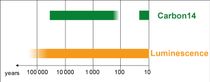
Two dating techniques are suitable for the study of bronze sculpture: trapped-charge dating, including thermoluminescence (TL) and optically stimulated luminescence (OSL), and radiocarbon dating. Of these methods, trapped-charge methods have seen the most use, although even they are infrequently applied. In both cases, it is not the copper alloy itself that is dated, but rather the material and/or the iron , almost always from the sculpture’s interior. These methods are thus restricted, with rare exceptions, to hollow sculpture that retains original core and/or iron armature. The main characteristics of both methods are presented in figure 433 and table 10 Open viewer.
Before embarking on trapped-charge or radiocarbon dating, confirm that the planned analysis is likely to yield a result with sufficient precision to answer the questions at hand. Neither method is highly precise, so other methods of estimating date (based on fabrication techniques, materials, historical sources, et cetera) may be equally advantageous, depending on the circumstances.
1 Trapped-charge dating: thermoluminescence (TL) and optically stimulated luminescence (OSL)
1.1 Basic scientific principles
Ambient radioactivity exists everywhere in the environment. Some minerals found in casting cores, notably quartz and feldspars, have the ability to store energy from ambient radioactivity in the form of free electrons that become trapped in nano-scale irregularities in the mineral’s crystal structure. The longer one of these minerals is exposed to radioactivity, the higher the stored energy or “accumulated dose.” When heated above 400°C (as happens to core material in contact with molten bronze at temperatures in excess of 900°C), a charge-trapping mineral releases its stored energy, and its accumulated dose is “zeroed out.” Therefore, the more time that has elapsed since a bronze was , the higher the accumulated dose of trapped energy in its core minerals.
Analytical techniques allow the accumulated dose to be measured and the date of last high temperature exposure to be roughly calculated. When stimulated by heat or light, energy-trapping minerals can release their trapped energy in the form of light (luminescence); therefore, a measurement of the amount of luminescence produced by a sample upon stimulation serves as a measure of the amount of trapped energy in the minerals. This, in turn, can be correlated to the amount of time that has passed since casting—or, more precisely, since the minerals were last zeroed out by heat or light.
Two measuring techniques are available. Either the sample is heated to stimulate luminescence—called thermoluminescence (TL)—or the sample is illuminated with single-wavelength laser light—called optically stimulated luminescence (OSL). When possible, it is advisable to measure both TL and OSL in order to reduce uncertainty. OSL offers a better reproducibility than TL but does not allow for discrimination between the unstable components of the signal (risk of under-evaluation). While all samples have a TL signal, the OSL is more rarely present.1
TL and OSL dating are, from an experimental point of view, extremely complex, with numerous potential opportunities for error. Samples must be meticulously prepared to isolate luminescent minerals. Measurement of the luminescence is fairly straightforward, but converting a luminescence value to an estimated date is not. First of all, an estimate must be made of the annual dose of radiation that the sample has received during its lifetime. Much of the dose will have been delivered from minute quantities of radionucleotides (such as thorium 232, uranium 238, radium 226, and potassium 40) that are naturally present in the sample material itself. The dose rate from these sources can be measured directly from the sample, but the nature and intensity of other sources of radiation that may have impacted the sample throughout its history may be difficult to determine with certainty.
Once the estimated annual dose is determined, a prediction of the amount of energy that will be trapped per annum in a given sample depends on the energy trapping efficiency of the specific minerals present. This must be measured empirically, by repeatedly irradiating and measuring the prepared sample material using known dosages of radiation. Finally, the estimated age may be determined by calculating the estimated dose received by the sample and dividing by the estimated annual dose.
1.2 Application to bronze sculpture
As mentioned, trapped-charge dating of bronze sculpture requires the presence of residual core material. The first dating of a bronze sculpture by luminescence was performed in the early 1970s.2 The dating method depends critically on the assumption that, during the fabrication process, the quartz- and/or feldspar-containing core was sufficiently heated to reset the signal (zero out the accumulated dose). Thus, only core material in close contact with the bronze surface (where the temperature has exceeded 400°C) can be dated.
Several special circumstances must be considered in trapped-charge dating for bronze sculpture:
-
Gypsum plaster cores often do not contain quartz or feldspar in sufficient quantity to be useful for standard TL or OSL dating. Research has been conducted on trapped-charge dating of geologic gypsum deposits,3 but this has not been applied to bronze core material.
-
Soil contamination is commonly present in the interior of archaeologically recovered sculpture and may be mistaken for core material, or mixed with it. The soil can often be dated, but in this case, the dated event corresponds to the last exposure of the minerals to light, and therefore to the burial of the sculpture, not its fabrication. (For specialists: experimental solutions may exist, such as single-crystal OSL.)
-
During the life of a bronze, exposure to fire or another heating event may set the accumulated energy to zero. The heating event is then dated instead of the sculpture’s fabrication.4
-
The metal wall of a bronze acts as a shield against external environmental radioactivity, which may reduce the annual radiation dose expected for the sample. This phenomenon is not encountered with ceramic materials and other sample types commonly dated by this method. For specialists: the gamma dose attenuation may be estimated by calculation5 or, if a dosimeter can be introduced inside the sculpture, by comparative measurements on the interior and exterior.
-
Since the method is based on the amount of ionizing radiation received, any exposure to an artificial source of radiation, for instance X-ray radiography, will cause the object to appear older than it is. Laboratory measurements have shown that an overestimation of the age of core material by as much as one thousand years is possible following radiography.6 It is generally not recommended to attempt dating an artwork that has previously been X-rayed.
1.3 Precision and accuracy
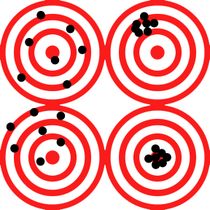
Broadly speaking, trapped-charge dating is an accurate method but not a precise one (fig. 413). For instance, the uncertainty of a TL or OSL date may be on the order of +/–140 years for a thousand-year-old object with 95% confidence. It is possible to reduce this uncertainty by increasing the number of measured samples, particularly where all the parameters are well characterized and measured. Recently, earth scientists have favored single-crystal OSL whereby each mineral grain from a sample is analyzed individually, allowing for a more nuanced interpretation of results.7
Artworks from museum collections are rarely sufficiently documented to enable precise estimation of the annual dose. In particular, the contribution due to the radioactivity from the environment is unknown; only the radioactivity from the object itself is measurable. As a consequence, for such artworks the uncertainty is often two to three times higher (a 95% confidence interval of +/–300 years for a thousand-year-old object).
1.4 Guidelines for sampling
To avoid disturbing the trapped-charge signal, samples for TL and OSL should be taken under photographic safelights.8 After judging the accessibility of the core for the sample, the surface of the core should be removed to a depth of 1–2 mm before taking the sample for analysis, preferably using a small tungsten carbide drill bit. If the residual core is less than 2 mm thick, dating may not be possible. The amount of powder required to carry out an analysis is about 100–200 mg, depending on the mineral composition of the core (an average-size black peppercorn weighs approximately 60 mg). Sampling can be difficult, particularly because the vibrations associated with drilling can unintentionally dislodge pieces of core. Vibration can be minimized by adjusting the speed of the drill. It is very important that the sample material be collected cleanly, without contamination. Working in enclosed spaces under dim safelight can make the entire process challenging.
1.5 Cost and availability
Several academic and private laboratories offer luminescence dating. Most laboratories are devoted to geological sediments; only a small number work with cultural heritage artifacts, and of these, most focus on archaeological materials. As of this writing, typical costs per analysis range from about US$300 to $1,000. The lowest prices generally correspond to simple “authentication tests,” which follow less robust calibration procedures and thus yield a larger uncertainty in the result. In a typical authentication test, only the trapped energy dose is measured. The inherent radioactivity of the sample material is not measured (although it determines the internal annual dose received by the sample). Instead, the expected annual radiation dose (and thus the age) is roughly estimated using typical mean values.
1.6. Risks of misinterpretation
Be aware that prior radiography can impact the results of trapped-charge dating, shifting the estimated date earlier than would be expected. This is primarily a concern if the sculpture has been radiographed repeatedly as part of a prior technical examination. Exposure to radiation for airport security screening or added cosmic radiation due to air travel will have a minor or negligible effect.
Samples taken for trapped-charge dating should be representative of the date of fabrication of the sculpture. For instance, insufficiently heated core (sampled from too far away from the metal wall) may yield ages much older than the fabrication of the sculpture; conversely, a core heated accidentally long after the fabrication of the statue (for instance by fire) will lead to a younger age. For suggestions on evaluating the condition and originality of core material, see II.7§3 and II.7§4.
2 Radiocarbon dating
2.1 Basic scientific principles
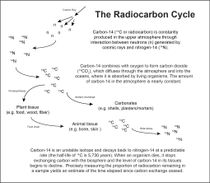
For more than fifty years, radiocarbon has been the most common dating method in archaeology. Covering a large period of time, from the beginning of the upper Paleolithic (about fifty thousand years ago) to the middle of the seventeenth century (fig. 433), it can be applied to a wide array of materials, provided they contain carbon. The dating principle is based on the radioactive decay of the carbon isotope with atomic weight 14 (carbon-14, or 14C), which is formed in the upper atmosphere by cosmic radiation interacting with atmospheric nitrogen (fig. 434). As carbon-14 is continuously formed and continuously decays at a nearly constant rate, a stable, though very small, amount of carbon-14 is present at equilibrium in the atmosphere in the form of carbon dioxide (CO2). Atmospheric carbon dioxide molecules are, in turn, incorporated into living organisms—plants and animals—throughout their lifetimes. When an organism dies, the assimilation of atmospheric carbon is interrupted, and thus the concentration of carbon-14 atoms in the organism’s tissue starts to decrease by radioactive decay; it loses half its radiogenic carbon every 5,730 years. By measuring the concentration of residual carbon-14 atoms in an organic biological sample, one can calculate an estimate of time elapsed since the tissue was formed. This is called the radiocarbon determination.
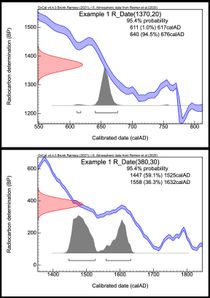
Complicating matters, minor natural fluctuations of carbon-14 production and distribution around the world and through time lead to discrepancies between radiocarbon determinations and true ages. As a result, radiocarbon determinations (reported in terms of years “before present,” or BP) must further be calibrated according to international calibration curves to obtain accurate calendar ages (fig. 435). These calibration curves are revised and refined on a regular basis.9
The advent of widespread coal burning led to a progressive reduction in the concentration of carbon-14 in the atmosphere due to the release of large amounts of fossil carbon, which is depleted in carbon-14. For this reason, carbon-14 dating becomes less and less precise after the early seventeenth century. The testing of thermonuclear weapons, beginning in the early 1950s and peaking in the early 1960s, produced large amounts of carbon-14 in the atmosphere, raising levels above the natural equilibrium state. This “bomb spike” is clearly detectable by radiocarbon dating.
For many years after its introduction in the late 1940s, radiocarbon dating was neglected in the study of art, mostly because of the large sample size required. In the last twenty-five years, the development of accelerator mass spectrometry (AMS) has allowed a drastic reduction in the amount of sample required. Whereas 5–10 g of charcoal or vegetal remains were necessary for conventional radiocarbon dating, today AMS requires only 2–5 mg to obtain a reliable date.
2.2 Application to bronze sculpture
2.2.1 Dating of organic material in the core
As far as bronze sculpture is concerned, additives to the core such as plant remains, fragments of wood, fiber, and charcoal may be present in casting core material. These materials, if they can be isolated in sufficient quantity, are suitable for radiocarbon dating, providing their age is contemporaneous with the fabrication date of the statue. On occasion, charcoal powder may have been used as a release agent on the surface of the casting core, and remnants of such material on the interior surface of the bronze sculpture have been used successfully for radiocarbon dating. The bulk of the core material (clay, sand, and/or gypsum plaster) is not suitable for radiocarbon dating.
2.2.2 Dating of iron components
Traditionally produced iron contains small amounts of carbon derived from the fuel used during the smelting process. This carbon is trapped in the microstructure of the metal in the form of cementite, or iron carbide (Fe3C). If the fuel source was charcoal (from recently cut wood), then the entrapped carbon can be usefully analyzed to estimate the iron’s date of production. If the fuel source was coke (a purified form of mineral coal, entirely depleted of carbon-14), then no useful date can be derived. Although coke or coal is known to have been used in metallurgy as long ago as ancient Roman times and in China at least as early as the eleventh century, the use of coke for iron smelting only became widespread beginning in the mid-eighteenth century in Britain.10 This means that iron armatures in sculptures produced prior to this time may be suitable for radiocarbon dating.
Radiocarbon dating of iron has been explored and tested since the 1960s.11 Over the years, a number of potential sources of contamination and interference have been identified that can make results unreliable.12 Since 2015, collaborative research between several units of the French National Centre for Scientific Research (CNRS) and the French Alternative Energies and Atomic Energy Commission (CEA) has resulted in an improved methodology that has gained wider acceptance for the dating of iron objects.13
2.3 Precision and accuracy
For cores and armatures, the final carbon-14 date is always given with an error correlated to both the experimental processes of sample preparation and measurement, and uncertainties associated with the subsequent calibration. Consequently, a radiocarbon age is better considered as an interval of time rather than a single date. The calibration process generates more or less large intervals of calendar ages—from eighty years to several centuries—depending on the period of time considered and the precision of the measurement (fig. 435).
2.4 Guidelines for sampling
2.4.1 Core sampling
Organic materials can be collected from the core matrix under a stereomicroscope using a scalpel and tweezers, then stored in aluminum foil pouches. Samples are then chemically cleaned at the radiocarbon laboratory with acid and alkali solutions to eliminate potential contaminants.14
2.4.2 Iron armature
Compared to organic materials, the carbon contents in bloomery iron are very low (<0.8wt% carbon). This considerably increases the sample size necessary to yield sufficient amounts of carbon for reliable dating. Furthermore, the carbon is often heterogeneously distributed within the metallic matrix, so a preliminary metallographic analysis of the sample is typically made to identify the areas containing the highest concentration of carbon.
Currently, standard practice is to extract at least one cubic centimeter of uncorroded iron for analysis. Sampling is usually executed using a thin diamond cutting wheel (0.6–1 mm thick; fig. 436) This sample should be examined metallographically and then resampled to yield 125–1000 mg (according to the carbon content in the metal) of iron drillings suitable for analysis.

2.5 Cost and availability
Carbon-14 dating of organic remains can be processed by any of several AMS radiocarbon laboratories for an average cost of approximately US $450 (discounts are sometimes available for nonprofit and academic institutions). For iron armatures, dating using the new methodology has thus far only been carried out as a collaboration between two laboratories, namely the Laboratoire Archéomatériaux et Prévision de l’Altération (LAPA-IRAMAT) and the Laboratoire de Mesure du Carbone 14 (LMC14-LSCE), following a comprehensive protocol that includes investigation of fabrication techniques and iron provenancing.
2.6 Risks of misinterpretation
When radiocarbon dating organic components of core material, it is very important to exclude any material that might have been introduced at a later date. In one cautionary example, fruit seeds deposited in the interior of a bronze sculpture by an animal led to erroneous radiocarbon dating.15 For suggestions on evaluating the condition and originality of core material, see II.7§4.
Be aware that if the sample material dates to the period between the early seventeenth century and the early 1950s, the precision of radiocarbon dating is likely to be very low.
Radiocarbon dating of iron armatures is not necessarily sufficient for an accurate dating of a bronze sculpture. Iron may be wholly or partially recycled, in which case radiocarbon dating would yield a date earlier than the fabrication of the sculpture. The LAPA and LMC14 laboratories recommend a comprehensive archeometallurgical study of the armature to address this possibility.
Notes
-
For more see Aitken, M. J. 1985. Thermoluminescence Dating. Orlando: Academic Press.; Aitken, M. J. 1998. An Introduction to Optical Dating: The Dating of Quaternary Sediments by the Use of Photon-Stimulated Luminescence. Oxford: Oxford University Press.. ↩︎
-
Fleming, S. J. 1971. “New Techniques of Thermoluminescence Dating of Ancient Pottery: II: The Predose Method.” In Proceedings of the Third International Conference on Luminescence Dosimetry, held at the Danish AEC Research Establishment Risö 11–14 October 1971, edited by V. Mejdahl, 3:895–929. Risø Report 249. Roskilde, Denmark: Risø National Laboratory. https://orbit.dtu.dk/en/publications/proceedings-of-the-third-international-conference-on-luminescence-3.; Zimmerman, D. W., M. P. Yuhas, and P. Meyers. 1974. “Thermoluminescence Authenticity Measurements on Core Material from the Bronze Horse of the New York Metropolitan Museum of Art.” Archaeometry 16 (1): 19–30.. ↩︎
-
Mahan, Shannon, and John Kay. 2012. “Building on Previous OSL Dating Techniques for Gypsum: A Case Study from Salt Basin Playa, New Mexico and Texas.” Quaternary Geochronology 10 (July): 345–52.. ↩︎
-
The luminescence dating of the Hawtar’athat statue (see Mille, Benoît, I. Gajda, F. Demange, C. Pariselle, Y. Coquinot, E. Porto, O. Tavoso, and Antoine Zink. 2010. “Hawtar’athat, Fils de Radaw’il Du Lignage de Shalalum. Une grande statue de bronze du Royaume de Saba’ (Yémen).” Monuments et mémoires de la Fondation Eugène Piot 89: 5–68. https://doi.org/10.3406/piot.2010.1726.) gave a much younger age (115 BCE–545 CE) than that deduced from epigraphic analysis (late seventh century BCE to first half of the sixth century BCE). It turns out that the metallographic analysis showed traces of fire. The statue of Hawtar’athat probably had a very long period of use, which unfortunately ended in a violent fire between 115 BCE and 545 CE. Radiocarbon dating of charcoal fragments trapped in the core (video 15) provided an age compatible with the epigraphic analysis. ↩︎
-
Martin, Loic, Sebastien Incerti, and Norbert Mercier. 2015. “DosiVox: Implementing Geant 4-Based Software for Dosimetry Simulations Relevant to Luminescence and ESR Dating Techniques.” Ancient TL 33 (1): 10.. ↩︎
-
Castaing, Jacques, and Antoine Zink with Thierry Borel and Elisa Porto. 2004. “Influence de l’irradiation aux rayons X sur la luminescence et la datation des terres cuites.” Techné 19:130–33.. ↩︎
-
Jacobs, Z., M. C. Meyer, R. G. Roberts, V. Aldeias, H. Dibble, and M. A. El Hajraoui. 2011. “Single-Grain OSL Dating at La Grotte Des Contrebandiers (‘Smugglers’ Cave’), Morocco: Improved Age Constraints for the Middle Paleolithic Levels.” Journal of Archaeological Science 38 (12): 3631–43.. ↩︎
-
A one-day exposure to daylight in northern Europe during winter is enough to set the accumulated dose to zero. ↩︎
-
Reimer, Paula J., William E. N. Austin, Edouard Bard, Alex Bayliss, Paul G. Blackwell, Christopher Bronk Ramsey, Martin Butzin et al. 2020. “The IntCal20 Northern Hemisphere Radiocarbon Age Calibration Curve (0–55 Cal KBP).” Radiocarbon 62 (4): 725–57. https://doi.org/10.1017/RDC.2020.41.. ↩︎
-
Taylor, R. E. 1987. “Radiocarbon Dating in Historical Perspective.” In Radiocarbon Dating: An Archaeological Perspective, edited by R. E. Taylor, 147–70. Orlando: Academic Press., 85–87. ↩︎
-
Merwe, Nicolas J. van der, and Minze Stuiver. 1968. “Dating Iron by the Carbon-14 Method.” Current Anthropology 9 (1): 48–53.. ↩︎
-
Hüls, C. Matthias, Ingo Petri, and Helmut Föll. 2019. “Absolute Dating of Early Iron Objects from the Ancient Orient: Radiocarbon Dating of Luristan Iron Mask Swords.” Radiocarbon 61 (5): 1229–38. https://doi.org/10.1017/RDC.2019.13.; Craddock, P. T., M. L. Wayman, and A. J. T. Jull. 2002. “The Radiocarbon Dating and Authentication of Iron Artifacts.” Radiocarbon 44 (3): 717–32.. For a summary of the history of radiocarbon dating of iron with additional references see Taylor, R. E. 1987. “Radiocarbon Dating in Historical Perspective.” In Radiocarbon Dating: An Archaeological Perspective, edited by R. E. Taylor, 147–70. Orlando: Academic Press., 85–87. ↩︎
-
The collaborating institutions include the Laboratoire Archéomatériaux et Prévision de l’Altération (LAPA), Institut de Recherche sur les Archéomatériaux (IRAMAT), Laboratoire de Mesure du Carbone 14 (LMC14), and Laboratoire des Sciences du Climat et de l’Environnement (LSCE). For details of the methodology see Leroy, Stéphanie, Mitch Hendrickson, Emmanuelle Delqué-Kolic, Enrique Vega, and Philippe Dillmann. 2015. “First Direct Dating for the Construction and Modification of the Baphuon Temple Mountain in Angkor, Cambodia.” PLOS ONE 10 (11): e0141052. https://doi.org/10.1371/journal.pone.0141052.; Leroy, Stéphanie, Maxime L’Héritier, Emmanuelle Delqué-Kolic, Jean-Pascal Dumoulin, Christophe Moreau, and Philippe Dillmann. 2015. “Consolidation or Initial Design? Radiocarbon Dating of Ancient Iron Alloys Sheds Light on the Reinforcements of French Gothic Cathedrals.” Journal of Archaeological Science 53 (January): 190–201.; Leroy, Stéphanie, Mitch Hendrickson, Sylvain Bauvais, Enrique Vega, Théo Blanchet, Alexandre Disser, and Emmanuelle Delque-Kolic. 2018. “The Ties That Bind: Archaeometallurgical Typology of Architectural Crampons as a Method for Reconstructing the Iron Economy of Angkor, Cambodia (Tenth to Thirteenth C.).” Archaeological and Anthropological Sciences 10:2137–57.; Delqué-Količ, Emmanuelle, Stéphanie Leroy, Gaspard Pagès, and Julie Leboyer. 2017. “Iron Bar Trade between the Mediterranean and Gaul in the Roman Period: 14C Dating of Products from Shipwrecks Discovered off the Coast of Saintes-Maries-de-La-Mer (Bouches-Du-Rhône, France).” Radiocarbon 59 (2): 531–44.. ↩︎
-
Dumoulin, J.-P., C. Comby-Zerbino, E. Delqué-Količ, C. Moreau, I. Caffy, S. Hain, M. Perron et al. 2017. “Status Report on Sample Preparation Protocols Developed at the LMC14 Laboratory, Saclay, France: From Sample Collection to 14C AMS Measurement.” Radiocarbon 59 (3): 713–26.. ↩︎
-
Michelucci, Maurizio, ed. 2006. Apoxyomenos: The Athlete of Croatia. Florence and Milan: Giunti.. ↩︎