Additional Contributors: Francesca G. Bewer, Andrew Lacey, Benoît Mille
This chapter aims to guide the reader in experimental simulation, a potentially powerful research tool for the better understanding of sculpture fabrication techniques.
1 What is experimental simulation?
Experimental simulation consists of replicating and testing the materials, tools, and/or procedures of a historical art technology,1 in this case the fabrication of bronze sculpture. In the cultural heritage field, experimental simulation has been carried out for more than seventy years, mainly in the field of archaeology.2 The simulation experiments themselves may be undertaken following several different models, which may be usefully divided into three main types: historical, laboratory, and virtual.
1.1 Historical simulation
Historical simulations strive to reconstruct a partial or full sequence of a historical (or prehistoric) process using tools and materials that approximate those used originally. The design of the reconstructions may be based on historical texts, physical evidence from historic production sites, physical evidence from fabricated objects, or a combination of these. This approach can deepen understanding of the physical characteristics that result from different production processes. It may also be useful for simulating the original appearance of objects that have deteriorated over time. In addition, historical simulations can elucidate the social and economic context within which objects were created. The experimenters may wish to answer questions related to productivity, efficiency, costs, and the skill level required for successful production. Historical simulations may be multifaceted, long-term undertakings or small-scale experiments designed to answer a specific question.3
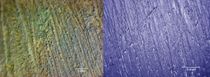
Historical simulations focused broadly on the fabrication of bronze sculpture have been carried out in European classical4 and Renaissance5 contexts. A long-term study of the economic factors affecting medieval European making was published in 2018.6 More specific studies have focused on fusion ,7 sixteenth-century French casting recipes,8 and the formulations of the Renaissance sculptor Antico (Italian, ca. 1455–1528).9 A simple but effective experiment to determine whether tool marks observed on a bronze sculpture were made in the wax or directly on the metal was conducted by Lorenzo Morigi (fig. 271).10
For researchers interested in historical simulation, publications beyond the scope of bronze sculpture may provide guidance and inspiration. Several archaeometallurgical publications address closely related subject matter.11 Two proceedings focused on paintings by the Art Technological Source Research study group discuss various aspects of using historic texts to inform historic reconstructions.12
1.2 Laboratory simulation
Laboratory simulations may have more narrowly focused objectives than historical simulations. The experimental setup is usually smaller in scale and may be quite dissimilar to the historical technical environment. Laboratory simulations tend to answer detailed scientific questions that are only answerable via repeated experiments under carefully controlled conditions. Such simulations may increase understanding of how basic parameters such as temperature, alloy composition, chemical interactions, or variations in procedure influence the final state of a bronze sculpture.
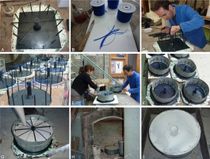
Examples of recent laboratory simulations include fusion welding experiments13 that have yielded evidence of the quite narrow operating window (alloy, temperature, timing) in which fusion welding can be carried out (video 12 Open viewer). These results have highlighted the exceptional skill of classical European in controlling complex heat transfers, particularly for large bronzes where welded joins may extend over several meters (see I.5, Case Study 1). The of various copper alloys has been tested through a series of experimental simulations that have, for the first time, properly demonstrated the role of lead in promoting the successful making of thin-walled (figs. 437, 438).14 Detailed investigations into specific patina formulations in classical bronzes have shed additional light on the sophistication of ancient craftspeople,15 and the thermodynamics of brass production by cementation have been rigorously investigated.16
To broaden the perspective to all archaeometallurgy, most laboratory experiments on historical copper metallurgical processes concern smelting.17 One may add to the list all the simulations that have synthesized ancient copper alloys in order to characterize their mechanical properties18 and color.19 Experiments carried out on copper and copper alloys to study the behavior of major and minor elements during smelting and melting are not directly connected to any process reconstruction.20
1.3 Virtual simulation
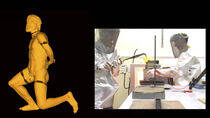
In virtual simulation (some prefer the terms “computational simulation” or “numerical simulation”) the materials and the phenomena are all investigated by computer modeling. This approach has only rarely been applied to historical technologies, but two studies demonstrate nicely the potential utility of virtual simulation with respect to bronze sculpture. Markus Ratka, Peter Sahm, and Wolfgang Bunk used computer modeling to infer the operating conditions (temperature, duration) and possible source of casting flaws in ancient bronze casting.21 Welding has also been investigated by virtual simulation.22 Beyond the specific topic of bronze sculpture, related simulation by computer modeling has mostly focused on ventilation issues for protohistoric copper and iron smelting.23
2 Designing an experimental simulation
2.1 Background research
Once a prospective topic for experimental simulation has been identified, a comprehensive survey of background sources is essential to inform the design of the experiment. Sources may, of course, include historical, scientific, and craft-oriented materials, or textual or audiovisual references. It is very important to consider that materials cited in historical documents may have, historically, contained significant impurities that are not present in today’s supplies.24 Publications of the Art Technological Source Research working group may provide helpful guidance in finding and interpreting historical sources.25 It is equally important to consider existing physical evidence from relevant artifacts.26
2.2 Defining the question
Any experimental setup obviously depends on the objectives of the trial. Defining a clear question and setting clear goals will help determine the appropriate methodology and subsequent reporting.27 Clearly, the more narrowly focused a specific experiment is, the likelier it will yield useful and clear results. Good experimental design is difficult to achieve in the context of bronze sculpture because so many process parameters feed into the work’s final appearance. The most successful experiment will investigate these parameters, as much as possible, one at a time in order to map the effect of each contribution.
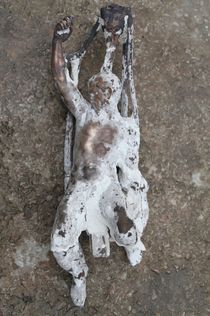
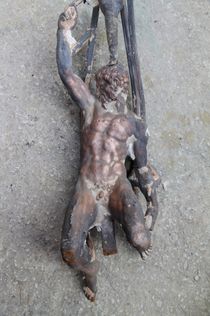
One example of this is provided by Andrew Lacey’s experiments on the Rothschild bronzes.28 After noticing that a hasty application of material to a wax model can have detrimental effects, the author duplicated his first casting, keeping all parameters but one unchanged; in the second iteration he applied the investment with much more care than the first time. The results speak for themselves: compare figure 4 versus figure 5. Through multiple focused experiments, the parameters of a larger process can be mapped and understood. Lacey, for example, also undertook a separate, specific simulation to find out whether the original model of a Rothschild statuette was made of wax or of clay, reconstructing only the modeling step (not the casting) based on two trials.
2.3 Special consideration for historical simulations
Laboratory simulations offer more controlled conditions than historical simulations in the field. They normally allow for faster experimental setup, better repeatability, and more accurate recording. For example, the temperature is much more homogenous in a laboratory electrical furnace than in a meter-deep charcoal-powered medieval-like brick furnace. Laboratory simulation is therefore strongly recommended when appropriate. If historical simulations are planned, it is often advisable to carry out several smaller-scale preparatory simulations in advance to help refine the materials and methods prior to full-scale implementation. This can rapidly clarify working hypotheses, and may reduce the necessary scope of costly and time-consuming field experiments.29
If historical simulation of an entire process is the goal, it is best to reproduce, as much as possible, the entire technical environment known to have prevailed at the time and in the cultural context under study, and at the proper scale. One usually refers to this type of undertaking as a field experiment. These require considerable investment in time and materials and are often conducted only once, and thus it is particularly important to meticulously record and document all materials, tools, and activities.30
2.4 How precise should the recording be?
Experimenters may be attracted by high-precision devices, such as pyrometers that record the temperature of a furnace to within 0.1°C or lasers that measure the diameter of a furnace with a precision of 0.1 mm. Particularly in the context of historical simulation, such precision is often not necessary. Historical production of bronze sculpture did not (and still does not) require a high degree of quantifiable precision for most operations. Craftspeople have traditionally relied on years of experience to make procedural judgments on the basis of observations such as the color of a flame or the sound of the hammer on the metal. Moreover, in an ancient or historical context, the operating conditions could not always be rigorously controlled.31
That said, when laboratory simulation aims to tackle fundamental chemical models, higher precision may be required. This was notably the case for the laboratory brass experiments that led to proposing a new thermodynamic model for the integration of zinc into copper.32 To sum up, the precision of measurements should be consistent with the aims of the experiment, the process under study, and the experimental setup.
At least as important as precision is reproducibility. To ensure that experiments are not affected by unwanted variables, such as a faulty measurement device or some unobserved failure of equipment, experiments should if possible be repeated at least once.
2.5 Skills of the experimental team
The skills of the experimenters in the processes under study are obviously decisive for a successful experimental simulation. The researchers should also possess deep historical knowledge regarding the artifacts at hand and, if possible, textual accounts of the processes under investigation. This is particularly important to avoid biases and preconceptions based on the researchers’ training or exposure to modern methods. Scientific skills are equally important to ensure rigorous and meticulous setup, recording, and reporting.33
Because of the varied skill sets necessary for success, many simulations should ideally be carried out as collaborations between individuals trained in craft, history, archaeology, and natural sciences. Whatever the initial skills of the experimenters, preliminary “soft” tests can be carried out to ensure that the experimenters are familiar with the materials and processes before commencing a formal simulation.34
2.6 Documentation and preservation of the experimental
artifacts
If properly carried out, an experimental simulation can produce samples of high scientific value. These samples may constitute collections of objects that may be useful for future investigations beyond the immediate experimental program. For this reason, all sample materials should be catalogued and preserved so that they are linked in a permanent way to the relevant experimental documentation.
3 Risks of misinterpretation
The results of experimental simulation can be difficult to interpret. For instance, a simulation that yields a result similar to a historical artifact does not mean that the artifact was produced in this way; it merely points to one possible means of achieving a given outcome. Likewise, failure to yield a specific result through simulation does not necessarily prove that the process was not used successfully in the past. The experiment may have failed because the experimental setup was not appropriate, or the skill of the experimenter was not sufficient, or the process was not fully understood. What might be called a “successful unsuccessful experiment” is often of great value in helping to define the outer parameters or boundaries of a process—that is, where parameters start to break down (for example, casting in a range of temperatures whereby the upper and lower temperatures fail for different reasons).
A thorough evaluation of the results of an experimental simulation may take considerable time and effort. Success in this regard will be aided by a simple and straightforward experimental design, detailed documentation of all procedures, and careful preservation of all sample materials.
Notes
-
The foreword of Mark Clarke, Joyce H. Townsend, and Ad Stijnman’s Art of the Past: Sources and Reconstruction defines art technology as “knowledge concerning the production methods of works of art or craft, i.e. machines, materials, studios, techniques, tools etc.” (Clarke, Mark, Joyce Townsend, Ad Stijnman, and Instituut Collectie Nederland, eds. 2005. Art of the Past: Sources and Reconstruction: Proceedings of the First Symposium of the Art Technological Source Research Study Group. London: Archetype.). ↩︎
-
As a result of archaeology’s dominance in this area, the term “experimental archaeology” is commonly used with regard to the experimental study or reconstruction of technological production methods. In the context of bronze sculpture, the term “experimental simulation” seems more appropriate. “Experiment” is sometimes used alone, instead of “experimental simulation.” If not sufficiently contextualized, this term may be misleading. Bear in mind that the simple observation of a phenomenon or an object is already an experiment, and belongs within the realm of experimental science (as opposed to theoretical science). ↩︎
-
A related pursuit is historical reenactment for didactic purposes. Such endeavors are not necessarily designed to answer specific technical questions and in this sense are not “experimental,” although they can be quite informative, as in the case of this reconstruction of an aquamanile by Ubaldo Vitali: https://www.youtube.com/watch?v=tbQSAVFf-OE&feature=youtu.be. ↩︎
-
Formigli, Edilberto. 1993. “Antiche terre di fusione.” In Antiche officine del bronzo: materiali, strumenti, tecniche: atti del Seminario di studi ed esperimenti, Murlo, 26–31 luglio 1991, edited by Edilberto Formigli, 69–98. Siena, Italy: Nuova Immagine.; Formigli, Edilberto, and Nele Hackländer. 1999. “Resocento della ricostruzione sperimentale di una fossa di fusione ellenistica e della cottura du un modello dell’adorante di Berlino.” In I grandi bronzi antichi: le fonderie e le tecniche di lavorazione dall’età arcaica al rinascimento: atti dei Seminari di Studi ed Esperimenti, Murlo 24–30 luglio 1993 e 1–7 luglio 1995, edited by Edilberto Formigli, 299–316. Siena, Italy: Nuova Immagine.. ↩︎
-
Lacey, Andrew. 2018. “The Sculptor at Work: Recreating the Rothschild Bronzes.” In Michelangelo: Sculptor in Bronze: The Rothschild Bronzes, edited by Victoria Avery, 174–99. London: Philip Wilson.. ↩︎
-
Thomas, Nicolas, and David Bourgarit. 2018. “La peine emporte-t-elle le profit? Économie de la production du laiton par cémentation au Moyen Âge.” In Cuivre, Bronzes et Laitons Médiévaux: Histoire, Archéologie et Archéométrie Des Productions En Laiton, Bronze et Autres Alliages à Base de Cuivre Dans l’Europe Médiévale (12e–16e Siècles) = Medieval Copper, Bronze and Brass: History, Archaeology and Archaeometry of the Production of Brass, Bronze and Other Copper Alloy Objects in Medieval Europe (12th–16th Centuries), edited by Nicolas Thomas and Pete Dandridge, 71–88. Études et Documents, Archéologie 39. Namur, Belgium: Agence wallonne du Patrimoine.. ↩︎
-
Zwicker, Ulrich. 1993. “Investigation on Antique Techniques for Joining and Repairing Bronzecastings.” In Antiche officine del bronzo: materiali, strumenti, tecniche: atti del seminario di studi ed esperimenti, Murlo, 26–31 luglio 1991, edited by Edilberto Formigli, 137–52. Siena, Italy: Nuova Immagine.; Formigli, Edilberto. 1999c. “Resoconto degli esperimenti di saldatura per colate e di rifinitura a freddo sui grandi bronzi antichi.” In I grandi bronzi antichi: le fonderie e le tecniche di lavorazione dall’età arcaica al rinascimento: atti dei Seminari di Studi ed Esperimenti, Murlo 24–30 luglio 1993 e 1–7 luglio 1995, edited by Edilberto Formigli, 317–34. Siena, Italy: Nuova Immagine.. ↩︎
-
For instance the Making and Knowing Project, Pamela H. Smith, Naomi Rosenkranz, Tianna Helena Uchacz, Tillmann Taape, Clément Godbarge, Sophie Pitman, Jenny Boulboullé, Joel Klein, Donna Bilak, Marc Smith, and Terry Catapano, eds. 2020. Secrets of Craft and Nature in Renaissance France: A Digital Critical Edition and English Translation of BnF Ms. Fr. 640. New York: Making and Knowing Project. http://edition640.makingandknowing.org., directed by Pamela Smith: https://www.makingandknowing.org. ↩︎
-
Stone, Richard E. 2011. “Understanding Antico’s Patinas.” In Antico: The Golden Age of Renaissance Bronzes, edited by Eleonora Luciano, 178–82. Washington, DC: National Gallery of Art; London: Paul Holberton.. ↩︎
-
Morigi, Lorenzo. 2018. “Relazione di restauro del busto in bronzo rappresentante l’imperatore Antonino Pio.” Florence: Muzeo Nazionale del Bargello.. ↩︎
-
Dungworth, David, and Roger Doonan, eds. 2013. Accidental and Experimental Archaeometallurgy. London: Historical Metallurgy Society.; Heeb, Julia, and Barbara S. Ottaway. 2014. “Experimental Archaeometallurgy.” In Archaeometallurgy in Global Perspective, edited by Benjamin W. Roberts and Christopher P. Thornton, 161–92. New York: Springer.. For a recent survey on copper extractive metallurgy experimental simulations see Bourgarit, David. 2019. “Mineralogy of Slags: A Key Approach for Our Understanding of Ancient Copper Smelting Processes.” In The Contribution of Mineralogy to Cultural Heritage, edited by Gilberto Artioli and Roberti Oberti. European Mineralogical Union Notes in Mineralogy 20. Mineralogical Society of Great Britain and Ireland. https://www.minersoc.org/emu-notes-20-5.html.. ↩︎
-
Clarke, Mark, Joyce Townsend, Ad Stijnman, and Instituut Collectie Nederland, eds. 2005. Art of the Past: Sources and Reconstruction: Proceedings of the First Symposium of the Art Technological Source Research Study Group. London: Archetype.; Kroustallis, Stefanos, Joyce Townsend, Elena Cenalmor Bruquetas, and Ad Stijnman, eds. 2008. Art Technology: Sources and Methods: Proceedings of the Second Symposium of the Art Technological Source Research Study Group. London: Archetype.. See in particular Stijnman, Ad. 2005. “Style and Technique Are Inseparable: Art Technological Sources and Reconstructions.” In Art of the Past: Sources and Reconstruction: Proceedings of the First Symposium of the Art Technological Source Research Study Group, edited by Mark Clarke, Joyce H. Townsend, and Ad Stijnman, 1–8. London: Archetype.. ↩︎
-
Azéma, A., Benoît Mille, Patrick Echegut, and Domingos de Sousa Meneses. 2011. “An Experimental Study of the Welding Techniques Used on Large Greek and Roman Bronze Statues.” Historical Metallurgy 45:71–80.; Azéma, Aurélia, Florent Angelini, Benoît Mille, Gaëlle Framezelle, and Daniel Chauveau. 2013. “Ultrasonic Phased Array Contribution to the Knowledge of the Flow Fusion Welding Process Used to Make the Roman Large Bronze Statues.” Welding in the World 57 (4): 477–86.. ↩︎
-
Pernot, M. 2000. “Forming Bronze by Plastic Deformation around the 1st Millennium BC in Western Europe.” In J. J. Jonas Symposium on Thermomechanical Processing of Steel, edited by S. Yue and E. Essadiqi, 615–26. Montreal, Quebec: Metallurgical Society of the Canadian Institute of Mining, Metallurgy and Petroleum.; Andrieu, Sandra, Bernard Bayle, Michel Pernot, and Jean-Marie Welter. 2000. “Influence de diverses inclusions sur le comportement d’un bronze CuSn9 sous différentes sollicitations mécaniques.” Revue de Métallurgie 97 (5): 599–612. https://doi.org/10.1051/metal/200097050599.; Mille, Benoît. 2017. “D’une amulette en cuivre aux grandes statues de bronze, évolution des techniques de fonte à la cire perdue, de l’Indus à la Méditerranée, du 5e millénaire au 5e siècle av. J.-C.” PhD diss., Université de Paris-Nanterre et Université de Fribourg. http://www.theses.fr/2017PA100057.; see also I.2§2.2. ↩︎
-
Mathis, F., S. Descamps, E. Delange, J. Salomon, S. Pagès-Camagna, M. Dubus, D. Robcis, and M. Aucouturier. 2007. “Corrosion Patina or Voluntary Patina? Contribution of Non-Destructive Analyses to the Surface Study of Copper Based Archaeological Objects.” In Corrosion of Metallic Heritage Artefacts: Investigation, Conservation and Prediction of Long Term Behaviour, edited by P. Dillmann, G. Beranger, P. Piccardo, and H. Matthiessen, 219–38. European Federation of Corrosion Series 48. Cambridge, UK: Woodhead.. ↩︎
-
Newbury, Brian D., Michael R. Notis, and Dale E. Newbury. 2005. “Revisiting the Zinc Composition Limit of Cementation Brass.” Historical Metallurgy 39 (2): 75–81.; Bourgarit, David, and Fanny Bauchau. 2010. “The Ancient Brass Cementation Processes Revisited by Extensive Experimental Simulation.” Journal of Metals 62 (3): 27–33.. ↩︎
-
Burger, E., D. Bourgarit, A. Wattiaux, and M. Fialin. 2010. “The Reconstruction of the First Copper Smelting Processes in Europe during the 4th to the 3rd Millennium BC: Where Does the Oxygen Come From?” Applied Physics A 100 (3): 713–24.; Burger, Emilien, David Bourgarit, Vincent Frotté, and Fabien Pilon. 2010. “Kinetics of Iron-Copper Sulphides Oxidation in Relation to Protohistoric Copper Smelting.” Journal of Thermal Analysis and Calorimetry 103 (1): 249–56.. ↩︎
-
Lechtman, Heather. 1996. “Arsenic Bronze: Dirty Copper or Chosen Alloy? A View from the Americas.” Journal of Field Archaeology 23 (4): 477–514.. ↩︎
-
Benzonelli, A., I. C. Freestone, and M. Martinón-Torres. 2017. “A Better Shade of Black: Effects of Manufacturing Parameters on the Development of Ancient Black Bronzes.” Archaeometry 59 (6): 1034–49.. ↩︎
-
Tylecote, R. F., H. A. Ghaznavi, and P. J. Boydell. 1977. “Partitioning of Trace Elements between the Ores, Fluxes, Slags and Metal during the Smelting of Copper.” Journal of Archaeological Sciences 4:305–33.. ↩︎
-
Bunk, Wolfgang G. J., Peter R. Sahm, and Markus Ratka. 1999. “Numerical Simulation of Historical Casting Processes for Bronze.” In The Beginnings of Metallurgy: Proceedings of the International Conference, Bochum 1995, edited by Andreas Hauptmann, Ernst Pernicka, Thilo Rehren, and Ünsal Yalçin, 301–3. Bochum, Germany: Deutsches Bergbau-Museum.. ↩︎
-
Zimmer, Gerhard, Monika Wirth, Rainer Ellerbrok, and Andreas Bührig-Polaczek. 2011. “Stückungstechnik griechischer Bronzestatuen-Kunst und technologischer Fortschritt.” Giesserei 98 (6): 264–73.. ↩︎
-
Kölschbach, S., G. Woelk, A. Hauptmann, and W. G. I. Bunk. 2000. “Experimente zur Simulation prähistorischer Kupfergewinnung: Zur Verfahrenstechnik von Windöfen.” Metalla 7 (7): 5–22.. ↩︎
-
Sometimes the composition of historically available raw materials can be determined. See for example Hickel, Erika. 1963. “Chemikalien im Arzneischatz deutscher Apotheken des 16. Jahrhunderts, unter besonderer Berücksichtigung der Metalle.” PhD diss., Technische Hochschule Carolo-Wilhelmina zu Braunschweig.. ↩︎
-
Stijnman, Ad. 2005. “Style and Technique Are Inseparable: Art Technological Sources and Reconstructions.” In Art of the Past: Sources and Reconstruction: Proceedings of the First Symposium of the Art Technological Source Research Study Group, edited by Mark Clarke, Joyce H. Townsend, and Ad Stijnman, 1–8. London: Archetype.. ↩︎
-
Stijnman, Ad. 2012. “Some Thoughts on Realia: Material Sources for Art Technological Source Research.” In The Artist’s Process: Technology and Interpretation: Proceedings of the Fourth Symposium of the Art Technological Source Research Working Group, edited by Sigrid Eyb-Green, 18–20. London: Archetype.. ↩︎
-
For more, see the concise and very explicit guidance provided by Alan Outram in Outram, Alan K. 2005. “Publishing Archaeological Experiments: A Quick Guide for the Uninitiated.” (Re)Construction and Experiment in Archaeology 2:107–10.. ↩︎
-
Lacey, Andrew. 2018. “The Sculptor at Work: Recreating the Rothschild Bronzes.” In Michelangelo: Sculptor in Bronze: The Rothschild Bronzes, edited by Victoria Avery, 174–99. London: Philip Wilson.. ↩︎
-
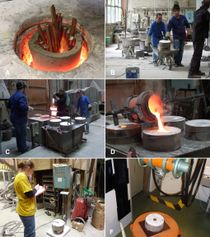
During the first three months of the Laitons Mosans project, aimed at understanding medieval brass making in Western Europe, about three hundred experimental simulations were carried out at the C2RMF laboratory to decipher the operating conditions (temperature, ratio of copper to zinc, et cetera). See Bourgarit, David, and Fanny Bauchau. 2010. “The Ancient Brass Cementation Processes Revisited by Extensive Experimental Simulation.” Journal of Metals 62 (3): 27–33.. This allowed the reduction of the number of resource-intensive field tests to eight (fig. 439) (Bourgarit, David, and Nicolas Thomas. 2011. “The Ancient Brass Cementation Processes: From Laboratory to Field Experiments.” Historical Metallurgy 45 (1): 8–16.). ↩︎
-
In the 1980s John Merkel tested numerous copper smelting processes using a large brick furnace installed in the basement of the Institute of Archaeology, University College London (Merkel, J. F. 1990. “Experimental Reconstruction of Bronze Age Copper Smelting Based on Archaeological Evidence from Timna.” In The Ancient Metallurgy of Copper: Archaeology-Experiment-Theory, edited by Beno Rothenberg, 78–122. London: Institute for Archaeo-Metallurgical Studies.). ↩︎
-
For example, within a one-meter-diameter medieval-like furnace used for field experiments on brass making, the temperature varied from several hundreds of degrees around 1000°C from the bottom to the top, in the stationary regime (Thomas, Nicolas, and David Bourgarit. 2018. “La peine emporte-t-elle le profit? Économie de la production du laiton par cémentation au Moyen Âge.” In Cuivre, Bronzes et Laitons Médiévaux: Histoire, Archéologie et Archéométrie Des Productions En Laiton, Bronze et Autres Alliages à Base de Cuivre Dans l’Europe Médiévale (12e–16e Siècles) = Medieval Copper, Bronze and Brass: History, Archaeology and Archaeometry of the Production of Brass, Bronze and Other Copper Alloy Objects in Medieval Europe (12th–16th Centuries), edited by Nicolas Thomas and Pete Dandridge, 71–88. Études et Documents, Archéologie 39. Namur, Belgium: Agence wallonne du Patrimoine.). ↩︎
-
This demonstrated that the widely cited threshold of 30wt% zinc in ancient brasses could not be explained by the intrinsic limitation of the cementation process (Bourgarit, David, and Fanny Bauchau. 2010. “The Ancient Brass Cementation Processes Revisited by Extensive Experimental Simulation.” Journal of Metals 62 (3): 27–33.). ↩︎
-
Outram, Alan K. 2005. “Publishing Archaeological Experiments: A Quick Guide for the Uninitiated.” (Re)Construction and Experiment in Archaeology 2:107–10.. ↩︎
-
Kucera, Matthias. 2004. “Das Experiment in der Archäologie.” In Archäologie in Europa, Bilanz 2004, edited by Corinna Endlich, 7–13. Oldenburg, Germany: Isensee. quoted by Heeb, Julia, and Barbara S. Ottaway. 2014. “Experimental Archaeometallurgy.” In Archaeometallurgy in Global Perspective, edited by Benjamin W. Roberts and Christopher P. Thornton, 161–92. New York: Springer. speaks of “soft” experiments for preparatory tests and “hard” experiments that can be scientifically exploited. ↩︎