Additional Contributors: Aurélia Azéma, Valérie Carpentier, Andrew Lacey, Elsa Lambert, Carol Mattusch, Mathilde Mechling, Peta Motture, Dominique Robcis, Brice Vincent, Jean-Marie Welter
This chapter describes the types of and that might be encountered on a sculpture, identifies working processes, and describes how inlays and overlays may be identified and associated with a specific technique. It applies to metal, stone, ivory, glass, and bone additions, but does not go into detail about how these additional elements are initially formed. and , which may sometimes be considered as overlay, are addressed in I.7. Other surface ornaments and dressings that enhance color, including attachments such as jewelry, garments, hair, or feathers, are not considered here. While inlays and overlays do not always survive, evidence of their prior existence may remain, and the descriptions below should, in some cases, help to identify them and assist in interpreting what the sculpture may have looked like earlier in its life.
1 What are the different inlay and overlay techniques and materials?
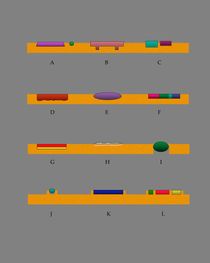
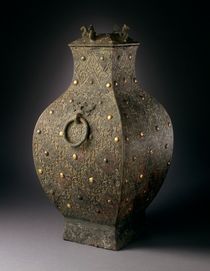
Inlays and overlays enhance the appearance of sculpture mostly by adding discrete elements of a different color to what is basically a monochromatic surface in which texture and generally serve to create coloristic variations. Inlays and overlays may add realism by enhancing details of human or animal forms, or may be applied more extensively to create overall decorative surface effects (fig. 340). The term “damascene” is sometimes used to describe inlays.
The applied materials may be clearly visible or presented more subtly, especially if small in scale or hidden by patina or . Overlays and inlays are also by their nature surface effects and susceptible to loss. Overlays are easily abraded, and mechanically attached inlays can be completely lost, leaving empty cavities.
1.1 Inlay or overlay?
The terms “inlay” and “overlay” are often used indiscriminately, although they differ in one main regard: inlays are inserted into the bronze surface, whereas overlays are set onto the surface. Another distinction has been proposed: inlays are mostly attached mechanically without any fasteners, sometimes in, whereas overlays are joined to the surface using a variety of techniques, including riveting, , and adhesives.1 This chapter subscribes to the first categorization—inserted into versus set onto the surface—to distinguish between the two.
Inlays are inserted directly into the bronze surface, generally after casting, following the design of the cut, cast, or recess (fig. 341). Inlays may create fine linear designs or larger fields of color by using a variety of materials, including metal, glazed fritware, glass, enamel, ivory, or stone. The surfaces of inlays themselves may be chased to form more precise designs so that a simple figure becomes more textured and detailed (fig. 342). Inlays have been used in copper-alloy works over a broad time period and in different parts of the world (see examples below).
Overlays comprise materials such as stone, enamel, or metal laid over the metal surface (see I.9§1.2 below). They are less frequent on bronzes than inlays. Good examples of overlays may be found in a variety of cultures (figs. 47, 223).
1.2 Inlay and overlay materials
Inlay and overlay materials may be inorganic—for instance colored stones, vitreous materials, contrasting metals—or organic materials such as shell, ivory, or plant-based items.
1.2.1 Inorganic materials: metal and metal-based
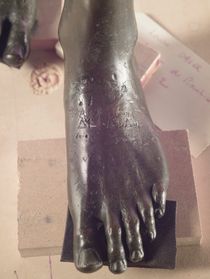
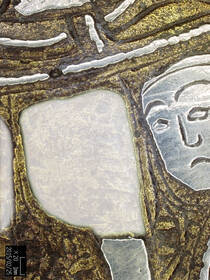
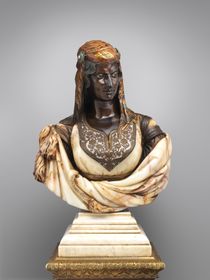
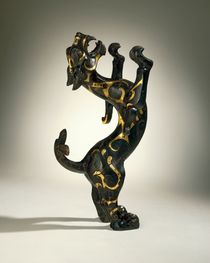
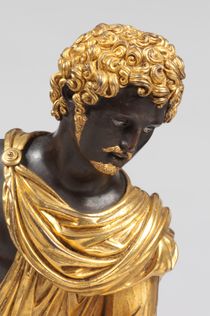
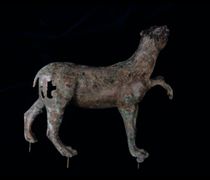
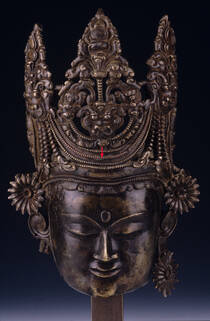
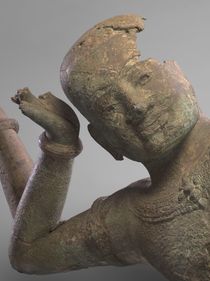
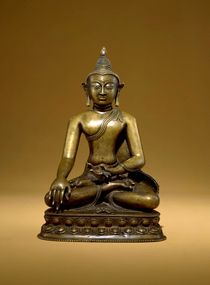
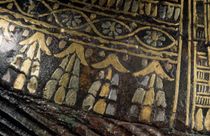
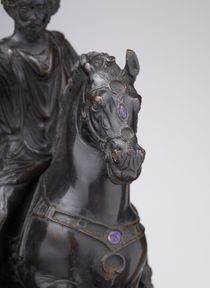
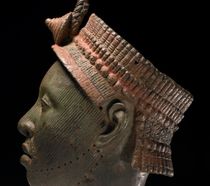
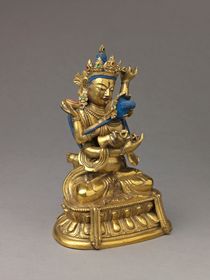
Metals for inlay are generally selected based on color, ductility, and melting point. They include gold (fig. 343), silver (figs. 293, 343, 344), copper (figs. 344, 345, 346),2 and iron, as well as alloyed (figs. 346, 347)3 and patinated metals.4 A copper-alloy inlay with a composition similar to the surface metal and with no color difference may suggest that it was originally patinated. Gray-colored inlays also occur, for instance in Buddhist statuary from Kashmir (eighth century CE).5 Lead-based compounds have been observed on Khmer bronzes (fig. 348). On ancient bronzes and Renaissance emulators, including Antico (Italian, ca. 1455–1528), tin may be confused with silver.6 Greater polychromy can be achieved by using multiple metals as inlays and overlays (figs. 349, 350),7 but also with gilding and silvering (see I.7).
Powders of both metal and metal oxides may be used in a manner similar to powdered glass (see I.9§1.4.2 below). Niello is a well-known example, although rarely encountered on bronze sculpture.8
1.2.2 Inorganic materials: mineral-based
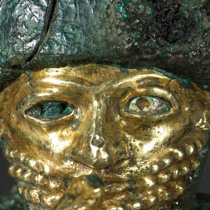
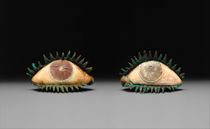
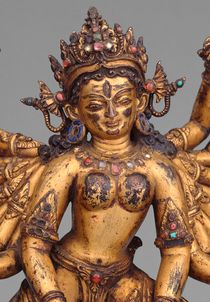
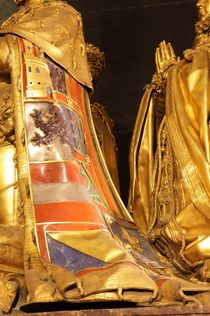
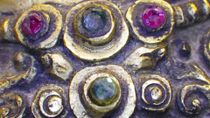
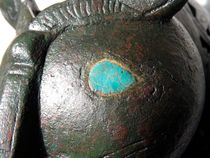
Inlays and overlays of mineral-based material include stones and semiprecious stones (figs. 297, 351, 352, 353), gems (fig. 354), glass (figs. 309, 351, 355), and mixed material such as frit (glass and ceramic mix) and pigmented glaze (fig. 356). A variety of stones can be employed to add detail to a sculpture, as on reliquaries and jewelry. They may be roughly shaped or cut into fine lamina for inlay, and may be opaque or translucent. Generally found on jewelry, they allow light reflection from a patterned underlayer of gold (fig. 340 G). Stones may also have symbolic or religious significance. Stone and/or pigment can be combined with metal to create multicolored effects, as seen notably on ancient Egyptian and medieval Indian statuary, and also on Chinese ware (fig. 357).
1.2.3 Organic materials
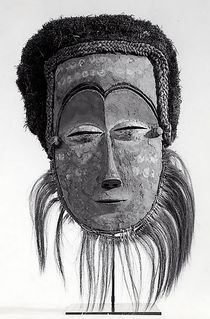
The use (or surviving evidence) of organic materials is more common in art objects from the medieval period onward, as such objects have not been subjected to aggressive bio-deterioration processes. In general, organic inlay materials include tortoiseshell, horn, claws, seashell (fig. 358), mother of pearl, coral, amber, pearl, wood, charcoal, and dyed resins. Secondary or ancillary compounds may include tinted waxes, resins, bitumen, or plaster. Organic resins may be tinted with pigments or dyes and applied in a manner similar to enamel. Organic materials such as ivory, bone, and teeth are sometimes present. Materials such as fibers and hairs may be used as attachments (figs. 359, 360).
Risks of misidentification/misinterpretation
-
Glass inlays and overlays are easily confused with enamel. Close examination with a microscope may be sufficient to make the distinction.
-
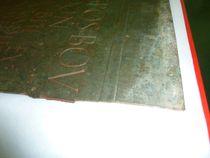
Pigments may be applied thickly (resembling overlay) or as thin surface glazes (figs. 360, 361). In some instances, pigment may be used in imitation of inlaid stone (fig. 362).
1.3 Surface preparation
Steps are required to effect the bond between the cast bronze surface and the added material.
1.3.1 Preformed cavity or perforation
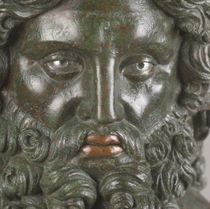
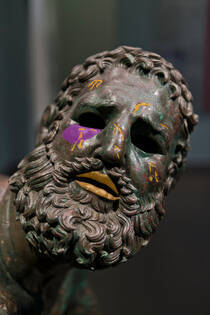
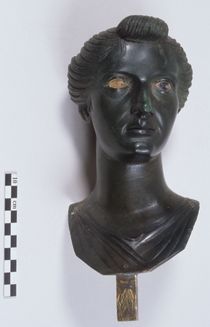
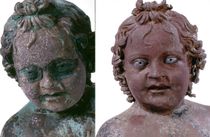
Many Egyptian, Greek, and Roman bronzes were produced with empty eye sockets for later insertion of naturalistic eye inlays (figs. 309, 311). Roman eye production was a specialized fabrication process and occupation (ocularis). Each eye includes multiple parts, such as copper supports and eyelashes, white stone or ivory sclera, and stone or enamel irises and pupils (fig. 351). During the Italian Renaissance these inlays were imitated (fig. 293).9 These apertures have no rear wall, as the inlays are held in place within folded copper sheets, often with eyelashes (fig. 340 I, fig. 351). The entire assembly may be lost during burial, revealing the empty eye socket.
1.3.2 Elevated decorative borders
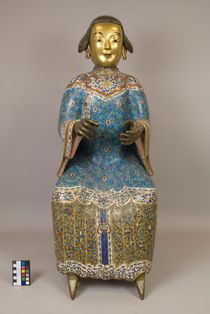
Decorative inlay or overlay may be enclosed by elevated decorative borders. Small chambers are created by soldering metal wires or strips to the surface (referred to as cloisonné).
1.3.3 Engraved or cast surface cavities
Different methods are used to shape cavities for inlays. These may be preestablished in the , or they may be cut into the metal post-casting (champlevé). Additional attachment holes may be created at various stages. The cavities may have smooth surfaces, or be roughened to increase the surface area and thereby assist with adhesion. Furthermore, as with repair , the perimeter of the recesses prepared for metal inlays may be slightly undercut, as the act of hammering these in will splay the metal edges and thereby help lock the added metal into place (fig. 340 A–C, F).
1.4 Attachment methods
For all but the last type of inlay listed above, once the area that is to receive the inlay or overlay has been prepared, the material of choice is attached to the bronze. This may require one or more methods of attachment.
1.4.1 Mechanical methods
Metal inlays are generally formed by hammering the material into the prepared recess in the cast sculpture. This requires the inlay metal to be ductile enough to flatten and spread during the operation—for example, gold, silver, or copper (fig. 344). In addition to roughening the surface with a , for instance (fig. 340 H), it may be desirable to bevel the edges of the recessed design. As the metal is hammered in, it spreads and locks into the undercuts around the perimeter (fig. 340 A). Conversely, the surface metal may be channeled and hammered around the inlay’s perimeter to secure it (fig. 340 E).
As noted previously, chambers cut into the substrate (fig. 340 C) or formed within elements soldered to the surface may be used to hold stone cabochons or enamels (fig. 340 J, K, L; see also I.9§1.3.2 above).
In some instances, an opening may be formed in the bronze substrate either before or after casting to allow for the insertion of larger inlays from the reverse side (fig. 340 I).
Riveting requires perforating the bronze (fig. 340 B). Hammering of the rivet either spreads and locks the rivet head or expands the entire feature, locking the inlay or overlay to the surface. Rivets and pin ends may be designed to function as decorative elements, or finished to be less visible on the surface, for instance by countersinking them.
Pinning is similar to riveting, but pins are usually smaller in diameter and more numerous. Compared to rivets, they may also be less visible. Riveting relies on the flattening or splaying of either end to secure an attachment, while pinning relies on simple pressure or friction within the substrate (as with a nail in a wall).
1.4.2 Methods employing heat
Casting-in consists of pouring molten metal into a recess in the surface to fill a prepared cavity. The final surface may require further leveling by filing, polishing, or burnishing (fig. 340 C).
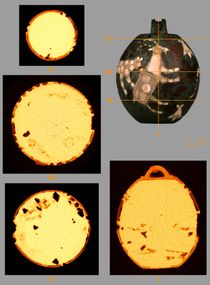
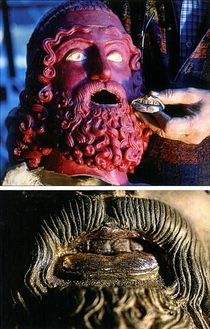
More elaborate metal inlays with several parts may be more easily fabricated separately and incorporated into the actual casting of the bronze. This is the case, for instance, with lips and nipples of ancient Greek statues that were formed in copper and set into the wax model before casting (fig. 363). Such an inlay needs to be made of metal with a higher melting point than the surrounding matrix to avoid being destroyed in the process. The use of such a process is characterized in part by a lack of clear borders, as the surrounding bronze is likely to run over its edges (fig. 340 D). Precast inlays may be held in a mold with tab-like extensions, for example. These would be concealed by the cast bronze and visible only by radiography (fig. 363). A decorative technique using liquefied metal may show characteristic evidence of flow or trapped bubbles.
Preformed inlay elements may also be joined onto the sculpture using a metal with a lower melting point than the surface metal (for example soldering with a lead-tin alloy, fig. 364). Solders may be made of wire, or a powdered solder may be applied between two elements and heated locally. When the melting point of the solder is reached, it flows and creates the join. The fact that solder bond is relatively weak and may deteriorate over time accounts for the frequent loss of inlays and overlays applied in this fashion. Remaining traces of the solder can be mistaken for evidence of tinning.
Enameling is a specialty in itself and is used on a variety of metals, including silver, gold, copper, and sometimes bronze. In the vitreous enamel technique, powdered glass is fused to the metal substrate by heating at high temperature to create opaque and translucent colors. Molten glass enamels flow on heating and are used for both inlay and overlay decoration. To form detailed inlay patterns, glass may be used within or cast-in depressions (fig. 309). Small partitions of metal are soldered onto the surface in order to enclose the enamels that are added later (figs. 223, 340 K, L). Enameling may also be applied directly to the prepared surface (fig. 47).10 A related material, frit, combines glass with ceramic and is used in a similar manner; elements may be molded or preformed prior to insertion.11
1.4.3 Adhesive methods
Whereas metal inlays and overlays are generally attached mechanically, nonmetallic materials (stone, glass, ivory, et cetera) may require an alternative attachment method such as an enclosed chamber used in conjunction with an inorganic bedding medium such as lime or gypsum plaster, or organic binder such as a resin (rosin, shellac, or gum arabic).12 Various binders were available in ancient Greece and Rome,13 and adhesives were presumably used for the attachment of glass and lapis inlays on Late Period Egyptian statuettes.14 These materials are subject to deterioration over time, ultimately causing inlays to detach, leaving only the associated recesses in the metal.
2 Why investigate inlays and overlays? and other FAQs
Characterizing the materials and techniques of inlays and overlays contributes to any study of the technological know-how of a bronze-producing craftsperson, workshop, or culture. Needless to say, it is also useful in the dating of a work and more nuanced description of its condition, especially if one finds evidence of later interventions. The distinction between overlays and inlays may, admittedly, be somewhat problematic given that the preparation and setting is often inaccessible for examination without resorting to a destructive sampling process. To complicate matters, both processes may be combined in the same area, or the inlay itself may rise above the level of the surrounding substrate.
2.1 Can I detect traces of lost or hidden inlay and/or
overlay?
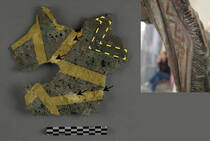
Given that inlays and overlays are particularly susceptible to wear, damage, and loss, a gaping cavity may account for the former presence of an inlay or overlay. Empty voids, especially those that are deep and with sharp borders (fig. 364), or the presence of preparatory traces on the surface, such as chasing marks or specific reliefs (fig. 348), may indicate lost inlays. An ancient statue with voids for eyes is likely to have lost these. Sheet or leaf metal applied with an adhesive is also more likely to become detached as the glue deteriorates, or to be worn down in exposed areas and preserved in protected recesses.
Traces of metal, solders, and adhesives, for example, may be a good indication of lost inlays or overlays (fig. 364). Later protective , patination, or corrosion may obscure ancient inlays and overlays (fig. 311). Surface elemental and/or structural analysis, for example using particle-induced X-ray emission spectroscopy (PIXE), portable X-ray diffraction (XRD), or Raman spectrometry, may help to detect inlays or overlays and even establish chemical compositions and the original color schemes.15 Radiographs may also be useful in detecting material composition and density differences, seams, and other features (tabs, extensions) associated with inlays and overlays (see I.9§3.2.1 below).
2.2 Can I distinguish between original inlay and/or
overlay and later intervention?
Careful comparison of all existing inlays and overlays and tooling traces throughout a sculpture can often help distinguish original versus replacement parts. Substitution of materials or restorations can generally be identified by inconsistencies in material composition (and the presence of anachronisms) or method of attachment.16 Even if lost, the former presence of an inlay may be inferred from jarring voids or recesses, or by comparison to related objects on which the inlay is preserved. Analytical methods may also be necessary to identify and compare materials.
2.3 Is there any chance of misinterpreting the nature of
an inlay or an overlay?
Materials used in small areas or deteriorated material may be hard to characterize or distinguish. Visually, tin may be confused with silver, and slightly oxidized silver may appear golden. A dark or black glass may resemble black marble.
Finely surfaced marble or alabaster may be hard to distinguish from ivory or bone. (This may require close microscopic examination or nondestructive surface elemental analysis using X-ray fluorescence spectroscopy, or XRF.) For example, under high magnification, marble will have a granular appearance and XRF may reveal a high calcium content. Separation of bone from ivory may rely on morphological study, although newer protein identification methods have been used successfully to distinguish animal species (see I.9§3.2.2 below).
Inlay methods may also be used for repair patching rather than as decorative methods. Similarly, repairs might be mistaken for decorative features (see I.4§1.1).
2.4 Can the characterization of inlays and overlays help
distinguish between different craftspeople, workshops, or
production centers?
Trace analysis of materials used in inlays and overlays may help characterize materials more precisely and help group related objects, as can a comparison of bulk metal and analysis (see I.2§4, II.7§1.2). The trace elements may point to sources of materials, processing methods, or production centers and reveal whether there is consistency or variety in their use. It is therefore important to balance analytical results with the identification of technical features, such as attachment techniques, that may be more characteristic of a particular workshop. Characterization of processes and tool marks can also indicate methods used in a given period or region. The study and careful documentation of tool markings can help establish production chronology and date production sequences.17
3 Checklist: How do we investigate inlays and overlays?
Inlays and overlays can be identified and defined using different basic methods of visual examination. Initial identification of features can help establish what further testing and analysis may be beneficial. As noted, identification of missing and hidden inlays or overlays is not always obvious, and different tools may be needed to detect them. For details of examination and analytical techniques please refer to tables 13, 10, 5 Open viewer.
3.1 Basic identification techniques
3.1.1 Visual examination
Visual examination is the logical first step in identifying seams, textural variations, and color differences. In addition to the naked eye, low-power magnification with a handheld magnifier or microscope is useful. Raking and variable-angle illumination using a simple handheld lamp or even a smartphone light can help with texture assessment and evaluation of the condition or state of deterioration. Ultraviolet light may help in detecting and identifying particular organic materials (see II.2§3.1) or adhesives that fluoresce under this lighting and can be signs of recent restoration.
3.1.2 Chemical and physical analysis
Basic methods include the use of a magnet to detect iron. Surface elemental analysis using handheld XRF can help to detect inlays.
3.2 Advanced techniques
3.2.1 Imaging
Radiography is useful in detecting and characterizing inlay, including the material used to make it. For example, gold is much denser than silver and copper, and thus a gold inlay is easy to distinguish from a silver or copper inlay using radiography as long as the inlay thicknesses are comparable (see II.3§1.4). Computed tomography may aid in imaging the overall shape of the inlay and isolating the material, based on radio-opacity. Reflectance transformation imaging (RTI) and infrared thermography (IRT) may be used to detect inlays.18
3.2.2 Chemical and physical analysis
Without sampling
XRF is useful as long as inlays and other features are more than a few millimeters in size. Better surface resolution can be achieved through PIXE analysis. Small statuettes less than a few centimeters deep may be introduced in a laser ablation cell and analyzed by laser ablation inductively coupled plasma mass spectroscopy (LA-ICP-MS). In addition to elemental analysis, other analytical approaches include XRD, ultraviolet (UV), surface-enhanced Raman (SERS), Rutherford backscattering spectrometry (RBS), and nuclear reaction analysis (NRA) (fig. 305 A). Materials applied with an adhesive may be detached, allowing analysis of traces of the adhesive. Color or hyperspectral analysis may also be very useful, although alteration may impact the original appearance (see II.2§4).
With sampling
Elemental and structural analysis may require a drilled sample (fig. 305 B, C). As for repairs, cast inlay can only be distinguished from one mechanically attached through cross-sectional analysis (see I.4§2.1). Similarly, an inlay or overlay may be too altered for proper surface analysis: sampling for cross section may be required. Adhesives can also be identified in cross section, and elemental and spectral analysis can characterize the adhesive composition.19 This may help to distinguish an ancient technology or material (for instance a bituminous or resinous compound) from a modern repair (made with a synthetic glue).
Notes
-
For a precise definition see Untracht, Oppi. 1982. Jewelry: Concepts and Technology. London: Robert Hale., 315. ↩︎
-
Copper inlay was also reportedly used in the historical restorations of Herculaneum bronzes in the eighteenth and nineteenth centuries (Lahusen, Götz, and Edilberto Formigli. 2006. “Römische Herrscher und Bürger: Die Bronzestatuen aus Herculaneum und ihre Restaurierung im 18. Jahrhundert.” Antike Welt 37 (2): 8–14.). Inlay wire is also described in material from the Mahdia shipwreck, Tunisia, carrying Greek works of art for Romans (Cüppers, Barbara. 1994. “Metalleinlagen als farbige Ziertechnik.” In Das Wrack. Der antike Schiffsfund von Mahdia, edited by Gisela Hellenkemper Salies with Hans-Hoyer von Prittwitz und Gaffron and Gerhard Bauchhenß, 1:1013–16. Kataloge des Rheinischen Landesmuseums Bonn. Cologne: Rheinland Verlag.). ↩︎
-
Alloys can be employed to achieve a variety of more subtle color effects. Alloys include pewter (85–99% tin with copper, bismuth, and antimony); copper alloyed with tin; lead (at sufficiently high concentrations that it can affect the color tonality of bronze, see fig. 346); zinc; gold (for example, copper alloyed with 25% gold to form Roman “pyropus,” see Pliny the Elder. 1857. Natural History, translated by John Bostock and Henry Thomas Riley. London: H.G. Bohn. https://www.google.com/books/edition/The_Natural_History_of_Pliny/9zwZAAAAYAAJ?hl=en&gbpv=0., 34.20); and electrum, a gold-silver alloy. Gold could also be alloyed to become more malleable for thin inlays. One of the most liberal uses of colored inlay is exemplified in the Alexandrian bronze table Mensa Isiaca in Turin, Italy (fig. 365). Alloy inlays are reported notably on Egyptian objects (La Niece, Susan, Fleur Shearman, John Taylor, and Anthony Simps. 2002. “Polychromy and Egyptian Bronze: New Evidence for Artificial Coloration.” Studies in Conservation 47 (2): 95–108.; see also fig. 350). A bronze bull of the Alaca Höyük type (ca. 2000 BCE) from Eastern Anatolia, now in the collection of the Museum of Fine Arts, Boston, is inlaid with copper-gold stripes and is partially silvered (inv. 58.14, https://collections.mfa.org/objects/267288). See Smith, Cyril Stanley. 1970. “An Examination of the Arsenic-Rich Coating on a Bronze Bull from Horoztepe.” In Application of Science in Examination of Works of Art, edited by William J. Young, 96–102. Boston: Museum of Fine Arts, Boston.. ↩︎
-
The authors do not know of examples of patinated copper inlays on sculpture, but do on bronze implements (Robcis, Dominique, David Bourgarit, and Benoît Mille. 2000. “Tsuba, de l’art à la matière.” Techné 13/14:84–88.; Descamps-Lequime, Sophie. 2005. “L’encrier de Vaison-La-Romaine et la patine volontaire des bronzes antiques.” Monuments et mémoires de la Fondation Eugène Piot 84 (1): 5–30.). ↩︎
-
See Pal, Pratapaditya. 2007. “Faith and Form: Religious Sculpture in Ancient Kashmir.” In The Arts of Kashimir, edited by Asia Society, 60–99. New York: Asia Society and Cincinnati Art Museum., 62. ↩︎
-
A layer of cassiterite (tin oxide), inferred as degraded tin sheet, has been identified on the eyes of an ancient Greek statue of Dionysos as a Youth (Mattusch, Carol C. 1996. The Fire of Hephaistos: Large Classical Bronzes from North American Collections. Cambridge, MA: Harvard University Art Museums., cat. no. 23, 224 and 231n6). Similarly, the Charioteer happens to be inlayed with tin (Descamps-Lequime, Sophie, Benoît Mille, et Nancy Psalti. “Projet d’une nouvelle étude technologique de l’Aurige de Delphes: les premiers résultats.” In Proceedings of the XXth International Congress on Ancient Bronzes: Resource, reconstruction, representation, role, edited by Philipp Baas, 45–55. BAR International series 2958. Oxford: BAR Publishing, 2019.). See also Snodgrass, Amy. 2000. “Analysis of Gilding and Other Decorative Metals on Chosen Bronzes.” In From the Parts to the Whole: Acta of the 13th International Bronze Congress, Held at Cambridge, Massachusetts, May 28–June 1, 1996, edited by Carol C. Mattusch, Amy Brauer, and Sandra E. Knudsen, 277–81. Cambridge, MA: Journal of Roman Archaeology.. For Antico, see Smith, Dylan, and Shelley G. Sturman. 2011. “The Art and Innovation of Antico’s Bronzes: A Technical Investigation.” In Antico: The Golden Age of Renaissance Bronzes, edited by Eleonora Luciano, 157–85. Washington, DC: National Gallery of Art; London: Paul Holberton.. ↩︎
-
For ancient Egypt see La Niece, Susan, Fleur Shearman, John Taylor, and Anthony Simps. 2002. “Polychromy and Egyptian Bronze: New Evidence for Artificial Coloration.” Studies in Conservation 47 (2): 95–108., 97–102. For Greek and Roman antiquity, see Descamps-Lequime, Sophie. 2015. “The Color of Bronze: Polychromy and the Aesthetics of Bronze Surfaces.” In Power and Pathos: Bronze Sculpture of the Hellenistic World, edited by Jens M. Daehner and Kenneth Lapatin, 150–66. Los Angeles: J. Paul Getty Museum. and Descamps-Lequime, Sophie. 2019. “La couleur des bronzes antiques: recherches récentes.” Technè: La science au service de l’histoire de l’art et de la préservation des biens culturels, no. 48 (December): 72–82. https://doi.org/10.4000/techne.2323.. ↩︎
-
Niello is composed of one or more metal sulfides (silver, copper, or copper and lead), with the composition varying depending on period and place. Its composition determines its method of application. Niello can be an inlay or an overlay of black material with a gray or blue reflection/appearance, and can be confused with black enamel. It is generally used on gold and silver, but can also be found on copper alloys. It can be inlaid in chased or overlaid on smooth surfaces. See Niece, Susan La. 1983. “Niello: An Historical and Technical Survey.” The Antiquaries Journal 63 (2): 279–97. https://doi.org/10.1017/S000358150006652X.. ↩︎
-
Smith, Dylan, and Shelley G. Sturman. 2011. “The Art and Innovation of Antico’s Bronzes: A Technical Investigation.” In Antico: The Golden Age of Renaissance Bronzes, edited by Eleonora Luciano, 157–85. Washington, DC: National Gallery of Art; London: Paul Holberton.. ↩︎
-
For example certain works by Charles Cordier (French, 1827–1905) in the collection of the Musée d’Orsay, Paris; see https://www.musee-orsay.fr/fr/evenements/expositions/aux-musees/presentation-detaillee/article/charles-cordier-1827-1905-sculpteur-lautre-et-lailleurs-4210.html. See also Papet, Édouard. 2018. En couleurs: La sculpture polychrome en France, 1850–1910. Vanves; Paris: Hazan; Musée d’Orsay.. ↩︎
-
See also the Egyptian bronze figurine of Osiris (ca. 3rd Intermediate Period through the 26th Dynasty, Research Collection of the School of Religion, University of Southern California, inv. USC 5407) inlaid with blue glass, analyzed in Scott, David A., and Lynn Swartz Dodd. 2002. “Examination, Conservation, and Analysis of a Gilded Bronze Osiris.” Journal of Cultural Heritage 3 (4): 333–45.. Inlays of preformed blue and green enamel are reported in Byzantine doors (Kleinbauer, W. Eugene. 1976. A Byzantine Revival: The Inlaid Bronze Doors of Constantinople. Cambridge, MA: Archaeology.). ↩︎
-
Untracht, Oppi. 1968. Metal Techniques for Craftsmen: A Basic Manual on the Methods of Forming and Decorating Metals. New York: Doubleday., 441. ↩︎
-
Formigli, Edilberto. 2013a. Colore e luce nella statuaria antica in bronzo. Rome: L’Erma di Bretschneider., 8: figures 23 and 24 describe the use of an organic binder in the manufacture of eye inlays in the Greek statue known as Riace A (460–450 BCE, H. 198 cm., National Archaeological Museum of Reggio Calabria). Although not specific to inlay, Pliny the Elder. 1857. Natural History, translated by John Bostock and Henry Thomas Riley. London: H.G. Bohn. https://www.google.com/books/edition/The_Natural_History_of_Pliny/9zwZAAAAYAAJ?hl=en&gbpv=0., 33.64, mentions adhesives such as albumen, fruit juices, fish glue, milk, and blood (Giumlia-Mair, Alessandra. 2002. “Zosimos the Alchemist: Manuscript 6.29, Cambridge, Metallurgical Interpretation.” In I bronzi antichi: Produzione e tecnologia. Atti del XV Congresso Internazionale sui Bronzi Antichi, edited by Alessandra Giumlia-Mair, 317–23. Montagnac, France: Editions Monique Mergoil., 33). ↩︎
-
La Niece, Susan, Fleur Shearman, John Taylor, and Anthony Simps. 2002. “Polychromy and Egyptian Bronze: New Evidence for Artificial Coloration.” Studies in Conservation 47 (2): 95–108., 101. ↩︎
-
For example see Robcis, Dominique, David Bourgarit, and Benoît Mille. 2000. “Tsuba, de l’art à la matière.” Techné 13/14:84–88.; Delange, Elisabeth, Marie-Emmanuelle Meyohas, and Marc Aucouturier. 2005. “The Statue of Karomama, a Testimony of the Skill of Egyptian Metallurgists in Polychrome Bronze Statuary.” CULHER Journal of Cultural Heritage 6 (2): 99–113.; Alessandri, O. Colacicchi, M. Ferretti, and Edilberto Formigli. 2013. “L’occhio pesto del pugile. Indagini archaeometriche sulla statua in bronzo del Museo Nazionale Romano.” In Colore e Luce Nella Statuaria Antica in Bronzo, edited by Edilberto Formigli, 25–31. Rome: L’Erma di Bretschneider.; Descamps-Lequime, Sophie, Benoît Mille, et Nancy Psalti. “Projet d’une nouvelle étude technologique de l’Aurige de Delphes: les premiers résultats.” In Proceedings of the XXth International Congress on Ancient Bronzes: Resource, reconstruction, representation, role, edited by Philipp Baas, 45–55. BAR International series 2958. Oxford: BAR Publishing, 2019.; Collinet, Annabelle. 2021. Précieuses matières: L’art du métal dans le monde iranien médiéval. Dijon: Éditions Faton.; and I.9§3.2.2. ↩︎
-
For example, see the restoration of the head of the seated Hermes from Herculaneum (Mattusch, Carol C. 2006. “The Seated Hermes from the Villa of the Papyri at Herculaneum: Ancient and Modern Lives.” In Mittel und Wege. Zur Bedeutung von Material und Technik in der Archäologie, edited by Astrid Dostert and Franziska Lang, 167–79. Berlin: Bibliopolis.) and the eighteenth-century repairs to Roman bronzes from the Villa dei Papiri at Herculaneum (Mattusch, Carol C. 2005. The Villa dei Papiri at Herculaneum. Life and Afterlife of a Sculpture Collection. Los Angeles: J. Paul Getty Museum.; Mattusch, Carol C. 2013. “Appearances Can Be Deceiving: The Presentation of Bronzes from Herculaneum and Pompeii.” In The Restoration of Ancient Bronzes: Naples and Beyond, edited by Erik Risser and David Saunders, 30–42. Los Angeles: J. Paul Getty Museum. http://www.getty.edu/publications/virtuallibrary/1606061542.html.). ↩︎
-
See the study on medieval Iranian inlaid metalware Collinet, Annabelle. 2021. Précieuses matières: L’art du métal dans le monde iranien médiéval. Dijon: Éditions Faton.. To the authors’ knowledge no such extensive study has been carried out on bronze sculpture. ↩︎
-
Mercuri, F., G. Caruso, N. Orazi, U. Zammit, C. Cicero, O. Colacicchi Alessandri, M. Ferretti, and S. Paoloni. 2018. “Interface Thermal Conductance Characterization by Infrared Thermography: A Tool for the Study of Insertions in Bronze Ancient Statuary.” Infrared Physics and Technology 90 (May): 31–39.. ↩︎
-
Possible additional methods include peptide mass fingerprinting (PMF, see Kirby, Daniel. P., Narayan Khandekar, Julie Arslanoglu, and Ken Sutherland. 2011. “Protein Identification in Artworks by Peptide Mass Fingerprinting.” In ICOM Committee for Conservation 16th Triennial Conference, Lisbon, Portugal, 19–23 September 2011, edited by Janet Bridgland. Almada, Portugal: Critério.) and antibody-based (ELISA, see Heginbotham, Arlen, Victoria Millay, and Michael Quick. 2006. “The Use of Immunofluorescence Microscopy and Enzyme-Linked Immunosorbent Assay as Complementary Techniques for Protein Identification in Artists’ Materials.” Journal of the American Institute for Conservation 45 (2): 89–105.). ↩︎