See figs. 287, 290, 293, 294, 295, 296, 297, 299, 301, 555.
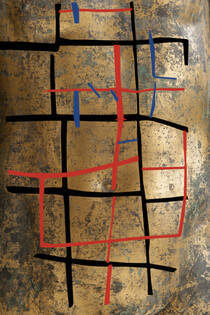
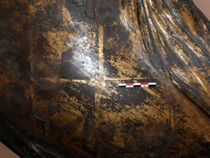
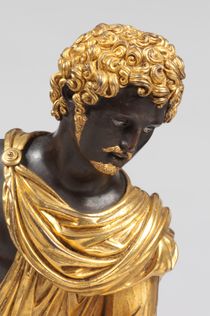
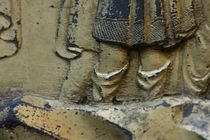
The application of gold to the surface of a sculpture. This can be achieved by a variety of methods. Traditionally gilding was mainly undertaken using leaf gilding or mercury gilding. Starting in the nineteenth century, electrochemical plating or deposition began to be used, as well as gold powder paint or wax. See I.7.
 Open viewer
Figure 287
Open viewer
Figure 287
 Open viewer
Figure 290
Open viewer
Figure 290
 Open viewer
Figure 293
Open viewer
Figure 293
 Open viewer
Figure 294
Open viewer
Figure 294
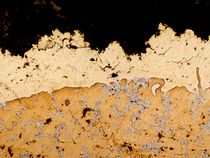 Open viewer
Figure 295
Open viewer
Figure 295
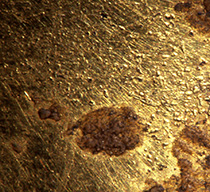 Open viewer
Figure 296
Open viewer
Figure 296
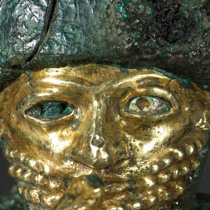 Open viewer
Figure 297
Open viewer
Figure 297
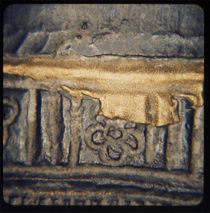 Open viewer
Figure 299
Open viewer
Figure 299
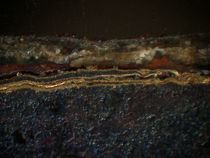 Open viewer
Figure 301
Open viewer
Figure 301
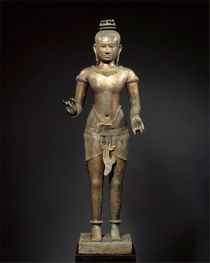 Open viewer
Figure 555
Open viewer
Figure 555
Sources
Cultural Heritage: Drayman-Weisser, Terry, ed. 2000. Gilded Metals: History, Technology and Conservation. London: Archetype in association with the American Institute of Conservation of Historic and Artistic Works.; Oddy, W. Andrew. 1993. “Gilding of Metals in the Old World.” In Metal Plating and Patination: Cultural, Technical and Historical Developments, edited by Susan La Niece and Paul Craddock, 171–81. Oxford, London, Boston [etc.]: Butterworth-Heinemann.; Salter, C. J., and B. J. J. Gilmour. n.d. “Glossary of Terms Used in the Study of Ancient Metal-Working and Associated Processes.” Materials Science-Based Archaeology Group, Department of Materials, University of Oxford.; Motture, Peta. 2019. The Culture of Bronze: Making and Meaning in Italian Renaissance Sculpture. London: V&A Publishing., 39
Translations
French:
dorure
Opération consistant à appliquer une couche d’or en surface, quel que soit le procédé. Désigne également le résultat.
Note: Nous n’avons pas trouvé mention du substantif « dorure » dans Félibien, André. 1690. Des principes de l’architecture, de la sculpture, de la peinture et des autres arts qui en dépendent: Avec un dictionnaire des termes propres à chacun de ces arts. 2nd ed. Paris: Chez la veuve de Jean Baptiste Coignard et Chez Jean Baptiste Coignard fils. https://archive.org/details/principesdelarch00fl., mais uniquement du verbe « dorer », p. 334.
Sources
Cultural Heritage: Baudry, Marie Thérèse, and Dominique Bozo. 1978. La sculpture: Méthode et vocabulaire. Principes d’analyse scientifique. Paris: Impr. nationale., 657; Azéma, Aurélia, and Benoît Mille. 2013b. “Un point sur la technique de fabrication des grands bronzes antiques.” L’actualité chimique 377:43–44.; Aucouturier, Marc, Michel Keddam, Luc Robbiola, and Hisasi Takenouti. 2003. “Les patines des alliages de cuivre: Processus naturel ou œuvre de l’homme?.” Techné 18:86–94.
Historical: Diderot, Denis, Jean le Rond d’Alembert et al. 1751. Encyclopédie; ou Dictionnaire raisonné des sciences, des arts et des métiers. 17 vols. Paris: Briasson. http://enccre.academie-sciences.fr/encyclopedie/., 5:57–60, entry « dorure »
German:
Vergoldung
Source
Lein, Edgar. 2004. Ars Aeraria. Die Kunst des Bronzegießens und die Bedeutung von Bronze in der florentinischen Renaissance. Mainz, Germany: von Zabern., 58
Italian:
doratura
Sources
“Treccani - La Cultura Italiana - Enciclopedia.” n.d. Accessed April 4, 2023. https://www.treccani.it/enciclopedia/., under doratura; Battaglia, S. 1961. Grande dizionario della lingua italiana. Edited by Giorgio Bárberi Squarotti. Turin, Italy: Unione tipografico-editrice torinese. http://www.gdli.it/., under doratura [vol. 4, 963]; Cellini, Benvenuto. (1568) 1983. Due Trattati: Uno Intorno Alle Otto Principali Arti Dell’oreficeria: L’altro in Materia Dell’arte Della Scultura, Dove Si Veggono Infiniti Segreti Nel Lavorar Le Figure Di Marmo, & Nel Gettarle Di Bronzo. Edited by Antonio Altomonte. Modena: Edizioni Aldine., 1, fol. 41
Chinese: 镀金
Sources
Ming Juxin | 明举新. 2001. 汉英冶金工业词典 = Han ying yejin gongye cidian = A Comprehensive Chinese-English Dictionary of Metallurgical Industry. 3rd ed. 长沙市: 中南大学出版社 = Changsha shi: Zhongnan daxue chuban she [Zhong Nan University Press]., 328; TNATD
Alternate Translation
-
鎏金
Although this literally translates to “gold-plating,” it is widely used to describe the technique of mercury gilding on ancient Chinese works.