See figs. 1, 52, 75, 130, 472, 559.
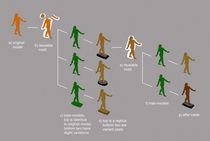
The creation of a may involve a series of and that can differ in size and material depending on the artist’s design process, and ultimately also on the casting process chosen to create the bronze version. The model is a positive version of the sculpture (as opposed to the negative mold); the word may refer to any work made as a step in the preparation of a finished sculpture, at any stage. An existing artwork or a live subject may also serve as model for a bronze. See I.1.
Note: When used in reference to general sculptural practice, the term may refer to a rough sketch made in order to work out the composition (bozzetto, modello, esquisse, or maquette) or to a more complete model (“presentation model”), sometimes used to obtain approval from a patron or as a record or reference. Because a may be the outcome of numerous steps of models and molds, it may be best to refer to the closest model of a cast as “precursor model” (e.g., the wax model melted out of the to create a particular lost-wax cast) since it can be difficult to identify the relationship of a bronze cast to the earliest model in its genealogy. “Precursor model” is a term newly proposed here.
 Open viewer
Figure 1
Open viewer
Figure 1
 Open viewer
Figure 52
Open viewer
Figure 52
 Open viewer
Figure 75
Open viewer
Figure 75
 Open viewer
Figure 130
Open viewer
Figure 130
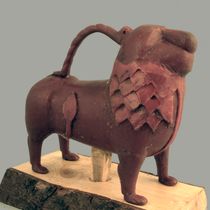 Open viewer
Figure 472
Open viewer
Figure 472
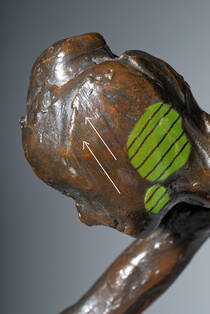 Open viewer
Figure 559
Open viewer
Figure 559
Sources
Cultural Heritage: Dillon, Jo. 2002. “Technical Reports” and “Glossary of Technical Terms.” In Avery, Victoria, Renaissance and Baroque Bronzes from the Fitzwilliam Museum, Cambridge, 276–88, 299–303. London: Daniel Katz Ltd.; Gli Ori.; Motture, Peta. 2019. The Culture of Bronze: Making and Meaning in Italian Renaissance Sculpture. London: V&A Publishing.
Art and Craft Textbook: McCreight, Tim. 1996. Practical Casting: A Studio Reference. Boylston, MA: Brynmorgen Press.
General Dictionary: https://www.merriam-webster.com/dictionary/model [definition 1]
Translations
French:
modèle
Terme générique désignant ici toute réalisation intervenant dans la fabrication d’une sculpture en bronze. Celle-ci peut mobiliser un grand nombre de modèles (et ) successifs (modèle original, , épreuve en cire, etc.).
Note: Le sens donné à modèle est ici plus large que l’« œuvre destinée à être reproduite » (Baudry, Marie Thérèse, and Dominique Bozo. 1978. La sculpture: Méthode et vocabulaire. Principes d’analyse scientifique. Paris: Impr. nationale., 624), et différent du modèle au sens de l’histoire de l’art qui peut revêtir une grande variété de formes (dessin, esquisse, maquette, etc.).
Sources
Cultural Heritage: Baudry, Marie Thérèse, and Dominique Bozo. 1978. La sculpture: Méthode et vocabulaire. Principes d’analyse scientifique. Paris: Impr. nationale., 242–47; Lebon, Elisabeth. 2012. Le Fondeur et le sculpteur: Technique du bronze et histoire de l’art. Paris: Publications de l’Institut national d’histoire de l’art.
Copper Industry: Association Technique de Fonderie, Commission Ingénieurs et Techniciens. 1979. Dictionnaire idéologique de fonderie / Indexed Foundry Dictionary / Systematisches Giessereiwörterbuch. Meudon: Techniques des industries de la Fonderie.
Historical: Boffrand, Germain. 1743. Description de ce qui a été pratiqué pour fondre en bronze d’un seul jet la figure équestre de Louis XIV, élevée par la ville de Paris dans la place de Louis le Grand, en 1699. Paris: Guillaume Cavelier. https://archive.org/details/gri_33125010863229/page/n3., 15–17; Mariette, Pierre-Jean. 1768. Description des travaux qui ont précédé, accompagné et suivi la fonte en bronze d’un seul jet de la statue équestre de Louis XV, le Bien-Aimé, dressée sur les mémoires de M. Lempereur. Paris: Imprimerie de P. G. Le Mercier. https://archive.org/details/gri_33125010908289/mode/2up., 23–26, 69; Diderot, Denis, Jean le Rond d’Alembert et al. 1751. Encyclopédie; ou Dictionnaire raisonné des sciences, des arts et des métiers. 17 vols. Paris: Briasson. http://enccre.academie-sciences.fr/encyclopedie/., 2:436–38, entry « bronze »
German:
Modell
Sources
Association Technique de Fonderie, Commission Ingénieurs et Techniciens. 1979. Dictionnaire idéologique de fonderie / Indexed Foundry Dictionary / Systematisches Giessereiwörterbuch. Meudon: Techniques des industries de la Fonderie.; Fleming, Eckart, and Werner Tilch. 1993. Formstoffe und Formverfahren. Leipzig, Germany: Deutscher Verlag für grundstoffindustrie., 127
Italian:
modello
Sources
“Treccani - La Cultura Italiana - Enciclopedia.” n.d. Accessed April 4, 2023. https://www.treccani.it/enciclopedia/., under modello [definition 3]; Battaglia, S. 1961. Grande dizionario della lingua italiana. Edited by Giorgio Bárberi Squarotti. Turin, Italy: Unione tipografico-editrice torinese. http://www.gdli.it/., under modello [definition 14 and 16, vol. 10, 646]; Cellini, Benvenuto. (1568) 1983. Due Trattati: Uno Intorno Alle Otto Principali Arti Dell’oreficeria: L’altro in Materia Dell’arte Della Scultura, Dove Si Veggono Infiniti Segreti Nel Lavorar Le Figure Di Marmo, & Nel Gettarle Di Bronzo. Edited by Antonio Altomonte. Modena: Edizioni Aldine., 11, fol. 46
Alternate Translations
-
forma
Can refer to both the model and the mold, which leads to potential confusion
-
forma da gittar di bronzo
This is the wax model that is used for casting, thus also possibly referring to the .
Source: Biringuccio, Vannoccio. (1540) 1990. The Pirotechnia of Vannoccio Biringuccio. Translated by Cyril Stanley Smith and Martha Teach Gnudi. New York: American Institute of Mining and Metallurgical Engineers., fol. 82v
Chinese: 模
Source
Hua Jueming |华觉明. 2013. “技术史的研究方法——以失蜡法学案为例 = Research Methodology for History of Technology: Using Lost-Wax Casting as an Example.” 自然科学史研究 = Studies in the History of Natural Sciences 32 (3): 347–59. https://www.ixueshu.com/document/214c9856c461100728794d8529613e51318947a18e7f9386.html.