Chicago
Castelle, Manon, and David Bourgarit. “Case Study 5. One Commission, Two Sculptors, How Many Founders?A Technical Study of Three Renaissance Statues from the
Monument of the Heart of Duke Anne de Montmorency.” In
Guidelines for the Technical Examination of Bronze
Sculpture, by David Bourgarit, Jane Bassett, Francesca G. Bewer, Arlen
Heginbotham, Andrew Lacey, and Peta Motture. Los Angeles: J.
Paul Getty Museum, 2025.
https://www.getty.edu/publications/bronze-guidelines/case-studies/5/.
MLA
Castelle, Manon, and David Bourgarit. “Case Study 5. One Commission, Two Sculptors, How Many Founders?A Technical Study of Three Renaissance Statues from the
Monument of the Heart of Duke Anne de Montmorency.”
Guidelines for the Technical Examination of Bronze
Sculpture, by David Bourgarit et al., J. Paul Getty Museum, 2025,
https://www.getty.edu/publications/bronze-guidelines/case-studies/5/.
Accessed
DD Mon. YYYY.
Case Study 5. One Commission, Two Sculptors, How Many Founders?A Technical Study of Three Renaissance Statues from the
Monument of the Heart of Duke Anne de Montmorency
Manon Castelle
David Bourgarit
Introduction
(fig. 523)
Commissioned in 1571, the Monument of the Heart of Duke
Anne de Montmorency (French, 1493–1567), Constable of
France, includes three
bronzeDefinition: bronze: Depending on the user,
“bronze” may designate a copper alloy that has tin
as the primary added element or any other
copper-based alloy. We recommend using the term
“bronze” specifically for copper-tin alloys unless
qualified by another …More
statues. These were made by two sculptors, Barthélémy
Prieur (French, 1536–1611) and Martin Lefort (French,
active 1562–82). In the archives, only one
founderDefinition: founder: Expert head of the
foundry or the person who pours the metal. Person(s)
responsible for the translation of the artist’s
sculptural model into cast metal sculptures. This
may entail a variety of specialized operations, from
mold making to …More, Nicolas Péron, is associated with the casting of two
of the statues. A technical investigation of the
statues, including metal and
coreDefinition: core: The portion of the
refractory mold that defines the internal space in a
hollow bronze sculpture. It may be formed in a
variety of ways and is usually (but not always) made
of similar material as that used for the outer
portion of the mold. …More
analysis and visual and radiographic examinations, was
undertaken to discern whether Péron might have
castDefinition: cast (v.): In the sculptural
context, the verb refers to pouring a slurry or
liquefied material (e.g., plaster, wax, metal) into
a hollow matrix or mold that will determine the
shape of the material in order to produce a cast
(n.).More
all three and to shed light on the relationship between
the sculptors and the founder(s), which was crucial in
this period of Renaissance bronze statuary.
The commission
In 1571, Madeleine of Savoy, Anne de Montmorency’s wife,
commissioned the architect Jean Bullant (French,
1515–1578) to produce a funerary monument for the heart
of her husband. The monument, now in the Louvre, is
composed of a sculpted stone column that would
originally have been topped by an urn containing the
heart. Bronze allegorical personifications of Abundance,
Peace, and Justice were situated around the base of the
column as witnesses to the character of the deceased.
Bullant charged two sculptors to produce the statues.
Prieur was responsible for Abundance and Peace, and
Lefort made Justice. Péron was commissioned to cast the
statues by Prieur. There is no record of who cast
Lefort’s.
The main questions
(figs. 34, 97, 524)
Considering the number of people who collaborated in
the production of such sculptures (and there were no
doubt more unnamed hands involved as well), can the
physical evidence help clarify who was ultimately in
charge of the production?
Does the technical evidence suggest that the same
founder or different ones worked with the two
sculptors to cast the three sculptures?
Can comparison of the casting processes used for
each of the statues help answer these questions?
What can the characterization and comparison of the
materials used tell us with regard to these
questions?
Visual evidence of lost-wax casting
(figs. 8, 51, 70)
Clear traces of
lost-wax castingDefinition: lost-wax casting: A technique in
which a model made of wax is embedded in a
refractory mold that is heated, thereby melting out
the wax and creating a void to be filled with molten
metal. Two primary variations of the technique are
referred to as “direct” …More
can be found in the modeling of details such as the vine
leaf and cornucopia held by Abundance. They reproduce
the malleable quality of the original model’s material.
ExpandFigure 51Detail of cornucopia showing tool marks in the wax
(green overlay). Marks of metal hammering are also
visible (orange arrows). Barthélemy Prieur (French,
1536–1611), Abundance, cast in 1571 by
Nicolas Péron, H. 128 cm (Musée du Louvre, inv. MR
1681). See Seelig-Teuwen, Bourgarit, and Bewer 2014.
See
fig. 34
for an overall view.
It is also clear from an examination of the inside of
the sculptures that all three are hollow
castsDefinition: cast (n.): A sculpture or more
generally an object that is shaped by pouring a
molten material or a slurry into a mold in which it
will solidify. Plaster of paris, metal, and wax are
among the cast-forming sculptural materials
routinely involved in …More
with relatively thick, uneven metal walls, still
partially filled with the baked, sandy clay cores that
were built around a system of iron
armatureDefinition: armature: Assemblage of joined
metal rods, tubes, and/or wires (and/or other
materials such as wood) that provides a structural
framework for a sculpture and usually attaches to a
base. Though generally internal, it may also include
external …More
rods, as seen here in the interior of Peace.
Internal evidence of unique chaplets
(fig. 38)
The location of
core supportsDefinition: core support: A general term for a
variety of metal or other features that reinforce or
support the core during the casting process. This
term is used in different ways depending on the
context. In industry, it is applied to metal inserts
or spacers …More
is nearly invisible on the radiographs. Endoscopic
examination of the interior metal walls of Justice and
Peace where the core had been removed revealed a rather
unique feature in both: the raised outline of what looks
like a rectangular bronze
patchDefinition: patch: A type of repair most often
mechanically set into the bronze surface, but which
may also be soldered, welded, or cast into place
(see
I.4). Patches are most often made of cut-out pieces of
copper alloy that are the same as …More
with an integral faceted tapering point extending out
from its center. No such
chapletsDefinition: chaplet: A type of metal insertion
placed in the gap between the core and the outer
mold as a spacer to hold the core in place during
the casting operation. A number of these are placed
strategically throughout the mold. They are most
often made of …More
were found in any other large contemporary Parisian
bronzes. That these features are idiosyncratic to these
two casts is a strong indication of their production in
the same foundry. Whether the Abundance has them can’t
be verified as the statue is still largely filled with
core.
A direct lost-wax cast?
(figs. 13, 34, 97, 524)
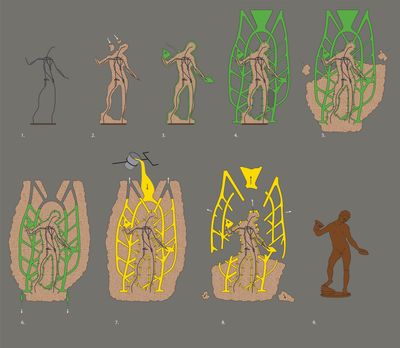
Radiography of the statues showed the relatively thick
metal walls and the shape of the preserved vestiges of
the original armatures. Few wax-to-wax joints are
visible, and the internal surfaces do not conform to
external contours. The latter features further support
the hypothesis that the sculptures were directly cast.
ExpandFigure 13Diagram depicting a version of the direct lost-wax
casting technique: 1) an armature is constructed of
iron rods and wires; 2) a refractory clay investment
is built up over the armature to form the core; 3) a
wax layer is then modeled over the core and details
refined in order to create a unique wax model; 4)
the wax sprue system is joined to the model and core
pins inserted through the wax and into the core; 5)
the wax is invested in a refractory mold; 6) the
mold is heated until dry and all traces of wax are
melted and burned out; 7) the mold is filled with
molten bronze; 8) when the metal is cool, the
investment, core pins, and sprue system are removed;
9) chasing includes polishing, burnishing, and the
addition of texture and sharpening of details as
needed. As a final step, the surface is patinated.
Diagram based on X-radiographs of Adriaen de Vries
(Netherlandish, 1556–1626), Juggling Man,
ca. 1615, H. 76.8 cm (J. Paul Getty Museum, inv.
90.SB.44). See
fig. 79, Bewer 1999.
Armature system
(figs. 34, 97, 524)
The armature systems were mapped out based on the
radiographs for each sculpture, to the extent possible.
The gauge of iron rods seems similar in all three. Both
of Prieur’s figures show that the core of the protruding
arms was bound with wires. The Lefort figure does not
have these, probably because the core was almost
entirely removed.
Conflicting archival evidence
(fig. 23)
It was a surprise to find out from the surviving
contract between Prieur and Peron that the founder was
to produce the wax
modelDefinition: model: The creation of a bronze
may involve a series of models and molds that can
differ in size and material depending on the
artist’s design process, and ultimately also on the
casting process chosen to create the bronze version.
The model is a …More
from a plaster
piece moldDefinition: piece mold: A type of mold
composed of two or more individually formed,
interlocking sections designed to circumvent
undercuts and/or be disassembled without damage to
the model or to the mold sections. Most often refers
to molds made of a rigid …More
that the sculptor had made of his original model. All of
the evidence forced us to reassess our interpretation
and points to some version of the lasagna technique
described by Benvenuto Cellini, the Florentine goldsmith
and sculptor who was active at the French court around
this time (Italian, 1500–1571; see
GI§2.3.2).
Some core could be sampled from underneath each statue.
A new methodology based on the precise measurement of
the size of the quartz inclusions showed that the cores
of the three allegories were not only the same, but very
specific with respect to sixteenth- and
seventeenth-century Parisian bronzes analyzed to date.
Indeed, whereas in most sixteenth- and
seventeenth-century Parisian bronzes,
some of which are represented below, two sizes of inclusions coexist (very small inclusions
of around 5 µm in diameter and much larger ones, up to
150 µm in diameter), in the allegories only large
inclusions are present (100–200 µm).
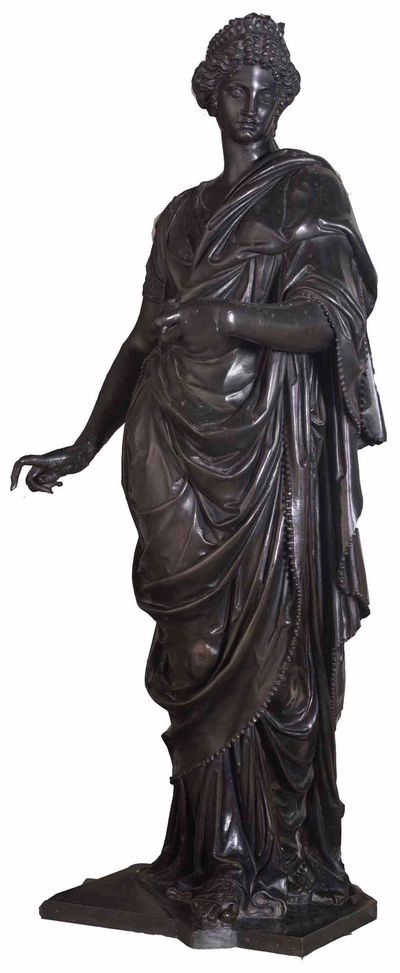
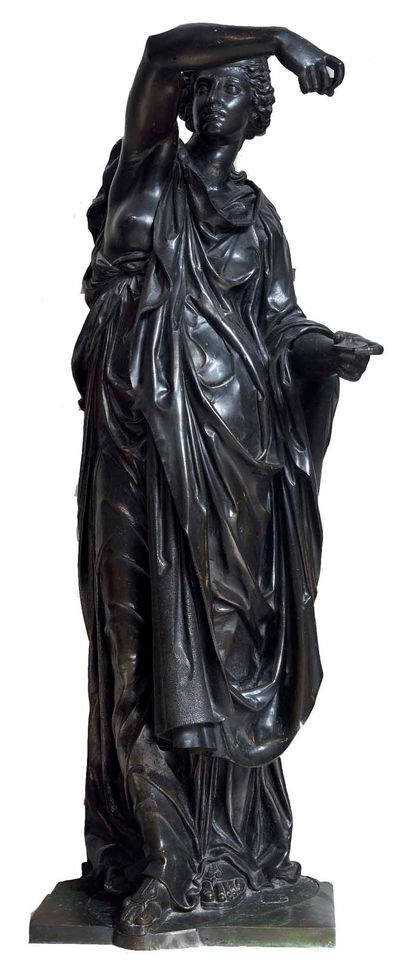
ExpandFigure 405Ponce Jacquiot (French, 1515–1571),
Prudence, Henri II and Catherine of Medici
Funerary Monument, 1567, H. 190 cm (Saint-Denis
Basilica, France). See Castelle 2016.ExpandFigure 406Ponce Jacquiot (French, 1515–1571),
Temperance, Henri II and Catherine of
Medici Funerary Monument, 1567, H. 187 cm
(Saint-Denis Basilica, France). See Castelle
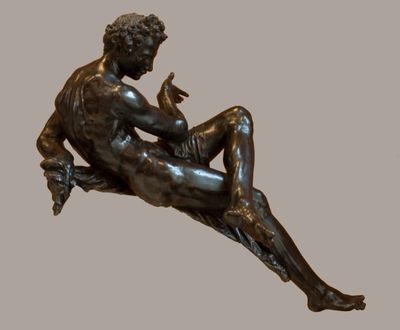
2016.ExpandFigure 526Barthélemy Prieur (French, 1536–1611),
Funerary Genius, Christophe de Thou Monument, 1583–85, L. 109 cm (Musée du Louvre, inv. MR
1685). See Seelig-Teuwen, Bourgarit, and Bewer
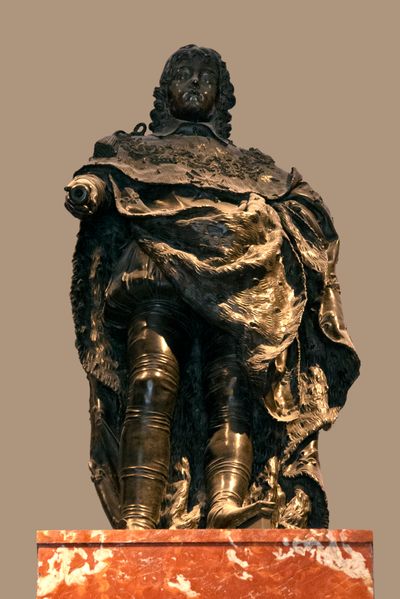
2014.ExpandFigure 527Simon Guillain (French 1581–1658),
Louis XIV as a Child, ca. 1647, H. 153 cm
(Musée du Louvre, inv. MR 3232). See C2RMF Internal
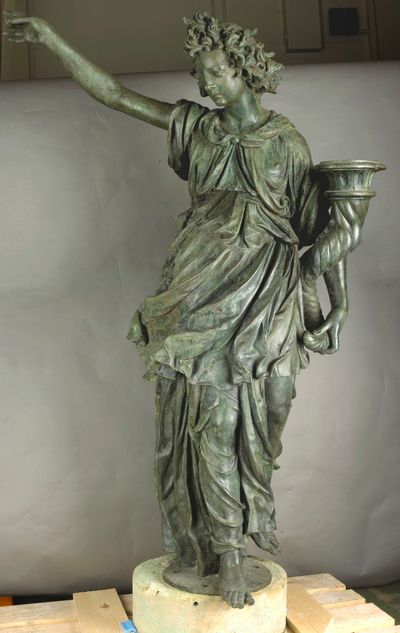
Report 2021.ExpandFigure 274Francesco Bordoni (Italian, 1580–1654),
Torchbearing Angel, 1613, H. 150 cm (École
Nationale Supérieure des Beaux Arts, Paris, inv.
WB38). See Bourgarit, Bewer, and Bresc-Bautier
2014.
The alloys
(fig. 528)
Inductively coupled plasma atomic emission spectroscopy
analysis (ICP-AES; see
II.5§3.1) of a sample drilled from each statue revealed that
Prieur’s Abundance and Peace are made of tin-bronze,
whereas Lefort’s Justice is made of
brassDefinition: brass: A copper alloy with zinc as
the primary added element. As with bronzes, there
are a wide variety of brass alloys.More. Moreover, the very different impurity patterns
suggest disparate copper ore sources. If Péron cast all
three sculptures, he would have been responsible for
preparing and
pouringDefinition: pour: The operation of pouring or
casting metal into the refractory mold.More
the metal. How then to explain the variation in the
alloy types?
Summary of findings
A unique founder?
(figs. 034, 097, 524)
The three figures were cast by a similar method using
idiosyncratic chaplets and a similar core composition,
which strongly suggests that they were cast by the same
founder. The variation in metal composition would
suggest, however, that a different founder may have been
involved. All of Prieur’s large bronzes that were cast
in France are made of tin-bronze. It is possible that he
imposed his choice of alloy on the founder. Conversely,
Lefort was of less renown, with no documented previous
experience in casting, and so he might have left it up
to Péron to work with his preferred alloy, which we
assume was brass (this of course is only a hypothesis;
we unfortunately have no record of other productions by
Péron).
In the end, the sculptors’ different backgrounds and
status led us to speculate that the choice of bronze
alloy adopted for Prieur’s two figures may have been
linked to the artist’s exposure to practices he
encountered in Italy, and that the founder Péron was
willing and able to successfully execute the casts for
the monument in both alloys.
Synopsis of technical parameters
The study was carried out at the C2RMF as a public
service to French museums, and the procedures undertaken
by staff unless indicated. Its total duration was more
than one hundred person-days, as part of Manon
Castelle’s PhD research. The study consisted of:
visual examination: Manon Castelle, David Bourgarit,
and Francesca G. Bewer (Harvard Art Museums). This
was one of the most time-consuming steps in the
study.
daylight photography: Dominique Bagault and Anne
Maigret. Of the circa 100 photos taken per statue,
about half were selected.
X-radiography: Thierry Borel, Jean Marsac, and Elsa
Lambert. The particularly large thickness of the
metal wall and the core filling created a very dense
barrier that pushed the X-ray facilities of the
C2RMF to their limit.
endoscopy: Manon Castelle.
bulk metal analyses by atomic emission spectrometry
(ICP-AES): Nathalie Gandolfo, Jessica Legendre,
Benoit Mille, and David Bourgarit.
core analysis: Manon Castelle and Yvan Coquinot. In
the framework of Castelle’s PhD work, this study
offered the opportunity to develop a new protocol
detailed in
II.7§2.2.4.
Further questions
What was the original
patinaDefinition: patina: The term has at least
three different meanings: 1) a pleasing surface
alteration acquired over time—whether on a
bronze or marble sculpture, furniture, or a
painting—that may add aesthetic value; 2) the
chemical transformation of a metal …More
of the statues? Was it the same for all three?
What was Péron’s training and production prior to
the casting of the allegories? Such information
might provide insight into his alloy preference and
approach to casting sculpture.
Further resources
Bewer, Bourgarit, and Bassett 2009Bewer, Francesca G., David Bourgarit, and Jane
Bassett, “French Bronzes (16th–18th centuries):
Notes on Technique.” In
Cast in Bronze: French Sculpture from Renaissance
to Revolution, ed. Geneviève Bresc-Bautier and Guilhem Scherf
with James David Draper. New York: Metropolitan
Museum of Art; Los Angeles: J. Paul Getty
Museum.
Bresc-Bautier and Scherf 2008Bresc-Bautier, Geneviève, and Guilhem Scherf, eds.
2008.
Bronzes français de la Renaissance au siècle des
lumières. Paris: Musée du Louvre, Somogy.
Castelle 2016Castelle, Manon. 2016. “Les techniques de la
fabrication de la grande statuaire en bronze entre
1540 et 1660 en France.” PhD diss., Université
Paris-Saclay / Versailles
Saint-Quentin-en-Yvelines.
Castelle, Bourgarit, and Bewer 2018Castelle, Manon, David Bourgarit, and Francesca G.
Bewer. 2018. “The Lasagna Method for Lost Wax
Casting of Large 16th-Century Bronzes: Searching for
the Sources.” In
Cuivre, bronzes et laitons médiévaux: Histoire,
archéologie et archéométrie des productions en
laiton, bronze et autres alliages à base de cuivre
dans l’Europe médiévale (12e–16e Siècles) =
Medieval Copper, Bronze and Brass: History,
Archaeology and Archaeometry of the Production of
Brass, Bronze and Other Copper Alloy Objects in
Medieval Europe (12th–16th Centuries), edited by Nicolas Thomas and Pete Dandridge,
297–308. Études et Documents, Archéologie 39. Namur,
Belgium: Agence wallonne du Patrimoine.
Castelle, Coquinot, and Bourgarit 2016Castelle, Manon, Yvan Coquinot, and David
Bourgarit. 2016. “Casting Cores of French Bronze
Statues of the 16th and 17th Centuries:
Identification of Regional Practices and Artistic
Choices.”
Microchemical Journal 126:121–31.
Castelle et al. 2021Castelle, Manon, David Bourgarit, Geneviève
Bresc-Bautier, and Lise Cadot-Leroux. 2021. “Three
Is the Magic Number: Techniques and Materials of the
Prestigious Anne de Montmorency Bronze Virtues.”
Studies in Conservation 28 (April):
1–14.
Grodecki 1986Grodecki, Catherine. 1986.
Documents du Minutier central des notaires de
Paris. Histoire de l’art au XVIème siècle
(1540–1600), Vol. 2,
Sculpture, peinture et gravure, broderie, faïence
et émaillerie, orfèvrerie et joaillerie, armes et
armures. Paris: Archives nationales., 134, 135
Seelig-Teuwen, Bourgarit, and Bewer 2014Seelig-Teuwen, Regina, David Bourgarit, and
Francesca G. Bewer. 2014. “Barthélemy Prieur
Fondeur, son atelier, ses méthodes de travail.” In
French Bronze Sculpture: Materials and Techniques
16th - 18th Century, edited by David Bourgarit, Jane Bassett,
Francesca G. Bewer, Geneviève Bresc-Bautier,
Phillippe Malgouyres, and Guilhem Scherf, 18–38.
London: Archetype.