See figs. 11, 27.
Refers specifically to the reproduction of a once-living form (either plant or animal) that results in a characterized by its high realism and fine detail. Life-casts are made by encasing the form in a and burning out the form, and are therefore generally solid, though there are some exceptions.
Note: The related term “burn-out method” is used for the replication of nonliving forms (such as textiles) in which the form is burned out in order to create the mold.
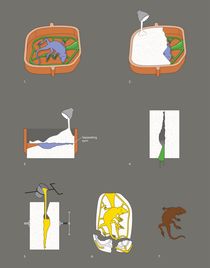
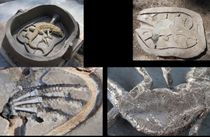
Source
Cultural Heritage: Smith, Pamela H., and Tonny Beentjes. 2010. “Nature and Art, Making and Knowing: Reconstructing Sixteenth-Century Life-Casting Techniques.” Renaissance Quarterly 63:128–79.
To Be Distinguished From
-
casting from life
“Life-casting” is to be distinguished from “casting from life,” in which a reusable mold is taken from a living form (e.g., a tree trunk or a body part) without harming it (e.g., a life mask). Such casts from life may be reproduced any number of times and in different materials.
Synonym
- life casting (alternate spelling)
Translations
French:
fonte sur le vif
Procédé de fonte consistant à enrober un élément végétal ou animal dans un , faire disparaître le modèle par combustion, et remplir de métal liquide le creux ainsi ménagé.
Note: La seule occurrence trouvée dans la littérature ancienne de ce procédé apparaît sous la forme « mouler sur le naturel » (Making and Knowing Project, Pamela H. Smith, Naomi Rosenkranz, Tianna Helena Uchacz, Tillmann Taape, Clément Godbarge, Sophie Pitman, Jenny Boulboullé, Joel Klein, Donna Bilak, Marc Smith, and Terry Catapano, eds. 2020. Secrets of Craft and Nature in Renaissance France: A Digital Critical Edition and English Translation of BnF Ms. Fr. 640. New York: Making and Knowing Project. http://edition640.makingandknowing.org., fol. 110v). Remarquer qu’une fonte sur le vif peut être creuse.
Source
Cultural Heritage: Making and Knowing Project, Pamela H. Smith, Naomi Rosenkranz, Tianna Helena Uchacz, Tillmann Taape, Clément Godbarge, Sophie Pitman, Jenny Boulboullé, Joel Klein, Donna Bilak, Marc Smith, and Terry Catapano, eds. 2020. Secrets of Craft and Nature in Renaissance France: A Digital Critical Edition and English Translation of BnF Ms. Fr. 640. New York: Making and Knowing Project. http://edition640.makingandknowing.org.
German:
Naturabguss
Source
Lein, Edgar. 2004. Ars Aeraria. Die Kunst des Bronzegießens und die Bedeutung von Bronze in der florentinischen Renaissance. Mainz, Germany: von Zabern., 42–45
Alternate Translation
-
Abguss über die Natur
Source: Uhlenhuth, Eduard. 1920. Vollständige Anleitung zum Formen und Giessen. 8th ed. Vienna and Leipzig, Germany: A. Hartleben’s Verlag., 51–53