Glass was one of the first substances invented, possibly as a very fortunate accident during experimentation with glazed pottery or faience. This advance probably took place sometime in the third millennium BCE, in all likelihood in Mesopotamia, and the first objects—monochrome or polychrome, translucent or opaque—were produced in Mesopotamia and Egypt. The indications for glassmaking in Egypt are rare but clear. Initially, simple beads and, later on, decorative elements and inlays were for a very long period the only glass creations, while vessels—polychrome opaque ones—are known only from the fifteenth century BCE onward (cats. 1–5).
Colored glass was available to glass workshops operating in major urban centers in Mesopotamia, Egypt, and the Aegean—with clear stylistic and color differences between them—thanks to the long-distance trade of glass ingots. The fact that all three regions’ workshops were housed in palaces or temples highlights the material’s elite status, and in this era the use of glass vessels was extremely restricted, occurring only in the most affluent social circles. In the Mycenaean world in the second half of the second millennium BCE, many beads and pendants of dark blue and only very rarely white glass were used (cats. 509–532) and a few small unguentaria made with mosaic technique are also noted. In eighth-century BCE Assyria, colorless transparent glass was made for the first time and used for the production of vessels (cat. 6).1
The raw materials required for the production of glass are silica, which is derived from sand; soda (sodium carbonate), of which the main source in historic times was natron from Wadi Natrun in northern Egypt and in other times plant ash;2 and calcium, either as limestone or from the crushed shells already present in sand. Glass was colored through the addition of metallic oxides (iron, manganese, cobalt, copper, lead, antimony).3
Glassmaking—that is, the production of glass out of raw materials—and glassworking, the forming of objects out of preexisting glass, constituted two distinct processes of ancient and medieval glass production that took place in different regions and at different times.4 For example, glass produced in the mid-second millennium BCE in the East—that is, on the Syro-Palestinian coast and in Egypt—was transported in ingot form and sold in distant western regions, where it could be used at any time, depending on the needs and intentions of the glassworker who bought it.
Glass workshops, although they were not supposed to operate within city walls, at least from Roman times onward have been archaeologically attested in almost all cities and towns of the Empire, either near the city walls (outside or inside them) or often housed in abandoned public spaces and buildings at the center of the cities, occasionally within workshop quarters but also around military camps.5
In Classical Greece, core-formed polychrome vessels, mainly unguentaria, and miniature replicas of tableware were produced from the sixth century BCE onward. These apparently were expensive items, meant only for gods, kings, and the highest ranks of society. In the fourth century BCE in Greece and the Near East, colorless transparent glass was reintroduced and fashioned into small objects and fancy tableware vessels apparently used in official or ceremonial banquets. During the Hellenistic period (fourth–first centuries BCE), technical and artistic advancements occurred in glassworking, but glass vessels remained exquisite products, like tableware, almost exclusively drinking vessels, such as bowls, and a few pouring vessels, such amphorae, which were still intended for elite users. It was only in the late Hellenistic period (second–first centuries BCE) that drinking vessels of simpler form and decoration started appearing in bigger numbers, for the first time produced for upper middle-class users.
The invention of the glassblowing technique in the first century BCE for the first time made glass objects even more accessible to wide parts of society and led to the prevalence of glass objects in almost every middle-class household. All classes of tableware were amply produced in glass: drinking vessels (bowls, beakers), vessels for presenting and offering food (dishes, plates, trays), and vessels for pouring liquids and drinks (jugs, decanters, flasks, and bottles). Unguentaria appear in a great variety of shapes and sizes, containing perfumes as well as cosmetic, medical, and religious substances.
For the first time, then, the storage, preservation, and trade of various products, even in large quantities, could be conducted in bulky, completely utilitarian glass vessels. Furthermore, from the third–fourth centuries CE onward a new use of the transparency of glass was devised and glass vessels were used as lamps. Some forms of tableware—bowls and beakers—were altered to serve as lamps, and other special forms were created to meet the needs of society for lighting, which from late antiquity onward were mainly satisfied by glass containers.
Throughout the Late Antique, Byzantine, and medieval periods, and according to social, economic, and commercial fluctuations, glass retained these uses. Glass served people in various ways in their everyday life, on official and important occasions, and finally accompanied them to their graves, where these fragile items were protected from breakage and the consequent recycling that was widely occurring, thereby offering us a better glimpse of the wide variety of shapes, sizes, and colors of these products.
Glass-Forming Techniques
The common feature among all ancient and modern glass-forming techniques is that they make good use of the fact that glass becomes liquid if adequately heated. Then, with the help of gravity—and frequently also of rotation, which helps to maintain an object’s symmetry—the molten glass is formed into the desired shape, using appropriate—and very basic—tools. During the Hellenistic era there was a push to explore the use of a variety of forming techniques. Blowing became the dominant technique after the first century CE.
Core-Forming
Core-forming involves the formation of a vessel with the help of a metal rod, the tip of which has been covered with a core made of a mixture of inorganic and organic materials.6 The exact details of this process are not yet fully known and more than one theory exists about it.7 It seems that the core is coated with a layer of crushed glass mixed with a little water; this procedure is repeated as many times as necessary to obtain the required thickness. The core is then inserted in the furnace opening, where the molten glass fuses and the vessel is formed. Thin threads of glass in contrasting colors with the body are wound around the vessel and dragged up and down, forming festoons, zigzags, or feather-like motifs (fig. 11).8
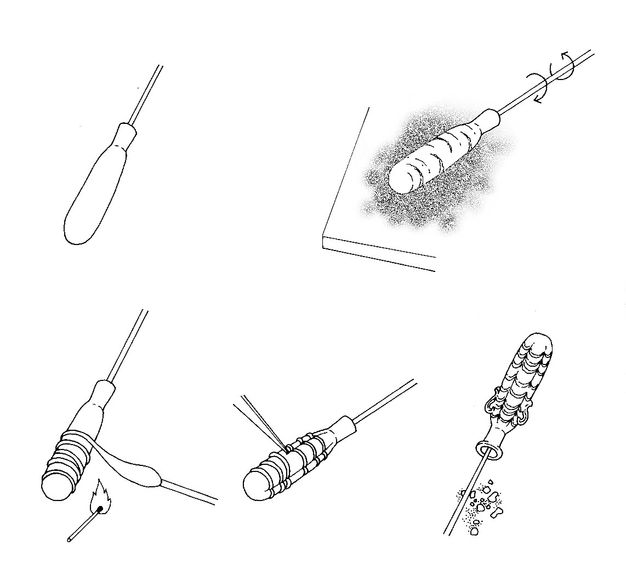
A core of organic and inorganic materials is made on the end of a metal rod; the metal rod is then rolled on crushed glass and is inserted in the kiln until the glass melts and covers the core. The glassworker uses tools to form the rim and neck of the vessel, and then adds handles and base. The decoration is usually made by winding threads of colored glass that are often combed to create a zigzag or feathered pattern.
The earliest recorded appearance of the core-forming technique was in fifteenth-century BCE Mesopotamia and during the second half of the second millennium BCE in Egypt, where local glass production appeared as well. Egyptian glassworking is different in the higher quality of the glass employed, and the greater variety of vessel shapes and decorative themes used. The high quality of the vessels can be connected to the fact that glass was made in workshops associated with royal palaces; such vessels were made exclusively for the use of royalty and high nobility.9 The Egyptian production of core-formed vessels, which include bottles, jugs, amphoriskoi, krateriskoi, beakers, flasks, cups, and other special shapes, has been organized into six major groups or workshops and the Getty collection includes examples of three of them.10 Egyptian glass production of the Pharaonic era is represented in the J. Paul Getty Museum collection by amphoriskoi (cats. 1–2), a krateriskos (cat. 3), a lentoid flask (cat. 4), and a flask (cat. 5) dated in the middle of the second millennium BCE. Between the tenth and the eighth centuries BCE, when they reappear in Mesopotamia, the manufacture of core-formed vessels in Egypt appears to have ceased.11
Very few sites and little infrastructure for glassworking practices are preserved between the discovery of glass in ancient Mesopotamia and the Roman era. Nonetheless, some information can be extracted from written sources, from excavated artifacts related to glass production, and from the products themselves. For instance, Mesopotamian glassmaking recipes, preserved in cuneiform texts, inform us that there were already three types of glassmaking furnaces being used.12 Also, the Hurrian site of Nuzi has yielded the earliest remains of glass manufacturing, dated in the second half of the fourteenth century BCE.13 Finds from fourteenth-century BCE Tel el-Amarna in Egypt have been identified as primary glassworking installations, as were finds from thirteenth-century BCE Qantir, while wall decoration at Karnak from the period of Tuthmosis III (1479–1425 BCE) seems to show blue glass ingots.14 Moreover, preserved glass ingots provide information regarding the form of furnaces and the materials used in firing; they show that glass was manufactured in small-scale crucibles of various shapes, either curved or rectilinear.15 These ingots, discovered in excavations of shipwrecks, also prove that the primary production of glass was already taking place in the middle of the second millennium BCE, in locations and regions that were far distant from the areas in which that glass would eventually be formed into vessels or other solid objects. For example, the glass ingots found in the ca. 1400 BCE shipwreck at Ulu Burun off the western coast of Türkiye may have been made in Egypt. Shipped to Greece, such ingots were formed into blue glass beads (cats. 509–532) by the Mycenaeans.16 The oldest excavated glass workshop, safely dated in the fourth century BCE, was active in the city of Rhodes, Greece, where both vessels and beads were produced.17
Core–formed vessels appear for the first time in the Aegean Sea region in the sixth century BCE, quite probably having been produced on the island of Rhodes. These are genuinely innovative products that do not imitate or evolve from known shapes in the repertoire of Mesopotamian and Egyptian core-formed vessels, but rather render the shapes of contemporaneous Greek clay vessels, in particular alabastra (cats. 10–21), amphoriskoi (small amphorae) (cats. 34–41), aryballoi (cats. 53–56), and oinochoae/juglets (cats. 48–49). It is believed that they were used as unguentaria, intended for aromatic and cosmetic substances.
The earlier examples are dated in the period between the middle of the sixth to the end of the fifth century BCE and appear in large numbers in Rhodes, Macedonia, the Aegean islands, and Italy.18 Two groups are easily discerned among these early examples, those made of dark blue and purple glass decorated with applied white, yellow, and turquoise threads (alabastra, cats. 13–21; amphoriskoi, cats. 35–41; aryballoi, cats. 53–56; oinochoae, cats. 48–49) and those made of milky glass decorated with purple threads (alabastra, cats. 10–11; amphoriskos, cat. 34). Core-formed vessels, like juglets with a spiky appearance (cat. 52), small bowls, and alabastra, were also produced in the Etruscan world from the middle of the seventh century BCE until the first decades of the sixth century BCE.
A second group of core-formed vessels appears after the early fourth century BCE; they were produced until the third century BCE. These vessels probably came from more than one workshop and are found predominantly in mainland Greece, as well as in central and southern Italy and, less often, on the Greek islands. The earlier examples of this group repeat the vessel types of the first group, that is, alabastra (cats. 22–26, 28, and possibly cat. 27), amphoriskoi, aryballoi, and juglets (cats. 50–51), with some differences in shape and decoration, following the morphological evolution of their clay counterparts. Sometime later completely new shapes appear, such as the hydriske, the unguentarium (cat. 42), and the lentoid aryballos.19
The third group of core-formed vessels is dated to the period between the second century BCE and the early first century CE; the centers of production appear to have been in Cyprus and on the Phoenician coast. What sets apart this group from the previous two is that the alabastra (cats. 29–33) and the amphoriskoi (cats. 43–47) it includes are different in shape from the older ones, following the shapes of contemporaneous ceramic vessels.20
Rod-Forming
In this method, a glass object is constructed around a metal mandrel (fig. 12). It was originally intended, and quite often was used, for making beads, pendants, and bracelets. Additionally, it allowed the construction of the tall, narrow vessels that first appeared in Egypt in the fourteenth century BCE,21 in the Near East between the sixth and fourth centuries BCE,22 and in the Hellenistic period.23 Rod-formed cylindrical unguentaria known as “kohl tubes”—probable Iranian products dating to the fifth century BCE—are represented in the J. Paul Getty Museum collection by three ornate examples (cats. 7–9). Moreover, in the fourth and fifth centuries CE this technique was widely used on the Syro-Palestinian coast to form small-size vessels out of brightly colored opaque glass—usually black and turquoise (cats. 376–378)24—with a very few known later examples dated to the seventh and eighth centuries (cat. 379).
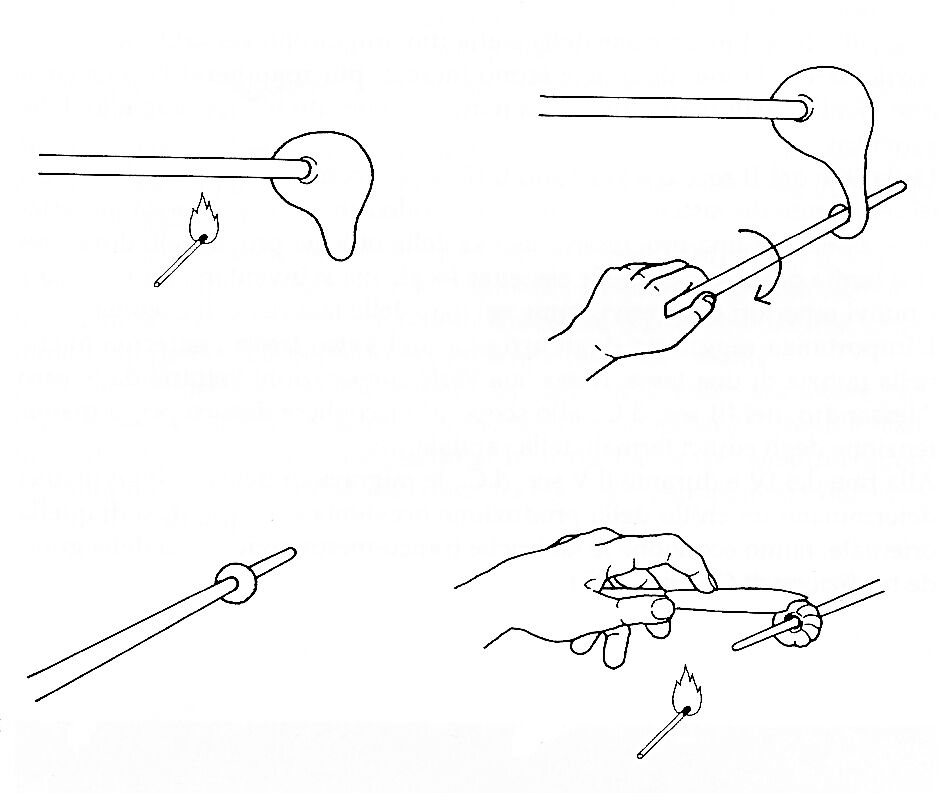
A glass object is formed around a core or metal mandrel. Most beads, pendants, and some core-formed vessels are made by winding the molten glass around a rod.
Casting
Casting in open, one-piece molds was the technique used for the production of the earliest glass objects, such as Egyptian inlays (cats. 443–448) and Mycenaean beads (cats. 509–532). Casting in closed molds is the technique of forming a glass vessel or a solid object like a sculpture (cats. 574–575) through the use of a mold, which is filled with cullet (crushed residual glass) (fig. 13). It is based on the lost-wax casting technique, widely employed in metalworking.25 Cullet was used because it was not possible through ancient pyrotechnologies to achieve temperatures high enough for the glass to melt and be poured into the mold. An early example in the collection of casting and drilling takes the form of an alabastron (cat. 6).
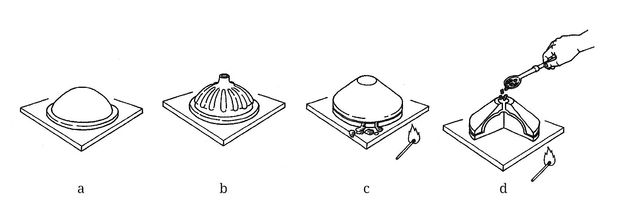
(a) Former. (b) Lower part of the mold is placed on the former. (c) Upper part of the mold is placed on top of the lower part and heated. (d) Cullet of glass is poured into the cavity between the two parts of the mold, then heated and fused to form the vessel.
During the Julio-Claudian era, single-colored, brightly hued glass vessels appeared that had the exact same shape as the clay and silver vessels of that time.26 Although it was once believed that they were cast,27 more recent research indicates that they may have actually been made using a rotary pressing variation (see below) (cats. 75–79).28
Slumping
Slumping is a technique used to form open-shaped vessels by slumping, or sagging, a disk of viscous glass heated in the furnace over a convex former mold or in a concave, open mold; the glass disk gradually slumps and takes the shape of the mold through gravity, with the glassworker’s appropriate tooling.29 This technique appears relatively often in the years before the invention of glassblowing, used for various vessel forms and production methods. What vessels formed by slumping have in common is the fact that human breath was not used in their production. Such vessels were formed by heating the glass and using either a simple, open mold or a bipartite, closed one. In addition, in the early first century CE, slumped and blown mosaic vessels—small- or medium-sized flasks and unguentaria—were produced, illustrating the transition to the free-blowing technique (cats. 148–158).30
Mosaic vessels were made of bands and/or horizontal rod or cane sections of glass, known as florets (cats. 86–157). Masses of hot glass of the adequate colors were put together, tooled, and adhered, creating a wide and thick plaque with the desired motif in large scale in it. This plaque was reheated and pulled out for several meters, producing thus a rod of a much smaller diameter with the design all the way through. Thin discoid sections of these rods or canes were cut and used to form mosaic vessels and architectural and furniture inlays. The bands/cane lengths used were sometimes simpler monochrome or polychrome pieces and other times composite ones, forming intricate motifs, such as spirals, concentric circles, or rosettes. These pieces were heated on a flat surface; placed in contact with each other, they fused together and created a disk, whose perimeter was enclosed by a twisted polychrome—usually white and blue—glass coil. In order to give the mosaic vessel its final form, glassworkers then used the slumping technique on a convex former mold (fig. 14).31 It is possible that for some types of vessels, glassworkers used a bipartite mold, which was filled with discoid tesserae that had been cut from cylindrical canes. The mold was sealed and heated so that the tesserae would fuse. After the vessel was , it was internally polished on a lathe.
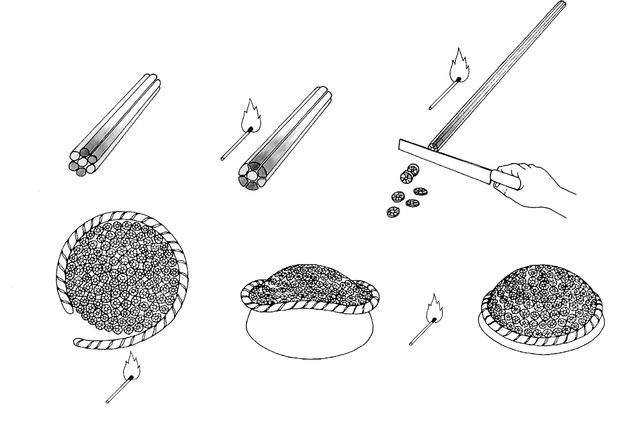
(a) Glass rods of various colors bundled together; (b) heated; (c) stretched and cut in small disks, i.e., florets; (d) florets arranged and heated to form a disk framed by a twisted glass rod; (e) disk slumped over a former mold to assume vessel’s final shape.
A long tradition of mainly monochrome glass inlays placed in cells cut into a wooden background flourished, especially during the Late Period in Egypt (712–332 BCE). They were used to decorate objects intended for religious or funerary purposes. Later, probably in Egypt or also in Italy, in about the late first century BCE through the early first century CE, composite mosaic glass canes were produced which were cut into slices, forming small plaques. They thereby presented a complete miniature theme from fused together glass canes that were tooled to form the appliqué of the incrustation bearing the entire desired motive and pulled out and reduced to the desired minuscule size: geometrical patterns, floral motives, theatrical masks, fish, deities, and imitations of veined stones (cats. 496, 501). These plaques represent the most exquisite and technically refined glass products of the ancient world. They were used to decorate wooden objects, like caskets or boxes, framed with other monochrome or polychrome glass elements, probably used in rows of similar motives.32 A unique trimming of such a rod composed of concentric layers of bright colored glass, which was pierced and used as a pendant, is in the Museum collection (cat. 554). Florets and other sections of mosaic rods and canes were used for the creation of beads (cats. 534–541) representing geometrical patterns or human faces.
Millefiori vessels are recognized as a special type of mosaic vessel even though their forming process was not technically different. Millefiori-vessel tesserae were pieces of composite mosaic canes that had the shape of a flower in cross-section, known as florets. The collection includes two dishes (cats. 86–87) and 28 bowls (cats. 88–112, cats. 114–116) are included.
The twisting network vessels of the reticella type are another category of mosaic vessel, whose forming technique was, however, different. They are made of a distinctive glass cane, composed of one or two thin threads of colored glass twisted onto or inside clear molten glass.33 The vessels were formed by firing and fusing together short canes of the type forming a disk, or by winding a long, hot cane around a former mold with the help of a long, wide, flat wooden tool, the paddle, while the rim was formed by attaching a twisted, bichrome coil.34 In the collection reticella mosaic vessels include fragments of two bowls (cats. 125–126).
Marbled mosaic vessels and gold-band mosaic vessels are formed in a similar way.35 A composite glass cane, with the desired motif formed along its length, was wound spirally on a flat surface. It was then pressed again at regular intervals so that an undulating motion would complement the spiral decorative motif, which resembled the veining of semiprecious stones.36 The vessel assumed its final shape through slumping in a former mold, a process that further distorted the decoration and rendered it even more intricate. In the Museum collection marbled mosaic vessels include four bowls, one plain (cat. 132), and three ribbed (cats. 133–135); a lidded pyxis (cat. 136); and fragments of six unidentified vessel shapes (cats. 137–142). In addition, there are three gold-band vessels: an alabastron (cat. 145), a pyxis (cat. 147), and a flask (cat. 146). Furthermore, in the collection are striped mosaic vessels—that is, vessels made of lengths of mosaic canes—including an alabastron (cat. 117) and six bowls (cats. 118–123, and eight vessels of unidentified shape cats. 124–131).
Some closed-shaped vessels were also formed by firing a blank disk composed of bands of glass. The disk was heated and slumped on an oval former mold made of plaster; gravity allowed its bottom part to acquire a conical shape. This part was then compressed into a narrow cylindrical neck with the help of a paddle. At the end of the process the form was crushed and its remains were removed from the inside of the vessel.37 For examples in the Museum collection, see the gold-band alabastron (cat. 145) and the flask (cat. 146). In the case of gold-band mosaic vessels, a band made of a sheet of gold leaf encased between two layers of transparent glass was used together with other composite bands, each made of two or three different colors of opaque glass. In the collection, three gold-band vessels appear: an alabastron (cat. 145), a flask (cat. 146), and a pyxis (cat. 147).
Rotary Pressing
This technique is almost the same as that of mold pressing, that is, the technique of forming an object by pressing viscous glass into an open mold made of plaster or clay; the only difference is that the former mold is placed on a potter’s wheel so that it can be rotated.
The desired decoration is generated in intaglio on the inside of a plaster mold or former; the mold/former is then placed on the potter’s wheel and preheated viscous glass is pressed onto its walls with a plunger that thus shapes the interior of the vessel. The mold is shattered in order to release the finished vessel.38 It is very likely that cameo glass vessels were at least partly formed through this technique (cats. 82–85).39
The ribbed bowl (cats. 66–74) is a widely circulated vessel form that was produced by a variation of this technique. Even though there are different theories as to the technique that was used to form such bowls, the prevailing one today is the following: a preheated disk of glass is placed on a form in order to receive its final shape, while at the same time it is pressed radially with a rod in order for the relief ribs to be created (fig. 15).40 After this is done, the vessel is momentarily reinserted in the furnace, and the heat to which it is exposed polishes its exterior. The vessel’s interior, as well as the exterior of its rim, is cold-polished on the lathe, a process which leaves visible traces in the form of fine striations.
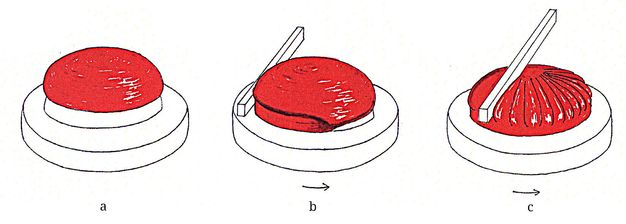
(a) Heated mass of glass slumped on former mold placed on a potter’s wheel; shaping (b) and decorating (c) vessel while slowly rotating.
A class of single-colored, brightly hued vessels appeared in the late first century BCE and were produced into the first half of the first century CE; their shape was identical to that of contemporary clay and silver vessels.41 These used to be considered as cast42 but more recent research suggests that they were produced through a variation of rotary pressing.43 In the Getty collection five bowls are included (cats. 75–79).
Finally, another simple vessel-forming technique, heavily influenced by pottery making, consists in placing a heated mass of glass on a potter’s wheel and forming the vessel’s vertical walls by simultaneously pressing a plunger in the center of the glass and using a paddle on the exterior (fig. 16). These two tools substitute for the potter’s hands. It is thought that this technique was invented in Crete in the early second century BCE; it was used in the production of a particular type of pyxis.44
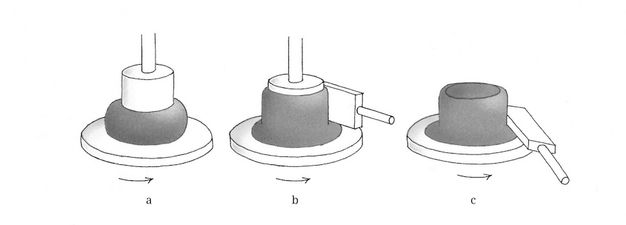
(a) The vessel is formed on a potter’s wheel. (b) The viscous glass is pressed down with a plunger on the rotating lathe. (c) A paddle shapes the outside.
Free-Blowing
The technique of free-blowing involves the inflation and further shaping of molten glass through the use of human breath channeled through a heat-insulated pipe. According to Pliny, glassblowing, or flatu figurare, that is, “shaping by breath,” was one of the three techniques that made Sidon a famous glassworking center.45 The technique was invented in the first half of the first century BCE somewhere in the Syro-Palestinian area, where there was already a centuries-long tradition in glassworking.46 Around the middle of the first century CE, free-blowing began to spread beyond the Syro-Palestinian region to Italy, Switzerland, and Dalmatia.47
The period of the technique’s spread and popularization coincided with the Augustan age—and the resulting political calm and economic flourishing. Moreover, this political situation made possible easy and fast communication between the different provinces. The economic boom in Italy attracted tradesmen and workmen from all over the Empire and especially from the eastern provinces. The quality and quantity of early blown vessels that have been preserved in the West, in contrast to the relative scarcity of such finds in the East, would seem to support this hypothesis. It appears that the blowing technique was perfected in Italy and, as documented also in historical sources,48 particularly in Rome, where glassworkers from the East—Sidonians especially—relocated for financial reasons.49
The free-blowing technique reached maturity with the help of three developments: the invention of the closed, vaulted furnace, in which it is possible to melt glass in a clay crucible or tank, which occurred by the third quarter of the first century CE at the latest;50 the invention of the blowpipe, a hollow rod—probably at first made out of clay and later of metal—through which the vessels were blown;51 the use of the blowpipe or of some other, solid iron rod (a pontil), onto which the half-finished vessel is transferred in order for the vessel’s rim to be formed while it is still hot (fig. 17).
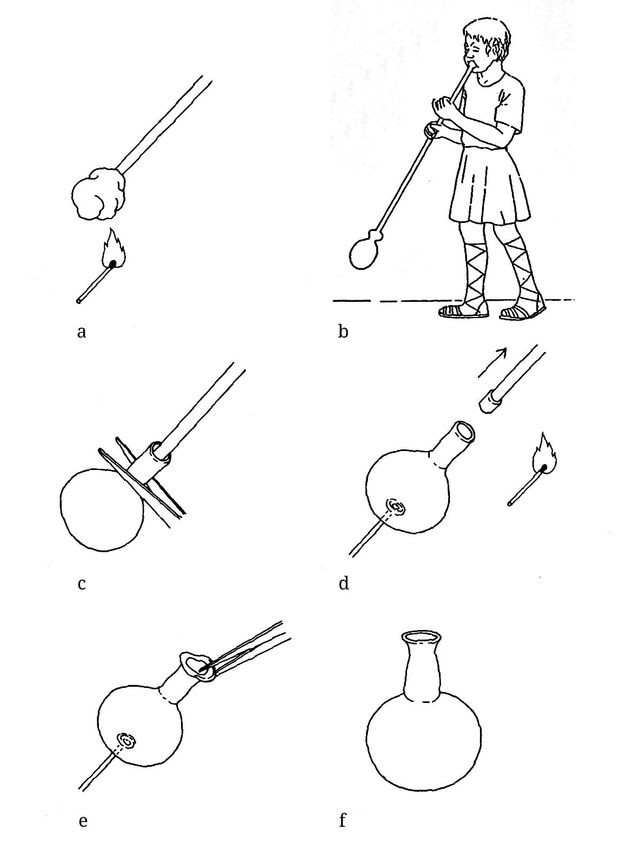
Forming an object by blowing into a mass of hot glass. (a) Blowing is done with the blowpipe, on whose lower end the gob (molten glass) has already been picked up. (b) The parison (bubble of glass at the end of the blowpipe) is produced by the initial act of blowing, and the final product is then formed. (c) The neck and the body are finalized while still attached to the blowpipe. (d) Then a metal rod (pontil/pounty) is attached to the bottom of the vessel and the blowpipe is cut off/removed. (e) While still on the pontil, the vessel’s rim is shaped, and additional elements (handles or decorative elements, e.g., blobs or threads) are applied. (f) The vessel is left to cool (anneal) gradually.
The innovative discovery of blowing rendered the production of glass vessels much easier and more economical, as each vessel could be made with much less glass and the formation process was much swifter in comparison with earlier techniques. Strabo illustrates this shift clearly when he writes that in the second half of the first century CE one could buy a glass vessel for just one copper coin.52 This resulted in the devaluing of glass objects in the economic and aesthetic system of Roman society. The use of glass then spread throughout all social strata, and geographically it reached the most remote parts of the Roman Empire and even beyond. Glass vessels also took on new functions, such as the transport and storage of liquid and solid products in large quantities. Gradually, everyday, utilitarian glass objects began to be sold by the pound.53 Blowing and technical processing in general did not significantly add to the price of glass as a raw material. This clearly points to the simplification of the forming process, as well as to the widespread circulation of glass products, even though they are known to have been ten times more expensive than clay vessels of equal size.54
Free-blown vessels represent the largest group of the Getty Museum vessels, with 148 examples, among them 4 plates and dishes (cats. 229–232), 23 bowls and cups (cats. 233–255), 10 beakers (cats. 256–265), 1 skyphos (cat. 266), 1 kantharos (cat. 267), 2 amphorae (cats. 268–269), 14 flasks (cats. 270–283), 5 guti (cats. 284–288), 18 jugs (cats. 289–306), 1 bottle (cat. 307), and 28 unguentaria (cats. 190–217) (12 handleless, 3 sprinklers, 11 amphoriskoi, 2 oinochoae).
Mold-Blowing
Mold-blown vessels—vessels made by blowing a heated mass of glass into a previously manufactured container, on the inside of which is an intaglio decoration that becomes imprinted on the exterior surface of the vessel being formed—were always a rarity (fig. 18). Even during the time of the technique’s greatest popularity in the first century CE, such items represented only a small fraction of the total glassworking production. This was an important technique from an aesthetic perspective, but quantitatively contributed only very little to the totality of glass production.55 The use of this technique with glass presents special difficulties. Unlike clay, glass does not shrink when cooling; it inserts itself in the most detailed points of the mold’s decoration, where it remains and hardens. It was therefore necessary to use two- and three-part clay or plaster molds56 that were casts of metal or glass originals. The molds were repaired or fully replaced relatively frequently because, upon coming into contact with the hot glass, they were subjected to a strong thermal shock that wore them out after a short period of use.
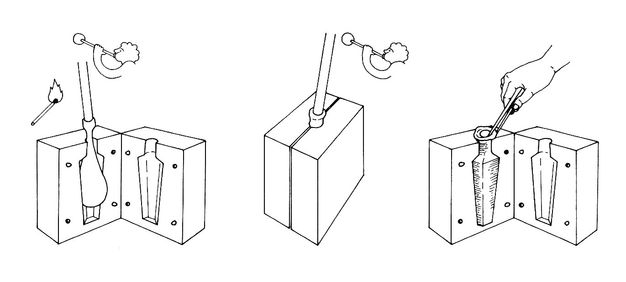
The vessel is formed by blowing into a concave or a specially shaped mold; the vessel is completed with the free-blowing of its rim and the attachment of handles.
Mold-blowing, referred to as argenti modo caelere, according to Pliny, is one of the three techniques that made Sidon a renowned glassworking center.57
The use of multipart molds was invented and developed on the Syro-Palestinian coast, probably in an effort to form glass products that imitated metal prototypes with forged-decorated surfaces.58 Mold-blowing started to be used commercially during the time of Augustus; its development in the western part of the Roman Empire began probably around the middle of the first century CE, with a focus on the production of tableware.59 It remained popular until the end of the Flavian era (69–96 CE), when it was superseded by the facet-cutting technique. Mold-blown vessels continued to be made, albeit sporadically, until the fourth century CE, using a very restricted set of decorative themes that mostly depicted human heads.60 Polygonal eulogia vessels, meant to hold sanctified liquid, water, or oil from the Holy Land, appeared in the eastern Mediterranean in the late sixth and early seventh centuries CE, bearing religious decorations consisting of Christian and Judaic motifs.61
Mold-blown vessels represent a large group among the Getty vessels, with 59 examples. Among them are 10 bowls and cups (cats. 159–168), 6 beakers (cats. 169–174), 6 flasks (cats. 175–180), 9 jugs (cats. 181–189), and 28 unguentaria (cats. 190–217: 12 handleless, 3 sprinklers, 11 amphoriskoi, 2 oinochoae).
Dip Mold–Blown
Dip mold–blowing is a variation on the mold-blowing technique used to produce decorated vessels, fully formed in a mold, with only details like the handle or rim shaped freehand. It comprises vessels that were produced by free-blowing, but whose decorations were first formed in a mold. These vessels acquired their relief decoration during the early stages of blowing by being inserted into a mold or a ring with a relief interior. Then, using free-blowing, they were given their final shape. As a result, the decoration expanded, covering a larger area and thus faded out and extruded less (fig. 19). Throughout the Roman era, dip mold–blowing was employed at various periods, especially during the fourth and fifth centuries CE.62 Additionally, it has been shown that, at least in some cases, engraved decorations were first roughly indicated by blowing the vessel in the appropriate mold before these blanks were completed by wheel-cutting.63
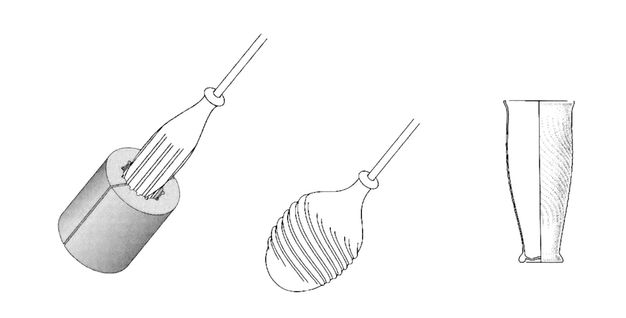
A vessel is partially formed by blowing into an intaglio or specially shaped mold; the vessel then acquires its finished dimensions through free blowing during which the original mold-made decoration is blunted or altered.
Dip mold–blown vessels represent a small group among the Getty vessels, with 11 examples. Among them appear one bowl (cat. 218), one beaker (cat. 219), one amphora (cat. 220), and eight flasks (cats. 221–228).
Decorative Techniques
Wheel-Cutting/Engraving
This technique involves the removal of part of the mass of glass from a vessel with the help of a bowdrill. It was used to partially form some vessels during Classical Greek and Hellenistic times in the second half of the first millennium BCE.64 During the Roman period all the ways of creating engraved decorations known today were in use. These engraved vessels are the vessels known in the historical sources as τορεύματα (“works in relief”);65 their decorations were formed with a rotating stone or metal lathe and pointed metal tools.66 The use of this technique linked glass and glass decorating with minor-object manufacture in general and with the production and decoration of silver and bone vessels and objects in particular.67 The decoration consisted mainly of geometrical patterns, faceting, inscriptions, floral motifs, and figurative scenes. Interesting examples in the collection include among others a plate (cat. 232), bowls (cats. 252, 256), a jug (cat. 290), and a flask (cat. 363).
Cameo Glass
The cameo technique also became linked with engraving. It was traditionally believed that cameo vessels or objects were produced through the repeated blowing, or “casting,” of different-colored layers of glass, that is, a darker background was coated with a white layer, a process repeated when more than one color was used. According to this view, the desired motif was carved into the outer layer through cold-cutting and cold-polishing, thus revealing around it the layer of glass below, a dark-colored background, against which the motif carved on the lighter-colored, upper layer would stand out. However, current scientific opinion holds, more convincingly, that basically the decoration was impressed on the vessel at the very moment of its formation, which occurred through rotary pressing in a mold. In the mold the different-colored plastic elements of the decoration were filled in advance with wet crushed glass, which melted and fused as the semi-viscous glass that would form the inner layer of the vessel body was pressed in (fig. 20).68
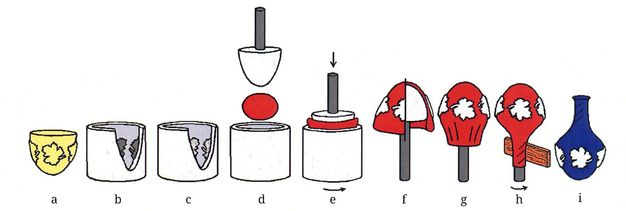
(a) Wax model with decoration in relief. (b) Plaster mold with spaces. (c) Spaces are filled with glass powder, perhaps also with binders. (d) Glass is pressed in. Hot glass melts the powdered glass that is being pressed in. (e) The plaster mold is turned and broken off. (f) The newly made glass is turned upside down. (g) The new glass sags and the rim flows. (h) The rim on the new glass is constricted. (i) The new glass is turned right side up and annealed (cooled).
Very few vessels with cameo decorations have been preserved; most surviving specimens are dated to the late first century BCE and the first half of the first century CE.69 The cameo technique, simplified and executed by wheel-cutting, is revived in the fourth century. These late products differ from the earlier examples in that their body is made of more translucent glass and their decoration is flat with vertical edges.70
In the Getty collection there are four cameo vessels, and among these are two of the most spectacular extant examples, a two-handled footed bowl, or skyphos (cat. 82), and a small flask (cat. 84). The other two examples are fragments of another skyphos (cat. 83) and an unidentified vessel (cat. 85).
Application of Plastic Elements
Decoration with applied plastic threads and coils of varying diameters constitutes the oldest decorative technique in glassworking, known since Pharaonic, Classical Greek, and Hellenistic times, and still in use during Roman times as well. In cases where the thread is attached to the vessel and marvered before the latter acquires its final dimensions, it is fully incorporated into the vessel’s surface and, provided that it is thick enough and appropriately placed, it may resemble the veining in stone vessels. In the first century CE, moreover, marvered and flattened threads, usually white ones on dark-colored vessels, are combined with pressed ribs to create the very particular vessels that are known by the German term “zarte Rippenschalen” (cats. 236, 238).71 Usually, however, the thread is attached after the vessel has acquired its final dimensions and therefore remains a relief decorative element.
In general, there can be discerned the following types of applied elements: (1) Oblong elements, finer threads, and thicker coils—left in relief (flasks and unguentaria, cats. 329, 365, 367, 370) or marvered flush on the surface of the vessel (cat. 298). In the second century CE a particular technique known as snake-threading involved the application of thick, flattened threads that bear a simple geometric motif in relief on their surface (cat. 270). (2) Circular elements, plain, amorphous, or circular blobs—either left in relief (bowls, cats. 254–255) or marvered flush (modiolus, cat. 233, aryballos cat. 352, amphoriskos cat. 355)—and relief decorative medallions.
Gold-Glass, or “Fondi d’Oro”
The gold-glass technique first emerged during the Classical Greek period, used in decorative inlays for couches, thrones and statues,72 while in Hellenistic times it was used for the decoration of vessels.73 It appears to have been forgotten or to have fallen into disuse until the fourth century CE, when it reappeared.
The exact shapes of the vessels on which this technique was applied are not known since no whole vessels have survived. The extant specimens consist of flat vessel bottoms that were discovered, almost in their entirety, embedded in the plaster that sealed tomb openings in the Roman catacombs. Overall, there are known examples of Christian, Jewish, and pagan themes used in the decorations. Among other hypotheses, it has been assumed that such vessels were produced in order to be used as keepsake gifts on formal occasions, such as weddings and anniversaries or the assumption of public office.74
Specific technical details regarding this decoration method remain unclear. In general, it refers to the attachment of a thin sheet of gold leaf to the inside bottom of an open-shaped vessel. The desired theme is engraved on the gold, while in some cases color is added to emphasize particular details. Subsequently, a second of glass is blown inside the vessel, which has already been adequately reheated so that it does not fracture due to thermal shock. The new layer of glass attaches itself to the walls of the vessel, thus sealing and protecting the decoration between two layers of translucent glass.75 This technique is used, both during the fourth century and the sixth century CE, for the production of tesserae as well as of plaques and crustae of opus sectile wall revetments.76 In the Getty collection there are two nineteenth-century replicas of gold-glass bowls (cats. 438–439).
Indentations
While the vessel is still hot it is decorated around its exterior with impressions that are probably intended to imitate the look of forged metal, the more valuable prototypes of glass vessels; the indentations are formed by simple thrusts with the help of pucellas. The same technique was also occasionally applied on clay vessels of the same period.77 The vessel body thus becomes sometimes almost cube-like and other times corrugated in shape. This technique, already used for free-blown vessels since the second half of the first century CE,78 becomes most widespread between the second and fourth centuries CE (cats. 261, 271, 344).79
Pinching
Protrusions of various sizes are created on the surface of the glass vessel with the help of pincers; these projections are usually spread all over the lower part of the vessel body (cats. 282–283, 349) and sometimes form toes (cats. 323–324) or a ring that acts as a substitute for a base (cat. 350). These protrusions are usually flat; they have a small indent in their middle that is sometimes perforated because of the pressure exerted by the pincers.80
This decorative technique appears in the eastern Mediterranean at the end of the second century CE,81 becomes more widespread from the fifth century on, and remains in use until the eighth century, at least in Jordan and in the Syro-Palestinian area (cats. 345–347).82 Pinching was also used for the shaping of scalloped rims, such as in the case of a bowl in the collection (cat. 249).
A technique that produces similar results, but is nonetheless different in terms of production, was used on vessels that have thicker, elongated protrusions, called “fins,” that are more regularly formed and arranged. In all likelihood, the fins in this case were created through mold-blowing. This technique appears around the third century CE83 and remains in use during the fourth century CE84 as well.
Finally, another similar, but more intricate decorative pattern—called “bifurcated” or “Fadendekor”—can also be produced by using pincers before the vessel has acquired its final size. In its simpler form the pattern is composed of vertical relief ribs that decorate the belly of the vessel, from base to shoulders. In its more complex version, the ribs are compressed at regular intervals, creating a rhomboid network.85
Bicoloring
Two or more different colors of glass were used in the production of vessels in Pharaonic Egypt, ancient Greece, the Roman world, and during medieval times. As part of the decoration of a vessel, the handles, the base, or even applied threads or blobs were formed of glass in a bright color that was different from the color of the vessel body.86 See, for example, core-formed alabastra and jugs (cats. 1, 7, 15, 50); mold-blown flasks (cats. 206, 208, 216); a dip mold-blown amphoriskos (cat. 220); and free-blown jugs (cats. 291, 304, 305), jars (cats. 310, 313), and an amphoriskos (cat. 268).
Painting/Enameling
After the Late Classical Greek and Hellenistic periods (fifth–first centuries BCE), painting/enameling was used quite rarely as a decorative technique on glass vessels, occasionally alongside gilding.87 However, glass vessels with rich painted decorations do appear in relatively larger numbers in the last quarter of the first century CE. Pliny, who died in 79 CE, noted that in his time glass was the most adaptable material, useful even for painting.
The material used is a kind of enamel: pulverized glass of the desired hue mixed with a liquid. The mixture is painted on the vessel, which is then heated so that the decoration can fuse to its surface.88 Among the earliest Roman glass vessels decorated with enamel are bowls, such as cat. 239, made between about 40 and 60 CE; these may be one of the forms of painted glass that attracted Pliny’s attention.89
There are known examples of gilded vessels and plaques from the first and second centuries CE. In that period gilding was done after and involved the application of gold leaf onto the surface to be decorated; the design details were then engraved with a pointed tool.90
Finally, the decorations on some third-century vessel lids were cold-painted. To keep the decoration protected from damage—to which it was particularly susceptible because of its means of production—the design was painted in reverse on the inside surface of the lid, intended to be viewed through the glass.91
All of the techniques described above continue in use during the third and fourth centuries CE,92 and they reappear occasionally later, such as during the Middle Byzantine period, between the tenth and thirteenth centuries CE.93
Notes
-
Stern, Eva Marianne, and Birgit Schlick–Nolte. 1994. Early Glass of the Ancient World, 1600 B.C.–A.D. 50: Ernesto Wolf Collection. Ostfildern: Gerd Hatje., pp. 28–37; Nicholson, Paul T., and Julian Henderson. 2000. “Glass.” In Ancient Egyptian Materials and Technology, ed. P. T. Nicholson and I. Shaw, 195–224. Cambridge: Cambridge University Press., pp. 195–224; Rehren, Thilo. 2021. “The Origin of Glass and the First Glass Industries.” In Ancient Glass of South Asia: Archaeology, Ethnography, and Global Connections, ed. A. K. Kanungo and L. Dussubieux. Singapore: Springer. https://doi.org/10.1007/978-981-16-3656-1_1.. ↩︎
-
Nenna, Marie-Dominique, Maurice Picon, and Michele Vichi. 2000. “Ateliers primaires et secondaires en Égypte à l’époque gréco-romaine.” In La route du verre: Ateliers primaires et secondaires du second millénaire av. J.C. au Moyen Âge. Colloque organisé en 1989 par l’Association Française pour l’Archéologie du Verre (AFAV), ed. Marie-Dominique, 97–112. Travaux de la Maison de l’Orient méditerranéen 33. Lyon: Maison de l’Orient et de la Méditerranée Jean Pouilloux., p. 99. ↩︎
-
C. Plini Secundi, Naturalis historiae libri XXXVII recognovit atque indicibus instruxit Ludovicus Janus, vol. 5, Libb. XXXIII–XXXVII. Leipzig, 1878. 36.62, 36.193; Lucius Annaeus Seneca. Epistulae morales ad Lucilium. In L. Annaei Senecae: Ad Lucilium Epistulae Morales, 2 vols., ed. L. D. Reynolds. Oxford, 1965. 90.31, and 105; Brill, Robert H. 1999. Chemical Analyses of Early Glasses. Vol. 1: Catalogue of Samples. Vol. 2: Tables of Analyses. Corning, NY: Corning Museum of Glass., vol. 1, pp. 15–17. ↩︎
-
Glassmaking and glassworking had been considered distinct processes since the fourteenth century BCE, as evidence of glass ingots from the Ulu Burun shipwreck demonstrates. See Bass, George F. 1986. “A Bronze Age Shipwreck at Ulu Burun (Kaş): 1984 Campaign.” American Journal of Archaeology 90: 269–296., pp. 281–282; Nicholson, Paul T., Caroline M. Jackson, and Katharine M. Trott. 1997. “The Ulu Burun Glass Ingots, Cylindrical Vessels, and Egyptian Glass.” Journal of Egyptian Archaeology 83: 143–153., pp. 143–153. ↩︎
-
Antonaras, Anastassios. 2012. Fire and Sand: Ancient Glass in the Princeton University Art Museum. New Haven, CT: Yale University Press., pp. 10–15, wherein previous bibliography. ↩︎
-
Auth, Susan Handler. 1976. Ancient Glass at the Newark Museum from the Eugene Schaefer Collection of Antiquities. Newark, NJ: Newark Museum., p. 20; Stern, Eva Marianne, and Birgit Schlick–Nolte. 1994. Early Glass of the Ancient World, 1600 B.C.–A.D. 50: Ernesto Wolf Collection. Ostfildern: Gerd Hatje., p. 29. ↩︎
-
Stern, Eva Marianne, and Birgit Schlick–Nolte. 1994. Early Glass of the Ancient World, 1600 B.C.–A.D. 50: Ernesto Wolf Collection. Ostfildern: Gerd Hatje., pp. 28–33. ↩︎
-
Harden, Donald B. 1981. Catalogue of Greek and Roman Glass in the British Museum, vol. 1: Core- and Rod-Formed Vessels and Pendants and Mycenean Cast Objects. London: British Museum.; Grose, David Frederick. 1989. Early Ancient Glass: Core-Formed, Rod-Formed, and Cast Vessels and Objects from the Late Bronze Age to the Early Roman Empire, 1600 B.C. to A.D. 50. New York: Hudson Hills Press., pp. 109–125; Stern, Eva Marianne, and Birgit Schlick–Nolte. 1994. Early Glass of the Ancient World, 1600 B.C.–A.D. 50: Ernesto Wolf Collection. Ostfildern: Gerd Hatje., pp. 28–36, 37–44. ↩︎
-
Stern, Eva Marianne, and Birgit Schlick–Nolte. 1994. Early Glass of the Ancient World, 1600 B.C.–A.D. 50: Ernesto Wolf Collection. Ostfildern: Gerd Hatje., p. 26. ↩︎
-
Nolte, Birgit. 1968. Die Glasgefäße im alten Ägypten. Münchner ägyptologische Studien 14. Berlin: Hessling.. ↩︎
-
Stern, Eva Marianne, and Birgit Schlick–Nolte. 1994. Early Glass of the Ancient World, 1600 B.C.–A.D. 50: Ernesto Wolf Collection. Ostfildern: Gerd Hatje., pp. 28–37. ↩︎
-
Oppenheim, A. Leo, Robert H. Brill, Dan Barag, and Axel von Saldern. 1970. Glass and Glassmaking in Ancient Mesopotamia. Corning, NY: Corning Museum of Glass., pp. 69–71. ↩︎
-
Schlick-Nolte, Birgit, and Rosemarie Lierke. 2002. “From Silica to Glass: On the Track of the Ancient Glass Artisans.” In Reflections on Ancient Glass from the Borowski Collection: Bible Lands Museum, Jerusalem, ed. Robert S. Bianchi, 9–40. Mainz: von Zabern., p. 19; Vandiver, Pamela B. 1983. “Glass Technology at the Mid-Second-Millennium B.C. Hurrian Site of Nuzi.” Journal of Glass Studies 25: 239–247., pp. 239–247. ↩︎
-
For the finds from Amarna, see Nicholson, Paul T., Caroline M. Jackson, and Katharine M. Trott. 1997. “The Ulu Burun Glass Ingots, Cylindrical Vessels, and Egyptian Glass.” Journal of Egyptian Archaeology 83: 143–153., pp. 143–153, pl. XVII; Nicholson, Paul T. 2007. Brilliant Things for Akhenaten: The Production of Glass, Vitreous Materials, and Pottery at Amarna Site 0.45.1. Excavation Memoirs. London: Egypt Exploration Society., esp. pp. 125, 158. For the finds from Qantir, see Rehren, Thilo, and Edgar B. Pusch. 1997. “New Kingdom Glass-Melting Crucibles from Qantir-Piramesses.” Journal of Egyptian Archaeology 83: 127–141.. For the finds from Karnak, see Schlick-Nolte, Birgit, and Rosemarie Lierke. 2002. “From Silica to Glass: On the Track of the Ancient Glass Artisans.” In Reflections on Ancient Glass from the Borowski Collection: Bible Lands Museum, Jerusalem, ed. Robert S. Bianchi, 9–40. Mainz: von Zabern., pp. 17–22, figs. 3–4. ↩︎
-
Barag 1985, pp. 107–113; Stern, Eva Marianne, and Birgit Schlick–Nolte. 1994. Early Glass of the Ancient World, 1600 B.C.–A.D. 50: Ernesto Wolf Collection. Ostfildern: Gerd Hatje., p. 20. ↩︎
-
On Mycenaean beads, see Nightingale, Georg. 2002. “Aegean Glass and Faience Beads: An Attempted Reconstruction of a Palatial Mycenaean High-Tech Industry.” In Hyalos Vitrum Glass: History, Technology, and Conservation of Glass and Vitreous Materials in the Hellenic World. First International Conference, ed. George Kordas, 47–54. Athens: Glassnet., with further bibliography. ↩︎
-
Triantafyllidis, Pavlos. 2000. Ροδιακή Υαλουργία Ι: Τα εν θερμώ διαμορφωμένα διαφανή αγγεία πολυτελείας: οι κλασικοί και οι πρώιμοι ελληνιστικοί χρόνοι. Athens: Hypourgeio Aigaiou, 22nd Ephoreia Proistorikon kai Klasikon Arhaiotiton., pp. 36–39, 193–195. ↩︎
-
Harden, Donald B. 1981. Catalogue of Greek and Roman Glass in the British Museum, vol. 1: Core- and Rod-Formed Vessels and Pendants and Mycenean Cast Objects. London: British Museum., pp. 58–99; Grose, David Frederick. 1989. Early Ancient Glass: Core-Formed, Rod-Formed, and Cast Vessels and Objects from the Late Bronze Age to the Early Roman Empire, 1600 B.C. to A.D. 50. New York: Hudson Hills Press., pp. 110–115. ↩︎
-
Harden, Donald B. 1981. Catalogue of Greek and Roman Glass in the British Museum, vol. 1: Core- and Rod-Formed Vessels and Pendants and Mycenean Cast Objects. London: British Museum., pp. 100–121; Grose, David Frederick. 1989. Early Ancient Glass: Core-Formed, Rod-Formed, and Cast Vessels and Objects from the Late Bronze Age to the Early Roman Empire, 1600 B.C. to A.D. 50. New York: Hudson Hills Press., pp. 115–122. ↩︎
-
Harden, Donald B. 1981. Catalogue of Greek and Roman Glass in the British Museum, vol. 1: Core- and Rod-Formed Vessels and Pendants and Mycenean Cast Objects. London: British Museum., pp. 123–141; Grose, David Frederick. 1989. Early Ancient Glass: Core-Formed, Rod-Formed, and Cast Vessels and Objects from the Late Bronze Age to the Early Roman Empire, 1600 B.C. to A.D. 50. New York: Hudson Hills Press., pp. 122–125. ↩︎
-
Stern, Eva Marianne, and Birgit Schlick–Nolte. 1994. Early Glass of the Ancient World, 1600 B.C.–A.D. 50: Ernesto Wolf Collection. Ostfildern: Gerd Hatje., p. 136, with rich bibliography on the Egyptian finds of the kind. ↩︎
-
Barag, Dan. 1975. “Rod-Formed Kohl Tubes of the Mid-First Millennium B.C.” Journal of Glass Studies 17: 23–36., pp. 23–26. ↩︎
-
Ignatiadou, Despoina. 2017. “Gold in Glass.” In Annales du 20e Congrès de l’Association Internationale pour l’Histoire du Verre, Friboug-Romont, 7–11 septembre 2015, ed. Sofie Wolf and Ann de Pury-Gysel, 61–67. Rahden: Marie Leidorf., p. 61; Lierke, Rosemarie. 2001. “With ‘Trial and Error’ through Ancient Glass Technology.” In Hyalos Vitrum Glass: History, Technology, and Conservation of Glass and Vitreous Materials in the Hellenic World. First International Conference, ed. George Kordas, 181–186. Athens: Glassnet., p. 183, fig. 10. ↩︎
-
Barag, Dan. 1975. “Rod-Formed Kohl Tubes of the Mid-First Millennium B.C.” Journal of Glass Studies 17: 23–36., p. 30, note 29; Stern, Eva Marianne. 2001. Roman, Byzantine, and Early Medieval Glass, 10 BCE–700 CE: Ernesto Wolf Collection. Ostfildern-Ruit: Hatje Cantz., p. 144, nos. 78–81. ↩︎
-
Stern, Eva Marianne, and Birgit Schlick–Nolte. 1994. Early Glass of the Ancient World, 1600 B.C.–A.D. 50: Ernesto Wolf Collection. Ostfildern: Gerd Hatje., pp. 50–52; Lierke, Rosemarie. 2001. “With ‘Trial and Error’ through Ancient Glass Technology.” In Hyalos Vitrum Glass: History, Technology, and Conservation of Glass and Vitreous Materials in the Hellenic World. First International Conference, ed. George Kordas, 181–186. Athens: Glassnet., pp. 183–184. ↩︎
-
Grose, David Frederick. 1991. “Early Imperial Roman Cast Glass: The Translucent Coloured and Colourless Fine Wares.” In Two Centuries of Art and Invention, ed. Martine Newby and Kenneth Painter, 1–18. Occasional Papers from the Society of Antiquaries of London 13. London: Society of Antiquaries of London., p. 2; Grose, David Frederick. 1989. Early Ancient Glass: Core-Formed, Rod-Formed, and Cast Vessels and Objects from the Late Bronze Age to the Early Roman Empire, 1600 B.C. to A.D. 50. New York: Hudson Hills Press., p. 254. ↩︎
-
Stern, Eva Marianne, and Birgit Schlick–Nolte. 1994. Early Glass of the Ancient World, 1600 B.C.–A.D. 50: Ernesto Wolf Collection. Ostfildern: Gerd Hatje., pp. 64–65. ↩︎
-
Lierke, Rosemarie, ed. 1999. Antike Glastöpferei: Ein vergessenes Kapitel der Glasgeschichte. Mainz: von Zabern., pp. 58–59. ↩︎
-
Stern, Eva Marianne, and Birgit Schlick–Nolte. 1994. Early Glass of the Ancient World, 1600 B.C.–A.D. 50: Ernesto Wolf Collection. Ostfildern: Gerd Hatje., pp. 68–71. ↩︎
-
Grose, David Frederick. 1989. Early Ancient Glass: Core-Formed, Rod-Formed, and Cast Vessels and Objects from the Late Bronze Age to the Early Roman Empire, 1600 B.C. to A.D. 50. New York: Hudson Hills Press., pp. 261–262; Stern, Eva Marianne, and Sylvia Fünfschilling. 2020. “Blown Mosaic Glass from Augusta Raurica (Switzerland).” Journal of Glass Studies 62: 41–68., pp. 41–68. ↩︎
-
Stern, Eva Marianne, and Birgit Schlick–Nolte. 1994. Early Glass of the Ancient World, 1600 B.C.–A.D. 50: Ernesto Wolf Collection. Ostfildern: Gerd Hatje., pp. 64–65, 68–69. Very enlightening on this matter are the illustrations in Tait, Hugh, ed. 1991. Five Thousand Years of Glass. London: British Museum Press., pp. 219–221, where glassmaker B. Gudenrath recreates the process using modern equipment. ↩︎
-
Bianchi, Robert Steven. 1983. “Those Ubiquitous Glass Inlays from Pharaonic Egypt: Suggestions about Their Functions and Dates.” Journal of Glass Studies 25: 29–35.; Bianchi, Robert Steven. 1983. “Those Ubiquitous Glass Inlays, Part II.” Bulletin of the Egyptological Seminar 5: 11–20.; Grose, David Frederick. 1989. Early Ancient Glass: Core-Formed, Rod-Formed, and Cast Vessels and Objects from the Late Bronze Age to the Early Roman Empire, 1600 B.C. to A.D. 50. New York: Hudson Hills Press., pp. 351–358; Stern, Eva Marianne, and Birgit Schlick–Nolte. 1994. Early Glass of the Ancient World, 1600 B.C.–A.D. 50: Ernesto Wolf Collection. Ostfildern: Gerd Hatje., pp. 61–63, 360–364, 368–409; Nenna, Marie-Dominique. 1995. “Les éléments d’incrustation: Une industrie égyptienne du verre.” In Alessandria e il mondo ellenistico-romano: I centenario del Museo greco-romano. Alessandria, 23–27 novembre 1992. Atti del II Congresso internazionale italo-egiziano, ed. N. Bonacasa et al., 377–384. Rome: Consiglio nazionale delle ricerche.; Auth, Susan Handler. 1999. “Mosaic Glass Mask Plaques and the Ancient Theater.” Journal of Glass Studies 41: 51–72.; Mahnke, Charis. 2008. Alexandrinische Mosaikglaseinlagen: Die Typologie, Systematik und Herstellung von Gesichterdarstellungen in der ptolemäischen Glaskunst. Philippika: Marburger Altertumskundliche Abhandlungen 22. Wiesbaden: Harrassowitz.; Nenna, Marie-Dominique. 2010. Review of C. Mahnke, Alexandrinische Mosaikglaseinlagen: Die Typologie, Systematik und Herstellung von Gesichterdarstellungen in der ptolemäischen Glaskunst. Bibliotheca Orientalis 67, nos. 1–2: 81–85., pp. 81–85. ↩︎
-
Stern, Eva Marianne, and Birgit Schlick–Nolte. 1994. Early Glass of the Ancient World, 1600 B.C.–A.D. 50: Ernesto Wolf Collection. Ostfildern: Gerd Hatje., p. 54. ↩︎
-
Auth, Susan Handler. 1976. Ancient Glass at the Newark Museum from the Eugene Schaefer Collection of Antiquities. Newark, NJ: Newark Museum., p. 54, col. pl. 51; Stern, Eva Marianne, and Birgit Schlick–Nolte. 1994. Early Glass of the Ancient World, 1600 B.C.–A.D. 50: Ernesto Wolf Collection. Ostfildern: Gerd Hatje., pp. 65–66, 274–275; Lierke, Rosemarie, ed. 1999. Antike Glastöpferei: Ein vergessenes Kapitel der Glasgeschichte. Mainz: von Zabern., pp. 39–41. ↩︎
-
Lierke, Rosemarie, ed. 1999. Antike Glastöpferei: Ein vergessenes Kapitel der Glasgeschichte. Mainz: von Zabern., pp. 61–66. ↩︎
-
Weinberg, Gladys D., and Murray C. McClellan. 1992. Glass Vessels in Ancient Greece: Their History Illustrated from the Collection of the National Archaeological Museum, Athens. Athens: Archaeological Receipt Fund., pp. 56–57, no. 48. ↩︎
-
Lierke, Rosemarie, ed. 1999. Antike Glastöpferei: Ein vergessenes Kapitel der Glasgeschichte. Mainz: von Zabern., pp. 64–66; Schlick-Nolte, Birgit, and Rosemarie Lierke. 2002. “From Silica to Glass: On the Track of the Ancient Glass Artisans.” In Reflections on Ancient Glass from the Borowski Collection: Bible Lands Museum, Jerusalem, ed. Robert S. Bianchi, 9–40. Mainz: von Zabern., pp. 29–31. ↩︎
-
Lierke, Rosemarie, ed. 1999. Antike Glastöpferei: Ein vergessenes Kapitel der Glasgeschichte. Mainz: von Zabern., pp. 32–36, 102–103. ↩︎
-
Lierke, Rosemarie, and Matthias R. Lindig. 1997. “Recent Investigations of Early Roman Cameo Glass.” Glastechnische Berichte 70, no. 6: 189–197.; Lierke, Rosemarie, ed. 1999. Antike Glastöpferei: Ein vergessenes Kapitel der Glasgeschichte. Mainz: von Zabern., pp. 67–96. ↩︎
-
Stern, Eva Marianne, and Birgit Schlick–Nolte. 1994. Early Glass of the Ancient World, 1600 B.C.–A.D. 50: Ernesto Wolf Collection. Ostfildern: Gerd Hatje., pp. 72–78. ↩︎
-
Grose, David Frederick. 1991. “Early Imperial Roman Cast Glass: The Translucent Coloured and Colourless Fine Wares.” In Two Centuries of Art and Invention, ed. Martine Newby and Kenneth Painter, 1–18. Occasional Papers from the Society of Antiquaries of London 13. London: Society of Antiquaries of London., p. 2; Grose, David Frederick. 1989. Early Ancient Glass: Core-Formed, Rod-Formed, and Cast Vessels and Objects from the Late Bronze Age to the Early Roman Empire, 1600 B.C. to A.D. 50. New York: Hudson Hills Press., p. 254. ↩︎
-
Stern, Eva Marianne, and Birgit Schlick–Nolte. 1994. Early Glass of the Ancient World, 1600 B.C.–A.D. 50: Ernesto Wolf Collection. Ostfildern: Gerd Hatje., pp. 64–65. ↩︎
-
Lierke, Rosemarie, ed. 1999. Antike Glastöpferei: Ein vergessenes Kapitel der Glasgeschichte. Mainz: von Zabern., pp. 58–59. ↩︎
-
Lierke, Rosemarie, ed. 1999. Antike Glastöpferei: Ein vergessenes Kapitel der Glasgeschichte. Mainz: von Zabern., pp. 37–39; Stern, Eva Marianne, and Birgit Schlick–Nolte. 1994. Early Glass of the Ancient World, 1600 B.C.–A.D. 50: Ernesto Wolf Collection. Ostfildern: Gerd Hatje., pp. 79–81. ↩︎
-
C. Plini Secundi, Naturalis historiae libri XXXVII recognovit atque indicibus instruxit Ludovicus Janus, vol. 5, Libb. XXXIII–XXXVII. Leipzig, 1878. 36.193. For a detailed commentary on the passage, see Stern, E. Marianne. 2007. “Ancient Glass in a Philological Context.” Mnemosyne 60: 341–406., pp. 358–359. ↩︎
-
Israeli, Yael. 1991. “The Invention of Blowing.” In Roman Glass: Two Centuries of Art and Invention, ed. Martine Newby and Kenneth Painter, 46–55. London: Society of Antiquaries., p. 53. ↩︎
-
Stern, E. Marianne. 1999. “Roman Glassblowing in a Cultural Context.” American Journal of Archaeology 103: 441–484., p. 443. ↩︎
-
Strabonis geographica. Ed. A. Meineke. 3 vols. Leipzig, 1877; repr. 1969. 16.2.25. ↩︎
-
Stern, E. Marianne. 2004. “The Glass Banausoi of Sidon and Rome.” In When Glass Matters: Studies in the History of Science and Art from Graeco-Roman Antiquity to [the] Early Modern Era, ed. Marco Beretta, 77–120. Florence: Olschki., pp. 82–83. ↩︎
-
Baldoni, Daniela. 1987. “Una lucerna romana con raffigurazione di officina vetraria: Alcune considerazioni sulla lavorazione del vetro soffiato nell’antichita.” Journal of Glass Studies 29: 22–29.; Stern, Eva Marianne, and Birgit Schlick–Nolte. 1994. Early Glass of the Ancient World, 1600 B.C.–A.D. 50: Ernesto Wolf Collection. Ostfildern: Gerd Hatje., pp. 24–25. ↩︎
-
Stern, E. Marianne. 1999. “Roman Glassblowing in a Cultural Context.” American Journal of Archaeology 103: 441–484., pp. 446–447. ↩︎
-
Strabonis geographica. Ed. A. Meineke. 3 vols. Leipzig, 1877; repr. 1969. 16.2.25. For a detailed commentary on the passage, see Stern 2007, pp. 362–363. ↩︎
-
Barag, Dan. 1985. Catalogue of Western Asiatic Glass in the British Museum, vol. 1. London: British Museum., pp. 113–116. ↩︎
-
Stern, E. Marianne. 1999. “Roman Glassblowing in a Cultural Context.” American Journal of Archaeology 103: 441–484., pp. 460–466. ↩︎
-
Fleming, Stuart J. 1999. Roman Glass: Reflections on Cultural Change. Philadelphia: University of Pennsylvania Museum of Archaeology and Anthropology., p. 42. For a general overview of finds from different areas, as well as of specific techniques and products, see Fontaine-Hodiamont, Chantal, Catherine Bourguignon, and Simon Laevers, eds. 2010. D’Ennion au Val Saint-Lambert: Le verre soufflé-moulé. Actes des 23ème Rencontres de l’Association Française pour l’Archéologie du Verre. Colloque international, Bruxelles-Namur, 17–19 octobre 2008. Scientia Artis 5. Brussels: Institut royal du patrimoine artistique.. A concise overview of what is known about this technique can be found in Stern, E. Marianne. 2010. “Souffler le verre dans des moules.” In D’Ennion au Val Saint-Lambert: Le verre soufflé-moulé. Actes des 23ème Rencontres de l’Association Française pour l’Archéologie du Verre. Colloque international, Bruxelles-Namur, 17–19 octobre 2008, ed. Chantal Fontaine-Hodiamont, Catherine Bourguignon, and Simon Laevers, 25–37. Scientia Artis 5. Brussels: Institut royal du patrimoine artistique.. For an example of finds from a large Mediterranean city, see Antonaras, Anastassios. 2010. “Roman and Early Christian Mold-Blown Vessels from Thessaloniki and Its Region, First–Fifth Centuries A.D.” In D’Ennion au Val Saint-Lambert: Le verre soufflé-moulé. Actes des 23ème Rencontres de l’Association Française pour l’Archéologie du Verre. Colloque international, Bruxelles-Namur, 17–19 octobre 2008, ed. Chantal Fontaine-Hodiamont, Catherine Bourguignon, and Simon Laevers, 241–252. Scientia Artis 5. Brussels: Institut royal du patrimoine artistique.. ↩︎
-
Stern, Eva Marianne. 1995. The Toledo Museum of Art. Roman Mold-Blown Glass: The First through Sixth Centuries. Rome: “L’Erma” di Bretschneider., pp. 46–47. ↩︎
-
C. Plini Secundi, Naturalis historiae libri XXXVII recognovit atque indicibus instruxit Ludovicus Janus, vol. 5, Libb. XXXIII–XXXVII. Leipzig, 1878. 36.193. For a detailed commentary on this passage, see Stern, E. Marianne. 2007. “Ancient Glass in a Philological Context.” Mnemosyne 60: 341–406., pp. 359–362. ↩︎
-
Isings, Clasina. 1957. Roman Glass from Dated Finds. Groningen: Wolters., p. 45, type 31. ↩︎
-
Stern, Eva Marianne. 2001. Roman, Byzantine, and Early Medieval Glass, 10 BCE–700 CE: Ernesto Wolf Collection. Ostfildern-Ruit: Hatje Cantz., p. 41. ↩︎
-
Stern, Eva Marianne. 1995. The Toledo Museum of Art. Roman Mold-Blown Glass: The First through Sixth Centuries. Rome: “L’Erma” di Bretschneider., pp. 201–246. On the production of mold-blown and dip mold-blown vessels in a large Mediterranean center like Thessaloniki throughout the Roman period and on the relation and juxtaposition of this technique with free-blowing, see Antonaras, Anastassios. 2010. “Roman and Early Christian Mold-Blown Vessels from Thessaloniki and Its Region, First–Fifth Centuries A.D.” In D’Ennion au Val Saint-Lambert: Le verre soufflé-moulé. Actes des 23ème Rencontres de l’Association Française pour l’Archéologie du Verre. Colloque international, Bruxelles-Namur, 17–19 octobre 2008, ed. Chantal Fontaine-Hodiamont, Catherine Bourguignon, and Simon Laevers, 241–252. Scientia Artis 5. Brussels: Institut royal du patrimoine artistique., p. 252. ↩︎
-
Barag, Dan. 1970. “Glass Pilgrim Vessels from Jerusalem, Part I.” Journal of Glass Studies 12: 35–63., pp. 35–63; Barag, Dan. 1971. “Glass Pilgrim Vessels from Jerusalem, Parts II–III.” Journal of Glass Studies 13: 45–63., pp. 45–63; Stern, Eva Marianne. 1995. The Toledo Museum of Art. Roman Mold-Blown Glass: The First through Sixth Centuries. Rome: “L’Erma” di Bretschneider., pp. 247–269; Newby, Martine. 2008. Byzantine Mould-Blown Glass from the Holy Land with Jewish and Christian Symbols (S. Moussaieff Collection). London: Shlomo Moussaieff., passim and see pp. 12–17 for an introduction. ↩︎
-
Price, Jennifer, and Sally Cottam. 1998. Romano-British Glass Vessels: A Handbook. Practical Handbook in Archaeology 14. York: Council for British Archaeology., p. 13; Stern, Eva Marianne. 2001. Roman, Byzantine, and Early Medieval Glass, 10 BCE–700 CE: Ernesto Wolf Collection. Ostfildern-Ruit: Hatje Cantz., pp. 27, 133–134. ↩︎
-
Sorokina, Nina. 1978. P. “Facettenschliffgläser des 2–3 Jhd. u.Z. aus dem Schwarzmeergebiet.” In Annales du 7e Congrès de l’Association Internationale pour l’Histoire du Verre, Berlin-Leipzig, 15–21 août 1977, 111–122. Liège: Ed. du Secrétariat général., pp. 118–119, pl. 4.2; this technique has been traced in a workshop of the second and/or third century CE at Tanais, on the Black Sea. ↩︎
-
Ignatiadou, Despoina. 2017. “Gold in Glass.” In Annales du 20e Congrès de l’Association Internationale pour l’Histoire du Verre, Friboug-Romont, 7–11 septembre 2015, ed. Sofie Wolf and Ann de Pury-Gysel, 61–67. Rahden: Marie Leidorf., p. 61. ↩︎
-
M. Val. Martialis. Epigrammata selecta. Ed. W. M. Lindsay. Oxford. 11.11 and 12.74. Clément d’Alexandrie. Le pédagogue. Ed. M. Harl, H.-I. Marrou, C. Matray, and C. Mondésert. 3 vols. Sources chrétiennes 70 (1960); 108 (1965); 158 (1970). Paris. 2.3.35. For detailed commentary on the passages, see Trowbridge, Mary Luella. 1930. Philological Studies in Ancient Glass. University of Illinois Studies in Language and Literature 13, nos. 3–4. Urbana: University of Illinois Press., pp. 109, 166, respectively. ↩︎
-
This technique has been studied in detail in Paolucci, Fabrizio. 1997. I vetri incisi dall’Italia settentrionale e dalla Rezia, nel periodo medio e tardo imperiale. Florence: All’insegna del Giglio., pp. 17–20 and passim. On techniques that survived through the Middle Ages and in more recent times, see Charleston, R. J. 1964. “Wheel-Engraving and -Cutting: Some Early Equipment. I. Engraving.” Journal of Glass Studies 6: 83–100., pp. 83–100 and Charleston, R. J. 1965. “Wheel-Engraving and -Cutting: Some Early Equipment. ΙΙ. Water-Power and Cutting.” Journal of Glass Studies 7: 41–54., pp. 41–54. ↩︎
-
Paolucci, Fabrizio. 1997. I vetri incisi dall’Italia settentrionale e dalla Rezia, nel periodo medio e tardo imperiale. Florence: All’insegna del Giglio., pp. 63–80. ↩︎
-
Lierke, Rosemarie, ed. 1999. Antike Glastöpferei: Ein vergessenes Kapitel der Glasgeschichte. Mainz: von Zabern., pp. 67–96, esp. 83–85. On older hypotheses regarding the way of production, see Gudenrath, William, and David Whitehouse. 1990. “The Manufacture of the Vase and Its Ancient Repair.” Journal of Glass Studies 32: 108–121.; Painter, Kenneth, and David Whitehouse. 1990. “The Place of the Vase in Roman Glassmaking.” Journal of Glass Studies 32: 126–129.; Painter, Kenneth, and David Whitehouse. 1990. “Early Roman Cameo Glasses.” Journal of Glass Studies 32: 138–165.; Sternini, Mara. 1995. La fenice di sabbia: Storia e tecnologia del vetro antico. Bibliotheca archaeologica 2. Bari: Edipuglia., pp. 120–121. ↩︎
-
Whitehouse, David. 1991. “Cameo Glass.” In Roman Glass: Two Centuries of Art and Invention, ed. M. Newby and K. Painter, 19–32. London: Society of Antiquaries of London.. ↩︎
-
Whitehouse, David. 1990. “Late Roman Cameo Glass.” In Annales du 11e Congrès de l’Association International pour l’Histoire du Verre, Bâle, 29 août–3 septembre 1988, 193–198. Amsterdam: AIHV.. For an overview on the matter with many examples from the Corning Museum of Glass collection, see Whitehouse, David B. 1997. Roman Glass in the Corning Museum of Glass, vol. 1. Corning, NY: Corning Museum of Glass., pp. 41–65. ↩︎
-
Stern, Eva Marianne. 2001. Roman, Byzantine, and Early Medieval Glass, 10 BCE–700 CE: Ernesto Wolf Collection. Ostfildern-Ruit: Hatje Cantz., pp. 81–82. ↩︎
-
Stern, Eva Marianne. 1999. “Ancient Glass in Athenian Temple Treasures.” Journal of Glass Studies 41: 19–50., pp. 40–41; Ignatiadou, Despoina, Elissavet Dotsika, A. Kouras, and Yiannis Maniatis. 2005. “Nitrum Chalestricum: The Natron of Macedonia.” In Annales du 16e Congrès de l’Association Internationale pour l’Histoire du Verre, London, 7–13 septembre 2003, 64–67. Nottingham: AIHV.. ↩︎
-
The term is used for the first time in Athenaei Naucratitae deipnosophistarum libri XV. Ed. G. Kaibel. 3 vols. Leipzig, 1887 and 1890; repr., Stuttgart, 1965 and 1966. 5.199f, in relation to glass vessels. For a commentary on the passage, see Trowbridge, Mary Luella. 1930. Philological Studies in Ancient Glass. University of Illinois Studies in Language and Literature 13, nos. 3–4. Urbana: University of Illinois Press., pp. 110, 154, note 23. For gilded vessels of this period, see Stern, Eva Marianne, and Birgit Schlick–Nolte. 1994. Early Glass of the Ancient World, 1600 B.C.–A.D. 50: Ernesto Wolf Collection. Ostfildern: Gerd Hatje., pp. 262–267, nos. 69–70; Ignatiadou, Despoina. 2000. “Three Cast Glass Vessels from a Macedonian Tomb in Pydna.” In Annales du 14e Congrès de l’Association Internationale pour l’Histoire du Verre, Italia/Venezia-Milano 1998, 35–38. Lochem: AIHV., pp. 35–36, figs. 1–4; Arveiller-Dulong, Véronique, and Marie-Dominique Nenna. 2000. Les verres antiques du Musée du Louvre 1: Contenants à parfums en verre moulé sur noyau et vaisselle moulée: VIIe siècle avant J.-C.–Ier siècle après J.-C. Paris: Somogy., pp. 168–171. ↩︎
-
Cameron, Averil. 1996. “Orfitus and Constantius: A Note on Roman Gold-Glasses.” Journal of Roman Archaeology 9: 295–301.. ↩︎
-
Stern, Eva Marianne. 2001. Roman, Byzantine, and Early Medieval Glass, 10 BCE–700 CE: Ernesto Wolf Collection. Ostfildern-Ruit: Hatje Cantz., pp. 139–140. ↩︎
-
Antonaras, Anastassios. 2008. “Glass and Obsidian Plaques from the Apostle Paul’s Basilica at Kephalari, Argos.” Journal of Glass Studies 50: 298–302., pp. 298–302. ↩︎
-
E.g., a fourth-century CE vessel from Thessaloniki (acc. no. ΒΚ 4467/186 in Museum of Byzantine Culture, Thessaloniki), rendering in clay a glass vessel of Isings’s form 103 with indentations around the body. ↩︎
-
Isings, Clasina. 1957. Roman Glass from Dated Finds. Groningen: Wolters., p. 46, form 32, and p. 49, form 35. ↩︎
-
Price, Jennifer, and Sally Cottam. 1998. Romano-British Glass Vessels: A Handbook. Practical Handbook in Archaeology 14. York: Council for British Archaeology., p. 33; Stern, Eva Marianne. 2001. Roman, Byzantine, and Early Medieval Glass, 10 BCE–700 CE: Ernesto Wolf Collection. Ostfildern-Ruit: Hatje Cantz., pp. 209–211, 242–243, nos. 99–101, 128–129. ↩︎
-
Stern, Eva Marianne. 2001. Roman, Byzantine, and Early Medieval Glass, 10 BCE–700 CE: Ernesto Wolf Collection. Ostfildern-Ruit: Hatje Cantz., p. 248, no. 134, where there is also a relevant bibliography. ↩︎
-
Price, Jennifer, and Sally Cottam. 1998. Romano-British Glass Vessels: A Handbook. Practical Handbook in Archaeology 14. York: Council for British Archaeology., pp. 32–33; Stern 2001, pp. 249–251, nos. 135–137. ↩︎
-
Dussart, Odile. 1998. Le verre en Jordanie et en Syrie du sud. Bibliothèque archéologique et historique 152. Beirut: Institut Français d’Archéologie du Proche-Orient., p. 128, BX 111a, table 32/1, p. 158, BX 83, table 46/21, p. 161, BXII.1, table 49/1; Stern, Eva Marianne. 2001. Roman, Byzantine, and Early Medieval Glass, 10 BCE–700 CE: Ernesto Wolf Collection. Ostfildern-Ruit: Hatje Cantz., p. 354, no. 201; Gorin-Rosen, Yael. 2006. “The Glass Vessels from Khirbat Ka’kul.” ‘Atiqot 54: 107–112., p. 111, note 7. ↩︎
-
Weinberg, Gladys D., and Murray C. McClellan. 1992. Glass Vessels in Ancient Greece: Their History Illustrated from the Collection of the National Archaeological Museum, Athens. Athens: Archaeological Receipt Fund., p. 132, no. 107; Fremersdorf, Fritz, and Edeltraud Polónyi-Fremersdorf. 1984. Die farblosen Gläser der Frühzeit in Köln, 2. und 3. Jahrhundert. Die Denkmäler des römischen Köln 9. Bonn: Habelt., p. 65, nos. 152–153. ↩︎
-
Dussart, Odile. 1998. Le verre en Jordanie et en Syrie du sud. Bibliothèque archéologique et historique 152. Beirut: Institut Français d’Archéologie du Proche-Orient., p. 162, BXII 214, table 49/7. ↩︎
-
Weinberg, Gladys D. 1988. Excavations at Jalame: Site of a Glass Factory in Late Roman Palestine. Columbia: University of Missouri Press., pp. 3, 80–81, cat. nos. 351–353, drawing in table 4-39, photo in table 4-15/351, 352, where there is also an older bibliography, as well as technical and production details. ↩︎
-
For typical examples from various periods and places of origin, see Stern, Eva Marianne, and Birgit Schlick–Nolte. 1994. Early Glass of the Ancient World, 1600 B.C.–A.D. 50: Ernesto Wolf Collection. Ostfildern: Gerd Hatje., pp. 137, 205, 237, 279, nos. 8, 43, 59, 76; Stern, Eva Marianne. 2001. Roman, Byzantine, and Early Medieval Glass, 10 BCE–700 CE: Ernesto Wolf Collection. Ostfildern-Ruit: Hatje Cantz., pp. 70, 119, 193, 235, 238, nos. 13, 49, 84, 121, 124. ↩︎
-
Stern, Eva Marianne, and Birgit Schlick–Nolte. 1994. Early Glass of the Ancient World, 1600 B.C.–A.D. 50: Ernesto Wolf Collection. Ostfildern: Gerd Hatje., pp. 262–267, nos. 69–70; Ignatiadou, Despoina. 2000. “Three Cast Glass Vessels from a Macedonian Tomb in Pydna.” In Annales du 14e Congrès de l’Association Internationale pour l’Histoire du Verre, Italia/Venezia-Milano 1998, 35–38. Lochem: AIHV., pp. 35–36, figs. 1–4; Arveiller-Dulong, Véronique, and Marie-Dominique Nenna. 2000. Les verres antiques du Musée du Louvre 1: Contenants à parfums en verre moulé sur noyau et vaisselle moulée: VIIe siècle avant J.-C.–Ier siècle après J.-C. Paris: Somogy., pp. 168–171. ↩︎
-
Rütti, Beat. 1991. “Early Enamelled Glass.” In Two Centuries of Art and Invention, ed. Martine Newby and Kenneth Painter, 122–136. Occasional Papers from the Society of Antiquaries of London 13. London: Society of Antiquaries of London.. ↩︎
-
Rütti, Beat. 1991. “Early Enamelled Glass.” In Two Centuries of Art and Invention, ed. Martine Newby and Kenneth Painter, 122–136. Occasional Papers from the Society of Antiquaries of London 13. London: Society of Antiquaries of London., pp. 134–135. ↩︎
-
Whitehouse, David B. 2001. Roman Glass in the Corning Museum of Glass, vol. 2. Corning, NY: Corning Museum of Glass., pp. 254, 273–274, no. 866. ↩︎
-
Vessberg, Olof. 1952. “Roman Glass in Cyprus.” Opuscula Archaeologica 7: 109–165., type I lid, pp. 149–150, table X, no. 5; Whitehouse, David B. 2001. Roman Glass in the Corning Museum of Glass, vol. 2. Corning, NY: Corning Museum of Glass., p. 264, no. 859. ↩︎
-
Whitehouse, David B. 2001. Roman Glass in the Corning Museum of Glass, vol. 2. Corning, NY: Corning Museum of Glass., pp. 253–277. ↩︎
-
Grabar, André. 1971. “La verrerie d’art byzantine au Moyen Âge.” Monuments et mémoires de la Fondation Eugène Piot 57: 89–127., pp. 90–106; Whitehouse, David. 1998. “Byzantine Gilded Glass.” In Gilded and Enamelled Glass from the Middle East, ed. Rachel Ward, 4–7. London: British Museum Press., pp. 4–7; Antonaras, Anastassios. 2010. “Early Christian and Byzantine Glass Vessels: Forms and Uses.” In Byzanz—das Römerreich im Mittelalter 1: Welt der Ideen, Welt der Dinge, ed. Falko Daim and Joerg Drauschke, 383–430. Monographien des Römisch-Germanischen Zentralmuseums 84. Mainz: Römisch-Germanisches Zentralmuseum., pp. 395–397. ↩︎