J. Paul Getty’s earliest purchases of ancient art predate the founding of the museum itself. The evolution of the collection from the first acquisition of ancient glass in 1940 until today reflects shifting goals, interests, and audiences over more than half a century. The colorful and varied glass objects in the collection have extensive histories of prior ownership that can stretch back decades and in some cases centuries, and the circumstances of the Getty’s acquisition of the works, as well as their public display, are also notable. Despite the popularity of ancient glass among collectors since the late eighteenth century, researching the provenance of these objects is often challenging.1 Ancient glass vessels share common shapes and many times are not distinctive enough to be identified without a detailed illustration. Typically, only the most exceptional works were documented with published drawings and photographs. Nevertheless, ongoing research has helped expand the documented histories of the collection.
Numbering nearly 600 objects, the Getty’s ancient glass holdings include J. Paul Getty’s personal collection (1940–54), objects Getty bought for the Ranch House Museum and the Villa (1954–76), and subsequent acquisitions purchased on the art market and from private collectors.2 The final and most substantial acquisition was a large selection of objects from the important Erwin Oppenländer glass collection in 2003 and 2004.
By the 1930s J. Paul Getty had started actively acquiring art, sporadically purchasing decorative arts, tapestries, and paintings from auction houses and dealers in Europe and New York. During an extended visit to Rome in the summer months of 1939, Getty frequented the city’s museums and archaeological sites, and this stay sparked a serious interest in collecting ancient sculpture.3 Getty bought his first antiquities that summer, including three marbles from the dealer Alfredo Barsanti in Rome: a torso of Aphrodite (later determined to be a modern forgery) and two portrait heads of imperial women.4 Following the outbreak of World War II in the fall of 1939, Getty returned to New York. In the spring of 1940, he acquired a group of 16 ancient glass vessels at the auction of the Harry Leonard Simmons collection through French & Co., the New York decorative arts dealer who acted as Getty’s trusted agent (fig. 1).5 These would be his last ancient art purchases before pausing all collecting when the United States entered the war in December 1941. Unfortunately, Getty’s personal diaries from this period are not preserved, so his motivations for buying ancient glass are unknown. He did consider himself a discerning collector, preferring more to “own a few choice pieces than to amass an agglomeration of second-rate items,” distinguishing himself from his friend and sometime rival William Randolph Hearst.6 For the Simmons sale, Getty limited his selection to objects illustrated in the catalogue, six of which included information about previous owners, all collectors based in New York in the early 1900s.7
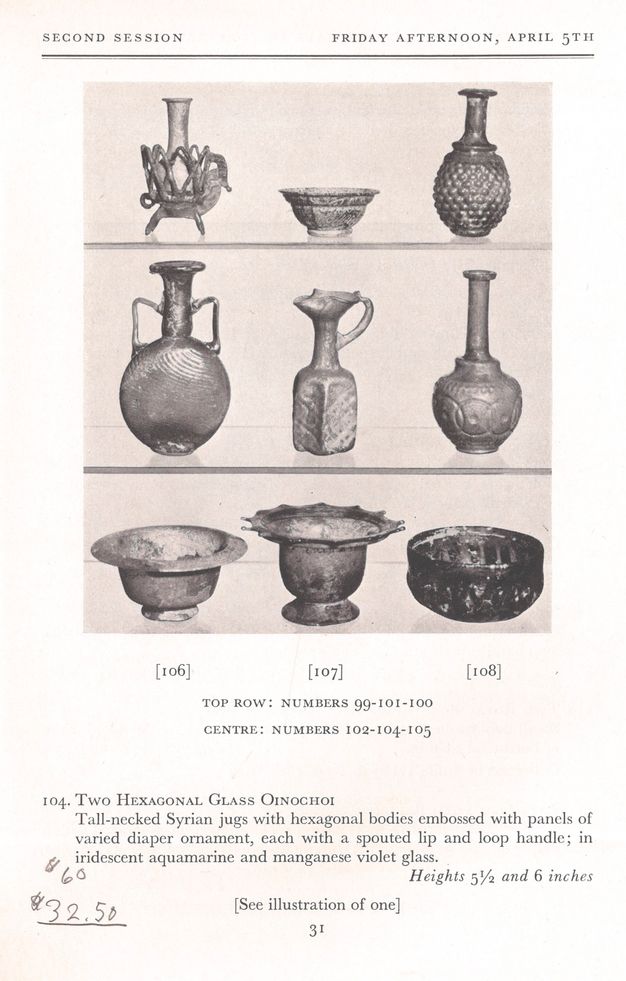
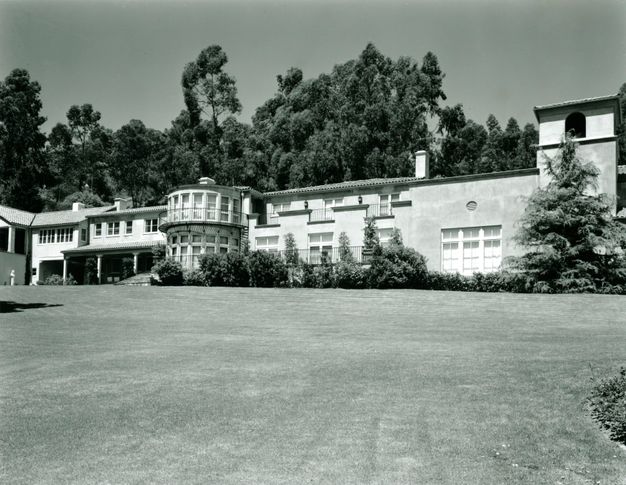
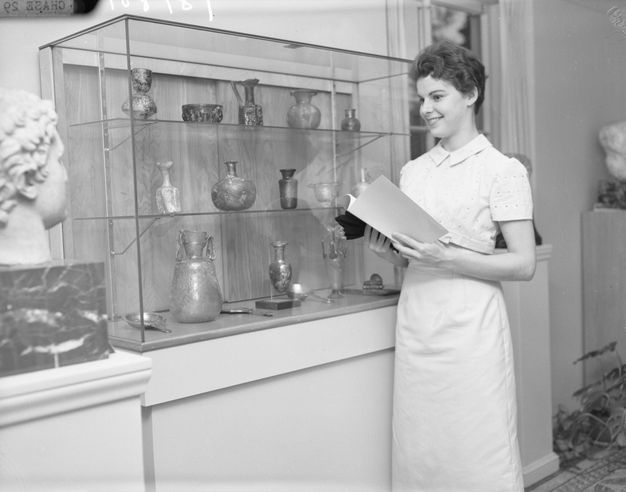
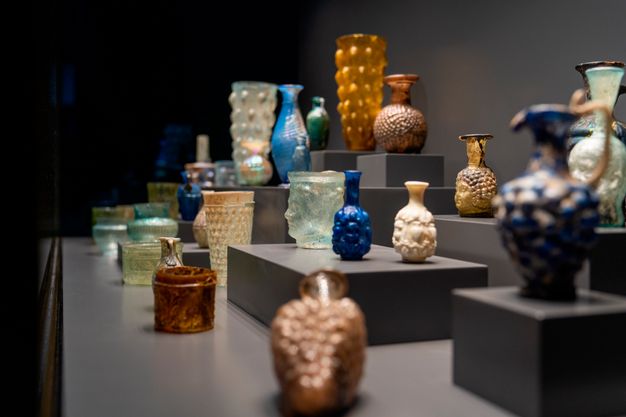
After the war Getty returned to collecting, acquiring his first examples of ancient mosaics, bronze statuettes, Attic pottery, and large-scale marble sculpture. Although marble portraits and sculpture made up the bulk of the antiquities acquired in the 1950s, Getty continued to show some interest in ancient glass, with five vessels obtained in two purchases from the London dealer Spink & Son, Ltd. in 1950 and 1953.8 These were the last ancient glass objects Getty bought for his personal collection, which officially opened to the public in the Ranch House as the J. Paul Getty Museum in 1954 (fig. 2). The first museum guidebook, published that year, notes that several ancient glass vessels were displayed along with a set of late antique silver drinking cups (later identified as modern) in the Roman Room.9 The 1965 museum handbook includes detailed descriptions of 12 glass vessels on display, calling attention to the varied colors and surface sheens, including light green, aquamarine, amber, brilliant blue, silver, and rainbow iridescence (fig. 3).10
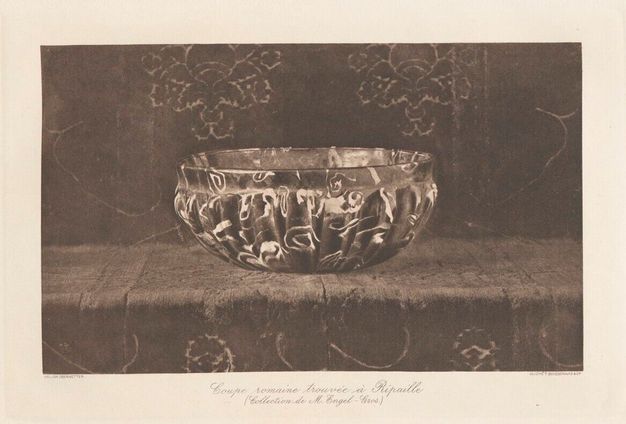
As the collection outgrew the Ranch House, plans were made for a new building, and Getty decided to model the museum after the ancient Villa dei Papiri in Herculaneum, a site he knew well from the excavation plan and finds displayed in the Naples Archaeological Museum; the Villa had captivated his imagination by the early 1950s, if not before.11 With curator Burton Fredericksen looking to quickly expand the collection holdings to fill the new gallery spaces, Getty approved the acquisition of more than 300 objects from Royal Athena Galleries in New York in 1971, an assortment of objects of mixed quality that included eight ancient glass vessels.12 The next year, Getty approved the purchase of the finest glass vessel to enter the collection up to that time, a ribbed bowl imitating banded agate. Discovered in 1764 on the grounds of Château de Ripaille, a fourteenth-century estate in Thonon-les-Bains on Lake Geneva, the bowl was found intact in a sealed lead box that also contained ashes of a cremation burial and several pieces of ancient jewelry. The bowl remained at the estate for nearly two centuries, until it was sold at auction in 1972 (fig. 4).13 A few months after this acquisition, Getty purchased a finely carved agate bowl, the type of Hellenistic luxury vessel that the ribbed glass bowl imitates.14 When the newly constructed J. Paul Getty Museum opened in 1974, the glass bowl received special mention in the guidebook and was displayed alongside the agate bowl and a Greek silver cup, calling attention to the varied mediums of luxury vessels.15 This would be the last ancient glass acquisition Getty approved, and today it is displayed in a gallery dedicated to J. Paul Getty as a collector.
Upon his death in 1976, Getty left the majority of his personal estate to the museum, making it the world’s wealthiest art institution. The endowment led to a shift in the museum’s approach to acquisitions, allowing the museum to build a world-class art collection and research center. Newly appointed antiquities curator Jiří Frel worked to expand the size and scope of the collection, securing high-quality works of art as well as groups of fragments and small objects for study. Frel bought from auctions and dealers, while also soliciting donations from dealers, academics, and collectors locally and beyond Los Angeles. Frel’s methods were often unscrupulous and included a well-documented tax-fraud donation scheme that led to his dismissal from the museum in 1984.16 Nevertheless, in those years there were donations of over a hundred ancient glass objects, mostly fragments and small flasks with little or no provenance information.17 Frel also pursued significant works, including two Phoenician and Punic glass pendant beads (as part of two Etruscan gold necklaces) and an elegant blue kantharos with twisted spiral handles.18 In 1984, the year of Frel’s departure, the museum acquired a cameo glass skyphos, an exquisite example of Roman glass craftsmanship (fig. 5).19
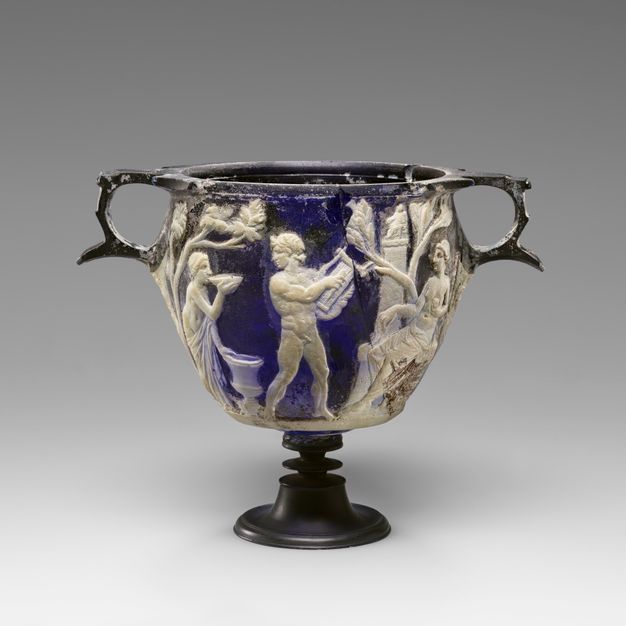
In 1985, antiquities curator Marion True arranged for the acquisition of selected works from the Kofler-Truniger collection at auction in London, including the most important work offered, a cameo glass flask with Egyptianizing motifs.20 The department’s graduate intern that year, Karol Wight, helped prepare the acquisition proposals for these objects, sparking her own interest in ancient glass, which ultimately led to her dissertation on one of the Kofler-Truniger pieces acquired at the sale, a first-century mythological beaker (fig. 6).21 Later that year, the Getty bought two blown-glass beakers from New York dealer Robert Haber.22 There were no additional glass acquisitions until the mid-1990s, when the partial purchase and donation of the Barbara and Lawrence Fleischman collection brought three ancient glass objects, the most notable a fine white and blue snake-thread flask.23 Around the same time, True acquired a mold-blown cup inscribed in Greek, “Be glad that you have come,” possibly made by the Syrian workshop of Ennion, and a remarkable facet-cut glass beaker.24
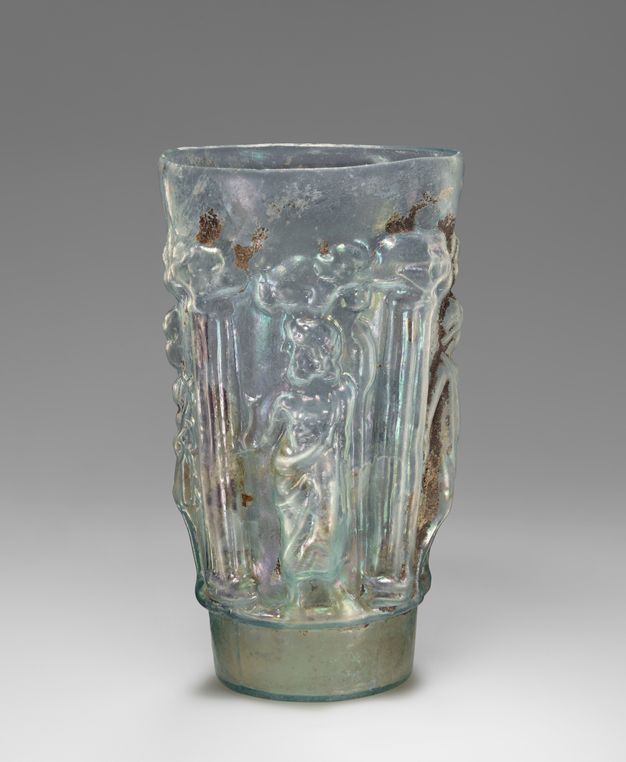
The Getty Museum’s ancient glass collection now numbered around 175 objects. The holdings included a selection of high-quality works, notably the two cameo glass vessels, but it was hardly representative of the great variety of glass objects produced in antiquity. In 2003 and 2004, however, Marion True, with assistance from Karol Wight, arranged for the purchase of approximately 420 pieces from the ancient glass collection of Erwin Oppenländer (1901–1988), which had been inherited by his two children, Gert and Ingrid.25 The entire collection of more than 1,000 objects had been assembled with great care to include only works of the highest quality that represent the various glass manufacturing techniques.26 Erwin Oppenländer began collecting ancient glass in the 1920s, buying works at auction and from European dealers. Pieces from his collection are first mentioned in articles in 1959 and, starting in 1965, appear in the “Recent Acquisitions” section of the Journal of Glass Studies. Among the selection acquired by the Getty, some objects have much earlier histories, a few coming from the Barberini and Stroganoff collections in Rome, which were assembled in the seventeenth and eighteenth centuries, and the collections of Louis de Clercq (1836–1901), Arnold Vogell (1857–1911), Fredrich von Gans (1833–1920), and Giorgio Sangiorgi (1886–1965). The 50 objects from the Pierre Mavrogordato (1870–1948) collection may have been purchased en bloc, but this is uncertain. By 1974, Oppenländer’s glass collection numbered 762 objects and was presented in a special exhibition in Hamburg and Cologne, accompanied by an extensive catalogue by the noted glass experts Axel von Saldern, Birgit Nolte, Peter La Baume, and Thea Elisabeth Haevernick.27
The Oppenländer acquisition greatly broadened and deepened the Getty Museum’s glass holdings. Like the Getty’s antiquities collection as a whole, the majority of the Oppenländer glass objects are Greek and Roman, but there are examples of Egyptian, Mesopotamian, Phoenician, and Achaemenid Persian glass as well. The Oppenländer material also expands the chronological range to span the entire history of ancient glass production, from New Kingdom Egyptian core-formed works and Mycenaean cast glass beads (about 1400–1300 BCE) to Byzantine and Islamic vessels (800–1100 CE), as well as modern copies and forgeries in the style of ancient glass.
After the acquisition, plans were drawn up for a special inaugural exhibition, and in 2005 Karol Wight and Catherine Hess co-authored a guide to ancient, Renaissance, Baroque, and modern glassmaking terms.28 Following an extensive redesign, the Getty Villa reopened in 2006 as the exclusive home of the museum’s antiquities collection. Four small galleries that focused on various materials and manufacturing techniques—terracotta, bronze, silver, and glass—included a selection of ancient glass vessels (fig. 7).29 A special temporary exhibition of the recent Erwin Oppenländer acquisition, titled Molten Color: Glassmaking in Antiquity, presented the history of the collection and overviews of ancient glassmaking techniques, including videos of contemporary glass artists at work.30 The next year, the Getty and the Corning Museum of Glass co-presented the exhibition Reflecting Antiquity: Modern Glass Inspired by Ancient Rome, which examined the impact of the rediscovery of Roman glass on modern glassmakers with over a hundred works, including a selection of Getty objects.31 Shortly after this exhibition closed, Molten Color was reinstalled, and in 2010 it became part of the Villa’s permanent installation (fig. 8).
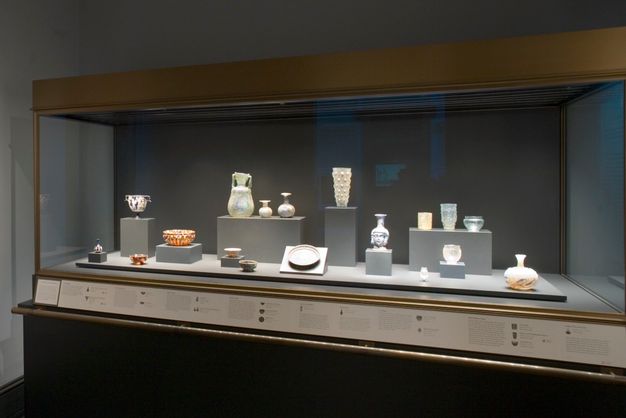
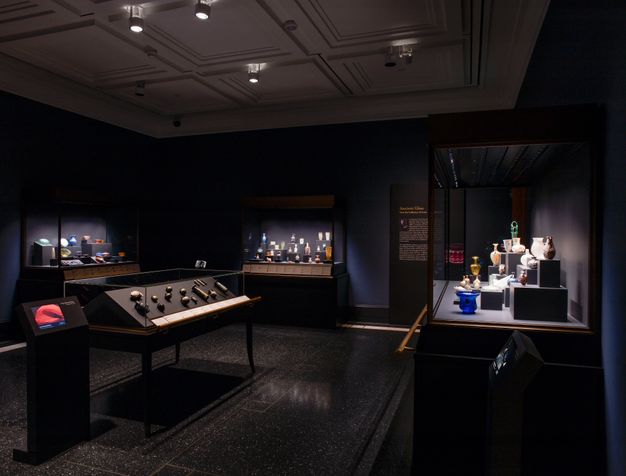
Between 2016 and 2018, the Villa’s permanent collections were fully reinstalled.32 Although this undertaking changed the permanent display considerably, the Molten Color gallery remained essentially intact—a testament to that display’s value and success—and was redesigned with brighter streamlined displays including material beyond the Oppenländer collection (fig. 9). Curated by Mary Louise Hart, the gallery has a more open floorplan with wall cases organized by glassmaking techniques, and at its center, the cameo glass skyphos and flask are shown in the round.33 In addition to the 140 works in this gallery, a few ancient glass objects are also on view in the galleries devoted to Persia and Bactria, the Etruscans, Neolithic and Bronze Age Greece, and J. Paul Getty the Collector. Although the finest works are on display, much of the glass collection, more than 400 objects, remains in storage.
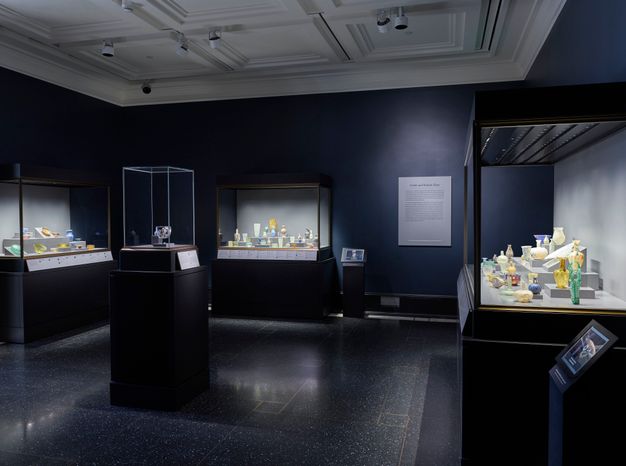
This catalogue is the first comprehensive presentation of the Getty Museum’s ancient glass collection, which in its diversity, quality, and beauty lives up to the promise of J. Paul Getty’s earliest acquisitions and is certainly the finest collection in the western United States. As an open-access digital catalogue that includes detailed technical studies and newly commissioned photography, this publication continues Getty’s commitment to sharing his collection with the public, allowing specialists and amateurs alike to discover and appreciate the wonder of ancient glass (fig. 10).
Notes
-
As part of the Getty Museum’s Antiquities Provenance Project, Judith Barr has extensively researched J. Paul Getty’s personal collection and the museum’s ancient glass holdings, and her findings have been invaluable in providing this summary. The study of ancient glass dates at least to the nineteenth century, though glass objects were documented in archaeological records even earlier; for a summary of the literature through the mid-twentieth century, see Harden, Donald B. 1984. “Study and Research on Ancient Glass: Past and Future.” Journal of Glass Studies 26: 9–24.. For more recent introductions to ancient Greek and Roman glass scholarship, see Larson, Katherine A. 2023. “Glass, Greek.” Oxford Classical Dictionary. https://doi.org/10.1093/acrefore/9780199381135.013.8972. and Cool, H. E. M. 2016. “Glass, Roman.” Oxford Classical Dictionary. https://doi.org/10.1093/acrefore/9780199381135.013.8059.. ↩︎
-
The Getty Museum at the Ranch House had a series of directors, curators, and acting curators, notably Paul Wescher and Burton Fredericksen, who specialized in paintings but oversaw antiquities purchases. ↩︎
-
Getty, J. Paul. 1941. The History of the Oil Business of George F. and J. Paul Getty from 1903–1939. Los Angeles: n.p., p. 392. ↩︎
-
Lapatin, Kenneth, ed. 2018. Guide to the Getty Villa, rev. ed. Los Angeles: Getty Publications., p. 109. Imitation Statue of Aphrodite (67.AK.12), Bust of a Woman (70.AA.100), and Portrait Head of Agrippina the Younger (70.AA.101). ↩︎
-
See Harry Leonard Simmons, cats. 269–289, and cat. 431; Paintings by Contemporary Artists: Brackman, Corbino, Philipp, Pushman, Lebduska, and Other Works by an Older Generation of Artists. Other Art Objects from the Collection of H. Leonard Simmons, New York, Sold by His Order: Public Sale, Paintings, April 4–5, 1940, sale cat. New York: Parke-Bernet Galleries.. ↩︎
-
Getty, J. Paul. 1965. The Joys of Collecting. New York: Hawthorn., p. 14. ↩︎
-
Just over a third of the ancient glass objects are illustrated in the auction catalog (19 of 53 lots) and a few include ex-collection information (12 of 53 lots); Paintings by Contemporary Artists: Brackman, Corbino, Philipp, Pushman, Lebduska, and Other Works by an Older Generation of Artists. Other Art Objects from the Collection of H. Leonard Simmons, New York, Sold by His Order: Public Sale, Paintings, April 4–5, 1940, sale cat. New York: Parke-Bernet Galleries.. Prior owners represented in Getty’s purchases include Emile Tabbagh, 1879–1933 (cats. 400, 407), George Dupont Pratt, 1869–1935 (cat. 179), and Robert Weeks de Forest, 1848–1931 (cat. 248), whose collections were sold in New York in the 1930s. Additional and earlier owners have since been identified, including Enrico Caruso, 1873–1921 (cat. 400), Frank Gair Macomber, 1849–1941 (cat. 431), Valentine Everit Macy, 1871–1930 (cat. 403), and a 1936 Anderson Galleries auction (cats. 89, 249). ↩︎
-
Imitation of Frankish Silver Treasure 78.AK.11–17; Valentiner, William R., and Paul Wescher. 1954. The J. Paul Getty Museum Guidebook. Los Angeles: J. Paul Getty Museum., p. 21. ↩︎
-
Stothart, Herbert. 1965. A Handbook of the Sculpture in the J. Paul Getty Museum. Malibu: J. Paul Getty Museum., pp. 20–21. For a photo of the early glass display, see the Los Angeles Times, Jan. 24, 1958, p. 25: https://www.newspapers.com/article/the-los-angeles-times/44318751/. ↩︎
-
In 1955 Getty published a fictionalized history of the Lansdowne Hercules (70.AA.109), which he imagined as having once been displayed in the actual Villa dei Papiri; see Lapatin, Kenneth, ed. 2018. Guide to the Getty Villa, rev. ed. Los Angeles: Getty Publications., pp. 15–18, and the novella “A Journey from Corinth” in Getty, J. Paul, and Ethel Le Vane. 1955. Collector’s Choice: The Chronicle of an Artistic Odyssey through Europe. London: W. H. Allen., pp. 273–329. ↩︎
-
71.AF.79–85, and 71.AK.86 which was deaccessioned; Fredericksen, Burton. 2015. The Burdens of Wealth: Paul Getty and His Museum. Bloomington: Archway., p. 104. ↩︎
-
The glass bowl (cat. 133) had long remained in the collections of the Château de Ripaille and in 1892 was transferred with the estate to Frédéric Engel-Gros (1843–1918), whose heirs still own the chateau. ↩︎
-
The agate bowl (72.AI.38) was found in Qift (formerly Koptos) in southern Egypt in 1930. ↩︎
-
Cristin, Lilli, ed. 1975. Guidebook: The J. Paul Getty Museum. 3rd ed. Malibu: J. Paul Getty Museum., p. 36; The J. Paul Getty Museum Handbook of the Collections. 4th ed. Los Angeles: J. Paul Getty Museum, 1997., p. 36. The silver cup was likely 72.AM.34. ↩︎
-
Felch, Jason, and Ralph Frammolino. 2011. Chasing Aphrodite: The Hunt for Looted Antiquities at the World’s Richest Museum. Boston: Houghton Mifflin Harcourt., 26–37; Kennedy, “Jiri Frel, Getty’s Former Antiquities Curator, Dies at 82,” New York Times, May 17, 2006. ↩︎
-
Donation groups include forty-five glass fragments (76.AF.70) from Bruce McNall, five glass pendants (cats. 556–560) from Ira Goldberg, a group of 46 glass vessels (cats. 185, 245, 340–342, 351, 380–382, 384–393, 397, 401–402, 408, 412–416, 418–430, 432, 561–562, 580–582) from Edwin Lipps, and a group of 27 glass fragments (cats. 57–124) from Jiří Frel (four fragments, 83.AF.28.3, 83.AF.28.5, 83.AF.28.7, 83.AF.28.13, were deaccessioned to the Education Department’s art handling collection in 2017). The donations from Frel note the importance of the objects for study purposes. ↩︎
-
Necklaces with Glass Pendants 83.AM.1 and Kantharos cat. 267. ↩︎
-
Ernest Kofler and Marthe Truniger acquired their ancient glass pieces from the mid-1950s through the late 1970s, assembling a collection of hundreds of vessels, Egyptian inlays, and fragments. From this sale, cats. 84, 86, 88, and 169 were acquired with Robin Symes acting as agent, and cat. 181 was acquired from the Mansour Gallery shortly after the auction. See Ancient Glass. Formerly the Kofler-Truniger Collection, March 5–6, 1985, sale cat. London: Christie’s.. ↩︎
-
Cat. 169; see Wight, Karol. 2011. Molten Color: Glassmaking in Antiquity. Los Angeles: J. Paul Getty Museum., p. vi. ↩︎
-
In 2003, the Getty bought the bulk of Gert Oppenländer’s collection, 370 works, and the following year acquired an additional 43 objects from Ingrid Reisser, who still retains the rest of her collection. On the Getty acquisition, Wight, Karol. 2004. “Glass from Oppenländer Collection Acquired by the J. Paul Getty Museum.” Journal of Glass Studies 46: 196–198., p. 196. ↩︎
-
Acquisition Proposal, Gert Oppenländer collection of ancient glass, 2003, Getty Museum, Antiquities Department records. ↩︎
-
Exhibitions were held at the Museum für Kunst und Gewerbe in Hamburg (October 4–November 17, 1974) and the Römisch-Germanisches Museum in Cologne (spring 1975); see Saldern von, Axel, Birgit Nolte, Peter La Baume, and Thea Elisabeth Haevernick. 1974. Gläser der Antike. Sammlung Erwin Oppenländer. Mainz: von Zabern.. ↩︎
-
Hess, Catherine, and Karol Wight. 2005. Looking at Glass: A Guide to Terms, Styles, and Techniques. Los Angeles: Getty Publications.. ↩︎
-
Mette Moltesen. 2007. “Museum Review: The Reopened Getty Villa.” American Journal of Archaeology 111: 155–159. https://www.jstor.org/stable/40024586, pp. 156–158, fig. 3. ↩︎
-
Molten Color: Glassmaking in Antiquity, J. Paul Getty Museum at the Getty Villa, January 28–August 6, 2006, reinstalled in 2007 (January 11–April 23, 2007), 2009 (October 8, 2009–February 22, 2010), and became part of the permanent collection in 2010 (October 8, 2010–February 26, 2017): https://www.getty.edu/art/collection/exhibition/103P50. ↩︎
-
Reflecting Antiquity: Modern Glass Inspired by Ancient Rome, J. Paul Getty Museum at the Getty Villa, October 8, 2007–January 14, 2008, and at the Corning Museum of Glass, February 15–May 27, 2008: https://www.getty.edu/art/collection/exhibition/103P2Z. ↩︎
-
“Reinstallation of Antiquities Collection Begins at the Getty Villa,” Getty News & Stories, December 6, 2016; Tim Potts, “A New Vision for the Collection at the Getty Villa,” Getty News & Stories, April 2, 2018. ↩︎
-
For a description of the current gallery and its contents, see Getty Villa, Gallery 214, Greek and Roman Glass, https://www.getty.edu/art/collection/gallery/113ZAX. ↩︎