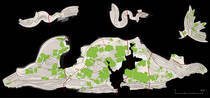
See fig. 367.
A methodological tool that has been developed by researchers to reverse engineer the casting sequence of a sculpture and visually represent the separately parts. It is based on the evidence presented in the object and attempts to map the decisions made by a foundry regarding the number and position of separately cast pieces.
Note: do not work with such charts or maps, although strategizing occurs at every stage (e.g., where joints in the wax or metal will occur).
Source
Cultural Heritage: Mille, Benoît, and Sophie Descamps-Lequime. 2017. “A Technological Reexamination of the Piombino Apollo.” In Artistry in Bronze: The Greeks and Their Legacy: XIXth International Congress on Ancient Bronzes, edited by Jens M. Daehner, Kenneth Lapatin, and Ambra Spinelli, 349–60. Los Angeles: J. Paul Getty Museum and Getty Conservation Institute. http://www.getty.edu/publications/artistryinbronze/conservation-and-analysis/42-mille-descamps/.
Translations
French:
plan de coulée
Plan de découpage prévu par le d’une sculpture en plusieurs éléments coulés séparément.
Note: Ce terme est très récent, il a été proposé par Benoît Mille comme élément technique susceptible d’aider à discriminer les grands bronzes antiques.
Source
Cultural Heritage: Azéma, Aurélia, and Benoît Mille. 2013b. “Un point sur la technique de fabrication des grands bronzes antiques.” L’actualité chimique 377:43–44.