DEFINITION
Information about the size, shape, scale, and dimensions of a work of art or architecture.
SUBCATEGORIES
- 6.1. Dimensions Description 🔺
- 6.2. Dimensions Type
- 6.3. Dimensions Value
- 6.4. Dimensions Unit
- 6.5. Dimensions Extent
- 6.6. Scale Type
- 6.7. Dimensions Qualifier
- 6.8. Dimensions Date
- 6.9. Shape
- 6.10. Format/Size
- 6.11. Remarks
- 6.12. Citations
- Examples
GENERAL DISCUSSION
The dimensions, format, and size of a work help to identify it. These characteristics also make it possible to distinguish between otherwise similar works, and to group comparable objects according to shared characteristics.
Types of measurements
The measurements of different types of works may be recorded
according to different criteria. A work that is considered
basically two dimensional, such as a painting, is usually
measured height by width. For works such as engravings, the
dimensions of both the printing plate and the sheet may be
significant [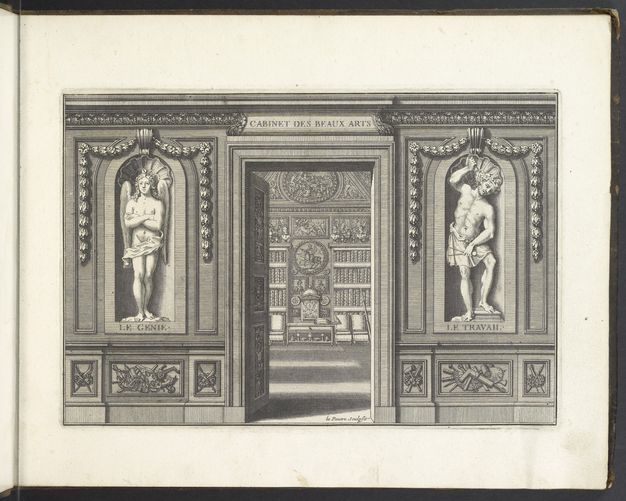 Figure 34
Les Cabinet des Beaux Arts, ca. 1690;
artist: probably engraved by Pierre Lepautre (French
sculptor and printmaker, born ca. 1660, died 1744);
from *Le Cabinet des Beaux Arts, ou, Recueil d’estampes
gravés d’aprés les tableaux d’un plafond ou les beaux arts
sont representées avec explication de ces mêmes
tableaux;
engraving on laid paper, plate mark: 17.6 x 26.4 cm (6 7/8
x 10 3/8 inches);
Getty Research Institute (Los Angeles, California),
88-B12341[plate 2] © The J. Paul Getty Trust. All Rights
Reserved.]. A work intended to be seen in three dimensions, such as
furniture, is typically measured height by width by depth. For
some works, such as coins, the weight may also be important.
Some works, such as costume, may be identified by size, while
others, such as examples of graphic design, are identified by
format. An architectural work may be measured only by height;
sometimes only the dimensions of a part are known, such as the
diameter of a dome. For a video or film, technical formats and
running time are the customary way of identifying size and
shape. For a group of items, this category should record the
average size of the items or the range of sizes represented in
the group.
Specificity
Measurements may be taken with the aid of precise instruments, and therefore are very accurate. They can also be estimations, taken on the basis of “sight,” or historical assessments of uncertain accuracy. The assessment of size, shape, and format may require a specialized knowledge of the characteristics of a particular medium.
When measuring an object, generally include one or two decimal places for metric measurements, rounding to the next larger digit. For inches, round up to the nearest eighth of an inch. Small objects should be measured more precisely (e.g., in millimeters for metric or up to the nearest 1/16 of an inch). Very large works may be measured more grossly (e.g., in meters for metric measurements or in feet rather than inches). If you are not measuring the original object, do not round off dimensions; accurately record measurements as found in an authoritative source.
Sources
Measurements and other indications of the work’s size and shape may be determined on the basis of direct examination, or may be found in published sources such as collection or exhibition catalogs, online museum sites, conservation reports, and in unpublished documents such as letters, inventories, or contracts.
Cataloging rules
For the subcategories in this section, basic recommendations and discussion are provided below. For a fuller, more prescriptive set of cataloging rules for some of the subcategories, see “Chapter 3: Physical Characteristics” in Cataloging Cultural Objects (CCO), which deals with a critical subset of the CDWA.
RELATED CATEGORIES and ACCESS
Researchers may be interested in studying works of particular shapes or formats to compare them to similar works of art (e.g., all of the small-format illuminated books of William Blake) or to dimensional standards implicit in materials (e.g., elephant-folio books or nineteenth-century painted tinware made from pieces of tin larger than those exported to America). In addition, dimensions can provide corroborating evidence in relating objects to one another, as in the case of reassembling a dispersed sketchbook or identifying painted panels as a pair.
6.1. Dimensions Description 🔺
DEFINITION
Information about the dimensions or scale of the work, presented in a syntax suitable for display to the end-user and including any necessary indications of uncertainty, ambiguity, and nuance. It may include the scale of the work. It may also include the number of the parts of a complex work, series, or collection.
EXAMPLES
-
Regular dimensions, simple height by width by depth:
-
46.5 x 38 cm (18 3/8 x 14 15/16 inches)
[
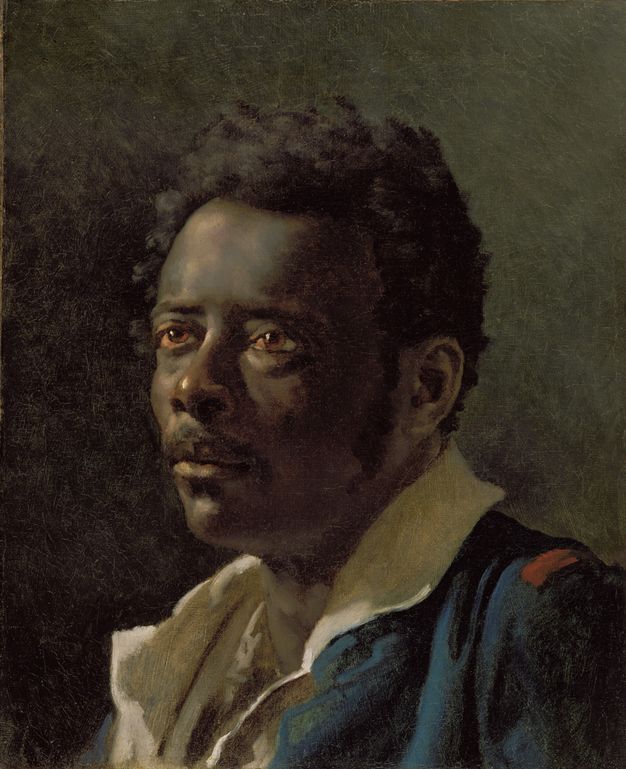 Figure 32
Portrait Study of a Man (painting), ca. 1818-1819;
artist: Théodore Géricault (French painter and draftsman, 1791-1824);
oil on canvas, 46.5 x 38 cm;
J. Paul Getty Museum (Los Angeles, California), 85.PA.407 © The J. Paul Getty Trust. All Rights Reserved.] - 198 x 233 x 82 cm (78 x 91 3/4 x 32 1/4 inches)
-
436.9 x 718 x 777 cm (14 feet 4 inches x 23 feet
6 1/2inches x 25 feet 6 inches)
[
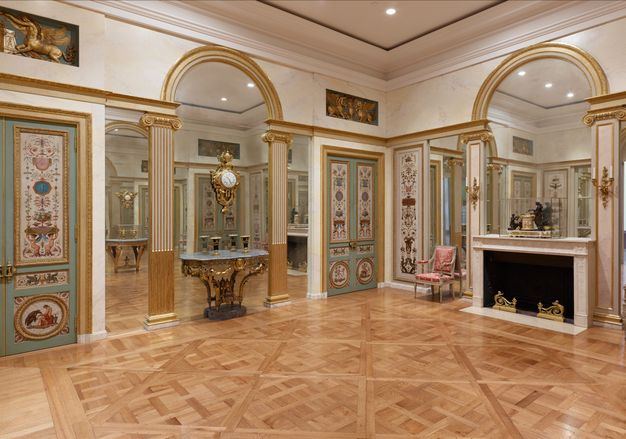 Figure 3a
Paneled Room (salon de compagnie), about 1790-1795;
artist: Claude-Nicolas Ledoux (French architect, 1736-1806);
painted panels: Jean-Siméon Rousseau de la Rottière (French painter and interior decorator, 1747-1820) and Jules-Hughes Rousseau (French sculptor and interior decorator, 1743-1806);
overdoors: Jean-Guillaume Moitte (French sculptor and draftsman, 1746-1810);
Painted and gilded oak, painted and gilded plaster, white marble, modern gilt-bronze hardware, and modern mirror glass, Entire Room: 682.2 × 592.8 cm (268 9/16 × 233 3/8 in.);
J. Paul Getty Museum (Los Angeles, California), 98.DH.149 © The J. Paul Getty Trust. All Rights Reserved.] [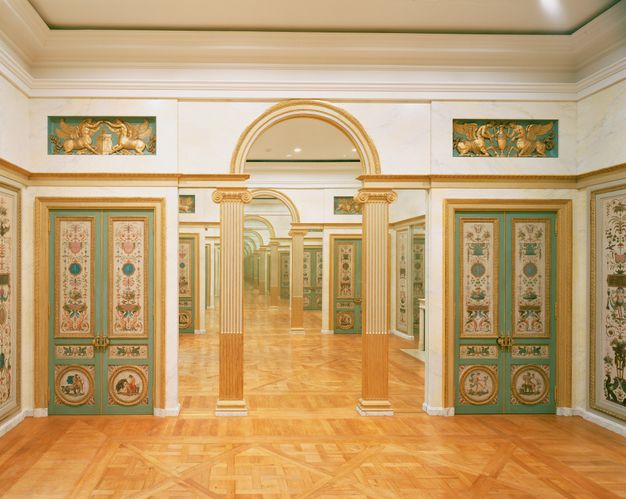 Figure 3b
Paneled Room (salon de compagnie), about 1790-1795;
artist: Claude-Nicolas Ledoux (French architect, 1736-1806);
painted panels: Jean-Siméon Rousseau de la Rottière (French painter and interior decorator, 1747-1820) and Jules-Hughes Rousseau (French sculptor and interior decorator, 1743-1806);
overdoors: Jean-Guillaume Moitte (French sculptor and draftsman, 1746-1810);
Painted and gilded oak, painted and gilded plaster, white marble, modern gilt-bronze hardware, and modern mirror glass, Entire Room: 682.2 × 592.8 cm (268 9/16 × 233 3/8 in.);
J. Paul Getty Museum (Los Angeles, California), 98.DH.149 © The J. Paul Getty Trust. All Rights Reserved.]
-
46.5 x 38 cm (18 3/8 x 14 15/16 inches)
[
-
Unusual shapes, scale, irregular dimensions:
- 89 cm (35 inches) (diameter)
- 29.8 x 20.3 cm (11 3/4 x 8 inches) (oval)
- 161.5 cm (63 5/8 inches) (circumference, sphere)
- 139 cm (54 3/4 inches) (greatest circumference of the body)
- 61.6 x 97.2 cm (24 1/4 x 38 1/4 inches); scale: 1 inch = 10 feet
- 19.1 x 23.5 x 13.9 cm (irregular, largest dimensions)
-
Measuring multiple parts:
-
48.3 (height) x 28.1 (diameter of mouth) cm (19 x
11 inches), 27.2 cm (10 3/4 inches) (diameter of
body)
[
 Figure 9
Red-Figured Kerch Pelike (pelike), ca. 350 BCE;
artist: Marsyas Painter (Attic vase painter, active ca. 330-ca. 320 BCE);
terracotta, 48.3 x 28.1 cm (diameter of mouth), 27.2 cm (diameter of body);
J. Paul Getty Museum (Los Angeles, California), 83.AE.10.] - 12 x 20.3 cm (4 3/4 x 8 inches); secondary support: 30.5 x 40 cm (12 x 15 3/4 inches)
-
17.6 x 26.4 cm (6 15/16 x 10 3/8 inches) (plate
mark), 24.5 x 30.7 cm (9 5/8 x 12 inches)
(folio)
[Figure 34
Les Cabinet des Beaux Arts, ca. 1690;
artist: probably engraved by Pierre Lepautre (French sculptor and printmaker, born ca. 1660, died 1744);
from *Le Cabinet des Beaux Arts, ou, Recueil d’estampes gravés d’aprés les tableaux d’un plafond ou les beaux arts sont representées avec explication de ces mêmes tableaux;
engraving on laid paper, plate mark: 17.6 x 26.4 cm (6 7/8 x 10 3/8 inches);
Getty Research Institute (Los Angeles, California), 88-B12341[plate 2] © The J. Paul Getty Trust. All Rights Reserved.] - composed of 4 panels, 23 x 45 cm each (9 x 17 3/4 inches)
- 183 x 187 cm (72 x 73 5/8 inches) (overall); 105 cm (41 3/8 inches) (width of central panel); 39 cm (15 3/8 inches) (width of each side panel)
-
48.3 (height) x 28.1 (diameter of mouth) cm (19 x
11 inches), 27.2 cm (10 3/4 inches) (diameter of
body)
[
-
Works on paper, manuscripts, books:
-
179 leaves; text block: 26.6 x 19.1 cm (10 1/2 x
7 7/16 inches), oak covers: 27.3 x 19.8 cm (10 3/4
x 7 7/8 inches)
[
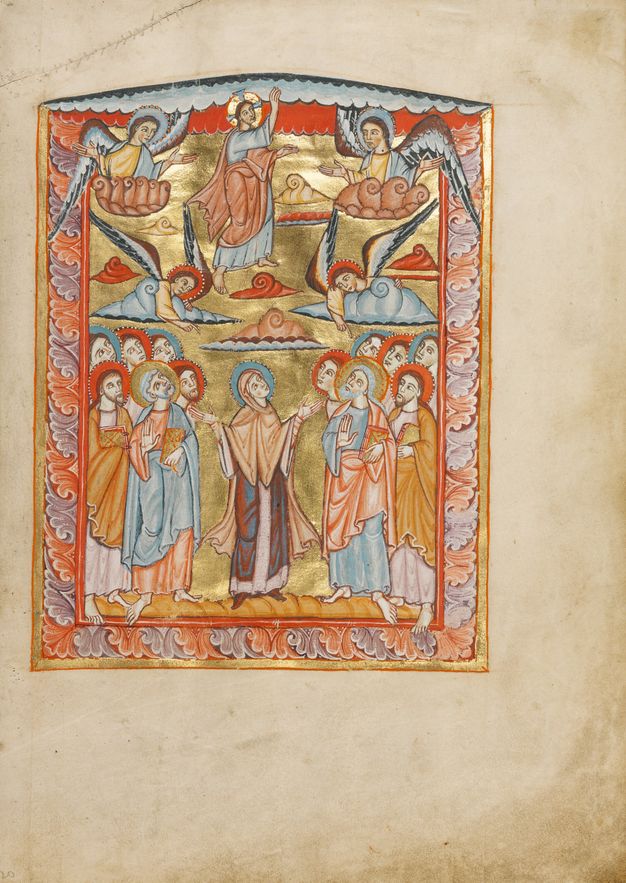 Figure 31a
The Christ in Majesty (cover), and The Ascension (illumination), about 1025-1050;
artist:unknown Ottonian;
tempera colors and gold, dimensions unknown;
J. Paul Getty Museum (Los Angeles, California), Ms. Ludwig V 2, fol. 20, 83.MF.77.20 © The J. Paul Getty Trust. All Rights Reserved.] [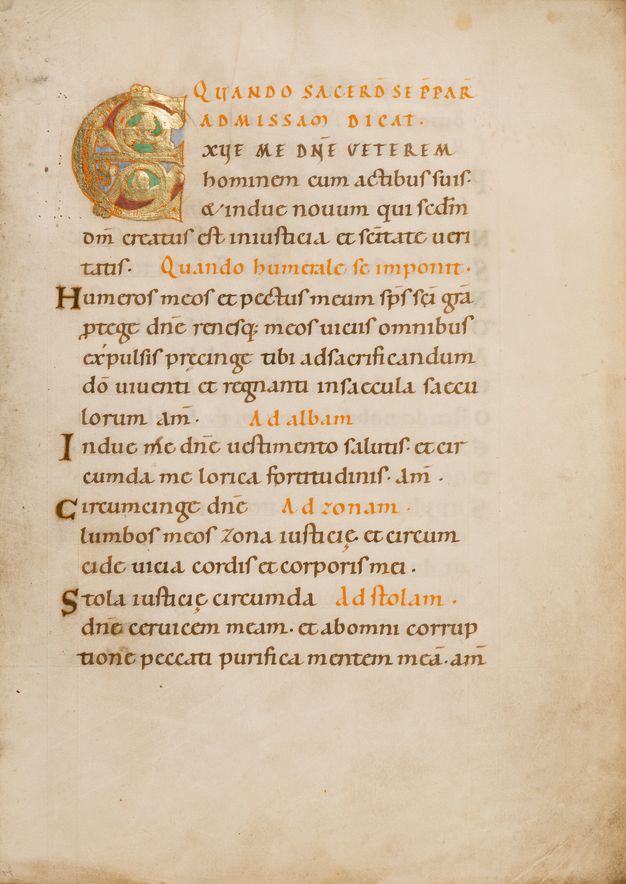 Figure 31b
The Christ in Majesty (cover), and The Ascension (illumination), about 1025-1050;
artist:unknown Ottonian;
tempera colors and gold, dimensions unknown;
J. Paul Getty Museum (Los Angeles, California), Ms. Ludwig V 2, fol. 20, 83.MF.77.20 © The J. Paul Getty Trust. All Rights Reserved.] - 3 volumes, 274 pages; textblock: 47 x 32.2 cm (18 1/2 x 12 11/16 inches)
- 13.3 x 20.6 cm (5 1/4 x 8 1/8 inches)(sheet); 25 mm apart (15/16 inch) (chain lines); 14 per 20 mm (7/8 inch) (laid lines)
-
179 leaves; text block: 26.6 x 19.1 cm (10 1/2 x
7 7/16 inches), oak covers: 27.3 x 19.8 cm (10 3/4
x 7 7/8 inches)
[
-
Approximate dimensions, sight measurements, historical measurements:
-
approximately 22.4 x 17.3 mm (7/8 x 5/8 inches)
(in setting)
[
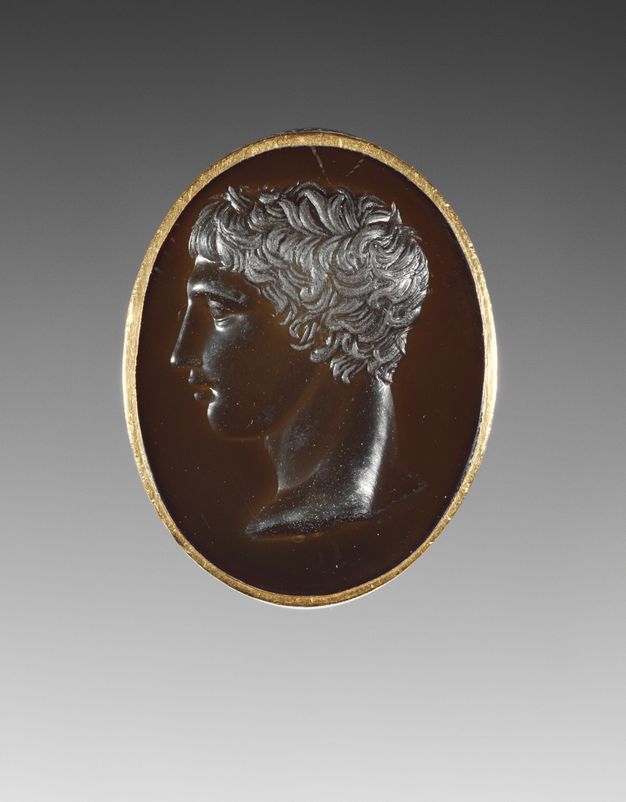 Figure 29
Engraved Gen. Inset Into a Ring: Head of the Doryphoros (gem), ca. 1st century BCE;
artist: unknown Roman;
engraved and polished dark green agate, approximately 22.4 x 17.3 mm (in setting);
J. Paul Getty Museum (Los Angeles, California), 75.AM.61 © The J. Paul Getty Trust. All Rights Reserved.] - circumference of the base of the object was measured as 5 braccia during the 17th century
- 86 x 93.35 cm (34 1/4 x 36 3/4 inches) (sight measurements, window of mat)
-
approximately 22.4 x 17.3 mm (7/8 x 5/8 inches)
(in setting)
[
-
Weight, format, running time, size, new media:
- 31 mm (1 1/8 inch) (diameter), 7.32 g (.2354 troy ounce)
- 32 x 254.5 cm (12 5/8 x 100 1/4 inches) (scroll)
- approximately 8.25 x 5.72 cm (3 1/4 x 2 1/4 inches) (image, carte-de-visite format); 10.16 x 6.35 cm (4 x 2 1/2 inches) (sheet)
- 2 hours 32 minutes 40 seconds (VHS)
- 239 feet, 35 mm; 153 minutes, 24 frames per second (running time)
- 17488 kb (jpeg)
- 2100 x 1557 pixels
- U.S. women’s size 8; 50 inches (127 cm) (length at center back)
-
Architecture, area:
- 43.59 m (143 feet) (diameter of dome); 43.59 m (143 feet) (interior height of dome from floor)
- 418 square m (4500 square feet) (interior area)
- approximately 5.18 square km (2 square miles) (area)
-
Group or collection of works:
- 21 items; sheets range in size from 28.3 x 41.2 cm to 35.9 x 66.4 cm (11 1/8 x 16 1/4 inches to 14 1/8 x 26 1/8 inches)
- 152 items; various dimensions
DISCUSSION and GUIDELINES
Required: Record a prose description of the dimensions, or construct a display by concatenating information from controlled fields. Include information about the dimensions, size, or scale of the work, presented in a syntax suitable for display to the end-user and including any necessary indications of uncertainty, ambiguity, and nuance. As appropriate, include the scale of the work or the number of the parts of a complex work, series, or collection.
Form and syntax
Include measurements in both metric units and US Customary
Units (e.g., inches, feet), if possible. Record
dimensions height by width by depth (e.g.,
198 x 233 x 82 cm (78 x 91 3/4 x 32 1/4 inches)),
if appropriate. The orientation is thus implied in the
description of the dimensions; for example, dimensions of
a painting of vertical orientation [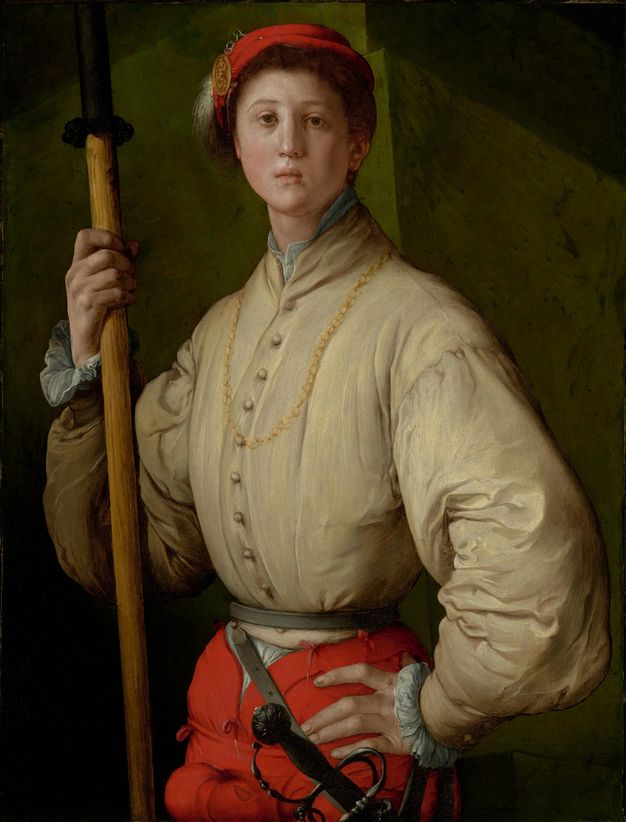 Figure 8
Portrait of a Halberdier (Francesco Guardi?), about 1528-1530;
artist: Pontormo (Italian
painter and draftsman, 1494-1557);
oil on
canvas, 92 x 72 cm;
J. Paul Getty Museum (Los
Angeles, California), 89.PA.49.] is implied in
92 x 72 cm (36 1/2 x 28 3/8 inches). Use standard
codes for metric units (e.g., cm for
centimeters). Spell out inches and
feet. Consult the “Examples” section above for
syntax.
In addition to the values and units of measurements,
include explanatory text as necessary to clarify what the
dimensions mean. For example, to express the dimensions of
a Greek vase [Figure 9
Red-Figured Kerch Pelike
(pelike), ca. 350 BCE;
artist: Marsyas Painter
(Attic vase painter, active ca. 330-ca. 320 BCE);
terracotta, 48.3 x 28.1 cm (diameter of mouth),
27.2 cm (diameter of body);
J. Paul Getty Museum
(Los Angeles, California), 83.AE.10.] the diameter of various parts may be indicated (e.g.,
48.3 cm (height) x 28.1 cm (diameter of mouth), 27.2 cm
(diameter of body)). The information contained in this description should
be indexed in other subcategories, the set of
subcategories of
. Historical units of measurement, such as
braccia, may be included in the description;
however they should be translated into modern equivalents
for indexing.
Measurements for various types of work
The characteristics of various works may require different kinds of dimensions. For example, when measuring a coin, weight is as important as diameter. For a painting, however, height and width are often sufficient. For a video or film, running time or length is the most important measurement. 1 Structural dimensions, such as warp and weft, textile or wallpaper pattern repeats, the spacing of chain lines on a piece of paper, or the weight of a piece of sculpture, are also important.
Approximate indications of size should be accommodated. “Sight” measurements (estimated measurements judged by eye) may be taken in situations in which a work cannot be accurately measured, such as a framed pastel or a ceiling fresco. When a set of dimensions is approximate or needs to be qualified in other ways, this should be indexed in .
It is important to note the overall dimensions; however, a work may have several other relevant sets of dimensions that are also important to record. When measuring a manuscript, for example, the dimensions of the volume, the page, and the text block could be indicated, and the number of lines on the page could be counted. The dimensions of each could be indicated in separate occurrences of the set of “Dimensions” within the category. Appropriate values entered into the , , and subcategories identify the kind of dimension given.
TERMINOLOGY/FORMAT
Free text : This is not a controlled field. Use consistent format and syntax when possible. It is recommended to index the display measurements by using the subcategories below. The dimensions, size, shape, scale, format, or storage configuration of the work, including volume, weight, area, or running time should be indexed in the subcategories below, if possible. If multiple parts of the work are measured, repeat the set of subcategories below.
RELATED CATEGORIES and ACCESS
Researchers may want to find objects of similar sizes to reconstruct disassembled objects, for example, a sketchbook or an altarpiece.
6.2. Dimensions Type
DEFINITION
The kind of dimension taken of a particular area or part of an object or work.
EXAMPLES
- height
- width
- depth
- length
- circumference
- diameter
- volume
- weight
- area
- running time
- base
- target
- count
DISCUSSION and GUIDELINES
Optional: Indexing the measurements is highly recommended, but optional. If you are indexing the measurements, include a value. Use lower case.
To indicate scale, use base and target as necessary. For example: Scale: numeric Value: .75 Unit: inch Type: base | Value: 1 Unit: foot Type: target.
Knowing what was measured is critical to understanding the dimensions of an object. Recording the identifies the orientation or nature of the measurement being recorded.
TERMINOLOGY/FORMAT
Controlled list: Control values with a list of terminology including the terms in the “Examples” section above and others as necessary. Where pertinent, use terms found in the AAT (especially Attributes and Properties hierarchy and the Activities facet).
6.3 Dimensions Value
DEFINITION
The numerical value of a particular dimension taken of a work.
EXAMPLES
- 60
- 238
- 91.6
- 17.25
DISCUSSION and GUIDELINES
Optional: Record the numerical value for dimensions. Indexing the measurements is highly recommended, but optional. If you are indexing the measurements, include the .
Separating the actual dimension from its qualifiers allows mathematical processing on numerical values. This value may be an exact number or an approximation. Dimensions may be measured to varying levels of accuracy.
TERMINOLOGY/FORMAT
Controlled format: Whole numbers or decimal fractions only. It is recommended to use numbers that refer metric units in this controlled field, however, local practice may vary.
6.4 Dimensions Unit
DEFINITION
The unit of measurement used.
EXAMPLES
- centimeters
- millimeters
- meters
- liters
- kilograms
- cubic centimeters
- minutes
- carats
- pixels
- stories
- inches
- square feet
- feet
DISCUSSION and GUIDELINES
Optional: Enter a term describing the unit of measurement. Use lower case.
Indexing the measurements is highly recommended, but optional. If you are indexing the measurements, include the unit of measurement. In order for a numerical measurement to have meaning and to allow manual or automated calculations, the unit of measurement must be specified.
To allow objects to be retrieved efficiently, historical measurements should be indexed according to modern equivalents.
TERMINOLOGY/FORMAT
Controlled list: Use a controlled list of terminology, including the values in the “Examples” section above. Metric units may be abbreviated using standard abbreviations. It is recommended to use metric units in this controlled field, however, local practice may vary.
6.5 Dimensions Extent
DEFINITION
An explanation of the part of the work being measured, included for clarity when necessary.
EXAMPLES
- image
- overall
- diameter
- platemark
- sheet
- secondary support
- mat
- mount
- frame
- pattern
- repeat
- lid
- footprint
- components
- stories
- tessera [i.e., per unit or number per square feet]
DISCUSSION and GUIDELINES
Optional: Record a term or terms indicating the part of the work being measured. Use lower case.
Measurements are assumed to be overall unless otherwise indicated. When it is necessary for clarity or to distinguish two sets of measurements, include the . For example, when dimensions are taken for different parts of a work, such as the body and the base of a sculpture, use to index the part referred to by each dimension. Overall or outside dimensions, including any secondary support, such as a mount, frame, border, or pedestal, must be differentiated from exact dimensions of the object’s primary support or image (e.g., the area covered by the medium without the support).
TERMINOLOGY/FORMAT
Authority or controlled list: Control this subcategory with the , which can be populated with terminology from the controlled vocabularies named below.
Use the following controlled vocabularies: AAT (especially Objects facet), ACRL/RBMS Binding Terms, ACRL/RBMS Genre Terms, ACRL/RBMS Paper Terms, ACRL/RBMS Printing and Publishing Evidence, Base Mérimée: Lexique, the British Archaeological Thesaurus, Glass’ Subject Index for the Visual Arts, ICOM Costume Terms, Index of Jewish Art, ISO 5127-3: Iconic Documents, ISO 5127-11: Audio-visual Documents, LC Descriptive Terms for Graphic Materials, Moving Image Materials, Revised Nomenclature, Reyniès’ Le Mobilier Domestique, and Tozzer Library Headings.
6.6 Scale Type
DEFINITION
A term describing the scale, which is an expression of the ratio between the size of the representation of something and that thing itself (e.g., the size of the drawn structure as compared to the actual built work). Used for studies, recorded drawings, models, and other representations drawn or constructed to scale.
EXAMPLES
- numeric
-
full-size [
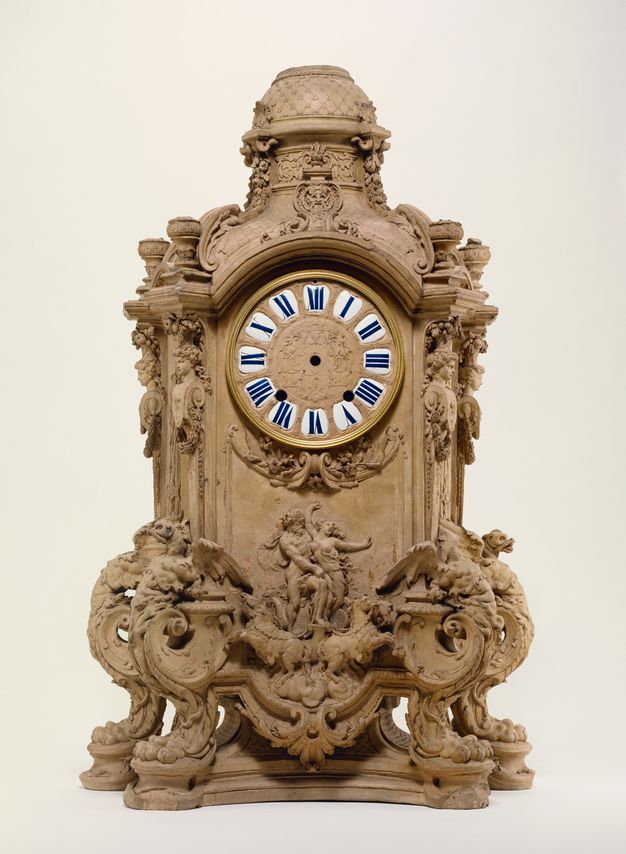 Figure 18
Model for a Mantel Clock, ca. 1700;
artist: unknown French;
terracotta with enameled metal plaques, 78.7 x 52.1 x 24.2 cm;
J. Paul Getty Museum (Los Angeles, California), 72.DB.52 © The J. Paul Getty Trust. All Rights Reserved.] - life-size
- monumental
DISCUSSION and GUIDELINES
Optional: Record the type of scale used, if any.
Form and syntax
Use lower case for the term.
For numeric scales, combine this term with , , and . Combine the with type “base” for the left side of the equation and “target” for the right side of the equation. For example, for 3/4 inch = 1 foot: : numeric; : .75; : inch; : base | : 1; : foot; target. Describe the scale in (e.g., 1:10; 1/4 inch. = 1foot; 1-to-1).
If necessary, transcribe the scale in . For example, scale upper left: ONE-HALF SCALE; bar scale lower center: 10 feet (10 ft. = 2 in.); scale lower right:Trenta Palmi Romani (30 palmi romani = 114 mm).
is used to indicate the relationship between the size of a representation and that of the work it depicts, or the size of one work to another. is often expressed as a numeric ratio of the scale of the object to the scale of the represented work. It may be characterized by a phrase (e.g., full size_) or by words (e.g. monumental or colossal).
Indicate when a scale has been derived by comparison or by
conversion. A scale may be inscribed on the object, as
with maps or pattern drawings, where it may be indicated
as a numerical ratio (e.g., 1 inch = 1 foot) or
as a bar with ruled divisions labeled with units. It is
also possible to determine the scale of an image or model
by comparing its dimensions to the dimensions of the work
depicted. For example, if a model depicts a clock of the
same size, then the scale is 1-to-1, or
full size [Figure 18
Model for a Mantel Clock, ca. 1700;
artist: unknown French;
terracotta with enameled metal plaques, 78.7 x
52.1 x 24.2 cm;
J. Paul Getty Museum (Los
Angeles, California), 72.DB.52 © The J. Paul Getty
Trust. All Rights Reserved.].
For some artists, such as Claes Oldenburg whose works are often seemingly oversize (e.g., Giant Three-way Plug, Scale A, 1/3), scale also carries a particular meaning, forming part of the aesthetics of the work. A sense of the scale of a work makes it possible to assess its visual impact. When considering studies, maquettes, maps, or models, the comparative size of the object and the work depicted are important clues to the level of detail in the image.
TERMINOLOGY/FORMAT
Controlled list: Use consistent terminology as in the “Examples” section above and others as necessary. Terms may be derived from the Art & Architecture Thesaurus (AAT) Hierarchy Display.
6.7 Dimensions Qualifier
DEFINITION
A word or phrase that elaborates on the nature of the measurements of the work when necessary, as when the measurements are approximate.
EXAMPLES
- sight
- maximum
- largest
- approximate
- assembled
- variable
- before restoration
- corners rounded
- framed
- with base
DISCUSSION and GUIDELINES
Optional: Include a term indicating how the dimensions of a work were taken, when appropriate. Use lower case.
Including this information allows the researcher to evaluate the accuracy of the measurements.
TERMINOLOGY/FORMAT
Controlled list: Use a controlled list of terminology, including the values in the “Examples” section above, as well as values found in other sources, such as the Art & Architecture Thesaurus (AAR) Hierarchy Display.
This subcategory may be linked to an authority, such as , which can be populated with terminology from the controlled vocabularies named above.
6.8 Dimensions Date
DEFINITION
A description of the date or range of dates when the measurement was determined, or a range of dates when a historical measurement was known to be valid.
EXAMPLES
- 12 December 1991
- May 1970
- 1993
- before 1652
- 1842-1896
- 17th century
DISCUSSION and GUIDELINES
Optional: Record the date when measurements were taken or the dates when they were valid. Include references to uncertainty or ambiguity as necessary.
Form and syntax
Follow the applicable rules for display dates found in the subcategory.
The date is useful in establishing the size of a work at a particular time and sets a benchmark for future comparison. Historical measurements are of value to the researcher, as the size of a work may have changed over time. For example, a piece of paper or canvas may have been trimmed to a smaller size, or a story may have been added to a structure, increasing its height.
Dates may be estimated or approximate. For example, it may only be known that a work was a certain size in the 18th century, but not precisely on which day or year the measurement was taken. For further discussion of dates in general, see .
TERMINOLOGY/FORMAT
Free-text: This is not a controlled field. Maintain consistent capitalization, punctuation, and syntax where possible. Index the dates in the controlled and subcategories.
6.8.1 Earliest Date
DEFINITION
The earliest date for which the dimensions are known to be valid.
EXAMPLES
- 1970
- 1842
- 01-21-2001
DISCUSSION and GUIDELINES
Optional: Record the earliest year indicated by the display .
Form and syntax
Always record years in the proleptic Gregorian calendar in the indexing dates fields. It is optional to record ; however, if you record a value here, you must also record . For rules, see .
TERMINOLOGY/FORMAT
Controlled format: Date information must be formatted consistently to allow retrieval. Local rules should be in place. Suggested formats are available in the ISO Standard and W3 XML Schema Part 2.
-
ISO 8601:2004 Representation of dates and times. International Organization for Standardization. Data Elements and Interchange Formats. Information Interchange. Representation of Dates and Times. Geneva, Switzerland: International Organization for Standardization, 2004.
6.8.2 Latest Date
DEFINITION
The latest date for which the dimensions are known to be valid.
EXAMPLES
- 1985
- 9999
- 01-21-2001
DISCUSSION and GUIDELINES
Optional: Record the latest year indicated by the display .
Form and syntax
Always record years in the proleptic Gregorian calendar in the indexing dates fields. It is optional to record ; however, if you record a value here, you must also record . For rules, see .
TERMINOLOGY/FORMAT
Controlled format: Date information must be formatted consistently to allow retrieval. Local rules should be in place. Suggested formats are available in the ISO Standard and W3 XML Schema Part 2. For dates that are still current, use the year 9999.
-
ISO 8601:2004 Representation of dates and times. International Organization for Standardization. Data Elements and Interchange Formats. Information Interchange. Representation of Dates and Times. Geneva, Switzerland: International Organization for Standardization, 2004.
6.9 Shape
DEFINITION
The outline, form, or characteristic configuration of a work or part of a work, including its contours; used for unusual shapes.
EXAMPLES
- square
- rectangular
- round
- oval
- triangular
- cylindrical
- hexagonal
- irregular
- sphere
- cruciform
- camel
- lotus
DISCUSSION and GUIDELINES
Optional: Record a term describing the shape of the work if it is an unusual or distinguishing characteristic (e.g., if a panel painting is oval rather than rectangular). Use lower case.
Recording the shape of a work provides context for its measurements and physical appearance. Objects may change shape over time, as when a rectangular panel painting has been cut down to an oval shape. Various shapes may be associated with multiple occurrences of the indexing fields, as when a round drawing is mounted on a square secondary support. Each shape could have corresponding dimensions and dates.
Shape is important to some lines of inquiry. For example, a scholar may wish to examine the composition of round paintings of the Northern Baroque.
In some areas of study, such as Asian art, it is traditional to note shapes in the most specific sense, such as camel [shaped]. In such cases, index the term, such as camel, in too.
TERMINOLOGY/FORMAT
Controlled list: Use a controlled list of terminology, including the values in the “Examples” section above and those found in other sources, such as the Art & Architecture Thesaurus (AAT) Hierarchy Display.
6.10 Format/Size
DEFINITION
The configuration of a work, including technical formats, or the conventional designation for the dimensions or proportion of a work.
EXAMPLES
-
Formats:
- longline
- 3-column grid
- tabloid
- stations format
- carte-de-visite
- cabinet photograph
- vignette
- VHS
- Beta
- IMAX
- DOS
-
Sizes:
- quarto
- elephant folio
- half-plate
- pint
- British men’s medium
- A4
DISCUSSION and GUIDELINES
Optional: Include a designation of the format or conventional size designation if pertinent. Use lower case, except for proper names and special codes.
Designations of format and of size often overlap. This subcategory describes the configuration of the work. It may also refer to standard technical formats, particularly in photography, film, video, printing, and computing. Sizes are relative designations of magnitude. Works of the same “size” may vary in actual dimensions, but share a common set of proportions.
To record numeric sizes, use to record the number and indicate the controlled term size in . Industry sizes are not always accurate or consistent, and vary within certain tolerances. Some sizes, such as those for standard containers or bottles, are strictly regulated. Others, such as clothing sizes, are inconsistent. Sizes often vary by nationality. A women’s size 12 in Great Britain differs from that in Canada or in the United States, and may be a size 40 in Europe. Sizes may also vary over time.
TERMINOLOGY/FORMAT
Controlled list: Use consistent terminology from a controlled list. Include the terms listed in the “Examples” section above and others derived from the Art & Architecture Thesaurus (AAT) Hierarchy Display or the ACRL/RBMS Paper Terms and ACRL/RBMS Type Evidence.
6.11 Remarks
DEFINITION
Additional notes or comments pertinent to information in this category.
DISCUSSION and GUIDELINES
Optional: Record a note regarding the measurements of the work. Use consistent syntax and format. For rules regarding writing notes, see .
FORMAT/TERMINOLOGY
Free-text: This is not a controlled field. Use consistent syntax and format.
6.12 Citations
DEFINITION
A reference to a bibliographic source, unpublished document, or individual opinion that provides the basis for the information recorded in this category.
DISCUSSION and GUIDELINES
Optional: Record the sources used for information in this category. For a full set of rules for citations, see .
TERMINOLOGY/FORMAT
Authority: Ideally, this information is controlled by citations in the citations authority; see .
6.12.1 Page
DEFINITION
Page number, volume, date accessed for Web sites, and any other information indicating where in the source the information was found.
DISCUSSION and GUIDELINES
Optional: For a full set of rules for pages, see .
FORMAT/TERMINOLOGY
Free-text: This is not a controlled field. Use consistent syntax and format.
Examples
For a painting, textile, or drawing:
-
Dimensions Description🔺: 44.5 x 63.8
cm (17 1/2 x 25 1/8 inches)
Value: 44.5 Unit: cm Type: height
Value: 63.8 Unit: cm Type: width
For a sculpture:
-
Dimensions Description:🔺 29.85 x 15.88
x 17.15 cm (11 3/4 x 6 1/4 x 6 3/4 inches)
Value: 29.85 Unit: cm Type: height
Value: 15.88 Unit: cm Type: width
Value: 17.15 Unit: cm Type: depth
Only one dimension known:
-
Dimensions Description:🔺 153 cm
(height) (61 inches)
Value: 153 Unit: cm Type: height
Multiple components; see also :
-
Dimensions Description:🔺 comprises 10
panels; overall: 280 x 215 cm (110 1/4 x 84 5/8
inches)
Extent: components Value: 10 Type: count
Value: 280 Unit: cm Type: height
Value: 215 Unit: cm Type: width
Multiple components; see also :
-
Dimensions Description:🔺 pair of
six-panel folding screens; each: 179.1 x 371.5 cm (5
feet 1 1/2 inches x 12 feet 2 1/4 inches)
Extent: parts Value: 2 Type: count
Extent: each part Value: 179.1 Unit: cm
Type: height
Value: 371.5 Unit: cm Type: width
Measured in frame:
-
Dimensions Description:🔺 88.9 x 177.8
cm (frame included) (2 feet 11 inches x 5 feet 10
inches)
Value: 88.9 Unit: cm Type: height
Value: 177.8 Unit: cm Type: width
Scale included:
-
Dimensions Description:🔺 59.44 x 91.44
cm (23 3/8 x 36 inches); scale: 3/4 inch = 1 foot
Value: 59.44 Unit: cm Type: height
Value: 91.44 Unit: cm Type: width
Scale: numeric Value: .75 Unit: inch Type: base
Value: 1 Unit: foot Type: target
For a group or collection:
-
Dimensions Description:🔺 152 items; various dimensions
Extent: items Value: 152 Type: count -
Dimensions Description:🔺 largest item: 119.38 x 43.18 x 38.1 cm (47 x 17 x 15 inches)
Qualifier: largest Value: 119.38 Unit: cm
Type: height
Value: 43.18 Unit: cm Type: width
Value: 38.1 Unit: cm Type: depth -
Dimensions Description:🔺 56 items, lengths range 36 to 64 mm (1 3/8 to 2 1/2 inches)
Extent: items Value: 56 Type: count
Qualifier: smallest Value: 36 Unit: mm
Type: length
Qualifier: largest Value: 64 Unit: mm Type: length
Building, noting shape:
-
Dimensions Description:🔺 octagonal, 2
stories
Extent: stories Value: 2 Type: count Shape: octagonal
Building and grounds:
-
Dimensions Description:🔺 3 stories,
over 100 rooms, White House and the grounds occupy 7.2
hectares (18 acres)
Extent: rooms Value: 104 Type: count
Extent: stories Value: 3 Type: count
Extent: grounds Value: 7.2 Unit: hectares
Type: area
Building:
-
Dimensions Description:🔺 dome: 43 m
(interior diameter and height) (141 feet); oculus: 8.9 m
(diameter) (29 feet 2 inches)
Qualifier: interior Extent: dome Value: 43 Unit: m Type: height
Value: 43 Unit: m Type: diameter
Extent: oculus Value: 8.9 Unit: m Type: diameter
Photograph:
-
Dimensions Description:🔺
quarter-plate, 10.79 x 16.51 cm (including case) (4 1/4
x 6 1/2 inches)
Format/Size: quarter-plate
Value: 10.79 Unit: cm Type: height
Value: 16.51 Unit: cm Type: width
Film:
-
Dimensions Description:🔺 35 mm, 176.78
m (580 feet); 28 minutes at 16 frames per second
Format/Size: 35 mm
Value: 176.78 Unit: m Type: length
Value: 28 Unit: minutes Type: running time
Value: 16 Unit: frames per second Type: running time
Garment:
-
Dimensions Description:🔺 U.S. women’s
size 8; 50 inches (127 cm) (length at center back)
Extent: center back Value: 127 Unit: cm
Type: length
Value: 8 Unit: U.S. women’s Type: size
Digital:
-
Dimensions Description:🔺 2100 x 1557
pixels
Value: 2100 Unit: pixels Type: height
Value: 1557 Unit: pixels Type: width
Vessel, circumference:
-
Dimensions Description:🔺 height with
lid, 89.5 cm (35 1/4 inches); circumference at shoulder,
115 cm (15 1/16 inches)
Value: 89.5 Unit: cm Type: height
Value: 115 Unit: cm Type: circumference
Manuscript:
-
Dimensions Description:🔺 179 leaves;
text block: 26.6 x 19.1 cm (10 1/2 x 7 1/2 inches); text
area: 17 x 13 cm (6 3/4 x 5 1/8 inches); oak covers:
27.3 x 19.8 cm (10 3/4 x 7 7/8 inches)
Extent: leaves Value: 179 Unit: N/A Type: count
Extent: text block Value: 26.6 Unit: cm Type: height
Value: 19.1 Unit: cm Type: width
Extent: text area Value: 17 Unit: cm Type: height
Value: 13 Unit: cm Type: width
Extent: cover Value: 27.3 Unit: cm Type: height
Value: 19.8 Unit: cm Type: width
Chain lines:
-
Dimensions Description:🔺 13.3 x 20.6
cm (5 1/4 x 8 1/8 inches)(sheet); 25 mm apart (15/16
inch) (chain lines); 14 per 20 mm (7/8 inch) (laid
lines)
Extent: sheet Value: 13.3 Unit: cm Type: height
Value: 20.6 Unit: cm Type: width
Extent: chain lines **Value:**25 Unit: mm Type: distance between
Extent: laid lines per 20 mm Value: 14 Unit: N/A Type: count
NOTE: 🔺 indicates a core CDWA category.
Revised 21 December 2023
by Emily Benoff
Notes
-
The AAT groups works such as videos and performance art under the guide term “<time-based works>.” ↩︎