DEFINITION
Political, social, economic, or religious events or movements associated with the work of art or architecture at its creation and over time, including competitions. This category is also used to record the placement of a work in a particular position within an architectural context and any information about the discovery or excavation of the work.
SUBCATEGORIES
- 17.1. Historical/Cultural Events
- 17.2. Architectural Context
- 17.3. Archaeological Context
- 17.4. Historical Location Context
- 17.5. Remarks
- 17.6. Citations
- Examples
GENERAL DISCUSSION
This category provides information-specific events (e.g., a coronation or a competition) and/or situations (e.g., the AIDS epidemic) that influenced the creation or later history of a work. It also records the historical relationship of the object to architectural environments, to an archaeological site, or to another historical location . The category positions the work in its historical framework, establishing the conditions that governed its creation or influenced the creator’s interpretation of his or her subject matter. Context contains the historical data that helps to define the work. The American Association for State and Local History defines historical data as, “Data that provides a broad historical context for objects, relating them to people, organizations, places, events, and concepts.” 1
Event-related context
Context is critical for works of art or architecture created for a particular event (e.g., the World’s Columbian Exhibition at Chicago in 1893) or a special competition. Historical events may have influenced a work’s creation in many ways. For example, Trajan’s Column was created to celebrate the Emperor’s successes against the Dacians; and the work of the General Idea collective was profoundly influenced by the AIDS epidemic.2
Architectural context
Perception of a work of art is often colored by the physical context within which it is seen. The spatial relationship between the viewer and the work of art may have influenced its creation. For example, a work may have been conceived to fit within a particular decorative scheme (e.g., Robert Adam’s work at Syon Park) or within a particular interior (e.g., Masaccio’s Trinity at Santa Maria Novella in Florence). The relative position of a work within a particular space, or on a building, may also have influenced its interpretation and assessment. For example, Bernini’s Fountain of the Four Rivers was given a prominent position in front of Borromini’s façade of Sant’Agnese in Agone, which has been interpreted as a polemical attitude of one architect toward the other.
Archaeological context
Documenting the discovery or archaeological excavation of a work provides important information about its origins, history, and past use. It can assist in dating the work and may provide clues to its creation. Archaeological context (e.g., the disposition of artifacts in the Sutton Hoo ship-burial hoard) becomes especially important when little else is known about the work or its creation.
Historical location
There may be locations associated with the work in various historical contexts. There are several areas of an object/work record where historical locations or “places” may be recorded as specifically related to other (sub)categories (e.g., ). The subcategories in the category allow for the recording of additional miscellaneous historical locations that fall outside the scope of any other subcategory in the object/work record.
Over time, a work can be associated with different contexts; each should be described in a separate occurrence of the sets of subcategories of the category. The interpretation of may be open to dispute, so multiple opinions should be accommodated.
Contextual information can be derived from inscriptions, literary descriptions, archival documents, eyewitness accounts, biographies, reviews, other works of art, letters, labels, inventories, artists’ statements, or later interpretations of a work or subject matter.
RELATED CATEGORIES and ACCESS
Record the culture that created the work in . Information in the category may be repeated to some extent in . Information in may be repeated or expanded upon in the , , , , and (sub)categories as necessary.
Other works that share a similar context may be indicated in . The provenance or history of ownership of a work is recorded in . If a work’s purpose has changed over time, its present function, the original object type, and all subsequent object types should be indicated in . The place where a work was produced should be specified in . Historical events and people depicted in a work should be indicated in the category. Competitions may be recorded in , but the history of a work’s inclusion in art gallery and museum exhibitions, as well as in other public spaces, is recorded in . If a particular context has altered a work’s appearance, this fact should be noted in . Technical studies that establish details about a context should be described in .
17.1 Historical/Cultural Events
DEFINITION
A description of the political, social, economic, or religious events or circumstances associated with the work over time.
EXAMPLES
For a drawing by S.W. Milburn and Partners:
- Design was made for the International Architectural Competition for the Opera House in Sydney, Australia.
For the painting The Oath of the Horatii:
- The official artist of the French Revolution was Jacques-Louis David (1748-1825), who was eventually entrusted with the commemorative portraits of martyred revolutionary leaders, the design of public pageants, celebrations, state funerals, and even the designs for the costumes to be worn by the citizens and citizenesses of the republic…The Oath of the Horatii shows the three Horatii brothers, chosen to defend Rome in combat against the Curiatii…The incident was recorded by Roman historians, and although it took place under the kingdom, [it] was believed by the French to have been an example of republican patriotism.3 Ironically, David’s painting was commissioned in 1785 by Louis XVI, even though it ultimately inspired the nascent revolutionary sentiments that led to his beheading in 1793.
DISCUSSION and GUIDELINES
Optional: Describe the relationship between the work and historical or cultural events associated with it. If this information is discussed in the category, it need not be repeated here, but it should be indexed in the subcategory, discussed below.
It is particularly important to record events or circumstances having to do with the purpose of the work. Context can include named events (e.g., Marriage of Maria de’Medici, World’s Columbian Exposition or Vietnam War) as well as generic circumstances that do not have a proper name (e.g., a funeral or marriage). Since the association of the work with the event may be a matter of opinion, explain any uncertainty or nuance.
Form and syntax
Use natural word order. You may use phrases or complete sentences, but always begin the note with a capital letter and end it with a period. Use sentence case (not all capitals or title case). Capitalize proper names. Avoid abbreviations. Write the note in the language of the catalog record (English in the United States). Names and other words in foreign languages may be used within the note when there is no commonly used English equivalent. Use diacritics as appropriate.
TERMINOLOGY/FORMAT
Free text: This is not a controlled field, however the use of consistent terminology is recommended for clarity. Index the event in .
17.1.1 Event Type
DEFINITION
Generic term characterizing the type of event associated with the work, excluding creation and events/activities recorded in other subcategories.
EXAMPLES
- coronation
- war
- inauguration
- competition
- exhibition
- funeral
DISCUSSION and GUIDELINES
Optional: Record a generic term referring to the type of event associated with the work. The term may be used alone, or with a named event in the subcategory.
Occasionally, it will be necessary to record an event in this subcategory for which a proper name is inappropriate (e.g., if the work refers to a generic funeral, not a particular one) or which, for other reasons, will not be identified in the subcategory discussed below.
Reference to the context or purpose of the work may be recorded as or in , and need not be repeated here. Record creation details in the subcategories. Record other events or activities in other specifically designated subcategories when possible.
Form and syntax
Record the term in lower case. Use the singular form of terms. Use terms in the language of the catalog record (English in the United States).
TERMINOLOGY/FORMAT
Controlled list: Control this subcategory with a controlled list, using the terms in the “Examples” section above, and others as necessary. Sources of vocabulary may include the Art & Architecture Thesaurus (AAT) Hierarchy Display (particularly the Events and Associated Concepts hierarchies).
17.1.2 Event Identification
DEFINITION
An identification of the event or situation involving the work of art or architecture.
EXAMPLES
- French Revolution (France, 1787-1799)
- World’s Columbian Exposition (Chicago, Illinois, USA, 1893)
-
Architectural Competition for the Manchester Town
Hall (Manchester, England, 1866)
[
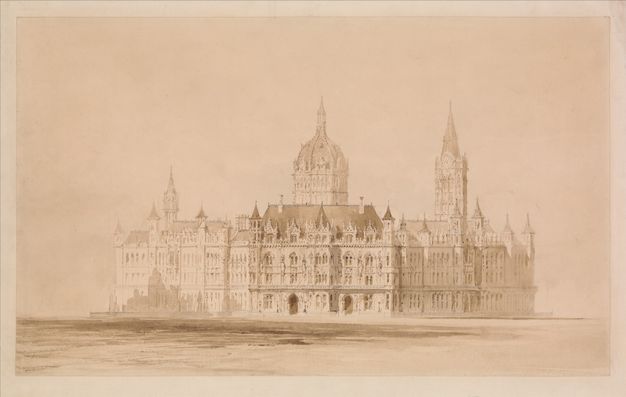 Figure 105
Competition Drawing for the Manchester Town Hall, 1866;
artist: Thomas Allom (English architect, artist, 1804-1872);
Pen and brown ink, brush and brown wash, Sheet: 30 x 40 in. (76.2 x 101.6 cm);
The Metropolitan Museum of Art (New York, New York), Dodge and Fletcher Funds, 1967, 67.736.1 © The Metropolitan Museum of Art. All Rights Reserved.] - European expansion in the “New World”(North and South America, 16th-17th century)
- Marriage of Peter the Great and Catherine Alekseyevna (Russia, 1712)
- Coronation of Itzcoatl (Mexico, 1427)
- Independence of Mexico (from Spain, 16 September 1810 )
- Bombing of Guernica (during Spanish Civil War, 26 April 1937)
- Battle of Marathon (Marathon plain, northeastern Attica, September 490 BCE)
- Vietnam War (Vietnam, 1954-1975)
- AIDS Epidemic (worldwide, first reported in 1981)
DISCUSSION and GUIDELINES
Optional: Record the particular event or situation with which the work is associated.
Form and syntax
For the proper names of events, record the names in title case, not sentence case. Maintain consistent capitalization, punctuation, and syntax in event names across the database where possible. Capitalize all personal, corporate, and geographic proper names in the event name. For constructed event names in English, capitalize the first word and all nouns, pronouns, verbs, adverbs, adjectives, and subordinate conjunctions; use lower case for articles, coordinate conjunctions, and prepositions, unless they are the first word of the name of the event. For event names in other languages, follow capitalization rules of that language. For further rules, see the .
Devise a name for events, when appropriate and as advised in the category. For example, a name should be constructed for the marriage between two famous people, such as Marriage of King Louis XVI of France and Marie Antoinette, even if the cataloger cannot find the proper name in a source.
Note that generic terms to describe named events will be recorded in the and do not need to be repeated here (e.g., if you record the event Vietnam War (Vietnam, 1954-1975) in this subcategory, the event will be indexed as a war in the authority). However, you may also record the generic event term in the subcategory if necessary, although that subcategory is generally used for generic event terms for which no named event will be recorded.
TERMINOLOGY/FORMAT
Authority or controlled list: Control the named events in this subcategory with the so-called , which contains records for events and can be populated with terminology from the controlled vocabularies named below. Named events should be recorded in the , together with their variant names; a term indicating the type of event, location of the event; dates of the event; people involved in the event; and other relevant information. Display the event names with the (generally comprising a geographic place and date). Sources of vocabulary include Canadiana Authorities, LC Name Authorities/LCSH, and others as recommended in the category.
Control terminology for generic events that do not have a proper name using the , or devise a more concise controlled list for this subcategory. Sources of vocabulary may include the Art & Architecture Thesaurus (AAT) Hierarchy Display (particularly the Events and Associated Concepts hierarchies).
17.1.3 Event Date
DEFINITION
A description of the year or span of time during which the work was associated with the event or situation.
EXAMPLES
- from 1492
- 1789-1799
- 312 BCE
- 30 May 1831
- May 1770
- 1587
- before 1952
- 17th century
- by 1848-ca. 1880
DISCUSSION and GUIDELINES
Optional: Record a year, precise day and month, span of years, or phrase that describes the specific or approximate date(s) when the work was associated with the event. Since dates may be approximate, indications of nuance and ucertainty should be expressed as necessary.
Form and syntax
Follow rules for display dates in .
Use this subcategory when the date inidcating the association of the work with the event does not directly correspond to the duration of the event (e.g., as when a work is associated with one particular year, but the event took place over a number of years). Note that the dates for the event itself will be recorded in the so-called and should not be repeated here (e.g., the dates of the French Revolution are 1787-1799; these dates should be recorded in the record for the French Revolution).
If a specific date is known, record the year, or the day, month and year. If a span of dates is applicable, record the year beginning the span, dash, and the year ending the span. Use natural word order. Do not capitalize words other than proper nouns or period names. Avoid abbreviations, except with ca. (for “circa”), the numbers in century or dynasty designations (e.g., 17th century), and BCE and CE. Include all digits for both years in a span; for example, with four-digit years, do not abbreviate the second year (e.g., record 1780-1795, NOT 1780-95).
Use ordinal numbers (e.g., 17th) and Arabic numbers (e.g., 1959), as appropriate. Express words and phrases in the language of the catalog record (English in the United States), except in rare cases where no English-language equivalent exists or where the foreign term is most commonly used (e.g., with the name of a period). Use diacritics as required.
Use the proleptic Gregorian calendar. Use BCE (Before Common Era) to indicate dates before the year 1 in the proleptic Gregorian calendar. Use CE as necessary. For very ancient works, artifacts, and in certain other disciplines where BCE is not appropriate (e.g., in Pre-Columbian studies), use the phrases years ago or before present.
Follow other rules as explained in the subcategory.
TERMINOLOGY/FORMAT
Free-text: This is not a controlled field. Maintain consistent capitalization, punctuation, and syntax where possible. Index the dates in the controlled and subcategories.
17.1.3.1 Earliest Date
DEFINITION
The earliest possible date when the work was associated with the event or situation.
EXAMPLES
- 1492
- 1789
- -312
- 1831-05-30
DISCUSSION and GUIDELINES
Optional: Record the earliest year when the work was associated with the event.
Form and syntax
Always record years in the proleptic Gregorian calendar in the indexing dates fields. You may record the precise day and month, if pertinent. Use the following syntax: YYYY-MM-DD (year, month, day, separated by dashes), if possible. The standards suggest alternate possibilities; you may use an alternative syntax if you are consistent and it is compliant with the standards. It is optional to record ; however, if you record a value here, you must also record . For other rules, see .
Note that the dates for the event itself are recorded in the so-called and do not need to be repeated here.
TERMINOLOGY/FORMAT
Controlled format: Date information must be formatted consistently to allow retrieval. Local rules should be in place. Suggested formats are available in the ISO Standard and W3 XML Schema Part 2.
-
ISO 8601:2004 Representation of dates and times. International Organization for Standardization. Data Elements and Interchange Formats. Information Interchange. Representation of Dates and Times. Geneva, Switzerland: International Organization for Standardization, 2004.
17.1.3.2 Latest Date
DEFINITION
The latest possible date when the work was associated with the event or situation.
EXAMPLES
- 1510
- 1799
- -312
- 1831-05-30
DISCUSSION and GUIDELINES
Optional: Record the latest year when the work was associated with the event. If the event is still going on, record 9999.
Form and syntax
Always record years in the proleptic Gregorian calendar in the indexing dates fields. You may record the precise day and month, if pertinent. Use the following syntax: YYYY-MM-DD (year, month, day, separated by dashes), if possible. The standards suggest alternate possibilities; you may use an alternative syntax if you are consistent and it is compliant with the standards. It is optional to record ; however, if you record a value here, you must also record . For other rules, see .
Note that the dates for the event itself are recorded in the so-called and do not need to be repeated here.
TERMINOLOGY/FORMAT
Controlled format: Date information must be formatted consistently to allow retrieval. Local rules should be in place. Suggested formats are available in the ISO Standard and W3 XML Schema Part 2.
-
ISO 8601:2004 Representation of dates and times. International Organization for Standardization. Data Elements and Interchange Formats. Information Interchange. Representation of Dates and Times. Geneva, Switzerland: International Organization for Standardization, 2004.
17.1.4 Event Place
DEFINITION
The geographic location where a work of art was associated with a particular event or situation.
EXAMPLES
- Rome (Lazio, Italy)
- Fotheringay Castle (Northamptonshire, England, United Kingdom)
- Washington (DC, USA)
- Karnak (Qin governorate, Upper Egypt region, Egypt)
- North and South America
- France
- Asia
- northern Africa
DISCUSSION and GUIDELINES
Optional: Record the geographic place where the work was associated with the event or situation. Use this subcategory to record only those places that are relevant to the relationship between the work and the event when this place differs from the location of the event overall (e.g., the AIDS epidemic is a worldwide event/situation; if the work is related only to the AIDS epidemic in the nation of Congo, Congo should be recorded here). Note that the location of the event as a whole will be recorded in the and should not be repeated here.
Express nuance and uncertainty regarding the place in the free-text subcategory or the category.
Form and syntax
Capitalize all proper names, including the names of villages, towns, cities, provinces, states, nations, empires, kingdoms, and physical features (e.g., Agroha (Haryana state, India)). If a name includes an article or preposition (e.g. de, des, la, l’), generally use lower case except when it is the first word in the name (e.g., Aire-sur-la-Lys (Nord-Pas-de-Calais, France), but La Chapelle (Louisiana, USA)). Avoid abbreviations. For detailed guidelines regarding the format and syntax of place names, see the category and the .
TERMINOLOGY/FORMAT
Authority: Control this subcategory with the , which can be populated with terminology from the following controlled vocabularies and others: TGN, NGA (NIMA) and USGS, Canadiana Authorities and LC Name Authorities. Display the names with the broader contexts as described in the .
RELATED CATEGORIES and ACCESS
If a work was installed in a particular building or part of a building, this should be indicated in .
17.1.5 Event Agent
DEFINITION
An individual or group associated with the work in a given context.
EXAMPLES
- Robespierre, Maximilien de (French Jacobin leader, 1758-1794)
- Itzcatl (Aztec ruler, ruled 1428-1440)
- Khafre (Egyptian king, 2520-2494 BCE)
- Elizabeth II (British queen, born 1926)
- Pope Julius II (Pope, 1443-1513)
- Jesuits (Roman Catholic religious order, founded 1524)
- Works Progress Administration (United States government work program, created in 1935)
DISCUSSION and GUIDELINES
Optional: Record people and corporate
bodies associated with the work in the context of the
named event or other historical context, excluding
creators and owners. This category may be used for
recording dedicatees or donors. For example, an
eighteenth-century globe bears a dedication to the
duchesse du Maine, wife of an illegitimate child of Louis
XIV [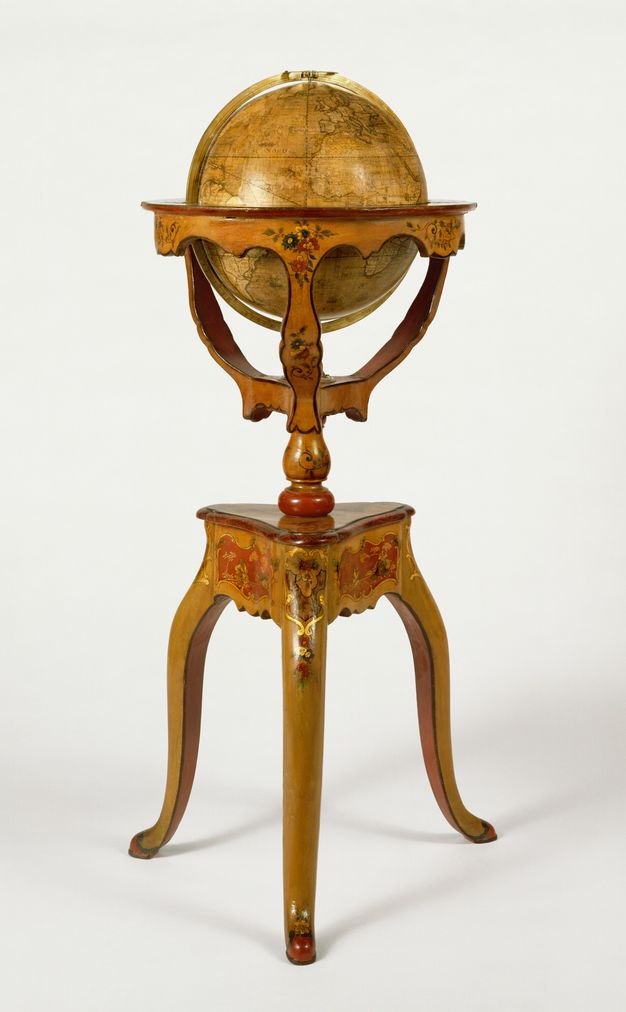 Figure 10
Terrestrial Globe (Globe terrestre), about 1728;
designer and assembler: Jean-Antoine Nollet (French
physicist and globe designer, 1700-1770);
engraver: Louis Borde (French cartographer and
engraver, active 1730-1740);
lacquer decorator: Guillaume Martin (French japanner,
died 1749) and Etienne-Simon Martin (French japanner,
died 1770);
Printed paper, papier-mâché, poplar, spruce, alder
painted with vernis Martin, and bronze, 109.2 × 44.5 ×
31.8 cm (43 × 17 1/2 × 12 1/2 in.);
J. Paul Getty Museum (Los Angeles, California),
86.DH.705.1 © The J. Paul Getty Trust. All Rights
Reserved.]; the generic event “dedication” may be recorded in
and the name of the dedicatee may be recorded in the
subcategory. Express nuance and uncertainty in the
free-text
subcategory or the
category.
Form and syntax
Capitalize all proper names. If a name includes an article or preposition (e.g. de, des, la, l’), generally use lower case except when it is the first word in the name. Avoid abbreviations. Display the name in natural order (rather than inverted order), if possible. For detailed guidelines regarding the format and syntax of names, see the subcategories and the .
TERMINOLOGY/FORMAT
Authority: Control this subcategory with the , which can be populated with published authorities, including the following: Canadiana Authorities, LC Name Authorities, United List of Artist Names (ULAN), and Yale British Artists. Display the names in the subcategory (generally comprising the nationality, life roles, and life dates).
RELATED CATEGORIES and ACCESS
Record the creators in the subcategories. Record the owners in . Patrons and donors will generally be recorded in , given that they are typically the first owner of the work. Patrons and donors may be recorded in subcategories if they have contributed to the design of the work (e.g., with many ancient Roman emperors).
17.1.5.1 Agent Role
DEFINITION
The role or activity performed by the person or corporate body in the context of the work in a particular event or situation.
EXAMPLES
- dedicatee
- donor
- queen
- pharaoh
- revolutionary leader
- evaluator
- thief
- smuggler
- agent
DISCUSSION and GUIDELINES
Optional: Record the role of the person or corporate body in the context of the particular event or other historical context. Note that this subcategory does not record the life roles of the person, which are recorded in the .
Form and syntax
Record the singular form of the term when it refers to one person; record a plural term when appropriate. Record the term in lower case except where the term includes a proper noun or is otherwise capitalized in the source controlled vocabulary. Avoid abbreviations. Record terms in natural word order, not inverted. Do not use punctuation, except hyphens, as required.
TERMINOLOGY/FORMAT
Authority: Control this subcategory with the . Use terms that have been populated from the Art & Architecture Thesaurus (AAT) Hierarchy Display (especially Agents facet).
17.1.6 Contextual Cost or Value
DEFINITION
The momentary value associated with a work in a specific historical or cultural context, including current value.
EXAMPLES
- restored for 26 scudi romani per day during 1770-1776
- appraised at £110,000 at Sotheby’s in 1946
DISCUSSION and GUIDELINES
Optional: Record the value of the work. Include the amount, the currency, the type of transaction, and the type of payment, if applicable. Since historical currencies are difficult to convert into modern ones, it is important to record the value as it is found in documentation; however, a conversion into modern equivalents may also be included. Evaluations or estimations may be expressed as a range (e.g., probably 50-55 gold florins).
TERMINOLOGY/FORMAT
Free text: This is not a controlled field. Even though this is a free-text field, the use of consistent format and controlled terminology is recommended for clarity.
RELATED CATEGORIES and ACCESS
Record the cost of the work as it changed hands with various owners in the subcategory.
17.1.6.1 Valuation
DEFINITION
An expression of the monetary value for display.
EXAMPLES
- 1000 Belgian Francs
- £110,000
- 48,000 yen
DISCUSSION and GUIDELINES
Optional: Record a display form for the value of the work, including currency and amount.
TERMINOLOGY/FORMAT
Free text: This is not a controlled field.
17.1.6.1.1 Valuation Amount
DEFINITION
The numerical amount expressed in the Valuation (17.1.6.1) subcategory.
EXAMPLES
- 1000
- 110,000
- 48,000
DISCUSSION and GUIDELINES
Optional: Record whole numbers or decimal fractions represented in the subcategory.
TERMINOLOGY/FORMAT
Controlled format: Whole numbers or decimal fractions only.
17.1.6.1.2 Currency Unit
DEFINITION
The type of currency expressed in the Valuation (17.1.6.1) subcategory.
EXAMPLES
- United States dollar
- Florentine florin
- South Korean won
DISCUSSION and GUIDELINES
Optional: Record the type of currency noted in the subcategory.
TERMINOLOGY/FORMAT
Controlled list: Use abbreviations or terms consistently. Use an authority, such as the AAT; use the narrower context terms for AAT 300411993 currencies (systems of money). Abbreviations may be used (e.g., FRF rather than French franc) however, note that if historical currencies are included in the data base, they may not have standard abbreviations.
17.1.6.2 Date of Valuation
DEFINITION
The date associated with the valuation, as recorded in the Valuation (17.1.6.1) subcategory.
EXAMPLES
- 22 May 1954
- 08/12/2001
- between 1600 and 1603
DISCUSSION and GUIDELINES
Optional: Record the date when the Valuation was made as recorded in the subcategory.
TERMINOLOGY/FORMAT
Free text: Typically a display date field. Ranges of dates, uncertainty, and ambiguity may be expressed. For indexing this display date with years, use the and subcategories described below. If it is necessary to instead consistently index using day, month, and year throughout the entire database, adopt a standard controlled format for date.
17.1.6.2.1 Earliest Date
DEFINITION
The earliest year indicated for the display Date of Valuation (17.1.6.2) subcategory.
EXAMPLES
- 1954
- 2001
- 1600
DISCUSSION and GUIDELINES
Optional: Index using a whole number representing the earliest year indicated in the display date for when the Valuation was made, as recorded in the subcategory.
TERMINOLOGY/FORMAT
Controlled format: Whole numbers.
17.1.6.2.2 Latest Date of Valuation
DEFINITION
The latest year indicated for the display Date of Valuation (17.1.6.2) subcategory.
EXAMPLES
- 1954
- 2001
- 1603
DISCUSSION and GUIDELINES
Optional: Index using a whole number representing the latest year indicated in the display date for when the valuation was made, as recorded in the subcategory. If the valuation was known to have been made in a single year, repeat the same year as in this field.
TERMINOLOGY/FORMAT
Controlled format: Whole numbers.
17.1.6.3 Valuation Agent
DEFINITION
The person or corporate body who made the valuation, as recorded in the Valuation (17.1.6.1) subcategory.
EXAMPLES
- Sotheby’s (International auction house, founded 1744 in London)
- Sir Robert Bruce Cotton (English antiquarian, 1571-1631)
DISCUSSION and GUIDELINES
Optional: Record the person or corporate body known to be responsible for the valuation, as recorded in the subcategory.
TERMINOLOGY/FORMAT
Authority: Control this subcategory with the . Populate the local authority with, or link to, standard authorities such as United List of Artist Names (ULAN), Canadiana Authorities, LC Name Authorities, and other sources as appropriate.
17.2 Architectural Context
DEFINITION
A description of the relationship between a work and a particular built work, environment, or open space.
EXAMPLES
For relief fragments in the Archaeological Museum, Corfu:
- The Medusa once stood at the apex of the west pediment at the Temple of Artemis, Corfu. The two crouching lions were positioned to either side.
For the Purification of the Virgin by Bartolo di Fredi, now in the Louvre, Paris:
- The Purification of the Virgin probably once stood on the altar in the chapel of San Guglielmo, in the church of Sant’Agostino, San Gimignano. The walls of this chapel were also painted by Bartolo and his shop, depicting other scenes from the Life of the Virgin…Apparently the Purification was the central panel in a large polyptych, reported to have had the Massacre of the Innocents depicted above, scenes from the Life of Christ (presumably a predella), and other saints…4
DISCUSSION and GUIDELINES
Optional: Record a description of where and how a work of art or architecture was incorporated in a particular space, whether it was a designed space; an interior; a public exterior space, such as a plaza; or a natural space, such as a mountain. Explain any uncertainty or nuance. If this information is discussed in the category, it need not be repeated here, but it should be indexed in the subcategory discussed below.
Form and syntax
Use natural word order. You may use phrases or complete sentences, but always begin the note with a capital letter and end it with a period. Use sentence case (not all capitals or title case). Capitalize proper names. Avoid abbreviations. Write the note in the language of the catalog record (English in the United States). Names and other words in foreign languages may be used within the note when there is no commonly used English equivalent. Use diacritics as appropriate.
TERMINOLOGY/FORMAT
Free text: This is not a controlled field, however the use of consistent terminology is recommended for clarity. Index the built work or place in .
17.2.1 Building/Site Context
DEFINITION
The specific built work or site within which the work of art or architecture was incorporated or displayed.
EXAMPLES
- Temple of Artemis (Ephesus, now in Turkey, destroyed 3rd century CE)
- Great Stupa of Dharmakaya (Shambhala Mountain Center, Red Feather Lakes, Colorado, USA; consecrated in 2001)
- Tornabuoni Chapel (Santa Maria Novella, Florence, Italy, 1470)
- Place de la Concorde (Paris, France, designed in 18th century)
- Ana Kai Tangata (cave) (Rapa Nui island, South Pacific)
DISCUSSION and GUIDELINES
Optional: Record the proper name of the building or other architectural context within which a particular work was originally or formerly seen. This name will typically represent a built work controlled by the so-called ; however, city squares may be controlled by the . Occasionally, a relationship between the work and a physical feature may be recorded (e.g., regarding the placement of the work inside a cave or on a mountain) and controlled by the .
Occasionally, the architectural work or place may not have a proper name; in such cases, use the constructed preferred “name” that has been recorded in the authority.
Explain any uncertainty or nuance regarding the architectural/site context in the free-text subcategory or in the .
Note: Do not use this subcategory to record the current or former locations of a work; use it only for an architectural or natural context that requires a description of placement and cannot be captured in a location or “place” subcategory elsewhere in the object/work record.
Specificity
Record the most specific reference that is warranted. For example, if an altarpiece was located in a particular chapel, record the name of the chapel (e.g., Tornabuoni Chapel (Santa Maria Novella, Florence, Italy, 1470)).
Form and syntax
Capitalize all proper names, including the names of buildings, city squares, and physical features. If a name includes an article or preposition (e.g. de, des, la, l’), generally use lower case except when it is the first word in the name. For additional guidelines regarding the syntax and format of the names of built works, see the . For additional guidelines regarding the syntax and format of place names, see the category and the .
TERMINOLOGY/FORMAT
Authority: For the names of built works, control terminology with the . Display the names of the buildings with the (generally comprising the geographic location and a date of construction). See the for recommendations regarding which published vocabularies may be used to populate the authority.
For the proper names of geographic places, control terminology with the . Display the names of the places with broader contexts as described in . See the authority for recommendations regarding which published vocabularies may be used to populate the authority.
RELATED CATEGORIES and ACCESS
Record the discovery location of the work in . If the placement of the work is not an issue and if the geographic location may not be captured in any other subcategory, record miscellaneous former locations in . Record the current or last known location of the work in . Record locations associated with owners of the work in . Record the locations of exhibitions in . Some institutions may wish to catalog the built work as a separate object/work in its own right, in addition to including a brief record for it in the ; the records for the two object/works may then be linked as , if appropriate.
17.2.2 Part/Placement Context
DEFINITION
A term referring to the particular location of a work of art or architectural element within a particular building or site, including its relative position in relation to the viewer and to other elements of the building or site. It may also refer to the part of a building or site in which a work figured or its placement on the work.
EXAMPLES
- west pediment
- chapel
- high altar
- nave
- railing medallion
- eye level
- above eye level
- left of doorway
- pediment
- main façade
- center of rose window
- first landing of main stairway
- facing east
- tilted at a five-degree angle
DISCUSSION and GUIDELINES
Optional: Record a generic term or phrase referring to a specific location within a building, building complex, or site where a work of art existed. If the part of the building has a specific names, such as the Chigi Chapel in Santa Maria del Popolo, Rome, record it in the and link it through the subcategory discussed above.
Note: If you are cataloging built works as works in their own right, generally do not make references to whole/part relationships within the category. Instead, create a separate catalog record for the part and link it to the whole in (e.g., between the dome of St. Peter’s and the basilica of St. Peter’s in Rome).
Form and syntax
Generally record the singular form of the term; record a plural term when appropriate. Record the term in lower case except where the term includes a proper noun or is otherwise capitalized in the source controlled vocabulary. Avoid abbreviations. Record terms in natural word order, not inverted. Do not use punctuation, except hyphens, as required.
TERMINOLOGY/FORMAT
Controlled list: Control this subcategory with an extensible controlled list. Use terms derived from the Art & Architecture Thesaurus (AAT) Hierarchy Display (Object Groupings and Systems, Components, Settlements and Landscapes, Built Complexes and Districts, Single Built Works, Open Spaces and Site Elements, Furnishings, and Attributes and Properties hierarchy) and other published controlled vocabularies where possible.
17.2.3 Architectural Context Date
DEFINITION
The date or range of dates when a work figured in a particular architectural context.
EXAMPLES
- ca. 600-580 BCE
- from ca. 1320
- before 1952
- 11th century
- Christmas 1682
DISCUSSION and GUIDELINES
Optional: Record a year, a span of years, or a phrase that describes the specific or approximate date when the work was associated with the architectural context. Since dates may be approximate, indications of nuance and certainty should be expressed, as necessary.
Form and syntax
Follow rules for display date in . Use this subcategory when the date of the association of the work with the architectural context does not directly correspond to the creation date of the architectural work (e.g., as when a work is associated with the architectural work during a time after the creation of the architectural work). Note that the creation dates for the architectural work itself will be recorded in the so-called and/or in a separate object/work record for the architectural work.
Follow rules for syntax and form as stated in the subcategory discussed above.
TERMINOLOGY/FORMAT
Free-text: This is not a controlled field. Maintain consistent capitalization, punctuation, and syntax where possible. Index the dates in the controlled and subcategories.
17.2.3.1 Earliest Date
DEFINITION
The earliest possible date during which the work figured in a particular architectural context.
EXAMPLES
- -650
- 1900
- 1682-12-25
DISCUSSION and GUIDELINES
Optional: Record the earliest year when the work was associated with the architectural context. A precise day, month, and year may be recorded, if appropriate. Note that the dates for the creation of the architectural work itself are recorded in the so-called and/or in a separate object/work record for the architectural work, and do not need to be repeated here.
Form and syntax
Always record years in the proleptic Gregorian calendar in the indexing dates fields. You may record the precise day and month, if pertinent. Use the following syntax: YYYY-MM-DD (year, month, day, separated by dashes), if possible. The standards suggest alternate possibilities; you may use an alternative syntax if you are consistent and it is compliant with the standards. It is optional to record ; however, if you record a value here, you must also record . For other rules, see .
TERMINOLOGY/FORMAT
Controlled format: Date information must be formatted consistently to allow retrieval. Local rules should be in place. Suggested formats are available in the ISO Standard and W3 XML Schema Part 2.
-
ISO 8601:2004 Representation of dates and times. International Organization for Standardization. Data Elements and Interchange Formats. Information Interchange. Representation of Dates and Times. Geneva, Switzerland: International Organization for Standardization, 2004.
17.2.3.2 Latest Date
DEFINITION
The latest possible date during which the work figured in a particular architectural context.
EXAMPLES
- -580
- 1952
- 1682-12-25
DISCUSSION and GUIDELINES
Optional: Record the latest year when the work was associated with the architectural context. You may record a specific day, month, and year, if appropriate. If the architectural placement is still relevant, record 9999. Note that the dates for the creation of the architectural work itself are recorded in the so-called and/or in a separate object/work record for the architectural work, and do not need to be repeated here.
Form and syntax
Always record years in the proleptic Gregorian calendar in the indexing dates fields. You may record the precise day and month, if pertinent. Use the following syntax: YYYY-MM-DD (year, month, day, separated by dashes), if possible. The standards suggest alternate possibilities; you may use an alternative syntax if you are consistent and it is compliant with the standards. It is optional to record ; however, if you record a value here, you must also record . For other rules, see .
TERMINOLOGY/FORMAT
Controlled format: Date information must be formatted consistently to allow retrieval. Local rules should be in place. Suggested formats are available in the ISO Standard and W3 XML Schema Part 2.
-
ISO 8601:2004 Representation of dates and times. International Organization for Standardization. Data Elements and Interchange Formats. Information Interchange. Representation of Dates and Times. Geneva, Switzerland: International Organization for Standardization, 2004.
17.3 Archaeological Context
DEFINITION
A description of the circumstances in which a work of art or architecture was excavated or discovered.
EXAMPLES
For a Roman statue:
-
Found at Tivoli in 1790 or 1791 in the ruins of the
villa of the emperor Hadrian.
[
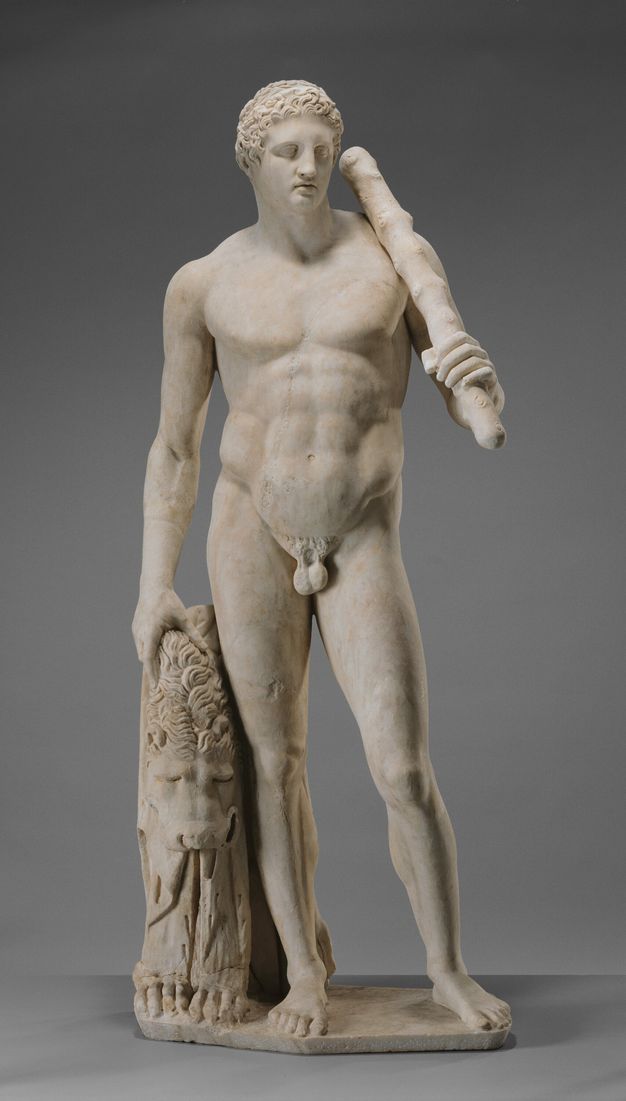 Figure 5
Lansdowne Herakles, ca. 125 CE;
artist: unknown Roman, after lost Greek original from School of Polykleitos;
Pentelic marble, 193.5 cm (height);
J. Paul Getty Museum (Los Angeles, California), 70.AA.109]
For a mosaic:
-
Found in Gaul. [
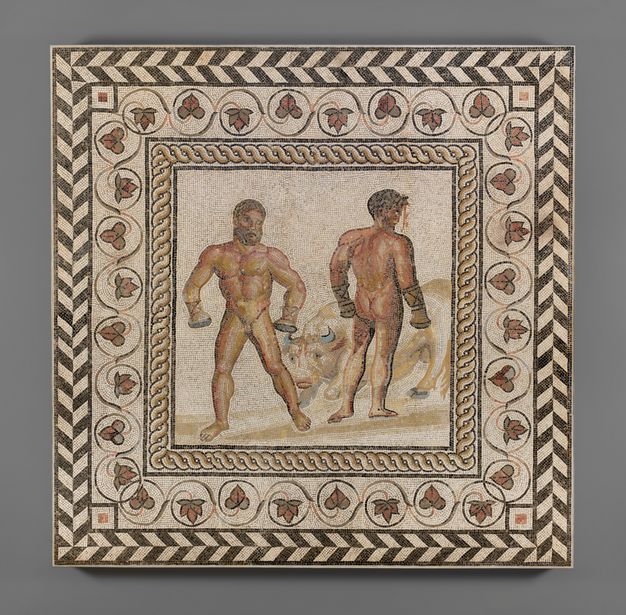 Figure 26
Mosaic with Combat Between Daris and Entellus (mosaic), probably 3rd century CE; unknown Roman or Gaul; mosaic, 206.5 x 206.5 cm;
J. Paul Getty Museum (Los Angeles, California), 71.AH.106 © The J. Paul Getty Trust. All Rights Reserved.]
For a mask:
- Probably found in North Africa.
For an Iron Age scabbard and sheath found in Flag Fen, near Lake Northey, Essex, England:
- …For centuries Flag Fen’s inhabitants cast offerings of metal weapons and tools, and even human bones, into the fen’s dark waters, perhaps to insure fertility or appease ancestors who protected their lands. The offerings were deliberately broken, ceremonially “killed,” before being cast into the water, a well-known Celtic practice…Within the trench are four walkways dating from 1300 to 900 BCE. These narrow pathways are delineated by the remains of substantial posts, and are covered with a thin layer of gravel. Between two of these posts Pryor found the well-preserved fragments of an Iron Age scabbard made of copper alloy. The sheath, which dates to between fifth and second centuries BC, has a front plate incised with spiral-like circles–perhaps a schematic rendering of a Celtic dragon, a motif found on a Hungarian dagger dated to ca. 300 BCE…5
DISCUSSION and GUIDELINES
Optional: Record a description of where and how a work of art or architecture was discovered or excavated. If this information is discussed in the , it need not be repeated here, but it should be indexed in the subcategory and other subcategories discussed below.
Express nuance and uncertainty as necessary. Note that information about the excavation of a work may be very detailed and scientific, as is the case with modern excavation reports, or it may be general and uncertain, as is the case with works excavated in the Renaissance.
Form and syntax
Use natural word order. You may use phrases or complete sentences, but always begin the note with a capital letter and end it with a period. Use sentence case (not all capitals or title case). Capitalize proper names. Avoid abbreviations. Write the note in the language of the catalog record (English in the United States). Names and other words in foreign languages may be used within the note when there is no commonly used English equivalent. Use diacritics as appropriate.
TERMINOLOGY/FORMAT
Free text: This is not a controlled field, however the use of consistent terminology is recommended for clarity. Index the place in , as discussed below.
17.3.1 Discovery/Excavation Place
DEFINITION
The geographic location where the work was excavated or discovered, including an identification of the site or plot if known.
EXAMPLES
- Flag Fen (Essex, England)
- Villa of the Mysteries (Pompeii, Napoli province, Campania, Italy)
- Teotihuacán (México state, México)
- Great Zimbabwe Ruins National Park (Victoria, Zimbabwe)
- Heliopolis (Cairo governorate, Egypt)
- Cyprus (Asia)
DISCUSSION and GUIDELINES
Optional: Record the geographic place where the work was discovered or excavated. Express nuance and uncertainty regarding the place in the free-text subcategory or the category.
Specificity
Record the most specific site known or applicable. Generally, the city or a more specific part of the site should be recorded. Any site or part of a site that has a proper name should be recorded and linked through the (e.g., Villa of the Mysteries (Pompeii, Napoli province, Campania, Italy)). Sectors, plots, and other divisions that are typically identified by numeric or alpha-numeric codes (e.g., A-456-01 or hill 78-098) may be recorded in one of two possible ways: (1) the numeric and alphanumeric codes may be recorded in the as hierarchically “part of” the site; (2) the numeric and alphanumeric codes may be recorded with the object/work in , discussed below. Either method is acceptable, provided it is applied consistently within the cataloging institution.
Form and syntax
Capitalize all proper names, including the names of villages, towns, cities, provinces, states, nations, empires, kingdoms, and physical features (e.g., Agroha (Haryana state, India)). If a name includes an article or preposition (e.g. de, des, la, l’), generally use lower case except when it is the first word in the name. for example, write Aire-sur-la-Lys (Nord-Pas-de-Calais, France), but La Chapelle (Louisiana, USA). Avoid abbreviations. For detailed guidelines regarding the format and syntax of place names, see the category and the .
TERMINOLOGY/FORMAT
Authority: Control this subcategory with the , which can be populated with terminology from the following controlled vocabularies and others as necessary: Thesaurus of Geographic Names (TGN), NGA (NIMA) and USGS, Canadiana Authorities, and LC Name Authorities. Display the name with broader contexts, as described in the .
RELATED CATEGORIES and ACCESS
If a work was installed in a particular building or part of a building, record it in . Record the place of creation in . Note that the place where a work was found does not necessarily indicate where it was made.
17.3.2 Excavation Site Sector
DEFINITION
The name, number, or other identifier assigned to the site where the work was excavated, and the square or other subdivision of the site where a work was excavated.
EXAMPLES
- # 125
- B2-3456, HOB sector
- hill 78-098
- trench A-66
DISCUSSION and GUIDELINES
Optional: Identify the code, number, or name of the specific site, square, or other sector where the work was found. In general, use lower case except when the code contains abbreviations expressed as capital letters.
Form and syntax
Sectors, plots, and other divisions that are typically identified by numeric or alpha-numeric codes (e.g., A-456-01 or hill 78-098) may be recorded in one of two possible ways: (1) the numeric and alphanumeric codes may be recorded in the as hierarchically “part of” the site; (2) the numeric and alphanumeric codes may be recorded with the object/work here in this subcategory. Either method is acceptable, provided it is applied consistently within the cataloging institution.
TERMINOLOGY/FORMAT
Free-text: This is not a controlled field. Maintain consistent capitalization, punctuation, and syntax where possible. Institutions that require retrieval on this information should control it by linking to the (i.e., make the site name and sector name or number hierarchically a “part of” the broader geographic place).
17.3.3 Excavator
DEFINITION
The name of the person or corporate body that excavated the work.
EXAMPLES
- Hawass, Zahi (Egyptian archaeologist, born 1947)
- George Edward Herbert, 5th Earl of Carnarvon (English aristocrat and archaeologist, 1866-1923)
- Anthropology Department, Indiana University (Bloomington, Indiana, USA)
DISCUSSION and GUIDELINES
Optional: Record the name and institutional affiliation of the person or corporate body who excavated the site. While a full name should be available for modern excavators, the names of historical excavators may not be known.
Form and syntax
Capitalize all proper names. If a name includes an article or preposition (e.g. de, des, la, l’), generally use lower case except when it is the first word in the name. Avoid abbreviations. Display the name in natural order (rather than inverted order), if possible. For detailed guidelines regarding the format and syntax of names, see the subcategories and the .
TERMINOLOGY/FORMAT
Authority: Control this subcategory with the . Populate the authority with Canadiana Authorities, LC Name Authorities, and other sources as appropriate. Display the name with the (typically the person’s nationality, life roles, and life dates).
17.3.4 Discovery/Excavation Date
DEFINITION
The date or range of dates when the work was discovered or excavated.
EXAMPLES
- 1993
- 12 December 1991
- May 1970
- before 1952
- between 1700 and 1798
- 19th century
DISCUSSION and GUIDELINES
Optional: Record a year, a span of years, or a phrase that describes the specific or approximate date when the work was excavated. Include indications of nuance and certainty, as necessary. See for additional rules.
Form and syntax
Follow rules for display dates in .
TERMINOLOGY/FORMAT
Free-text: This is not a controlled field. Maintain consistent capitalization, punctuation, and syntax where possible. Index the dates in the controlled and subcategories.
17.3.4.1 Earliest Date
DEFINITION
The earliest possible date when the work was discovered or excavated.
EXAMPLES
- 1492
- 1789
- -312
- 1831-05-30
DISCUSSION and GUIDELINES
Optional: Record the earliest year when the work was discovered or excavated.
Form and syntax
Always record years in the proleptic Gregorian calendar in the indexing dates fields. You may record the precise day and month, if pertinent. Use the following syntax: YYYY-MM-DD (year, month, day, separated by dashes), if possible. The standards suggest alternate possibilities; you may use an alternative syntax if you are consistent and it is compliant with the standards. It is optional to record ; however, if you record a value here, you must also record . For other rules, see .
TERMINOLOGY/FORMAT
Controlled format: Date information must be formatted consistently to allow retrieval. Local rules should be in place. Suggested formats are available in the ISO Standard and W3 XML Schema Part 2.
-
ISO 8601:2004 Representation of dates and times. International Organization for Standardization. Data Elements and Interchange Formats. Information Interchange. Representation of Dates and Times. Geneva, Switzerland: International Organization for Standardization, 2004.
17.3.4.2 Latest Date
DEFINITION
The latest possible date when the work was discovered or excavated.
EXAMPLES
- 1510
- 1799
- -312
- 1831-05-30
DISCUSSION and GUIDELINES
Optional: Record the latest year when the work was discovered or excavated. If the event is still going on, record 9999.
Form and syntax
Always record years in the proleptic Gregorian calendar in the indexing dates fields. You may record the precise day and month, if pertinent. Use the following syntax: YYYY-MM-DD (year, month, day, separated by dashes), if possible. The standards suggest alternate possibilities; you may use an alternative syntax if you are consistent and it is compliant with the standards. It is optional to record ; however, if you record a value here, you must also record . For other rules, see .
TERMINOLOGY/FORMAT
Controlled format: Date information must be formatted consistently to allow retrieval. Local rules should be in place. Suggested formats are available in the ISO Standard and W3 XML Schema Part 2.
-
ISO 8601:2004 Representation of dates and times. International Organization for Standardization. Data Elements and Interchange Formats. Information Interchange. Representation of Dates and Times. Geneva, Switzerland: International Organization for Standardization, 2004.
17.4 Historical Location Context
DEFINITION
A description of an historical context for the work that is not recorded in another Place or Location subcategory in the record.
EXAMPLES
For a missal:
- Based on contemporary contract documents, was probably copied while in Flanders in 1412.
DISCUSSION and GUIDELINES
Optional: Record a description of activities or circumstances surrounding the object while it was in a given place, when this place is not recorded elsewhere in the record. If this information is discussed in the , it need not be repeated here, but should be indexed with the subcategories listed below.
Express nuance and uncertainty as necessary.
Form and syntax
Use natural word order. You may use phrases or complete sentences, but always begin the note with a capital letter and end it with a period. Use sentence case (not all capitals or title case). Capitalize proper names. Avoid abbreviations. Write the note in the language of the catalog record (English in the United States). Names and other words in foreign languages may be used within the note when there is no commonly used English equivalent. Use diacritics as appropriate.
TERMINOLOGY/FORMAT
Free text: This is not a controlled field, however the use of consistent terminology is recommended.
17.4.1 Historical Location Place
DEFINITION
A location that provides historical context for the work but is not recorded in another Place or Location subcategory in the record.
EXAMPLES
- Alfdanga (Dhaka, Bangladesh)
- Moscow (Russia)
- Flanders
DISCUSSION and GUIDELINES
Optional: Record the name of the geographic place that provided historical context for the work. Use historical names when appropriate. Use this subcategory to record only those places that provide historical context that cannot be recorded in any other Location or Place subcategory in the object/work record.
Express nuance and uncertainty regarding the place in the .
Form and syntax
Capitalize all proper names, including the names of villages, towns, cities, provinces, states, nations, empires, kingdoms, and physical features (e.g., Agroha (Haryana state, India)). If a name includes an article or preposition (e.g. de, des, la, l’), generally use lower case except when it is the first word in the name. For example, record Aire-sur-la-Lys (Nord-Pas-de-Calais, France), but La Chapelle (Louisiana, USA). Avoid abbreviations. For detailed guidelines regarding the format and syntax of place names, see the category and the .
TERMINOLOGY/FORMAT
Authority: Control this subcategory with the , which can be populated with terminology from the following published sources, and others as necessary: Thesaurus of Geographic Names (TGN), NGA (NIMA) and USGS, Canadiana Authorities, and LC Name Authorities.
RELATED CATEGORIES and ACCESS
Record the place of creation in . Record the current location in . Record places where the work was under previous ownership in . Record places of exhibition, conservation, or examination in ; ; or . Record places that are the subject of the work in .
17.4.2 Historical Location Date
DEFINITION
The date or range of dates when the work was associated with the historical location.
EXAMPLES
- 2001
- 23 October 1876
- June 1943
- before 1780
- between 1632 and 1634
- 8th century BCE
DISCUSSION and GUIDELINES
Optional: Record a year, a span of years, or a phrase that describes the specific or approximate date when the work was associated with the location. Express nuance and uncertainty as necessary.
Form and syntax
Follow rules for display date in .
TERMINOLOGY/FORMAT
Free-text: This is not a controlled field. Maintain consistent capitalization, punctuation, and syntax where possible. Index the dates in the controlled and subcategories discussed below.
17.4.2.1 Earliest Date
DEFINITION
The earliest possible date when the work was associated with the historical location.
EXAMPLES
- 1632
- -899
- 1876-10-23
DISCUSSION and GUIDELINES
Optional: Record the earliest year when the work was associated with the historical location.
Form and syntax
Always record years in the proleptic Gregorian calendar in the indexing dates fields. You may record the precise day and month, if pertinent. Use the following syntax: YYYY-MM-DD (year, month, day, separated by dashes), if possible. The standards suggest alternate possibilities; you may use an alternative syntax if you are consistent and it is compliant with the standards. It is optional to record ; however, if you record a value here, you must also record . For other rules, see .
TERMINOLOGY/FORMAT
Controlled format: Date information must be formatted consistently to allow retrieval. Local rules should be in place. Suggested formats are available in the ISO Standard and W3 XML Schema Part 2.
-
ISO 8601:2004 Representation of dates and times. International Organization for Standardization. Data Elements and Interchange Formats. Information Interchange. Representation of Dates and Times. Geneva, Switzerland: International Organization for Standardization, 2004.
17.4.2.2 Latest Date
DEFINITION
The latest possible date when the work was associated with the historical location.
EXAMPLES
- 1510
- 1799
- -312
- 1831-05-30
DISCUSSION and GUIDELINES
Optional: Record the latest year when the work was associated with the geographic context. If the place is still pertinent, record 9999.
Form and syntax
Always record years in the proleptic Gregorian calendar in the indexing dates fields. You may record the precise day and month, if pertinent. Use the following syntax: YYYY-MM-DD (year, month, day, separated by dashes), if possible. The standards suggest alternate possibilities; you may use an alternative syntax if you are consistent and it is compliant with the standards. It is optional to record ; however, if you record a value here, you must also record . For other rules, see .
TERMINOLOGY/FORMAT
Controlled format: Date information must be formatted consistently to allow retrieval. Local rules should be in place. Suggested formats are available in the ISO Standard and W3 XML Schema Part 2.
-
ISO 8601:2004 Representation of dates and times. International Organization for Standardization. Data Elements and Interchange Formats. Information Interchange. Representation of Dates and Times. Geneva, Switzerland: International Organization for Standardization, 2004.
17.5 Remarks
DEFINITION
Additional notes or comments pertinent to information in this category.
DISCUSSION and GUIDELINES
Optional: Record a note containing additional information or comments on this category. Use consistent syntax and format. For rules regarding writing notes, see .
FORMAT/TERMINOLOGY
Free-text: This is not a controlled field. Use consistent syntax and format.
17.6 Citations
DEFINITION
A reference to a bibliographic source, unpublished document, or individual opinion that provides the basis for the information recorded in this category.
DISCUSSION and GUIDELINES
Optional: Record the source used for information in this category. For a full set of rules for citations, see .
TERMINOLOGY/FORMAT
Authority: Ideally, this information is controlled by citations in the citations authority; see .
17.6.1 Page
DEFINITION
Page number, volume, date accessed for Web sites, and any other information indicating where in the source the information was found.
DISCUSSION and GUIDELINES
Optional: For a full set of rules for pages, see .
FORMAT/TERMINOLOGY
Free-text: This is not a controlled field. Use consistent syntax and format.
Examples
Competition “event” for a design drawing:
-
Event Identification: Vietnam Veterans
Memorial Competition
Date: 1980
Agent: Vietnam Veterans Memorial Fund (VVMF)
Original architectural placement for a sculpture:
-
Building/Site: Rajarani Temple
(Bhuvanesvara, Orissa, India)
Part/Placement: exterior wall
For excavated pottery:
-
Discovery/Excavation Place: Northeast
Building (Upper Agora, Ephesus, Turkey)
Discovery/Excavation Date: 1996-2001
Excavator: Sagalassos Archaeological Research Project (Katholieke Universiteit, Leuven, Belgium)
Revised 18 January 2024
by Emily Benoff
Notes
-
James R. Blackaby, chair. “Managing Historical Data: The Report of the Common Agenda Task Force,” AASLH Special Report 3, Technical Information Service, American Association for State and Local History, 1989, n.p. ↩︎
-
For indexing this display date with years, use Earliest and Latest Dates, described below. General Idea, The AIDS Project , with an essay by Allan Schwartzman. Toronto: Gershon Iskowitz Foundation, 1989. ↩︎
-
Frederick Hartt. Art: A History of Painting, Sculpture, Architecture. 3rd, edition. Englewood Cliffs, New Jersey: Prentice-Hall, Inc., 1989, 788-789. ↩︎
-
Patricia Harpring. The Sienese Trecento Painter Bartolo di Fredi. London and Toronto: Associated University Presses, 1993, 116. ↩︎
-
Brian Fagan. “New Finds at Flag Fen,” Archaeology Magazine, XLVIII:2, March/April 1995, 24-26. ↩︎