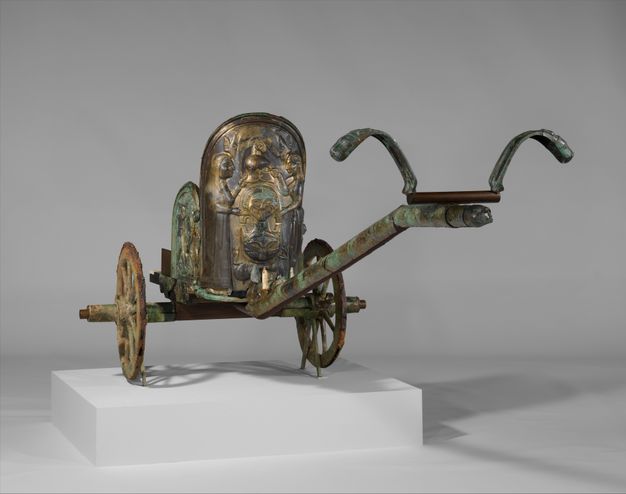
artist: Unknown Etruscan;
Bronze, ivory, total H. 51 9/16 in. (130.9 cm), length of pole 82 1/4 in. (209 cm);
The Metropolitan Museum of Art (New York, New York), Rogers Fund, 1903, 03.23.1 © The Metropolitan Museum of Art. All Rights Reserved.
Object/Work🔺
- Catalog Level:🔺 item (value type: controlled list)
- Type:🔺 chariot (value type: authority)
Classification🔺
-
Terms:🔺
vehicles
Greek and Roman art (value type: controlled list)
Titles or Names🔺
-
Text:🔺 Bronze Chariot Inlaid With
Ivory (value type: free text)
Preference: preferred (value type: controlled list)
Type: repository
Creation🔺
-
Creator Description:🔺 unknown Etruscan (value type: free text)
-
Identity:🔺 unknown Etruscan (value type: authority)
Role:🔺 creator -
Creation Date:🔺 second quarter of the 6th century BCE (value type: free text)
Earliest:🔺 -530 Latest:🔺 -550 (value type: controlled format)
Measurements🔺
-
Dimensions Description:🔺 total: 130.9 cm (51 9/16 inch) (height); pole: 209 cm (82 1/4 inches) (length) (value type: free text)
-
Extent: total
Value: 130.9 Unit: cm Type: height
Extent: pole
Value: 209 Unit: cm Type: length (value type: controlled format and controlled lists)
Materials and Techniques🔺
-
Description:🔺 Bronze and ivory (value type: free text)
-
Material Name:
ivory
bronze
Technique Name: repoussé (value type: authority)
Subject Matter🔺
-
Indexing Terms:🔺
object (utilitarian)
locomotion
transportation
animals
Achilles (Greek diety)
warriors
religion/mythology
Memnon (Greek diety)
Chiron (Greek diety) (value type: authority)
Descriptive Note
-
Text: Discovered within a subterranean tomb in Monteleone, Italy, this chariot comprises three major panels depicting various episodes from the life of Achilles, the Greek hero of the Trojan War. In portraying Achilles from a Homeric perspective, the panel designs emphasize a reverence for heroism commonly found in Etruscan works of the time. Though none of the chariot’s original substructures have survived, new supports were created by the Metropolitan Museum of Art in 1903 using ancient structural principles. This chariot is the best preserved example of its kind originating from pre-Roman Italy. (value type: free text)
-
Citation: The Met Collection online (value type: authority)
Page: accessed 18 July 2024 (value type: free text)
Context
- Archaeological Context-Discovery/Excavation Place: Monteleone di Puglia (Foggia province, Apulia region, Italy) (value type: authority)
Current Location🔺
-
Repository Name/Geographic Location:🔺
The Metropolitan Museum of Art (New York, New York, United
States) (value type: authority)
Repository Numbers:🔺 03.23.1 (value type: free text)
NOTE: 🔺 indicates a core CDWA category.
Revised 24 July 2024
by Emily Benoff