DEFINITION
The titles or names given to a work of art, architecture, or group, as well as the type of title, and the dates when the title was valid.
SUBCATEGORIES
- 3.1. Title Text 🔺
- 3.2. Title Type
- 3.3. Preference
- 3.4. Title Language
- 3.5. Title Date
- 3.6. Remarks
- 3.7. Citations
- Examples
GENERAL DISCUSSION
This category is considered core, even when a work has only a name and no proper title, because it is critical to always have a name by which to refer to the work. The category is also useful for retrieval, even though it is a free-text field.
What is a title?
This category records both titles and names that serve as titles. It records titles in the traditional Western sense, that is, descriptive phrases that refer to the iconographical subject or theme of the art work, such as Adoration of the Magi, or Portrait of Thomas Jefferson. It also records names of objects, architecture, or groups that do not have a title per se. Such names could include the object type of the work (e.g., Ceramic Bowl) or the dedication or name of a building (e.g., Saint Paul’s Cathedral).
Titles can be descriptive, such as
Perspective View of the Old Testament Portal from the North
Transept, Chartres Cathedral, or figurative, such as
After Rain in the Magic Garden. They can refer to
religious subjects, such as The Annunciation [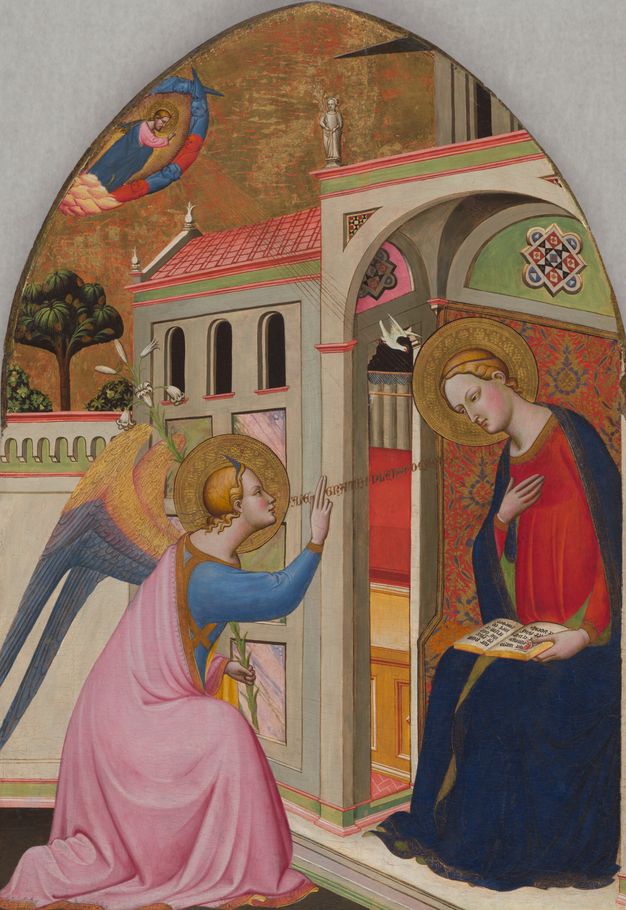 Figure 28
The Annunciation
(painting), probably ca. 1410;
artist: Tommaso del
Mazza (Italian artist, active late 14th century);
tempera on panel, 128.1 x 92 cm;
J. Paul Getty
Museum (Los Angeles, California), 71.PB.21 © The J. Paul
Getty Trust. All Rights Reserved.], or to mythical or literary subjects, such as
Farewell of Telemachus and Eucharis [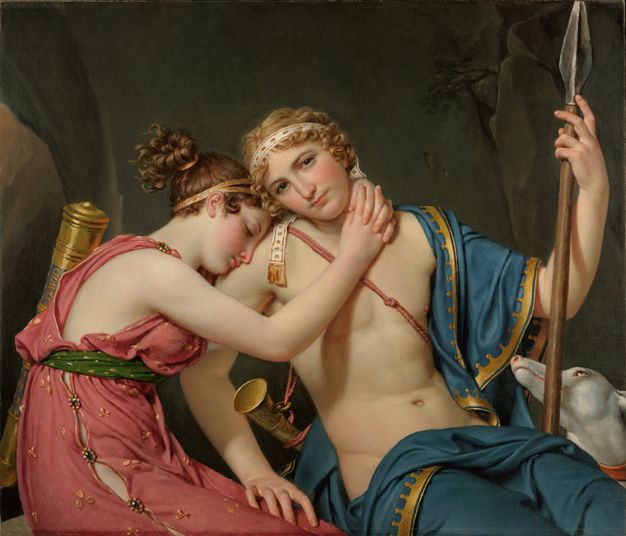 Figure 6
The Farewell of Telemachus and Eucharis, 1818;
artist: Jacques-Louis David (French
painter, 1748-1825);
oil on canvas, 87.2 x 103 cm;
J. Paul Getty Museum (Los Angeles, California),
87.PA.27.], or to historical events, such as
Battle of the Little Big Horn. It is also possible,
especially in contemporary art, for a work to be called
Untitled. Use Untitled only when this is the
name assigned by the artist or repository.
Decorative objects, non-Western art, archaeological works, or
groups are often known by a name rather than by a title (e.g.,
Chandelier [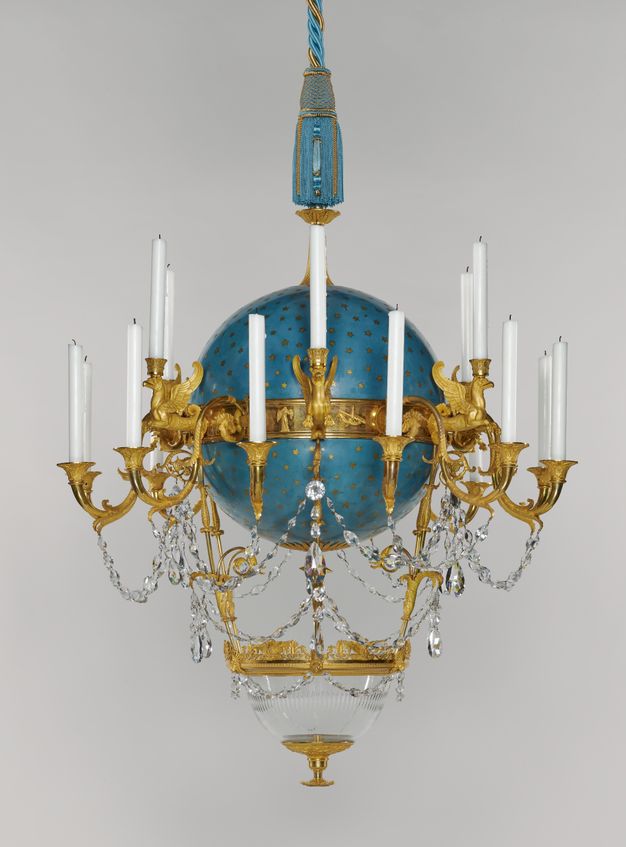 Figure 4
Chandelier
(chandelier), ca. 1818-1819;
artist: Gérard-Jean
Galle (French bronze caster and gilder, 1788-1846);
glass and enameled metal with gilt bronze mounts,
129.5 x 96.5 cm (diameter);
J. Paul Getty Museum
(Los Angeles, California), 73.DH.76.] or Rolltop Desk [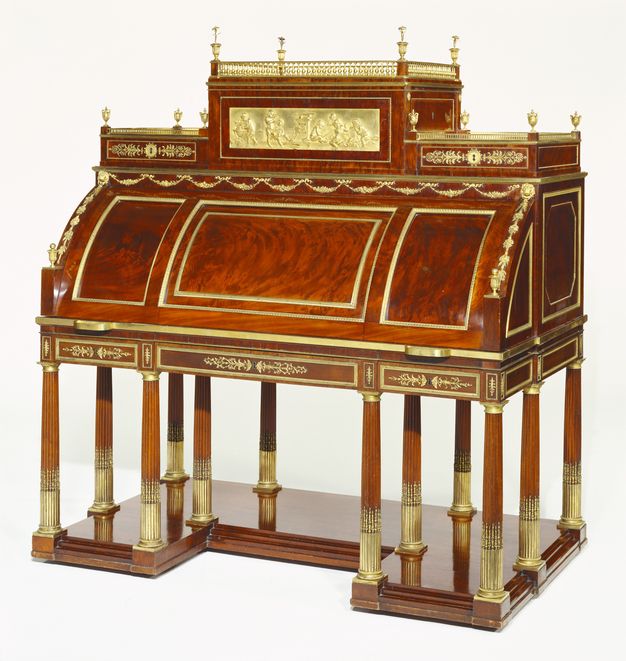 Figure 13
Rolltop Desk
(desk), ca. 1780-1785;
artist: David Roentgen
(German ébéniste, 1743-1807);
veneered with
mahogany, with gilt bronze mounts and steel fittings,
168.3 × 155.9 × 89.3 cm, 347.0017 kg (66 1/4 × 61 3/8 × 35
3/16 in., 765 lb.);
J. Paul Getty Museum (Los
Angeles, California), 72.DA.47 © The J. Paul Getty Trust.
All Rights Reserved.], Mask, or Portfolio of Sketches). Such
names are sometimes based on classification terms or object
types. They may also be modified by phrases that serve to
identify and briefly describe the work itself. These names or
terms therefore perform the same distinguishing function as a
title.
Object types or names can be used in combination with other
information as titles. They may include literary references,
such as the Culprit Fay (mirror-frame).1
They can also include references to their owners, or the
places where they were used, such as the
Burghley Bowl,
2
the Leinster Service,3
the Lansdowne Herakles [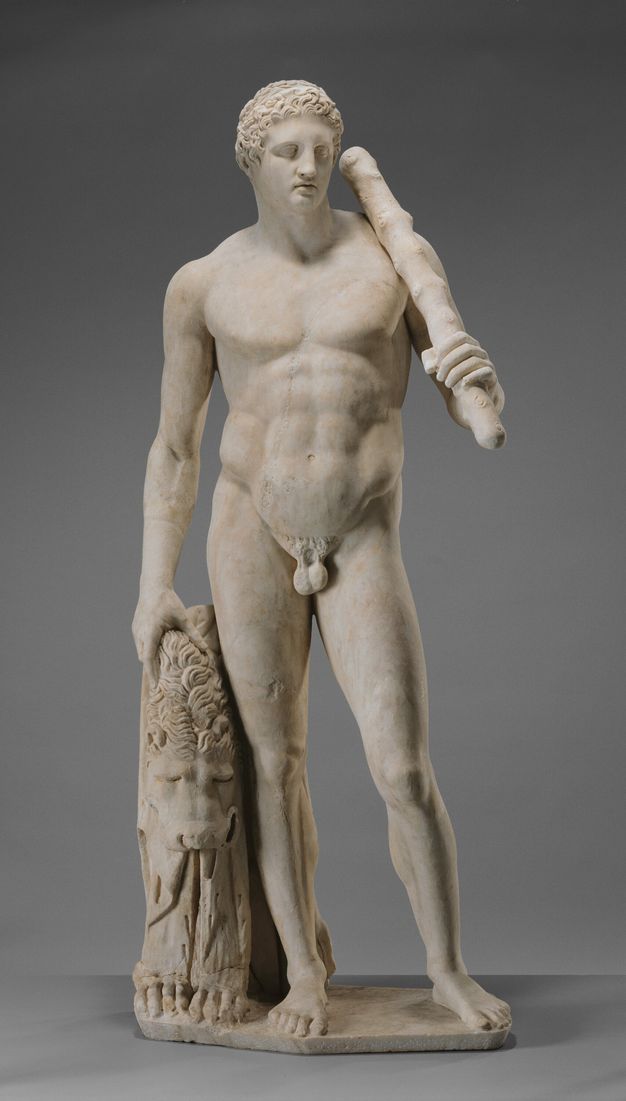 Figure 5
Lansdowne Herakles, ca. 125 CE;
artist: unknown Roman, after lost
Greek original from School of Polykleitos;
Pentelic
marble, 193.5 cm (height);
J. Paul Getty Museum (Los
Angeles, California), 70.AA.109], or the Sears Tower. Object names can simply be
descriptions, such as Lidded Bowl on Stand [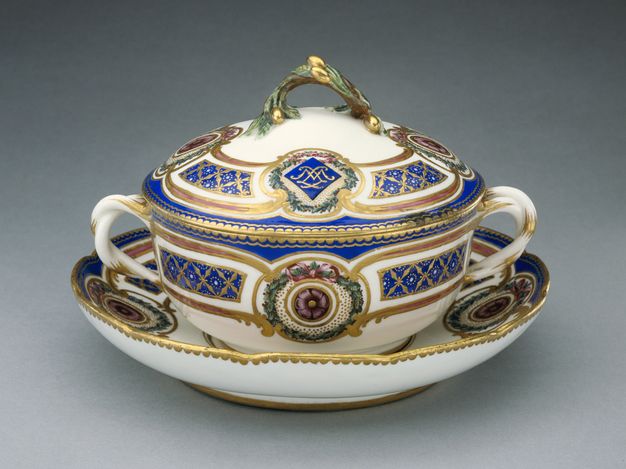 Figure 1
Lidded Bowl on Dish, 1794;
artist: painted by Pierre-Antoine Méraud (French porcelain
painter and gilder, ca. 1735-1791);
soft-paste porcelain, colored enamel decoration, gilding,
12.7 x 19.7 x 21.1 cm;
The Metropolitan Museum of Art (New York, New York),
78.DE.65 © The Metropolitan Museum of Art. All Rights
Reserved.]. Names may refer to the geographic location of the object
or building, such as Siena Cathedral.
Some works, such as manuscripts, may be known by an appellation based on a particular numbering system, such as Harley 609.
Titles or names given to works of art may have a particular meaning for the artist; therefore, accurately transcribe the wording, language, punctuation, and idiom in an artist’s title. In some cases, the title assigned to a work by the artist provides essential insight into the meaning of the work.
A significant change in a work’s title or name can often indicate an art-historical discovery. For example, when the subject of a drawing was correctly identified, its title changed from Study for a Female Figure Holding a Sword to Study for Fame Revealing Cardinal Richelieu.4
Cataloging rules
For the subcategories in this section, basic recommendations and discussion are provided below. For a fuller, more prescriptive set of cataloging rules for some of the subcategories, see “Title” in “Chapter 1: Object Naming” in Cataloging Cultural Objects (CCO), which deals with a critical subset of the CDWA.
RELATED CATEGORIES and ACCESS
The subcategory is a Primary Access Point. Searching on the title or name of a work is a common way to retrieve it. As different works often have the same title, searches should be qualified by information from other categories. Names and titles are used to identify a particular work of art or architecture. However, as many works can have the same title, such as Madonna and Child, titles must be combined with other categories of information, including and .
Researchers may also want to use the title of a group of works or a series title, such as Marcel Duchamp’s Prière de Toucher, to assemble all the single works that were once part of this collective work.
3.1. Title Text 🔺
DEFINITION
Titles, identifying phrases, or names given to a work of art, architecture, or material culture. For complex works, series, or collections, the title may refer to a discrete unit within the larger entity (a print from a series, a photograph in a collection, a panel from a fresco cycle, a builting within a temple complex) or it may identify only the larger entity (series, collection, cycle) itself.
EXAMPLES
- Venus and Cupid
-
Les Adieux de Télémaque et Eucharis [Figure 6
The Farewell of Telemachus and Eucharis, 1818;
artist: Jacques-Louis David (French painter, 1748-1825);
oil on canvas, 87.2 x 103 cm;
J. Paul Getty Museum (Los Angeles, California), 87.PA.27.] -
The Farewell of Telemachus and Eucharis [Figure 6
The Farewell of Telemachus and Eucharis, 1818;
artist: Jacques-Louis David (French painter, 1748-1825);
oil on canvas, 87.2 x 103 cm;
J. Paul Getty Museum (Los Angeles, California), 87.PA.27.] -
Polyptych with Saint James Major, Madonna and Child,
and various Saints
[
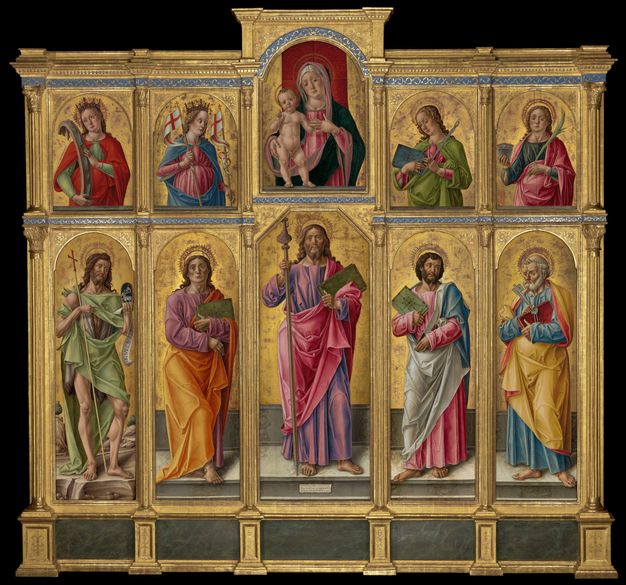 Figure 2
Polyptych with St. James Major, Madonna and Child, and Various Saints (altarpiece), 1490;
artist: Bartolomeo Vivarini (Italian painter and draftsman, active from ca. 1440, died after 1500);
tempera on panel, 280 x 215 cm;
J. Paul Getty Museum (Los Angeles, California), 71.PB.30.] - Virgin of the Rocks
- La vierge à l’hostie
- Battle of Little Big Horn
-
Adoration of the Magi [
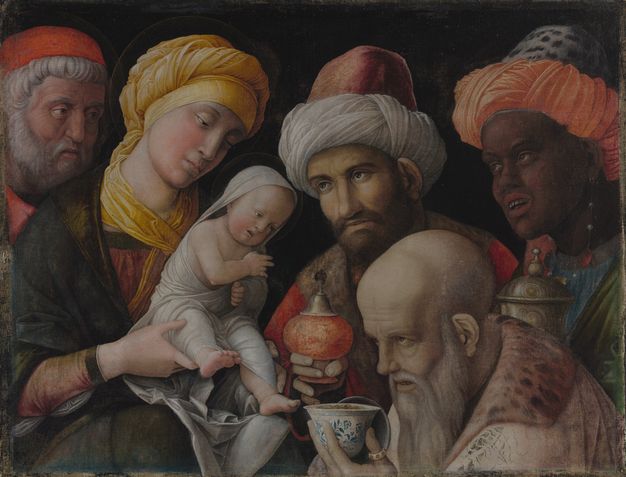 Figure 24
Adoration of the Magi, ca. 1495-1505;
artist: Andrea Mantegna (Italian painter, ca. 1431-1506);
distemper on linen, stretcher 54.6 x 69.2 cm;
J. Paul Getty Museum (Los Angeles, California), 85.PA.417 © The J. Paul Getty Trust. All Rights Reserved.] -
Portrait Study of a Man [
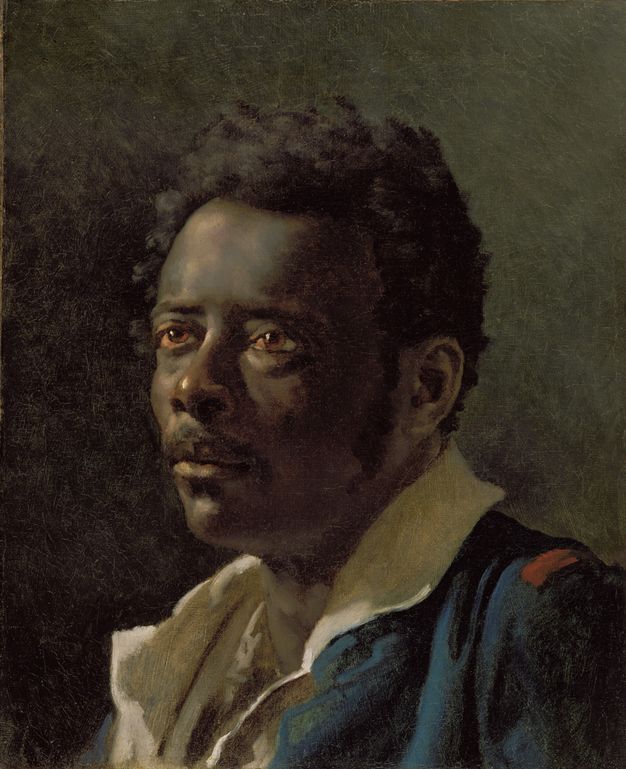 Figure 32
Portrait Study of a Man (painting), ca. 1818-1819;
artist: Théodore Géricault (French painter and draftsman, 1791-1824);
oil on canvas, 46.5 x 38 cm;
J. Paul Getty Museum (Los Angeles, California), 85.PA.407 © The J. Paul Getty Trust. All Rights Reserved.] -
Portrait of a Halberdier (Francesco Guardi?)
[
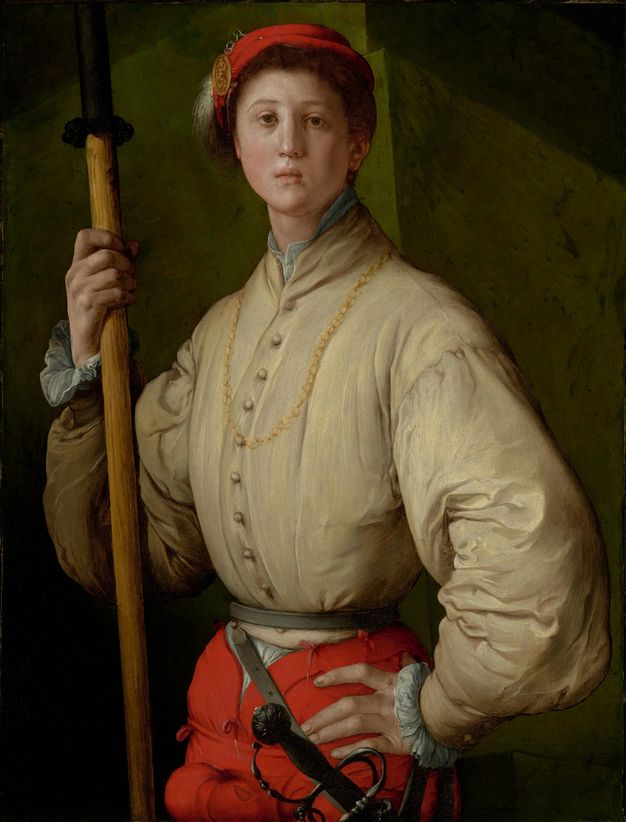 Figure 8
Portrait of a Halberdier (Francesco Guardi?), about 1528-1530;
artist: Pontormo (Italian painter and draftsman, 1494-1557);
oil on canvas, 92 x 72 cm;
J. Paul Getty Museum (Los Angeles, California), 89.PA.49.] - Queen Dedes as Prajnaparamita
- Eight Scenes of the Xiao-Xiang Rivers
- Sketches and Studies after Roman tombs
- Site Plan for the Opera at the Placedu Palais Royal, Paris
- Sculptural Group of Two Griffins Attacking a Fallen Doe
- Male Torso
- Noli me tangere
- The Bride Stripped Bare by Her Bachelors, Even
- Death and Fire
- Nave Nave Mahana
- Asante Figurative Goldweight
-
Lidded Bowl on Stand [Figure 1
Lidded Bowl on Dish, 1794;
artist: painted by Pierre-Antoine Méraud (French porcelain painter and gilder, ca. 1735-1791);
soft-paste porcelain, colored enamel decoration, gilding, 12.7 x 19.7 x 21.1 cm;
The Metropolitan Museum of Art (New York, New York), 78.DE.65 © The Metropolitan Museum of Art. All Rights Reserved.] - Finger-Ring Amulet
-
Chandelier [Figure 4
Chandelier (chandelier), ca. 1818-1819;
artist: Gérard-Jean Galle (French bronze caster and gilder, 1788-1846);
glass and enameled metal with gilt bronze mounts, 129.5 x 96.5 cm (diameter);
J. Paul Getty Museum (Los Angeles, California), 73.DH.76.] - Untitled
- Number One
- Empire State Building
- Santa Maria Novella
- MS Ludwig XV
DISCUSSION and GUIDELINES
Required: Record at least one title or name for the work, group of works, collection, or series. If a work has been known by multiple titles or names, include them in repeating instances of this subcategory.
Specificity
Titles should generally be concise and specific to the work. A preferred descriptive title should be concise (e.g., from the National Gallery of Art in Washington, Maiolica Plate with Profile Bust), but an alternate title may include more details (e.g., Maiolica Plate with Running Plant Border and Geometric Panels on Well; in the Center, Profile Bust of a Man in Armor).
Form and syntax
Record titles and names in title case, not sentence case. Maintain consistent capitalization, punctuation, and syntax in titles across the database where possible. Capitalize proper names in the title. For titles derived from authoritative sources, follow the capitalization and punctuation of the source. For constructed titles in English, capitalize the first word and all nouns, pronouns, verbs, adverbs, adjectives, and subordinate conjunctions; use lower case for articles, coordinate conjunctions, and prepositions, unless they are the first word of the title. For titles in other languages, follow capitalization rules of that language.
For the preferred title, avoid abbreviations. Include common abbreviations in alternate titles to provide access. Generally avoid initial articles, unless it is commonly used and confusion could result if it were omitted (e.g., La Vierge). For the preferred title, use the language of the catalog record, except when the title is commonly expressed in another language (e.g., Noli me tangere). Include translations of the title in other languages, if known.
Preferred title
One title for each work must be flagged as preferred. For the preferred title, use a concise descriptive title in the language of the catalog record, if possible. The preferred title should be a recent title provided by the owning institution, a concise inscribed title, or a title provided by the artist, if known and if it is sufficiently descriptive. Construct a descriptive title if necessary. Flag the preferred title; see below.
- Exception: If the work is commonly known by a title, use that title as preferred, even if it is not descriptive. However, a descriptive title is still required and should be flagged with “descriptive.”
In brief: Give precedence to owning institution’s and artist’s titles when choosing a preferred title. However, if these titles are not descriptive, they should be flagged as preferred, but a separate non-preferred descriptive title should be created and flagged Descriptive.
Types of titles
Include the following types of titles. Label them appropriately using .
-
Descriptive title: The descriptive title must convey to the user what the work is or what its subject is about. Also record the subject in . If the repository title or another title is descriptive, the cataloger need not construct one. If the preferred title is not descriptive and in the language of the catalog record, it is required to also display the descriptive title to end-users.
-
Inscribed title: Include any title that was applied to the work by the creator with the apparent purpose of giving it a title. If the inscribed title is not descriptive, it need not be the preferred title, but it should be included as an alternate title. For prints and books, record any title inscribed in the printing plate or on the title page (e.g., Cabinet des Beaux Arts [
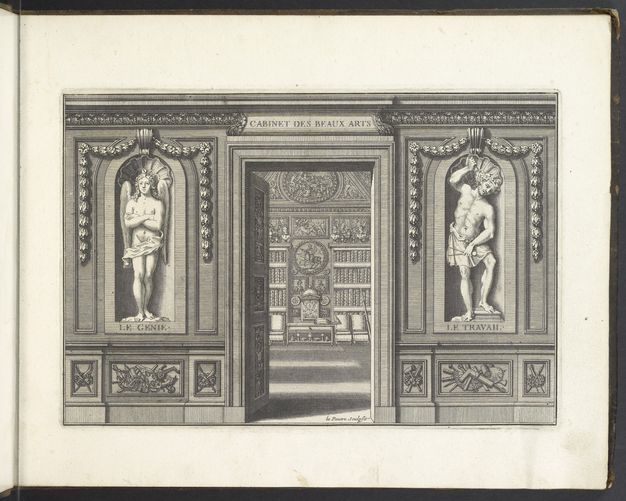 Figure 34
Les Cabinet des Beaux Arts, ca. 1690;
artist: probably engraved by Pierre Lepautre (French sculptor and printmaker, born ca. 1660, died 1744);
from *Le Cabinet des Beaux Arts, ou, Recueil d’estampes gravés d’aprés les tableaux d’un plafond ou les beaux arts sont representées avec explication de ces mêmes tableaux;
engraving on laid paper, plate mark: 17.6 x 26.4 cm (6 7/8 x 10 3/8 inches);
Getty Research Institute (Los Angeles, California), 88-B12341[plate 2] © The J. Paul Getty Trust. All Rights Reserved.]). For books, it is customary to make the inscribed title preferred; however, if the inscribed title is not descriptive, a desctiptive title should also be included. The inscribed title may also be recorded with other inscriptions in the category. -
Creator’s and repository’s titles: Include any titles assigned to the work by the creator or by the repository.
-
Collective titles: In general, avoid putting two titles in the same title field. If the work is part of a series or other larger whole, if possible catalog both the part and the whole separately; a link between the two related records would allow for a display of both titles in the record for the part. However, if it is not possible to catalog both the part and the whole, include the title for the larger whole in the title (e.g., Le Cheval Rayé from the Les Anciennes Indes [
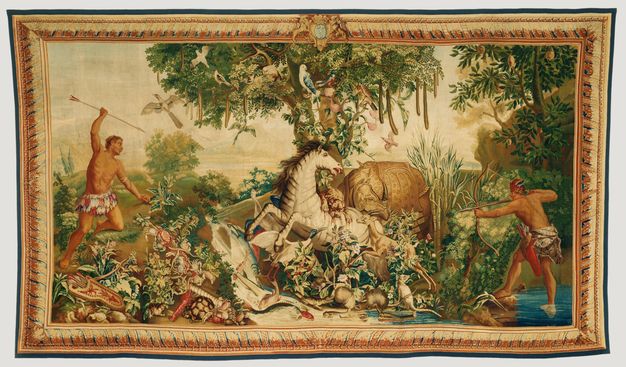 Figure 25
Le Cheval Rayé, ca. 1690-1730, based on sketches from mid-17th cen.;
from series Les Anciennes Indes;
artist: Gobelins (French craftsmen’s factory, established in 1662 in Paris, closed in 20th century), after a cartoon by Albert Eckhout (Dutch painter and draftsman, ca.1610-1666) and Frans Post (Dutch painter and draftsman, 1612-1680), retouched by Jean-Baptiste Monnoyer (French painter and etcher, 1636-1699, active in Paris and London), René-Antoine Houasse (French painter, ca. 1645-1710), François Bonnemer (French painter and engraver, 1637-1689), and Alexandre-François Desportes (French painter, 1661-1743);
wool and silk, 326 x 580.2 cm;
J. Paul Getty Museum (Los Angeles, California), 92.DD.21 © The J. Paul Getty Trust. All Rights Reserved.]). If the parts of a work are not cataloged separately, include the titles of two or more parts in the same title field (e.g., Two Standing Male Figures (recto); A Reclining Figure, Two Partial Figures (verso)).
Constructing a title
If a title must be constructed, it may include the following types of content:
-
Iconography: Where appropriate, list named religious, mythological, literary, historical, or allegorical themes or subjects (e.g., Battle of Little Big Horn or Shiva and his Consorts).
-
Proper names: Include named or anonymous figures, other works, or places depicted in the work, using proper names, if known (e.g., Plan and Elevation of the Houses of Parliament, London or Portrait of Abraham Lincoln ).
-
Work type: For decorative works, utilitarian works, archaeological works, architecture, or groups of works that do not have a title per se, include a descriptive phrase or name based on work types or a brief physical description the work (e.g., Silver Chocolate Pot). The work type may be combined with the names of iconographical or other themes (e.g., Vessel with Zeus Chasing the Trojan Prince Ganymede).
-
Owners: Where appropriate, record a title that includes the names of current or former owners, a current or former location, or other historical references (e.g., Bayeux Tapestry).
-
Architecture: For architecture, record a descriptive name, a name that refers to the owner, a dedication (e.g., for a church), or a street address, as appropriate. Many buildings do not have names, in which case the title may refer to the work type (e.g., Amphitheater) or it may be a longer descriptive phrase. For manuscripts or other works, if appropriate, record an appellation based on a particular numbering system, such as a “shelfmark” (e.g., British Museum Harley 2788).
-
Unknown titles: For works for which a title must be constructed, but where the work type and purpose are unknown, construct a descriptive title using any generic information available (e.g., Abstract Composition). Do not use the word “Untitled” as a title unless the work has intentionally been called Untitled by the creator.
TERMINOLOGY/FORMAT
Free-text: This is not a controlled field. If there is important information in the title, such as , , etc., index this information in the pertinent controlled subcategory elsewhere in the record.
RELATED CATEGORIES and ACCESS
If the title includes the type of work, repeat it in the subcategory. Its parts should be listed in . Classification terms in the title may also be recorded in . Inscribed titles should be transcribed with other inscriptions in the category. The subject of the work whose title is given here is recorded in .
3.2. Title Type
DEFINITION
The kind of title or name assigned to a work.
EXAMPLES
- descriptive
- repository
- inscribed
- artist’s
- former
- translated
- constructed
- original
- brand name
- popular
- published
- series
- manuscript designation
DISCUSSION and GUIDELINES
Optional: Record a term indicating the type of title. It is required to record a descriptive title. Use terms in lower case.
It is particularly important to label the descriptive title, the repository title, any inscribed title, or the artist’s title. Each title may have multiple (e.g., one title may be repository, descriptive, and artist’s).
TERMINOLOGY/FORMAT
Controlled list: Control this subcategory with a controlled list: preferred, descriptive, repository, inscribed, artist’s, former, translated, and others as required.
3.3. Preference
DEFINITION
An indication of whether the title is the preferred title for the work.
EXAMPLES
- preferred
- alternate
DISCUSSION and GUIDELINES
Optional: Designate if the title is a preferred or alternate title/name. Use lower case.
If there are multiple titles, it is recommended to mark one of them as preferred, to be used by default in displays. The preferred title should be a descriptive title in the language of the catalog record. See further discussion above under .
TERMINOLOGY/FORMAT
Controlled list: Control this subcategory with a controlled list. Recommended values: preferred, alternate.
3.4. Title Language
DEFINITION
The language of the title or name.
EXAMPLES
- English
- French
- Italian
- Liturgical Latin
DISCUSSION and GUIDELINES
Optional: Record a term indicating the language of title. Capitalize the names of languages.
TERMINOLOGY/FORMAT
Controlled list: Control this subcategory with a controlled list. Values may be derived from a source such as Ethnologue: Languages of the World. 14th edition. Barbara F. Grimes, ed. Dallas, Texas: SIL International, 2000. The ISO-639 standard may be used for language codes; however, if ISO codes are used, values must be translated into legible form for end-users.
3.5. Title Date
DEFINITION
A description of the date on which a particular title was assigned to the work, or a range of dates during which a title was known to be valid.
EXAMPLES
- 1887
- late 17th century
- until 1986
DISCUSSION and GUIDELINES
Optional: Record the dates or date range when a title was used. Include references to uncertainty or ambiguity as necessary.
Form and syntax
Follow the applicable rules for display dates in .
Since titles may change over time, it is important to know when a particular title was in use. The date for titles or names can be used to identify the work in documents from the time the title was current or to understand how it was interpreted at a particular time.
TERMINOLOGY/FORMAT
Free-text: This is not a controlled field. Maintain consistent capitalization, punctuation, and syntax where possible. Index the dates in the controlled and subcategories.
3.5.1 Earliest Date
DEFINITION
The earliest date on which a particular title was assigned to the work or was valid.
EXAMPLES
- 1877
- 1670
- 1950
DISCUSSION and GUIDELINES
Optional: Record the earliest year indicated by the display .
Form and syntax
Always record years in the proleptic Gregorian calendar in the indexing dates fields. It is optional to record ; however, if you record a value here, you must also record . See rules at .
TERMINOLOGY/FORMAT
Controlled format: Date information must be formatted consistently to allow retrieval. Local rules should be in place. Suggested formats are available in the ISO Standard and W3 XML Schema Part 2.
-
ISO 8601:2004 Representation of dates and times. International Organization for Standardization. Data Elements and Interchange Formats. Information Interchange. Representation of Dates and Times. Geneva, Switzerland: International Organization for Standardization, 2004.
3.5.2 Latest Date
DEFINITION
The earliest date on which a particular title was assigned to the work was valid.
EXAMPLES
- 1897
- 1699
- 1986
DISCUSSION and GUIDELINES
Optional: Record the latest year indicated by the display .
Form and syntax
Always record years in the proleptic Gregorian calendar in the indexing dates fields. It is optional to record ; however, if you record a value here, you must also record . See rules at .
TERMINOLOGY/FORMAT
Controlled format: Date information must be formatted consistently to allow retrieval. Local rules should be in place. Suggested formats are available in the ISO Standard and W3 XML Schema Part 2.
-
ISO 8601:2004 Representation of dates and times. International Organization for Standardization. Data Elements and Interchange Formats. Information Interchange. Representation of Dates and Times. Geneva, Switzerland: International Organization for Standardization, 2004.
3.6. Remarks
DEFINITION
Additional notes or comments pertinent to information in this category.
DISCUSSION and GUIDELINES
Optional: Record a note regarding the title or name of the work. Use consistent syntax and format. For rules regarding writing notes, see .
FORMAT/TERMINOLOGY
Free-text: This is not a controlled field. Use consistent syntax and format.
3.7 Citations
DEFINITION
A reference to a bibliographic source, unpublished document, or individual opinion that provides the basis for the information recorded in this category.
DISCUSSION and GUIDELINES
Optional: Record the source used for information in this category. For a full set of rules for citations, see .
TERMINOLOGY/FORMAT
Authority: Ideally, this information is controlled by citations in the citations authority; see .
3.7.1 Page
DEFINITION
Page number, volume, date accessed for Web sites, and any other information including where in the source the information was found.
DISCUSSION and GUIDELINES
Optional: For a full set of rules for pages, see .
TERMINOLOGY/FORMAT
Free-text: This is not a controlled field. Use consistent syntax and format.
Examples
The following examples include subcategories along with .
For portraits and named places:
-
Object/Work Type:🔺 pastel
Title/Name:🔺 Portrait of Maria Frederike van Reede-Athlone at Seven Years of Age
Preferece: preferred -
Object/Work Type:🔺 albumen print
Title/Name:🔺 Naiche, Youngest Son of Cochise
Preference: preferred -
Object/Work Type:🔺 painting
Title/Name:🔺 Maude Adams as Joan of Arc
Preference: preferred -
Object/Work Type:🔺 relief
Title/Name:🔺 Relief of Nebhepetra Mentuhotep
Preference: preferred -
Object/Work Type:🔺 handscroll
Title/Name: 🔺Viewing the Waterfall at Longiu
Preference: preferred
Title/Name:🔺 Longqiu guanpo tu
Preference: alternate -
Object/Work Type:🔺 painting
Title/Name:🔺 Autumn: On the Hudson River
Preference: preferred -
Object/Work Type:🔺 design drawing | competition drawing
Title/Name: 🔺Temple Design for the Lincoln Memorial
Preference: preferred
Uncertainty regarding the identity of the sitter is expressed in parentheses:
-
Object/Work Type:🔺 painting
Title/Name:🔺 Portrait of a Halberdier (Francesco Guardi?)
Preference: preferred
Title/Name:🔺 Portrait of Cosimo I de’Medici
Preference: alternate Title Type: former
For genre scenes, unnamed people and places, abstract:
-
Object/Work Type:🔺 preparatory drawing
Title/Name:🔺 Group of Nine Standing Figures
Preference: preferred -
Object/Work Type:🔺 screen
Title/Name:🔺 Eight-Planked Bridge (Yatsuhashi)
Preference: preferred -
Object/Work Type:🔺 painting
Title/Name:🔺 Landscape with Classical Ruins and Figures
Preference: preferred -
Object/Work Type:🔺 assemblage | scatter pieces
Title/Name:🔺 Tori
Preference: preferred Title Type: artist’s
Title/Name:🔺 Nine Forms Arranged Casually on the Floor
Preference: alternate Title Type: descriptive -
Object/Work Type:🔺 sculpture
Title/Name:🔺 Unique Forms of Continuity in Space
Preference: preferred
Title/Name:🔺 Abstract Bronze Sculpture
Preference: alternate Title Type: descriptive
The repository title is in French, so a descriptive title in English is included too:
-
Object/Work Type:🔺 drawing
Title/Name:🔺 Téte à téte
Preference: preferred Title Type: repository
Language: French
Title/Name:🔺 Two Lovers
Preference: alternate Title Type: descriptive -
Object/Work Type:🔺 painting
Title/Name:🔺 Les Demoiselles d’Avignon
Preference: preferred Title Type: repository
Title/Name:🔺 Five Female Nudes
Preference: alternate Title Type: descriptive
Title includes parenthetical explanation of what a “hacha” is:
-
Object/Work Type:🔺 hacha
Title/Name:🔺 Hacha (Ceremonial Ax)
Preference: preferred
For still lives:
-
Object/Work Type:🔺 etching
Title/Name:🔺 Shell (Murex brandaris)
Preference: preferred -
Object/Work Type:🔺 watercolor
Title/Name:🔺 Still Life with Flowers
Preference: preferred
For books and prints:
-
Object/Work Type:🔺 book | etchings | maps | plans | panoramas
Title/Name:🔺 Theatrum civitatum nec non admirandorum Neapolis et Siciliae regnorum
Preference: preferred Title Type: inscribed
Title/Name:🔺 Views of the Cities and Sights of the Realm of Naples and Sicily
Preference: alternate Title Type: descriptive -
Object/Work Type:🔺 color woodcuts
Title/Name:🔺 Thirty-six Views of Mount Fuji: First Series
Preference: preferred
Title/Name:🔺 First Series: Mt. Fuji Views Preference: alternate
Title/Name:🔺 Fugaku sanjurokkei Preference: alternate -
Object/Work Type:🔺 gelatin silver print
Title/Name:🔺 Chez Mondrian
Preference: preferred Title Type: repository
Title/Name:🔺 Interior View of a Room and an Open Door
Preference: alternate Title Type: descriptive -
Object/Work Type:🔺 cartes-de-visite
Title/Name:🔺 Peruvian Portrait Cartes-de-Visite
Preference: preferred
For iconography, literature, and events:
-
Object/Work Type:🔺 cup
Title/Name:🔺 Vessel with Mythological Scene of the Maya Underworld
Preference: preferred -
Object/Work Type:🔺 lithograph
Title/Name:🔺 Battle of Bull’s Run
Preference: preferred Title Type: artist’s
Title/Name:🔺 Battle of Manassas Preference: alternate
Title/Name:🔺 Battle of Bull Run Preference: alternate -
Object/Work Type:🔺 etching
Title/Name:🔺 Menuet de la Mariée
Preference: preferred Title Type: inscribed Title Type: repository Language: French
Title/Name:🔺 Minuet of the Bride
Preference: alternate Title Type: translated Language: English -
Object/Work Type:🔺 statue
Title/Name:🔺 Standing Parvati Preference: preferred -
Object/Work Type:🔺 statue fragment
Title/Name:🔺 Head of a Buddha Preference: preferred
Two scenes are in one work, both included in the title:
-
Object/Work Type:🔺 panel painting | predella panel
Title/Name:🔺 Creation of the World and Expulsion from Paradise
Preference: preferred -
Object/Work Type:🔺 fresco cycle
Title/Name:🔺 Scenes from the Life of Christ and the Virgin Mary
Preference: preferred -
Object/Work Type:🔺 mosaic
Title/Name:🔺 Alexander the Great Defeating the Persian King Darius
Preference: preferred
Title of the larger work is included in parentheses because the larger work is not cataloged separately:
-
Object/Work Type:🔺 stained glass
Title/Name:🔺 Theodosius Arrives at Ephesus (Scene from the Legend of the Seven Sleepers of Ephesus)
Preference: preferred
Characters in a Disney movie are named in the title, i.e., names are “Turtle” and “Chipmunk”:
-
Object/Work Type:🔺 production cel |
cel set-up
Title/Name:🔺 Turtle and Chipmunk Preference: preferred
Title/Name:🔺 Turtle Washing Preference: alternate Title Type: former
Work Type is the Title/Name:
-
Object/Work Type:🔺 vase
Title/Name:🔺 Vase Preference: preferred -
Object/Work Type:🔺 bowl
Title/Name:🔺 Broad-rimmed Bowl Preference: preferred -
Object/Work Type:🔺 basket
Title/Name:🔺 Small Seed or Water-Carrying Basket Preference: preferred -
Object/Work Type:🔺 headrest
Title/Name:🔺 Headrest in the Shape of an Elephant Preference: preferred -
Object/Work Type:🔺 sacramentary | illuminated manuscript
-
Title/Name:🔺 Sacramentary Preference: preferred
-
Object/Work Type:🔺 doll
Title/Name:🔺 Doll with China Head Preference: preferred -
Object/Work Type:🔺 rolltop desk
Title/Name:🔺 Rolltop Desk
Preference: preferred Language: English
Title/Name:🔺 Secrétaire à Cylindre
Preference: alternate Title Type: alternate Language: French
For Textiles:
-
Unfamiliar term is explained in parentheses:
-
Object/Work Type:🔺 tunic
Title/Name:🔺 Tunic with Tocapu (Geometric Pictographs)
Preference: preferred
-
Object/Work Type:🔺 tunic
-
Iconography is used as a title:
-
Object/Work Type:🔺 tapestry
Title/Name:🔺 Unicorn in Captivity
Preference: preferred
-
Object/Work Type:🔺 tapestry
-
For architecture and architectural sculpture:
-
Object/Work Type:🔺 observation tower
Title/Name:🔺 Eiffel Tower Preference: preferred
Title/Name:🔺 Tour Eiffel Preference: alternate
Title/Name:🔺 Three-Hundred-Meter Tower Preference: alternate Title Type: former -
Object/Work Type:🔺 temple | rotunda | church
Title/Name:🔺 Pantheon Preference: preferred
Title/Name:🔺 Santa Maria ad Martyres Preference: alternate
Title/Name:🔺 Santa Maria Rotunda Preference: alternate
-
-
Title includes the iconography and the location of the work:
-
Object/Work Type:🔺 architectural
sculpture
Title/Name:🔺 Last Judgment, Chartres Preference: preferred
Title/Name:🔺 Tympanum, South Transept, Chartres Title Type: alternate
-
Object/Work Type:🔺 architectural
sculpture
NOTE: 🔺 indicates a core CDWA category.
Revised 11 December 2023
by Emily Benoff
Notes
-
Doreen Bolger Burke, et al. In Pursuit of Beauty: Americans and the Aesthetic Movement. New York: Metropolitan Museum of Art and Rizzoli, 1986, ill.9.15, 311. ↩︎
-
Gervase Jackson-Stops, ed., Treasure Houses of Britain: Five Hundred Years of Private Patronage and Art Collecting. Washington, DC: National Gallery of Art; New Haven: Yale University Press, 1985, cat. no. 415. ↩︎
-
Ibid, cat. no.379. ↩︎
-
National Gallery of Canada, acc. no. 6318. ↩︎