DEFINITION
An explanation of the way a work is meant to be seen or has been displayed.
SUBCATEGORIES
- 12.1. Orientation/Arrangement Description
- 12.2. Orientation Indexing Terms
- 12.3. Remarks
- 12.4. Citations
- Examples
GENERAL DISCUSSION
The orientation or arrangement of the work may be important to understanding its meaning and context. Current arrangements, as well as intended or former arrangements, may be noted.
In certain cases, particularly with abstract or nonrepresentational works, it is difficult to know how the artist intended the work to be oriented or arranged unless this is explained. Opinions about the arrangement of a work may vary, or a work may have been assembled in different ways for different installations. Each variation should be described separately.
Specificity
A precise description of arrangement and orientation enables the researcher to visualize the object and aids in the understanding of its composition and subject matter. For complex multi-part works, arrangement and orientation may be known for each of the parts, for example for contemporary installations in the so-called “stations format.” Multi-part works are often quite complex in their physical composition: a description of their arrangement and orientation makes it possible to understand how the parts relate to each other and ensures that the work will be seen in the appropriate sequence. For single-part works, noting orientation ensures that the work will be installed appropriately.
A full statement of the arrangement of a work is critical for installations and other large works, which are often stored in parts. This enables an accurate reconstruction of the work when it is exhibited again. Information about orientation and arrangement can be used to connect works of art with similar orientations, such as all hanging scrolls or all paintings of a particular type that have a horizontal orientation. In addition, information about the arrangement of objects in reference to one another is of interest, whether as parts of a whole, as in the arrangement of the Elgin Marbles, or as works arranged together in a particular context (e.g., the juxtaposition of sculptures by three generations of Calders on the Benjamin Franklin Parkway in Philadelphia).
Sources
The source for the arrangement of a work of art may be the artist him- or herself. Other sources may include visual documentation of the work in situ, or descriptions of the work when it was exhibited. There may also be information carried within the work itself, such as the place-numbers assigned to works within a portfolio, which indicate their sequence. Orientation and arrangement may also be derived from a direct examination of the work itself.
RELATED CATEGORIES and ACCESS
For archival arrangements, use .
The parts of the work of art or architecture should be recorded in . Part/whole relationships are further articulated in . Information regarding the work’s dimensions and format should be recorded in . Any inscriptions on the work that provide information regarding its arrangement should be transcribed or described in . A work may be arranged differently when it is installed in various locations. A work’s exhibition history is provided in . An arrangement or orientation may be related to a work in a particular context. This should be recorded in . Visual images that provide information about the work of art should be cited in .
12.1. Orientation/Arrangement Description
DEFINITION
A description of the way the work is meant to be seen or has been displayed.
EXAMPLES
- hung horizontally
- Three projection screens form three walls and a two-way mirror forms the fourth wall of an enclosed space, using 3 channel-video projection and two folding chairs set up in the center of the room facing the mirror
-
The polyptych was formerly arranged differently. In
the upper tier, an earlier reconstruction placed Mary
Magdalene on the outside left and St. Catherine on the
outside right (while they are currently in reverse
positions). In the lower tier, the earlier
reconstruction placed St. Bartholomew to the left of
the central St. James Major, and St. John the
Evangelist to the right of James (while the current
reconstruction has swapped the positions of
Bartholomew and John)
[
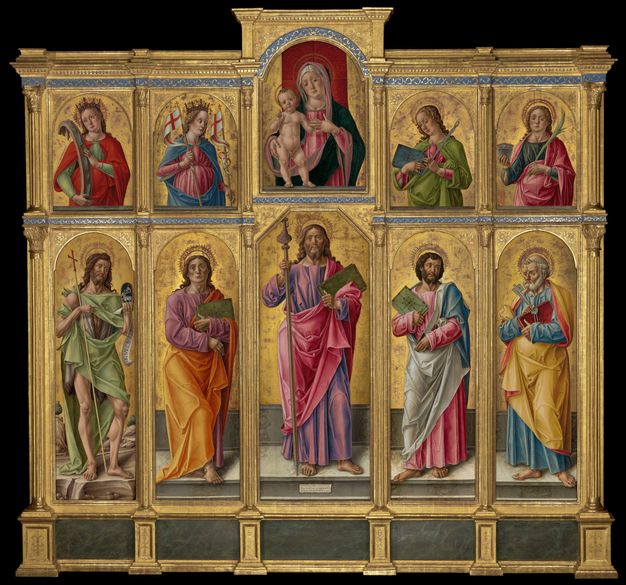 Figure 2
Polyptych with St. James Major, Madonna and Child, and Various Saints (altarpiece), 1490;
artist: Bartolomeo Vivarini (Italian painter and draftsman, active from ca. 1440, died after 1500);
tempera on panel, 280 x 215 cm;
J. Paul Getty Museum (Los Angeles, California), 71.PB.30.] - “The miniature Nude Descending a Staircase was painted for Carrie’s dollhouse, where it hangs today, between the ballroom’s great Renaissance fireplace and its silver-and-ivory grand piano.” 1
-
Chandelier is suspended from rosette in the center of
the ceiling; glass bowl at bottom of piece was
designed to hold goldfish
[
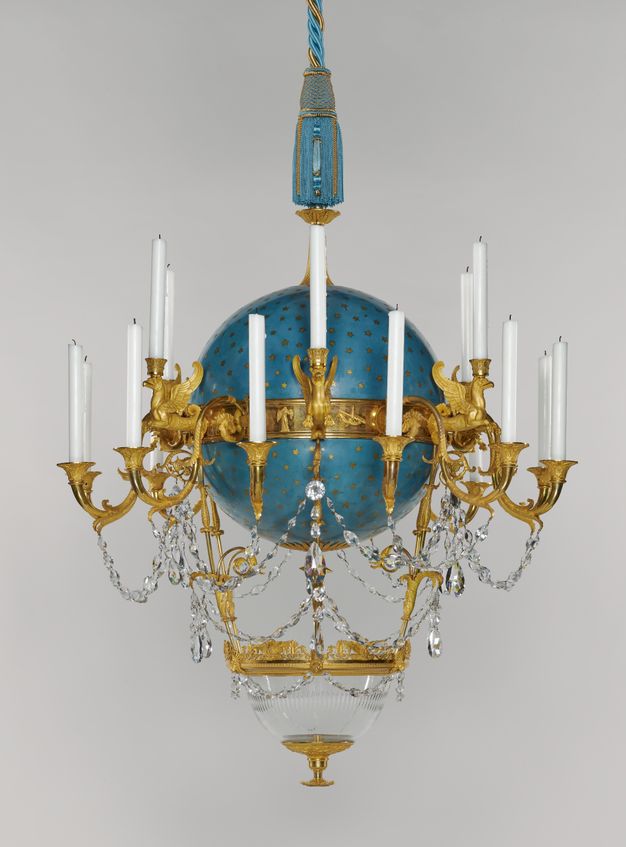 Figure 4
Chandelier (chandelier), ca. 1818-1819;
artist: Gérard-Jean Galle (French bronze caster and gilder, 1788-1846);
glass and enameled metal with gilt bronze mounts, 129.5 x 96.5 cm (diameter);
J. Paul Getty Museum (Los Angeles, California), 73.DH.76.] -
Terrestrial and Celestial Globes stand on corners of
the carpet, on either side of a double-form desk
[
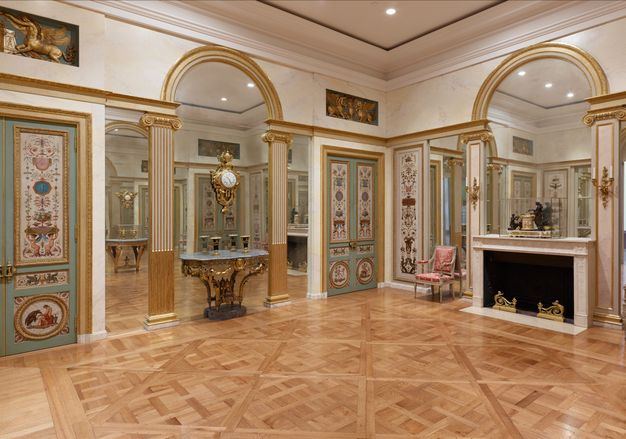 Figure 3a
Paneled Room (salon de compagnie), about 1790-1795;
artist: Claude-Nicolas Ledoux (French architect, 1736-1806);
painted panels: Jean-Siméon Rousseau de la Rottière (French painter and interior decorator, 1747-1820) and Jules-Hughes Rousseau (French sculptor and interior decorator, 1743-1806);
overdoors: Jean-Guillaume Moitte (French sculptor and draftsman, 1746-1810);
Painted and gilded oak, painted and gilded plaster, white marble, modern gilt-bronze hardware, and modern mirror glass, Entire Room: 682.2 × 592.8 cm (268 9/16 × 233 3/8 in.);
J. Paul Getty Museum (Los Angeles, California), 98.DH.149 © The J. Paul Getty Trust. All Rights Reserved.] [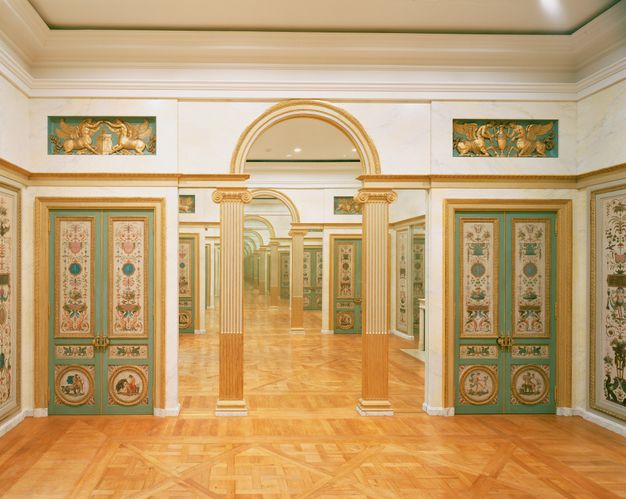 Figure 3b
Paneled Room (salon de compagnie), about 1790-1795;
artist: Claude-Nicolas Ledoux (French architect, 1736-1806);
painted panels: Jean-Siméon Rousseau de la Rottière (French painter and interior decorator, 1747-1820) and Jules-Hughes Rousseau (French sculptor and interior decorator, 1743-1806);
overdoors: Jean-Guillaume Moitte (French sculptor and draftsman, 1746-1810);
Painted and gilded oak, painted and gilded plaster, white marble, modern gilt-bronze hardware, and modern mirror glass, Entire Room: 682.2 × 592.8 cm (268 9/16 × 233 3/8 in.);
J. Paul Getty Museum (Los Angeles, California), 98.DH.149 © The J. Paul Getty Trust. All Rights Reserved.] and [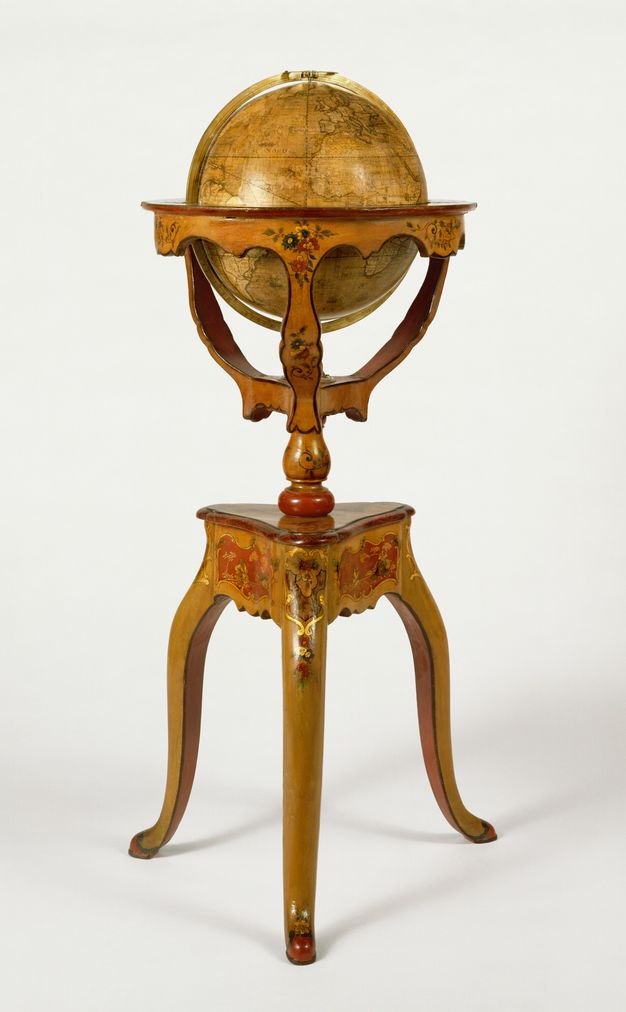 Figure 10
Terrestrial Globe (Globe terrestre), about 1728;
designer and assembler: Jean-Antoine Nollet (French physicist and globe designer, 1700-1770);
engraver: Louis Borde (French cartographer and engraver, active 1730-1740);
lacquer decorator: Guillaume Martin (French japanner, died 1749) and Etienne-Simon Martin (French japanner, died 1770);
Printed paper, papier-mâché, poplar, spruce, alder painted with vernis Martin, and bronze, 109.2 × 44.5 × 31.8 cm (43 × 17 1/2 × 12 1/2 in.);
J. Paul Getty Museum (Los Angeles, California), 86.DH.705.1 © The J. Paul Getty Trust. All Rights Reserved.]
DISCUSSION and GUIDELINES
Optional: Record an explanation of how the work is meant to be displayed, or has been displayed in the past.
Form and syntax
For short entries, use phrases in lower case. Capitalize proper names. For other words, use lower case. Avoid abbreviations. Provide directional descriptions for architecture, sculpture, and other three dimensional objects (e.g., for a building, note view from the east, or for a portrait bust, note left profile). Do not capitalize cardinal directions (east, west, etc.) Note special lighting conditions (e.g., raking light).
For longer statements, use sentence case and complete sentences or phrases.
TERMINOLOGY/FORMAT
Free text: This is not a controlled field. Index the subject in .
Describe the placement, construction, or reconstruction of the work, including the the intended arrangement of a multi-part display or installation, the sequence of works within a series, or the arrangement of pages within an album. If available, a diagrammatic indication or drawing of how a work in several parts should be arranged may be cited in .
12.2. Orientation Indexing Terms
DEFINITION
Terms indexing the orientation or arrangement of the work.
EXAMPLES
- vertical
- horizontal
- hanging
- open
- closed
DISCUSSION and GUIDELINES
Optional: Use controlled vocabulary to index how the work is meant to be displayed, or has been displayed in the past. Use lower case.
TERMINOLOGY/FORMAT
Controlled list: Control this subcategory with a controlled list of terms including: vertical, horizontal, hanging, prone, open, closed, etc.
12.3. Remarks
DEFINITION
Additional notes or comments pertinent to information in this category.
DISCUSSION and GUIDELINES
Optional: Record a note regarding the orientation or arrangement of the work. Use consistent syntax and format. For rules regarding writing notes, see .
FORMAT/TERMINOLOGY
Free-text: This is not a controlled field. Use consistent syntax and format.
12.4. Citations
DEFINITION
A reference to a bibliographic source, unpublished document, or individual opinion that provides the basis for the information recorded in this category.
DISCUSSION and GUIDELINES
Optional: Record the source used for image. For a full set of rules for citations, see .
TERMINOLOGY/FORMAT
Authority: Ideally, this information is controlled by citations in the citations authority; see .
12.4.1 Page
DEFINITION
Page number, volume, date accessed for Web sites, and any other information indicating where in the source the information was found.
DISCUSSION and GUIDELINES
Optional: For a full set of rules for pages, see .
TERMINOLOGY/FORMAT
Free-text: This is not a controlled field. Use consistent syntax and format.
Examples
EXAMPLES
-
Orientation/Arrangement Description:
Screen should be placed on the pedestal in an open
position.
Indexing Terms: open
When a description is not necessary:
- Orientation/Arrangement Indexing Term: horizontal
Revised 8 September 2024
by Emily Benoff
Notes
-
Stephen Watson. Strange Bedfellows: First American Avant-Garde. New York: Abbeville Press, 1991, 326. ↩︎