DEFINITION
Placement of a work of art or architecture within a classification scheme that groups other, similar works together on the basis of similar characteristics.
SUBCATEGORIES
GENERAL DISCUSSION
Classification terms or codes are used to place a work of art or architecture in a useful organizational scheme that has been devised by a repository, collector, or other person or entity. Formal classification systems are used to relate a work of art or architecture to broader, narrower, and related objects. Classification terms group similar works together according to varying criteria.
Kinds of classification schemes
This category generally does not include classification strictly by style, period, or subject, since these attributes are accommodated in their own categories. However, some repositories classify their collections by geographic region or period. A classification scheme may be a hierarchy, typology, or informal grouping. For example, with a hierarchically structured classification system based on general classes of objects, connections between the broader term (furniture) and the narrower terms (chairs, tables, or beds) can be made. A classification scheme based on social function might connect all works with a liturgical function, whether or not the are textiles, metalwork, books, or furnishings. The placement of a work within such a scheme implies similarities among works within the logic of the classification.
The same work of art or architecture can be classified in many different ways. For example, a sculpture may be seen as both a carving and a mask; a lithographic poster may be classified as a print or an advertising graphic; a church may be classified as both a religious structure and a public building. The subcategories in this category repeat together as a group.
How a work is classified will often depend on the context within which it is being described. For example, a textile collection may have a much more detailed system for classifying textiles than a history museum does. A textile collection may classify a dress according to its construction, or the materials it incorporates. In a history museum, dress may be supplemented by more generic classifications, such as women’s clothing or Ukrainian clothing.
Classification is often used to provide order for collections management. It may correspond to the structure of curatorial departments within a museum, although this is not always the case. Classification in terms of a shelf list or other scheme for noting the physical location of the object is a collections management concern outside the scope of the CDWA. Classification terminology may be locally developed, such as the Victoria & Albert Museum Classification System 1, or widely available, such as schemes based on the AAT or Revised Nomenclature.
The assignment of classification terms should be based on local guidelines specific to a particular institution. Classification terms should be assigned after an examination of the object, if possible. Alternatively, published or unpublished sources may be consulted.
Cataloging rules
For the subcategories in this section, basic recommendations and discussion are provided below. For a fuller, more prescriptive set of cataloging rules for , see “Chapter 7: Class” in Cataloging Cultural Objects (CCO), which deals with a critical subset of the CDWA.
RELATED CATEGORIES and ACCESS
is a Primary Access Point. It should be accessible in combination with and other categories.
Classification on the basis of style or period should be repeated in . Classification on the basis of subject matter should be repeated in . Terms that identify the work or its parts should be repeated in or Components. Often works that do not have titles are known by their or ; repeat these terms in . Catalogers may expand on classification based on use in the category.
2.1 Classification Term 🔺
DEFINITION
The term from a classification scheme that has been assigned to a work.
EXAMPLES
- architecture
-
paintings [
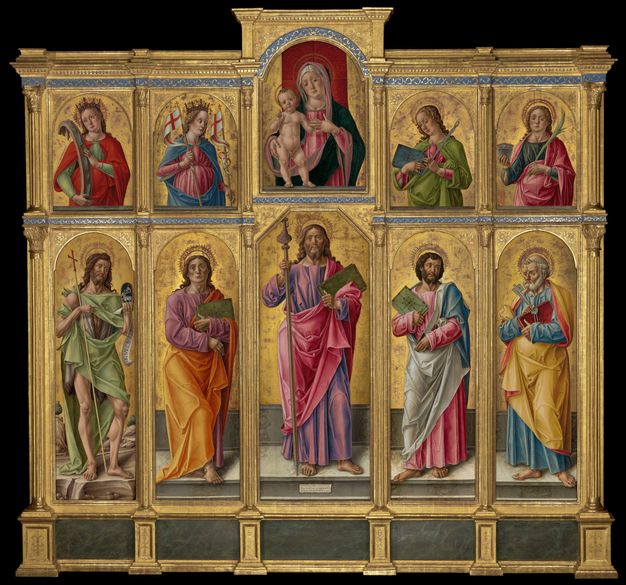 Figure 2
Polyptych with St. James Major, Madonna and Child, and Various Saints (altarpiece), 1490;
artist: Bartolomeo Vivarini (Italian painter and draftsman, active from ca. 1440, died after 1500);
tempera on panel, 280 x 215 cm;
J. Paul Getty Museum (Los Angeles, California), 71.PB.30.] and [ Figure 17
Irises (painting), 1889;
artist: Vincent van Gogh (Dutch painter and draftsman, 1853-1890);
oil on canvas, 71 x 93 cm;
J. Paul Getty Museum (Los Angeles, California), 90.PA.20 © The J. Paul Getty Trust. All Rights Reserved.] -
sculpture [
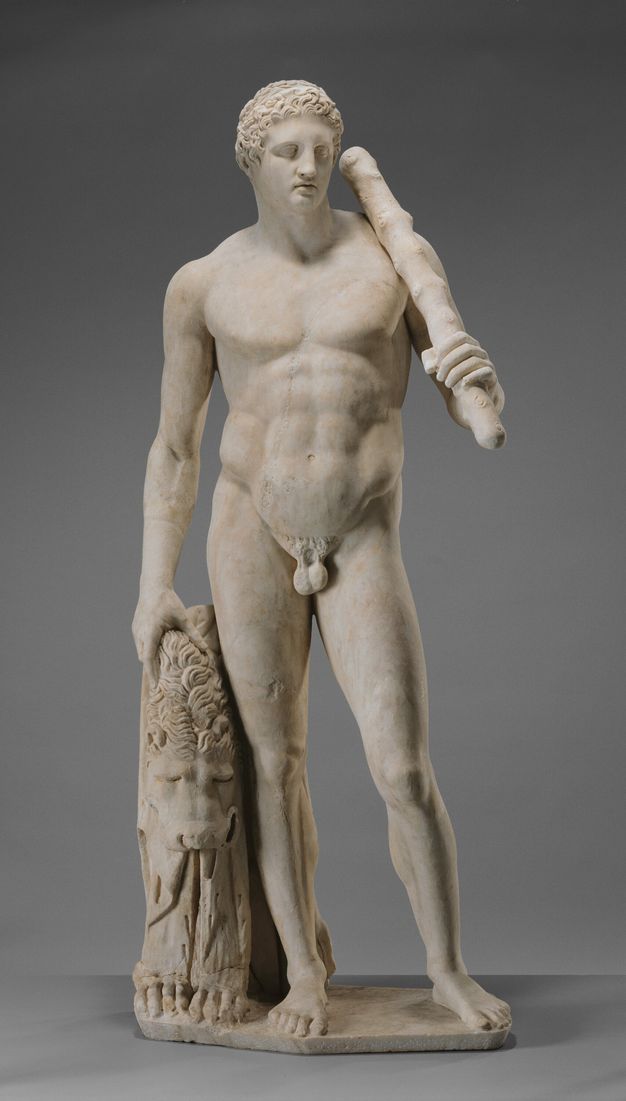 Figure 5
Lansdowne Herakles, ca. 125 CE;
artist: unknown Roman, after lost Greek original from School of Polykleitos;
Pentelic marble, 193.5 cm (height);
J. Paul Getty Museum (Los Angeles, California), 70.AA.109] and [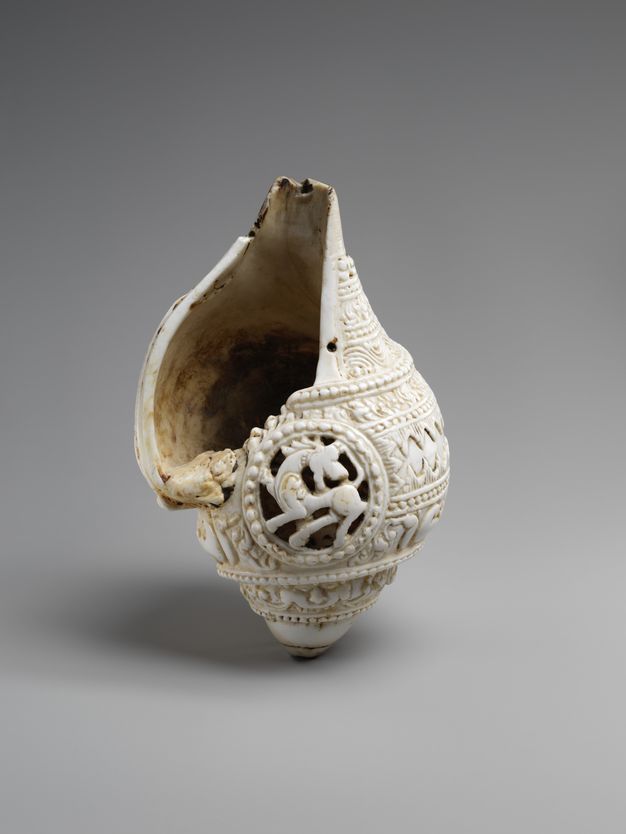 Figure 46
Carved Conch, 11th century or earlier;
artist: Unknown Indian;
Shell, H. 6 in. (15.2 cm); W. 4 1/8 in. (10.5 cm); D. 3 5/8 in. (9.2 cm);
The Metropolitan Museum of Art (New York, New York), Gift of Evelyn Kossak, The Kronos Collections, 1986, 1986.501.5 © The Metropolitan Museum of Art. All Rights Reserved. ] -
graphic arts [
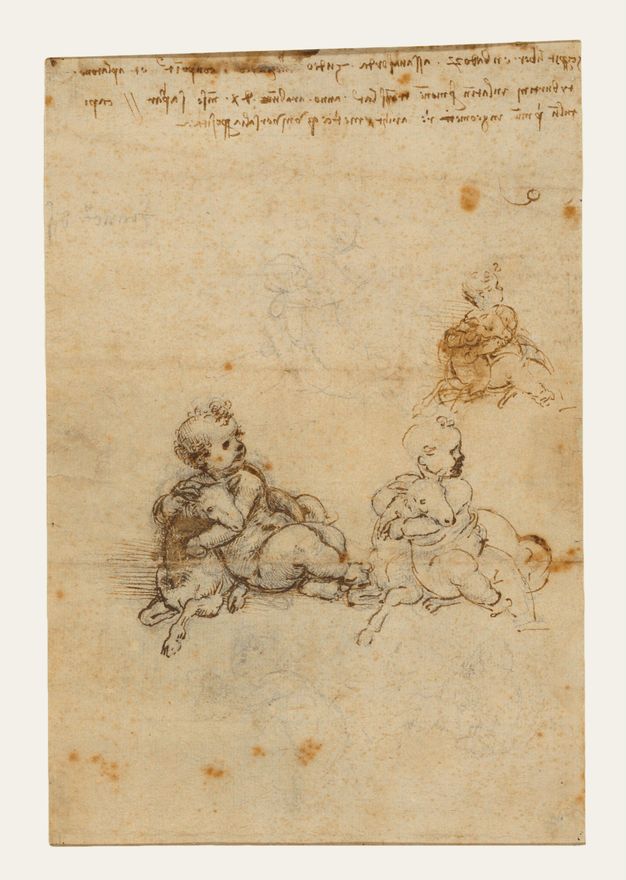 Figure 30a
Studies for the Christ Child with a Lamb (recto); Head of an Old Man, and Studies of Machinery (verso), about 1503-1506;
artist: Leonardo da Vinci (Italian painter, draftsman, scientist, 1452-1519);
black chalk, pen and brown ink, Unframed: 21 × 14.1 cm (8 1/4 × 5 9/16 in.);
J. Paul Getty Museum (Los Angeles, California), 86.GG.725 © The J. Paul Getty Trust. All Rights Reserved.] [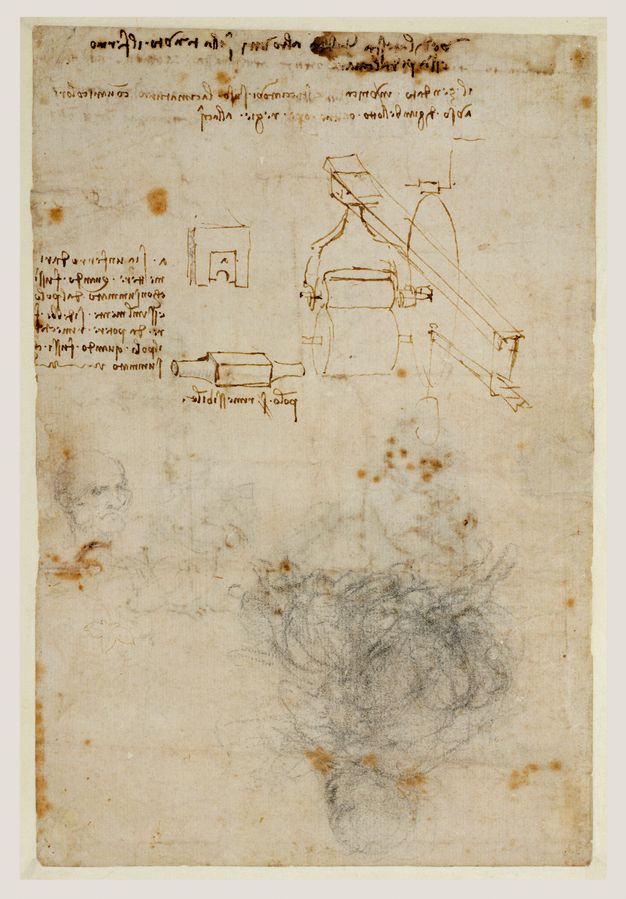 Figure 30b
Studies for the Christ Child with a Lamb (recto); Head of an Old Man, and Studies of Machinery (verso), about 1503-1506;
artist: Leonardo da Vinci (Italian painter, draftsman, scientist, 1452-1519);
black chalk, pen and brown ink, Unframed: 21 × 14.1 cm (8 1/4 × 5 9/16 in.);
J. Paul Getty Museum (Los Angeles, California), 86.GG.725 © The J. Paul Getty Trust. All Rights Reserved.] and [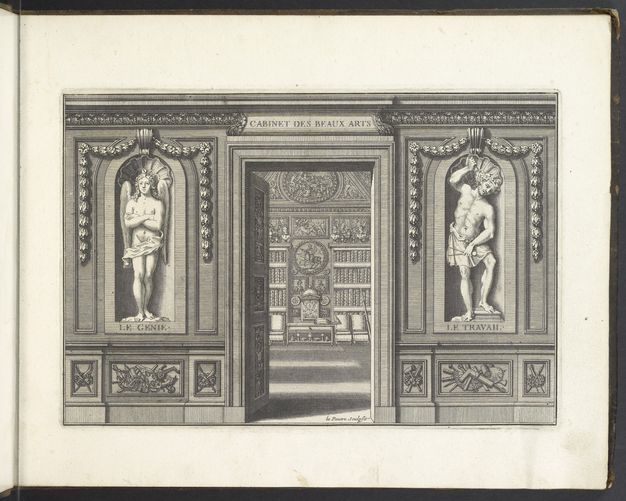 Figure 34
Les Cabinet des Beaux Arts, ca. 1690;
artist: probably engraved by Pierre Lepautre (French sculptor and printmaker, born ca. 1660, died 1744);
from *Le Cabinet des Beaux Arts, ou, Recueil d’estampes gravés d’aprés les tableaux d’un plafond ou les beaux arts sont representées avec explication de ces mêmes tableaux;
engraving on laid paper, plate mark: 17.6 x 26.4 cm (6 7/8 x 10 3/8 inches);
Getty Research Institute (Los Angeles, California), 88-B12341[plate 2] © The J. Paul Getty Trust. All Rights Reserved.] -
decorative arts [
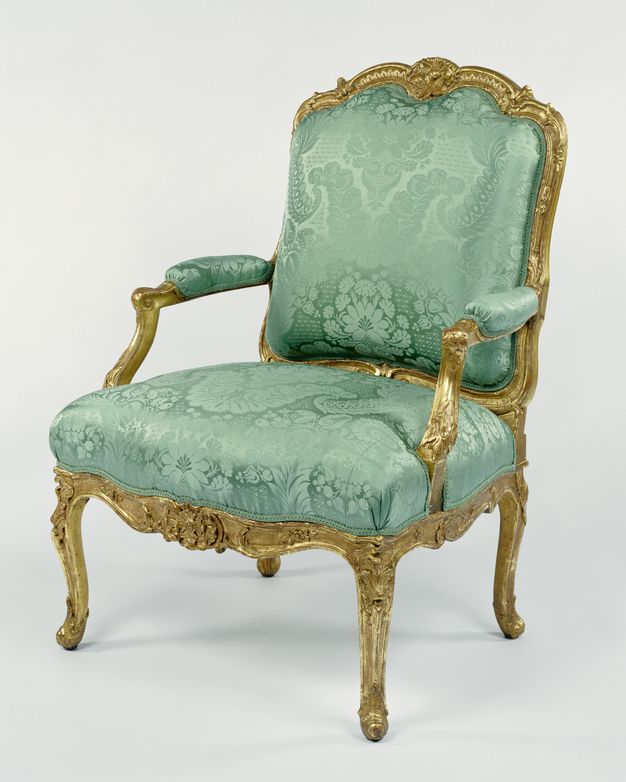 Figure 14
One of a Pair of Armchairs, ca. 1750-1755;
artist: Jean Avisse (French menuisier, 1723-after 1796);
carved and gilded beechwood with modern upholstery and braiding, 104.7 x 76.2 x 59.6 cm;
J. Paul Getty Museum (Los Angeles, California), 83.DA.230.1 © The J. Paul Getty Trust. All Rights Reserved.] - textiles
- costume
- tools
-
furniture [
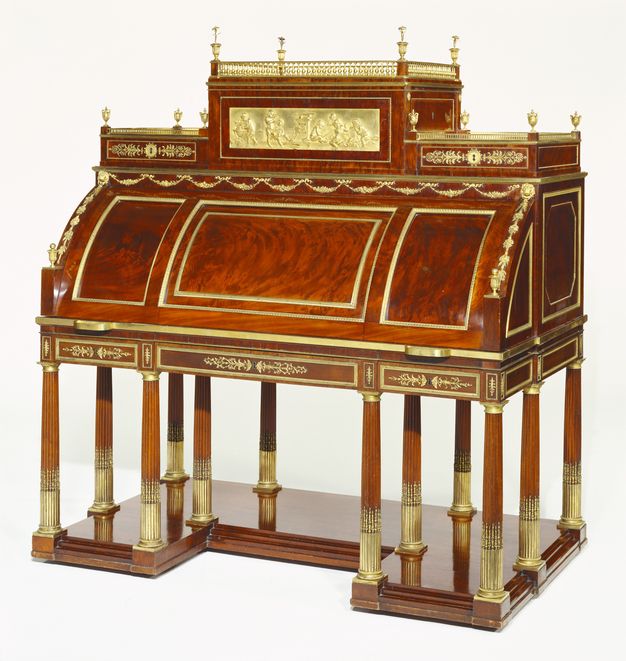 Figure 13
Rolltop Desk (desk), ca. 1780-1785;
artist: David Roentgen (German ébéniste, 1743-1807);
veneered with mahogany, with gilt bronze mounts and steel fittings, 168.3 × 155.9 × 89.3 cm, 347.0017 kg (66 1/4 × 61 3/8 × 35 3/16 in., 765 lb.);
J. Paul Getty Museum (Los Angeles, California), 72.DA.47 © The J. Paul Getty Trust. All Rights Reserved.] -
ceramics [
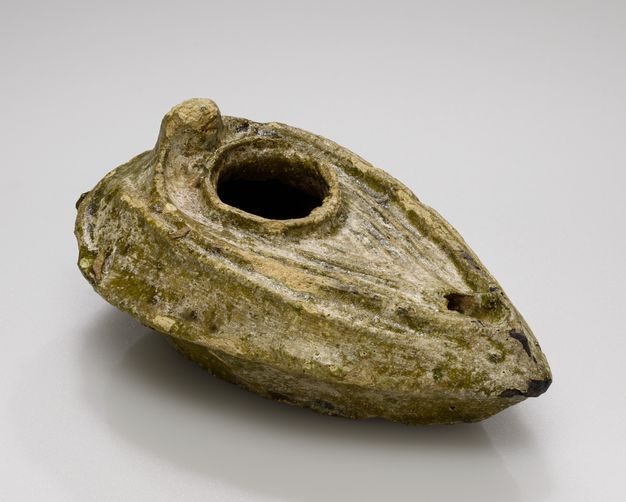 Figure 75
Lamp, 5th-6th century;
artist: Unknown Syrian;
terracotta with green glaze, Object: 3.2 × 6 × 9.5 cm (1 1/4 × 2 3/8 × 3 3/4 in.);
J. Paul Getty Museum (Los Angeles, California), 83.AQ.377.454 © The J. Paul Getty Trust. All Rights Reserved.] - European art
- Asian art
- Pre-Columbian art
DISCUSSION and GUIDELINES
Required: Record one or more terms designating the broad class into which the work may be organized. If there are multiple classification terms for one work, record them in repeating instances of . Record a term or terms that relate the work to other works with similar characteristics, including materials, form, shape, function, region of origin, cultural context, or historical or stylistic period, based on the organizational scheme of a particular repository or collection.
Specificity
A Classification term should typically be more general than the specific term recorded in . For example, if a work is identified as a chair in , it could have a broader of furniture. However, the and are sometimes the same. The level of specificity to which a work is classified (for example, whether a spindle-back rocking chair is classified as furniture or chair or rocking chair) will depend on the perspective of the discipline involved and the policy of the individual institution. Determining an appropriate level should be left to the discretion of the institution.
Form and syntax
Generally use the plural form of nouns, since classifications represent groups of similar items, not an individual item (e.g., prints and drawings). When the term refers to a broad type and the plural form is not appropriate, use the singular form (e.g., sculpture, architecture). Use compound concepts when appropriate for your institution’s collection; compound concepts are terms composed of multiple concepts (e.g., European paintings). Capitalize the proper names of culture, nationality, period, or style where appropriate (e.g., Pre-Columbian ceramics). For other terms, use lower case. Avoid abbreviations.
Classification terms are drawn from ordered systems of categories or from hierarchically structured thesauri. These terms may be locally defined, developed from common usage within a particular discipline, or developed as a national or international standard.
TERMINOLOGY/FORMAT
Authority or controlled list: Control terminology with theGeneric , or devise a more concise controlled list for this subcategory.
Sources of terminology may include the following: AAT (especially Objects facet), ACRL/RBMS Genre Terms, ACRL/RBMS Paper Terms, ACRL/RBMS Printing and Publishing Evidence, Base Mérimée: Lexique, the British Archaeological Thesaurus, ICOM Costume Terms, the Index of Jewish Art, ISO 5127-3: Iconic Documents, ISO 5127-11: Audio-visual Documents, LC Descriptive Terms for Graphic Materials, Moving Image Materials, Revised Nomenclature, Reyniès’ Le Mobilier Domestique, Social History and Industrial Classification, Dizionario Terminologico della Suppellettile Ecclesiastica, Objets religieux/Religious objects: Méthode d’analyse et vocabulaire/User’s Guide and Terminology, and Tozzer Library Headings.
2.2. Remarks
DEFINITION
Additional notes or comments pertinent to the information in this category
DISCUSSION and GUIDELINES
Optional: Record a note regarding the of the work. Use consistent syntax and format. For rules regarding writing notes, see .
TERMINOLOGY/FORMAT
Free-text: This is not a controlled field. Use consistent syntax and format.
2.3 Citations
DEFINITION
A reference to a bibliographic source, unpublished document, or individual opinion that provides the basis for the information recorded in this category.
DISCUSSION and GUIDELINES
Optional: Record the source used for image. For a full set of rules for citations, see .
TERMINOLOGY/FORMAT
Authority: Ideally, this information is controlled by citations in the citations authority; see .
2.3.1 Page
DEFINITION
Page number, volume, date accessed for Web sites, and any other information indicating where in the source the information was found."
DISCUSSION and GUIDELINES
Optional: For a full set of rules for page, see .
TERMINOLOGY/FORMAT
Free-text: This is not a controlled field. Use consistent syntax and format.
Examples
The examples below include from this chapter in addition to subcategories from .
For paintings:
-
Catalog Level:🔺 item
Classification:🔺 paintings | European art
Object/Work Type:🔺 panel painting | predella panel -
Catalog Level:🔺 item
Classification:🔺 paintings | Asian art
Object/Work Type:🔺 handscroll
For sculpture:
-
Catalog Level:🔺 item
Classification:🔺 sculpture | American art
Object/Work Type:🔺 statue -
Catalog Level:🔺 item
Classification:🔺 sculpture | Pre-Columbian art
Object/Work Type:🔺 hacha -
Catalog Level:🔺 item
Classification:🔺 sculpture | Greek and Roman art
Object/Work Type:🔺 statue
For works on walls:
-
Catalog Level:🔺 item
Classification:🔺 paintings | murals | European art
Object/Work Type:🔺 fresco -
Catalog Level:🔺 item
Classification:🔺 paintings | Greek and Roman art | architectural art
Object/Work Type:🔺 mosaic
For works on paper:
-
Catalog Level:🔺 item
Classification:🔺 prints and drawings | European art
Object/Work Type:🔺 preparatory drawing -
Catalog Level:🔺 item
Classification:🔺 photographs American art
Object/Work Type:🔺 albumen print -
Catalog Level:🔺 item
Classification:🔺 prints and drawings | European art
Object/Work Type:🔺 watercolor
For decorative arts:
-
Catalog Level:🔺 item
Classification:🔺 decorative arts | Native American art
Object/Work Type:🔺 basket -
Catalog Level:🔺 item
Classification:🔺 decorative arts | furniture | Islamic art
Object/Work Type:🔺 tabouret -
Catalog Level:🔺 item
Classification:🔺 decorative arts | ceramics | European art | Asian art
Object/Work Type:🔺 bowl -
Catalog Level:🔺 item
Classification:🔺 decorative arts | furniture | African art
Object/Work Type:🔺 headrest -
Catalog Level:🔺 item
Classification:🔺 decorative arts | costume | jewelry | Asian art
Object/Work Type:🔺 crown -
Catalog Level: item
Classification: decorative arts | toys | European art | American art
Object/Work Type: doll -
Catalog Level:🔺 item
Classification:🔺 decorative arts | textiles | European art
Object/Work Type:🔺 tapestry
For costume:
-
Catalog Level:🔺 item
Classification:🔺 costume | armor | Greek and Roman art
Object/Work Type:🔺 helmet (armor) -
Catalog Level:🔺 item
Classification:🔺 costume | textiles | Asian art
Object/Work Type:🔺 coat
For collections, sets, series, and groups:
-
Catalog Level:🔺 collection
Classification:🔺 photographs | European art
Object/Work Type:🔺 cartes-de-visite -
Catalog Level:🔺 group
Classification:🔺 tools and implements | Pre-Columbian art
Object/Work Type:🔺 arrowheads | kirk points | netting -
Catalog Level:🔺 set
Classification:🔺 costume | sculpture | African art
Object/Work Type:🔺 chi wara -
Catalog Level:🔺 series
Classification:🔺 prints and drawings | Asian art
Object/Work Type:🔺 color woodcuts
For sculpture associated with architecture:
-
Catalog Level:🔺 item
Classification:🔺 sculpture | architecture | Egyptian art
Object/Work Type:🔺 colossus -
Catalog Level:🔺 component
Classification:🔺 sculputure | architecture | European art
Object/Work Type:🔺 architectural sculpture
For architecture:
-
Catalog Level:🔺 item
Classification:🔺 architecture | European art
Object/Work Type:🔺 observation tower -
Catalog Level:🔺 item
Classification:🔺 architecture | ancient European art
Object/Work Type:🔺 standing stones | temple | observatory -
Catalog Level:🔺 item
Classification:🔺 architecture | African art
Object/Work Type:🔺 building | complex | ruins
NOTE: 🔺 indicates a core CDWA category.
Revised 8 December 2023
by Emily Benoff
Notes
-
Victoria and Albert Museum, Collections Department, Data Structure and Core Data, draft 1 October 1992, 40. ↩︎